
Mostly Monday Reads: A Big, Ugly Mess
Posted: May 19, 2025 Filed under: A thread for Ranting, Agency Purges, Banksters, Broligarchy, democracy is threatened, Joe Biden, kakistocracy, kleptocracy, New Orleans, Polycrisis | Tags: @johnbuss.bsky.social John Buss, Big Beautiful Bill, China Dumps T-Bonds, Eat the Rich, FARTUS, Major Disruption in the Polar Vortex, Medicaid Cuts, New Orleans Bubble Day, No Kings Day, No Kings protest over #FARTUS parade, Trump budget destroys medicaid, Trump tax cuts for the rich 9 Comments
“Relax, it’s just a cartoon. I know he can’t do yoga.” John Buss, @repeat1968
Good Day, Sky Dancers!
As you know, I’m a nerd on all levels. I was catching up on my usual rabbit holes. The last thing I was reading was in the category of weather and climate change, and a major disruption in the polar vortex that will drastically change the weather from here on out. It’s slid off the North Pole and is moving over Northern Europe. That was after I was reading about this equally major disruption in the global economy. “China Dumps $18,900,000,000 in Treasuries as US Government Faces Major Dilemma: Macro Analyst Luke Gromen.” I’m now working on “In late-night vote, Republicans move closer to pushing Trump agenda bill through House. GOP officials are scrambling to advance massive tax breaks and dramatic Medicaid cuts, and it’s worth appreciating why they’re in such a rush,” written by Steve Benen.
Here in New Orleans, we had a Big Bubble Protest because of some rich guy that moved to the Quarter last year and has filed no less than 15 Criminal complaints over a bubble machine on the balcony of a restaurant that’s been there for over ten years. He thinks that the bubbles will ruin his Porsche and poison his drink when he imbibes on his balcony. This is the typical New Orleans gentrifier. He comes from someplace and expects New Orleans to accommodate his burbie weirdness. Just another old rich white guy trying to rule the world.
Meanwhile, Trump was posting madly early in the morning about every big music star that ever rejected him. That’s right before he’s supposed to be meeting with Putin and Zelensky over Putin’s invasion of Ukraine. Joe Biden has cancer, and Junior’s been hitting Truth Social and drugs at the same time.
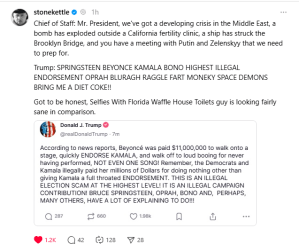
All I can do is quote Chief Meteorologist Emeritus for Channel 2 Action News’ Severe Weather Team 2. AMS certified Glenn Burns. He was talking about the Polar Vortex, but it applies to everything these days. “Nothing is like it used to be anymore.”

You can go read about the selfies of Trump with the Waffle House Toilet guys for yourself. Yes, it’s up there on the Daily Mail.
No wonder the Polar Vortex doesn’t want to be near the United States anymore. Who would?

There are a lot of improvements we need in this country, but none of this stands as necessary or wanted. I love this float pic but think Senator Duckworth’s label Cadet Bone Spurs is more appropriate since Yam Tits would have never made it to a rank of sargent. But, yes, we’re getting a big, beautiful parade. It’s going to cost millions. This rather makes it official. We’re a damn Banana Republic. But the best thing is that pissed-off Americans are once more taking to the streets with placards and protests. This is from lawyermonthly. ““No Kings Day” Protests Set to Disrupt Trump’s $45M Birthday Military Parade.”
On June 14, a date that commemorates both the 250th anniversary of the U.S. Army and the 79th birthday of former President Donald J. Trump, the streets of the nation’s capital are expected to swell, not only with tanks, soldiers, and fighter jets, but with thousands of protestors prepared to send a very different message.
In a show of political theater unprecedented in recent years, Trump and his allies are staging what they’ve dubbed a “patriotic celebration,” complete with more than 6,000 uniformed troops, 150 military vehicles, and a dramatic aerial flyover.
The event, organizers say, is intended to honor America’s armed forces. Critics, however, see something more troubling: a public spectacle designed to cement the image of Trump as commander-in-chief, long after leaving office.
But while the parade commands the headlines, another force is quietly gaining momentum and it’s aiming to steal the spotlight.
Born from frustration and sharpened by years of political tension, a broad coalition of advocacy groups is organizing a massive counter-movement under the banner “No Kings Day.”
It’s not just a protest, they say. It’s a rejection of the authoritarian imagery they believe the parade represents.
Organizers from groups including the 50501 Movement and Refuse Fascism say they’re mobilizing demonstrations in over 100 cities nationwide, with Washington, D.C. serving as the focal point.
Estimates suggest between 10,000 to 20,000 demonstrators will gather in Meridian Hill Park before marching toward the National Mall.
“It’s not about hating Trump, it’s about preserving democracy,” said Angela V., a volunteer coordinator in Maryland who’s helping coordinate buses into the city. “We can’t normalize tanks in the streets every time a former president wants a birthday party.”
Though the name “No Kings Day” may sound theatrical, the intentions behind it are serious.
Protestors plan to highlight what they see as Trump’s attempts to centralize power and glamorize military dominance, particularly during a time when the former president faces multiple indictments related to election interference, classified documents, and alleged abuse of power.
 How about we use that $45 million plus whatever it costs to undo the damage Washington D.C. roads to fund the Veterans’ services cut by that ugly budget winding its way to the Senate today? Economist Paul Krugman–writing at his substack–colorfully describes the budget process as “Attack of the Sadistic Zombies. The GOP budget is incredibly cruel — and that’s the point.” Sounds a lot like the guy who doesn’t want bubbles in his drink or on his Porsche.
Republicans in Congress, taking their marching orders from Donald Trump, are on track to enact a hugely regressive budget — big tax giveaways to the wealthy combined with cruel cuts in programs that serve lower-income Americans. True, the legislation suffered a setback last week, initially failing to make it out of committee. But that was largely because some right-wing Republicans didn’t think the benefit cuts were vicious enough.
OK, news at 11. Isn’t this what Republicans always do? But this reconciliation bill — that is, legislation structured in such a way that it can’t be filibustered and may well pass with no Democratic votes — is different in both degree and kind from what we’ve seen before: Its cruelty is exceptional even by recent right-wing standards. Furthermore, the way that cruelty will be implemented is notable for its reliance on claims we know aren’t true and policies we know won’t work — what some of us call zombie ideas.
And it’s hard to avoid the sense that the counterproductive viciousness is actually the point. Think of what we’re seeing as the attack of the sadistic zombies.
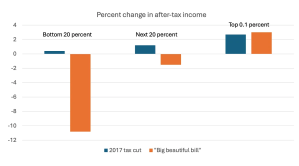
To get a sense of how extreme this legislation is, do a side-by-side comparison of the impact on different groups of Americans between this bill and Trump’s one major legislative achievement during his first term, the 2017 Tax Cuts and Jobs Act. It looks like this:
Source: Tax Policy Center and Penn-Wharton Budget Model
The TCJA, like the current legislation, gave big tax breaks to the wealthiest Americans. But it also threw a few crumbs to people further down the scale. By contrast, the House Reconciliation Bill, by slashing benefits — especially Medicaid — will cause immense, almost inconceivable hardship to the bottom 40 percent of Americans, especially the poorest fifth.
Medicaid, in case anyone needs reminding, is the national health insurance program for low-income Americans who probably don’t have any other way to pay for medical care. In 2023 Medicaid covered 69 million Americans, far more than Medicare (which covers seniors), including 39 percent of children.
Providing health care to children, by the way, isn’t just about social justice and basic decency. It’s also good economics: Children who receive adequate care grow up to be more productive adults. Among other things they end up paying more taxes, so Medicaid for children almost surely pays for itself.
And although Republican legislation apparently won’t explicitly target childrens’ care, it will impose paperwork requirements that will cause both children and their parents to lose coverage.
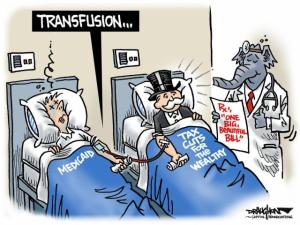 Here’s some analysis of the late-night passage of the bill on the substack of Heather Cox Richardson, historian. ‘
Tonight, late on a Sunday night, the House Budget Committee passed what Republicans are calling their “Big, Beautiful Bill” to enact Trump’s agenda although it had failed on Friday when far-right Republicans voted against it, complaining it did not make deep enough cuts to social programs.
The vote tonight was a strict party line vote, with 16 Democrats voting against the measure, 17 Republicans voting for it, and 4 far right Republicans voting “present.” House speaker Mike Johnson (R-LA) said there would be “minor modifications” to the measure; Representative Chip Roy (R-TX) wrote on X that those changes include new work requirements for Medicaid and cuts to green energy subsidies.
And so the bill moves forward.
In The Bulwark today, Jonathan Cohn noted that Republicans are in a tearing hurry to push that Big, Beautiful Bill through Congress before most of us can get a handle on what’s in it. Just a week ago, Cohn notes, there was still no specific language in the measure. Republican leaders didn’t release the piece of the massive bill that would cut Medicaid until last Sunday night and then announced the Committee on Energy and Commerce would take it up not even a full two days later, on Tuesday, before the nonpartisan Congressional Budget Office could produce a detailed analysis of the cost of the proposals. The committee markup happened in a 26-hour marathon in which the parts about Medicaid happened in the middle of the night. And now, the bill moves forward in an unusual meeting late on a Sunday night.
Cohn recalls that in 2009, when the Democrats were pushing the Affordable Care Act, more popularly known as Obamacare, that measure had months of public debate before it went to the Committee on Energy and Commerce. That committee held eight separate hearings about healthcare reform, and it was just one of three committees working on the issue. The ACA markup took a full two weeks.
Cohn explains that Medicaid cuts are extremely unpopular, and the Republicans hope to jam those cuts through by claiming they are cutting “waste, fraud, and abuse” without leaving enough time for scrutiny. Cohn points out that if they are truly interested in savings, they could turn instead to the privatized part of Medicare, Medicare Advantage The Congressional Budget Office estimates that cutting overpayments to Medicare Advantage when private insurers “upcode” care to place patients in a higher risk bracket, could save more than $1 trillion over the next decade.
Instead of saving money, the Big, Beautiful Bill actually blows the budget deficit wide open by extending the 2017 tax cuts for the wealthy and corporations. The Congressional Budget Office estimates that those extensions would cost at least $4.6 trillion over the next ten years. And while the tax cuts would go into effect immediately, the cuts to Medicaid are currently scheduled not to hit until 2029, enabling the Republicans to avoid voter fury over them in the midterms and the 2028 election.
The prospect of that debt explosion led Moody’s on Friday to downgrade U.S. credit for the first time since 1917, following Fitch, which downgraded the U.S. rating in 2023, and Standard & Poor’s, which did so back in 2011. “If the 2017 Tax Cuts and Jobs Act is extended, which is our base case,” Moody’s explained, “it will add around $4 trillion to the federal fiscal primary (excluding interest payments) deficit over the next decade. As a result, we expect federal deficits to widen, reaching nearly 9% of GDP by 2035, up from 6.4% in 2024, driven mainly by increased interest payments on debt, rising entitlement spending and relatively low revenue generation.”
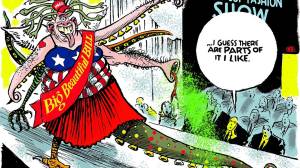 Steven Beschloss calls for more activism today at his substack, America, America. “Heeding the Warnings! We must avoid normalcy bias, expand our imagination, and both recognize and confront the fascistic danger of the Trump regime.”
Last week On Tyranny author Timothy Snyder warned that the second 100 days of the Trump regime could entail a dangerous escalation that includes some kind of terrorist attack. Imagining this can be hard; it’s understandable to ignore such a warning since it’s not yet true, it’s unpleasant to consider—and yes, it may not happen.
But it’s worth listening to what this historian of authoritarian regimes envisions—a warning layered with advice on how to prepare and how to respond. “I think it’s very important to expect there will now be exogenous surprises,” he said in a short video, including the “bottom falling out” of the economy because of the tariffs, “a major disruption” within the U.S. or even some kind of terrorist attack.
“Don’t fall for language about extremism or terrorism,” Snyder urged if it happens. He also emphasized the importance of staying calm, being active and sticking together. “Be aware that this is the pretext that will be used to push things further…use it as an opportunity to hold the people responsible who should be taking responsibility.”
This mirrors what he said in one of the final chapters of his short book that offers lessons to prepare, one entitled “Be calm when the unthinkable arrives.” His thinking draws on the Reichstag Fire staged by Hitler and the Nazis in 1933.
Modern tyranny is terror management. When the terrorist attack comes, remember that authoritarians exploit such events in order to consolidate power. The sudden disaster that requires the end of checks and balances, the dissolution of opposition parties, the suspension of freedom of expression, the right to a fair trial, and so on, is the oldest trick in the Hitlerian book. Do not fall for it.
As he notes in a Substack piece published last month about the possibility of such an attack, “The people in the White House have no governing skills, but they do have entertainment skills. They will seek to transform themselves from the villains of the story to the heroes, and in the process bring down the republic.”
None of us know if such an attack will happen. But I agree with Snyder that it’s important to expand our imaginations and be prepared if it does. That means not falling victim to normalcy bias.
Yes, millions of Americans failed to grasp the potential for disaster and crisis if Donald Trump were to occupy the White House again. But rather than look backward and rue that misfortune, let’s look forward and do what we can.
Warn the people we know. Warn the people we meet. Reach out on social media and email to our friends and communities. Contact our elected officials. Participate in public demonstrations and bring friends with us.
Let them all know this is an emergency—no time for business as usual and old ways of doing things. There’s an arsonist in the White House aggressively seeking to end our constitutional republic, free speech and the rule of law. And let’s not lose sight of our collective power to ensure that the Trump regime’s desired trajectory is not inevitable.
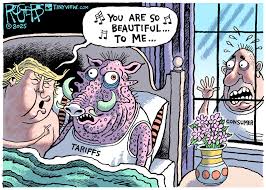 The Financial Markets are reeling. This is from NYT. “Markets Rattled on Concerns About U.S. Debt. Stocks fell, the dollar slipped, and bond yields jumped after a rating downgrade highlighted worries about the cost of President Trump’s policies and the health of the economy.”
Turbulent trading hit financial markets on Monday, with investors selling U.S. stocks and bonds and the dollar, an ugly combination that suggests sentiment is souring on the outlook for the world’s largest economy.
The S&P 500 index fell about 1 percent in early trading in New York. Bond markets shuddered, with U.S. Treasury prices falling and their yields, which underpin interest rates across the economy, rising. The 10-year yield jumped a tenth of a percentage point, a large move in that market, to 4.54 percent. The dollar also fell, with a gauge of its value against other major currencies slipping 0.8 percent.
One factor jarring markets is a bill in Congress that would make President Trump’s signature 2017 tax cuts permanent and could add trillions of dollars to federal debt. A House committee voted to approve the bill Sunday night, although it was expected to remain a focus of contentious congressional debate.
The United States’ loss of its last triple-A credit rating late on Friday and mounting concerns about government debt have threatened to disrupt the relative calm in markets that has prevailed since Mr. Trump paused many of his tariffs in recent weeks.
In downgrading the U.S. credit rating, Moody’s cited the tax cut legislation along with broader concerns about the fiscal deficit and growing debt costs. The move by Moody’s means that all three major rating agencies no longer consider the United States qualified for their top credit ratings.
The U.S. credit rating downgrade and worries about debt and deficits could further upset financial markets if they begin to shake the safe-haven status of Treasury bonds. That would likely spur global investors to demand higher premiums in return for buying U.S. debt.
On Monday, the 30-year Treasury yield rose to its highest level in a year and a half, above 5 percent.
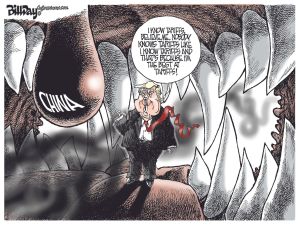 The market has yet to fully absorb the Treasury Bond Dump by China. This is from the Daily HODL (News and Insight for the Digital Economy). Yes, I’m getting seriously nerdy for you know. This is the kind of stuff that drives my research and derivatives class lectures. This is the stuff that should frighten everyone if they ever knew about it. “China Dumps $18,900,000,000 in Treasuries as US Government Faces Major Dilemma: Macro Analyst Luke Gromen.”
Macro investor Luke Gromen warns that the countries buying more USTs won’t be able to simultaneously buy more American-manufactured goods, further hurting America’s trade deficit that President Trump has promised to address.
Says Gromen,
“Foreign UST holdings rose $133 billion Mar vs. Feb.
UK, Caymans, and Canada were $86 billion of that $133 billion; China sold $19 billion.
UK surpassed China as the 2nd biggest US foreign creditor for 1st time ever in March.
Cayman Islands (pop. ~73,000) is now the fourth biggest US foreign creditor at $455 billion…
How are they going to buy both USTs and more goods from America going forward?”
Analysts reportedly told Reuters that Chinese holdings of USTs have been in a downward trajectory since 2018, even though foreign holdings of Treasuries surged to an all-time high of $9.05 trillion in March.
 That means our exports will go down in many of the countries. It’s damned recessionary. Also, if the price of bonds goes down because a country dumps their portfolio of treasuries, the interest rates go up. It will be truly interesting to see what the Fed does with this. Then there’s this. I bet Senator Warren is apoplectic. This report comes from The Guardian. You remember how fun that crash was. “US reportedly plans to slash bank rules imposed to prevent 2008-style crash. Watchdogs could cut capital rules as Trump’s deregulation drive opens door to rollback of post-crisis protections.”
US watchdogs are reportedly planning to slash capital rules for banks designed to prevent another 2008-style crash, as Donald Trump’s deregulation drive opens the door to the biggest rollback of post-crisis protections in more than a decade.
The move follows heavy lobbying by the banking industry, with lenders such as JP Morgan and Goldman Sachs having long complained that competition and lending have been hindered by burdensome rules governing the assets they must hold versus their liabilities.
Regulators are expected to put forward the proposals this summer, aimed at cutting the supplementary leverage ratio that requires big banks to hold high-quality capital against risky assets including loans and derivatives, according to the Financial Times, which cited unnamed sources.
The rules came into force after the 2008 financial crisis, as part of efforts to shockproof the banking system and avoid damaging ripple effects that could cause another global economic meltdown. The crisis forced governments to spend billions of dollars bailing out big lenders that took too much risk.
Changes to bank capital rules have been widely expected, with Trump having promised a bonfire of regulation during his second term in office, with plans to slash 10 regulations for every new one added.
While some critics warn it is the wrong time to slash protections, given growing uncertainty over policy overhauls and market volatility, banks seem to have won the ear of policymakers. Lobbyists have long argued that the rules punish them for holding relatively low-risk assets including US debt, known as treasuries, and hinders their ability to provide more loans.
 I just want to wish Former President the best as he struggles with cancer. I know how that feels. I’m 35 years out from a stage 4 cancer episode. It transforms how you see time. “President Biden has metastatic prostate cancer. Here’s what you should know,” via CNN. He will receive top-quality cancer treatment and has a wonderful supportive family. All of this will help him. He’s also one tough cookie.
President Joe Biden’s diagnosis of metastatic prostate cancer has understandably raised concerns and questions: How long has he had cancer, how will he be treated, and what is his prognosis?
As a urologist, I regularly diagnose prostate cancer in my patients, and each time I share the diagnosis with them and their family, it’s never easy. Over time, I’ve learned the importance of keeping conversations simple and straightforward — avoiding sugar-coating and instead using data, statistics and personal experience to help patients begin their cancer journey.
As his public announcement draws attention to this type of cancer, it’s a reminder to regularly check on your own health. Here’s what you need to know about metastatic prostate cancer: how it’s detected, what treatments look like, and why early screening remains essential for men’s health.
The former president’s diagnosis began after he experienced “increasing urinary symptoms,” his office said, and a prostate nodule was discovered.
…
“Metastatic” means the cancer cells have spread beyond the original location (the prostate gland) into other areas — most commonly bones and lymph nodes. Biden’s cancer has specifically spread to his bones, placing him among the 5% to 7% of prostate cancer cases in the United States that are metastatic at initial diagnosis. While this percentage seems small, it represents a significant number given that over 300,000 men in the US and approximately 1.5 million worldwide are diagnosed with prostate cancer every year.
Early-stage prostate cancer carries an excellent prognosis, with nearly a 100% five-year survival rate. However, when prostate cancer is metastatic at diagnosis, the five-year survival rate drops sharply to around 37%. Importantly, these survival rates are statistical averages, and individual outcomes vary considerably based on overall health, age, cancer aggressiveness, and how well a patient responds to treatment.
All of the #FARTUS policies add up to a big mess for the economy. It’s driving me back to research again. But right now, I guess I’ll go blow some bubbles for a while.
What’s on your reading and blogging list today?


 peej
peej Carissa
 ecocatwoman
 jjlo
jjlo mablue2
 Mama Lopez
 peggysue22
 quixote
 skydancingguestblogger
 Mona (aka Wonk the Vote)



 Sky Dancing
The VP and others are now blasting conspiracy theories about Joe and Jill Biden. Once a mean girl, always a mean girl.
Try to rest and chill this week. Memorial Day weekend is coming and we should be thinking on those who gave their lives for our country, not those who are doing everything possible to destroy it.
xoxo
How DOGE’s grand plan to remake Social Security is backfiring
The agency is abandoning an initiative aimed at preventing fraud, the latest example of a failed effort by Elon Musk’s disruptive cost-cutting team.
The U.S. DOGE Service arrived at the Social Security Administration this year determined to slash staff and root out what it claimed was widespread fraud and wasteful spending — a mission Elon Musk’s cost-cutting team has pursued across the government.
But as of this week, many of the major changes DOGE pushed at Social Security have been abandoned or are being reversed after proving ineffective, while others are yielding unintended consequences and badly damaging customer service and satisfaction. The problems come as the agency struggles to cope with a record surge of hundreds of thousands of retirement claims in recent months.
There you go:
But we have to deal with this icky Afrikaners? I’d rather have Venezuelans anyday.
I can’t believe it was 8 to 1
56% Of Americans Report Living Paycheck To Paycheck. Nearly three quarters of Americans say consumer prices have risen in recent weeks, signalling oncoming economic pain.
New polling from Canadian pollster, Leger, suggests the economic situation in America hasn’t been improving.
The survey found that 56% of Americans report living paycheck to paycheck, while only 39% say they are not. According to the poll, younger Americans are more likely to face economic precarity than their older counterparts.
The most cash-strapped age group are those aged 18–34, with 62% saying they live paycheck to paycheck. Among those aged 35–54, 61% report the same. Only among Americans aged 55 and older do more say they are not struggling financially than are, at 48% compared to 46%.
Economic precarity appears similar across partisan lines, with 56% of Independents, 54% of Democrats, and 53% of Republicans reporting they live paycheck to paycheck.
It’s not surprising then that a majority of Americans (52%) believe the country is currently in an economic recession. That belief is highest among Democrats (70%) and much lower among Republicans (34%).
Meanwhile, 29% of Americans say the U.S. is not in a recession, and another 19% say they are unsure of the current economic situation.