
Wednesday Reads: Clown Prince Trump
Posted: April 9, 2025 Filed under: Donald Trump, U.S. Economy, U.S. Politics | Tags: bond market crash, China, Elon Musk, EU, Financial Crisis, global safe haven, Stock Market, UK 13 Comments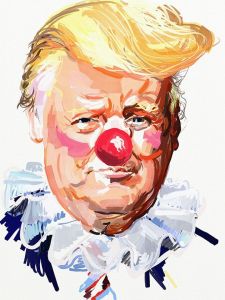
By Eric Fischl
Hello Sky Dancers!!
Dakinikat should be writing this post, but you’re stuck with me. I stayed up till about 2:30 last night doom scrolling and trying to understand what Trump’s tariff madness has done to us. The latest disaster last night was that the bond market is collapsing.
I’ll do my best to post relevant stories, and perhaps Dakinikat will chime in later. Thanks to Trump’s insanity, we could end up in another financial crisis comparable to the one in 2008.
What’s happening with tariffs:
There’s even more insane news this morning: China responded to Trump’s 104 percent tariff threat with another 84% tariff on the U.S.
CNBC: China slaps 84% retaliatory tariffs on U.S. goods in response to Trump.
China has pushed back again on U.S. President Donald Trump’s tariff policies by hiking its levies on U.S. imports to more than 80%.
Tariffs on U.S. goods entering China will rise to 84% from 34% starting April 10, according to a translation of a Office of the Tariff Commission of the State Council announcement. The hike comes in response to the latest U.S. tariff increase on Chinese goods to more than 100% that began at midnight.
The tit-for-tat escalation of tariffs threatens to crush trade between the world’s two largest economies. According to the Office of the U.S. Trade Representative, the U.S. exported $143.5 billion of goods to China in 2024, while importing products worth $438.9 billion.
The Trump administration announced a sweeping new tariff policy last week, warning other countries not to retaliate. Some nations, including Japan, have seemed willing to negotiate on tariffs, but China appears to be taking a more hard-line stance and quickly announced a countertariff.
After China’s initial response to the April 2 tariff rollout, Trump announced an additional 50% hike, putting the total level for import taxes on Chinese goods at 104%….
The trade war has spooked investors around the world by increasing the odds of slower economic growth, higher inflation and lower corporate profits, sparking a sharp sell-off in April.
The S&P 500 finished Tuesday down nearly 20% from its peak, putting the U.S. large-cap stock index in a bear market. South Korea’s Kospi Index fell into a bear market of its own on Wednesday. Stocks in Shanghai and Hong Kong are also down sharply since the U.S. tariff announcement on April 2.
David Pierson and Barry Wang at The New York Times: For U.S. and China, a Risky Game of Chicken With No Off-Ramp in Sight.
A whopping increase in tariffs, followed by a whopping retaliation. Nationalist Chinese bloggers comparing President Trump’s levies to a declaration of war. China’s Foreign Ministry vowing that Beijing will “fight to the end.”
For years, the world’s two biggest powers have flirted with the idea of an economic decoupling as tensions between them have risen. The acceleration this week of their trade relationship’s deterioration has made the prospect of such a divorce seem closer than ever.
That was underscored on Wednesday when China announced an additional 50 percent tariff on U.S. goods, matching new American levies that had taken effect hours earlier. China also struck at American companies, imposing export controls on a dozen of them and adding six others to a list of “unreliable entities,” preventing them from doing business in China.
China’s new tariffs, which will take effect on Thursday, mean all American goods shipped to China will face an additional 85 percent import tax. The minimum U.S. tax on Chinese imports is now 104 percent. Both figures would have been unimaginable a few weeks ago.
With China’s top leader, Xi Jinping, and Mr. Trump locked in a game of chicken — each unwilling to risk looking weak by making a concession — the trade fight could spiral even further out of control, inflaming tensions over other areas of competition like technology and the fate of Taiwan, the self-governing island claimed by Beijing.
Mr. Trump’s bare-knuckle tactics make him a singular force in U.S. politics. But in Mr. Xi, he faces a hardened opponent who survived the turmoil of China’s late-20th-century political purges, and who views the United States’ competitive tactics as ultimately aimed at subverting the ruling Communist Party’s legitimacy.
“Trump has never gone into a back-alley brawl where the other side is willing to brawl and use the same kind of tactics as him,” said Scott Kennedy, a senior adviser at the Center for Strategic and International Studies, a Washington think tank. “For China, this is about their sovereignty. This is about the Communist Party’s hold on power. For Trump, it might just be a political campaign.”
 From what I’m hearing and reading, this is going to hit U.S. small businesses hard, drive many of them into bankruptcy, and send their employees to the unemployment lines.
China isn’t the only country that’s retaliating.
Politico: EU takes revenge on Trump’s tariffs as countries approve €20B+ retaliation.
BRUSSELS — The EU can apply retaliatory tariffs on nearly €21 billion of U.S. products like soybeans, motorcycles and orange juice after the bloc’s 27 countries assented to the measures on Wednesday, the European Commission announced.
“The EU considers U.S. tariffs unjustified and damaging, causing economic harm to both sides, as well as the global economy. The EU has stated its clear preference to find negotiated outcomes with the U.S., which would be balanced and mutually beneficial,” the EU executive said in a statement.
Hitting back against U.S. President Donald Trump’s steel and aluminum tariffs, the European Union’s countermeasures will apply in three rounds. Measures covering €3.9 billion in trade will go into force next week, with a further €13.5 billion from mid-May and a final round of €3.5 billion following in December.
Only Hungary opposed the package, according to four EU diplomats with direct knowledge of the vote, while all other 26 countries voted in favor….
The retaliation does not yet respond to Trump’s imposition of 20 percent “reciprocal” tariffs on all EU exports, which came into force on Wednesday, and his latest 25 percent tariff on cars. Trump has also said tariffs on pharmaceuticals are coming soon.
The European Commission is considering putting forward its countermeasures on those tariffs as early as next week. “It will for sure be soon. I expect it could be as early as next week,” trade spokesperson Olof Gill said Tuesday.
What’s happening with the bond markets:
Felix Salmon at Axios: The bond market plunges as crisis brews.
The price of U.S. Treasury bonds is plunging, in what Treasury Secretary Scott Bessent on Wednesday called “deleveraging convulsions.” The effect is to raise borrowing costs just as recession fears spike.
Why it matters: The last thing America needed in the midst of a global trade war and a stock-market meltdown was a debt crisis too. But that now seems to be a real possibility.
What they’re saying: “This is the script for a truly existential financial crisis,” writes Columbia economic historian Adam Tooze, who wrote a whole book on the very similar dynamics that overtook the Treasury market in March 2020.
Driving the news: Bond yields — which move in the opposite direction to prices — are soaring in the wake of protectionist U.S. tariffs.
- The amount that the U.S. government needs to pay to borrow money for a decade rose briefly to more than 4.5% Wednesday morning. For a 30-year bond, the yield rose to more than 5%.
- Those moves are truly enormous by bond market standards. As recently as Friday, the 10-year yield was less than 4%, and the 30-year was below 4.4%.
The intrigue: In normal times, the most consistent buyer of Treasury bonds is a group of hedge funds that participate in something called the “basis trade.”
- They buy the bonds in order to hedge their derivatives exposure to institutional investors, who can lock in slightly higher yields in the futures market.
- The profit on any given trade is minuscule, but it’s also very close to risk-free, so the hedge funds can apply as much as 50x or even 100x leverage.
- By many accounts, the basis trade is now unwinding, which means the hedge funds are selling their bonds — or, at the very least, not buying new ones.
The big picture: In a move reminiscent of the bond-market tantrum that swept U.K. Prime Minister Liz Truss from office in 2022, the technical factors in the bond market were precipitated by — and also exacerbated — fundamental issues with the country’s finances.
 More from Philip Inman and Jasper Jolly at The Guardian: Dramatic sell-off of US government bonds as tariff war panic deepens.
US government bonds, traditionally seen as one of the world’s safest financial assets, are undergoing a dramatic sell-off as Donald Trump’s escalation of his tariff war with China sends panic through all sectors of the financial markets.
The falls suggest that as Trump’s fresh wave of tariffs on dozens of economies came into force, including 104% levies against Chinese goods, investors are beginning to lose confidence in the US as a cornerstone of the global economy.
The yield – or interest rate – on the benchmark 10-year US Treasury bond rose by 0.16 percentage points on Wednesday to 4.42%, its highest since late February – and this week has undergone the three biggest intraday moves since Trump was elected in November. Yields move inversely to prices, so surging yields mean falling prices as demand drops.
The move in the 30-year bond was more dramatic. The 30-year yield briefly jumped above 5% to its highest since late 2023 and was last trading at 4.9157%, or 0.2 percentage points higher than Tuesday.
“This is a fire sale of Treasuries,” said Calvin Yeoh, portfolio manager at the hedge fund Blue Edge Advisors. “I haven’t seen moves or volatility of this size since the chaos of the pandemic in 2020,” he told Bloomberg.
Analysts believe the US Federal Reserve may need to step in. Jim Reid, at Deutsche Bank, said: “Markets are pricing a growing probability of an emergency [interest rate] cut, just as we saw during the Covid turmoil and the height of the GFC [global financial crisis] in 2008.” [….]
UK bonds were also under severe pressure after the US moves. The yield on a 30-year UK gilt hit 5.518% on Wednesday morning, up 16 basis points and surpassing a previous 27-year high of 5.472% set in January.
Shorter-dated 10-year gilt yields were slightly higher at 4.69% while two-year yields ticked down at 3.92%.
Higher yields on gilts – UK government bonds – will make things even more difficult for Downing Street, as it will raise the cost of borrowing to fund investment.
Colby Smith at The New York Times (gift link): U.S. Bond Sell-Off Raises Questions About ‘Safe Haven’ Status.
A sharp sell-off in U.S. government bond markets has sparked fears about the growing fallout from President Trump’s sweeping tariffs and retaliation by China, the European Union and others, raising questions about what is typically seen as the safest corner for investors to take cover during times of turmoil.
Yields on 10-year Treasuries — the benchmark for a wide variety of debt — shot 0.2 percentage points higher on Wednesday, to 4.45 percent, a big move in that market. Just a few days ago, it had traded below 4 percent. Yields on the 30-year bond rose significantly as well, at one point on Wednesday topping 5 percent. Borrowing costs globally have also shot higher.
The sell-off comes as investors have fled riskier assets globally in what some fear has parallels to what became known as the “dash for cash” episode during the pandemic, when the Treasury market broke down. The recent moves have upended a longstanding relationship in which the U.S. government bond market serves as a safe harbor during times of stress.
Volatility has surged as stock markets have plummeted amid fears that the U.S. economy is hurtling toward stagflation, in which economic growth contracts while inflation surges. The S&P 500 is now on the verge of entering a bear market, meaning it has dropped 20 percent from its recent high.
 The global safe-haven:
“The global safe-haven status is in question,” said Priya Misra, a portfolio manager at JPMorgan Asset Management. “Disorderly moves have happened this week because there is no safe place to hide.”
Scott Bessent, the U.S. Treasury secretary, sought to tamp down concerns on Wednesday, brushing off the sell-off as nothing more than investors who bought assets with borrowed money having to cover their losses.
“I believe that there is nothing systemic about this — I think that it is an uncomfortable but normal deleveraging that’s going on in the bond market,” he said in an interview with Fox Business.
But the moves have been significant enough to raise broader concerns about how foreign investors now perceive the United States, after Mr. Trump decided to slap onerous tariffs on nearly all of its trading partners. Some countries have sought to strike deals with the administration to lower their tariff rates. But China retaliated on Wednesday, announcing an 84 percent levy on U.S. goods after Mr. Trump raised the tariff rate on Chinese goods to 104 percent.
In a social media post on Wednesday, the former U.S. Treasury secretary Lawrence H. Summers said the broader sell-off suggested a “generalized aversion to US assets in global financial markets” and warned about the possibility of a “serious financial crisis wholly induced by US government tariff policy.”
Some analysis and commentary on what’s happening:
Heather Cox Richardson at Letters from an American: April 8, 2025.
Stocks were up early today as traders put their hopes in Treasury Secretary Scott Bessent’s suggestion that the Trump administration was open to negotiations for lowering Trump’s proposed tariffs. But then U.S. Trade Representative Jamieson Greer said there would not be exemptions from the tariffs for individual products or companies, and President Donald J. Trump said he was going forward with 104% tariffs on China, effective at 12:01 am on Wednesday.
Markets fell again. By the end of the day, the Dow Jones Industrial Average had fallen by another 320 points, or 0.8%, a 52-week low. The S&P 500 fell 1.6% and the Nasdaq Composite fell 2.2%.
Rob Copeland, Maureen Farrell, and Lauren Hirsch of the New York Times reported today that over the weekend, Wall Street billionaires tried desperately and unsuccessfully to change Trump’s mind on tariffs. This week they have begun to go public, calling out what they call the “stupidity” of the new measures. These industry leaders, the reporters write, did not expect Trump to place such high tariffs on so many products and are shocked to find themselves outside the corridors of power where the tariff decisions have been made.
Elon Musk is one of the people Trump is ignoring to side with Peter Navarro, his senior counselor for trade and manufacturing. Navarro went to prison for refusing to answer a congressional subpoena for information regarding Trump’s attempt to overturn the 2020 presidential election. Since Musk poured $290 million into getting Trump elected in 2024 and then burst into the news with his “Department of Government Efficiency,” he has seemed to be in control of the administration. But he has stolen the limelight from Trump, and it appears Trump’s patience with him might be wearing thin.
Elizabeth Dwoskin, Faiz Siddiqui, Pranshu Verma, and Trisha Thadani of the Washington Post reported today that Musk was among those who worked over the weekend to get Trump to end his new tariffs. When Musk failed to change the president’s mind, he took to social media to attack Navarro personally, saying the trade advisor is “truly a moron,” and “dumber than a sack of bricks.”
Read the rest at the Substack link above.
David E. Sanger at The New York Times (gift link): An Experiment in Recklessness: Trump as Global Disrupter.
As the breadth of the Trump revolution has spread across Washington in recent weeks, its most defining feature is a burn-it-down-first, figure-out-the-consequences-later recklessness. The costs of that approach are now becoming clear.
Administration officials knew the markets would dive and other nations would retaliate when President Trump announced his long-promised “reciprocal” tariffs. But when pressed, several senior officials conceded that they had spent only a few days considering how the economic earthquake might have second-order effects.
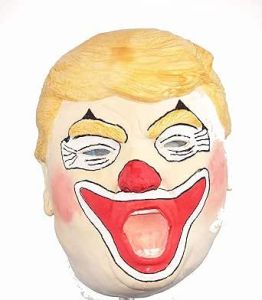
Trump clown mask
And officials have yet to describe the strategy for managing a global system of astounding complexity after the initial shock wears off, other than endless threats and negotiations between the leader of the world’s largest economy and everyone else.
Take the seemingly unmanaged escalation with China, the world’s second largest economy, and the only superpower capable of challenging the United States economically, technologically and militarily. By American and Chinese accounts, there was no substantive conversation between Mr. Trump and China’s top leader, Xi Jinping, or engagement among their senior aides, before the countries plunged toward a trade war.
Last Wednesday, Mr. Trump’s hastily devised formula for figuring out country-by-country tariffs came up with a 34 percent tax on all Chinese goods, everything from car parts to iPhones to much of what is on the shelves at Walmart and on Amazon’s app.
When Mr. Xi, predictably, matched that figure, Mr. Trump issued an ultimatum for him to reverse the decision in 24 hours — waving a red flag in front of a leader who would never want to appear to be backing down to Washington. On Wednesday, the tariff went to 104 percent, with no visible strategy for de-escalation.
If Mr. Trump does get into a trade war with China, he shouldn’t look for much help from America’s traditional allies — Japan, South Korea or the European Union — who together with the United States account for nearly half of the world economy. All of them were equally shocked, and while each is negotiating with Mr. Trump, they seem in no mood to help him manage China.
“Donald Trump has launched a global economic war without any allies,” the economist Josh Lipsky of the Atlantic Council wrote on Tuesday. “That is why — unlike previous economic crises in this century — there is no one coming to save the global economy if the situation starts to unravel.”
The global trading system is only one example of the Trump administration tearing something apart, only to reveal it has no plan for how to replace it.
Read the rest at the NYT.
Andrew Egger at The Bulwark: A Microwaved Mind.
There’s a paradox to covering Donald Trump these days. On the one hand, he’s never out of the news—a wannabe dictator busy remaking the government and the economy so that more and more decisions about our futures answer only to his whim. On the other hand, there’s so much news about what he’s doing that it’s easy to reduce our thinking about Trump to the sum of his actions. There’s Trump the bundle of bad policy ideas, Trump the destroyer of institutions, Trump the fountain of post-truth grievance. It’s hard to take the time to dwell on the man himself—to focus our attention on Donald Trump the clown.
Yesterday afternoon, as markets continued crashing and with the further implementation of backbreaking tariffs just hours away, the clown was on full display. Trump participated in the ceremonial signing of an executive order on “unleashing American energy.” In the East Room event, he was in his element: coal miners in hard hats behind him, an audience crammed with his political flunkies in front. He ended up riffing for about 45 minutes. Let’s listen in, shall we? [….]
The topic du jour, of course, was energy, specifically the “beautiful clean coal” that Trump loves so much. Trump riffed at length on the supposed stupidity of proposals to retrain miners for skilled labor in other industries, reminiscing his 2016 campaign against Hillary Clinton:
“One thing I learned about the coal miners . . . You could give them a penthouse on Fifth Avenue and a different kind of a job and they’d be unhappy. Coal mining is what they love to do,” Trump said. “And she was gonna put them in a high-tech industry, to make little cell phones, I don’t know. Do you think you’d be good at that? I don’t know.”
Anyway, no need for any of that now, the president exulted: “We’re gonna be crushing Biden-era environmental restrictions. . . . And we have clean air and clean water and now we have clean coal. And at the same time we’re gonna do other things and forms of technology and also energy, like our country has never seen before.”
On his tariffs:
Trump didn’t totally avoid talk of the market crash he kicked off last week—a “whole situation,” he noted, that “was somewhat explosive.”
But, Trump added, you should see the response we’re getting! “We have had talks with many, many countries. . . . And our problem is, we can’t see that many that fast. But we don’t have to because, you know, the tariffs are on, and money is pouring in at a level that we’ve never seen before.”
How much money are we talking? “We’re taking in almost $2 billion a day in tariffs,” Trump said. “America is gonna be very rich again very soon.”
Got all that? Yes, markets are tanking because of the tariffs. But not to worry: We’re going to strike great deals to replace them soon. But not too soon, because we don’t have time to deal with all these countries at once. But that’s okay, because look at how much money these tariffs are making us!
That’s it for me. I’ve learned a lot and I plan to continue studying this stuff. I expect Daknikat with have a lot to say on Friday. For now, hang in there everyone and take care of yourselves.


 peej
peej Carissa
 ecocatwoman
 mablue2
 Mama Lopez
 peggysue22
 quixote
 skydancingguestblogger
 Mona (aka Wonk the Vote)



 Sky Dancing
Jamelle Bouie at The New York Times: The Tariff Saga Is About One Thing.
It is a fool’s errand to try to rationalize President Trump’s obsession with tariffs.
This is not to say that people haven’t tried. There are any number of theories that seek to explain Trump’s preoccupation with tariffs and trade wars. Perhaps he wants to revitalize American manufacturing and bring factory jobs back to postindustrial communities racked by poverty and despair. Perhaps he wants the revenue he generates from large tariffs to reduce deficits and help address the nation’s long-term debt. Or perhaps he hopes to rebalance the global economic system, weakening the dollar in order to make the United States a more export-driven economy.
But each line of thinking shares an obvious problem: How does one accomplish any of these goals with blanket tariffs that threaten to radically reduce trade with the United States? How do you revitalize American manufacturing if manufacturers can’t reasonably import the materials they need to build factories and produce goods? Where is capital supposed to come from? How do you reset the nation’s relationship with its trading partners if those partners are forced to treat you as a bad force that can’t be trusted? And how are you supposed to revitalize working-class communities if your trade policies will probably destroy as many blue-collar jobs as they might, theoretically, create?
There is a hypothetical president with a hypothetically similar agenda who could answer these questions. This actual president cannot. He did not reason himself into his preoccupation with tariffs and can neither reason nor speak coherently about them. There is no grand plan or strategic vision, no matter what his advisers claim — only the impulsive actions of a mad king, untethered from any responsibility to the nation or its people. For as much as the president’s apologists would like us to believe otherwise, Trump’s tariffs are not a policy as we traditionally understand it. What they are is an instantiation of his psyche: a concrete expression of his zero-sum worldview.
The fundamental truth of Donald Trump is that he apparently cannot conceive of any relationship between individuals, peoples or states as anything other than a status game, a competition for dominance. His long history of scams and hostile litigation — not to mention his frequent refusal to pay contractors, lawyers, brokers and other people who were working for him — is evidence enough of the reality that a deal with Trump is less an agreement between equals than an opportunity for Trump to abuse and exploit the other party for his own benefit. For Trump, there is no such thing as a mutually beneficial relationship or a positive-sum outcome. In every interaction, no matter how trivial or insignificant, someone has to win, and someone has to lose. And Trump, as we all know, is a winner.
It is amazing to me , how one man can fuck up the global economy sooooo much.
He wouldn’t be able to if the damned Republicans in Congress would do their job. I think we can assume SCOTUS will enable him too. These people are total idiots.
The Daily Beast: Trump Insists ‘I Know What the Hell I’m Doing’ as His Tariffs Unleash Carnage.
President Donald Trump insisted he knows what he’s doing with his “Liberation Day” tariffs even as markets plummeted and comparatively safe assets like Treasury bonds cratered.
Speaking to the National Republican Congressional Committee on Tuesday night, Trump insisted manufacturing was already pouring back into the country, with companies halting plant construction in Mexico and moving back to former production sites in the U.S.
“I know what the hell I’m doing,” he said.
Hours later, his steep tariffs took effect—including a 104 percent levy on Chinese goods—unleashing even more economic carnage after nearly a week of market losses. China also retaliated Wednesday by slapping an 84-percent tariff on U.S. goods, roiling global markets….
U.S. Treasuries, which are largely considered the world’s safest asset, suffered a vicious selloff Wednesday that temporarily drove the 10-year yield up to 4.51 percent and the 30-year yield above 5 percent.
The 10-year yield settled at 4.37 percent, up from 3.9 percent earlier in the week, and could be a sign that the world no longer sees U.S. Treasuries as the global fixed-income safe haven, experts told the Financial Times.
More at the link.
I think he’s just it’s part of his revenge tour and kissing up to Putin. I can’t imagine any sane person wanting to do this We’ve generally liked the upper hand that producing a lot of military weapons and using the dollar instead of gold for the safe haven. This will totally upend the post World War 2 order and we will likely find ourselves propelling to the bottom of the advance economies list.
this is huge:
Trump orders a 90 day pause on the reciprocal tariffs, for everyone but China to give countries time to negotiate. Bassent claims this was the plan all along. The tariffs he announced were maximum possible levels. Except he never said this at the time.
He has now raised the tariffs on China to 125 percent.
He thinks China is going to back down, a country with 4 times the population and the rest of the world to sell to.
So the news down here in my formally hot neighborhood real estate market is that land lords are dumping their rentals in anticipation that they won’t be able to get the rents they need to keep the buildings up and pay the anticipated tax increases based on the shortfall in the state budget.
I already have friends who are being giving 30 days notice because the building is going for sale after that.
https://www.cnbc.com/2025/04/08/stock-market-today-live-updates-.html
“Stocks surged Wednesday after President Donald Trump announced a pause in some of the ‘reciprocal’ tariffs, causing a market that’s been under extreme pressure for the last week to explode higher.
The S&P 500 skyrocketed 7.3%, on pace for its biggest one-day gain in five years. The Dow Jones Industrial Average advanced 2,377 points, or 6.2%, also its biggest gain since 2020. The Nasdaq Composite jumped 9.2%.
“I have authorized a 90 day PAUSE, and a substantially lowered Reciprocal Tariff during this period, of 10%, also effective immediately,” Trump posted on his Truth Social. Trump, in the same post, said he was raising the tariff on China higher again to 125%.
Treasury Secretary Scott Bessent later clarified that all countries except China would go back to the 10% baseline tariff rate as negotiations take place. The pause would not apply to sector tariffs, Bessent said.”
Looks like he’s chickening out. The EU socked us with huge tarrifs early this morning.
Trump’s tariff onslaught against China escalates a battle the US may not be able to win
https://www.cnn.com/2025/04/09/politics/china-trump-tariffs-trade-war/index.html
“In retreating from a vast front of global tariff war, President Donald Trump escalated a showdown with the one nation that might be able to beat the United States in a trade duel.
Trump on Wednesday suddenly announced a 90-day pause in all the “reciprocal” tariffs that he rolled out with massive fanfare last week. But he excluded China, pushing up its tariff from 104% to 125% in the latest phase of a tit-for-tat struggle that has pitched the world’s two superpowers into a bitter standoff.
The president’s decision to back off from reciprocal tariffs came after days of stock market losses and amid mounting warnings that he was about to tip the US economy into a disastrous recession.
His doubling down on China may have been an attempt to save face as he reversed his previous policy, but it will sharpen fears that trade between the world’s two largest economies will grind to a halt, severely hurting both sides and sending negative reverberations across the globe.
The White House tried to spin an embarrassing retreat into a great victory, explaining that the reciprocal tariffs were paused because of a rush of countries wanting to do deals with Washington. It said China was punished because it responded to Trump’s trade warfare with its own tariffs.
Treasury Secretary Scott Bessent described the singling out of Beijing as an attempt to take on “bad actors” and said it was “due to their insistence on escalation.”
Almost everyone in Washington agrees the trading relationship with China is unbalanced and that a firm US stance is needed to respond to Beijing’s perceived violations. But Trump’s haphazard leadership seems unlikely to have the desired effect, since his every dare is met by a riposte from President Xi Jinping — who has as much credibility invested in the showdown as the US president.
Gawd this man’s policies are exhausting and destructive! Thanks for this BB. It got me off the starting block this morning and now I just have to keep watching this next turn around.
He’s basically manipulating the market. Crashing it and then telling his buddies to buy.
Thread