
Mostly Monday Reads: War is Hell
Posted: March 9, 2026 Filed under: "Der Fuehrer's Face", #FARTUS, #MAGAnomics, #We are so Fucked, Iran, Israel/Iran War | Tags: Cadet Bonespur's Iran War, Iran War, Oil Prices Surge, Rationale for Iran War 3 Comments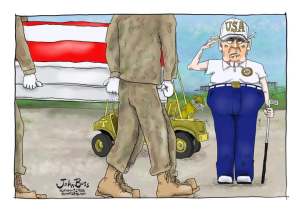
“The Pieces President” John Buss, @repeat1968
Good Day, Sky Dancers!
The one thing holding inflation prices down in this country was the price of oil. It peaked in 2023 and began a decline until Orange Caligula launched a full-on attack on Iran and disrupted traffic in the Straight of Hormuz. Such is the result of a madman’s insane policy choices based on revenge, power-grabbing, and greed. It’s like giving a toddler the driving wheel and letting him take you down from a very tall mountain.
It’s not like I didn’t warn everyone to clear out of the stock market and hunker down about a year ago. It’s also just going to get worse. I fortunately cleared out the last of one of my 403(b)s last week to use it to improve the house before it gets any more expensive. I managed to lose only a bit of it, and I’m glad to know the check got cut before the worst hit so far. I can’t promise you that it’s going to get any better either. We’re worse than a Banana Republic. We’ve gone back to something akin to the dark ages with plagues of measles and armed thugs wandering the streets, looking to harm and jail workers and poor people. We can’t even put a bunch of pedophiles in suits into the justice system. What good is our Constitution for if money means you can ignore it
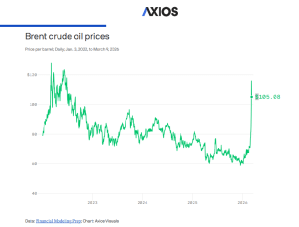
I’m going to start with AXIOS because they always get straight to the point. This analysis is by Neil Irwin, and this absolutely stunning chart provides some visuals. That line covering the first few months of 2026 screams outlier with a discernible reason. To the moon and beyond! It’s also obvious that none of it was Joe Biden’s fault, given the dates accompanying the data points. Okay, I’ll step down from the professor’s podium. I’ll just say economics students will be studying this for as long as universities stand.
In the first week of the American and Israeli attack on Iran, the economic ripples were looking pretty minimal. But as Week 2 begins, the risks to the global economy are growing much more serious.
The big picture: You can’t decapitate the leadership of a country of 90 million people, with expansive military and intelligence capabilities, in the heart of some of the world’s most economically important supply chains, without a huge cost.
- The hours and days and weeks ahead are all about quantifying that cost.
Zoom in: Oil skyrocketed 25% overnight, to just under $120 a barrel, fueling worries that higher energy costs will stoke inflation and curb spending by U.S. consumers. Tokyo’s Nikkei 225 index plunged more than 5%.
- That’s the highest oil price since about four years ago, when energy prices surged due to Russia’s invasion of Ukraine.
- Patrick De Haan — a widely cited gas price expert and an analyst for GasBuddy — estimates there’s an 80% chance the national average gas price will hit $4 per gallon in the next month.
The latest: As of 5am ET, a barrel of the global crude oil benchmark was going for about $107 on futures markets, up 15% from Friday and 47% from 10 days ago, before the Iran attack. Brent crude prices approached $120 overnight before receding on reports of coordinated global action to release oil reserves.
- The oil price rise is poised to translate into a rapid increase in the cost of retail gasoline, which was already up about 51 cents per gallon before the weekend run-up in oil prices.
The risk of a broader economic slump is rising with the disruption to oil supplies. S&P 500 futures are down 1.3% overnight, setting Wall Street up for its third consecutive day of losses.
- Japan’s Nikkei index was down 5.2% and South Korea’s KOSPI down 6%, reflecting those economies’ more direct dependence on Middle Eastern oil now at risk of a protracted blockade.
Of note: The odds of a U.S. recession this year spiked to 38% in overnight trading on Polymarket, from 24% at the start of the month.
State of play: Iran is seeking to block the Strait of Hormuz, which connects the Persian Gulf with the rest of the world, and is threatening to attack ships that seek to pass through.
- The war has already caused the largest oil disruption in history, taking out roughly 20% of the world’s supply, according to Bob McNally, president of Rapidan Energy and a former George W. Bush energy adviser.
- That’s double the previous record set during the Suez Crisis in the 1950s, which disrupted just under 10% of global supply.
- The weekend also brought apparently successful Iranian attacks on desalination plants in the Gulf region that are critical for drinking water.
- President Trump has raised the possibility of U.S. ground forces in Iran.
 More at the link. CNBC shows the data with more analysis. “Oil prices topped $100 per barrel on record supply disruption, but are off session highs.” We’ll see if that lasts until the markets close this afternoon.
Shortly after oil blasted past $100 at the open of trading Sunday evening, President Donald Trump posted on Truth Social that a gain in “short term oil prices” was a “very small price to pay” for destroying Iran’s nuclear threat.
“Only fools would think differently!” Trump added.
Gulf Arab states are cutting production because they are running out of storage space, as crude piles up with nowhere to go due to the closure of the Strait. Tankers are unwilling transit the narrow waterway because they are worried Iran will attack them.
The closure of the Strait has triggered the biggest oil supply disruption history, according to an analysis by consulting firm Rapidan Energy. About 20% of the world’s oil consumption is exported through the Strait.
Iran’s foreign ministry spokesman warned Monday that oil tankers “must be very careful.”
“As long as the situation is insecure, I think all tankers, all maritime navigation, must be very careful,” Foreign Ministry spokesman Esmail Baghaei told CNBC in an interview.
Kuwait, the fifth-biggest producer in OPEC, announced precautionary cuts Saturday to its oil production and refinery output due to “Iranian threats against safe passage of ships through the Strait of Hormuz.” The state-owned Kuwait Petroleum Corp. did not detail the size of the cuts.
Output in Iraq, the second-biggest OPEC producer, has effectively collapsed. Production from its three main southern oilfields has fallen 70% to 1.3 million barrels per day, three industry officials told Reuters on Sunday. Those fields produced 4.3 million bpd before Iran war.
And the United Arab Emirates, the third-biggest producer in OPEC, said Saturday that it is “carefully managing offshore production levels to address storage requirements.” The Abu Dhabi National Oil Co., or ADNOC, said its onshore operations are continuing normally.
The war showed little signs of easing despite Trump’s claim it was “already won.” Iran named Ayatollah Ali Khamenei’s son, Mojtaba, as its new supreme leader, according to reports. The U.S. and Israel killed Khamenei in the opening days of the war.
Energy Secretary Chris Wright said Sunday that traffic through the Strait will resume after the U.S. has destroyed Iran’s ability to threaten tankers.
 It’s really odd to think that I started my career as an economist during the OPEC maneuvers and I’m winding down my career as one with the US maneuvers. Frankly, I think China is sitting pretty right now. They’ve been doing a lot with alternative energy and have the entire Pacific Region — including many Latin American Countries with oil — undoubtedly rooting for them right now.
Alex Harring at CNBC analyzes the market activity. This is fresh off the ticker today. “Stocks pare losses as oil falls back below $100; Dow is down 300 points: Live updates.”
The Dow Jones Industrial Average fell to start the week as U.S. oil topped $100 a barrel, raising concerns about a stagflationary environment for the U.S. economy of rising inflation and slowing growth.
The 30-stock index fell 293 points, or 0.6%, and is coming off its biggest weekly slide in nearly a year. The S&P 500 lost 0.2%, while the Nasdaq Composite gained 0.2%. That signifies a meaningful turnaround for the three indexes, as the Dow was down nearly 900 points, or 1.9%, at its low of the day, and the S&P 500 and Nasdaq were each lower by around 1.5%.
The broader market was helped off its lows by a rise in semiconductor stocks, however. Broadcom jumped more than 3%, while Micron Technology and Advanced Micro Devices gained almost 2% each. Nvidia climbed more than 1%.
West Texas Intermediate crude broke above $100 per barrel in overnight trading to hit more than $119, its first time above the $100 level since 2022, when investors were reacting to the aftermath of Russia’s invasion of Ukraine. It was last up 6% at around $96 a barrel. International benchmark Brent crude added 7% to $99 a barrel. U.S. oil prices began the year below $60 a barrel.
Oil futures jumped after major Middle East producers slashed their output due to the continued closure of the key Strait of Hormuz passageway. Kuwait announced cuts but did not say by how much, while Iraq has reportedly seen its production fall 70%.
Oil prices later came off their highest levels of the session and stocks rose from their lows following a Financial Times report that G7 officials were considering tapping their strategic reserves. But the publication also reported coordinated release was not ready yet, helping to send major indexes lower.
The Cboe Volatility index — Wall Street’s fear gauge measuring investors seeking protection in the options market — topped 30 for the first time since the market’s tariff driven sell-off in April 2025. It was last above 27.
The $100 oil level was seen by many on Wall Street as a breaking point for the economy unless the war is resolved quickly and prices retreat. Trump posted Sunday evening that a gain in “short term oil prices” was a “very small price to pay” for destroying Iran’s nuclear threat.
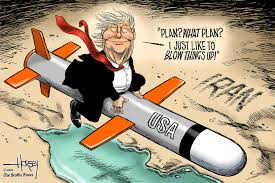 Trump donors are feeling this immediately. Trump voters will shortly see the impact on their budgets and gas prices. I can’t say I feel sorry for any of them, but there’s not a person who won’t feel this one way or another. The Bulwark’s Andrew Egger examines Trump’s seeming confusion over his War.
What did the White House think it was getting into in Iran? A strike against Iran’s oppressive and fanatical regime, sure. A display of America’s awesome military might, definitely. But it’s become increasingly, painfully clear: They didn’t think there was going to be a war.
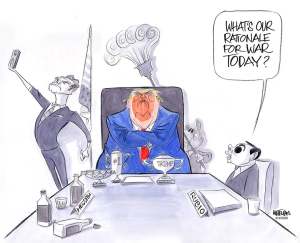
The Trump administration developed no real theory of the objectives of the Iran war, because they didn’t think there was going to be a war. Instead, the administration has backfilled a dizzying array of post-hoc goals for the strikes against Iran. Judd Legum counts seventeen different rationales offered by many different officials, from the president’s “feeling, based on fact” that Iran was about to strike the United Statesto a desire to free the Iranian people to a need to destroy a nuclear program the White House had claimed was already “obliterated.”
The Trump administration made no effort to get the American people on board with war, because they didn’t think there was going to be a war. A majority of the public is already opposed to war with Iran, and what support the war does have seems to be based on the questionable assumption that the conflict will be shortly resolved: 44 percent of Americans support the strikes so far, but only 12 percentwould be in favor of sending U.S. ground troops into the country. But the White House has made no broad effort to convince the public on a bipartisan basis that they should be prepared for a long-haul conflict.
They didn’t think there was going to be a war, and so the White House seemingly gave no thought to what the economic ramifications of war would be. After several days of strikes on Iran, President Trump seemed suddenly to realize last week that the ongoing conflict was going to be terrible for energy prices. He tried to slap a band-aid on the problem by announcing risk insurance and military escorts for all oil tankers through the Strait of Hormuz, but it wasn’t enough: Suddenly, oil prices went through the roof, and the White House was scrambling to contain the damage—rushing to reassure consumers that the price hikes would be temporary and even waiving some sanctions on Russian oil to try to ease pressures on global supply. “Short term oil prices, which will drop rapidly when the destruction of the Iran nuclear threat is over, is a very small price to pay for U.S.A, and World, Safety and Peace,” Trump posted on Truth Social yesterday. “ONLY FOOLS WOULD THINK DIFFERENTLY!”
They didn’t think there was going to be a war, and so the president assumed he’d be in charge of picking Iran’s next political leadership. This plan, admittedly, hit an unexpected snag early on: The initial round of strikes that took out Iran’s top leaders also killed a number of lower-ranking regime figures that the White House had identified as pragmatists who might be willing to negotiate. “The attack was so successful it knocked out most of the candidates,” Trump said a day after the strikes began. “It’s not going to be anybody that we were thinking of because they’re all dead. Second or third place is dead.” Still, Trump made it clear he expected to be involved in picking Iran’s next supreme leader, and absolutely ruled out Mojtaba Khamenei, the son of the slain ayatollah: “They are wasting their time . . . Khamenei’s son is unacceptable to me.” But this morning, Iran went ahead and proclaimed Mojtaba Khamenei their next supreme leader anyway.
Somehow, the president seems to remain so confident Iran will be buttoned up in no time that he’s already openly licking his chops over the next triumphant blitzkrieg. “Cuba is gonna fall pretty soon, by the way,” Trump told CNN Friday. “I’m going to put Marco over there and we’ll see how that works out. We’re really focused on this one right now.”
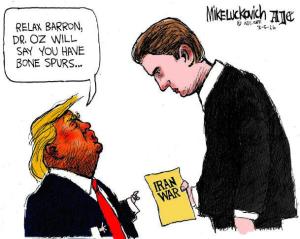 Judd LeGum at Popular Information specifies not the unknowables of the attack, but the rationale and plans for the future, which are blowing in the wind. “9 days in, the most basic question about the Iran war remains unanswered. In just over a week, Trump and top administration officials have given at least 17 different responses about why the war began.” Yup. We still don’t know why they did this.
On February 28, President Trump announced that “the United States military began major combat operations in Iran.” The war has claimed the lives of more than 1500 people, including about 1300 Iranians, dozens in neighboring countries, and six U.S. troops. The Pentagon has estimated the conflict is costing U.S. taxpayers about $1 billion per day — and that figure may be too low.
And yet, nine days into the war, Trump and his administration have failed to clearly answer the most fundamental question: Why did the war begin?
Instead, the Trump administration has offered a bewildering series of shifting, contradictory, and factually incorrect answers. In just over a week, Trump and top administration officials have given at least 17 different responses about why the war began:
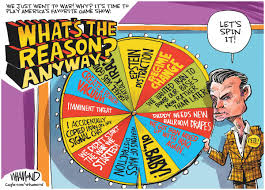 A brief description of each of those 17 responses is given in the article. You may read it at this fully gifted link. The New York Times reports on information from Iran’s new Supreme Leader. “Live Updates: Oil Price Surge Rattles Markets; Iran’s Choice of Leader Signals Defiance. Stocks fell on fears of the Iran war’s effects on energy prices. Top clerics selected Mojtaba Khamenei as Iran’s supreme leader, despite President Trump’s warning that he was “unacceptable.”
U.S. stocks fell at the start of trading on Monday, after markets in Asia and Europe tumbled, as a spike in oil prices reflected global fears of a prolonged U.S.-Israeli war with Iran. Meanwhile, Iran projected defiance by naming a son of its slain supreme leader as his successor.
Oil prices briefly surged early Monday to almost $120 per barrel, their highest level since the Covid pandemic, as President Trump’s plans for the next steps in the war, let alone its endgame, remained unclear and Iran showed no sign of bowing to his demand for unconditional surrender.
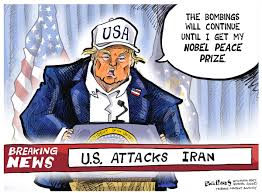 It still looks like the start of World War 3 to me. From the same link above.
Eleven countries have asked Ukraine for security support to help counter Shahed drones, according to President Volodymyr Zelenskyy. He said in a social media post that the requests have come from countries neighboring Iran, European nations and the United States — and that some “have already been met with concrete decisions and specific support.”
He did not provide further details, though Zelensky earlier told The New York Times that Ukraine sent interceptor drones and a team of experts to protect U.S. military bases in Jordan.
“There is clear interest in Ukraine’s experience in protecting lives, relevant interceptors, electronic warfare systems, and training,” Zelensky added in his post on social media. “Ukraine is ready to respond positively to requests from those who help us protect the lives of Ukrainians and the independence of Ukraine.
This headline is one that worries me. It’s from the Times of Israel. “Trump to Times of Israel: It’ll be a ‘mutual’ decision with Netanyahu regarding when Iran war ends. US president, in phone interview, clarifies that he’ll make final call to end operation ‘at right time’; says he and PM ‘worked together’ against Islamic Republic: ‘We’ve destroyed a country that would have destroyed Israel’.”
US President Donald Trump told The Times of Israel on Sunday that a decision on when to end the war with Iran will be a “mutual” one that he’ll make together with Prime Minister Benjamin Netanyahu.
Trump also asserted in the brief telephone interview that the Islamic Republic would have destroyed Israel if he and Netanyahu had not been around. “Iran was going to destroy Israel and everything else around it… We’ve worked together. We’ve destroyed a country that wanted to destroy Israel.”
The US president was asked whether he alone would decide when the war with Iran ends or if Netanyahu would also have a say.
“I think it’s mutual… a little bit. We’ve been talking. I’ll make a decision at the right time, but everything’s going to be taken into account,” he responded, indicating that while Netanyahu will have input, the US president will have the final say.
Asked whether Israel could continue the war against Iran even after the US decides to halt its strikes, Trump declined to entertain the theoretical possibility before adding: “I don’t think it’s going to be necessary.”
So, it’s still two megalomaniacs avoiding prison sentences running the show. Don’t you feel much better now?
What’s on your Reading, Action, and Blogging list today?


 peej
peej Carissa
 bostonboomer
 ecocatwoman
 mablue2
 Mama Lopez
 peggysue22
 quixote
 skydancingguestblogger
 Mona (aka Wonk the Vote)



 Sky Dancing
Certainly glad that I’m not a war correspondent. It looks like we attacked a boys school as well as a girls elementary school.
And there’s just so many blowboacks it’s hard to get them all in blog post.
Trump and Rubio dismantled U.S. diplomacy. It’s making the Iran War harder.
Statecraft helps war-fighting as well as peacemaking.
and there is really going to be bad shit going on with everything because of AI …