

Michael Atkinson (former inspector general of the intelligence community)
Lloyd Austin (defense secretary under President Joe Biden)
Brian Auten (supervisory intelligence analyst, FBI)
James Baker (not the former secretary of state; this James Baker is former general counsel for the FBI and former deputy general counsel at Twitter)
Bill Barr (former attorney general under Trump)
John Bolton (former national security adviser under Trump)
Stephen Boyd (former chief of legislative affairs, FBI)
Joe Biden (president of the United States)
John Brennan (former CIA director under President Barack Obama)
John Carlin (acting deputy attorney general, previously ran DOJ’s national security division under Trump)
Eric Ciaramella (former National Security Council staffer, Obama and Trump administrations)
Pat Cippolone (former White House counsel under Trump)
James Clapper (Obama’s director of national intelligence)
Hillary Clinton (former secretary of state and presidential candidate)
James Comey (former FBI director)
Elizabeth Dibble (former deputy chief of mission, U.S. Embassy, London)
Mark Esper (former secretary of defense under Trump)
Alyssa Farah (former director of strategic communications under Trump)
Evelyn Farkas (former deputy assistant secretary of defense for Russia, Ukraine, Eurasia under Obama)
Sarah Isgur Flores (former DOJ head of communications under Trump)
Merrick Garland (attorney general under Biden)
Stephanie Grisham (former press secretary under Trump)
Kamala Harris (vice president under Biden; former presidential candidate)
Gina Haspel (CIA director under Trump)
Fiona Hill (former staffer on the National Security Council)
Curtis Heide (FBI agent)
Eric Holder (former FBI director under Obama)
Robert Hur (special counsel who investigated Biden over mishandling of classified documents)
Cassidy Hutchinson (aide to Trump chief of staff Mark Meadows)
Nina Jankowicz (former executive director, Disinformation Governance Board, under Biden)
Lois Lerner (former IRS director under Obama)
Loretta Lynch (former attorney general under Obama)
Charles Kupperman (former deputy national security adviser under Trump)
Gen. Kenneth Mackenzie, retired (former commander of United States Central Command)
Andrew McCabe (former FBI deputy director under Trump)
Ryan McCarthy (former secretary of the Army under Trump)
Mary McCord (former acting assistant attorney general for national security under Obama)
Denis McDonough (former chief of staff for Obama, secretary of veterans affairs under Biden)
Gen. Mark Milley, retired (former chairman, Joint Chiefs of Staff)
Lisa Monaco (deputy attorney general under Biden)
Sally Myer (former supervisory attorney, FBI)
Robert Mueller (former FBI director, special counsel for Russiagate)
Bruce Ohr (former associate deputy attorney general under Obama and Trump)
Nellie Ohr (wife of Bruce Ohr and former CIA employee)
Lisa Page (former legal counsel for Deputy Director Andrew McCabe at FBI under Obama and Trump; exchanged texts about Trump with Peter Strzok)
Pat Philbin (former deputy White House counsel under Trump)
John Podesta (former counselor to Obama; senior adviser to Biden on climate policy)
Samatha Power (former ambassador to the United Nations under Obama, administrator of AID under Biden)
Bill Priestap (former assistant director for counterintelligence, FBI, under Obama)
Susan Rice (former national security adviser under Obama, director of the Domestic Policy Council under Biden)
Rod Rosenstein (former deputy attorney general under Trump)
Peter Strzok (former deputy assistant director for counterintelligence, FBI, under Obama and Trump; exchanged texts about Trump with Lisa Page)
Jake Sullivan (national security adviser under President Joe Biden)
Michael Sussman (former legal representative, Democratic National Committee)
Miles Taylor (former DHS official under Trump; penned New York Times op-ed critical of Trump under the byline, “Anonymous”)
Timothy Thibault (former assistant special agent, FBI)
Andrew Weissman (Mueller’s deputy in Russiagate probe)
Alexander Vindman (former National Security Council director for European affairs)
Christopher Wray (FBI director under Trump and Biden; Trump nominated Patel to replace him even though Wray’s term doesn’t expire until August 2027)
Sally Yates (former deputy attorney general under Obama and, briefly, acting attorney general under Trump)
Andrew Egger writes at The Bulwark: House GOP to Kash Patel: Do Liz First.
Last week, I noted with alarm that House Republicans were shrugging off—or even approving of—Donald Trump wanting to jail some of their past and current colleagues who served on the January 6th Committee. As it turns out, I underestimated their bloodthirstiness.
Yesterday, a key House Republican released a report directly calling for a criminal investigation into former Rep. Liz Cheney for her committee work.
The report came from Rep. Barry Loudermilk (R-Ga.), whom House Republicans tapped two years ago to spearhead the House Administration Committee’s probe into the actions of the January 6th Committee itself. It was clear from the start that Loudermilk’s primary goal was to shift blame for the attempted insurrection away from Trump. His report works plenty hard at that.
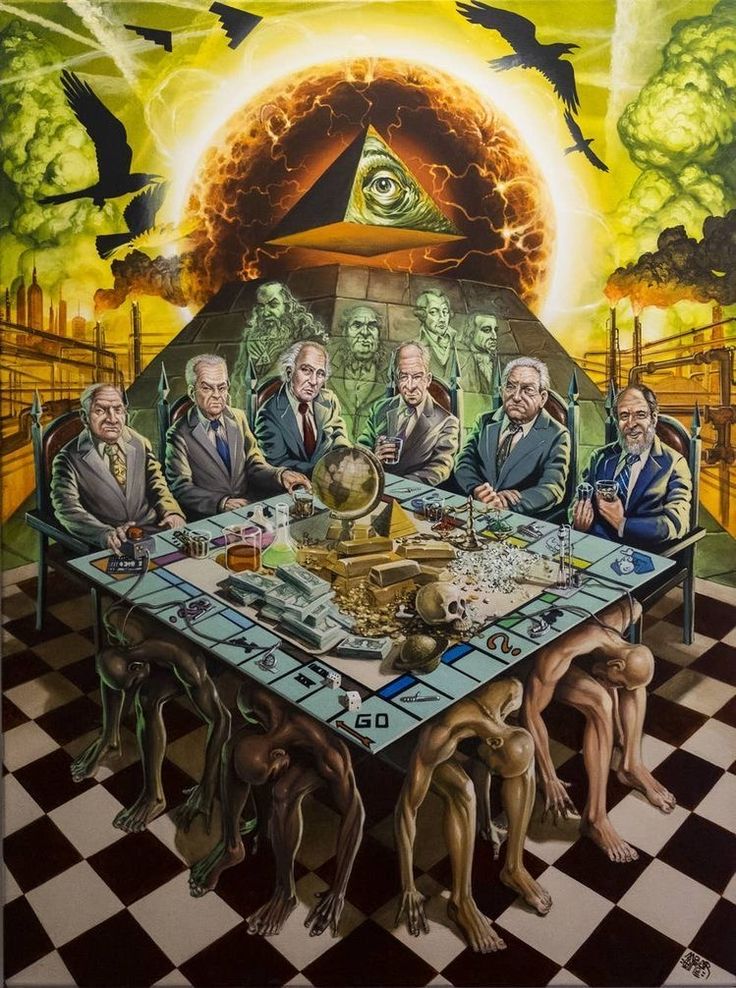
False Profits by Mear One
What wasn’t expected was what Loudermilk would bring forward as his number-one “top finding”: “Former Representative Liz Cheney colluded with ‘star witness’ Cassidy Hutchinson without Hutchinson’s attorney’s knowledge. Former Representative Liz Cheney should be investigated for potential criminal witness tampering based on the new information about her communication.”
Testimony from Hutchinson, a former aide to Trump’s one-time chief of staff Mark Meadows, featured prominently in the January 6th Committee’s work. Loudermilk focuses in on the fact that Hutchinson, who by her own account originally intended to keep her head down and clam up—even asking Team Trump for a lawyer to represent her through her interactions with the committee—had a change of heart midway through. Bracing to break with Trumpworld, Hutchinson reached out to Cheney for advice, and they had several conversations without Hutchinson’s Trump-issued lawyer present.
“Representative Cheney’s influence on Hutchinson is apparent from that point forward by her dramatic change in testimony and eventual claims against President Trump using second- and thirdhand accounts,” the report reads.
This is incredibly weak
milktea on any level. Hutchinson clearly intended to open up to Cheney’s committee before Cheney ever spoke with her. That’s obvious from the fact that it was Hutchinson who initiated the contact, not Cheney. The idea that this amounted to witness-tampering on Cheney’s behalf would be too stupid to entertain if not for the fact that the country’s most powerful people are trying to pass it off with a straight face.In a statement, Cheney denounced Loudermilk’s report as “a malicious and cowardly assault on the truth.” “No reputable lawyer, legislator or judge,” she added, “would take this seriously.”
Andrew Howard at Politico: Trump: Liz Cheney ‘could be in a lot of trouble’ over Jan. 6 committee.
President-elect Donald Trump reignited his longstanding feud with former Rep. Liz Cheney, saying she “could be in a lot of trouble” following a House subcommittee report accusing her of wrongdoing while serving on the panel that investigated the Jan. 6, 2021, attack on the Capitol.
Trump’s post cites a 128-page report released Tuesday by the House Administration Oversight Subcommittee chaired by GOP Rep. Barry Loudermilk that accuses Cheney of colluding with top witnesses and calls for her to be investigated for witness tampering. “Liz Cheney could be in a lot of trouble based on the evidence obtained by the subcommittee,” Trump wrote. “Which states that ‘numerous federal laws were likely broken by Liz Cheney, and these violations should be investigated by the FBI.’”
The report also accuses members of the Jan. 6 committee of withholding evidence and failing to preserve records from its investigation. It places blame for the attack on a “series of intelligence, security, and leadership failures at several levels and numerous entities” rather than Trump, who urged his supporters to march on the Capitol that day during an earlier rally near the White House.
Cheney responded:
In a statement, Cheney defended her work while taking a shot at Trump.
“January 6th showed Donald Trump for who he really is — a cruel and vindictive man who allowed violent attacks to continue against our Capitol and law enforcement officers while he watched television and refused for hours to instruct his supporters to stand down and leave,” Cheney said in a statement.
“Now, Chairman Loudermilk’s ‘Interim Report’ intentionally disregards the truth and the Select Committee’s tremendous weight of evidence, and instead fabricates lies and defamatory allegations in an attempt to cover up what Donald Trump did.”
This is frightening. Trump isn’t even waiting until he takes office to try to prosecute anyone who opposes him.
David Smith at The Guardian: Trump planning to target progressive non-profits, US watchdog warns.
Donald Trump and his Republican allies are planning to target progressive groups they perceive as political enemies in a sign of deepening “authoritarianism”, a US watchdog has warned.
The president-elect could potentially use the justice department and Internal Revenue Service (IRS) to target non-profits and researchers, launch politically motivated investigations and pass legislation to restrict their activities.
Playing God, Troy Jacobson
“Trump has made it clear that he plans to use his second term to attack the progressive ecosystem and his perceived enemies,” Adrienne Watson of the Congressional Integrity Project (CIP) told the Guardian. “This is a worrying progression of Trump’s authoritarianism that would undermine our democracy.”
The CIP announced on Wednesday that it will aim to counter such abuses of power with a new initiative to defend progressive groups and individuals. The Civic Defense Project will be led by Watson, a former White House and Democratic National Committee spokesperson.
Fears have been raised by the Trump second term agenda’s considerable overlap with Project 2025, a policy blueprint from the Heritage Foundation think tank that includes plans to attack non-profits, researchers and civil society groups that have challenged election denial narratives.
Activists say the threat extends beyond political investigations and includes leveraging government agencies such as the justice department and IRS to investigate, prosecute and shut down organisations that oppose the administration’s policies.

More at the link.
The Democrats don’t seem to be doing much to deal with all this. Will they ever wake up? At The New York Times, Jamelle Bouie writes: What Do Democrats Need to Do? Act Like an Opposition Party.
Democrats may be in the minority, but they are not yet an opposition.
What’s the difference?
An opposition would use every opportunity it had to demonstrate its resolute stance against the incoming administration. It would do everything in its power to try to seize the public’s attention and make hay of the president-elect’s efforts to put lawlessness at the center of American government. An opposition would highlight the extent to which Donald Trump has no intention of fulfilling his pledge of lower prices and greater economic prosperity for ordinary people and is openly scheming with the billionaire oligarchs who paid for and ran his campaign to gut the social safety net and bring something like Hooverism back from the ash heap of history.
An opposition would treat the proposed nomination of figures like Robert F. Kennedy Jr., Kash Patel and Pete Hegseth as an early chance to define a second Trump administration as dangerous to the lives and livelihoods of ordinary Americans. It would prioritize nimble, aggressive leadership over an unbending commitment to seniority and the elevation of whoever is next in line. Above all, an opposition would see that politics is about conflict — or, as Henry Adams famously put it, “the systematic organization of hatreds” — and reject the risk-averse strategies of the past in favor of new blood and new ideas.
By Jhonata Aguiar
The Democratic Party lacks the energy of a determined opposition — it is adrift, listless in the wake of defeat. Too many elected Democrats seem ready to concede that Trump is some kind of avatar for the national spirit — a living embodiment of the American people. They’ve accepted his proposed nominees as legitimate and entertained surrender under the guise of political reconciliation. Senator Richard Blumenthal of Connecticut, for example, praised Elon Musk, a key Trump lieutenant, as “the champion among big tech executives of First Amendment values and principles.” Senator Chris Coons of Delaware similarly praised Musk and Vivek Ramaswamy’s so-called Department of Government Efficiency, a glorified blue-ribbon commission, as a potentially worthwhile enterprise — “a constructive undertaking that ought to be embraced.” And a fair number of Democrats have had friendly words for the prospect of Kennedy going to the Department of Health and Human Services, with credulous praise for his interest in “healthy food.”
“I’ve heard him say a lot of things that are absolutely right,” Senator Cory Booker of New Jersey said last week. “I have concerns, obviously, about people leading in our country who aren’t based in science and fact.” But, he continued, “when he speaks about the issues I was just speaking about, we’re talking out of the same playbook.”
And at least two Democrats want President Biden to consider a pardon for incoming President Trump. “The Trump hush money and Hunter Biden cases were both bullshit, and pardons are appropriate,” Senator John Fetterman of Pennsylvania wrote in his first post on Trump’s social networking website.
Representative Jim Clyburn of South Carolina also said that Biden should consider a pardon for Trump as a way of “cleaning the slate” for the country.

Reading that makes me feel like throwing up. We are going to have to fight the Democrats and the media if we want to save what’s left of our democracy.
At Talking Points Memo, Josh Marshall writes that we need to get serious about preparing to fight Trump’s efforts to become dictator for life: A Big Pile of Money and Lawyering to Defend Trump’s Legal Targets?
In the wake of Donald Trump’s election victory and promised revenge tour, a number of individuals have proposed the creation of an organization or fund which would take on the job of defending the various lawsuits, prosecutions and generalized legal harassment Trump will bring to the table in the next four years. It’s a very good idea. It’s a necessary one. Over the last six weeks I’ve had a number of people reach out to me and ask who is doing this. Where should they send money to fund this effort? This includes people who are in the small-donor category and also very wealthy people who could give in larger sums. So a few days ago I started reaching out to some people in the legal world and anti-Trump world to find out what’s going on, whether any efforts are afoot and who is doing what.
What I found out is that there are at least a couple groups working toward doing something like this. But the efforts seem embryonic. Or at least I wasn’t able to find out too much. And to be clear, I wasn’t reaching out as a journalist per se. I was explicitly clear about this. I was doing so as a concerned citizen, not to report anything as a news story but as someone who wants such an entity to come into existence. The overnight news that Trump is now suing Ann Selzer and the Des Moines Register over her final election poll for “election interference” makes me think that these efforts aren’t coming together soon enough or can’t come together soon enough. (If you’re not familiar with the details, Selzer is a pollster of almost legendary status and in what turned out to be her final public poll, dramatically missed not only the result of the election but the whole direction of it.) So what I’m going to write here is simply my take on why such an effort is important and what shape it should take….
Waldemar von Kosak, We are the Robots
Trump’s retribution may focus on individuals, but it’s a collective harm. So it makes sense to spread the cost of dealing with it. If person X is targeted for defending the rule of law or democracy or related equities, those are things we all have an interest in defending. So it makes sense to spread the burden.
When a powerful person (and in this case a president) targets individuals, he is trying to overwhelm them, force them to knuckle under because they lack the resources to fight. That does more damage to the civic equities we’re trying to defend. The point of such retribution is to make an example of someone and cast a penumbra of fear that keeps other people from getting out of line. If people are confident their costs — literal and figurative — will be covered they will be more likely to speak their minds, do the right thing, run risks.
These two points are straightforward. But they’re worth articulating. First, fairness: targeted individuals shouldn’t alone bear the costs of protecting collective goods. Second, self-protection: people who believe in democracy and the rule of law have a clear interest in guaranteeing these defenses and preventing the spread of civic fear.

A bit more:
But there’s another need that may not be as clear and its a role some group like this should fill.
Let’s take the Selzer/Des Moines Register suit as our example. Trump is claiming that he was damaged and should be made whole because of a poll that showed him behind and turned out to be wrong. His lawyers are trying to shoe-horn this claim into an Iowa consumer fraud statute. But we shouldn’t be distracted by that. The idea that a political candidate has a cause of action over a poll is absurd on its face. And really that is precisely the point. I’ve written a number of times recently about the ways Trump casts penumbras of power and fear with talk, how he holds public space, how he keeps opponents off balance and guessing. This is another example.
As I noted above, a lot of the power and point of such an exercise is precisely the absurdity of it. It is meant to spur a chorus of “You can’t do that” and “How can he do that?” But he does do it. We have that same mixture of outrage, incomprehension, uncanny laughter, the upshot of which is an overwhelming and over-powering belief that the rules somehow don’t apply to this guy. That’s the power and that is the point. It is a performance art of power enabled by a shameless abuse of the legal system.
Read the rest at TPM. Marshall also discussed his ideas with Greg Sargent at The New Republic: Transcript: Trump’s Angry New Tirade on Truth Social Signals Dark 2025.
I’ll end there, and post a few more links in the comment thread. Have a nice Wednesday!


 peej
peej Carissa
 bostonboomer
 ecocatwoman
 mablue2
 Mama Lopez
 peggysue22
 quixote
 skydancingguestblogger
 Mona (aka Wonk the Vote)



 Sky Dancing
CNN: In reversal, key House panel votes to release Matt Gaetz ethics report.
The House Ethics Committee secretly voted earlier this month to release its report into the conduct of former Rep. Matt Gaetz before the end of this Congress, according to multiple sources with knowledge of the matter.
The report is now expected to be made public after the House’s final day of votes this year as lawmakers leave Washington for the holidays, those sources said.
The vote, which has not previously been reported, amounts to a stark reversal for the panel after it had voted along party lines in late November not to release the results of the investigation. The decision to release the report suggests that some Republicans ultimately decided to side with Democrats on the matter, and it is unclear if the committee will once again change course now that it has voted.
Elon Musk’s security clearance is getting attention from the government.
The New York Times: Elon Musk and SpaceX Face Federal Reviews After Violations of Security Reporting Rules.
Elon Musk and his rocket company, SpaceX, have repeatedly failed to comply with federal reporting protocols aimed at protecting state secrets, including by not providing some details of his meetings with foreign leaders, according to people with knowledge of the company and internal documents.
Concerns about the reporting practices — and particularly about Mr. Musk, who is SpaceX’s chief executive — have triggered at least three federal reviews, eight people with knowledge of the efforts said. The Defense Department’s Office of Inspector General opened a review into the matter this year, and the Air Force and the Pentagon’s Office of the Under Secretary of Defense for Intelligence and Security separately initiated reviews last month.
The Air Force also recently denied Mr. Musk a high-level security access, citing potential security risks associated with the billionaire. Several allied nations, including Israel, have also expressed concerns that he could share sensitive data with others, according to defense officials.
Internally, SpaceX has a team that is expected to ensure compliance with the government’s national security rules. Some of those employees have complained to the Defense Department’s Office of Inspector General and other agencies about the lax reporting, which goes back to at least 2021, four people with knowledge of the company said. SpaceX was awarded at least $10 billion in federal contracts with the Pentagon and NASA from 2019 to 2023, making it a major contractor.
The Independent: SpaceX was advised not to seek higher clearance for Elon Musk due to Putin contacts: Report.
Executives working for Elon Musk have been advised not to seek a higher security clearance for him due to concerns about his drug use and contact with foreign nationals, according to reports.
Lawyers at Musk’s rocket launch company SpaceX had warned senior executives that applying to upgrade his access would force him to answer awkward questions and even put his existing clearance at risk, The Wall Street Journal reported.
Yet Musk will soon hold a powerful position as a top aide to President-elect Donald Trump with access to an extraordinary trove of federal information.
The revelation follows a bombshell report by the Journal in October alleging that Musk has been in regular contact with Vladimir Putin since late 2022, on top of previous reports claiming that he had used ketamine multiple times.
What an awesome post, thank you for this compilation. On a side note, WTF is wrong with Democratic leadership? Now is the time to ramp up an opposition party, as I’ve said to some politicians, and yet they’re largely silent. Why, oh why is that so? Are their donors telling them to be silent? Or are they just cowards?
it makes me want to scream. It also makes me want to promote anyone new who has some gumption. Rise up, democrats! No time to waste.
Thank you! It’s time for the elderly Democrats to step back and let their younger colleagues take over. We need new blood. AOC should be the top Democrat om the oversight committee, not 74 year old Gerry Connolly.
great post BB! Thank you for doing such a great job on these.
Thank you. You do a fantastic job though.
I swear they just want to take down the entire country and run wild!
I finally finished the entire Lawfare article you posted up there and it should be made a requirement for every civics course at universities and high schools. And civics courses, should be required for everyone period.
It is just annoying me to no end that there’s a large population of idiots who don’t care or don’t know what their vote will do to their lives.
The price of eggs will seem quite trivia in about a year.
This post was so pithy and full of good stuff I hope every one takes a dive into it BB!!! Great post! And it seems the great ones these days are the ones that are so depressing you want to cry, unfortunately.