ROUND HILL, Va. — They said goodbye to Aimee outside her elementary school, watching nervously as she joined the other children streaming into a low brick building framed by the foothills of the Blue Ridge Mountains. Christina and Aaron Beall stood among many families resuming an emotional but familiar routine: the first day of full-time,in-person classes since public schools closed at the beginning of the pandemic.
incomprehensible to the parents around them. Their 6-year-old daughter, wearing a sequined blue dress and a pink backpack that almost obscured her small body, hesitated as she reached the doors. Although Aaron had told her again and again how brave she was, he knewit would be years before she understood how much he meant it — understood that for her mother and father, the decision to send her to school was nothing less than a revolt.
Aaron and Christina had never attended school when they were children. Until a few days earlier, when Round Hill Elementary held a back-to-school open house, they had rarely set foot inside a school building. Both had been raised to believe that public schools were tools of a demonic social order, government “indoctrination camps” devoted to the propagation of lies and the subversion of Christian families.
At a time when home education was still a fringe phenomenon, the Bealls had grown up in the most powerful and ideologically committed faction of the modern home-schooling movement. That movement, led by deeply conservative Christians, saw home schooling as a way of life — a conscious rejection of contemporary ideas about biology, history, gender equality and the role of religion in American government.
Christina and Aaron were supposed to advance the banner of that movement, instilling its codes in their children through the same forms of corporal punishment once inflicted upon them. Yet instead, along with many others of their age and upbringing, they had walked away.
Jamison describes how right wing Christians have used home schooling to indoctrinate their children and tie them to their religious beliefs.
Among conservative Christians, home schooling became a tool for binding children to fundamentalist beliefs they felt were threatened by exposure to other points of view. Rightly educated, those children would grow into what HSLDA founder Michael Farris called a “Joshua Generation” that would seek the political power and cultural influence to reshape America according to biblical principles.
Over decades, they have eroded state regulations, ensuring that parents who home-school face little oversight in much of the country.More recently, they have inflamed the nation’s culture wars, fueling attacks on public-school lessonsabout race and gender with the politically potent language of “parental rights.”
But now younger generations are rebelling.
Former home-schoolers have been at the forefront of those arguing for greater oversight of home schooling, forming the nonprofit Coalition for Responsible Home Education to make their case.
“As an adult I can say, ‘No. What happened to me as a child was wrong,’” said Samantha Field, the coalition’s government relations director.
More about Christina and Aaron Beall:
Christina, 34, and Aaron, 37, had joined no coalitions.They had published no memoirs. Their rebellion played out in angry text messages and emails with their parents, in tense conversations conducted at the edges of birthday parties and Easter gatherings. Their own children — four of them, including Aimee — knew little of their reasons for abandoning home schooling: the physical and emotional trauma of the “biblical discipline” to which they had been subjected, the regrets over what Aaron called “a life robbed” by strictures on what and how they learned.
Aaron had grown up believing Christians could out-populate atheists and Muslims by scorning birth control; Christina had been taught the Bible-based arithmetic necessary to calculate the age of a universe less than 8,000 years old. Their education was one in which dinosaurs were herdedaboard Noah’s ark — and in which the penalty for doubt or disobedience was swift. Sometimes they still flinched when they remembered their parents’ literal adherence to the words of the Old Testament: “Do not withhold correction from a child, for if you beat him with a rod, he will not die.”
The Bealls knew that many home-schooling families didn’t share the religious doctrines that had so warped their own lives. But they also knew that the same laws that had failed to protect them would continue to fail other children.
“It’s specifically a system that is set up to hide the abuse, to make them invisible, to strip them of any capability of getting help. And not just in a physical way,” Christina said. “At some point, you become so mentally imprisoned you don’t even realize you need help.”
I’ve quoted a lot, but there is much more to this fascinating story. Much of it was new to me, although I was not completely surprised. I hope you will check it out.
Next up a story about infighting among Trump’s many lawyers.
With three anticipated indictments, two ongoing court cases, and an ever-expanding cadre of lawyers, former President Donald Trump is at a critical juncture—and yet his legal advisers are starting to turn on each other.
According to five sources with direct knowledge of the situation, clashing personalities and the increasing outside threat of law enforcement has sown deep divisions that have only worsened in recent months. The internal bickering has already sparked one departure in recent weeks—and that could be just the beginning.
As Trump’s legal troubles keep growing—with criminal and civil investigations in New York City, Washington, and Atlanta—so too does the unwieldy band of attorneys who simply can’t get along.
The cast of characters includes an accused meddler who has Trump’s ear, a young attorney who lawyers on the team suggested is only there because the former president likes the way she looks, and a celebrity lawyer who’s increasingly viewed with disdain. Worst of all, now that federal investigators have turned the interrogation spotlight on some of Trump’s lawyers themselves, defense attorneys on the team seem to be questioning whether their colleagues may actually turn into snitches.
“There’s a lot of lawyers and a lot of jealousy,” said one person on Trump’s legal team, explaining that the sheer number of lawyers protecting a single man accused of so many crimes is without parallel.
At the center of the controversy is Boris Epshteyn, who has been in Trump’s orbit since 2016 and now is so close to Trump that he’s been compared to a presidential chief of staff.
Part of the concern over lawyers turning on each other is due to the fact that the Department of Justice already has one Trump attorney’s professional notes, which could position him as a future witness against his own client, and the DOJ has another lawyer who said too much in an unrelated case and has positioned herself as yet another potential witness against her client.
But much of the anger from Trump’s lawyers is directed at the former president’s right-hand man, Boris Epshteyn, who’s accused of running interference on certain legal advice from more experienced courtroom gladiators.
Boris Epshteyn
Epshteyn, who’s a lawyer himself, has risen through the ranks in Trumpworld over the years, first as an adviser for Trump’s 2016 campaign, then as a more senior adviser for 2020, and now part of Trump’s innermost circle for 2024.
Ephsteyn seems to have the former president’s supreme confidence, with what’s described as a final say on all matters related to public relations and legal issues. But there’s snickering in the shadows. Several sources ridiculed the way Ephsteyn refers to himself as “in-house counsel”—normally a term for a company’s corporate attorney—noting how it echoes the way John Gotti’s mafia lawyer used to describe his services for the infamous Gambino crime family.
Epshteyn’s meddling has particularly affected the lawyers working to defend Trump from Department of Justice Special Counsel Jack Smith and his investigation into whether the former president broke the law when he took top secret documents on his way out of the White House in January 2021 and hoarded them at Mar-a-Lago.
Another complication is there are separate groups of lawyers working on different cases in Georgia, New York, and Washington DC.
The Manhattan District Attorney’s Office, which indicted Trump in March for faking business records, is about to dump thousands of documents of evidence on defense lawyers Todd Blanche, Susan Necheles, and Joe Tacopina—who aren’t allowed to freely share those documents with the former president. They may even have to fight Trump to prevent him from stupidly posting sensitive details on social media.
The DA’s prosecutors are already trying to fracture Trump’s legal team by attempting to disqualify Tacopina and make him seem like a weak link, because he has a tenuous connection to a key witness in the case, the porn star Stormy Daniels whose hush money payment Trump tried to hide while running for president back in 2016.
Meanwhile, defense attorneys Alina Habba and Christopher Kise are gearing up for a civil trial in October against the New York Attorney General, who seeks to bleed the Trump Organization dry and destroy Trump’s ability to do conduct business in the financial capital of the world by holding him personally liable for bank and insurance fraud.
In Georgia, the defense lawyers Drew Findling, Melissa Goldberg, and Jennifer L. Little are preparing for the Fulton County District Attorney to indict Trump in July or August over the way he intimidated the state’s top elections official in 2021 while trying to overturn his loss there—a recorded phone call where he was advised by yet other lawyers he trusted.
And an entirely different team of lawyers split up between the nation’s capital and his oceanside Florida estate—former federal prosecutors M. Evan Corcoran, John P. Rowley, and Jim Trusty up north and Halligan down south—are gearing up for two different fights with the Department of Justice.
Again, I’ve quote quite a bit, but there is much much more to this story.
The third long read is from Marcy Wheeler at Emptywheel. It’s about the media’s failure to include Trump’s many legal problems in their analysis of his chances at winning the nomination in 2024.
Over the weekend I argued that all horserace coverage of the GOP primary is useless if it doesn't account for possible Trump indictments. https://t.co/5Gxud33hvJ
Its analysis of the numbers and Ron DeSantis’ early failures isn’t bad. But because it is silent about how the expanding field might play in the likelihood of Trump indictments, it is entirely worthless.
For example, the content and timing of indictments may have an utterly central impact on the two dynamics described in the piece: Trump’s diehard base and the unwillingness of others in the party to criticize Trump directly.
The rapidly ballooning field, combined with Mr. Trump’s seemingly unbreakable core of support, represents a grave threat to Mr. DeSantis, imperiling his ability to consolidate the non-Trump vote, and could mirror the dynamics that powered Mr. Trump’s takeover of the party in 2016.
It’s a matter of math: Each new entrant threatens to steal a small piece of Mr. DeSantis’s potential coalition — whether it be Mr. Pence with Iowa evangelicals or Mr. Scott with college-educated suburbanites. And these new candidates are unlikely to eat into Mr. Trump’s votes. The former president’s base — more than 30 percent of Republicans — remains strongly devoted to him.
[snip]
The reluctance to go after Mr. Trump, for many Republicans, feels eerily like a repeat of 2016. Then, Mr. Trump’s rivals left him mostly alone for months, assuming that he would implode or that they were destined to beat him the moment they could narrow the field to a one-on-one matchup, a situation that never transpired.
Consider how each of three legal risks (and these are only the most obvious) might affect these issues. This post builds on this series I did last month:
A small group picnics on ledger-style tombstones in Historic St. Luke’s Ancient Cemetery. The photo is not dated but is believed to have been taken prior to St. Luke’s 1957 Pilgrimage Service. COURTESY HISTORIC ST. LUKE’S
Good day and I hope your Holiday weekend is peaceful, Sky Dancers!
This day reminds me of my family’s picnics in small-town Missouri and Kansas graveyards, where we would clean up the family plots. I don’t even remember where they are, although I could dig my scrapbooks up if I had a ladder to get up there. We paid particular attention to the Civil War Veterans. Many had their own good size monuments. I don’t think anyone does this anymore, but I remember it clearly. “Remembering When Americans Picnicked in Cemeteries. For a time, eating and relaxing among the dead was a national pastime.”
Now I would just like to do it to remind the NeoConfederates they freaking lost.
With apologies to Peggy Lee: Is that all there is?
Late Saturday night, the White House and House Speaker Kevin McCarthy (R-Calif.) announced broad outlines of a deal to resolve the debt limit standoff. Their agreement would suspend the debt ceiling through 2025 — which means, hopefully, taking the threat of default and ensuing global financial crisis off the table at least untilafter the next presidential election.
In exchange, Congress would expand spending on defense and veterans’ programs; leave Social Security, Medicare, Medicaid and tax rates untouched; keep most other domestic spending roughly flat; trim funding for the Internal Revenue Service; modestly amend the permitting process for energy projects; and tweak the existing work requirements in the food-stamp program.
We’re still waiting on details, of course. But from what we know so far, this much-ballyhooed “deal” doesn’t seem terribly different from whatever budget agreement would have materialized anyway later this year, during the usual annual appropriations process, under divided government. To President Biden’s credit, the most objectionable ransoms that Republicans had been demanding are all gone. For example, there are no longer sharp cuts to safety-net programs, nor measures to effectively block all agency regulations nor new work requirements for Medicaid.
Arlington Cemetery. Illustration: The Library of Congress
Check out the deal Biden got. For starters and very importantly, it raises the debt ceiling for two years—not one as the GOP wanted. That means during the 2024 presidential election the House GOP can neither hold our economy hostage in exchange for massive cuts—nor cause a default that would be horrific for our economy but could be perceived as good for the 2024 GOP presidential candidate.
In addition, the budget cuts agreed–to per a NY Times analysis Sunday–amount to only “a fraction of the cuts Republicans originally sought.” In addition, Biden’s student loan relief program and climate change policies all remain intact. The deal also meets the requests in Biden’s budget to increase spending for the military and veterans affairs in line with inflation. However, the deal will include increasing work requirements—temporarily—as demanded by the GOP for certain federal programs but at the same time it expands food stamp benefits for veterans and the homeless.
The reality is that this deal—if approved—was much more than just about raising the debt ceiling. Like many of us, I believed—as I wrote last week–that President Biden should invoke the untested, yet legally plausible approach of invoking Section 4 of the 14th Amendment to authorize the Treasury to pay bills above the debt limit. (The history behind that post-Civil War Amendment makes using it today against the same GOP responsible for the Jan 6 attack was especially fitting.)
But it became clear late last week from President Biden that these negotiations were more focused on reaching a broader budget deal. As the President stated Thursday afternoon: “I want to be clear that the negotiations were happening with Speaker McCarthy is about the outlines of what the budget will look like, not about default.” He added, “It’s about competing visions for America. Speaker McCarthy and I have a very different view of who should bear the burden of additional efforts to get our fiscal house in order.”
Russia’s Interior Ministry on Monday issued an arrest warrant for U.S. Sen. Lindsey Graham following his comments related to the fighting in Ukraine.
In an edited video of his meeting on Friday with Ukrainian President Volodymyr Zelenskyy that was released by Zelenskyy’s office, Graham, a Republican from South Carolina, noted that “the Russians are dying” and described the U.S. military assistance to the country as “the best money we’ve ever spent.”
While Graham appeared to have made the remarks in different parts of the conversation, the short video by Ukraine’s presidential office put them next to each other, causing outrage in Russia.
Later, Zelenskyy’s office issued video of Graham’s actual remarks showing the shorter version had been edited. The Reuters news agency made the video available.
I’m keeping it short today because I’ve been sick the last few days and the fever finally broke last night but I’m still exhausted. Hope you’re enjoying the day!
What’s on your reading and blogging list today?
This definitely is an open thread.
Did you like this post? Please share it with your friends:
The folks in DC are still arguing about whether the U.S. government should pay its bills or not. Republicans think it’s much more important to make poor, disabled, and elderly Americans, as well as federal employees–including the military–suffer than to simply write those checks and then sit down and work on the next budget. If Congress doesn’t get its act together, millions of people in those categories will be unable to pay their rent and bills and buy food. I suppose this will go down to the wire and then be worked out, but I think the whole mess is getting dangerous.
The United States has a few more days than expected before it runs out of money, Treasury Secretary Janet Yellen said in a letter Friday afternoon.
The new deadline to act or risk breaching the debt ceiling is June 5, Yellen said, setting a hard deadline for the first time. She had previously been less specific, saying the breach could occur “potentially as early as June 1.”
The Treasury Department hit the statutory borrowing limit in January and has since been using “extraordinary measures” to pay the country’s bills.
“Based on the most recent available data, we now estimate that Treasury will have insufficient resources to satisfy the government’s obligations if Congress has not raised or suspended the debt limit by June 5,” Yellen wrote to congressional leaders.
This is just about paying the bills that we’ve already run up, but Republicans want hold the funds hostage so they can punish people who need help from the government.
The two parties have been sorting through their differences on spending levels. But a major hangup is the Republican demand to impose tougher work requirements for Americans to receive federal benefits like SNAP, the Supplemental Nutrition Assistance Program, two sources familiar with the talks said.
Rep. Garret Graves of Louisiana, who is leading negotiations for House Republicans, said it’s “totally appropriate” for an older group of able-bodied Americans without dependents to be subject to work requirements in order to get federal aid….
Democrats say work requirements already exist for federal programs and argue that stricter policies would create more red tape and throw eligible Americans who don’t complete the paperwork correctly off the rolls, and that work requirements have little impact on unemployment.
Painting by Quint Bucholz
Republicans know they’d never win this argument without holding the full faith and credit of our country hostage, so that is what they are doing. If only Democrats had listened to Yellen when they still held a majority in both houses for a brief time after the midterms, this wouldn’t be happening now.
In the days after November’s midterm elections, Treasury Secretary Janet L. Yellen was feeling upbeat about the fact that Democrats had performed better than expected and maintained control of the Senate.
But as she traveled to the Group of 20 leaders summit in Indonesia that month, she said Republicans taking control of the House posed a new threat to the U.S. economy.
“I always worry about the debt ceiling,” Ms. Yellen told The New York Times in an interview on her flight from New Delhi to Bali, Indonesia, in which she urged Democrats to use their remaining time in control of Washington to lift the debt limit beyond the 2024 elections. “Any way that Congress can find to get it done, I’m all for.”
Democrats did not heed Ms. Yellen’s advice. Instead, the United States has spent most of this year inching toward the brink of default as Republicans refused to raise or suspend the nation’s $31.4 trillion borrowing limit without capping spending and rolling back parts of President Biden’s agenda.
So what will Yellen do in the worst case scenario?
Ms. Yellen has held her contingency plans close to the vest but signaled this week that she had been thinking about how to prepare for the worst. Speaking at a WSJ CEO Council event, the Treasury secretary laid out the difficult decisions she would face if the Treasury was forced to choose which bills to prioritize.
Most market watchers expect that the Treasury Department would opt to make interest and principal payments to bondholders before paying other bills, yet Ms. Yellen would say only that she would face “very tough choices.”
White House officials have refused to say if any contingency planning is underway. Early this year, Biden administration officials said they were not planning for how to prioritize payments. As the U.S. edges closer to default, the Treasury Department declined to say whether that has changed.
Yet former Treasury and Federal Reserve officials said it was nearly certain that emergency plans were being devised.
Sen. Kyrsten Sinema (I-Ariz.) has inserted herself into the debt ceiling negotiations, working with both sides to try to bridge differences on permitting reform, according to people familiar with the matter.
Why it matters: Her late entrance is a sign that negotiators are willing to explore new avenues to resolve thorny issues before June 5, the new deadline from Treasury Secretary Janet Yellen for when the U.S. government will run out of money.
— Permitting reform — a catch-all category that includes both Republican and Democratic plans to improve energy production and transmission — is emerging as a tough-to-resolve disagreement between the White House and congressional negotiators.
— Republicans want to change the National Environmental Policy Act (NEPA) with the goal of cutting red tape for oil and gas companies when they develop new projects. Democrats want to make it easier for solar and wind farms to access transmission lines.
Negotiators also are at an impasse on a demand from House Speaker Kevin McCarthy (R-Calif.) to add new work requirements to welfare benefits, according to Biden administration officials.
— But the two sides are making progress on overall spending levels, with the goal of capping spending for two years at lower levels. In exchange, the debt ceiling would be raised past the 2024 elections.
After a debt limit negotiating session at the White House this week, House Speaker Kevin McCarthy returned to the Capitol and offered reporters an update.
“Let me be very clear,” he said. “From the first day I sat with the president, there’s two criterias I told him,” McCarthy said, raising two fingers. “We’re not going to raise taxes because we bring in more money than we ever have. And we’re not going to pass a clean debt ceiling. And we’ve got to spend less than we spent this year.”
Let me be very clear, Mr. Speaker. Those are three, er, “criterias.”
Filippo Corelli, Cat in a Doorway, early 20th century
This might be the most worrying aspect of the default standoff: The full faith and credit of the United States hangs in the balance, and the man sitting across the negotiating table from the president seems to be genuinely off-kilter.
Whipsawed by public pressure from the far-right House Freedom Caucus and from former president Donald Trump, McCarthy has at one moment praised the “honesty” and “professionalism” of White House negotiators and the next moment attacked the other side as “socialist.” He gives daily (sometimes hourly) updates packed with fake statistics, nonsense anecdotes and malapropisms. His negotiators have walked out of talks only to resume them hours later. This week, at a meeting of the House Republican Conference during the height of negotiations, he decided it was the right moment to auction off a stick of his used lip balm as a fundraiser for House Republicans’ political campaigns. (Rep. Marjorie Taylor “Jewish Space Lasers” Greene won the bidding at $100,000.)
The speaker’s erraticism has an obvious origin. As usual, he isn’t leading. He’s being buffeted by crosscurrents. If he bends too much in talks, he’ll lose his GOP hardliners and could therefore lose his job. If he pleases the hardliners, he keeps his job but throws the country and perhaps the world into economic calamity. His job security or the world economy? McCarthy just can’t decide.
Prosecutors in former President Donald Trump’s Manhattan criminal case have released to his attorneys a recording of Trump and a witness, whose identity was not disclosed, according to a document the office made public Friday.
The document, called an automatic discovery form, describes the nature of the charges against a defendant and a broad overview of the evidence that prosecutors will present at Trump’s preliminary hearing or at trial. Trump’s attorneys and media organizations, including CBS News, had repeatedly requested that such a form be made public in the weeks since Trump’s arrest on April 4….
The document lists the dates of 34 instances between Feb. 14, 2017 and Dec. 5, 2017 when he allegedly falsified records.
In a section devoted to electronic evidence that will be turned over, a prosecutor for Manhattan District Attorney Alvin Bragg’s office indicated they have disclosed to the defense a “recording of a conversation between defendant and a witness.”
The section also indicates prosecutors intend to disclose recordings of calls between witnesses and others.
Dressed in white coats, Drs. Tracey Wilkinson and Caroline Rouse were among the first to arrive at Caitlin Bernard’s Thursday hearing in front of the Indiana medical licensing board. When the hearing ended nearly 15 hours later, they were among the last to leave.
Six months after Indiana’s Republican attorney general filed a complaint against the Indianapolis obstetrician-gynecologist, the board voted to reprimand and fine Bernard on Thursday, finding that she violated privacy laws in giving a reporter information about a 10-year-old rape victim.
But representatives of the medical community nationwide – from individual doctors to the American Medical Association to an author of HIPAA – don’t think Bernard did anything wrong. Further, they say, the decision will have a chilling effect on those involved with patient care.
“This sends a message to all doctors everywhere that political persecution can be happening to you next for providing health care to your patients,” Wilkinson said.
“It’s terrible,” Rouse said. They’d just spent hours “listening to our friend and our colleague be put on trial for taking care of her patient and providing evidence-based health care, and that is incredibly demoralizing as a physician.”
Guess what? Republicans don’t care.
Ron DeSantis has been announcing some of the things he would do if he were elected president in 2024.
Florida Gov. Ron DeSantis (R) said Thursday that if elected president, he will consider pardoning all the Jan. 6 defendants — including former President Trump — on his first day in office.
“On day one, I will have folks that will get together and look at all these cases, who people are victims of weaponization or political targeting, and we will be aggressive in issuing pardons,” DeSantis said on “The Clay Travis & Buck Sexton Show” podcast when asked about whether he will consider pardoning Jan. 6 defendants, including Trump, who is currently facing a federal investigation over his role on Jan. 6.
Nineteenth Century cat in doorway, Boston School, artist unknown
“I would say any example of disfavored treatment based on politics, or weaponization would be included in that review, no matter how small or how big,” he added.
DeSantis also accused the Justice Department and the FBI of weaponizing its authority by pursuing ongoing investigations into the Jan. 6 attack on the Capitol. The Justice Department said earlier this month that 1,033 arrests have been made in connection to the Capitol attacks and about 485 people have been sentenced due to criminal activity conducted that day.
DeSantis also claimed that the FBI is targeting anti-abortion groups, as well as parents who want to attend school board meetings. He said that if elected, his administration would determine on a “case-by-case” basis if the government was weaponized against certain groups.
“We’re going to find examples where the government’s been weaponized against disfavored groups, and we will apply relief as appropriate, but it will be done on a case-by-case basis,” he said.
Florida Gov. Ron DeSantis (R) said Friday that if elected president, he would call on Congress to repeal the criminal justice reform bill signed into law by then-President Trump, his latest attack on Trump from the right.
DeSantis, appearing on “The Ben Shapiro Show,” criticized the First Step Act, a bipartisan bill passed in 2018 that reduced mandatory minimum sentences, expanded credits for well-behaved prisoners looking for shorter sentences and aimed to reduce recidivism.
The Florida governor, who officially entered the 2024 White House race on Wednesday, called the legislation “basically a jailbreak bill.”
“So one of the things I would want to do as president is go to Congress and seek the repeal of the First Step Act,” he said. “If you are in jail, you should serve your time. And the idea that they’re releasing people who have not been rehabilitated early, so that they can prey on people in our society is a huge, huge mistake.”
DeSantis voted for the initial House version of the bill while serving as a congressman in 2018, something Trump’s team has highlighted.
Top aides to Gov. Ron DeSantis were involved in rounding up endorsements for his presidential campaign from members of the Florida Legislature during a time when lawmaker’s bills and budget priorities were at the mercy of the governor’s office, according to three GOP sources with knowledge of the conversations.
A Republican lawmaker says DeSantis’ top budget official called earlier this month to discuss the lawmaker endorsing DeSantis’ presidential campaign.
The lawmaker and a GOP consultant who was told about the endorsement conversation with DeSantis’ budget chief Chris Spencer immediately after it happened said the call was inappropriate and raised ethical questions.
Blinking in the Sun, by Ralph Hedley, 1881
Having state employees in the governor’s office, instead of staff on the governor’s political team, asking for endorsements raises concerns about whether the governor’s staff was improperly leveraging state resources to help his campaign.
That includes using taxpayer-funded employees for political purposes, which is allowed if it’s not during work hours but still inappropriate in this circumstance in the mind of the lawmaker contacted by Spencer. It also relates to what some saw as an implied threat that lawmakers’ bills and state budget items could be vetoed if they didn’t back DeSantis.
The lawmaker who spoke to Spencer said budget priorities didn’t come up during the call, but the fact that DeSantis’ budget director was calling about an endorsement implicitly tied the budget items to the political ask….
Another top DeSantis aide — legislative affairs director Stephanie Kopelousos — did discuss budget items during calls with multiple lawmakers that included Kopelousos asking them to endorse DeSantis, according to the GOP lawmaker who spoke with Spencer.
That lawmaker later spoke with at least five legislators who were asked by Kopelousos to endorse DeSantis. Another prominent GOP leader in Florida said he spoke to a lawmaker who relayed that he repeatedly was contacted by Kopelousos about endorsing DeSantis.
This guy should never get anywhere near the presidency.
That’s it for me today. What stories have captured your interest lately?
Did you like this post? Please share it with your friends:
I am addicted to books. In my adult years, I have bought so many books that I could never read them all; but I can’t stop myself–or maybe I don’t want to. When I moved into the apartment I live in now, I had to leave hundreds of books behind, because I simply didn’t have room for them. I tell myself an addiction to buying books is at least better than addictions to alcohol and drugs. I do much of my reading on my Kindle now, and at least those books don’t take up space. But I still love physical books and I still buy more than I can read. I’m 75 years old now, and I don’t have that much time left; but I still want to read as many books as I can before I “shuffle off this mortal coil.”
Okay, probably not; but it’s an interesting fantasy. And now for some news.
Yesterday The Washington Post broke a story on the investigation into Trump’s theft of, and refusal to return, government documents. A short time later, The New York Times followed up with more details.
Two of Donald Trump’s employees moved boxes of papers the day before an early June visit byFBI agents and a prosecutor to the former president’s Florida home to retrieve classified documents in response to a subpoena — timing that investigators have come to view as suspicious and an indication of possible obstruction, according to people familiar with the matter.
Trump and his aides also allegedly carried out a “dress rehearsal” for moving sensitive papers even before his office received the May 2022 subpoena, according to the people familiar with the matter who spoke on the condition of anonymity to describe a sensitive ongoing investigation.
Prosecutors in addition have gathered evidence indicating that Trump at times kept classified documents in his office in a place where they were visible and sometimes showed them to others, these people said.
Taken together, the new details of the classified-documents investigation suggest a greater breadth and specificity to the instances of possible obstruction found by the FBI and Justice Department than have been previously reported. It also broadens the timeline of possible obstruction episodes that investigators are examining — a period stretching from events at Mar-a-Lago before the subpoena to the period after the FBI search there on Aug. 8.
That timeline may prove crucial as prosecutors seek to determine Trump’s intent in keeping hundreds of classified documents after he left the White House, a key factor in deciding whether to file charges, possibly for obstruction, mishandling national security secrets or both. The Washington Post has previously reported that the boxes were moved out of the storage area after Trump’s office received a subpoena. But the precise timing of that activity is a significant element in the investigation, the people familiar with the matter said.
The WaPo writers focus on obstruction, but if Trump showed documents to other people, that could be espionage. Remember, espionage was one of the crimes listed on the warrant for the FBI search of Mar-a-Lago.
More details from the WaPo story:
Of particular importance to investigators in the classified-documents case, according to people familiar with the probe, is evidence showing that boxes of documents were moved into a storage area on June 2, just before senior Justice Department lawyer Jay Bratt arrived at Mar-a-Lago with agents. The June 3 visit by law enforcement officialswas to collect material in response to the May 2022grand jury subpoena demanding the return of all documents with classified markings.
John Irving, a lawyer representing one of the two employees who moved the boxes, said the worker did not know what was in them and was only trying to help Trump valet Walt Nauta, who was using a dolly or hand truck to move a number of boxes.
“He was seen on Mar-a-Lago security video helping Walt Nauta move boxes into a storage area on June 2, 2022. My client saw Mr. Nauta moving the boxes and volunteered to help him,” Irving said. The next day, he added, the employee helped Nauta pack an SUV “when former president Trump left for Bedminster for the summer.”
The lawyer said his client, a longtime Mar-a-Lago employee whom he declined to identify, has cooperated with the government and did not have “any reason to think that helping to move boxes was at all significant.” Other people familiar with the investigation confirmed the employee’s role and said he has been questioned multiple times by authorities.
Awhile back there was a video circulating on Twitter of people moving boxes out of Mar-a-Lago and loading them onto a truck to be taken to Bedminster. This happened the day before Trump left to spend the summer at his New Jersey golf club. Now it’s being posted again.
Mar-a-Lago Express:
May 6, 2021 – National Archives notifies Trump that high-profile presidential records are missing
May 9, 2021 – Trump takes private plane from Palm Beach to Bedminster, with document boxes loaded onto the plane
The day before a key meeting last year between a lawyer for former President Donald J. Trump and officials seeking the return of classified documents in Mr. Trump’s possession, a maintenance worker at the former president’s private club saw an aide moving boxes into a storage room, according to a person familiar with the matter.
The maintenance worker offered to help the aide — Walt Nauta, who was Mr. Trump’s valet in the White House — move the boxes and ended up lending him a hand. But the worker had no idea what was inside the boxes, the person familiar with the matter said. The maintenance worker has shared that account with federal prosecutors, the person said….
Mr. Trump was found to have been keeping some of the documents in the storage room where Mr. Nauta and the maintenance worker were moving boxes on the day before the Justice Department’s top counterintelligence official, Jay Bratt, traveled to Mar-a-Lago last June to seek the return of any government materials being held by the former president.
Mr. Nauta and the worker moved the boxes into the room before a search of the storage room that same day by M. Evan Corcoran, a lawyer for Mr. Trump who was in discussions with Mr. Bratt. Mr. Corcoran called Justice Department officials that night to set up a meeting for the next day. He believed that he did not have a security clearance to transport documents with classified markings, a person briefed on his decision said.
Weeks earlier, the Justice Department had issued a subpoena demanding the return of the documents. Prosecutors have been trying to determine whether Mr. Trump had documents moved around Mar-a-Lago or sought to conceal some of them after the subpoena.
Part of their interest is in trying to determine whether documents were moved before Mr. Corcoran went through the boxes himself ahead of a meeting with Justice Department officials looking to retrieve them. Prosecutors have been asking witnesses about the roles of Mr. Nauta and the maintenance worker, whose name has not been publicly disclosed, in moving documents around that time.
During his trip to Mar-a-Lago on June 3, Mr. Bratt was given a packet of roughly three dozen documents with classified markings by a lawyer for Mr. Trump. Mr. Bratt was also given a letter, drafted by Mr. Corcoran but signed by another lawyer for the former president, attesting that a diligent search had been carried out for any additional material in response to the subpoena and that none had been found. Mr. Bratt was not given access to search the storage room at that point.
The obvious inference is that Trump may have gone through the boxes and removed items that he wanted to keep, concealing them in his private quarters. Remember that classified documents were later found in his office desk and in his bedroom.
Like the WaPo writers, Feuer and Haberman focus their discussion on possible obstruction charges, and ignore the obvious possibility of espionage charges based on the fact that Trump showed documents to people at his private club and left them lying around in plain sight.
I expect this will result in Espionage Act charges. Dissemination is key.
"Prosecutors…have gathered evidence indicating that Trump at times kept classified documents in his office in a place where they were visible and sometimes showed them to others."https://t.co/1pmZkv7TG2
“Other evidence demonstrates that the former president willfully sought to retain classified documents when he was not authorized to do so, and knew it.”
At issue is the reach of the 51-year-old Clean Water Act and how courts should determine what count as “waters of the United States” under that law. Nearly two decades ago, the court ruled that wetlands are protected by the Clean Water Act if they have a “significant nexus” to regulated waters.
The Supreme Court decided that rule no longer applies and said the Environmental Protection Agency’s interpretation of its powers went too far, giving it regulatory power beyond what Congress had authorized….
Writing for five justices of the court, Justice Samuel A. Alito ruled that the Clean Water Act extends only to “those wetlands with a continuous surface connection to bodies that are ‘waters of the United States’ in their own right, so that they are ‘indistinguishable’ from those waters.” He was joined by Chief Justice John G. Roberts Jr. and Justices Clarence Thomas, Neil M. Gorsuch and Amy Coney Barrett….
Some environmental groups and legal experts estimate that the decision will remove federal protection from half of all wetlands in the continental United States. According to estimates from Earthjustice, an environmental law firm, the decision will prevent the EPA from placing federal protections on as many as 118 million acres of wetlands, an area larger than the landmass of California. Those estimates could not be immediately confirmed, but the ruling is expected to give farmers, home builders and other developers far more latitude to disturb lands previously regulated under the Clean Water Act….
The ruling affects one of the EPA’s most fundamental authorities — its ability to protect upstream waters in order to protect downstream water quality for drinking supplies and wildlife. Experts say greater development upstream could result in silt and pollutants damaging downstream waters and habitat, and reduce the flood control and groundwater-recharge benefits of protected wetlands.
Read all the gory details at the WaPo link.
“Far-right hack Justice Samuel Alito absurdly wrote that wetlands aren't technically "waters" so the Clean Water Act doesn't protect them.” https://t.co/1RXpjm4U84
On Thursday, the Supreme Court dealt a devastating blow to the nation’s wetlands by rewriting a statute the court does not like to mean something it does not mean. The court’s decision in Sackett v. EPAis one of the its most egregious betrayals of textualism in memory. Put simply: The Clean Water Act protects wetlands that are “adjacent” to larger bodies of water. Five justices, however, do not think the federal government should be able to stop landowners from destroying wetlands on their property. To close this gap between what the majority wants and what the statute says, the majority crossed through the word “adjacent” and replaced it with a new test that’s designed to give landowners maximum latitude to fill in, build upon, or otherwise obliterate some of the most valuable ecosystems on earth.
Justice Samuel Alito’s opinion for the court is remarkably brazen about this approach—so brazen that Justice Brett Kavanaugh (of all people!) authored a sharp opinion accusing him of failing to “stick to the text.” Alito began with a long history of the Supreme Court’s struggles to identify the “outer boundaries” of the Clean Water Act, as if to explain why the time had come for the court to give up wrestling with the text and just impose whatever standard it prefers. The law expressly protects “waters of the United States” (like rivers and lakes) as well as “wetlands adjacent” to these waters. Congress added the wetlands provision in 1977 to codify the EPA’s definition of “adjacent,” which also happens to be the actual definition: “bordering, contiguous, or neighboring.” Under that interpretation—the one Congress adopted—wetlands that neighbor a larger body of water remain protected, even if they aren’t directly connected.
Why did Congress make that choice? Because wetlands provide immense environmental benefits: They filter and purify water draining into nearby streams, rivers, and lakes. They slow down runoff into these larger bodies. And they serve as vital flood control. In other words, the Clean Water Act has to protect “adjacent” wetlands to serve its overarching goal of safeguarding the broader “waters of the United States” from pollution.
Too bad, Alito wrote: We don’t like the definition that Congress used. It could lead to “crushing” fines for landowners and interfere with “mundane” activities like “moving dirt.” It interferes with “traditional state authority.” And it could give the EPA “truly staggering” regulatory authority. Five justices on the Supreme Court think all of that is very bad. So they declared that, instead of applying the statute’s words, the court would impose a different standard: Only wetlands with “a continuous surface connection” to larger bodies of water merit protection under the Clean Water Act.
This definition—which, it just can’t be stressed enough, appears nowhere in the law—is a crushing defeat for wetlands and their protectors. These ecosystems, as Kavanaugh pointed out, are frequently separated from larger bodies of water by “man-made dikes or barriers” as well as “natural river berms, beach dunes, or the like.” Such wetlands “play an important role in protecting neighboring and downstream waters,” which is why Congress included them in the statute. But under the majority’s new test, they are stripped of federal protection.
Sam Alito: the same asshole who overturned Roe v. Wade while citing a 17th century judge who presided over a witch trial.
Indiana’s medical licensing board decided late Thursday to discipline a doctor who made headlines last year for performing an abortion for a 10-year-old Ohio rape victim. The board gave the doctor a letter of reprimand and ordered her to pay a $3,000 fine for violating ethical standards and state laws by discussing the case with a reporter.
For nearly a year, Indiana’s Attorney General Todd Rokita (R) pursued punishment for Caitlin Bernard, an OB/GYN and an assistant professor at the Indiana University School of Medicine who carried out the abortion in June 2022, less than a week after Roe v. Wade was struck down, enacting trigger laws.
Bernard broke patient privacy laws by telling an Indianapolis Star reporter about the patient’s care, the board decided Thursday night after a roughly 14-hour hearing that ended shortly after 11:30 p.m. Bernard’s lawyers argued she properly reported the incident to an Indiana University Health social worker and did not run afoul of privacy laws when she discussed the patient’s case in a general and “deidentified” manner that is typical for doctors.
Records obtained by The Washington Post last year show that Bernard reported the girl’s abortion to the relevant state agencies ahead of the legally mandated deadline, which the board agreed with Thursday night, clearing her of a charge related to that issue.
These assholes are supposedly doing this in order to “protect” the patient–a 10-year-old child who was impregnated by a rapist in Ohio and had to travel to Indiana because her Ohio politicians determined that she should be forced to bear her rapist’s child even though that could be life-threatening for her.
Bernard’s lawyers rejected Rokita’s allegations as baseless and politically motivated. The seven-member board of governor appointees could, by a majority vote, have either taken no action against Bernard or imposed a range of disciplinary measures up to and including the immediate termination of Bernard’s medical license.
Throughout the lengthy hearing, Bernard faced at times pointed questions about her decisions.
She explained how, as a doctor, she felt she had “an obligation” to ensure Hoosiers understood how abortion bans were affecting people across the country — and could eventually affect them.
Bernard was also asked whether she thought she would have “gotten as much attention” if she had not mentioned the 10-year-old patient’s case to a reporter.
“I don’t think that anybody would have been looking into this story as any different than any other interview that I’ve ever given if it was not politicized the way that it was by public figures in our state and in Ohio,” Bernard said.
That’s my contribution for today. What stories have you been following lately?
Did you like this post? Please share it with your friends:
Democrats in the House chamber burst into raucous laughter when Marjorie Taylor Greene called for “decorum”.
The far-right Georgia Republican, controversialist and conspiracy theorist was presiding over the House on Wednesday as Steve Scalise, the Republican majority leader, was speaking.
Scalise was discussing the debt ceiling standoff between House Republicans and the Biden White House.
He said: “We are in fact the only body in this town who has actually taken steps to address the debt ceiling and the spending problem in Washington.”
An unseen lawmaker yelled something. From the dais, Greene pounded her gavel and called for order.
Scalise asked: “I ask that the House be in order and there be some decorum on the other side.”
After a pause, Greene pounded her gavel and said: “The members are reminded to abide by decorum of the House.”
The chamber erupted in laughter and catcalls. Greene banged her gavel repeatedly. Eventually, Scalise returned to his remarks.
We had an idea that the DeSantis blastoff with Twitter Monster Elon Musk would be a disaster but, now it’s being called a #DeSaster. They own it. This is from Susan B. Glasser at The New Yorker. “It Was More Than a #DeSaster. Ron DeSantis’s botched campaign launch suggests that he’s no Trump killer.” Did he remember to write “Be Likable” at the top of his notes?
I’ve long been of the view that Donald Trump is something akin to a horror-movie monster—a Godzilla or a T. Rex, say—for the American political system. In such movies, it’s often not the puny humans who take out the monster; it’s another monster. And in such a scenario it would seem to make perfect sense that only a Republican specifically engineered and optimized for the bizarre cult of G.O.P. politics in 2024 would be the right candidate to do the job on Trump. But if that’s the theory of the case for Ron DeSantis, the forty-four-year-old governor of Florida, the events of Wednesday evening showed it’s still very much an unproven theory.
Was DeSantis’s Presidential-campaign launch best described as a debacle? A farce? A nightmare? The Times called it a “meltdown.” Politico went with “horrendous.” Perhaps the best summation of Wednesday’s epic fail was #DeSaster, an actual trending hashtag on Twitter. Whatever one chose to call it, it’s a pretty bad sign for a campaign when the biggest controversy inspired by its début is what synonym for “terrible” to give it. And the problem wasn’t just the technical glitches. The start of the Twitter Spaces event featuring DeSantis and Twitter’s billionaire owner, Elon Musk, was delayed by more than twenty-five minutes while Musk audibly struggled to get his new platform to work. But just as wretched was what DeSantis had to say once he started talking, both on Twitter and in a subsequent interview on Fox News, which boiled down to a lot of complaints about the “legacy media” and little rationale for his candidacy.
Trump, whose name DeSantis never uttered on Wednesday night, welcomed the news of his rival’s implosion with a video of a rocket labelled “Ron 2024!” exploding on a launchpad. Don, Jr., gleefully compared DeSantis to the former Florida Republican governor eviscerated by his father in 2016. “DeSantis is making JEB! look high energy right now,” he taunted. Even Joe Biden, who unlike Trump was mentioned frequently by DeSantis, joined in. The President tweaked DeSantis in a tweet urging supporters to give money to his own campaign. “This link works,” Biden promised.
But the rush to mockery, though understandable, was also a bit of a distraction.
There are so many public guffaws over this it’s hard to keep track of the links. But, here’s a good one from Axios. “DeSantis PAC adds fake fighter jets to launch video.” All that was missing were the white boots, the pudding fingers, and the New Hampshire guffaw seen ’round the world.
The super PAC supporting Ron DeSantis’ presidential campaign altered footage to include the sound and sight of fighter jets flying over the Florida governor in its video promoting his campaign launch.
The video by Never Back Down, called “A President for the People,” includes a scene with DeSantis raising his arm to the sky in front of a U.S. flag while jets appear above him, whooshing by.
Why it matters: It’s the latest instance of political ads including digitally altered videos to promote or attack candidates, making it difficult for viewers to discern what’s real.
What they’re saying: The PAC did not deny altering the footage but responded to Axios’ questions by focusing on the video’s larger message.
Communications director Erin Perrine told Axios: “The ‘President for the People’ video encapsulates the mounting issues facing our nation caused by Joe Biden, and how Governor Ron DeSantis will stand up to the challenge, beat Biden, and turn our country around.
“This message and this election is so important for all Americans.”
Between the lines: The DeSantis PAC is a key part of his campaign, even though they cannot legally coordinate with each other.
Guess what’s going on with CPAC after its pious leader has been credibly accused of grabbing them by the balls? Have we finally rid our country of the Hoedown of Hate? This is from New York Magazine and Ben Jacobs. “CPAC Is Rocked by a Resignation.”
A top leader in the organization that puts on CPAC, the highly influential conference of conservative leaders, resigned on Tuesday night, citing financial mysteries surrounding the organization’s leader.
Bob Beauprez, the longtime treasurer of the American Conservative Union, said that he was not fully informed about money being paid for chairman Matt Schlapp’s legal defense against a lawsuit accusing him of sexual assault. “I cannot deliver a financial report at the upcoming board meeting with any confidence in the accuracy of the numbers,” Beauprez wrote in a letter to the ACU’s board of directors.
Schlapp did not immediately respond to a request for comment. Beauprez’s resignation comes at a time of crisis for the group as Schlapp fends off the lawsuit and CPAC’s influence dwindles in the post-Trump era.
Every time you deal with a Republican, you have to follow the money.
I’m ending on a different note. The world is a better place because of Tiny Turner. She saved my life. She gave me the strength to leave an abusive relationship, and her mantra led me to my Buddhist path even though we belong to different sects. She was not only the Queen of Rock and Roll but the Queen of many hearts. I saw this story and had to share it. “How Tina Turner Became the ‘Queen of Rugby League’ In Australia.”
The late Tina Turner had a river deep connection with Australia, one that was built on hits, touring, connections and a unique sporting alliance.
Turner’s extraordinary solo comeback in 1984 was engineered by Roger Davies, the great Australian artist manager who has guided the careers of Pink, Olivia Newton-John, Janet Jackson, Cher and many others. For bonus points, Davies was portrayed by one of his clients, James Reyne, frontman of Australian Crawl, in 1993’s What’s Love Got to Do With It, the award-winning autobiographical film based on Turner’s life.
The rocker also starred as Auntie Entity in 1985’s Beyond Thunderdome, the third in George Miller’s Mad Max action movie franchise.
The “Nutbush City Limits” singer, however, would tackle something no other U.S pop artist had done, when she committed to a series of much-loved campaigns for Australia’s premier rugby league competition.
From 1989 to 1995, Turner was the face of the New South Wales Rugby League (NSWRL) competition, now rebranded the National Rugby League (NRL), appearing alongside the game’s most famous athletes in national commercials, and sometimes on the ground for the sport’s showpiece events, including a set during the 1993 grand final at the Sydney Football Stadium.
Those campaigns included Turner’s hits “What You Get Is What You See” and “The Best,” and, for many sports fans and athletes in these parts, she represents a golden era for the code.
Thanks to her contribution as the competition expanded out of New South Wales, “The Best” is today recognized as the unofficial anthem of rugby league in Australia, a sport for only the knuckliest, toughest types in society.
So deeply sad to hear about Tina Turner's passing… I loved her version of Proud Mary! It was different and fantastic. I was also so happy because she chose my song and it was her breakthrough record. pic.twitter.com/pH1Qt8u25Y
The Sky Dancing banner headline uses a snippet from a work by artist Tashi Mannox called 'Rainbow Study'. The work is described as a" study of typical Tibetan rainbow clouds, that feature in Thanka painting, temple decoration and silk brocades". dakinikat was immediately drawn to the image when trying to find stylized Tibetan Clouds to represent Sky Dancing. It is probably because Tashi's practice is similar to her own. His updated take on the clouds that fill the collection of traditional thankas is quite special.
You can find his work at his website by clicking on his logo below. He is also a calligraphy artist that uses important vajrayana syllables. We encourage you to visit his on line studio.

 Jamison describes how right wing Christians have used home schooling to indoctrinate their children and tie them to their religious beliefs.


 If you want a good smile this morning, try this headline from CBS News.







 There are so many public guffaws over this it’s hard to keep track of the links. But, here’s a good one from
 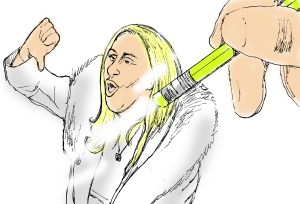 Guess what’s going on with CPAC after its pious leader has been credibly accused of grabbing them by the balls? Have we finally rid our country of the Hoedown of Hate? This is from New York Magazine and Ben Jacobs.
  I’m ending on a different note. The world is a better place because of Tiny Turner. She saved my life. She gave me the strength to leave an abusive relationship, and her mantra led me to my Buddhist path even though we belong to different sects. She was not only the Queen of Rock and Roll but the Queen of many hearts. I saw this story and had to share it.
 peej
peej Carissa
 bostonboomer
 dakinikat
 ecocatwoman
 mablue2
 Mama Lopez
 peggysue22
 quixote
 skydancingguestblogger
 Mona (aka Wonk the Vote)



 Sky Dancing
Recent Comments