
Friday Reads: The Right to Vote is Essential to Addressing the Issues of Our Time
Posted: December 17, 2021 Filed under: Bread and Roses, The Biden/Harris Administration, U.S. Economy, Voter Ignorance, Voting Rights, Voting Rights and Voter Suppression, Women's Rights, worker rights 19 Comments
Marc Chagall – Saint-Paul de Vance at Sunset, 1977
Good Day Sky Dancers!
I hope your week went well and your weekend goes better! I think I’m fully moved into my new phone and zapped then returned the old one. I’m about to start switching over to the new computer tomorrow. I just have a few more adulting things to do and I, fortunately, don’t need the camera and mic until Sunday.
American Life is so abnormal that I am really glad that I don’t have to drag myself into a classroom until January. I’ve dealt with teaching far worse economies and financial markets so that’s not the challenge. Part of me is just bugged by the fact I can’t depend on any American to do the right thing in this latest surge of Pandemic. Indeed, I’m actually thinking I may be back on Zoom instead of behind a podium next year. I think our economy is looking resilient and the financial markets are functional. What I think is dysfunctional is the way America does business. That’s the model that doesn’t work. It’s especially not working now. The extreme nature of the American ideological take on Capitalism is causing all kinds of things just to not work.
Then, there’s the weather situation which was elucidated in an article in The Guardian that BB posted yesterday. We’re not just experiencing extreme weather. It’s extreme and unique. This week we had temperatures never reported before in December in places like St. Paul. We continue to have severe thunderstorms and tornadoes in the midwest in December. These records are not only record-setting. These instances are making records because their occurences are unknown to us in modern times. Between the weather and the global pandemic, we need to strengthen and address flaws in our institutions before it all kills nearly everything.

Marc Chagall, Bouquets de Lilas a Saint-Paul (Bouquets of Lilacs at Saint-Paul), 1978
I do want to address the new push to reinstate and further Voting Rights and why it’s so important. First, I want to address what I’ve said above by sharing this Article in VOX by Anna North. “The world as we know it is ending. Why are we still at work? From the pandemic to climate change, Americans are still expected to work no matter what happens.”
It’s a good question to ask and it’s being asked by the workers at Kellogg’s including the one I spent my teen years viewing out school windows and those of my house on the hill. The plant in Omaha is way across on another hill where you can always see the big ol’ red Kellogg’s signature on the building. My thought was always the same. I’m never going to put myself in a place where I have to endlessly and mindlessly drop trinkets in cereal boxes for at least 8 hours a day. Yesterday, on MSNBC, I heard from Senator Sanders that some workers worked overtime for 100-120 consecutive days at Kellogg’s factories. We also learned that workers at the decimated candle factory in Kentucky were threatened with firing if they didn’t keep working. Are candles and dry cereal really worth this?
We didn’t learn anything from all the workers dropping dead from COVID-19 at meat processing plants? Now, we also find out there’s no shortage of truckers, it’s just how there’s a major difference between how independent truckers are paid and those that are union. It’s basically a problem of driver delays. Nonunion drivers get paid by the mile so they get assigned to places where they have to sit forever. Union drivers are paid by the hour. I’m frankly blessed not to have been pushed prematurely back into the classroom but that’s only because I’m semiretired and can say no without it threatening my work.
So, with that background, let’s read Anna North’s article.
For a moment in early 2020, it seemed like we might get a break from capitalism.
A novel coronavirus was sweeping the globe, and leaders and experts recommended that the US pay millions of people to stay home until the immediate crisis was over. These people wouldn’t work. They’d hunker down, take care of their families, and isolate themselves to keep everyone safe. With almost the whole economy on pause, the virus would stop spreading, and Americans could soon go back to normalcy with relatively little loss of life.
Obviously, that didn’t happen.
Instead, white-collar workers shifted over to Zoom (often with kids in the background), and everybody else was forced to keep showing up to their jobs in the face of a deadly virus. Hundreds of thousands died, countless numbers descended into depression and burnout, and a grim new standard was set: Americans keep working, even during the apocalypse.
Now it’s been nearly two years since the beginning of the pandemic — a time that has also encompassed an attempted coup, innumerable extreme weather events likely tied to climate change, and ongoing police violence against Black Americans — and we’ve been expected to show up to work through all of it. “I don’t think people are well,” says Riana Elyse Anderson, a clinical and community psychologist and professor at the University of Michigan’s School of Public Health. “We are moving along but we are certainly not well.”
For some Americans, working during the apocalypse is fatal — think of the transit workers who died from Covid-19 in 2020, or the Amazon warehouse workers killed by a tornado on December 10 in Illinois. “All disasters are workplace disasters for some people,” said Jacob Remes, a historian and the director of the Initiative for Critical Disaster Studies at New York University. For others, the effects are more of a slow burn; the chronic stress that comes with putting on a game face at work, day in and day out, as the world becomes ever more terrifying.
Of course, Americans haven’t all quietly accepted the demand that we work through the end times. Record numbers are quitting their jobs in search of higher pay and better conditions. After more than 20 months of being asked to keep showing up uncomplainingly while everything crumbles around them, people are demanding a more humane approach to work in the age of interlocking crises.
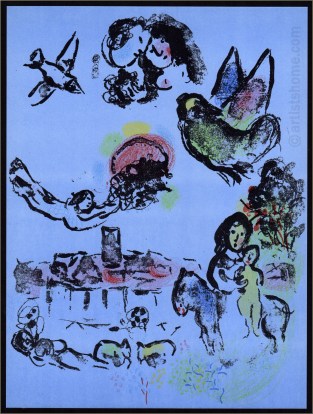
Marc Chagall: “Nocturne at Vence” 1963
Please read the full article.
So, the question is how do we get more humane treatment at work, access to educations, and childcare at a reasonable cost? Pharmaceuticals at a reasonable cost? Food at a reasonable cost? How about energy that doesn’t cost too much and kill us at the same time? Fewer wars? Actual customer service instead of automated checkouts and endless phone trees to get to someone that can actually help you? The business model these days is basically about where it was pre-union. Just jack up prices, lower service levels, overwork what employees you have, push a paperwork and surveillance atmosphere, then drive all the profits to the top where no one has to pay taxes on anything or can hide their money. This is not sustainable in this day and age. Where do we get some redress and control?
We should get it through our voter franchise and our democracy and representatives that deliver to voters and not just donors and radical bases. We’re losing all kinds of rights and none of them will return to us unless the majority of the democracy can vote easily and get fair elections, Can we get this done?
Not, when all roads lead to Joe Manchin and there’s a filibuster rule in the Senate for for basic civil, human, constitutional rights. These things should not be left to overturn by a radical minority.
From the AP: “Power of one: Manchin is singularly halting Biden’s agenda.” Let’s be real about this. It’s not just Biden’s Agenda it’s the people’s agenda as demonstrated by poll -after-poll. Joe Manchin is the perfect example of someone that pushes everything that’s not sustainable and mostly because his wealth depends on it and his power.
Sen. Joe Manchin settled in at President Joe Biden’s family home in Delaware on a Sunday morning in the fall as the Democrats worked furiously to gain his support on their far-reaching domestic package.
The two-hour-long session was the kind of special treatment being showered on the West Virginia senator — the president at one point even showing Manchin around his Wilmington home.
But months later, despite Democrats slashing Biden’s big bill in half and meeting the senator’s other demands, Manchin is no closer to voting yes.In an extraordinary display of political power in the evenly split 50-50 Senate, a single senator is about to seriously set back an entire presidential agenda.
Biden said in a statement Thursday night that he still believed “we will bridge our differences and advance the Build Back Better plan, even in the face of fierce Republican opposition.”
But with his domestic agenda stalled out in Congress, senators are coming to terms with the reality that passage of the president’s signature “Build Back Better Act,” as well as Democrats’ high-priority voting rights package, would most likely have to be delayed to next year.
Failing to deliver on Biden’s roughly $2 trillion social and environmental bill would be a stunning end to the president’s first year in office.
Manchin’s actions throw Democrats into turmoil at time when families are struggling against the prolonged COVID-19 crisis and Biden’s party needs to convince voters heading toward the 2022 election that their unified party control of Washington can keep its campaign promises.
This has been pushed to the back burner and now they have decided to shift to voting rights. Look at who’s on the catbird seat again.

Circus Dancer (Le Grand Cirque) 1968
From The Hill article in the above Tweet:
President Biden joined a Zoom call with Senate Democrats on Thursday to encourage them to pass voting rights legislation, as the chamber appears poised to leave for the year without a deal.
Sens. Tim Kaine (D-Va.) and Jon Tester (D-Mont.), who are both part of the group negotiating rules changes and voting rights, said that they had spoken with Biden about their efforts.
“Very positive. ‘Good work, guys. Keep at it,’” Kaine said about Biden’s message.
“‘Are you talking, are you taking it seriously, are you trying to get there?’ Yes. So he [was] encouraging us, thanking us and encouraging us,” the Virginia Democrat added.
Tester, asked about Biden’s general message, summed it up as the right to vote is “important for democracy.”
Those included on the call were Sens. Joe Manchin (D-W.Va.), Amy Klobuchar (D-Minn.), Angus King (I-Maine), Alex Padilla (D-Calif.), Jeff Merkley (D-Ore.), Raphael Warnock (D-Ga.), Senate Majority Leader Charles Schumer (D-N.Y.), Kaine and Tester, a source familiar told The Hill. Vice President Harris was also on the call.
The White House didn’t immediately respond to a request for comment on the call.
Biden’s call come as Senate Democrats are poised to wrap their work for the year without a deal on how to move voting rights legislation.
“We don’t have the votes right now to change the rules,” Sen. Chris Murphy (D-Conn.) told reporters after a closed-door caucus lunch, acknowledging the political reality that the party currently faces.
Democrats have been holding a flurry of behind-the-scenes meetings to try to come to a deal that unites all 50 Democrats on changing the Senate rules.
A group of Senate Democrats — Kaine, Tester and King — have been tasked with coming up with a proposal on how to alter the 60-vote legislative filibuster in a way that would allow voting rights legislation to move forward.
Republicans have blocked several voting rights and election bills, fueling calls from within the Senate Democratic caucus to change the rules.

Marc Chagall – le jardin d’Eden, 1980
Meanwhile, the Senate is going on holiday. Why can’t we all get paid and have work hours and benefits like them?
Long-simmering frustrations among prominent Black leaders appeared to be boiling over as they pressure President Joe Biden to do more to encourage the Senate to act. Progressive advocacy groups have revved up their pressure campaigns, fearing that time is running out to avert what they see as an existential threat to democracy. Leaders of the effort in the Senate, notably Sen. Raphael Warnock of Georgia, have held meetings with colleagues to find a path forward.
And moderates like Sens. Mark Warner of Virginia and John Hickenlooper of Colorado, said this week they’re ready to change the Senate rules to allow a vote on an election overhaul. But despite this movement, it may not be enough.
Manchin and Sinema are supportive of the Freedom to Vote Act, which would enshrine a series of voting-access guarantees across all states, and the John Lewis Voting Rights Advancement Act, which would impose additional limits on states with a history of discrimination. But neither supports a rule change to get around the 60-vote threshold that is blocking votes on those bills.
Manchin, who spoke to Warnock about the issue and left the Capitol shoulder-to-shoulder with him this week, told reporters he wants support from both parties before establishing new rules.
“All my discussions have been bipartisan, Republicans and Democrats. A rules change should be done to where we all have input in this rules change because we’re going to have to live with it,” he said.
That’s a problem: Republicans are extremely unlikely to sign off on any rule changes that would enable passage of voting rights legislation, which they staunchly oppose. A filibuster change through the regular process require a two-thirds vote, and even moderate Republicans say they’re not interested.
“I don’t see how. Unless Sen. (Chuck) Schumer tries to employ the nuclear option, rule changes require 67 votes,” Sen. Susan Collins, R-Maine, told NBC News, referring to the Senate majority leader. “I think the rules and traditions of the Senate have generally served us well, and I don’t see the need for rule changes.”
Sinema said through a spokesperson that she still opposes weakening the 60-vote rule to pass a voting bill.
And that Ladies and Gentlemen is how empires and democracies die!
Have a great weekend! I hope you enjoy the soothing colors of Marc Chagall!
What’s on your reading and blogging list today?
Thursday Reads: bell hooks (and other news)
Posted: December 16, 2021 Filed under: just because, morning reads | Tags: bell hooks, coronavirus pandemic, Covid-19, feminism, January 6 investigation, Omicron variant 13 CommentsGood Morning!!
Yesterday we lost bell hooks (born Gloria Watkins), feminist theorist, poet, and activist.
I’m ashamed to admit that I’ve never read her work, but I was impressed by what I read about hooks this morning. Dakinikat was inspired by her, so perhaps she will share her thoughts today and/or tomorrow.
Lucy Knight at The Guardian: bell hooks, author and activist, dies aged 69.
Gloria Jean Watkins, better known by her pen name bell hooks, has died aged 69.
Her niece Ebony Motley tweeted: “The family of @bellhooks is sad to announce the passing of our sister, aunt, great aunt and great great aunt.”
She also attached a statement, which said that “the family of Gloria Jean Watkins is deeply saddened at the passing of our beloved sister on December 15, 2021. The family honored her request to transition at home with family and friends by her side.”
The author, professor and activist was born in Hopkinsville, Kentucky in 1952, and published more than 30 books in her lifetime, covering topics including race, feminism, capitalism and intersectionality.
She adopted her maternal great-grandmother’s name as a pen name, since she so admired her, but used lowercase letters to distinguish herself from her family member. hooks’ first major work, Ain’t I a Woman?, was published in 1981, and became widely recognised as an important feminist text. It was named one of the 20 most influential women’s books in the last 20 years by Publishers Weekly in 1992.
She went on to write Feminist Theory: From Margin to Center in 1984, All About Love: New Visions in 2000 and We Real Cool: Black Men and Masculinity in 2004, continuing to draw on themes of feminism, race, love and gender.
Since 2004, she taught at Berea College in Kentucky, a liberal arts college that offers free tuition.
In 2016 hooks wrote in the Guardian that Beyoncé’s album Lemonade was “capitalist money-making at its best”, but criticised the notion of “freedom” depicted in the lyrics. “To truly be free,” wrote hooks, “we must choose beyond simply surviving adversity, we must dare to create lives of sustained optimal wellbeing and joy.”
“I want my work to be about healing,” she said in 2018 when she was inducted into the Kentucky Writers’ Hall of Fame. “I am a fortunate writer because every day of my life practically I get a letter, a phone call from someone who tells me how my work has transformed their life.”
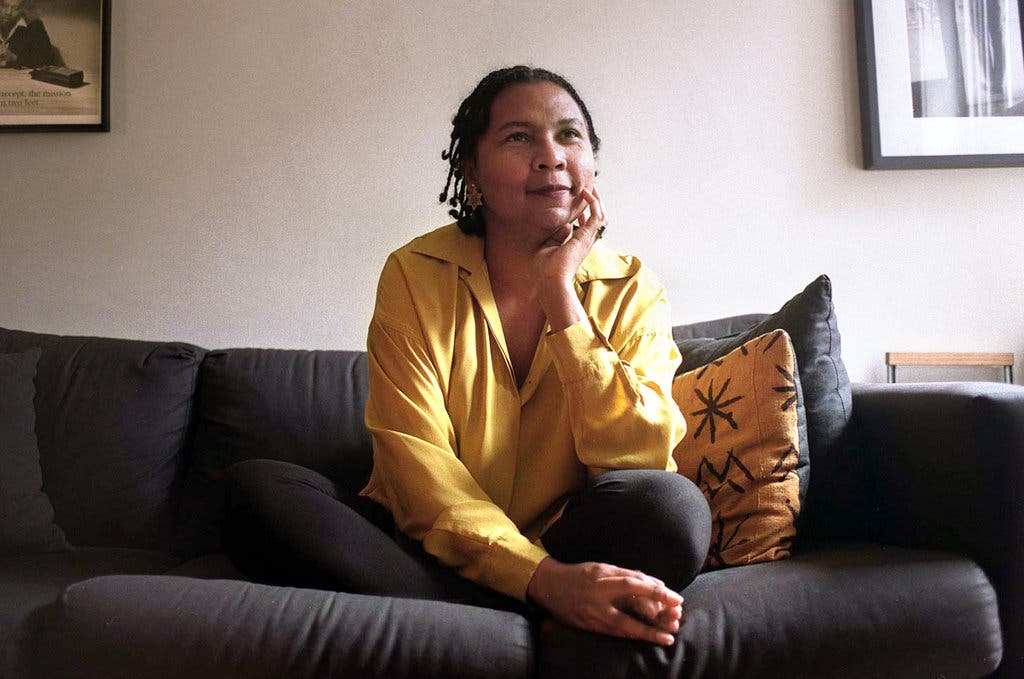 From The Literary Hub:
hooks’s first published work of theory, Ain’t I A Woman: Black Women and Feminism, was published when she was 29 but written when she was an undergraduate, launching a four-decade-long career of writing and teaching, with a focus on classroom accessibility. hooks’s extensive body of scholarship and poetry—that remains and will continue to remain relevant—was consistent in its generosity, emphasizing the importance of loving communities to challenging systemic inequalities. Hooks believed a “militant commitment to feminism” was not at all at odds with joy and humor; in fact, that love “is the necessary foundation enabling us to survive the wars, the hardships, the sickness, and the dying with our spirits intact.” As she told The New York Times in 2015,
“We cannot have a meaningful revolution without humor. Every time we see the left or any group trying to move forward politically in a radical way, when they’re humorless, they fail. Humor is essential to the integrative balance that we need to deal with diversity and difference and the building of community. For example, I love to be in conversation with Cornel West. We always go high and we go low, and we always bring the joyful humor in. The last talk he and I gave together, many people were upset because we were silly together. But I consider it a high holy calling that we can be humorous together. How many times do we see an African-American man and an African-American woman talking together, critiquing one another, and yet having delicious, humorous delight? It’s a miracle.”
hooks’s family said contributions and memorials can be made to the Christian County Literacy Council, which promotes reading for children, or the Museums of Historic Hopkinsville Christian County, where a biographical exhibit is on display.
From the New Yorker piece:
I came to her work in the mid-nineties, during a fertile era of Black cultural studies, when it felt like your typical alternative weekly or independent magazine was as rigorous as an academic monograph. For hooks, writing in the public sphere was just an application of her mind to a more immediate concern, whether her subject was Madonna, Spike Lee, or, in one memorably withering piece, Larry Clark’s “Kids.” She was writing at a time when the serious study of culture—mining for subtexts, sifting for clues—was still a scrappy undertaking. As an Asian American reader, I was enamored with how critics like hooks drew on their own backgrounds and friendships, not to flatten their lives into something relatably universal but to remind us how we all index a vast, often contradictory array of tastes and experiences. Her criticism suggested a pulsing, tireless brain trying to make sense of how a work of art made her feel. She modelled an intellect: following the distant echoes of white supremacy and Black resistance over time and pinpointing their legacies in the works of Quentin Tarantino or Forest Whitaker’s “Waiting to Exhale.”
Yet her work—books such as “Reel to Real” or “Art on My Mind,” which have survived decades of rereadings and underlinings—also modelled how to simply live and breathe in the world. She was zealous in her praise—especially when it came to Julie Dash’s “Daughters of the Dust,” a film referenced countless times in her work—and she never lost grasp of how it feels to be awestruck while standing before a stirring work of art. She couldn’t deny the excitement as the lights dim and we prepare to surrender to the performance. But she made demands on the world. She believed criticism came from a place of love, a desire for things worthy of losing ourselves to….
This has been a particularly trying time for critics who came of age in the eighties and nineties, as giants like hooks, Greg Tate, and Dave Hickey have passed. hooks was a brilliant, tough critic—no doubt her death will inspire many revisitations of works like “Ain’t I a Woman,” “Black Looks,” or “Outlaw Culture.” Yet she was also a dazzling memoirist and poet. In 1982, she published a poem titled “in the matter of the egyptians” in Hambone, a journal she worked on with her then partner, Nathaniel Mackey. It reads:
I enjoyed reading this piece from 2019 by Min Jin Lee in The New York Times: In Praise of bell hooks.
In 1987, I was a sophomore at Yale. I’d been in the United States for 11 years, and although I was a history major, I wanted to read novels again. I signed up for “Introduction to African-American Literature,” which was taught by Gloria Watkins, an assistant professor in the English department, and she was such a wonderful teacher that I signed up for her other class, “Black Women and Their Fiction.”
Gloria — as we were allowed to address her in the classroom — had a slight figure with elegant wrists that peeked out of her tunic sweater sleeves. She was soft-spoken with a faint Southern accent, which I attributed to her birthplace, Hopkinsville, Ky. She was in her mid-30s then but looked much younger. Large, horn-rimmed glasses framed the open gaze of her genuinely curious mind. You knew her classes were special. The temperature in the room seemed to change in her presence because everything felt so intense and crackling like the way the air can feel heavy before a long-awaited rain. It wasn’t just school then. No, I think, we were falling in love with thinking and imagining again….
I was 19 when I took hooks’s classes, and I was just becoming a young feminist myself. I had begun my study of feminism with Mary Wollstonecraft, Charlotte Perkins Gilman, Susan B. Anthony, Elizabeth Cady Stanton, Virginia Woolf, Betty Friedan and Gloria Steinem, among other white women, and perhaps, because I was foreign-born — rightly or wrongly — I had not expected that people like me would be included in their vision of feminist liberation. Women and men of Asian ethnicities are so often neglected, excluded and marginalized in the Western academy, so as a college student I’d no doubt internalized my alleged insignificance. bell hooks changed my limited perception.
Her book of theory taught me to ask for more from art, literature, media, politics and history — and for me, a Korean girl who had been born in a divided nation once led by kings, colonizers, then a succession of presidents who were more or less dictators, and for millenniums, that had enforced rigid class systems with slaves and serfs until the early 20th century, and where women of all classes were deeply oppressed and brutalized, I needed to see that the movement had a space for me.
What else is in the news? January 6 and the never ending pandemic.
January 6: Could it be that the investigation is really heating up?
David Rohde at The New Yorker: Is There a Smoking Gun in the January 6th Investigation?
William Saletan at Slate: The Chilling Lesson of Mark Meadows’ Text Messages.
The New York Times: Meadows and the Band of Loyalists: How They Fought to Keep Trump in Power.https://www.nytimes.com/2021/12/15/us/politics/trump-meadows-republicans-congress-jan-6.html
Kyle Cheney at Politico: The Jan. 6 puzzle piece that’s going largely ignored.
Kyle Cheney at Politico: Jan. 6 investigators mull whether Trump violated obstruction law.
CNN: Jim Jordan sent one of the texts revealed by January 6 committee.
The Washington Post: Role as Trump’s gatekeeper puts Meadows in legal jeopardy — and at odds with Trump.
Georgia Public Radio: Exclusive: More Georgia Secretary of State’s office officials interviewed by Jan. 6 committee.
The never ending pandemic
CNBC: Omicron symptoms could seem like a cold — but don’t underestimate this variant, experts warn.
AP via KTLA: U.S. faces a double coronavirus surge as omicron variant advances.
Ian Bogost at The Atlantic: I’m Starting to Give Up on Post-pandemic Life.
Yasmin Tayag at The Atlantic: Don’t Be Surprised When You Get Omicron.
Ed Yong at The Atlantic: America Is Not Ready for Omicron. The new variant poses a far graver threat at the collective level than the individual one—the kind of test that the U.S. has repeatedly failed.
Have courage and enjoy the present moment. There’s no telling what will happen next.
Cat Tuesday: January 6 News and Commentary
Posted: December 14, 2021 Filed under: Afternoon Reads, just because | Tags: January 6 Committee, January 6 insurrection, Jungle art, Mark Meadows 17 Comments
Cat, by Gabriel Alix, Haitian artist, 1979
Good Afternoon!!
The paintings in this post are examples of “jungle art” by Haitian artists. Dakinikat posted a couple of these yesterday and I really like them. They have a similar quality to “folk art.”
Last night the House January 6 committee met to vote on whether to refer Mark Meadows to the Justice Department for criminal contempt of Congress. The session was televised and generated quite a bit of news and commentary. The committee plans to hold televised meetings “in the first quarter” of 2022. When that happens, we could see more interest from the general public. I only hope the hearings start sooner rather than later.
Here’s the latest news on the hearing:
The Washington Post: House Jan. 6 committee votes to hold Meadows in contempt, details texts from Trump allies who wanted him to call off rioters.


Yesterday Fox News ignored the January 6 committee hearing.
The committee also met yesterday with the former commander of the DC National Guard, who has accused defense department officials of refusing to deploy the guard during the violent insurrection. CNN: Former DC National Guard commander meets with January 6 committee
Commentary on recent revelations about Mark Meadows and others about January 6
Jennifer Rubin at The Washington Post: Opinion: Mark Meadows has already established a coup plot. Do we care enough to save the republic?
Multiple pieces of evidence have emerged pointing to a deliberate effort to overthrow our democracy. And it is former White House chief of staff Mark Meadows who is key to piecing them all together.
Now, we just need to see if the country cares enough to hold all those involved accountable.
Start with the two memos from John Eastman, President Donald Trump’s lawyer, who sketched out a plan for Vice President Mike Pence to block Joe Biden from assuming the presidency. After making false accusations of election fraud, Eastman suggested Pence could simply refuse to accept electoral college votes when Congress met on Jan. 6 to certify the results, making Trump the “winner” or throwing it to the House where Republicans on a unit vote (one per each state delegation) might have crowned Trump president.
Two additional memos from Trump campaign counsel Jenna Ellis, one on Dec. 31 and one on Jan. 5, have also surfaced. Politico reports: “In the Jan. 5 memo, Ellis argued that key provisions of the Electoral Count Act — limiting Pence’s authority to affirm or reject certain electors — were likely unconstitutional. She concluded that Pence, while presiding over lawmakers’ counting of electors, should simply halt the process when their alphabetical proceeding reached Arizona.” This, of course, would be patently illegal. (Has her state bar been contacted?)
We also know of Trump’s efforts to force the Justice Department to declare the election was corrupt and “leave the rest to me” and Republicans in Congress. And we have seen the mind-boggling 38-page PowerPoint plan to conduct a coup, including a declaration of “national security emergency” that could halt the voting, if needed. As bizarre as the document was, even more bizarre are the alleged meetings that Meadows and lawmakers had with the plan’s author, none of whom had the common sense and loyalty to report it to the FBI.
The House select committee on the Jan. 6 insurrection, in its document release in advance of the contempt vote for Meadows’s failure to appear for his deposition, sets out a list of questions it would have asked Meadows. In doing so, they provided the outline of the coup plot:
Click the link to read the rest.
SV Date at HuffPost: Meadows’ ‘Protect Pro Trump People’ Email May Explain Military Reluctance To Deploy Troops.
An email authored by Donald Trump’s chief of staff in the run-up to the Jan. 6 assault on the U.S. Capitol may help explain military leaders’ reluctance to deploy troops that day: Doing so could have forced troops to choose between following the orders of their direct commanders or obeying the commander in chief of the United States armed forces.
Mark Meadows wrote that the National Guard would be deployed to “‘protect pro Trump people’ and that many more would be available on standby,” according to the resolution by the House committee investigating Jan. 6 that recommends referring criminal contempt of Congress charges against Meadows to the Department of Justice.
The resolution did not specify the recipient of that note or when it was sent.
Top military officials in the Trump administration’s final days have previously said they were concerned that Trump would try to use the military to remain in power. At the time, describing his goals through the end of Trump’s term, acting Secretary of Defense Chris Miller told associates “No military coup, no major war, and no troops in the streets,” according to the book “Betrayal,” by ABC’s Jon Karl.
Joint Chiefs of Staff Chairman Mark Milley also worried about a coup, and told colleagues that Trump had become “the classic authoritarian leader with nothing to lose,” according to the book “I Alone Can Fix It,” by Washington Post reporters Carol Leonnig and Philip Rucker.
One source familiar with the Jan. 6 committee’s work said the worry about troops potentially receiving “conflicting orders” ― one set via the non-political military chain of command, to protect the constitutional process, and the other from Trump himself, designed to let him retain power ― was a real concern in early January.
Read the rest at HuffPo.

Tigre, by Gabriel Aliz
Aaron Rupar at Public Notice: Unpacking the pro-coup PowerPoint that wound up in Mark Meadows’s emails.
Thanks to the work of the January 6 committee, the gaps in our knowledge of what happened in the weeks leading up to the insurrection are finally being filled. In fact, as I write this newsletter late Sunday, a major story just broke about a January 5 email from then-White House Chief of Staff Mark Meadows advising an unnamed person that the National Guard was on standby to “protect pro Trump people.”
That obviously sounds bad, but the extent to which then-President Trump tried to subvert the military to help him overturn his election loss (and thereby essentially end democracy in the US) remains somewhat shrouded in mystery. A White House document that surfaced as a result of the committee’s subpoena of Meadows, however, indicates the National Guard comment was more than idle chatter.
The document I’m referring to is a PowerPoint presentation that circulated around Trumpworld ahead of January 6 and was part of the emails Meadows turned over to the committee. And unlike the often dull PowerPoints you are I are familiar with from offices or academic settings, this one was basically a blueprint to a coup.
Some key details remain unknown — such as who authored the presentation and to what extent it embodied the White House’s thinking — but the man who circulated it around the White House, a retired US Army colonel named Phil Waldron, was influential enough to reportedly work alongside Rudy Giuliani, be in meetings with Trump, and brief multiple members of Congress about the contents of the PowerPoint ahead of January 6.
On Sunday I put together a Twitter thread sharing notable details from the 36-page document. You can check out the whole thing starting here. But to boil it down, it outlines a fantastical, fact-free, debunked conspiracy theory about China being behind a global conspiracy to get Donald Trump out of the White House, then cites that conspiracy as a pretext for Trump to throw out the election results….
The details of the conspiracy aren’t really important. A flood of official investigations and lawsuits (not to mention a number of former Trump administration officials) have affirmed time and time again that Biden’s win was fair, and nothing in the PowerPoint will persuade anyone who isn’t already guzzling the MAGA Kool-aid. All that matters is it provided a cover story for then-Vice President Mike Pence to take extraordinary steps to prevent the election from being certified.
Read the rest at the link and do check out Rupar’s twitter thread.

By Fritz Philemon
Finally, check out Hunter Walker’s new piece at Rolling Stone: Two Jan. 6 Organizers Are Coming Forward and Naming Names: ‘We’re Turning It All Over’
Two key organizers of the main Jan. 6 rally in Washington, D.C. are coming in from the cold.
Dustin Stockton and Jennifer Lynn Lawrence are set to testify next week before the House select committee investigating the attack on the U.S. Capitol. The pair will deliver testimony and turn over documents, including text messages, that indicate the extensive involvement members of Congress and the Trump administration had in planning the House challenge to certifying Biden’s election and rally near the White House where Donald Trump spoke — efforts that ultimately contributed to a massive and violent attack on the Capitol.
Among the documents the couple is providing are conversations they had with staffers and members of Congress as they planned the main rally that took place on the White House Ellipse that day. Stockton described these discussions as largely logistical and focused on planning the members’ participation in objections to the electoral certification on the House floor and various events that were staged to protest against the election. They include Instagram messages Lawrence exchanged with Rep. Madison Cawthorn (R-N.C.) as she tried to get him to speak at the Ellipse rally. Cawthorn, whose office did not immediately respond to a request for comment, ultimately appeared onstage at that event.
“We’re turning it all over and we’ll let the cards fall where they may,” Stockton says.
It’s the latest revelation from the couple, veteran activists who have spent the better part of a decade specializing in staging political stunts while working for conservative activist groups, Republican campaigns, and Trump’s on-again-off-again strategist Steve Bannon. Stockton and Lawrence were members of the team that led the nationwide “March for Trump” bus tour, which ended with the Jan. 6 rally at the White House Ellipse. In recent weeks, Stockton and Lawrence have participated in an extensive series of interviews with Rolling Stone revealing what they knew about the day.
The pair were the sources for a story that was published in late October, when they said members of Congress were involved in planning Trump’s efforts to overturn the election and the Jan. 6 Ellipse rally. They claimed one of these lawmakers, Rep. Paul Gosar (R-Ariz.), suggested the possibility Trump could get them a “blanket pardon” in an unrelated ongoing investigation if they helped protest the election. (Gosar later suggested that story was “categorically false and defamatory.”) Stockton and Lawrence also say they were told that Trump’s former chief of staff, Mark Meadows, had communicated with the organizers and was warned about concerns of potential violence.
Nothing in the documents viewed by Rolling Stone or the couple’s statements revealed any planning for, or coordination with, the violent attack on the Capitol by Trump supporters.
I’ll post a few more stories in the comment thread and I hope you will too.
Monday Reads: Deep State Doo-Doo Edition
Posted: December 13, 2021 Filed under: January 6 Committee, Mark Meadows, The Insurrection Fallout 16 Comments
Henri Rousseau, The Equatorial Jungle, 1909, National Gallery of Art, Washington
Good Day Sky Dancers!
I’m having one of those bad tech weeks. After replacing and updating my cellphone, I started work only to find that my camera no longer works, which isn’t a good situation for a professor still highly reliant on Zoom. The internal camera and mic are messed up completely. Fortunately, an old headset can get me talking, but I just had to order a new computer. I tried resetting, and no dice. So, I’m in for a long period of installing and updating. Not exactly what I had planned for the end-of-year budget or festivities. I’m a nervous wreck from all this, and we’ll see what I’m up to doing today.
So, is it just me, or is it getting to be a Jungle out there?
The January 6 committee is voting this week to indict Mark Meadows, who renigged on his cooperation after incriminating himself. This is from Politico: “Meadows Jan. 5 email indicated Guard on standby to ‘protect pro-Trump people,’ investigators say. The context for the message is unclear, but it comes amid scrutiny of the Guard’s slow response to the Jan. 6 violence at the Capitol.”
It’s unclear who Meadows, the former White House chief of staff to Donald Trump, relayed the information to or whether it was the result of any insight provided by the Defense Department. But the exchange is of high interest to congressional investigators probing whether Trump played a role in the three-hour delay between the Capitol Police’s urgent request for Guard support and their ultimate arrival at the Capitol, which had been overrun by pro-Trump rioters. The comment also aligns with testimony from former Defense Secretary Christopher Miller, who said that in a Jan. 3 conversation with Trump, the then-president told him to “do whatever was necessary to protect the demonstrators that were executing their constitutionally protected rights.”
The description of the message is part of a 51-page document released Sunday by the select panel a day before it is set to vote to hold Meadows in contempt of Congress. The full House is expected to vote to hold Meadows in criminal contempt of Congress on Tuesday.
In other messages described by the committee, Meadows appears to have asked members of Congress to help connect Trump with state lawmakers shortly after his defeat in November.
“POTUS wants to chat with them,” Meadows said, according to documents obtained by the Jan. 6 committee and described publicly Sunday evening.
The messages also describe numerous contacts with members of Congress about Trump’s efforts to recruit state lawmakers and encourage them to help overturn the election results. They also included questions about Meadows’ exchanges with members of Congress as they pressed him urgently to issue a statement telling rioters on Jan. 6 to exit the Capitol.

Henri Rousseau, Tiger in a Tropical Storm, 1891, National Gallery, London.
Luke Broadwater–writing for The New York Times–has this to say.
The House committee investigating the Jan. 6 attack on the Capitol released a report on Sunday that laid out its case for a contempt of Congress charge against Mark Meadows, the chief of staff to former President Donald J. Trump, presenting evidence of Mr. Meadows’s deep involvement in the effort to overturn the 2020 presidential election.
In the 51-page document, the committee said it wanted to question Mr. Meadows about an email he had sent a day before the attack advising that the National Guard would be used to defend Trump supporters. The panel said it also wanted to ask him about an exchange with an unnamed senator about rejecting electors for Joseph R. Biden Jr.
Mr. Meadows had been cooperating with the committee’s investigation, but he refused to appear for a scheduled deposition last week or to turn over additional documents, citing Mr. Trump’s assertion of executive privilege. The committee, which is controlled by Democrats, is slated to vote on Monday to recommend a contempt of Congress charge against him for his refusal to cooperate with its subpoena. That charge carries a penalty of up to a year in jail.
Before coming to loggerheads with the panel, Mr. Meadows provided more than 9,000 pages of records to the committee. The information they contained raised additional questions, the panel said.
Among the emails and text messages that Mr. Meadows turned over were the following, the panel said:
A Nov. 7 email that discussed an attempt to arrange with state legislators to appoint slates of pro-Trump electors instead of the Biden electors chosen by the voters. Mr. Meadows’s text messages also showed him asking members of Congress how to put Mr. Trump in contact with state legislators.
Text messages Mr. Meadows exchanged with an unidentified senator in which he recounted Mr. Trump’s view on Vice President Mike Pence’s ability to reject electors from certain states. Mr. Trump “thinks the legislators have the power, but the VP has power too,” Mr. Meadows wrote.
A Jan. 5 email in which Mr. Meadows said the National Guard would be present at the Capitol on Jan. 6 to “protect pro Trump people.”
Emails from Mr. Meadows to Justice Department officials on Dec. 29, Dec. 30 and Jan. 1 in which he encouraged investigations of voter fraud, including allegations already rejected by federal investigators and courts.
Text messages Mr. Meadows exchanged with members of Congress as violence engulfed the Capitol on Jan. 6 in which lawmakers encouraged him to persuade Mr. Trump to discourage the attack, as well as a text message sent to one of the president’s family members in which Mr. Meadows said he was “pushing hard” for Mr. Trump to “condemn this.”
Text messages reflecting Mr. Meadows’s private skepticism about some of the wild public statements about allegations of widespread election fraud and compromised voting machines that were put forth by Sidney Powell, a lawyer working with Rudolph W. Giuliani, Mr. Trump’s personal lawyer.
The committee also said it had a number of questions prompted by Mr. Meadows’s new book, “The Chief’s Chief,” and cited it as evidence that his refusal to testify was “untenable.”
This is from The Raw Story link in the tweet above.
Donald Trump’s allies — including Meadows, his White House chief of staff — were frantically covering up the former president’s reaction to the Jan. 6 insurrection as the mob was attacking police and invading the U.S. Capitol, and Washington Post columnist Greg Sargent said the report shows some of the topics Meadows was afraid to testify about.
“We know from press accounts, such as this Post report, that Trump watched the violent assault unfold on TV and ignored many frantic pleas that he step in,” Sargent wrote. “One Trump adviser told The Post that Trump was enjoying the spectacle of his followers fighting on his behalf.”

3 Black Cats And Nature By Pierre Maxo
Every day we learn about how depraved and corrupt the Republican party has become. Juan Williams has this to say in The Hill: “The GOP is an anti-America party”.
The problem is with voters willing to back Trump.
Those are people who value slogans more than the ability to govern the country.
That means ambitious GOP politicians are right to imitate Trump’s tactics of inciting outrage and demeaning anyone, including Republicans, who stand outside the cult.
It also means that Republicans are indifferent to the corruption in the Trump White House that has been detailed in numerous books.
Those books agree Trump tried to overturn the presidential election.
Those books say he bullied his own vice president and tried to intimidate Justice Department officials.
This is contemptible. Yet today’s Republican voters still tell pollsters they will support Trump for the party’s 2024 nomination.
The self-destruction of the party is evident in the GOP’s voting record in Congress.
In the last year, every congressional Republican voted against a bill to help the country recover from the economic damage caused by COVID-19.
Republicans also overwhelmingly opposed an infrastructure bill favored by most Americans.
Now the GOP is opposed to President Biden’s Build Back Better bill to lower taxes for the middle class and help with child care.
Last month, Senate Minority Leader Mitch McConnell (R-Ky.) apparently shrugged off a question about a Republican agenda to help the country move forward.
A donor at a private dinner asked McConnell about what kind of platform the GOP might actually propose, according to Axios.
McConnell, Axios reported, replied by essentially dismissing the idea that the GOP should even consider doing such a thing, when it could instead make hay just by hitting Democrats.
Republicans in the Senate, led by Utah’s Mike Lee, recently threatened a government shutdown to oppose the Biden administration’s mandate that larger businesses must require their employees to either get vaccinated or have weekly COVID-19 tests.
Opposing a mandate for vaccination is legitimate. Allowing a deadly vaccine hesitancy to grow among Republicans to score political points is worthy of scorn.
That indifference to public good leads to the conclusion that the GOP wants to collapse faith in government to gain support for a coup attempt in 2024.
Well, that about sums it up!
I’m really not sure what to do about these two. It is dangerous performance art or something worse.

Self Portrait with Monkeys by Frida Kahlo, 1943
David Leonhardt writes this for the New York Times: “America’s Anti-Democratic Movement. It’s making progress.”
The main battlegrounds are swing states where Republicans control the state legislature, like Arizona, Georgia, Michigan, Pennsylvania and Wisconsin.
Republicans control these legislatures because of both gerrymandered districts and Democratic weakness outside of major metro areas. (One way Democrats can push back against the anti-democratic movement: Make a bigger effort to win working-class votes.) The Constitution lets state legislatures set the rules for choosing presidential electors.
“None of this is happening behind closed doors,” Jamelle Bouie, a Times columnist, recently wrote. “We are headed for a crisis of some sort. When it comes, we can be shocked that it is actually happening, but we shouldn’t be surprised.”
Here is an overview of recent developments:
I still don’t understand how working-class voters–used in this sense–don’t seem to include women or people of color but anyway, check out the actions from those states. It’s an appalling set of anti-democratic laws and moves.

Gabriel Alix (1930-1998)
Les tigres
Here’s an interesting read from Eleanor Eagan writing for American Prospect: “The Trump Officials Still Running Biden’s Justice Department.”
We are rapidly approaching the one-year anniversary of January 6, and Attorney General Merrick Garland has yet to give any sign that his Justice Department is independently investigating former President Trump and his fellow instigators. This is, by far, Garland’s most high-profile failure when it comes to accountability for the prior administration, one that more observers have begun to notice. But it is not the only one.
The Revolving Door Project has identified two Trump political officials who remain in senior career roles at the Department of Justice, in the Federal Programs Branch and the solicitor general’s office, after being hired under suspicious circumstances. From their perches, both have played a part maintaining Trump’s legacy in the courts. Their presence and power point to the danger of Garland’s refusal to “look backward.”
The first official is Alexander Haas, the current director of the DOJ Civil Division’s Federal Programs Branch. Haas joined the department in January 2017, the first month of the Trump administration. He nominally left his job at law firm King & Spalding for a career position as an assistant U.S. attorney in the DOJ. Just one month later, however, he already had a new gig as chief of staff and special counsel to Acting Assistant Attorney General for the Civil Division Chad Readler.
It’s not just the timing that’s unusual here. Almost without exception, chiefs of staff to assistant attorney generals are political appointees. On paper, however, Haas appears to have remained an assistant U.S. attorney, with his stint in the Civil Division front office a temporary detail. If he was going to be transferred into a political role so quickly, why was he not hired into that position to begin with? Was there some reason it was preferable that he be hired as a career official?
Whatever the category listed on his HR paperwork, Haas was indistinguishable from any other political appointee. At the Trump DOJ, he worked closely with Readler—a man whom the Alliance for Justice described as exhibiting a “diehard advocacy for right-wing causes” when he was subsequently nominated and confirmed to a seat on the Sixth Circuit Court of Appeals—on some of the Trump administration’s most horrendous cases. For example, in Garza v. Hargan, Haas defended the Trump administration in a case challenging the federal government’s refusal to allow a 17-year-old ICE detainee access to an abortion.
In 2019, Haas became the director of the Federal Programs Branch, a career position. But while his political title was gone, his actions did not follow. In 2020, Haas defended the Trump administration’s efforts to truncate the 2020 census, a move that civil rights groups labeled a backdoor effort at disenfranchisement. Haas also put his name to a Justice Department complaint against Melania Trump’s former adviser Stephanie Winston Wolkoff for publishing her tell-all memoir. Legal experts decried the filing as “legally unenforceable” and “a complete abuse of the Justice Department’s finite resources.”
That ain’t good! Go figure things out Ms. VEEP.
So, that’s out for me! What’s on your reading and blogging list today?
Friday Reads: Oh, I wish I wasn’t in the Land of Surreality
Posted: December 10, 2021 Filed under: abortion rights, Capitalism 3.0, Civil Liberties, Civil Rights, court rulings, COVID19, Feminists, inflation 21 Comments
Hi Sky Dancers!
I really had hoped that last year’s elections and dump of Trump would calm the country down. I can tell you that my street is already seeing infrastructure improvements. I lost water all day long while contractors cut out a huge–and I mean huge–old steel sewer pipe out of the street to replace it with PVC. This will be at least a year-long process. This pipe was put in the street before my parents were born. There are many more like it to be replaced.
I can only think about these pipes being formed in someplace where there were thousands of real steelers working up North. They were likely put on trains that could reach a place where they could be floated on barges to their home down here. That pipe was at least 20 feet underground and was large enough for a good-sized man to crawl through it using hands and knees. I’m now curious about what kind of cranes they had back in the day because that pipe likely weighed a lot. So, think back to those years where the dawn of the last century met science, technology, and progress. That picture of pipes placed in Boston in 1909 looked a lot like the one they pulled out of the cross street on my block.

I bugged the crew with so many questions that they offered to get me sloggers and let me watch while they used an iron saw to take it apart. I unfortunately, had to teach but this little girl that loved her building sets and her sandbox dump trucks would have been there in a minute if I could have.
So, I have messy, smelly, life-interrupting proof of infrastructure projects! Why do I feel so little progress is being made to get out of the mess the Republicans have made of this country this century? Well, let me share some headlines with you.
This is from David Leonhardt writing for The New York Times: “Covid Malaise. Why do Americans say the economy is in rough shape? Because it is.” I’m writing this as I watched 3 neighbors get booted from their apartments with a 5-day notice after the release of the evictions block by the Federal Government. I’m also aware that there was money available to their landlords and it appears a bunch of small landlords are booting their tenants and using the money to upgrade the property to seek higher rents instead of keeping renters in place. Yes, I’m just full of anecdotal evidence today!
Offices remain eerily empty. Airlines have canceled thousands of flights. Subways and buses are running less often. Schools sometimes call off entire days of class. Consumers waste time waiting in store lines. Annual inflation has reached its highest level in three decades.
Does this sound like a healthy economy to you?
In recent weeks, economists and pundits have been asking why Americans feel grouchy about the economy when many indicators — like G.D.P. growth, stock prices and the unemployment rate — look strong.
But I think the answer to this supposed paradox is that it’s not really a paradox: Americans think the economy is in rough shape because the economy is in rough shape.
Sure, some major statistics look good, and they reflect true economic strengths, including the state of families’ finances. But the economy is more than a household balance sheet; it is the combined experience of working, shopping and interacting in society. Americans evidently understand the distinction: In an Associated Press poll, 64 percent describe their personal finances as good — and only 35 percent describe the national economy as good.
There are plenty of reasons. Many services don’t function as well as they used to, largely because of supply-chain problems and labor shortages. Rising prices are cutting into paychecks, especially for working-class households. People spend less time socializing. The unending nature of the pandemic — the masks, Covid tests, Zoom meetings and anxiety-producing runny noses — is wearying.
While some of these disruptions are minor inconveniences, others are causing serious troubles. The increase in social isolation has harmed both physical and mental health. Americans’ blood pressure has risen. Fatal drug overdoses have soared, with a growing toll among Black Americans. A report this week from the surgeon general found that depression, anxiety, impulsive behavior and attempted suicides had all risen among children and adolescents.
“It would be a tragedy if we beat back one public health crisis only to allow another to grow in its place,” Dr. Vivek Murthy, the surgeon general, wrote.
Schools are a particular source of frustration. Last year, the closure of in-person school caused large learning losses. This year, teachers have the near-impossible task of trying to help students make up for lost time, which has left many teachers feeling burned out.
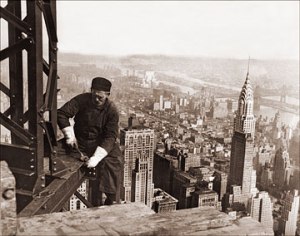
Worker building New York’s Empire State Building circa 1930s.
I feel like I’m living in a developing country. Inflation is rising. It’s about at levels it was during the Reagan years though. It’s nowhere near peak Nixon level. This is from Jeff Cox at CNBC. Actually, when a country is growing, inflation is not unusual. Nor is it unusual when a country is reeling from a shock like the Covid-19 epidemic that was badly mishandled by the Trump Regime.
Inflation accelerated at its fastest pace since 1982 in November, the Labor Department said Friday, putting pressure on the economic recovery and raising the stakes for the Federal Reserve.
The consumer price index, which measures the cost of a wide-ranging basket of goods and services, rose 0.8% for the month, good for a 6.8% pace on a year over year basis and the fastest rate since June 1982.
Excluding food and energy prices, so-called core CPI was up 0.5% for the month and 4.9% from a year ago, which itself was the sharpest pickup since mid-1991.
The Dow Jones estimate was for a 6.7% annual gain for headline CPI and 4.9% for core.
There is a difference between what’s called the headline CPI and the core CPI. Headline inflation is the total inflation in an economy. … It is different from core inflation, which excludes food and energy prices while calculating inflation. Food and energy are not included in core inflation because their prices are volatile. It makes headline inflation a more volatile measure than core inflation. The core is a more reliable measure of underlying price trends.
So, now this is looking less of a temporary surge which means policymakers will have to make decisions. This is especially relevant for the Federal Reserve Bank Board of Governors supported by information from its economists. This is from The Washington Post. and Rachel Siegel.
In time, it’s possible that lower gas and energy prices or unclogged supply chains can help steer prices back down to more sustainable levels. But there’s no telling when that will happen, and in the meantime, businesses and consumers could start to change their expectations of what’s still to come.
“Yes, inflation can abate, but what [policymakers] care about is, is it significant or insignificant to peoples’ lives and decision-making?” said Diane Swonk, chief economist at Grant Thornton. “This is inflation that’s not likely to be insignificant anytime soon, and that’s a problem.”
Financial markets appeared to shrug off the news, with the Dow Jones industrial average and the tech-heavy Nasdaq up slightly on Friday.
Inflation has emerged as a top political concern for voters ahead of the 2022 midterms, especially because the cost of food or gas is often a test for how people perceive the economy.
Republicans criticized the high inflation numbers, blaming Democrats’ stimulus as the culprit and warning against future legislative packages.
The problem with Republican criticism is that Trump’s massive tax cuts and his original Covid-19 payments are as responsible for this as anything the Biden administration has done to date. Most of those funds have yet to be circulated and after all, we’re still on the Trump Budget since it’s stalled in the Senate.

Progress in the early 20th century also included giving women the right to vote. Here’s a list of 50 countries and when women achieved this. You’ll notice the US was behind many European countries.
What is most unsettling to me are the continuing stories about the ongoing Trump coup. So little appears to be happening to punish the culprits in charge of the Trump Regime. This headline would be so Hollywood if it wasn’t real. From Reuters: “Kanye West publicist pressed Georgia election worker to confess to bogus fraud charges.”
Weeks after the 2020 election, a Chicago publicist for hip-hop artist Kanye West traveled to the suburban home of Ruby Freeman, a frightened Georgia election worker who was facing death threats after being falsely accused by former President Donald Trump of manipulating votes. The publicist knocked on the door and offered to help.
The visitor, Trevian Kutti, gave her name but didn’t say she worked for West, a longtime billionaire friend of Trump. She said she was sent by a “high-profile individual,” whom she didn’t identify, to give Freeman an urgent message: confess to Trump’s voter-fraud allegations, or people would come to her home in 48 hours, and she’d go to jail.
Freeman refused. This story of how an associate of a music mogul pressured a 62-year-old temporary election worker at the center of a Trump conspiracy theory is based on previously unreported police recordings and reports, legal filings, and Freeman’s first media interview since she was dragged into Trump’s attempt to reverse his election loss.
Kutti did not respond to requests for comment. Her biography for her work at the Women’s Global Initiative, a business networking group, identifies her as a member of “the Young Black Leadership Council under President Donald Trump.” It notes that in September 2018, she “was secured as publicist to Kanye West” and “now serves as West’s Director of Operations.”
Oh, and then there’s this:
Why is CNN trying to keep Trump in the headlines? Is it really because of the coup?
Nothing is more symbolic than this picture. Guess who didn’t wear a mask to Bob Dole’s funeral?
So, I’m going to putting some headlines up about the signaling the Supremes seem to be doing on taking down Roe V. Wade next. This makes me shake with anger. Women are headed back to chattel status on a state-by-state basis.
I am officially tired of this shit. What will the backlash from this be? I’m not sure how much more I got left in me.
Have a good, peaceful weekend.
What’s on your blogging and reading list today?

 peej
peej Carissa
 bostonboomer
 dakinikat
 ecocatwoman
 mablue2
 Mama Lopez
 peggysue22
 quixote
 skydancingguestblogger
 Mona (aka Wonk the Vote)



 Sky Dancing
Recent Comments