
Tuesday Reads: Election Day
Posted: November 2, 2021 Filed under: morning reads | Tags: Annissa Essaibi-George, Boston Mayor, Brad Raffenspurger, Glenn Youngkin, Michelle Wu, National Guard, Ruth Bader Ginsburg, SCOTUS, Terry McAuliffe, Virginia Governor 31 CommentsGood Morning!!

MIchelle Wu and Annissa Essaibi-George are running for Mayor of Boston.
Today is election day in states across the country. The is the deadlocked race between gubernatorial candidates Terry McAuliffe and Glenn Youngkin is getting the most attention, but there’s also a historic election in Massachusetts, where a woman of color most likely will be elected Mayor of Boston today. 7News Boston: Boston voters heading to the polls for historic mayor’s race.
BOSTON (AP) — Boston voters are heading to the polls Tuesday not only to choose between Democrats Michelle Wu and Annissa Essaibi George for mayor, but to mark a turning point in the city’s history, for the first time electing a woman and person of color to helm Boston.
The choice of Wu and Essaibi George for the top political post is just the latest marker of how much the Boston of not-so-long-ago — known for its ethnic neighborhoods, glad-handing politicians and mayors with Irish surnames — is giving way to a new Boston.
Throughout its long history, Boston has previously only elected white men as mayor.
Despite the groundbreaking nature of the candidates, the campaign has turned on familiar themes for the city’s 675,000 residents, including public education, policing, public transportation and the skyrocketing cost of housing.
Among the newer issues facing Boston residents is the effect of climate change on the costal metropolis.
One of the thorniest issues in the campaign is whether Boston should pursue a form of rent control or rent stabilization, something supported by Wu and opposed by Essaibi George. In 1994, Massachusetts voters narrowly approved a 1994 ballot question banning rent control statewide.
Both candidates have spent the final hours of the campaign urging their voters to get to the polls.
Nearly 40,000 ballots have already been cast in early voting. Democratic Secretary of the Commonwealth William Galvin told reporters Monday he estimates about 135,000 ballots will be cast in Boston — about 30% of the city’s 442,000 registered voters.
Both candidates are children of immigrants.
The 36-year-old Wu, whose parents immigrated to the U.S. from Taiwan, grew up in Chicago and moved to Boston to attend Harvard University and Harvard Law School.
Essaibi George, 47, a lifelong Boston resident and former public school teacher, describes herself as a first-generation Arab-Polish American. Her father was a Muslim immigrant from Tunisia. Her mother, a Catholic, immigrated from Poland.
The contest could also be a test of whether voters in a city long dominated by parochial neighborhood politics are ready to tap someone not born and raised in the city like Wu, who grew up in Chicago.
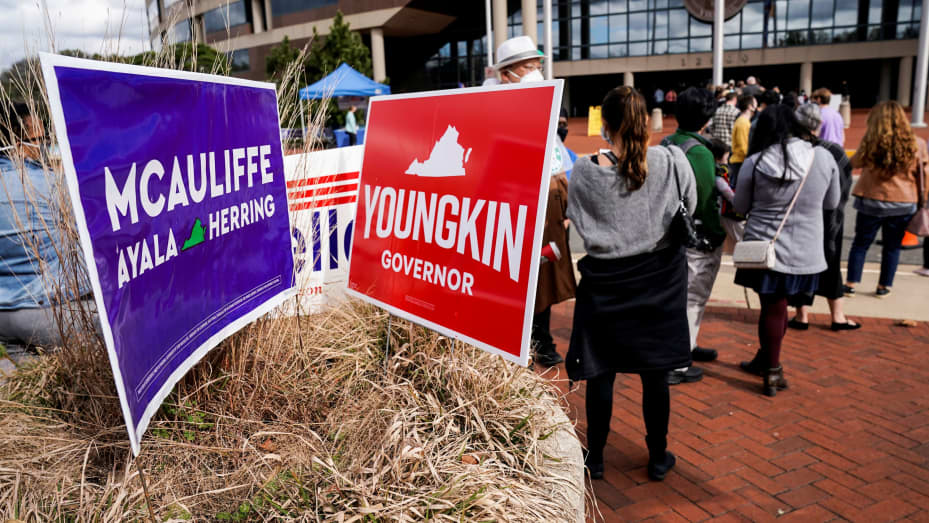 In Virginia, McAuliffe and Youngkin are running neck and neck, and observers are speculating about how the result with impact the midterm elections in 2022. Bloomberg: Virginia Race Offers Hint of 2022 Fight to Control Congress.
Virginia’s gubernatorial contest Tuesday between Terry McAuliffe and Glenn Youngkin will offer the clearest picture yet of how much momentum Republicans have heading into 2022 elections that will decide control of Congress, while President Joe Biden struggles to advance his agenda in Washington.
Polls show the Virginia race essentially deadlocked as Democrat McAuliffe’s lead during the summer evaporated along with Biden’s approval ratings. In the final weeks of the campaign, Republican Youngkin, the former co-chief executive officer of the Carlyle Group Inc., has capitalized on voter frustration with national Democrats and local education issues.
The election comes a day after Senator Joe Manchin, a moderate Democrat from West Virginia, slammed the door on Biden’s wish for Congress to take quick action on his $1.75 trillion tax and spending package, the centerpiece of his presidential campaign. Virginia, a state Biden won by 10 percentage points a year ago, is a bellwether for the Congressional midterms. A McAuliffe loss would be the biggest omen for Democratic prospects to hold onto their slim majority in Congress.
Longtime Democratic strategist Jesse Ferguson said that Virginia is often an “early-warning system” for the party in power as to how it will do in the midterms, especially because of the diversity of the state, which includes rural, suburban and urban areas; military, farming and technology workers; and White, Hispanic and Black voters.
“Virginia allows you for a dry run of the arguments you’re going to make in the midterms, to see how different parts of the electorate respond,” Ferguson said.
Read more at the link.
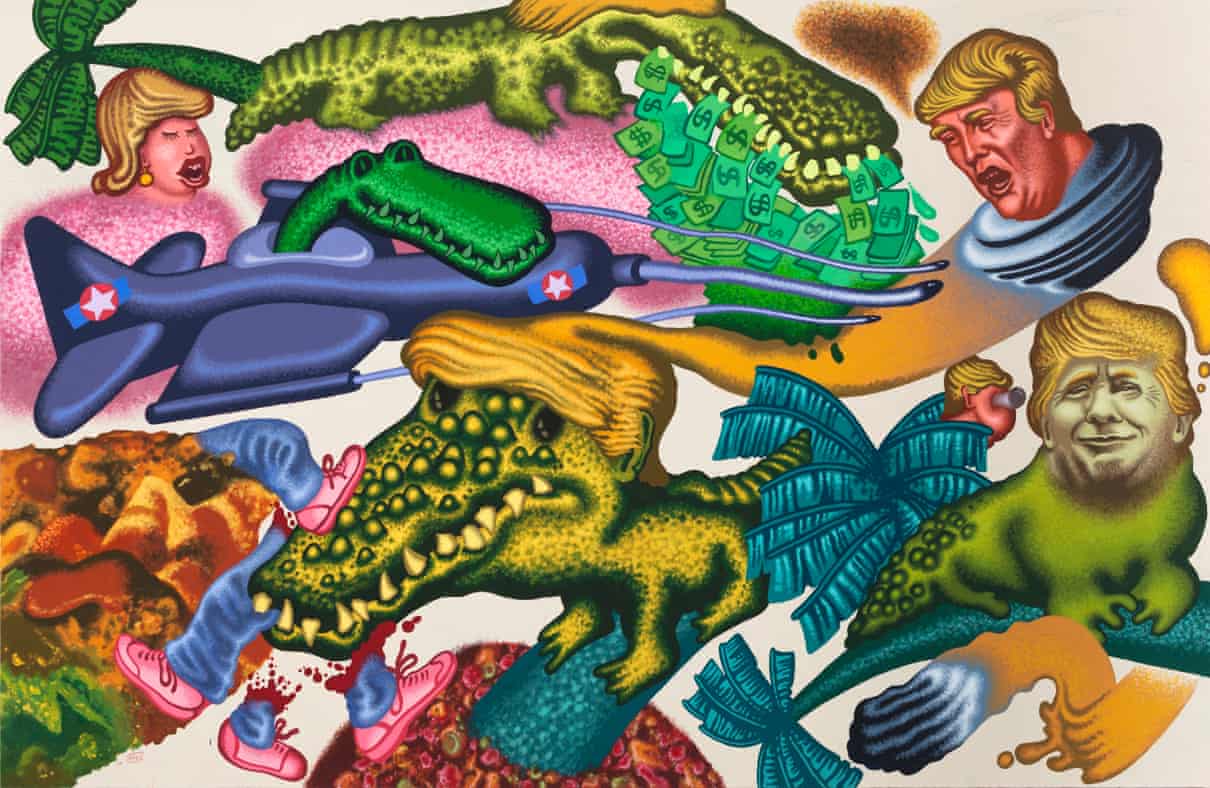
Peter Saul, Donald Trump in Florida, 2017.
At The Atlantic, Virginia resident Michael Tolhurst writes that a Youngkin win in Virginia could lead to a Constitutional crisis. That’s because governors control the National Guard. I can only provide a brief excerpt, so I hope you’ll read the entire article at The Atlantic.
…[i]n addition to the substantive policy disagreements or politics as pastime, people across America should be monitoring the outcome of this race for another reason: Governors command the National Guard, and after the January 6 riot, the country saw the National Guard defend our constitutional order.
at the outbreak of the Civil War, the prompt arrival of the 6th Regiment Massachusetts Volunteer Militia in Washington, D.C., in April 1861 helped secure a capital precariously close to the battlefront. Later forces arrived, building up the defenses around the city in the Northern Virginia towns of Arlington and Alexandria. This included, a century and a half before I came to live in the area, Connecticut’s 22nd Regiment in which my many-greats-grandfather Edwin Tolhurst served. (His military experience was unromantic—he dug ditches in the red mud of Northern Virginia for nine months, caught consumption, and died shortly after he was discharged.)
We’re not, of course, in a civil war. But law professors and public intellectuals have seriously discussed the possibility of secession or a “national divorce.” A recent University of Virginia study revealed that 41 percent of people who voted for Joe Biden in 2020 and 52 percent of Donald Trump voters “at least somewhat agree that it’s time to split the country.” The same study revealed that significant numbers on both sides wish their preferred president wouldn’t have to be constrained by Congress or the courts.
Given this tinderbox, we unfortunately have to revisit the question of what role the present-day state militias—the National Guard—and the governors who command them might play in a constitutional crisis. As the writer Andrew Sullivan put it, there is an “increasingly nihilist cult on the right among the GOP” that has shown an “increasingly menacing contempt for electoral integrity and a stable democracy.” Will all elected governors rush to the defense of the constitutional order when necessary, as did the 6th Massachusetts and the 22nd Connecticut? Or will they fight for a separatist movement? This is not a happy thought, but as even previously respectable institutions are being coy about the possibility of such a conflict, it must be considered.
It’s difficult to accept that the situation is getting that serious, but you just have to look at how completely the Republican Party has been captured by the Trump/Q-Anon cults to understand that we need to be prepared for the worst. I still need to finish reading the powerful Washington Post series on the January 6 insurrection, but I hope to do so this afternoon.
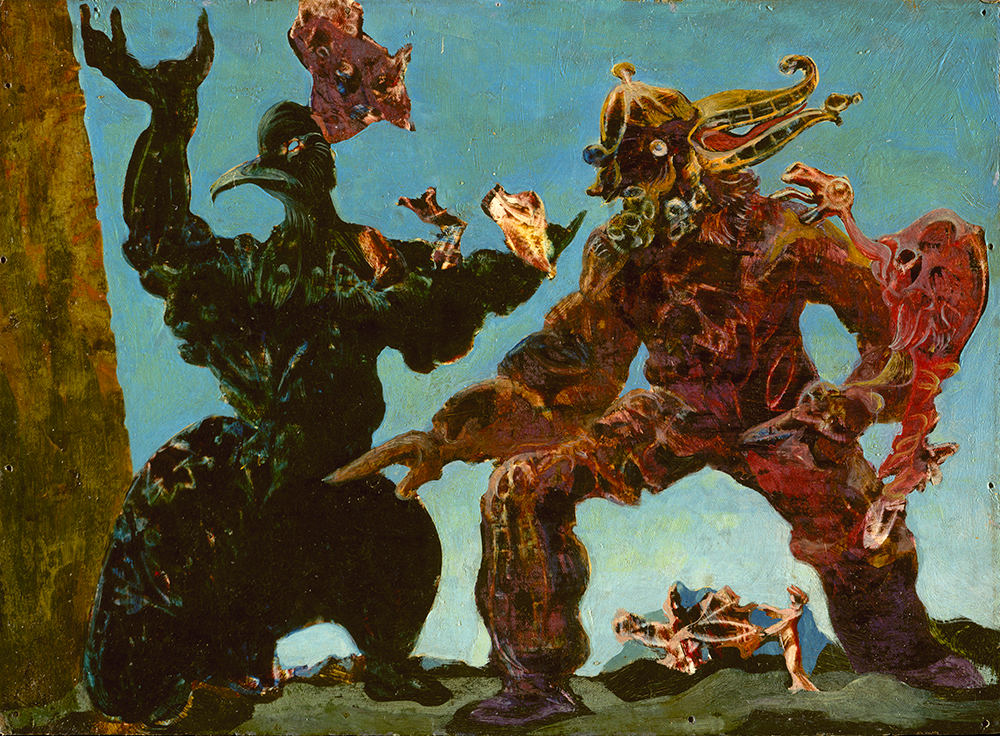
The Barbarians by Max Ernst, 1937
Harking back to the 2020 presidential election, Georgia Secretary of State Brad Raffenspurger has written a book. AP: Georgia official: Trump call to ‘find’ votes was a threat.
Donald Trump was threatening Georgia Secretary of State Brad Raffensperger when he asked him to help “find” enough votes to overturn his loss in Georgia to Democratic President Joe Biden, Raffensperger writes in a new book.
The book, “Integrity Counts,” was released Tuesday. In it, Raffensperger depicts a man who defied pressure from Trump to alter election results, but also reveals a public official settling political scores as he seeks to survive a hostile Republican primary environment and win reelection in 2022.
An engineer who grew wealthy before running for office, Raffensperger recounts in his book the struggle in Georgia that followed Biden’s narrow victory, including death threats texted to his wife, an encounter with men who he says may have been staking out his suburban Atlanta home, and being escorted out of the Georgia capitol on Jan. 6 as a handful of right-wing protesters entered the building on the same day many more protesters stormed the U.S. Capitol.
The book climaxes with the phone call, which was recorded and then given to multiple news organizations. Raffensperger — known as a conservative Republican before Trump targeted him — writes that he perceived Trump as threatening him multiple times during the phone call.
“I felt then — and still believe today — that this was a threat,” Raffensperger writes. “Others obviously thought so, too, because some of Trump’s more radical followers have responded as if it was their duty to carry out this threat.”
Fulton County District Attorney Fani Willis is investigating potential attempts to improperly influence Georgia’s 2020 election. Raffensperger said in an interview with The Associated Press that Willis’ investigators have talked to some employees in his office, but that he hasn’t been interviewed.
Read more about the book at USA today: Brad Raffensperger, GOP target of Trump ire in Georgia, warns of potential for more election violence.

Ruth Bader Ginsburg, by Bijou Karman
Another extremely important issue we face is that “conservatives” have taken over the Supreme Court. Linda Greenhouse at The Atlantic: What Can Liberals on the Supreme Court Do Now? They’re outnumbered, but they’re not powerless.
By the time the Supreme Court started its new term on the first Monday of October, a tumultuous summer of midnight orders and unsigned opinions had left no doubt about who was in charge. A five-member conservative bloc, anchored by three Trump-appointed justices, had largely stripped Chief Justice John Roberts of leverage and the three remaining liberals of any hope of striking a meaningful alliance with him. The best the liberals can hope for now, even with the chief justice on their side, is a 5–4 loss.
What path is open to them? Can they play a weak hand in a way that can make a difference? Is building bridges worthwhile, or has the time come to burn them all down? These are the questions hovering over the opening of a term that is likely to produce major decisions on abortion, religion, and the Second Amendment.
Perhaps some answers can be found in the memory of Ruth Bader Ginsburg, who died in September 2020 and was replaced with astonishing speed by Amy Coney Barrett. Powerless in her later years to change minds on the increasingly conservative Court, Ginsburg used the tool at her disposal: her voice. The purpose of her blunt and quotable dissenting opinions was not only to call out the majority when she believed it was wrong but to shape how the public understood the Court’s actions.
It’s easy to forget that this was not always Ginsburg’s way. For most of her years on the public stage, there was nothing flamboyant about her. Quite the opposite: A woman of few, precisely chosen words, she seemed content to fade into the background. During her years on the federal appeals court in Washington, she was so well known for her friendship with that court’s conservatives, particularly Antonin Scalia, who moved up to the Supreme Court in 1986, that many leaders of the women’s movement didn’t quite trust her when Bill Clinton chose her to fill his first Supreme Court vacancy, in 1993. In a lecture Ginsburg delivered months before her nomination, she emphasized the importance of dialogue and said that the “effective judge … strives to persuade, and not to pontificate,” and “speaks in a moderate and restrained voice.”
She didn’t become the “Notorious RBG” until much later; the bestselling biography Notorious RBG: The Life and Times of Ruth Bader Ginsburg came out in 2015. By then, Ginsburg had been on the Court for 22 years. It wasn’t so much that Ginsburg had changed as that the Court and the culture had changed around her.
Read the rest at The Atlantic.
Today will be a busy news day. What stories are you following? Please share your thoughts and links in the comment thread below.
Monday Reads: It’s one of those days where I’m just speechless
Posted: November 1, 2021 Filed under: Reproductive Rights, Republican Code Words and Concepts, Republican politics, Republican presidential politics, Revisionism, Treason and Sedition Republican Style 20 Comments
Free South Africa- Keith Haring- 1985
Well, it’s Monday Sky Dancers!
I’m just going to put these items up and see if you’re as shocked and speechless as I am. The Supreme Court is holding oral arguments on the unconstitutional Texas Abortion Law that’s designed to make women chattel property of whatever state decides that’s their political wish. You can watch it on C-Span 2 where you can see that Clarence Thomas actually can speak from the bench and not just from political fundraisers.
The artwork today is from this link: “Famous Political Art Pieces” and this link: “15 Influential Political Art Pieces. Artwork(s) In Focus, Top Lists, Art History, Socially Engaged Art”.
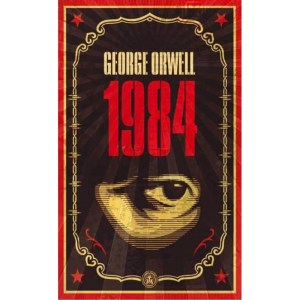
Shepard Fairey-George Orwell Print Set with Books (2008)
There really never was a day in America when political discourse wasn’t wrapped up in testosterone posing but this tit-for-tat shit is really out there. I just learned about the “Let’s go Brandon” thing and here’s Dan Rather to damn it so I don’t have to fire a synapse thinking about college boys at football games creating a national meanness meme. “A Party Embraces Vulgarity.”
The issue at hand can succinctly be summed up in three words: “Let’s go Brandon.” If you have no idea what I am talking about, consider yourself fortunate. For reasons too mundane to fully outline here, “Let’s go Brandon” has become a favorite chant and rallying cry for many Republicans as a stand-in for another three-word chant that you may also have heard : “F- Joe Biden,” with F-, for the purposes of decorum in this newsletter, standing for a four-letter vulgarity. Search for “Let’s Go Brandon,” and you will start finding it everywhere – all over social media, a song with a ton of downloads on iTunes, at political rallies, and among snickering Republicans in Washington.
In a compelling column in the Washington Post, Dana Milbank uses the phrase to dive into the stark differences between the seriousness and propriety of the two political parties at this moment. He writes:
“Democrats clear the way for passage of a $1.2 trillion infrastructure bill that will provide broadband Internet and lead-free drinking water to every American, and better roads, bridges and ports for all to enjoy. And Republicans reply: Let’s go Brandon…
Could the contrast be any greater? Half of America’s leaders are trying to govern, and the other half are hurling vulgarities.”
The entire piece is worth the read, but for our discussion here I would like to delve a little deeper into what I think these vulgarities really mean, what motivates them, and what should be our – particularly the media’s – response.
Politics has never been a genteel pastime. The volume of vulgarities I heard covering the White House, Congress, and politics at the state and local level over the decades would rival any comedy special on HBO. In the passionate pursuit of power, discourse, especially behind the closed doors where the real action takes place, is often reduced to words that can be spelled with only four letters, or their adjectival equivalents. And no matter what side of the political divide you might be on, there have likely been moments when you are reading something or listening to an opposing politician speak and you have been moved to at least think of obscenities, if not utter them out loud. There have certainly been many Democratic politicians who have sworn about Republicans. But what we are witnessing here is fundamentally different.
“F- Joe Biden,” or the slightly less explicitly obscene but no more clever “Let’s go Brandon,” is about much more than political passion or anger. It’s about weaponizing the vulgar dehumanization of our entire democratic – small d – experiment. Joe Biden is not only a person; he is the President of the United States, whether your tinfoil-shrouded conspiracy brain cares to recognize that fact or not. How many times have we heard Republicans sanctimoniously preach about how Democrats don’t “respect” the office of the presidency for such things as President Obama not saluting properly or wearing a tan suit?
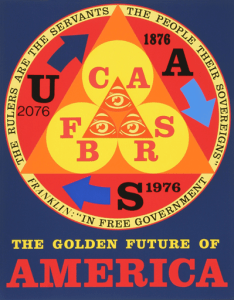
Golden Future of America- Robert Indiana- 1976
Not to be outdone, The Wall Street Journal Op-Ed page which is a favorite thing of those seeking to line rat cages is pearl-clutching over 5 young people dressed up as the Torch Terrorists in Charlottesville and stood in silent ironic protest in front of the Trumpist running for governor in Virginia’s campaign bus. Wow, they really let the Lincoln Project get to them this time. “A Dirty Campaign Trick in Virginia. The Lincoln Project plays the race card in a false-flag operation.” As usual, there are two right-wing conspiracy theory signals dog-whistling from the headline. Everything surrounding racism is playing “the race card” and I can’t even figure how this is a “false-flag operation,” but hey, get down with your crazy stupid selves! How long do we have to wait before we read the next attempt to label it “virtue-signaling”?
Democrats routinely play the race card when they’re worried about losing an election, and that’s exactly what the operatives from the Lincoln Project did last week in staging a dirty campaign trick against surging GOP candidate Glenn Youngkin.
It started Friday when a reporter for a local NBC affiliate tweeted a photo of four men and one woman dressed in white shirts, khakis and sunglasses and holding tiki torches. They were standing in front of Republican gubernatorial candidate Glenn Youngkin’s bus during a campaign stop in Virginia.
“These men approached @GlennYoungkin’s bus as it pulled up saying what sounded like, ‘We’re all in for Glenn.” tweeted Elizabeth Holmes. The tiki torches were meant to tie Mr. Youngkin to the infamous torchlit, white nationalist march in Charlottesville in 2017.Twitter exploded, with various people claiming to have identified people in the tiki-torch photo as Democrats. They hadn’t been positively ID’d by the time we went to press on Sunday.
But as evidence grew that this was a setup, the Lincoln Project finally fessed up. It presented its attempt to play the white supremacist card as an exercise in civic virtue, saying it was “our way of reminding Virginians” about Charlottesville, “the Republican Party’s embrace of those values,” and Mr. Youngkin’s “failure to condemn it.” This is a slur against Mr. Youngkin and the Virginia GOP.
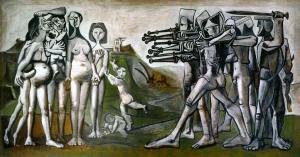
Massacre in Korea, 1951 by Pablo Picasso
So, this is all pretty radically nuts because the latest craziness by the Republicans in Virginia is all about that Critical Race Theory nuttiness. Juan William states it plainly. ‘Parents’ rights’ is code for white race politics’. I remember living through this same craziness in 1992 when the code word was “multiculturalism” which basically means if it wasn’t spat out by a white christianist it shouldn’t be taught to children.
After white supremacists spilled blood in defense of keeping up Confederate statues in 2017, the GOP candidate for governor of Virginia, Ed Gillespie, said the monuments should stay up as a matter of heritage and history.
His TV advertising featured threatening images of Latino gangs, labeled illegal immigrants, involved in murder and rape.
The racially loaded “Culture Wars” campaign, straight from then-President Trump’s playbook, gave Gillespie a push, but he ultimately lost the race to Democrat Ralph Northam.
Now Virginia Republicans are back with a new and improved “Culture Wars” campaign for 2021. The closing argument is once again full of racial division — but this time it is dressed up as a defense of little children.
The rallying cry is “Parents’ Rights.”
It is a campaign to stop classroom discussion of Black Lives Matter protests or slavery because it could upset some children, especially white children who might feel guilt.
And this time, the Trump-imitating Republicans think they have struck political gold.
Unlike their earlier defense of Confederate monuments, the “Parents’ Rights” campaign message at first glance looks to have zero to do with race.
That puts Democrats on the defensive. They are in the uncomfortable position of calling the attention of suburban white moms to divisive racial politics being used by Republican Glenn Youngkin’s campaign.
Terry McAuliffe, the Democratic candidate, calls the Republican message a “racist dog whistle.”

The Problem we all live with, Norman Rockwell, 1963
 Still, that race–that will be determined tomorrow–is a dead heat. This is from the NYT: “In the Final Days Before Virginia Votes, Both Sides Claim Momentum.”
The high-stakes race for governor of Virginia entered its final stretch with Glenn Youngkin and Terry McAuliffe trading accusations of sowing division, as voters appeared closely divided over returning a Democrat to office or electing a Republican to lead their state for the first time in more than a decade.
The size and atmosphere of dueling events during the last weekend of campaigning before Election Day on Tuesday reflected the trends in the most recent polls. Mr. Youngkin, the Republican candidate, greeted crowds of more than 1,000, while Mr. McAuliffe, the Democrat, hustled through sparsely attended events from morning to night.
Mr. McAuliffe, who served one term as governor from 2014 to 2018, has displayed a rising sense of urgency lately, dispatching some of the Democratic Party’s biggest stars to campaign for him and push people to vote early. In 11 hours on Saturday, Mr. McAuliffe traveled more than 120 miles, making eight stops in six cities amid a whirlwind day of campaigning in which he urged supporters not to be complacent.
“We are substantially leading on the early vote, but we cannot take our foot off the gas,” Mr. McAuliffe told a crowd on Saturday in Norfolk, where he met with labor leaders who were planning to spend the day knocking on doors.
Meanwhile, The Bulwark’s Tim Miller just had to put this headline in front of me today: “Donald Trump Is Now the Odds-On Favorite to Be President in 2025 .” I’m gagging over here.
So, Donald Trump is now the odds-on favorite to be president of the United States in 2025.
I know that lede sentence was also the headline, but I wanted you to read it one more time just to let it really settle in the ol’ noggin before pressing forward.
The twice-impeached, disgraced loser who was schlonged in the 2020 election, tried to stay in power against the will of the people, and then came ten cowardly Republican senators away from being disqualified from ever running for office again, is now more likely than any other person in the world to take the next oath of office on the Capitol steps on January 20, 2025.
How is that for some weird shit?
Now I’m sure some will roll their eyes when this headline comes across the Twitter feed. Attribute this article to my raging Trump Derangement Syndrome or The Bulwark’s Cady Heron-level obsession with Mar-a-Lago’s in-house wedding toastmaster.
But this ain’t about my compulsions. It’s the actual, real-world reality being presented by those who have the most skin in the game.
Both the major off-shore gambling quants and the online trading markets have moved in Mr. Trump’s favor in the past couple weeks.
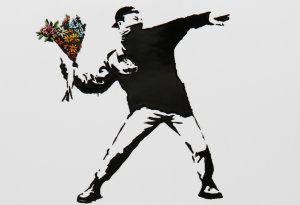
Banksy, The Flower Thrower, 1963
Here’s some more crazy shit that I’m speechless about.
- Olivia Beavers / Politico: ‘They’re probably going to put us back in power’: GOP basks in Dem discord
- Bill Schneider / The Hill: 2022 and ‘the passion gap’ — why Republicans are more fired up
- David A. Graham / The Atlantic: Josh Mandel Might Be Craven Enough to Win
- Terry Jones / Issues & Insights: I&I/TIPP Poll: Just 42% Now Think Biden Is ‘Mentally Sharp
- Sarah Rumpf / Mediaite: Matt Gaetz Jokes About Blowing Up Capitol Metal Detectors With Explosives (UPDATE: Lauren Boebert Tweets ‘I’ll Bring the Tannerite!’)
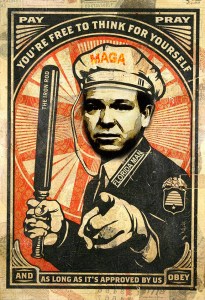
Why does the press keep trying to incite a civil war instead of elucidating the danger in all of this? Rad idea below Atlantic writer suggests Never Trumperz support DeSantis. (Connor Friedsdorf warning) What drug is this guy on? Or Read this shake-down in New York Magazine describing DeSantis worship.
I’m going to go play music and eat chocolate now. Hope you have a great day and that you’re not as depressed and confused about all this is and derp as I am.
I had to steal this image from my blogging buddy Peter Athas Get his take on that TNR article here.
What’s on your reading and blogging list today?

 peej
peej Carissa
 bostonboomer
 dakinikat
 ecocatwoman
 mablue2
 Mama Lopez
 peggysue22
 quixote
 skydancingguestblogger
 Mona (aka Wonk the Vote)



 Sky Dancing
Recent Comments