It looks like the media is going to focus on Afghanistan for the foreseeable future. They’ve spent the past 6 months searching for something they can attack Biden about, and now they’ve found it. Never mind that Trump is the one who negotiated with the Taliban and withdrew most of the troops. This is all Biden’s fault.
Never mind that Trump mismanaged and then ignored a deadly virus that has now killed more Americans than the Civil War. Never mind that Republican Governors in the South and people refusing vaccines based on conspiracy theories that are making the pandemic worse. That can’t be pinned on Biden, so the media will ignore the problem for now. They will also largely ignore the horrific earthquake in Haiti. The media loves covering wars.
This war has gone on much longer than Vietnam, and it’s clear we’re not going to win it. The best thing we can do is get as many vulnerable Afghanis out and bring them to the U.S. or send them to other countries. Of course Republicans won’t like that, even though they are criticizing the pullout at the moment (They cheered Trump and Pompeo’s agreement with the Taliban that freed 5,000 fighters from prison. Now they are pretending that didn’t happen).
I’m not saying what’s happening in Afghanistan at the moment isn’t horrible. It is. I honestly don’t know if it could have been handled better. Maybe so. Wiser people than I will have plenty to say about that. But I’m willing to wait and see what happens.
If nothing else for media watchers there’s a fascinating dynamic developing over the last day or so in trying to define the US exit from Afghanistan. It’s not a new dynamic. In fact, it’s one I first saw a quarter century ago when DC’s establishment press got really, really upset that not only Bill Clinton but more importantly most of the country didn’t agree with their take on impeachment in 1998. Official DC was baffled when Democrats actually managed to pick up a few seats in the 1998 midterm that was entirely about impeachment. The specifics of the case are of course pretty radically different. But the dynamic of establishment DC press escalation is not. Politico’s morning newsletter this morning captures the dynamic. It starts quoting David Axelrod making clear that Biden messed up and has admit he messed up but then notes that Biden didn’t get the message and said it was the right decision. A sort of primal scream of “WTF, JOE BIDEN?!?!?!!?!” virtually bleeds through the copy.
After quoting Biden at length saying “I stand squarely behind my decision…” Politico jumps back in: “Of course, that’s not the issue. And Republicans — as well as many in the media — were quick to point that out …”
No, no, no, Joe Biden! that’s not right!
Sunday Afternoon – Interior with a Girl Reading, Michael Peter Ancher
As I’ve made clear repeatedly, it’s not like this is a big win for Biden, at least in the near term. American public opinion is never going to like seeing the people we spent twenty years and a trillion dollars fighting getting comfy in the presidential palace after the US-backed President hopped the first plane out of Kabul. That stings no matter what the backstory. But there’s also little question that the very strong consensus among establishment DC press opinion-makers is not in line with the mood or opinion of most of the country.
At least half a dozen Politico articles in the last 36 hours have run with a snap Morning Consult poll showing that support for Biden’s withdrawal plan has fallen from 69% in May to 49% on Sunday, a whopping 20 point drop. This is hardly surprising: the concept of bringing everyone home is easier to support without pictures of the messy realities of the situation. The data point is listed in this morning’s Politico newsletter as well (“Here’s one bad sign for Biden:”). Not mentioned as far as I can tell in any of these write-ups is this: Even after a weekend of chaotic, ugly images and 48 hours of relentlessly negative news coverage, support and opposition to Biden’s withdrawal plan, according to this poll was 49% in favor and 37% opposed. The fact that the plan still has a net +12 approval even at such a bleak moment is surely a relevant part of the story.
There’s a pretty palpable reflex to keep the storyline in check and Biden is not helping.
The media needs everyone to go along with their narrative, just as they did when they were cheering the buildup to the Iraq war and many of us ordinary American were terrified of another Vietnam.
As Taliban forces pushed through Afghanistan this past week, most news outlets covered the swiftly shifting story by falling back to their usual position: reporting from inside the Beltway.
That kind of journalism — insular and hermetically-sealed — can read “out of touch” to most news consumers and only further cements skepticism about the media.
In Washington, the situation in Afghanistan was largely viewed as an event with disastrous consequences for President Biden. According to the headlines, the president now faced “political peril” as the end of the war entered “treacherous terrain.”
More than that, one report insisted, this represented a “grim reckoning” for Biden, who had “rebuffed Pentagon recommendations” to leave a contingent of U.S. troops in the country.
In case the point was somehow missed, a cable news chyron shouted: “Afghanistan’s Rapid Unravelling Threatens Biden’s Legacy.”
It’s undeniable that the circumstances in Afghanistan have deteriorated much more quickly than the administration anticipated — or, at least, that it wanted to discuss publicly. But two main questions were left under-examined as the political media rushed to do what it too-often does: Find a simple D.C.-centric story thread and race to repeat it.
The more important questions, according to Ferullo:
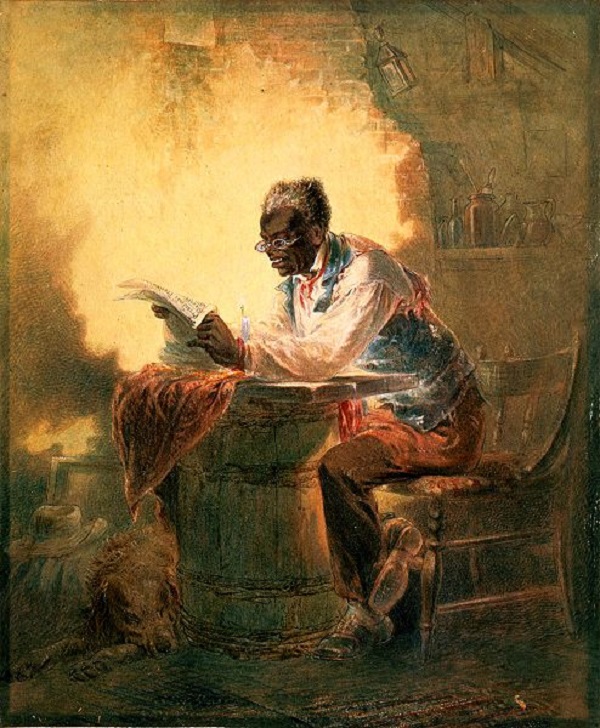
Black Man Reading Newspaper by Candlelight, Henry Louis Stevens
The most important issue: What do the American people want? Reports from outside the Beltway, looking for voter reaction, have been rare. But recent polling makes the answer clear. In one April survey, 73 percent of respondents approved of Biden’s plan to withdraw from Afghanistan. As late as last month, polls showed 57 percent supported ending the war.
In other words, the people who have for the past 20 years been asked to do the fighting — or to send loved ones far away, tour-after-tour, as the conflict dragged on — have said “Enough is enough.” Their voices should count for something, yet their point of view was largely missing from reports out of Washington this past week.
Also largely left unconsidered: Why was the Taliban able to advance so quickly? The story line most often picked up blamed a hasty U.S. withdrawal. It was, according to one headline, “Joe Biden’s Fall of Saigon.”
That comparison actually rings true — but not for the reasons most journalists have settled on. With the passage of time, it became clear that, in large part, South Vietnam fell so quickly because its government simply did not have the support of its people. America’s military presence in Vietnam — over the course of nearly 20 years and 58,000 U.S. combat deaths — was unable to build a political infrastructure that citizens could trust.
The same is true in Afghanistan. We set up a government that the people didn’t like or trust. Read more at the link.
My national security team and I have been closely monitoring the situation on the ground in Afghanistan and moving quickly to execute the plans we had put in place to respond to every constituency, including — and contingency — including the rapid collapse we’re seeing now….
We went to Afghanistan almost 20 years ago with clear goals: get those who attacked us on September 11th, 2001, and make sure al Qaeda could not use Afghanistan as a base from which to attack us again.
We did that. We severely degraded al Qaeda in Afghanistan. We never gave up the hunt for Osama bin Laden, and we got him. That was a decade ago.
Our mission in Afghanistan was never supposed to have been nation building. It was never supposed to be creating a unified, centralized democracy….
I’ve argued for many years that our mission should be narrowly focused on counterterrorism — not counterinsurgency or nation building. That’s why I opposed the surge when it was proposed in 2009 when I was Vice President.
And that’s why, as President, I am adamant that we focus on the threats we face today in 2021 — not yesterday’s threats.
Christopher Wilson We conduct effective counterterrorism missions against terrorist groups in multiple countries where we don’t have a permanent military presence.
If necessary, we will do the same in Afghanistan. We’ve developed counterterrorism over-the-horizon capability that will allow us to keep our eyes firmly fixed on any direct threats to the United States in the region and to act quickly and decisively if needed.
Rosa and Bertha Gugger, 1883, Albert Anker
When I came into office, I inherited a deal that President Trump negotiated with the Taliban. Under his agreement, U.S. forces would be out of Afghanistan by May 1, 2021 — just a little over three months after I took office.
U.S. forces had already drawn down during the Trump administration from roughly 15,500 American forces to 2,500 troops in country, and the Taliban was at its strongest militarily since 2001.
The choice I had to make, as your President, was either to follow through on that agreement or be prepared to go back to fighting the Taliban in the middle of the spring fighting season.
There would have been no ceasefire after May 1. There was no agreement protecting our forces after May 1. There was no status quo of stability without American casualties after May 1.
There was only the cold reality of either following through on the agreement to withdraw our forces or escalating the conflict and sending thousands more American troops back into combat in Afghanistan, lurching into the third decade of conflict.
There’s more at the link but here’s the bottom line.
I stand squarely behind my decision. After 20 years, I’ve learned the hard way that there was never a good time to withdraw U.S. forces….
American troops cannot and should not be fighting in a war and dying in a war that Afghan forces are not willing to fight for themselves. We spent over a trillion dollars. We trained and equipped an Afghan military force of some 300,000 strong — incredibly well equipped — a force larger in size than the militaries of many of our NATO allies.
We gave them every tool they could need. We paid their salaries, provided for the maintenance of their air force — something the Taliban doesn’t have. Taliban does not have an air force. We provided close air support….
And here’s what I believe to my core: It is wrong to order American troops to step up when Afghanistan’s own armed forces would not. If the political leaders of Afghanistan were unable to come together for the good of their people, unable to negotiate for the future of their country when the chips were down, they would never have done so while U.S. troops remained in Afghanistan bearing the brunt of the fighting for them.
Senior national security officials presiding over a historic foreign policy collapse are privately expressing deep frustrations about the thin Afghanistan withdrawal plans left behind by Donald Trump.
Why it matters: Many experienced operatives in both parties are aghast that President Biden and his team didn’t ready better preparations over nearly seven months since taking office.
But two Biden officials who spoke with Axios on Monday on condition of anonymity bristled at the criticism coming from former President Trump and his administration in the wake of the Taliban’s rapid sweep across Afghanistan and capture of Kabul.
What they’re saying: “There was no plan to evacuate our diplomats to the airport,” a senior national security official told Axios about the preparations they inherited from the previous administration. “None of this was on the shelf, so to speak.”
“When we got in, on Jan. 20, we saw that the cupboard was bare,” the official said, echoing a complaint Team Biden also made about Trump’s vaccine distribution plan….
Reading (Clara), circa 1865, Federico Faruffini
Biden officials said that Trump’s team during the transition, was slow to brief them on key details and context behind the 2020 peace agreement signed in Doha.
That Trump-era deal between the U.S. and the Taliban called for a withdrawal of troops by May 2021.
Separately, Trump, after losing the election, signed a secret memo to withdraw all troops from Afghanistan before Biden took office, as Axios’ Jonathan Swan and Zachary Basu reported. But after some Trump officials became aware of “an off-the-books operation by the commander in chief himself,” they eventually persuaded Trump to keep some 2,500 troops in Afghanistan.
After all of that, the senior Biden officials said, Trump effectively didn’t have a plan to bring all Americans including troops, contractors and diplomats home safely. One said that created “headwinds” and “unnecessarily increased” the degree of difficulty for the new administration.
“The entire policy process had atrophied,” one of the officials said. “It was really manifest here.
“On the one hand, they set a May deadline for withdrawal,” the official said. “On the other hand, there was no interagency planning on how to execute a withdrawal.”
The bottom line: Biden officials aren’t directly blaming Trump for how events unfolded in Kabul.
But they do want to challenge what they see as bad-faith arguments from Trump officials making the case that they would have presided over a more orderly withdrawal.
Biden, keenly aware of the impact of the horrifying scenes of chaos in the Afghan capital of Kabul, looked straight into the camera and said, “I am the president of the United States and the buck stops with me.” He acknowledged the mayhem and the human toll it is taking and he expressed his clear anger at the failure of the Afghan government and military to mount a defense of their own country. He specifically noted that the government had urged the U.S. not to begin early evacuations of foreign nationals because of the message it might send.
After he spoke, the talking heads came out in force and argued he did not accept responsibility. But “the buck stops here” is the ultimate expression of a president owning his actions. They said he did not explain how we could be in the situation we are in. But what they really mean is that he did not give the explanation they wanted.
Compartment C, Car 293, 1938, Edward Hopper
CNN’s Jake Tapper called Biden’s description of the swift collapse of the Afghan central government and military “finger pointing.” But it was indeed that collapse that accounted for the speed of the Taliban’s take-over: When the Afghan forces the U.S. has invested billions in should have stood up, they did not. Given that it was widely expected that the Taliban would ultimately seize control of the country — they were, after all, the parties with whom the last administration was negotiating — the key variable was whether the Taliban would meet any resistance.
Biden described the measures being taken to get thousands of embassy employees, US citizens, citizens of allied nations and Afghans who had aiding allied forces out. He reasserted the commitment of the U.S. to using international mechanisms to provide aid to the people of Afghanistan, and stressed that the U.S. would continue to place human rights at the center of our foreign policy priorities.
It would have been heartening to hear him use tougher language with regard to applying international pressure should the rights of women and girls be violated. He should have made a commitment to investigate fully where things went wrong with the exit plan. But he left no uncertainty about our willingness to use force in the event that violent extremists posing a threat to the U.S. again appear within Afghanistan’s borders.
So that’s a counterpoint to the media freakout. I’ll post some of the latest attacks on Biden along with some more reasoned articles in the comment thread. Let me know what you think, and remember this is an open thread.
Did you like this post? Please share it with your friends:
I was at university when Saigon fell. Like everything else about the Vietnam war, it was televised during your mealtimes. I asked my ex-husband if this meant I could finally burn his draft card. He held onto it for a while before I finally took it and incinerated it in a fired-up grill.
The dulcet tones of “White Christmas” that crackled over Armed Forces Radio airwaves on April 29, 1975, failed to spread cheer across sunbaked Saigon. Instead, the broadcast of the holiday standard after the announcement that “the temperature in Saigon is 105 degrees and rising” instilled fear and panic in all who recognized the coded signal to begin an immediate evacuation of all Americans from Vietnam.
Although the United States had withdrawn its combat forces from Vietnam after the signing of the Paris Peace Accords in 1973, approximately 5,000 Americans—including diplomats, marine guards, contractors and Central Intelligence Agency employees—remained. President Richard Nixon had secretly promised South Vietnam that the United States would “respond with full force” if North Vietnam violated the peace treaty. However, after the Watergate scandal forced Nixon to resign, the North Vietnamese Army felt emboldened to launch a major offensive in March 1975.
“From Hanoi’s point of view, the turmoil leading up to and including Nixon’s resignation was an opportunity to take advantage of a distracted United States,” says Tom Clavin, co-author of Last Men Out: The True Story of America’s Heroic Final Hours in Vietnam. “North Vietnam never intended to abide by the 1973 agreement—its ultimate mission was to unify the country—but the political crisis in America allowed them to move up their timetable.”
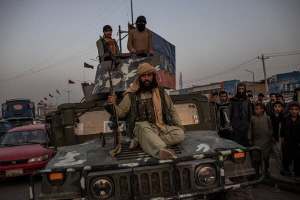
Taliban fighters in Kabul, the capital, on Sunday on a Humvee seized from Afghan forces. The speed of the Taliban’s sweep through the country startled American officials. Credit…Jim Huylebroek for The New York Times
The Bodega on the corner is run by a family around my age. There is a grandmother and a grandson. I’ve never really asked the grandmother or the parents about Vietnam, but I know they are part of the large diaspora of South Vietnamese that landed here. My French teacher was in Saigon when it fell. I’ve seen his photos and listened to his stories, although I’m not really sure how he and his Vietnamese bride got out of there. It’s actually getting difficult to find Vietnamese Veterans these days who will share their stories. But they’re out there still.
Taliban fighters poured into the Afghan capital on Sunday amid scenes of panic and chaos, bringing a swift and shocking close to the Afghan government and the 20-year American era in the country.
President Ashraf Ghani of Afghanistan fled the country, and a council of Afghan officials, including former President Hamid Karzai, said they would open negotiations with the Taliban over the shape of the insurgency’s takeover. By day’s end, the insurgents had all but officially sealed their control of the entire country.
The speed and violence of the Taliban sweep through the countryside and cities the previous week caught the American military and government flat-footed. Hastily arranged American military helicopter flights evacuated the sprawling American Embassy compound in Kabul, ferrying American diplomats and Afghan Embassy workers to the Kabul military airport. At the civilian airport next door, Afghans wept as they begged airline workers to put their families on outbound commercial flights even as most were grounded in favor of military aircraft.
Amid occasional bursts of gunfire, the whump of American Chinook and Black Hawk helicopters overhead drowned out the thrum of traffic as the frenzied evacuation effort unfolded. Below, Kabul’s streets were jammed with vehicles as panic set off a race to leave the city.
Two decades after American troops invaded Afghanistan to root out Qaeda terrorists who attacked on Sept. 11, 2001, the American nation-building experiment was in ruins — undercut by misguided and often contradictory policies and by a relentless insurgency whose staying power had been profoundly underestimated by U.S. military planners.
More than 2,400 American troops gave their lives and thousands more were wounded in an effort to build a democratic Afghan government. Tens of thousands of civilians died in the fighting, and thousands more were displaced from their homes. In recent days alone, thousands fled to Kabul as the Taliban advanced through other cities at breakneck speed.
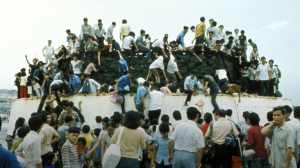
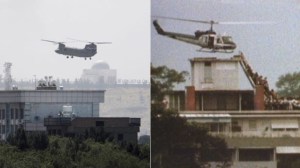
Evacuation of Kabul (Left) and Fall of Saigon (Right). Picture: Collected
President Biden’s top advisers concede they were stunned by the rapid collapse of the Afghan army in the face of an aggressive, well-planned offensive by the Taliban that now threatens Kabul, Afghanistan’s capital.
The past 20 years show they should not have been.
If there is a consistent theme over two decades of war in Afghanistan, it is the overestimation of the results of the $83 billion the United States has spent since 2001 training and equipping the Afghan security forces and an underestimation of the brutal, wily strategy of the Taliban. The Pentagon had issued dire warnings to Mr. Biden even before he took office about the potential for the Taliban to overrun the Afghan army, but intelligence estimates, now shown to have badly missed the mark, assessed it might happen in 18 months, not weeks.
Commanders did know that the afflictions of the Afghan forces had never been cured: the deep corruption, the failure by the government to pay many Afghan soldiers and police officers for months, the defections, the soldiers sent to the front without adequate food and water, let alone arms. In the past several days, the Afghan forces have steadily collapsed as they battled to defend ever shrinking territory, losing Mazar-i-Sharif, the country’s economic engine, to the Taliban on Saturday.
Mr. Biden’s aides say that the persistence of those problems reinforced his belief that the United States could not prop up the Afghan government and military in perpetuity. In Oval Office meetings this spring, he told aides that staying another year, or even five, would not make a substantial difference and was not worth the risks.
In the end, an Afghan force that did not believe in itself and a U.S. effort that Mr. Biden, and most Americans, no longer believed would alter the course of events combined to bring an ignoble close to America’s longest war. The United States kept forces in Afghanistan far longer than the British did in the 19th century, and twice as long as the Soviets — with roughly the same results.
Joint Statement from the Department of State and Department of Defense: Update on Afghanis https://t.co/9jV3g9wfDC . Hope they using the ✈️ that deployed the Troops in to Air Port to back hall People out of Afghan every plane ✈️ should leave full of evacuees @nytimes@MSNBC
The Taliban weren't involved with 9/11. A council of 600 senior AfPak Muslim clerics – essentially the Taliban's governing body – expressed dismay at the 9/11 attacks and offered to expel bin Laden from the country.
— M.S. Bellows, Jr. msbellows@c.im (@msbellows) August 15, 2021
So, there will be a lot more happening, and I’m sure the discussion will be brisk. Please add anything interesting you’ve read on seen or your thoughts, please!
As we all know, there’s a substantial portion of American society that has surrendered to mass delusions. The things these people believe are so insane that you have to wonder of a large proportion of them may actually have serious, previously undiagnosed psychological disorders. From Twitter yesterday: Two examples of apparently insane people speaking at local board meetings about covid-19 conspiracies.
Some of these crazies have actually acted on their delusions. Recall the man who traveled from North Carolina to Washington DC to investigate the “pizzagate” conspiracy–the belief that Hillary Clinton and other Democrats were using the basement of a pizza restaurant to sexually abuse children and then extract “adrenachrome” from their adrenaline glands to gain immortality. There isn’t even a basement in the restaurant. He took his AR-15 into the place and waved it around. Now he’s in prison.
Believe it or not, the “adrenachrome” delusion comes from the book by Hunter S. Thompson, Fear and Loathing in Las Vegas. I read it several times back in the day and I clearly recall the hilarious scene in the book. This is from Raw Story this morning in a very useful piece by Thom Hartmann: Trump’s shared psychosis is destroying the fabric of society
Thompson was bemoaning running out of hashish and being almost out of opium when his “fat Samoan” sidekick offered an alternative:
“As your attorney,” he said, “I advise you not worry.” He nodded toward the bathroom. “Take a hit out of that little brown bottle in my shaving kit.” “What is it?”
“Adrenochrome,” he said. “You won’t need much. Just a little tiny taste.” I got the bottle and dipped the head of a paper match into it.
By Mary Fedden
“That’s about right,” he said. “That stuff makes pure mescaline seem like ginger beer. You’ll go completely crazy if you take too much.”
I licked the end of the match. “Where’d you get this?” I asked. “You can’t buy it.” “Never mind,” he said. “It’s absolutely pure.”
I shook my head sadly. “Jesus! What kind of monster client have you picked up this time? There’s only one source for this stuff…”
He nodded. “The adrenaline glands from a living human body,” I said. “It’s no good if you get it out of a corpse.”
When Thompson asks his “attorney” where the adrenochrome came from, the fictional character tells the fictional tale of having once been hired to represent a child molester/murderer who’d presumably extracted it from one of his victims.
“Christ, what could I say?” Thompson’s sidekick told him. “Even a goddamn werewolf is entitled to legal counsel. I didn’t dare turn the creep down. He might have picked up a letter opener and gone after my pineal gland.” Which then led them to a discussion about eating pineal glands to get high…
The pineal gland episode is even wilder. I doubt if very many of these Pizzagate/Q-Anon cultists have read Hunter Thompson, but somehow this fictional episode was absorbed into their conspiracy theories.
Q-Anon-inspired delusional beliefs have led to a number of real-life incidents of deadly violence. This horror happened a couple of days ago:
A Southern California man has been charged with killing his two young children with a spearfishing gun, deluded by QAnon conspiracy theories that made him believe that his kids were possessed with serpent DNA and that killing them would save the world, authorities said.
Matthew Taylor Coleman, 40, of Santa Barbara, was arrested Monday while reentering the U.S. from Mexico, where the bodies of his 2-year-old son and 10-month-old daughter had been found earlier that day, according to the criminal complaint.
Coleman, who founded a surf school in Santa Barbara, had been reported missing by his wife after she told authorities that he unexpectedly took off with their two children on Saturday while they were planning a family camping trip. He didn’t say where he was going, failed to answer her text messages and didn’t have a child’s car seat in his vehicle, she told authorities….
Mexico authorities later reported to U.S. officials that the bodies of two children matching the missing kids’ description had been found that morning in a ditch with large puncture wounds in their chests.
In a recorded interview, authorities said Coleman confessed to killing his children and leaving their bodies in Mexico. He said he drove them across the border on Saturday, having “believed his children were going to grow into monster so he had to kill them,” according to the criminal complaint.
Coleman told authorities that he was “enlightened by QAnan and illuminati conspiracy theories and was receiving visions and signs revealing that his wife … possessed serpent DNA and had passed it onto his children,” according to the complaint.
Killing his children, he told investigators, would be “saving the world from monsters,” the complaint said. He knew it was wrong, “but it was the only course of action that would save the world.”
By Brigid Marlin, 1936
How many of these Q Anon cultists actually have undiagnosed psychological disorders? I’d bet quite a few. A bit more from the Thom Hartman article quoted above:
Their psychological issues included “post-traumatic stress disorder, paranoid schizophrenia, bipolar disorder, and Munchausen syndrome by proxy.”
The “Qanon Shaman” of so many iconic 1/6 pictures has now pleaded mental illness as his reason for showing up at the Capitol, as have two others who “were found to be mentally unfit to stand trial and were transferred to mental health care facilities.”
Of the six women arrested on 1/6 who’d also committed crimes before or after the coup attempt, the researchers note, “all six…have documented mental health concerns.”
These people are not only committing crimes because of their Trumpian delusions, but also they are helping to spread the coronavirus by claiming it is a government hoax and refusing to get vaccinated and wear masks. And powerful Republicans like Ron DeSantis and Gregg Abbott are catering to their delusions with deadly results, as I wrote in my Thursday post. The latest dire reports from Florida:
Florida continues to see record COVID-19 infections across the state. Now, deaths are rising too.
The state reported 151,415 infections from Aug. 6-12, according to the state Department of Health. That’s an average of more than 21,600 cases a day. It’s the third week in a row that the Sunshine State set a record for weekly cases. Only Louisiana saw more infections per capita.
Florida also reported 1,071 deaths, a 74 percent increase from the previous week. Two children are among the dead.
More than 500,000 Floridians have been infected since June 19, when cases began climbing again. The more contagious delta variant is the dominant strain of COVID-19 in the nation, rewriting the old rules of staying safe as it powers the fourth — and worst — wave of the 17-month pandemic.
The burden on Florida hospitals continues to grow with an average of 2,222 new COVID-19 patients admitted every day over the past week, according to data from the Department of Health and Human Services. As of Friday, there were 15,441 confirmed COVID-19 patients being cared for in state hospitals.
The Sunshine State accounts for more than one out of every six infections and one out of every five hospitalizations in the U.S. this past week.
The calls came fast, first with a cardiac arrest case, next with multiple patients who were having trouble breathing, and all were suspected to have COVID. Usually, Stew Eubanks, a paramedic in Sumter County, Florida, deals with lots of minor emergencies, but now it’s mainly life-threatening cases. After a nonstop 24 hours, his Wednesday shift ended with another cardiac arrest.
“It’s bad right now,” Eubanks, 39, told BuzzFeed News. “We’re stacking patients in the hallways, stacking patients in the waiting room.”
Florida’s hospitals are filling up, with nearly 85% of inpatient hospital beds occupied, according to the Florida Hospital Association’s latest report. In the last week, the state has averaged more than 20,000 new COVID-19 cases a day, with nearly 15,000 people hospitalized. That’s shattered previous case records for the state, and COVID-19 deaths, which had been steadily declining since February, are also steeply rising.
By the end of his shift, Eubanks had transported 14 patients, a sharp increase from the six he’d see on a normal day prepandemic servicing the Villages, the largest retirement community in the country. Not only did he have more patients than normal, but they were also much sicker and required more critical care. Of the 13 hospitals in the local area, eight had limitations on which patients they would accept, including a standalone ER that warned it did not have enough oxygen to admit more COVID patients. Eubanks said even patients who manage to get admitted are waiting over 12 hours to receive care and that hospitals no longer have the space to separate highly contagious COVID patients from other people requiring emergency medical attention.
“Everybody is on fire and nobody has any water,” Eubanks said.
Covid-19 cases and hospitalizations are surging and in Dallas County, Texas, there are “zero ICU beds left for children,” county judgeClay Jenkins said in a news conference Friday morning.
“That means if your child’s in a car wreck, if your child has a congenital heart defect or something and needs an ICU bed, or more likely if they have Covid and need an ICU bed, we don’t have one. Your child will wait for another child to die,” Jenkins said. “Your child will just not get on the ventilator, your child will be CareFlighted to Temple or Oklahoma City or wherever we can find them a bed, but they won’t be getting one here unless one clears.”
The judge added no ICU beds have been available for children for at least 24 hours. The Texas Department of State Health Services told CNN the shortage of pediatric ICU beds is related to a shortage in medical staff.
Géza Faragó, Slim Woman with a Cat
“Hospitals are licensed for a specific number of beds and most hospitals regularly staff fewer beds than they are licensed for. They can’t use beds that aren’t staffed. With the increase in COVID cases, hospitals are experiencing a shortage of people to staff the beds that they are licensed for,” department spokesperson Lara Anton said in an email, adding that staffing agencies in the state are working on recruiting medical surge staff from across the US.
Earlier in the week, Texas Gov. Greg Abbott announced more than 2,500 medical staff would be deployed to hospitals in the state to help with the increasing number of Covid-19 patients. More than 11,200 people are hospitalized with Covid-19 in Texas, according to state data, with roughly 323 ICU beds left available statewide.
Jenkins spoke alongside other elected officials as well as leaders from the Workers Defense Action Fund and other groups who said Abbott’s handling of the pandemic is putting residents in danger.
In July, Abbott issued an executive order combining many of his earlier Covid-19 orders, which included language that no governmental entity, including school districts, could require masks.
Austin-area doctors who are seeing COVID-19 cases regularly — and some of the more severe cases up close — say they believe we could be dealing with this latest surge for months to come.
Driven by the highly transmissible delta variant of the coronavirus and fueled by a significant unvaccinated population, the spike in COVID-19 cases has squeezed the number of available hospital beds in Texas to a pandemic low of 7,187 — in yet another troubling sign of a strained hospital infrastructure.
According to state data, only about 439 total hospital beds are available for an 11-county region, made up of 2.3 million people across Travis, Williamson, Hays, Bastrop, Blanco, Burnet, Caldwell, Fayette, Lee, Llano and San Saba counties. The region had only seven staffed intensive care unit beds available Friday, up from just two on Tuesday.
“It’s much more cases in the hospital than we’ve ever really dealt with,” said Dr. Brian Metzger, the medical director of infectious diseases at St. David’s HealthCare. “It’s rough. Everybody is just tired.”
The patients are the unvaccinated, mainly in their 30s and 40s, but some in their 20s as well as some older people. Metzger is also starting to see families. Currently in his hospital are two brothers who have been in the intensive care unit for weeks. He also had been treating a husband and wife: She’s on a ventilator, and he died last night.
Online extremist rhetoric is strikingly similar to the buildup to the January 6 attack on the US Capitol, with increasing calls for violence linked to conspiracy theories and false narratives, Homeland Security Intelligence chief John Cohen said in an interview with CNN.
There have been online comments such as “the system is broken,” “take action into their own hands” and “bring out the gallows,” Cohen said, offering as paraphrases of what has been observed.
Youki and Cat, Leonard Tsuguharu
While the conspiracy theories vary, there has been an ongoing narrative focused on the false premise that the presidential election was illegitimate, Cohen said. That narrative is paired with an increase in calls for violence to rectify the situation.
His comments come as the Department of Homeland Security issued a new terrorism bulletin warning the public about increasingly complex and volatile threats and days after DHS alerted state and local authorities to an increase in calls for violence online tied to election-related conspiracy theories.
“It’s very similar to the stuff we saw prior to January 6,” said Cohen, the DHS Office of Intelligence and Analysis senior official performing the duties of the under secretary. But the comments have stopped short of specific dates and threats, he noted.
Several swirling conspiracy theories point to a process that will change the results of the election.
“Concern from a law enforcement perspective is at a certain point in time, all of the conspiracy theories that point to a change occurring through process are going to sort of wear out. And the question is going to be, are people going to try to resort to violence, in or in furtherance of, that false narrative?” Cohen said.
What can be done about all this mass delusion? I frankly have no idea. All I can do is try to lay out what’s happening. Please let me know what you think. As always, this is an open thread.
Did you like this post? Please share it with your friends:
I was thinking a lot about the Spanish Civil War because BB has been reading a book on it. So, I chose these pictures today that are from that period about the event. They are mostly Modernist and Avant-Garde. Some, as you may see at this link, are propaganda. I think it’s important to remember that history has lessons for us if we’re really to listen.
From The Guardian story:
The United States is becoming a land filled with “democracy deserts”, where gerrymandering and voting restrictions are making voters powerless to make change. And this round of redistricting could make things even worse.
Why is Wisconsin so bad? Consider that, among other things, its a swing-state that helped decide the 2016 election. Control the outcome in Wisconsin, and you could control the nation. But Wisconsin isn’t the only democracy desert. Alabama (31), North Carolina (32), Michigan (37), Ohio (33), Texas (35), Florida (37) and Georgia (39) scored only nominally higher. Nations that join them in the 30s include Hungary, Turkey and Syria.
Now redistricting is upon us again. This week, the US Census Bureau will release the first round of population data to the states, and the decennial gerrymandering Olympics will begin in state capitols nationwide. And while there has been much coverage of the national stakes – Republicans could win more than the five seats they need to control of Congress next fall through redrawing Texas, Georgia, North Carolina and Florida alone, and they’ve made clear that’s their plan – much less alarm has been raised about the long-term consequences of entrenched Republican minority rule in the states.
Joan Miró, Help Spain, 1937, Museum of Modern Art, New York
The peril we face as a democratic Republic is great. John Nichols writes this for The Nation: “The Next Gerrymandering Nightmare Has Begun. With the release of 2020 Census data, GOP legislators will rush to draw new maps. If they get their way, they’re likely to flip the US House.”
It may not be too late to prevent the partisan gerrymandering of electoral maps that Republicans believe will deliver them control of the US House of Representatives in 2022—as well as a tighter grip on the statehouses that will set so many of the rules for the 2024 presidential election. But it is almost too late.
Ten years ago, Republican governors and legislators used the redistricting process that extended from the 2010 Census to gain dramatic political advantages. Now, with the release of fresh Census data, they are poised to do so again. No one should doubt what is at stake. If the supporters of voter suppression succeed, they could deny Americans representation based on the racial and ethnic diversity that the new data reveals.
“States have long been preparing for this moment, and they now have the green light to start gerrymandering. If left unchecked, this year’s redistricting cycle represents a severe threat to our democracy,” explains Josh Silver, who heads the nonpartisan reform group RepresentUs. “Gerrymandering is one of the worst forms of political corruption, and leads to extremism and partisan gridlock. The maps drawn this year will shape American politics and policy for the next decade.”
The best scenario for American democracy would have been for Senate Democrats to scrap the filibuster and enact the For the People Act before Thursday’s release of the Census data. That legislation seeks to ban partisan gerrymandering and strengthen the position of advocates for communities of color in the redistricting process. “It would also,” notes the Brennan Center for Justice, “enhance the ability of voters to challenge racially or politically discriminatory maps in court, require meaningful transparency in the map-drawing process, and mandate the use of independent commissions to draw maps.”
When senators failed to pass the For the People Act before the August recess, they left an opening for partisans to warp district lines in the 35 states where maps will be drawn by legislators, as opposed to nonpartisan commissions. That gives Republicans a substantial advantage. As Drew DeSilver of the Pew Research Center reminds us, “Republicans will drive that process in 20 states, versus 11 for Democrats.” In four states, divided government makes it most likely that the final decision could be made in the state courts.
Republicans are in full control of states that will be adding seats based on patterns of population growth confirmed by the Census data, such as Texas and Florida. They also control several large states, such as Georgia, where seats will not be added but where a redrawing of lines could be used to tip existing seats to the GOP candidates. In contrast, a number of states where Democrats are in charge, such as New York and Illinois, will lose congressional seats. So, too, will heavily Democratic California, where lines are drawn by a nonpartisan commission.
The Party Road Painting Aurelio Arteta
This discussion has yet to reach the level of coverage it deserves. Here’s an interesting article on the role of Math and stopping gerrymandering from The MIT Technology Review. Basically, there’s an algorithm for that!
The maps for US congressional and state legislative races often resemble electoral bestiaries, with bizarrely shaped districts emerging from wonky hybrids of counties, precincts, and census blocks.
It’s the drawing of these maps, more than anything—more than voter suppression laws, more than voter fraud—that determines how votes translate into who gets elected. “You can take the same set of votes, with different district maps, and get very different outcomes,” says Jonathan Mattingly, a mathematician at Duke University in the purple state of North Carolina. “The question is, if the choice of maps is so important to how we interpret these votes, which map should we choose, and how should we decide if someone has done a good job in choosing that map?”
Over recent months, Mattingly and like-minded mathematicians have been busy in anticipation of a data release expected today, August 12, from the US Census Bureau. Every decade, new census data launches the decennial redistricting cycle—state legislators (or sometimes appointed commissions) draw new maps, moving district lines to account for demographic shifts.
In preparation, mathematicians are sharpening new algorithms—open-source tools, developed over recent years—that detect and counter gerrymandering, the egregious practice giving rise to those bestiaries, whereby politicians rig the maps and skew the results to favor one political party over another. Republicans have openly declared that with this redistricting cycle they intend to gerrymander a path to retaking the US House of Representatives in 2022.
Francis Picabia. La Révolution espagnole (The Spanish Revolution). 1937
According to the U.S. Census Bureau’s diversity index — which measures the likelihood that two people chosen at random would be from different racial and ethnic groups — Maryland is now one of the most diverse states in the nation, surpassed only by Nevada, California and Hawaii.
Nevada also was the only other state in the country to become majority non-White over the last decade.
The change in Maryland’s demographic makeup was driven by growing Asian and Latino populations in the District’s inner suburbs and areas around Baltimore.
The article primarily focuses on the states surround the District. The New York Times provides information on what you need to know when the data is released. It was released on Thursday, but we still are waiting for the major slice and dice to come. This is written by Nick Corasaniti.
With Democrats clinging to a slim margin in the House of Representatives, control of the chamber in 2022 could be decided through congressional redistricting alone: Republican-leaning states like Texas and Florida are adding new seats through reapportionment, and G.O.P.-dominated state legislatures will steer much more of the redistricting process, allowing them to draw more maps than Democrats.
In a matter of days — if history is any guide — as soon as state officials can crunch census data files into their more modern formats, an intense process of mapmaking, political contention, legal wrangling, well-financed opinion-shaping and ornery public feedback will unfold in statehouses, courthouses, on the air and even on the streets in regions of special contention.
The redistricting fight arrives amid one of the most protracted assaults on voting access since the Voting Rights Act was passed in 1965, an effort that has made the right to vote among the most divisive issues in American politics. And redistricting will take place this fall without critical guardrails that the Voting Rights Act had erected: a process known as preclearance that ensured oversight of states with a history of discrimination. The Supreme Court effectively neutered that provision in a 2013 ruling, meaning that it could take lawsuits — and years — to force the redrawing of districts that dilute the voting power of minority communities.
Every 10 years, states redraw their legislative and congressional district lines following the census. Because communities change, redistricting is critical to our democracy: maps must be redrawn to ensure that districts are equally populated, comply with laws such as the Voting Rights Act, and are otherwise representative of a state’s population. Done right, redistricting is a chance to create maps that, in the words of John Adams, are an “exact portrait, a miniature” of the people as a whole.
But sometimes the process is used to draw maps that put a thumb on the scale to manufacture election outcomes that are detached from the preferences of voters. Rather than voters choosing their representatives, gerrymandering empowers politicians to choose their voters. This tends to occur especially when linedrawing is left to legislatures and one political party controls the process, as has become increasingly common. When that happens, partisan concerns almost invariably take precedence over all else. That produces maps where electoral results are virtually guaranteed even in years where the party drawing maps has a bad year.
There are multiple ways to gerrymander.
While legislative and congressional district shapes may look wildly different from state to state, most attempts to gerrymander can best be understood through the lens of two basic techniques: cracking and packing.
Cracking splits groups of people with similar characteristics, such as voters of the same party affiliation, across multiple districts. With their voting strength divided, these groups struggle to elect their preferred candidates in any of the districts.
Packing is the opposite of cracking: map drawers cram certain groups of voters into as few districts as possible. In these few districts, the “packed” groups are likely to elect their preferred candidates, but the groups’ voting strength is weakened everywhere else.
The Politico link has good coverage of the broader population trends released in April. It follows up describing the “mad-dash to redistricting.
Broadly, the data released on Thursday shows a country that has become more urbanized” and more diverse over the last decade. Metro areas across the country grew by 9 percent, and all ten of America’s largest cities have over 1 million people for the first time in U.S. history.
The country has also become less white over the last decade. White Americans still make up the largest demographic in the country, but decreased by 8.6 percent over the last decade.
The dataset could also give an indication of whether the Census undercounted people of color in certain regions, and a state-by-state review will revealwhether individual states need to add additional opportunity districts for Blacks and Latinos, as required by the Voting Rights Act. That officially sets the stage for a wave of lawsuits expected from both parties as redistricting moves forward.
The process is also at the center of the battle for control of Congress. Redistricting decisions made in the coming months will be perhaps the largest determining factor in whether Democrats can hang onto to their razor-thin House majority.
“These data play an important role in our democracy, and also begin to illuminate how the local and demographic makeup of our nation has changed over the last decade,” said Ron Jarmin, the acting director of the Census Bureau, during a presentation Thursday.
So, this will be something we must continue to watch over the next two months. It’s vital to our democracy that we minimize gerrymandering. Gerrymandering is the basic tool of voter disenfranchisement. It happens even if the worst voter suppression measures are defeated.
What’s on your reading and blogging list today?
Did you like this post? Please share it with your friends:
More news broke yesterday about Trump’s intense efforts to overturn the results of the election so he could stay in office. It’s becoming clear that his inciting of the January 5 insurrection was just a last ditch effort after repeated coup attempts had failed.
Remember when the U.S. Attorney in Atlanta suddenly resigned early this year around the time when Trump’s phone calls pressuring Georgia Secretary of State Brad Raffensperger to find enough votes to change the state’s election results?
Byung J. Pak, a former U.S. attorney in Atlanta, told congressional investigators on Wednesday that his abrupt resignation in January had been prompted by Justice Department officials’ warning that President Donald J. BTrump intended to fire him for refusing to say that widespread voter fraud had been found in Georgia, according to a person familiar with his testimony.
Mr. Pak, who provided more than three hours of closed-door testimony to the Senate Judiciary Committee, stepped down with no notice on Jan. 4, saying that he had done his best “to be thoughtful and consistent, and to provide justice for my fellow citizens in a fair, effective and efficient manner.”
While he did not discuss Mr. Trump’s role in his decision to resign at the time, he told the Senate panel that the president had been dismayed that Mr. Pak had investigated allegations of voter fraud in Fulton County, Ga., and not found evidence to support them, according to the person familiar with the statements.
Mr. Pak testified that top department officials had made clear that Mr. Trump intended to fire him over his refusal to say that the results in Georgia had been undermined by voter fraud, the person said. Resigning would pre-empt a public dismissal.
Kenneth Rowntree, The Balcony
He also described work done by state officials and the F.B.I. to vet Mr. Trump’s claims of voter fraud, and said they had not found evidence to support those allegations.
The Senate Judiciary Committee is examining Mr. Pak’s departure as part of its broader investigation into the final weeks of the Trump administration and the White House’s efforts to pressure the Justice Department to falsely assert that the election was corrupt. The Justice Department’s inspector general is also looking at Mr. Pak’s resignation.
During a phone call with Secretary of State Brad Raffensperger of Georgia on Jan. 2, two days before Mr. Pak resigned, Mr. Trump asked Mr. Raffensperger to find enough votes to reverse the state’s presidential election results and described fraud allegations that Mr. Raffensperger said were not supported by facts, according to leaked audio of the call.
Mr. Pak had refused to support similar election fraud claims because of the lack of evidence, according to two people familiar with his investigation. “You have your never-Trumper U.S. attorney there,” Mr. Trump told Mr. Raffensperger during their phone call.
President Donald Trump’s last acting attorney general has told U.S. senators his boss was “persistent” in trying to pressure the Justice Department to discredit the results of the 2020 election.
In closed-door testimony Saturday before the Senate Judiciary Committee, Jeffrey Rosen said he had to “persuade the president not to pursue a different path” at a high-stakes January meeting in which Trump considered ousting Rosen as the nation’s most powerful law enforcement officer.
Late Summer, Hermann Wessel, 1924
According to a person familiar with the testimony, Rosen’s opening statement also characterized as “inexplicable” the actions of his Justice Department colleague, Jeffrey Clark, who was willing to push Trump’s false claims of election fraud and whom Trump considered installing as acting attorney general to replace Rosen….
On Saturday, Rosen appeared before the Senate committee to deliver his account directly. Donoghue testified as well. During a seven-hour interview, Rosen emphasized how he and other senior leaders resisted Trump’s entreaties.
“The president was persistent with his inquiries, and I would have strongly preferred that he had chosen a different focus in the last month of his presidency,” he said in his opening statement, according to a person familiar with the testimony, who spoke on the condition of anonymity to discuss the closed-door session. “But as to the actual issues put to the Justice Department, DOJ consistently acted with integrity, and the rule of law held fast.”
Rosen said he thought Trump’s claims about voting irregularities were “misguided, and I disagreed with things that President Trump suggested the Justice Department do with regard to the election. So we did not do them.”
Click the link to read the rest.
Mary Harris at Slate: A Rogue DOJ Lawyer Almost Kept Trump in Office. This is a report of an interview with Mark Joseph Stern, a Slate writer who has been reporting on Trump’s coup attempts. Stern argues that the DOJ’s Jeffrey Clark was supporting the efforts of Trump’s lawyers to get courts to declare various states’ election results invalid.
Mark Joseph Stern: …[Y]ou’ve got Sidney Powell and Rudy Giuliani claiming there’s mass voter fraud. You’ve got state attorneys general in 18 different states, as well as a lot of conservative intellectuals and Republican politicians, claiming that the election was conducted in an unconstitutional way….
Gari Melchers, The Sun Porch
So these folks talked about voter fraud, but they focused on this idea that only state legislatures get to decide the rules for a presidential election. And here, you had a lot of other players—governors, state courts, election boards—tweaking these rules in part because legislatures can’t foresee every possible election regulation, and sometimes state courts or secretaries of state or governors will have to step in and clarify things. But also, because of the COVID-19 crisis, you had a lot of states trying new things for the first time. And you also had a lot of states that refused to try new things, whose restrictive voting laws were going to force people to potentially wait in line indoors for a very long time and expose themselves to COVID. But all the modifications certain states made were modest.
Mary Harris: The neatness of making this argument that somehow the election was unconstitutional is that it potentially allows state legislatures to step in and override the vote, right?
That’s exactly right. That’s the endgame here. It’s not as if these folks were flailing and screaming and accusing the election results of being illegitimate. They had a purpose, which was to throw the procedure of the election into sufficient legal doubt so state legislatures would have an excuse to reconvene, step in, essentially ignore the results of the actual vote, and appoint their states’ electors in the Electoral College to Donald Trump….
It looks like most Justice Department officials balked at this idea, but Jeffrey Bossert Clark was all for it. And what we’ve seen in the release of documents that the House Oversight Committee has provided, and also from other reporting, is that he eagerly wanted to have the Justice Department step in in several different ways, specifically in Georgia, to push the state legislature to call its own special session, overturn the actual results, and declare Trump the real winner.
Winslow Homer, Sunshine and Shadow
We’ve actually seen the drafts of the letters and lawsuits that Clark was typing up furiously and trying to issue on behalf of the entire Justice Department—and that would have potentially nudged Georgia and its legislature toward overthrowing its own election results….
There are a number of reports from high-level Justice Department officials that are somewhat corroborated by other emails we’ve seen about various meetings that were taking place at this time. They show that at this point, Clark had decided that Rosen didn’t have the backbone to steal the election or to intervene on Trump’s behalf. So Clark apparently held unauthorized conversations behind the backs of his superiors with the president himself, and seems to have floated this idea of using the Justice Department to make these state legislatures reconvene and reassign their electoral votes. Trump seems to have really liked this idea and even said to Rosen, Why am I having to deal with you and these state suits when I could be dealing with Clark, who would do everything I say? All I need to do is fire you and make Clark the new acting attorney general, and then he’ll do whatever I want.
During Donald Trump’s final weeks in office, top Justice Department officials wrangled over how the FBI should handle a particularly wacky voter fraud allegation promoted by the then-president and his allies. Unreleased emails obtained by POLITICO show just how tense the episode got.
The dispute pitted a senior career section chief against one of the DOJ’s top officials, with the FBI caught in the crossfire. Trump’s appointees at DOJ ultimately prevailed, and their investigation — a probe into a viral video from Georgia that didn’t actually find any evidence of fraud — ended up playing a role in torpedoing the president’s narrative. While Trump’s opponents fretted that the FBI’s involvementwould undermine public confidence in elections and boost Republican talking points, it had the opposite effect.
Summer Porch at Mr. and Mrs. C.E.S. Woods, 1904, Child Hassam
At the time of the email dispute, Trump and his allies were lobbing a host of allegations about voter fraud, claiming wide-reaching and nefarious forces had conspired to steal the election for Biden. One allegation in particular commanded the president’s attention:a video showing election workers counting ballots at State Farm Arena in Atlanta. Trump’s allies claimed it showed the workers secretly pulling ballots out of “suitcases” and using them to commit election fraud.
Officials in the office of Georgia’s secretary of state quickly debunked those claims. But on Dec. 5, Trump alluded to the video at a rally in Georgia, suggesting it proved poll workers were stuffing ballot boxes to help the Democrats.
This led to this dispute between DOJ officials involving the FBI. It’s a convoluted story that I can’s easily summarize, but the story is worth reading.
Unfortunately, the ravages of the Delta variant of the coronavirus are still the top story of the day. Here’s the latest depressing news, links only:
The Sky Dancing banner headline uses a snippet from a work by artist Tashi Mannox called 'Rainbow Study'. The work is described as a" study of typical Tibetan rainbow clouds, that feature in Thanka painting, temple decoration and silk brocades". dakinikat was immediately drawn to the image when trying to find stylized Tibetan Clouds to represent Sky Dancing. It is probably because Tashi's practice is similar to her own. His updated take on the clouds that fill the collection of traditional thankas is quite special.
You can find his work at his website by clicking on his logo below. He is also a calligraphy artist that uses important vajrayana syllables. We encourage you to visit his on line studio.
























 peej
peej Carissa
 bostonboomer
 dakinikat
 ecocatwoman
 mablue2
 Mama Lopez
 peggysue22
 quixote
 skydancingguestblogger
 Mona (aka Wonk the Vote)



 Sky Dancing
Recent Comments