Revelations just keep on coming about Trump’s crazy efforts to overturn the 2020 election. The New York Times and CNN have obtained emails that show how the White House tried to get the Justice Department to investigate insane claims about election conspiracy theories, including a baseless theory about Italian satellites changing votes.
An hour before President Donald J. Trump announced in December that William P. Barr would step down as attorney general, the president began pressuring Mr. Barr’s eventual replacement to have the Justice Department take up his false claims of election fraud.
Mr. Trump sent an email via his assistant to Jeffrey A. Rosen, the incoming acting attorney general, that contained documents purporting to show evidence of election fraud in northern Michigan — the same claims that a federal judge had thrown out a week earlier in a lawsuit filed by one of Mr. Trump’s personal lawyers.
Another email from Mr. Trump to Mr. Rosen followed two weeks later, again via the president’s assistant, that included a draft of a brief that Mr. Trump wanted the Justice Department to file to the Supreme Court. It argued, among other things, that state officials had used the pandemic to weaken election security and pave the way for widespread election fraud.
The draft echoed claims in a lawsuit in Texas by the Trump-allied state attorney general that the justices had thrown out, and a lawyer who had helped on that effort later tried with increasing urgency to track down Mr. Rosen at the Justice Department, saying he had been dispatched by Mr. Trump to speak with him.
The emails, turned over by the Justice Department to investigators on the House Oversight Committee and obtained by The New York Times, show how Mr. Trump pressured Mr. Rosen to put the power of the Justice Department behind lawsuits that had already failed to try to prove his false claims that extensive voter fraud had affected the election results….
The documents dovetail with emails around the same time from Mark Meadows, Mr. Trump’s chief of staff, asking Mr. Rosen to examine unfounded conspiracy theories about the election, including one that claimed people associated with an Italian defense contractor were able to use satellite technology to tamper with U.S. voting equipment from Europe.
Yellow House in Arles, Vincent Van Gogh
Benner reports much more insanity in this article. Here’s just a bit more:
Much of the correspondence also occurred during a tense week within the Justice Department, when Mr. Rosen and his top deputies realized that one of their peers had plotted with Mr. Trump to first oust Mr. Rosen and then to try to use federal law enforcement to force Georgia to overturn its election results. Mr. Trump nearly replaced Mr. Rosen with that colleague, Jeffrey Clark, then the acting head of the civil division.
Mr. Rosen made clear to his top deputy in one message that he would have nothing to do with the Italy conspiracy theory, arrange a meeting between the F.B.I. and one of the proponents of the conspiracy, Brad Johnson, or speak about it with Rudolph W. Giuliani, Mr. Trump’s personal lawyer.
“I learned that Johnson is working with Rudy Giuliani, who regarded my comments as an ‘insult,’” Mr. Rosen wrote in the email. “Asked if I would reconsider, I flatly refused, said I would not be giving any special treatment to Giuliani or any of his ‘witnesses’, and reaffirmed yet again that I will not talk to Giuliani about any of this.”
The emails also provide new detail into how Mark Meadows, then-White House chief of staff, directed Rosen to have then-Assistant Attorney General Jeffrey Clark — who reportedly urged Trump to make him acting attorney general instead of Rosen — investigate voter fraud issues in Georgia before the US attorney there resigned in January.
When Meadows sought to have Rosen arrange an FBI meeting with a Giuliani ally pushing a conspiracy theory that Italy was using military technology and satellites to somehow change votes to Joe Biden, Rosen said he would not help Giuliani.
Weatherside, 1965, by Andrew Wyeth
“I flatly refused, said I would not be giving any special treatment to Giuliani or any of his ‘witnesses,’ and re-affirmed yet again that I will not talk to Giuliani about any of this,” Rosen wrote to Donoghue.\The new emails provide additional detail to reports earlier this month from CNN, The New York Times and others on Meadows’ emails to Rosen after the election, which revealed how the top White House aide had urged the Justice Department to take action for Trump’s benefit. The emails included a list of complaints about voting procedures in New Mexico, alleged “anomalies” in a Georgia county and the claims about Italian satellites.
The emails also show how Trump directed allies toward Rosen, who had been named acting attorney general following Barr’s December 2020 resignation after Barr had publicly said there had not been widespread fraud in the election.
Kurt Olsen, a private attorney, reached out to John Moran at the Justice Department on December 29 requesting a meeting with Rosen, promising he could meet at the Justice Department with an hour’s notice. He attached a draft complaint modeled after the Texas Supreme Court lawsuit unsuccessfully challenging the election results in four states, and wrote in a follow-up email that Trump directed him to meet with Rosen to discuss the US bringing a similar action.
“The President of the United States has seen this complaint, and he directed me last night to brief AG Rosen in person today to discuss bringing this action,” Olsen wrote. “I have been instructed to report back to the President this afternoon after the meeting.”
The same day, Trump’s White House assistant also forwarded the draft complaint to Rosen and Donoghue to review, saying it had also been shared with Meadows and White House counsel Pat Cipollone.
By the end of the year, it was clear Rosen and Donoghue had tired of the pressure campaign from the White House.
At least it’s good to know there was pushback from some Trump appointees.
In the wake of the Arizona audit’s success at grabbing publicity across right-wing media, Republican lawmakers in states that Trump won are demanding Arizona-style audits or other election inspections of their own.
The Republican hunt for voter-fraud evidence even in states that voted for Trump reveals how far inside the party the idea has spread that the election was stolen.
Houses at Falaise in the Fog, Claude Monet
Focusing on fraud claims allows Republican officials to raise money and attention from devoted Trump supporters, according to former Republican National Committee communications director Doug Heye. It also helps lawmakers align themselves with Trump’s claims of widespread fraud, ingratiating themselves with the energized Trump grassroots as they try to claim more power in the party.“
This is about two things, and these are symbiotic,” Heye said. “The continued fealty for all things Trump, and placating the base or the portion of the base that still can’t accept a clear loss.” [….]
The prospect of audits that could somehow dispute Biden’s electoral college win have become articles of faith for Trump supporters unable to get over the former president’s defeat, as Republican-held legislatures across the country use a sense that the election was stolen to push voting restrictions across the country. Some Republican voters have also become fixated on a “domino theory” about the election, which holds that if Arizona’s audit finds fraud in their election, other states that voted for Biden will fall like dominos.
The Biden administration is aiming to bolster information sharing with technology companies, potentially expand hiring of intelligence analysts and improve screening of government employees for ties to domestic terrorism as part of a much-anticipated plan expected to be released on Tuesday detailing how the federal government should combat extremism.
The 32-page plan synthesizes steps that have been recommended by national security officials — including bolstering relationships with social media companies and improving information sharing among law enforcement agencies — into one blueprint on how to more effectively identify extremists in the country after years of heightened focus on foreign terrorists.
“We cannot ignore this threat or wish it away,” Mr. Biden wrote in the strategy document. “Preventing domestic terrorism and reducing the factors that fuel it demand a multifaceted response across the federal government and beyond.”
The new strategy was widely expected to detail a position on whether the government should establish a domestic terrorism law that prosecutors could use to investigate and charge homegrown extremists instead of relying on assault, murder and hate crime charges. The strategy instead indicates that the administration is focused for now on bolstering methods of combating extremism already used by the government, despite Mr. Biden calling for such a law during the presidential campaign.
The White House has published its first ever national strategy for countering domestic terrorism five months after a violent mob stormed the US Capitol in Washington.
The framework released on Tuesday by the national security council describes the threat as now more serious than potential attacks from overseas but emphasises the need to protect civil liberties.
Anticipating Republican objections that Joe Biden could use counterterrorism tools to persecute supporters of Donald Trump, the strategy is also careful to state that domestic terrorism must be tackled in an “ideologically neutral” manner.
Houses in Munich, 1908, Wassily Kandinsky
It cites examples such as “an anti-authority extremist” ambushing, shooting and killing five police officers in Dallas In 2016; a lone gunman (and leftwing activist) wounding four people at a congressional baseball practice in 2017; and an “unprecedented attack” on Congress on 6 January.
“They come across the political spectrum,” a senior administration said on a media conference call. “We acknowledge the shooting at the congressional baseball, the attack on police officers in Dallas, just as we acknowledge the attack in Charlottesville and the attack on the Capitol on January 6.
“So it’s not motivating politics or ideology that matters for us or, more importantly for the strategy and its implementation. It’s when political grievances become acts of violence and we remain laser focused on that.”
The political world and the media have zeroed in on President Joe Biden’s meeting this week with Vladimir Putin as the most important diplomatic event in which this young administration has participated. But the truth is that the heaviest diplomatic lifting with regard to the US-Russia relationship, and American national security, will have already taken place before the meeting in Geneva begins—or it will come in its wake.
National Security Advisor Jake Sullivan said that Biden would be arriving at the Geneva meeting “with the wind at his back.” What he meant by that, according to a senior official traveling with the president, is that “in many respects, the most important part of the president’s message to Putin will have been made in the days before the meeting.” The official cited the achievements associated with Biden’s meetings with the U.K. leadership, G7 leaders, his NATO counterparts and top officials from the EU.
House in Provence, 1867, Paul Cezanne
Trump not only distinguished himself from all previous American presidents by publicly bending the knee before his political sponsor Vladimir Putin in Helsinki, on Twitter and whenever he had the chance, the only coherent part of Trump foreign policy was that he effectively rejected three-quarters of a century of U.S. history by seeking to dismantle the international order America had tried to build since World War II. He attacked our allies. He condemned NATO. He disparaged the EU. And whenever he was given a chance, he rewarded Putin despite his invasion of Ukraine, his murder of his opponents (including on foreign soil), his freelancing in Syria, his efforts to erode the west’s relationship with Turkey and more.
Biden has been one of those who helped build the international system Trump attacked. He has been committed to undoing the damage Trump did. Just in the last week, Biden announced an effort to revitalize the Atlantic Charter, mended ties within the G7, made an unprecedented pledge of 500 million doses of COVID-19 vaccine as part of the G7’s commitment to provide 1 billion doses to needy nations worldwide, and re-engaged with our allies on terms more consistent with the pro-democracy, anti-autocracy message of our past.
Read the rest at The Daily Beast.
That’s it for me. What’s on your mind today?
Did you like this post? Please share it with your friends:
Yesterday went up to 97 degrees Fahrenheit with a feels like 107 heat index. The heat index is supposed to hit 110 today. We got a reprieve finally when a storm blew down from the north with rain and kicked us into the high 70s.
I need to get my central air repaired and was planning on doing it last month but I have had nearly 6 years of an unwanted guest and it does no good for me to fix anything so I’ve been operating on a very small window unit in the guest room for the entire back of the house. I’m just exhausted so need to get this up before the intense heat kicks in again. I’ll probably be in a cold bath reading something or another.
Reports that low-wage employers were having trouble filling open jobs sent Republican policymakers into a tizzy and led at least 25 Republican governors — and one Democratic governor — to announce plans to cut off expanded unemployment benefits early. Chipotle said that it would increase prices by about 4 percent to cover the cost of higher wages, prompting the National Republican Congressional Committee to issue a blistering response: “Democrats’ socialist stimulus bill caused a labor shortage, and now burrito lovers everywhere are footing the bill.” The Trumpist outlet The Federalist complained, “Restaurants have had to bribe current and prospective workers with fatter paychecks to lure them off their backsides and back to work.”
But it’s not just the right. The financial press, the cable news squawkers and even many on the center-left greet news of labor shortages and price increases with an alarm they rarely bring to the ongoing agonies of poverty or low-wage toil.
I actually tweeted one of my deplorable senators when he started at it. Got a nice number of retweets too
Hello. I'm an economist. That's simply not true and it twists reality. In order to get people back to work, they need places for their children, they need to be able to get there, they need to know it's going to be stable. That amount is not enough to keep workers out of mkt.
— Dr. Kat PhD. … not your kiddo, buddy🇺🇦🌻 (@Dakinikat) June 12, 2021
Back to Klein:
This is the conversation about poverty that we don’t like to have: We discuss the poor as a pity or a blight, but we rarely admit that America’s high rate of poverty is a policy choice, and there are reasons we choose it over and over again. We typically frame those reasons as questions of fairness (“Why should I have to pay for someone else’s laziness?”) or tough-minded paternalism (“Work is good for people, and if they can live on the dole, they would”). But there’s more to it than that.
It is true, of course, that some might use a guaranteed income to play video games or melt into Netflix. But why are they the center of this conversation? We know full well that America is full of hardworking people who are kept poor by very low wages and harsh circumstance. We know many who want a job can’t find one, and many of the jobs people can find are cruel in ways that would appall anyone sitting comfortably behind a desk. We know the absence of child care and affordable housing and decent public transit makes work, to say nothing of advancement, impossible for many. We know people lose jobs they value because of mental illness or physical disability or other factors beyond their control. We are not so naïve as to believe near-poverty and joblessness to be a comfortable condition or an attractive choice.
Most Americans don’t think of themselves as benefiting from the poverty of others, and I don’t think objections to a guaranteed income would manifest as arguments in favor of impoverishment. Instead, we would see much of what we’re seeing now, only magnified: Fears of inflation, lectures about how the government is subsidizing indolence, paeans to the character-building qualities of low-wage labor, worries that the economy will be strangled by taxes or deficits, anger that Uber and Lyft rides have gotten more expensive, sympathy for the struggling employers who can’t fill open roles rather than for the workers who had good reason not to take those jobs. These would reflect not America’s love of poverty but opposition to the inconveniences that would accompany its elimination.
Nor would these costs be merely imagined. Inflation would be a real risk, as prices often rise when wages rise, and some small businesses would shutter if they had to pay their workers more. There are services many of us enjoy now that would become rarer or costlier if workers had more bargaining power. We’d see more investments in automation and possibly in outsourcing. The truth of our politics lies in the risks we refuse to accept, and it is rising worker power, not continued poverty, that we treat as intolerable. You can see it happening right now, driven by policies far smaller and with effects far more modest than a guaranteed income.
Olive Trees With Yellow Sky And Sun VINCENT VAN GOGH, 1889
I have a friend who is the walking anecdotal evidence on “shoe-leather costs” and how they relate to risks in job searches. She had an off-and-on job as a concierge at a small hotel during the panic and had to rely on unemployment for obvious reasons. Another neighbor had a long-term job with a big hotel here and they basically paid to retire him early which may or may not have been a good deal but a year ago the risks of being out of a job were quite hard to predict. They’re both out on the street. He’s about my age and she’s in her 40s and on her own.
So, she gets this great job offer at a start-up hotel operation in the Garden District in a historic building about a month ago. She was on the payroll as they were training everyone and getting ready to open which they did about 10 days ago. She quit her not-so-stable job for one that appeared to look like a great opportunity. Well, about 2 days of open hotel, the owners realized they’d be overly optimistic on business and they downsized. That’s business-speak for leaving your employees to the wolves.
She has a job interview today. But, look at her now. She has two jobs from which she is unlikely to get references and look sketchy in terms of time on the job on a resume. She’s trying to get back on UI because once again, she’s out of work. It’s risky and hard work to find a reliable, well-paying job these days. Low wages are built into the business model since we’ve been in an employer’s job market. Well, if all it takes is giving people a certain level of money to pressure low-wage payers to pony up, then call me a Marxist.
Remember the business owner in Seattle that just paid everyone what would be needed to live in Seattle? Here are his comments about the little ticket to ride Jeff Bezos just bought.
We're giving Blue Origin a $10 billion bailout so its owner (who is worth $194 billion) can sell tickets to space for $28 million.
Another, the weather is hell story comes from me last night working at this desk and waiting for Amazon to deliver my two packages of socks. I noticed the storm coming in and that the parish had just shut down the causeway because of 65 mph winds. I ran out to meet my driver–a young black woman–who was frantically trying to get the last of the packages delivered around 8 pm. Yes, I left my desk. I wanted her to know they had just shut down the causeway and what she might get caught up in. She didn’t know the causeway had closed but she said all of us were trying to tell them it was going to get bad but they kept telling us to get that last package out. I said please be safe and rain through the misty rain to the desk where I am underpaid and overworked while being way overeducated. The first question I had was why did those other workers in that other state turn down a union. The only place I ever worked as a college instructor that actually paid fairly was solidly unionized and bargained for wages and would get a complaint into the NLB if the negotiations were crap.
The Senator up there is also whining that everyone is being mean to the oil and gas company. I sure hope he is here melting in the “unusual” heat we have going on with everyone else. Maybe he’d like to work a while with the guys trying to clean out the drains before the next “unusually active” hurricane season gets on with it. He needs to hang with those folks working outside to give his Doctor Senator Ass a chance to learn about heat exhaustion.
He’s also against equal pay for equal work and any kind of law that stops racial discrimination or anything else that has nothing to do with getting a job done. All of these things prove that we don’t have the kinds of perfect job markets because according to classical economics (i.e. capitalism) we should all be paid according to our productivity. Sex and Racial discrimination shouldn’t exist but they do which requires some kind of intervention to make the market right. So, the guy hates functional markets. What else can I deduce from his prattle?
Anyway, thanks for coming to my Ted Talk and reading my rant. I’m probably going a bit crazy from the heat and I still have to work today. My employer isn’t interested in my AC issues just that it makes me unfit for service.
What’s on your reading and blogging list today?
Did you like this post? Please share it with your friends:
As we learn more about Trump’s successful efforts to undermine U.S. democracy, it is becoming evident that Trump and Trumpism will be haunting us for a long time to come. I only hope it isn’t too late for this country to recover.
Yesterday, Dakinikat wrote about the latest Trumpian outrages, and this morning there is much more being reported in the aftermath of yesterday’s revelations about Trump’s corruption of the Department of Justice–specifically about The New York Times’s blockbuster story about the Trump DOJ obtaining phone and email data belonging to members of the House Intelligence Committee.
The Department of Justice sent a broad request in February 2018 to Apple as part of its investigation that collected data on members of Congress, staffers and their families. The department demanded metadata on 73 phone numbers and 36 email addresses from Apple, the company said Friday evening.
Apple received the subpoena from the Justice Department on Feb. 6, 2018, but it contained no information about who the investigation was targeting or why, the company said. Apple also said determining who the targeted accounts belonged to would have required extensive research.
A person familiar with the request said the subpoena requested information on the targeted accounts beginning with the inception of the accounts through the day of the subpoena.
Apple said it limited the information it provided to metadata and account subscriber information and did not provide any content such as emails or pictures. While Apple says it would have normally informed customers, a nondisclosure order prevented it from doing so in this case, the company said.
The nondisclosure order was extended three times, each time for a year, Apple said. When it was not extended for a fourth time, Apple said it informed the affected customers on May 5, 2021.
Apple said they believe that other providers also got subpoenas, and the story reports that Microsoft was ordered to turn over data belonging to a Congressional staffer. This one was also accompanied by a gag order.
According to Reuters, Apple has now “tightened some of its rules for responding to legal requests.”
Former Attorney General Jeff Sessions is telling associates he had no idea his Justice Department seized phone records of two top Democratic congressional critics of then-President Donald Trump.
Painting by Lotte Laserstein
In the hours since The New York Times broke the news on Thursday that prosecutors subpoenaed Apple metadata from Reps. Adam Schiff (D-CA) and Eric Swalwell (D-CA), former Attorney General Sessions has privately told people that he wasn’t aware of, nor was he briefed on, the reported data seizures while he led the Trump DOJ. This week’s revelations were a surprise to him, according to a source familiar with the matter, and another person close to Sessions.
“[What’s been reported] is explicitly the kind of thing that Donald Trump would often say he wanted out of his Justice Department,” said the individual familiar with the matter. “But right now, it’s unclear how many top officials [at the time] even knew about this.”
Former Attorney General William Barr on Friday distanced himself from reports that the Trump Justice Department seized communications records belonging to two prominent Democratic lawmakers who were spearheading investigations into then-President Donald Trump.
In a phone interview, Barr said he didn’t recall getting briefed on the moves.
Barr’s comments came after The New York Times reported that in 2017 and 2018, the Justice Department secretly seized the records of at least 12 people connected to the House Intelligence Committee, including its current chair. Barr became attorney general in 2019….
Barr said that while he was attorney general, he was “not aware of any congressman’s records being sought in a leak case.” He added that Trump never encouraged him to zero in on the Democratic lawmakers who reportedly became targets of the former president’s push to unmask leakers of classified information.
Trump “was not aware of who we were looking at in any of the cases,” Barr said. “I never discussed the leak cases with Trump. He didn’t really ask me any of the specifics.”
Yeah, right. I don’t believe a word of that bullshit.
(CNN)The Justice Department’s leak investigation that targeted lawmakers was more than a year old when Attorney General William Barr took office in 2019. Barr had vowed early on to help answer lingering questions from conservatives about the fairness of the Justice Department’s handling of politically sensitive investigations.
Barr pushed for briefings from national security prosecutors and urged them to move quickly to complete investigations, according to people briefed on the matter. In some cases, he sought to bring in outside prosecutors to help reinvigorate investigations he thought weren’t moving quickly enough….
Painting by Giacomo Ceruti
The probe looking into whether lawmakers briefed on classified information leaked information to reporters was among several that were launched early on during the era of Deputy Attorney General Rod Rosenstein, who was overseeing matters related to Russia, since Attorney General Jeff Sessions was recused….
As part of his effort to crack down on leakers, Barr brought in a well-regarded New Jersey prosecutor, Osmar Benvenuto, in early 2020 to help oversee leak investigations, which raised some eyebrows among Washington-based prosecutors because the line prosecutor had not had extensive counterintelligence or leak investigation experience. Like Trump, Barr had suspicions about leaks and believed the department’s credibility was at stake if it couldn’t show it fully investigated them, people briefed on the matter said.
He also found a set of aggressive career prosecutors leading this and other leak cases who were willing to take extraordinary steps to try to complete the probes.
Good old Rod Rosenstein. He turned out to be a loyal Trumpist too.
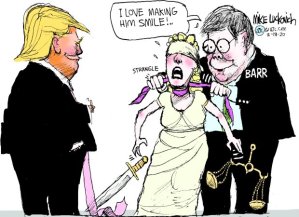
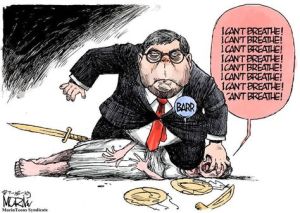
It was already a matter of record that William Barr abused his power as attorney general under former President Donald Trump. Turns out, it’s even worse than we knew.
There’s no question that Barr was fundamentally dishonest (to put it charitably). Federal judges nominated to the bench by presidents of both political parties have found that Barr “lack(ed) … candor“; that his public and in-court statements were “disingenuous,” “incomplete,” “inconsistent” with truth and “called into question Attorney General Barr’s credibility.” Others, including former special counsel Robert Mueller, thousands of former Justice Department officials (including me), and members of Congress have expressed doubt or worse about Barr’s truthfulness and integrity.
Photo by Brook Hummer
We already knew that Barr politicized the Justice Department. He used it defensively to shield Trump from potential criminal exposure by misleading the public about Mueller’s findings, and by declaring, contrary to the evidence and the law, that Trump had not obstructed justice. (In his report, Mueller detailed extensive evidence of obstruction, but declined to clearly state whether he concluded that Trump had committed a crime). And Barr intervened in unprecedented fashion to undermine his own Justice Department’s prosecutions of Trump’s political allies Michael Flynn and Roger Stone.
But recent revelations — that prosecutors in Trump’s Department of Justice subpoenaed Apple for data from the accounts of Democratic members of Congress, their staffs and families — are different in kind. According to The New York Times, Barr even moved a New Jersey-based attorney to the main Justice Department to work on a case related to Rep. Adam Schiff of California, one of the House Democrats whose data was sought. (Barr, the Justice Department and Apple declined to comment on the story to the Times, though the Justice Department’s inspector general has said it will investigate.)
In taking such action, Barr used the staggering power of his position to selectively pursue Trump’s perceived political rivals. This is eerily similar to former President Richard Nixon’s “enemies list” and his efforts at retributive action.
Read the rest at CNN.
In other news, a number of media outlets recently reported that an IG report exonerated Trump of accusations that he ordered protesters cleared from Lafayette Square last year so he could do his despicable photo-op holding up a bible. Not so fast.
On June 1, 2020, as the Black Lives Matter protests were escalating, President Donald Trump, in an effort to project power and restore a sense of “law and order,” decided to walk across the street from the White House and hold aloft a Bible outside St. John’s Church, which had been damaged during a protest the night before.
He was able to do so because the crowd of protesters in Lafayette Square, which abuts the church, had been forcibly cleared by law enforcement in what some outlets referred to as an “attack” — officers from various law enforcement groups used horses, riot shields, batons, pepper spray, and tear gas to clear the area.
Girl in the red dress with cat and dog, by Ammi Phillips, 1788-1865
Reporters and onlookers understandably linked Trump’s desire to hold a photo op with the operation to forcibly clear protesters. But the new IG report has prompted a reevaluation of that linkage with its conclusion that “the evidence we obtained did not support a finding that the USPP (United States Park Police) cleared the park to allow the President to survey the damage and walk to St. John’s Church.”
“Instead, the evidence we reviewed showed that the USPP cleared the park to allow the contractor to safely install the antiscale fencing in response to destruction of property and injury to officers occurring on May 30 and 31,” it says.
Again, not so fast.
But the report does not clarify everything about what happened on June 1. For example, it does not offer perspective on whether the injury to officers actually necessitated clearing the park — a question raised immediately after protesters were removed. Nor does it definitively state that Trump had nothing to with how the clearing was carried out.
In fact, the report also suggests that other law enforcement agencies that were on the scene that day, such as the Secret Service, may have had reasons for taking aggressive action to clear protesters that went beyond the desire to install new fencing.
But because the IG report is limited to the actions of the USPP and did not include interviews with the Secret Service or the attorney general at the time of the incident, Bill Barr — who spoke with law enforcement before the operation began — important questions about the chain of events that led to protesters being forcibly cleared from the area on that day remain unanswered.
I turned on the TV last night to catch a “whoa” look on Chris Hayes’s face as he read the breaking news. The look said it all. We’ve grown accustomed to the depths to which former AG Barr and all those involved in the Trumpist family and Republican Crime syndicate had gone to subvert our institutions. It amazes me that so many folks with a sworn duty to our Constitution could so easily set it on fire. It did not surprise me that the ‘s Justice Department’s Katie Benner broke the story along with support from others. Michael Schmidt had actually been the target of an earlier discovery of Trump’s justice department stalking reporters while finding a Judge to cover it up. Last night we found out those antics extended to key Democratic Congressmen, staff, and even a juvenile family member of one of them.
As the Justice Department investigated who was behind leaks of classified information early in the Trump administration, it took a highly unusual step: Prosecutors subpoenaed Apple for data from the accounts of at least two Democrats on the House Intelligence Committee, aides and family members. One was a minor.
All told, the records of at least a dozen people tied to the committee were seized in 2017 and early 2018, including those of Representative Adam B. Schiff of California, then the panel’s top Democrat and now its chairman, according to committee officials and two other people briefed on the inquiry. Representative Eric Swalwell of California said in an interview Thursday night that he had also been notified that his data had been subpoenaed.
Prosecutors, under the beleaguered attorney general, Jeff Sessions, were hunting for the sources behind news media reports about contacts between Trump associates and Russia. Ultimately, the data and other evidence did not tie the committee to the leaks, and investigators debated whether they had hit a dead end and some even discussed closing the inquiry.
But William P. Barr revived languishing leak investigations after he became attorney general a year later. He moved a trusted prosecutor from New Jersey with little relevant experience to the main Justice Department to work on the Schiff-related case and about a half-dozen others, according to three people with knowledge of his work who did not want to be identified discussing federal investigations.
The zeal in the Trump administration’s efforts to hunt leakers led to the extraordinary step of subpoenaing communications metadata from members of Congress — a nearly unheard-of move outside of corruption investigations. While Justice Department leak investigations are routine, current and former congressional officials familiar with the inquiry said they could not recall an instance in which the records of lawmakers had been seized as part of one.
Moreover, just as it did in investigating news organizations, the Justice Department secured a gag order on Apple that expired this year, according to a person familiar with the inquiry, so lawmakers did not know they were being investigated until Apple informed them last month.
Prosecutors also eventually secured subpoenas for reporters’ records to try to identify their confidential sources, a move that department policy allows only after all other avenues of inquiry are exhausted.
The subpoenas remained secret until the Justice Department disclosed them in recent weeks to the news organizations — The Washington Post, The New York Times and CNN — revelations that set off criticism that the government was intruding on press freedoms.
We found out that the main Congressman stalked by Former AG Barr and Trump was the man Trump constantly called “Shifty Schiff”. Congressman and Chairman of the House Intelligence Committee who immediatlely asked if any of the targets were Republican. No answer has been provided by anyone on that. At the moment, it looks like the use of government resources and the DOJ to hunt down political opponents. The legal community is as stunned as the media.
“Prosecutors, under the beleaguered attorney general, Jeff Sessions, were hunting for the sources behind news media reports about contacts between Trump associates and Russia. Ultimately, the data and other evidence did not tie the committee to the leaks, and investigators debated whether they had hit a dead end and some even discussed closing the inquiry,” the newspaper reported. “But William P. Barr revived languishing leak investigations after he became attorney general a year later. He moved a trusted prosecutor from New Jersey with little relevant experience to the main Justice Department to work on the Schiff-related case and about a half-dozen others, according to three people with knowledge of his work who did not want to be identified discussing federal investigations.”
First Comey, now Schiff. Clear that leak investigations are the way DOJ officials decided they could answer Trump’s demand to target his political opponents while telling themselves they were just following the law. Without a doubt more to come.
The continuing fall out from the destructive Trumpist years continue. This is from Reuters and Linda So: “Trump-inspired death threats are terrorizing election workers ” This, too, is not surprising. Any of us that have been stalked by forced birthers have experienced this.
Note: This story contains offensive language
Late on the night of April 24, the wife of Georgia’s top election official got a chilling text message: “You and your family will be killed very slowly.”
A week earlier, Tricia Raffensperger, wife of Secretary of State Brad Raffensperger, had received another anonymous text: “We plan for the death of you and your family every day.”
That followed an April 5 text warning. A family member, the texter told her, was “going to have a very unfortunate incident.”
Those messages, which have not been previously reported, illustrate the continuing barrage of threats and intimidation against election officials and their families months after former U.S. President Donald Trump’s November election defeat. While reports of threats against Georgia officials emerged in the heated weeks after the voting, Reuters interviews with more than a dozen election workers and top officials – and a review of disturbing texts, voicemails and emails that they and their families received – reveal the previously hidden breadth and severity of the menacing tactics.
Trump’s relentless false claims that the vote was “rigged” against him sparked a campaign to terrorize election officials nationwide – from senior officials such as Raffensperger to the lowest-level local election workers. The intimidation has been particularly severe in Georgia, where Raffensperger and other Republican election officials refuted Trump’s stolen-election claims. The ongoing harassment could have far-reaching implications for future elections by making the already difficult task of recruiting staff and poll workers much harder, election officials say.
In an exclusive interview, Tricia Raffensperger spoke publicly for the first time about the threats of violence to her family and shared the menacing text messages with Reuters.
The Raffenspergers – Tricia, 65, and Brad, 66 – began receiving death threats almost immediately after Trump’s surprise loss in Georgia, long a Republican bastion. Tricia Raffensperger started taking precautions. She canceled regular weekly visits in her home with two grandchildren, ages 3 and 5 – the children of her eldest son, Brenton, who died from a drug overdose in 2018.
“I couldn’t have them come to my house anymore,” she said. “You don’t know if these people are actually going to act on this stuff.”
In late November, the family went into hiding for nearly a week after intruders broke into the home of the Raffenspergers’ widowed daughter-in-law, an incident the family believed was intended to intimidate them. That evening, people who identified themselves to police as Oath Keepers – a far-right militia group that has supported Trump’s bid to overturn the election – were found outside the Raffenspergers’ home, according to Tricia Raffensperger and two sources with direct knowledge of the family’s ordeal. Neither incident has been previously reported.
“Brad and I didn’t feel like we could protect ourselves,” she said, explaining the decision to flee their home.
Brad Raffensperger told Reuters in a statement that “vitriol and threats are an unfortunate, but expected, part of public service. But my family should be left alone.”
You may read more at the link if you can stomach it. And more fall out with links via memeorandum.
Manchin is “acting like Republicans and Democrats are working together on this stuff, and Republicans in Arizona have completely shut the Democrats out of the [legislative] process,” Katie Hobbs, the Democratic secretary of state there, told me in an interview. Similarly, Jennifer Konfrst, the Democratic whip in the Iowa House of Representatives said, “It is unfathomable to me that we would look at this issue and say we have to bring Republicans along, in this political climate, in order to make true change. I don’t see anywhere where Republicans are inviting Democrats along, or inviting Democrats to the table. Why are some Democrats saying ‘I won’t do this unless it’s bipartisan?’”
n its latest tally of state voting laws, the Brennan Center says that since January, 14 states have passed 24 laws restricting voting access. (That’s not likely to be the final tally, because the center also reports that dozens of other restrictive bills are still pending across another 18 states.) Of the new restrictions that have already passed, the Brennan Center qualifies 17 in nine states as “highly restrictive,” imposing the greatest barriers to participation. In all of those nine states, Republicans hold unified control of both the state legislature and the governorship, except for Kansas, where the GOP-legislature overrode Democratic Governor Laura Kelly’s veto of their voting changes.
Every state-legislative Democrat casting a ballot voted against 13 of those 17 laws, according to the Brennan analysis. A single Democratic state House member in Arkansas and Montana, and a single state senator in Wyoming, voted for three of the other bills. The only bill Brennan classifies as restrictive that drew meaningful Democratic support was a second bill in Arkansas, narrowing the forms of identification voters could use at polling places, which a significant number of Democrats from both legislative chambers backed.
Apart from that Arkansas voter-ID bill, the other 16 restrictive Republican measures won support from just two of the 509 state House or Assembly Democrats who voted on them, and just one of the 207 Democratic state senators. No Democrat co-sponsored any of these restrictive bills, the Brennan Center found.
Meanwhile, no more than a single Republican in either legislative chamber voted against any of these bills, other than two measures in Montana (one of which was opposed by two Republican state House members; the other by two GOP state senators) and an absentee-voting bill in Arkansas (that six in the state House opposed). Of the 1,143 state House or Assembly Republicans who voted on these restrictive bills, just 12 voted no (including the six on that one Arkansas bill); among state Senate Republicans, just seven of 458 voted no on any of these measures, the Brennan analysis found. “This was overwhelmingly a Republican partisan push and effort in the states,” says Wendy Weiser, the vice president for democracy at the Brennan Center.
We’re a group of voices over here out of many who see all this as the continuing march to an authoritarian regime. We may have only a few months or years of Joe Biden’s time to cancel all of this. There are many who think that current AG Merrick Garland may not be up to the job. I certainly hope that’s not true but some of this latest stuff seems to be radical and there’s not a time for his subtle approaches. Even, the usual Nixonists agree.
Well, it’s time for your thoughts and shared reads. I’m getting overwhelmed by all of this. It seems ominous at the very least. I still believe we may see another attempt at insurrection in August.
What’s on your reading and blogging list today?
I pulled up behind a Cadillac We were waiting for the light And I took a look at his license plate It said, “just ice” Is justice just ice? Governed by greed and lust? Just the strong doing what they can And the weak suffering what they must? Oh, and the gas leaks And the oil spills And sex sells everything Sex kills
Did you like this post? Please share it with your friends:
ARLINGTON, VIRGINIA – JUNE 10: A partial solar eclipse is seen as the sun rises behind the Capitol Building on June 10, 2021 in Arlington, Virginia. (Photo by Bill Ingalls/NASA via Getty Images)
Good Morning!!
I don’t know why I keep reading articles about the lab-leak theory. It’s not that I necessarily believe it’s true. I certainly don’t believe that a virus was created or modified in the Wuhan lab and then released into the population. I do think it’s possible that a researcher picked up a virus in the field and somehow carelessly infected someone on the outside. I still think the most likely scenario is the cross species (animal-to-human) route, because that clearly happens. I guess I’m just interested in why the argument has arisen in the media and won’t go away.
Anyway, there’s an interesting article on the subject at The Atlantic this morning: Don’t Fall for These Lab-Leak Traps. Recent coverage of the pandemic’s origins has ensnared readers in semantic quibbles, side points, and distractions, by Daniel Engber. I won’t try to summarize the piece because it’s so long, but here’s a bit of what Engber writes about what he calls “the mad scientist trap.”
The lab-leak theory isn’t singular; rather, it’s a catchall for a continuum of possible scenarios, ranging from the mundane to the diabolical. At one end, a researcher from the Wuhan Institute of Virology might have gone out to sample bat guano, become infected with a novel pathogen while in the field, and then seeded it back home in a crowded city. Or maybe researchers brought a specimen of a wild-bat virus back into the lab without becoming infected, only to set it free via someone’s clothes or through a leaky sewage pipe.
The microbiologists Michael Imperiale and David Relman, both former members of the National Science Advisory Board for Biosecurity, told me several weeks ago that lab-leak scenarios of this rather more innocent variety—involving the collection and accidental release of a naturally occuring pathogen—were the most probable of all the non-natural possibilities. Yet the most prominent opinionating on this topic has clustered at the other end of the continuum, at first around the dark-side theory of a bioweapon gone awry, and then around the idea that a harmless virus had been deliberately transformed into SARS-CoV-2 (and released by accident) after a reckless series of tabletop experiments.
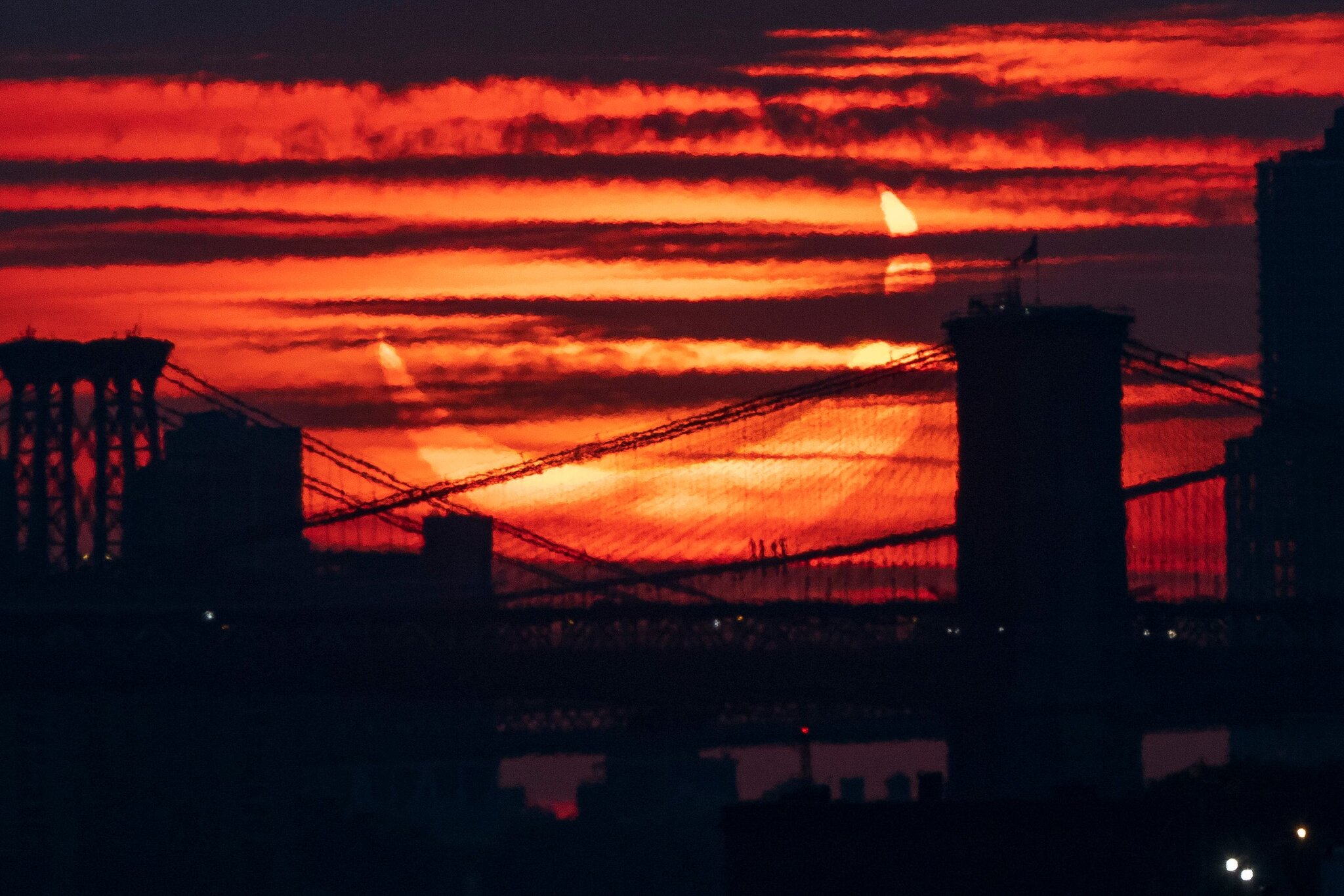
The eclipse viewed from Brooklyn Thursday morning. Justin Lane EPA, via Shutterstock
That’s another pitfall in this debate: a tendency to focus only on the most disturbing and improbable versions of the lab-leak hypothesis, and to downplay the rest. The mad-scientist trap sprays a mist across the facts by presuming scientific motivations; it posits that researchers could have caused the pandemic only if they’d been trying to create infectious pathogens.
Efforts to enhance a virus in a lab, usually described as “gain of function” studies, have engendered hyperbolic speculation….
The problem is, depending on how one chooses to define gain-of-function research, it could well include most virological research, some forms of vaccine development, and a healthy portion of biology writ large. Anytime a scientist tries to probe or tweak the function of a gene, she could be working in this vein. In that sense, yes, the National Institutes of Health is a “huge gain-of-function bureaucracy.” So what?
Engler concludes:
One might assume that the single-minded fear of gain-of-function research is peculiar to conservatives—sitting, as it does, at the shadowy convergence of Big Government and Critical Frankenstein Studies. But the urge to blame scientific hubris for scientific problems, as opposed to farcical incompetence, seems to have long-standing, bipartisan support.
This trap was last sprung seven years ago. In March 2014, a CDC lab accidently shipped the highly virulent H5N1 bird flu to a poultry lab at the Department of Agriculture. Then in June, another CDC lab sent off samples of the bacteria that cause anthrax without properly inactivating them—and 75 government employees were potentially exposed. A few weeks after that, scientists at NIH stumbled across six vials of smallpox in a forgotten cardboard box. Regulators had every reason to believe that accidental laboratory leaks of naturally occurring pathogens were more common (and more likely) than genetic-engineering studies gone awry. But when confronted with all this evidence that scientists were slipping on banana peels, the government looked at other risks instead: It announced a pause on gain-of-function research.
The sun rises next to the Statue of Liberty during an annular eclipse on June 10, 2021 in New York City. (Photo by Gary Hershorn/Getty Images)
We’re in the process of defaulting to the same idea—that better biosafety might be achieved, and the next pandemic headed off, if we prevent or slow the development of genetically engineered bananas. That might only help ensure that no one thinks too hard about the odds of slapstick-fueled catastrophe. We may yet find, with more investigation, that the Wuhan Institute of Virology, and other places like it around the world, is positively strewn with banana peels. If that’s the case, our first and most important goal should be to clean them up. In the meantime, don’t be fooled by false antonyms. The opposite of nature isn’t hubris, and if SARS-CoV-2 turns out not to have a “natural” origin, that doesn’t have to mean someone made it in a lab.
Sorry for the long excerpt, but I do think it’s a useful article. Read more at the link if you’re interested.
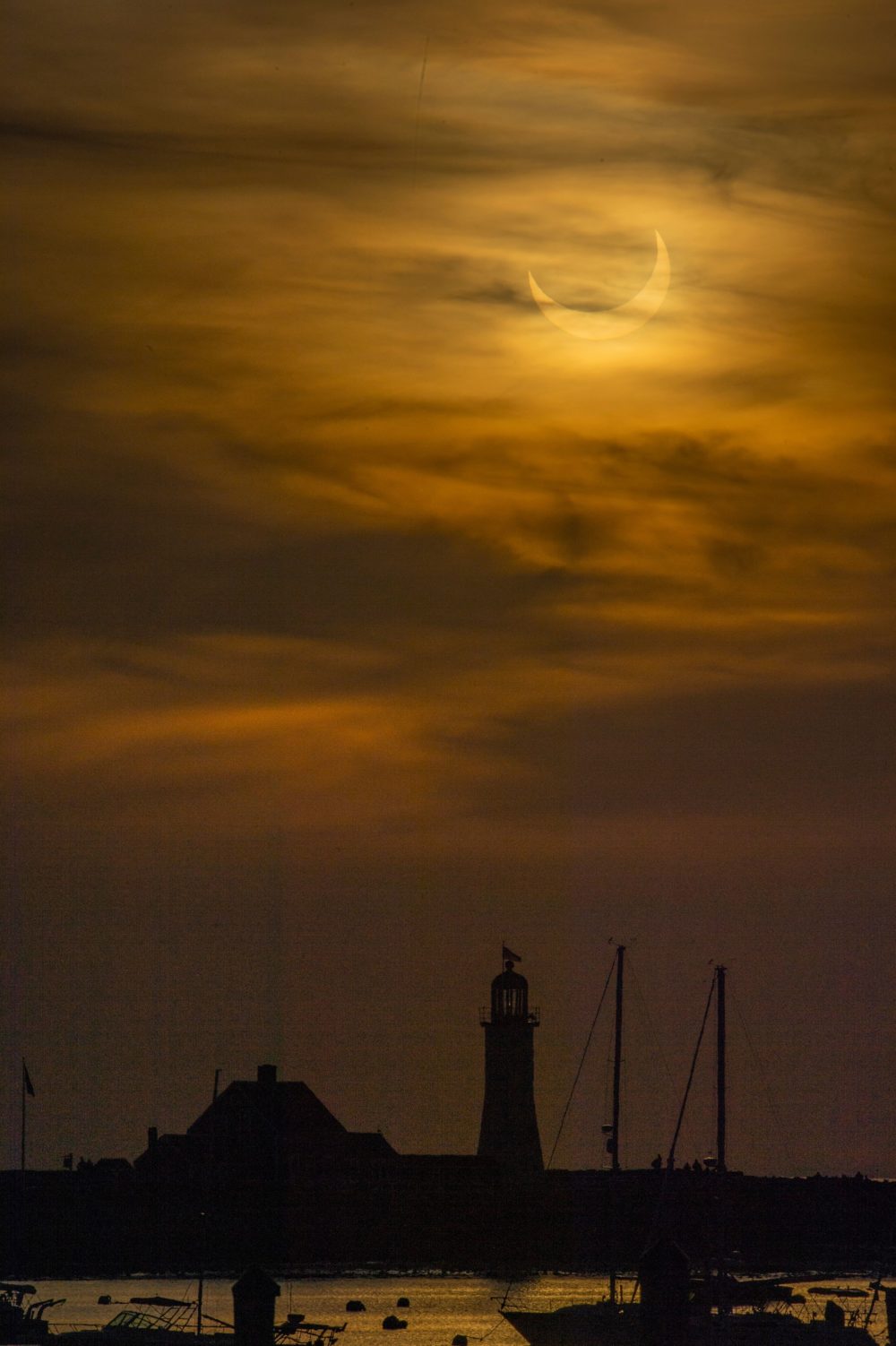
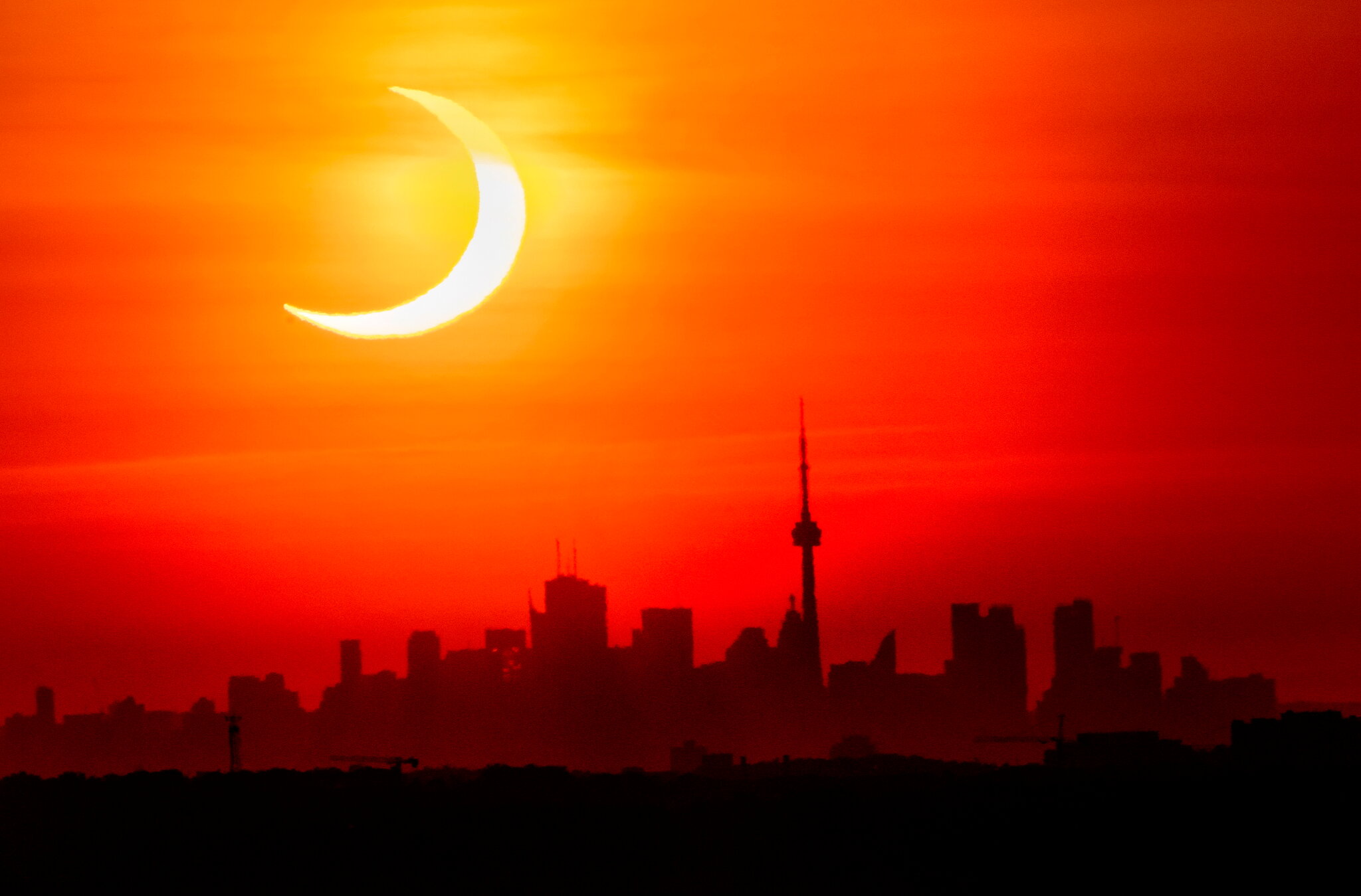
Just after sunrise over the eastern half of North America, the sun was almost completely blotted out by the moon for a few dawn hours in an annular solar eclipse.
During such an eclipse, the black silhouette of the moon — too far from Earth to completely cover the sun — will be surrounded by a thin ring of our home star’s surface, or photosphere. Many know this as a “ring of fire,” but few will get to experience the full effect.
The eclipse started after sunrise north of Lake Superior and began crossing remote regions of Canada, on its way into Greenland and the Arctic Ocean before going over the North Pole. Its course then heads south before ending in parts of the Russian Far East.
Still, some lucky souls got to experience this cosmic geometry, and a few were even intrepid and well organized enough to book airplane flights into the zone of maximum darkness. Many more of us got to experience a partial solar eclipse if we woke up early to clear enough skies….
It was dark and windy as the visitors spread out across the 86th floor observation deck 1,050 feet above midtown, adjusting camera lenses and perfecting positions as they waited for the sun to appear.
When the sky began to lighten and clouds turned shades of fuchsia pink, attendees of the event, who had paid $114.81 each to be there, could be overheard begging the skyline to clear up so there would be a better view….
Finally, the sun rose and the eclipse was visible — if a little hazily — through the cloud cover.
“You could hear the entire audience react at the first viewing of the sun,” said Jean-Yves Ghazi, president of the Empire State Building Observatory. “Everybody was gasping and it was absolutely magical.”
Read more at the link.
Annular (partial solar) eclipse is seen as the sun rises over Scituate Light in Scituate, MA, June 10, 2021. (Photo by Joseph Prezioso / AFP) via Getty Images)
No US President has ever left the nation’s shores with democratic values under attack as broadly and systemically at home as they are abroad. This extraordinary reality will complicate his mission to purge the trauma of the Donald Trump era and convince both foes and friends that the US is reclaiming its global leadership role for good.
Biden meets British Prime Minister Boris Johnson on Thursday before the G7 summit, makes a hop to NATO in Brussels, then has a summit with Russian President Vladimir Putin in Geneva that will evoke the most tense days of the Cold War.
“We’re going to make it clear that the United States is back and democracies of the world are standing together to tackle the toughest challenges,” Biden told US troops at an air base in eastern England on WednesdaFor Biden, democracy is not just some abstract concept from civics class that Americans experience only when they enter the voting booth every few years.
It is a system, a way of life and a set of rules and norms that made the United States the strongest and richest country in history. The free, prosperous nations the US rebuilt and protected after World War II faced down communist tyranny in the form of the Soviet Union and underwrote 70 years of peace. This web of open, like-minded countries is also the key to America’s global power. If democracy ebbs abroad, so does US influence.
The rise of a new superpower, China, determined to overhaul US riches and power is becoming a grave threat to democracy, and offers potential autocrats an alternative power template of one-party rule.
Russia — the adversary that Biden will confront at the end of his Europe trip — meddled in the last two US elections to help Trump, who often seemed to advance its foreign interests over America’s.
But the most extraordinary feature of Biden’s trip is that he’s not an American President going out to confront tyranny abroad — that’s happened before. He’s huddling with US allies at a moment when the greatest threat to democracy comes from within the United States.
The world looked on, horrified, at the insurrection against the US Capitol orchestrated by Trump in January. Since then, the ex-President has poisoned millions of Americans against democracy with his false electoral-fraud claims. Republican state lawmakers are quickly passing bills that make it harder for all but their own supporters to vote and make it easier to steal elections. The principle that voters have the right to pick their own leaders is under threat.
Thursday’s eclipse over the Toronto skyline. Credit Frank Gunn, The Canadian Press, via Associated Press
I don’t see how U.S. democracy can be saved unless Trump and his enablers are investigated and prosecuted. It’s also vitally important to investigate the insurrection that Trump incited on January 6, 2021. There are endless avenues of corruption to deal with from Trump’s four years in office, but here’s the latest to hit the news (actually is old news…).
In a fit of pique over Special Counsel Robert Mueller’s Russia investigation, former President Donald Trump almost reached an “inflection point” and “point of no return” that would have set in motion a Richard Nixon-style “Saturday Night Massacre,” ex-White House Counsel Don McGahn recently told Congress behind closed doors.
The just-released transcript of McGahn’s closed door testimony before the House Judiciary Committee contains a series of new answers and elaborations on details that were publicized in the Mueller Report.
Releasing the June 4th transcript on Wednesday, Judiciary Chair Jerry Nadler (D-N.Y.) said: “Mr. McGahn provided the Committee with substantial new information—including firsthand accounts of President Trump’s increasingly out of control behavior, and insight into concerns that the former President’s conduct could expose both Trump and McGahn to criminal liability.”
“Mr. McGahn also confirmed that President Trump lied when he denied the accuracy of the Mueller report, and admitted that he was the source for a Washington Post report that confirmed Trump’s direction to McGahn to remove the Special Counsel,” Nadler wrote in a statement.
In the transcript, McGahn explains his reluctance to convey a message from Trump pressuring then-Deputy Attorney General Rod Rosenstein to not allow the special counsel to serve because of alleged conflicts—a request that McGahn considered an “inflection point.”
“‘Inflection point,’ with that I meant a point of no return,” McGahn testified. “If the Acting Attorney General received what he thought was a direction from the counsel to the President to remove a special counsel, he would either have to remove the special counsel or resign. We are still talking about the ‘Saturday Night Massacre’ decades and decades later.”
Have a great Thursday Sky Dancers!!
Did you like this post? Please share it with your friends:
The Sky Dancing banner headline uses a snippet from a work by artist Tashi Mannox called 'Rainbow Study'. The work is described as a" study of typical Tibetan rainbow clouds, that feature in Thanka painting, temple decoration and silk brocades". dakinikat was immediately drawn to the image when trying to find stylized Tibetan Clouds to represent Sky Dancing. It is probably because Tashi's practice is similar to her own. His updated take on the clouds that fill the collection of traditional thankas is quite special.
You can find his work at his website by clicking on his logo below. He is also a calligraphy artist that uses important vajrayana syllables. We encourage you to visit his on line studio.















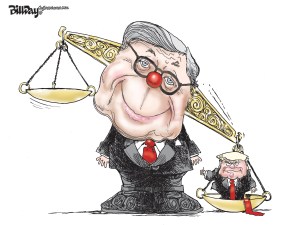 ‘s Justice Department’s Katie Benner broke the story along with support from others. Michael Schmidt had actually been the target of an earlier discovery of Trump’s justice department stalking reporters while finding a Judge to cover it up. Last night we found out those antics extended to key Democratic Congressmen, staff, and even a juvenile family member of one of them.
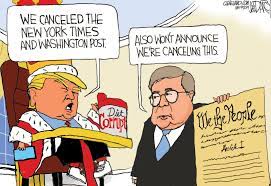 We found out that the main Congressman stalked by Former AG Barr and Trump was the man Trump constantly called “Shifty Schiff”. Congressman and Chairman of the House Intelligence Committee who immediatlely asked if any of the targets were Republican. No answer has been provided by anyone on that. At the moment, it looks like the use of government resources and the DOJ to hunt down political opponents. The legal community is as stunned as the media.
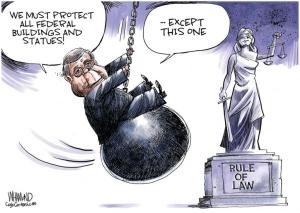 The continuing fall out from the destructive Trumpist years continue. This is from Reuters and Linda So: “
 You may read more at the link if you can stomach it. And more fall out with links via memeorandum.
 We’ve just got a potpourri of Trump-inspired attacks on our Democracy. It’s disgusting and frightening! Ronald Brownstein–writing for The Atlantic–has this analysis: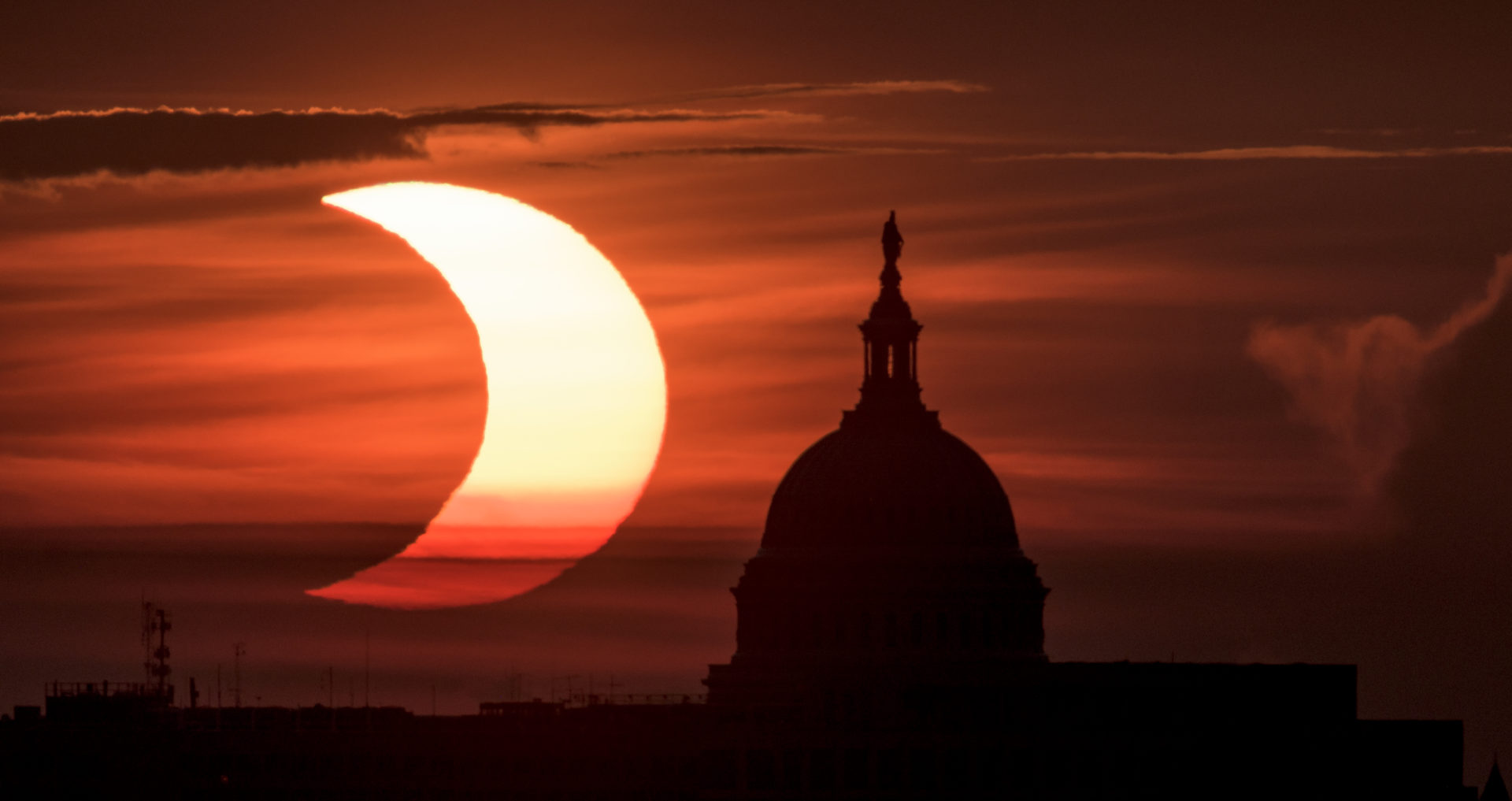


 peej
peej Carissa
 bostonboomer
 dakinikat
 ecocatwoman
 mablue2
 Mama Lopez
 peggysue22
 quixote
 skydancingguestblogger
 Mona (aka Wonk the Vote)



 Sky Dancing
Recent Comments