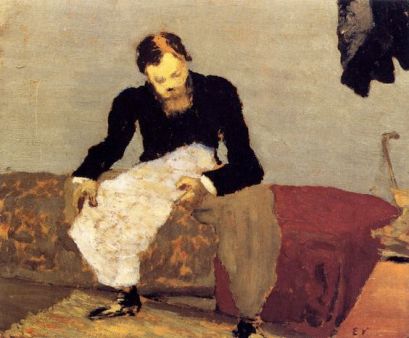
Ker-Xavier Roussel Reading the Newspaper, 1893, Private Collection Édouard Vuillard
Happy World Press Freedom Day Sky Dancers!
A Free Press is enshrined in our Constitution here in the United States. It’s always been a hallmark of open, democratic societies. So, how is the press doing in this day of increasing right-wing authoritarianism?
The world of journalism faces “drastic losses”, the UN has warned, as it highlights the importance of ‘information as a public good’ on World Press Freedom day.
The intergovernmental organisation says the current coronavirus crisis has forced closures and job cuts within the industry, while other media outlets are facing “political capture”.
The result is more “creeping news deserts” in countries where journalists are unable to get accurate information out to the public.
You may read country descriptions based on the Press Freedom Index on the challenges faced by journalists.
A grim reminder: Turkey is still one of the world's biggest jailers of journalists. Since 2016, at least 180 media outlets have been shut down in Turkey and scores of journalists have been imprisoned.#FreeTurkeyMedia#PostForThePresspic.twitter.com/BJ81Sy4gtb
We may be going back towards normalcy with the White House recognizing the role of a free press today. You may remember that we spent the last four years hearing how the press was the enemy of the people unless it presented stories that flattered and backed-up the delusional rantings of the previous guy. It is also high time the Saudis pay for killing one of our journalists. This is just one of the atrocities the previous guy ignored.
Will Biden stand up to the Saudis for the Prince’s murder of Jamal Khashoggi? This is from NBC.
The Biden administration earlier this year released a U.S. intelligence report implicating the crown prince in the 2018 murder of Saudi journalist Jamal Khashoggi but spared him any direct punishment. The prince denies any involvement.
On World Press Freedom Day – Remember those who've lost their lives, been jailed, been beaten and been threatened for trying to get the word out. #PostForThePress Justice for Jamal Khashoggi.#JamalKhashoggi@POTUS Free jailed reporters across the Globe.@RSF_enpic.twitter.com/bvC1zq8cPK
We have impeached judges before. Is this the decade of taking out the trash dumped in our justice system? Perhaps we could at least develop and enforce standards of ethical behavior for judges?
A lot of hand-wringing has accompanied Supreme Court Justice Amy Coney Barrett’s$2 million book deal (including from those of us who wish we had a $2 million book deal). While there’s always reason to worry when big piles of money land on the court, and Coney Barrett has wasted little time monetizing her new job, some larger points are getting lost in all of this.
After all, Coney Barrett isn’t the first justice to reel in a big book deal. Justice Sonia Sotomayor collected an advance of more than $3 million for her memoir, and Justice Clarence Thomas got $1.5 million for his. Justice Neil Gorsuch was paid $225,000 for a book about the Constitution. Here’s the rub: Federal ethics guidelines mandate that justices can’t accept more than about $30,000 annually in outside pay. However, book income — which can reliably bring in much larger sums than the relatively modest pay justices receive for teaching gigs — is exempt from the guidelines.
When these deals arise, concerns are often voiced about justices being compromised by pocketing money from publishers who might have free speech and other issues affecting them before the court. But books are only a small part of a bigger problem: The Supreme Court’s conflicts of interest and financial disclosure rules remain ragged and outdated.
Unlike every other member of state and federal judiciaries, the court’s nine justices aren’t subject to an ethical code of conduct. That mirrors the latitude given the presidency, which also isn’t beholden to most guidelines circumscribing financial and professional practices of people in lower-ranking government jobs. Former President Donald Trump’s tenure, marked by flagrant financial conflicts of interest, is a reminder of how ineffective self-regulating ethics are when someone isn’t really interested in self-regulation.
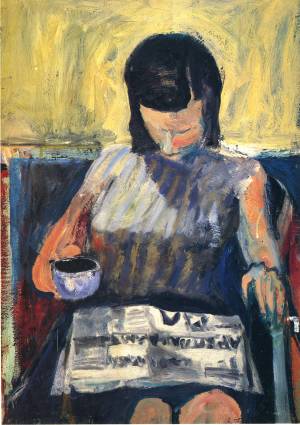
Woman with a newspaper, Richard Diebenkorn
The danger of right-wing propaganda to our Democracy has been an ongoing issue in the last several centuries. It has always skirted the First Amendment in terms of substance and motivation. We depend on an educated populace to search out the truth among many sources. The role it has played in putting public health issues into the realm of political cosplay is beyond the pale. Derek Thomas writes this for The Atlantic: “Millions Are Saying No to the Vaccines. What Are They Thinking? Feelings about the vaccine are intertwined with feelings about the pandemic.” It’s also intertwined with politics and right-wing news media falsehoods.
What are they thinking, these vaccine-hesitant, vaccine-resistant, and COVID-apathetic? I wanted to know. So I posted an invitation on Twitter for anybody who wasn’t planning to get vaccinated to email me and explain why. In the past few days, I spoke or corresponded with more than a dozen such people. I told them that I was staunchly pro-vaccine, but this wouldn’t be a takedown piece. I wanted to produce an ethnography of a position I didn’t really understand.
The people I spoke with were all under 50. A few of them self-identified as Republican, and none of them claimed the modern Democratic Party as their political home. Most said they weren’t against all vaccines; they were just a “no” on thisvaccine. They were COVID-19 no-vaxxers, not overall anti-vaxxers.
Many people I spoke with said they trusted their immune system to protect them. “Nobody ever looks at it from the perspective of a guy who’s like me,” Bradley Baca, a 39-year-old truck driver in Colorado, told me. “As an essential worker, my life was never going to change in the pandemic, and I knew I was going to get COVID no matter what. Now I think I’ve got the antibodies, so why would I take a risk on the vaccine?”
Some had already recovered from COVID-19 and considered the vaccine unnecessary. “In December 2020 I tested positive and experienced many symptoms,” said Derek Perrin, a 31-year-old service technician in Connecticut. “Since I have already survived one recorded bout with this virus, I see no reason to take a vaccine that has only been approved for emergency use. I trust my immune system more than this current experiment.”
Others were worried that the vaccines might have long-term side effects. “As a Black American descendant of slavery, I am bottom caste, in terms of finances,” Georgette Russell, a 40-year-old resident of New Jersey, told me. “The fact that there is no way to sue the government or the pharmaceutical company if I have any adverse reactions is highly problematic to me.”
Many people said they had read up on the risk of COVID-19 to people under 50 and felt that the pandemic didn’t pose a particularly grave threat. “The chances of me dying from a car accident are higher than my dying of COVID,” said Michael Searle, a 36-year-old who owns a consulting firm in Austin, Texas. “But it’s not like I don’t get in my car.”
And many others said that perceived liberal overreach had pushed them to the right. “Before March 2020, I was a solid progressive Democrat,” Jenin Younes, a 37-year-old attorney, said. “I am so disturbed by the Democrats’ failure to recognize the importance of civil liberties. I’ll vote for anyone who takes a strong stand for civil liberties and doesn’t permit the erosion of our fundamental rights that we are seeing now.” Baca, the Colorado truck driver, also told me he didn’t vote much before the pandemic, but the perception of liberal overreach had a strong politicizing effect. “When COVID hit, I saw rights being taken away. So in 2020, I voted for the first time in my life, and I voted all the way Republican down the ballot.”
In many ways, the 2020 election was basically like every recent Americanpresidentialelection: The Republican candidate won the white vote (54 percent to 44 percent, per CES), and the Democratic candidate won the overwhelming majority of the Black (90 percent to 8 percent), Asian American (66 percent to 31 percent) and Hispanic (64 percent to 33 percent) vote. Like in 2016, there was a huge difference among non-Hispanic white voters by education, as those with at least a four-year college degree favored Biden (55 percent to 42 percent), while those without degrees (63 to 35) favored Trump. (There wasn’t a huge education split among voters of color.)1
Othersurveystell the same general story: Trump won white voters overall by a margin in the double digits and won whites without four-year degrees by even more; Trump lost among whites with at least a four-year college degree, lost by a big margin with Asian American and Latino voters and lost by an enormous margin among African Americans.
So the main reason that Trump nearly won a second term was not his increased support among Latinos, who are only about 10 percent of American voters and are a group he lost by more than 20 points. Trump’s main strength was his huge advantage among non-Hispanic white voters without college degrees, who are about 45 percent of American voters. His second biggest bloc of support was among non-Hispanic white Americans with degrees, who are about 30 percent of all voters. According to the CES, over 80 percent of Trump’s voters were non-Hispanic white voters, with or without a college degree. In contrast, around 70 percent of nonwhite voters supported Biden, and they made up close to 40 percent of his supporters. So it is very much still the case that the Republicans are an overwhelmingly white party and that the Democratic coalition is much more racially diverse.
Speaker One: "Don't amplify!"
Speaker Two: "I hear you, but sometimes we have to!"
The story began when Chalmette State Representative Raymond Garofalo proposed a bill where-in he wanted to ban “critical race theory” from being taught, a complex subject that conservatives have been using as a talking point recently to score political points. He said that he, in fact, wanted to “teach the good, the bad, and the ugly” about slavery. To which Hilferty replied, “There’s nothing good about slavery” to laughter.
Garofalo corrected himself, saying that, “You’re right. I didn’t mean to imply that. I don’t believe that, and I know that’s the case. But I’m using the term, ‘the good, bad, and ugly as a generic way of saying that you can teach any facts, factually based on anything.”
Both Hilferty and Garofalo have spoken directly to the media about the incident. Garofalo has tried to clarify his words, explain the terminology “good, bad, and ugly” was meant “generically,” and Hilferty claimed he was, “…talking about the good in slavery.”
Whether Garofalo meant that there were good aspects to slavery or whether he was speaking “generically,” Huckaby repeatedly came to his defense, and to the defense of slavery itself. The above was not her only post related to slavery and Garofalo. She also wrote in another post, “Slavery goes all they [sic] way back to biblical times, and if you’ve read your Bible, you would know that many of the slaves loved their masters, and their masters loved them, and took very good care of them, and their families.”
In addition, she indicated that, “Stephanie (Hilferty) has been indoctrinated by leftis [sic] marxisum [sic] education.”
So, hmm, I’m a communist troll in her eyes. So bet it! At this point, I’ll take any moniker that doesn’t include what she’s all about.
Anyway, you’ll have a good week! What’s on your reading and blogging list today?
Did you like this post? Please share it with your friends:
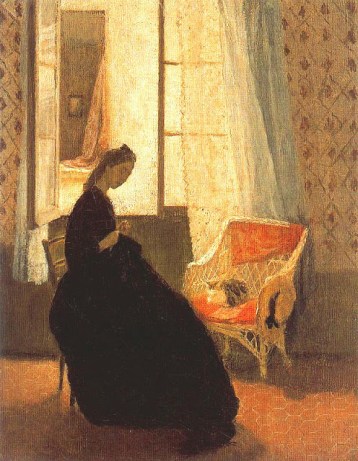
Gwen John (British painter, 1876-1939) Interior with Woman Sewing at Window and Cat
Good Afternoon!!
It’s the weekend, and we should be having fun even though we’re in the midst of a global pandemic with wars raging around the world and our democracy still in danger because one of our political parties has turned into a suicidal cult obsessed with conspiracy theories, led by a pathetic huckster who is rapidly sinking into dementia. So before I start on the news of the day, here’s a fun read at The New Yorker:
The article is long and involved, so there’s no way to summarize it with excerpts, but here’s just a taste:
The government may not have been in regular touch with exotic civilizations, but it had been keeping something from its citizens. By 2017, [Leslie] Kean was the author of a best-selling U.F.O. book and was known for what she has termed, borrowing from the political scientist Alexander Wendt, a “militantly agnostic” approach to the phenomenon. On December 16th of that year, in a front-page story in the Times, Kean, together with two Times journalists, revealed that the Pentagon had been running a surreptitious U.F.O. program for ten years. The article included two videos, recorded by the Navy, of what were being described in official channels as “unidentified aerial phenomena,” or U.A.P. In blogs and on podcasts, ufologists began referring to “December, 2017” as shorthand for the moment the taboo began to lift. Joe Rogan, the popular podcast host, has often mentioned the article, praising Kean’s work as having precipitated a cultural shift. “It’s a dangerous subject for someone, because you’re open to ridicule,” he said, in an episode this spring. But now “you could say, ‘Listen, this is not something to be mocked anymore—there’s something to this.’ ”
Since then, high-level officials have publicly conceded their bewilderment about U.A.P. without shame or apology. Last July, Senator Marco Rubio, the former acting chairman of the Select Committee on Intelligence, spoke on CBS News about mysterious flying objects in restricted airspace. “We don’t know what it is,” he said, “and it isn’t ours.” In December, in a video interview with the economist Tyler Cowen, the former C.I.A. director John Brennan admitted, somewhat tortuously, that he didn’t quite know what to think: “Some of the phenomena we’re going to be seeing continues to be unexplained and might, in fact, be some type of phenomenon that is the result of something that we don’t yet understand and that could involve some type of activity that some might say constitutes a different form of life.”
Mann mit Katze. Christoph Paudiss 1618 Private Collection
Last summer, David Norquist, the Deputy Secretary of Defense, announced the formal existence of the Unidentified Aerial Phenomena Task Force. The 2021 Intelligence Authorization Act, signed this past December, stipulated that the government had a hundred and eighty days to gather and analyze data from disparate agencies. Its report is expected in June….
Leslie Kean is a self-possessed woman with a sensible demeanor and a nimbus of curly graying hair. She lives alone in a light-filled corner apartment near the northern extreme of Manhattan, where, on the wall behind her desk, there is a framed black-and-white image that looks like a sonogram of a Frisbee. The photograph was given to her, along with chain-of-custody documentation, by contacts in the Costa Rican government; in her estimation, it is the finest image of a U.F.O. ever made public. The first time I visited, she wore a black blazer over a T-shirt advertising “The Phenomenon,” a documentary from 2020 with strikingly high production values in a genre known for grainy footage of dubious provenance. Kean is
stubborn but unassuming, and she tends to speak of the impact of “the Times story,” and the new cycle of U.F.O. attention it has inaugurated, as if she had not been its principal instigator. She told me, “When the New York Times story came out, there was this sense of ‘This is what the U.F.O. people have wanted forever.’ ”
Kean is always assiduously polite toward the “U.F.O. people,” although she stands apart from the ufological mainstream.
India posted a record daily rise of 401,993 new coronavirus cases on Saturday as the country opened up its massive vaccination drive to all adults, although several states warned of acute shortages.
It was the first time India’s daily case count had topped 400,000 after 10 consecutive days over 300,000. Deaths from Covid-19 jumped by 3,523 over the past 24 hours, taking the total toll in India to 211,853, according to official data.
The world’s biggest producer of Covid-19 vaccines has a limited number of shots available, worsening a grim second wave of infections that has overwhelmed hospitals and morgues while families scramble for scarce medicines and oxygen.
Hundreds of people were seen queuing to be vaccinated across Ahmedabad, the main commercial city in Prime Minister Narendra Modi’s home state of Gujarat, on Saturday.
Blaze at an Indian hospital Covid-19 ward kills 18
Eighteen people are dead after a fire broke out at a Covid-19 hospital ward in India’s Gujarat state in the early hours of Saturday.
Lillian Lancaster c. 1887-1973, The Boy and the Cat; Grundy Art Gallery
The fire broke out in the intensive care unit of the Welfare Hospital in the western state’s Bharuch district, according to Dr. MD Modiya, a senior district official.
According to Modiya, 16 of the dead were patients. Two were staff members.
Nearly 60 patients were in the hospital at the time of the fire, which broke out around 1 a.m. local time, he said. The remaining patients have been moved to nearby hospitals.
The cause of the fire is yet to be determined but initial investigations suggest a short circuit, according to Dr Modiya.
In a tweet on Saturday, Gujarat’s chief minister, Vijay Rupani, said two senior officers from the Indian Administrative Service have been dispatched to Bharuch to investigate the fire. The state government will open a judicial inquiry into the fire, he added.
In an earlier post, Rupani offered his condolences to the patients and staff at Welfare Hospital and offered $5,398 in compensation to the families of each of the victims.
Indian Prime Minister Narendra Modi also tweeted his condolences.
“Pained by the loss of lives due to a fire at a hospital in Bharuch,” he said. “Condolences to the bereaved families.”
Vaccine shortage halts rollout across two more Indian states
India’s southern states Telangana and Andhra Pradesh have become the latest to postpone Saturday’s planned national Covid-19 vaccination rollout, citing shortages of shots.
On Friday, Telangana’s Director of Public Health, Dr. G. Srinavasa Rao, tweeted that the state wouldn’t be vaccinating people over the weekend as it hadn’t received doses.
In neighboring Andhra Pradesh, officials have acknowledged that it was not “practically possible” to start vaccinating those over the age 18 due to limited stocks.
“If we need to fulfil the commitment to the former age group batch, it is definitely going to take all of May,” Anil Kumar Singhal, Andhra Pradesh’s Principal Health Secretary, told reporters on Friday.
At least seven states and territories are facing shortages that are impacting the planned vaccine rollout.
New Delhi — The first shipment of emergency medical aid supplies from the United States arrived in India on Friday as the country continued battling an explosion of coronavirus cases that has strained its health care system to breaking point. A U.S. military transport plane carrying more than 400 oxygen cylinders, nearly one million rapid coronavirus test kits and other supplies landed in Delhi on Friday morning.
But as mass vaccination centers were forced to close without any doses to stick in arms, and people continued to die without oxygen at jam-packed hospitals, the aid from the U.S. and other countries that’s started to pour in is like a Band-Aid for a severed leg….
“The United States stands with India as we fight the COVID-19 pandemic together,” said the U.S. Embassy in India in a tweet.
India’s External Affairs Ministry thanked the U.S. for the contributions, which were the first step toward fulfilling President Joe Biden’s pledge earlier this week to support India in its “time of need… Just as India sent assistance to the United States as our hospitals were strained early in the pandemic.”
Victims of India’s devastating COVID-19 surge are being cremated in parking lots, with one crematorium so overwhelmed that it has launched a ticketing system.
In the past two weeks, the number of new daily COVID-19 cases in India has repeatedly broken global records, with the country recording thousands of new deaths every day.
The staff at the Seemapuri crematorium in New Delhi recently erected several extra burning platforms in the parking lot to keep up with the staggering demand, CNN reported.
Cremation is the standard death rite in Hinduism, India’s dominant religion, and crematoriums are under intense pressure.
“Before the pandemic, we used to cremate eight to 10 people” a day, Jitender Singh Shunty, the head of the Seemapuri crematorium, told CNN. “Now, we are cremating 100 to 120 a day.”
Man with Cat, Candace Hunt
Madhukar Pai and Manu Prakash at The Washington Post: Opinion: India’s covid-19 crisis is a dire warning for all countries.
The covid-19 crisis in India is a massive setback for the entire world. The scale of the nation’s surge is a warning not only for its neighboring countries, which are also experiencing sharp increases in cases, but also for countries around the globe. If we do not heed this warning and work on vaccine equity, we risk a forever pandemic with long-term cycles of lockdowns, economic damage and constant fear.
India is reporting more than 380,000 cases and 3,500 deaths daily. Both are underestimates. The Indian health-care system is completely overwhelmed. It is impossible to find hospital beds. Supplies such as oxygen are incredibly scarce, and there is a huge backlog with diagnostic testing. Many people with sick family members and friends in India — including us — are checking in on them. This time around, younger people are sick and, as is always the case, the poor are hit the hardest.
India has 95,000 intensive care beds and 48,000 ventilators. By mid-May, it is projected that the country will need 340,000 beds and more than 700,000 ventilators. Rural India has few of these and is already hit hard. India needs the global community’s support to survive this crisis.
The devastating second wave in India is the result of a perfect storm: a failure to plan for a second wave; premature relaxation of public health measures; large gatherings; insufficient vaccination coverage; and newer variants such as B.1.1.7 and B.1.617 that are highly transmissible and potentially more severe.\India has 95,000 intensive care beds and 48,000 ventilators. By mid-May, it is projected that the country will need 340,000 beds and more than 700,000 ventilators. Rural India has few of these and is already hit hard. India needs the global community’s support to survive this crisis.\Even as India struggles to get the second wave under control, cases are surging among India’s neighbors, including Nepal, Pakistan, Bangladesh and Sri Lanka. While the exact variant driving the new surges among India’s neighbors is unclear, the B.1.617 variant has already spread to more than 18 countries….
India has 95,000 intensive care beds and 48,000 ventilators. By mid-May, it is projected that the country will need 340,000 beds and more than 700,000 ventilators. Rural India has few of these and is already hit hard. India needs the global community’s support to survive this crisis.
Even as India struggles to get the second wave under control, cases are surging among India’s neighbors, including Nepal, Pakistan, Bangladesh and Sri Lanka. While the exact variant driving the new surges among India’s neighbors is unclear, the B.1.617 variant has already spread to more than 18 countries.
Other countries in South Asia have far less resources and medical infrastructure compared with India. Nepal, for example, has 1,486 ICU beds and 634 ventilators , and Nepal’s health ministry is anticipating a need to treat 15,000 ICU patients by July. Bangladesh, home to 163 million people, has only 1,134 covid-19 ICU beds. Pakistan, the fifth-largest country in the world, has fewer than 4,000 ventilators. India’s neighbors can ill afford the kind of devastation India is experiencing.
Read the rest at the WaPo.
I’m running out of space, but I’ll end with some links to the latest on the huge–but fun for us–Rudy Giuliani story:
The Sky Dancing banner headline uses a snippet from a work by artist Tashi Mannox called 'Rainbow Study'. The work is described as a" study of typical Tibetan rainbow clouds, that feature in Thanka painting, temple decoration and silk brocades". dakinikat was immediately drawn to the image when trying to find stylized Tibetan Clouds to represent Sky Dancing. It is probably because Tashi's practice is similar to her own. His updated take on the clouds that fill the collection of traditional thankas is quite special.
You can find his work at his website by clicking on his logo below. He is also a calligraphy artist that uses important vajrayana syllables. We encourage you to visit his on line studio.








 India has 95,000 intensive care beds and 48,000
 peej
peej Carissa
 bostonboomer
 dakinikat
 ecocatwoman
 mablue2
 Mama Lopez
 peggysue22
 quixote
 skydancingguestblogger
 Mona (aka Wonk the Vote)



 Sky Dancing
Recent Comments