Take my advice for tonight’s debate. Don’t watch the pundits or you’ll need some form of tranquilizer. Have I mentioned how horrible Andrea Mitchell is lately?
So, the debate is tonight and of course, we’ll be live blogging the drama. I am assuming there will be drama. I’m still trying to figure out if there will be blood. Several little bits about the particulars first before we get on with the big build up to the event.
Bloomberg TV will conduct on-screen fact checks of statements made by both Donald Trump and Hillary Clinton during Monday night’s debate, POLITICO has confirmed.
The channel’s decision to conduct an on-screen fact-check sets Bloomberg apart from the other major TV networks, none of whom have committed to doing on-screen fact checks during the debate. Most will leave the fact-checking to segments in the post-debate analysis coverage.
Clinton’s supporters have called for aggressive fact-checking during Monday’s debate, saying that members of the media have failed to adequately fact-check and correct falsehoods from her Republican rival. NBC’s Matt Lauer was recently criticized for not correcting several false statements from Trump during a presidential forum on the network.
Spokespeople for the networks told POLITICO that on-screen fact checks would be hard to execute in real-time, which is why they were opting out. That leaves the real-time fact-checking up to NBC’s Lester Holt, the debate moderator, or Clinton herself.
The first presidential debate between Hillary Clinton and Donald Trump is tonight at 9 p.m. Eastern. It will be televised on all major broadcast and cable news networks.
AIR TIME: The debate will begin at 9 p.m. Eastern. It’s scheduled to end at 10:30 p.m. Eastern.
TV CHANNEL: This debate will be broadcast live on all the major networks and leading cable sites, including ABC, CBS, NBC, CNN, CNBC, Fox, Fox News, MSNBC, and PBS NewsHour and Univision.
To find out what channel the station you want to watch is on for you, click here to go to TV Guide’s listings. Then change the “Provider” (right under TV Listings) to your local provider. You’ll be able to scroll down to see what channel the station you’re interested in is on for you.
Over that stretch I have tried to develop my own pressthink in reply to “theirs,” meaning the ideas most campaign journalists have about their work, and the explanations they tend to give when criticized for it. I tried to summarize the first 20 years of this tension in my 2011 lecture: Why Political Coverage is Broken. What I said there is still basic to how I do my criticism, but Trump’s spectacular intervention has raised the stakes and altered the terms of the debate.
Trump is not a normal candidate and can’t be covered like one. Journalists have finally accepted that. Just the other day Dean Baquet, editor of the New York Times, said this about Trump
He’s been hugely challenging. I don’t think we’ve ever had somebody who in my time as a journalist so openly lies, and that was a word that we struggled to actually utter. We’re used to, I think as journalists, we’re used to philosophical debates, like one party thinks we should go to war on Iraq, makes its case—exaggerates its case, we now know. But there are warring philosophies. I’ve never quite seen anything like [Trump], and I think it’s a real challenge for us.
Elections were about warring philosophies. Journalists sat in the press box and brought you the action. Baquet admits: this organizing image no longer organizes much. But even his phrase “hugely challenging” understates it, I think. Here are the major propositions I have been using to understand this unique and perilous moment.
1. Political journalism rests on a picture of politics that journalists and politicos share.
As practiced by the “mainstream media” (the professionals who work at NBC, ABC, CBS, CNN, PBS, NPR, the AP, the New York Times, the Washington Post, the Wall Street Journal, the Los Angeles Times, USA Today, Reuters, Bloomberg, Politico, Time magazine) political journalism is constructed — it rests entirely — on a mental picture of the American system in which the two major parties are similar actors with, as Baquet put it, “warring philosophies.”
Elections are the big contests that distribute power between them. The day-to-day of politics is a series of minor battles for tactical advantage. The press is part of this picture because it distributes attention, but — in this view of things — it doesn’t participate in politics itself. It reports on battles large and small, questions the power holders, tries to reveal machinations going on behind the scenes and generates public interest in the drama of politics. But it is unaligned with the major players and unaffected by the outcome of the contests it chronicles.
To report successfully on such a system you need sources who trust you inside both parties. You need people in both parties who will return your calls and have drinks with you at the Des Moines Marriott. The simplest way to guarantee that is to look at politics in the same way that people in the party establishments do. The political pros who staff the committees and run the campaigns and consult with the big players are the closest readers of political journalism and closest in outlook to the journalists who consider reporting on politics their profession.
I called this a mental picture, but it’s more than that. It’s a stable framework within which work can be done, coverage can be planned, knowledge can be refined, reputation can be won, careers can be built. The image of two similar parties with warring philosophies that compete for tactical advantage also positions the mainstream press in a comfortable way: between partisan players as chronicler, questioner and referee. Among those most comfortable with that position: media owners and managers hoping to alienate as few people as possible.
In other words: powerful forces keep the mental picture in place.
2. Asymmetry between the parties fries the circuits of the mainstream press.
Now imagine what happens when over time the base of one party, far more than the base of the other, begins to treat the press as a hostile actor, and its own establishment as part of the rot; when it not only opposes but denies the legitimacy — and loyalty to the state — of the other side’s leader; when it prefers conspiracy theory to party-friendly narratives that at least cope with verified fact; when it is scornful of the reality that in a divided system you never get everything you want.
This is the thesis that Thomas Mann and Norman Ornstein developed in their 2012 book, It’s Even Worse Than It Looks. They are think tank scholars with PhDs and Washington insiders who were frequently called on by journalists to explain trends and furnish quotes. They had the same incentives as journalists to stay on conversant terms with politicos in both parties. Mann and Ornstein came to the conclusion that something had changed in the Republican Party. Their summary of it: #
The GOP has become an insurgent outlier in American politics. It is ideologically extreme; scornful of compromise; unmoved by conventional understanding of facts, evidence and science; and dismissive of the legitimacy of its political opposition. When one party moves this far from the mainstream, it makes it nearly impossible for the political system to deal constructively with the country’s challenges.
Political scandals, whether focused on Hillary Clinton’s email use or Donald Trump’s shady business dealings, have emerged as one of the most popular talking points of the 2016 presidential election. But as John Oliver explained on the latest“Last Week Tonight,” when you break down all the alleged scandals plaguing both candidates, it’s overwhelmingly clear that there is no contest: Trump is “unethically compromised to an almost unprecedented degree.”
“This campaign has been dominated by scandals, but it is dangerous to think that there is an equal number on both sides,” Oliver said. “You can be irritated by some of Hillary’s—that is understandable—but you should then be fucking outraged by Trump’s.”
–ANALYSIS — ABC’s RICK KLEIN: What if he apologizes? What if he behaves himself? What if he drops “Crooked Hillary” for “Madam Secretary”? What if – stay with us here – he doesn’t stretch the truth? Forget the no-holds-barred attacks Donald Trump has proven himself capable of. Hillary Clinton’s worst nightmare might be humble Trump, since that would flip storylines enough to potentially dominate the takeaways regardless of what else happens at Hofstra. Clinton’s camp is pressuring Lester Holt to do the fact-checking the candidate doesn’t want to do by herself. But she may be in the position of wanting and needing to draw Trump out – to bait him into a discussion of President Obama’s birth status, for instance, or a real policy discussion on Iraq or Afghanistan or ISIS. Clinton-as-aggressor would surely be unexpected. It also may be helpful in a race where she continues to struggle to lock down her base. The latest ABC News/Washington Post poll shows Trump getting a larger share of Republicans and of Romney voters than Clinton is of Democrats and Obama voters. Clinton isn’t known for smackdowns. But it may not hurt for her to show some fight.
— Reviewing the coverage ahead of Trump’s 9 p.m. showdown with Hillary Clinton at Hofstra University makes it sound like all the GOP nominee really needs to do is not talk about how well-endowed he is…
“I think that Trump is buoyed by the very low expectations. This is a guy who’s never debated one-on-one … So if he does passably, we’ll all say he won,” a Politico reporter said last week. The headline of a lead story on Politico this morning, citing anonymous “insiders,” declares that “The heat is on Hillary.”
“A lot of people are going to look at Donald Trump and think, ‘Hey, if he can even get out a good sentence and show off his experience, then he’s doing well,’” New York Times correspondent Yamiche Alcindor said on “Morning Joe” last week, addressing the Clinton campaign’s complaints that she’s being subjected to a double standard.
“Clinton has the much tougher task tonight,” NPR declares in its curtain-raiser this morning.“She has the burden of high expectations. The former senator and secretary of state, who’s now been through two presidential campaigns, is an experienced debater who knows policy inside and out. But her job is very hard — Clinton has to convince voters who don’t want to vote for Trump but haven’t warmed up to her that she is likeable, honest and trustworthy. And she has to press her case that Trump is unqualified to be president without being overly aggressive or ‘harsh.’”
“I do think that the stakes are much higher in this debate and all the debates for Hillary Clinton,” CNN’s Dana Bash said on the air recently. “Because she is a seasoned politician. She is a seasoned debater. Yes, we saw Donald Trump in the primaries debate for the first time, but he is a first-time politician. So for lots of reasons—maybe it’s not fair, but it’s the way it is—the onus is on her.”
The liberal group Media Matters has rounded up several other examples in this vein. The editor in chief of The Hill, Bob Cusack, also said on Fox News earlier this month that the bar for Clinton is “higher” than for Trump. “So there is an opportunity for Trump—if he can do the prep work and land some zingers—he could really make up some ground in the battleground states,” Cusack said.
As the Huffington Post’s Amanda Terkel notes, tongue in cheek, “Debate Bar So Low For Donald Trump That If He Doesn’t Vomit, He’s Exceeded Expectations.”
— This tenor of coverage has influenced public perceptions about the debate. Our new Washington Post/ABC News poll shows the race is within the margin of error nationally. Likely voters split 46 percent for Clinton and 44 percent for Trump. Among registered voters, Clinton and Trump are tied at 41 percent. The poll finds that eight in 10 voters plan to watch tonight’s debate, prompting some to estimate that upwards of 100 million could tune in. Overall, no matter who they’re supporting,44 percent expect Clinton to win versus 34 percent who expect Trump to come out ahead. Many who say they’ll watch have already made up their minds. While about one in five registered voters say the debate could change their minds, only 6 percent said there is a good chance of that occurring.
Just one point separates Hillary Clinton and Donald Trump in two states that are critical to both candidates’ chances of becoming president, according to new CNN/ORC polls in Pennsylvania and Colorado.
In Colorado, likely voters break 42% for Trump, 41% for Clinton, 13% for Libertarian Gary Johnson and 3% for Green Party candidate Jill Stein. Pennsylvania’s likely voters split 45% for Clinton, 44% for Trump, 6% for Johnson and 3% for Stein. Those divides are well within each poll’s 3.5-point margin of sampling error.
Polls are likely to move after the debate. It is the moment when voters get to make a direct, side-by-side comparison of the two candidates. This may also be the last time for any significant shift in the race.
Both before and after the debate, pundits will emit opinions about “expectations.” This commentary does not have predictive value. It would be better if they kept their focus on policy substance or factchecking.
Here are three reasons why you should basically ignore the onslaught of horserace punditry that is about to rain down.
Above is a mild example of what you can expect in the coming 24 hours. This particular statement is a bit circular: of course Trump will probably be perceived as “winning” if his numbers improve. However, there’s a bigger problem: the premise of “meeting expectations” itself carries no predictive value.
Trump could take the lead, but it would go against what we know so far. I would characterize the race as being very close, but not as uncertain as you might think. Why? The unappreciated story of 2016 is the amazing stability of public opinion. As measured by national polls, 2016 marks the most stable Presidential race in >60 years of modern polling. At the level of state-poll-based analysis, the stability is even greater. This basic fact should inform all analysis.
Wang provides 3 reasons and explanations. I’ll just list the points here and let you go read the explanations.
1. What commentators think about “exceeding expectations” is an anti-indicator.
2. If polls move after the debate, the reasons were baked in a long time ago
3. Polarization has made it difficult for opinion to move much.
I think his bottom line is most interesting here.
The groups that may choose up sides are self-described undecideds (4%), Gary Johnson supporters (8%), and Jill Stein supporters (3%). Undecideds andJohnson supporters are likely to split evenly between Clinton and Trump, while Stein supporters should break heavily toward Clinton. Tomorrow is a chance for them to get on the bus.
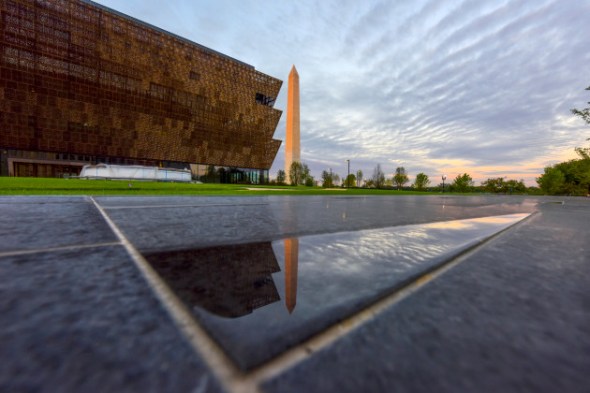
The first direct morning sun paints the Washington Monument a shade of red near the Smithsonian Institute”s National Museum of African American History and Culture in Washington, DC. MUST CREDIT: Washington Post photo by Jahi Chikwendiu
Good Afternoon!!
I’m devoting this post to articles about the Smithsonian Museum of African American History and Culture, which opened this morning. I think we all need rest from the campaign and the endless advice on how Hillary should behave at Monday night’s debate.
Centuries of struggles and strife, decades of planning and pain, and years of hoping for a place that African-American history can call home will culminate as President Barack Obama officially opens the Smithsonian National Museum of African American History and Culture.
A shining bronze beacon on the National Mall, only steps away from a monument dedicated to a slaveholder president, the new Smithsonian will chronicle the complex relationship between the United States and a people it once enslaved, and tell the story of those who worked to make the necessary changes to bring the country to where it is today.
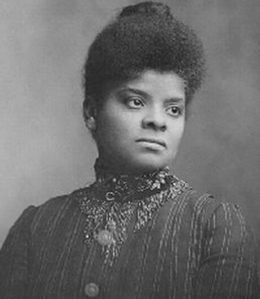
Ida B. Wells
“It doesn’t gauze up some bygone era or avoid uncomfortable truths,” Obama said in his weekly radio and internet talk. “Rather, it embraces the patriotic recognition that America is a constant work in progress, that each successive generation can look upon our imperfections and decide that it is within our collective power to align this nation with the high ideals of our founding.” ….
Ground was broken for the new museum in 2012 on a five-acre tract near the Washington Monument after a decades-long push for an African-American museum on the National Mall. Congressman John Lewis of Georgia, a longtime civil rights icon, worked with then-Sen. Sam Brownback of Kansas to usher legislation through Congress, and President George W. Bush signed into law the bill that allowed the museum to move forward.
Construction was completed earlier this year on the 400,000-square-foot museum designed by British-Ghanaian architect David Adjaye. The museum strikes a unique shape on the Mall with its three-tiered bronze exterior panels inspired by an African wooden column. The patterned bronze colored tiles are inspired by 19th century ironwork created by slaves in the South, and allow sunlight into the museum through patterned openings.
Inside, museum officials say they have nearly 3,000 items occupying 85,000 square feet of exhibition space including exhibits like a Tuskegee Airmen training plane and the casket of Emmett Till, a murdered African-American boy whose death helped rally the civil rights movement.
“It’s been 100 years in the making. So many people have dreamed about this fought for this and wanted this to happen,” said U.S. Circuit Judge Robert L. Wilkins, who wrote the book “Long Road to Hard Truth” about the struggle to get the museum open. “It’s going to be a testament to their work and a testament to so many of our ancestors that this museum will open on the Mall.”
As a child in St. Paul’s Rondo neighborhood in the 1950s, there were few places Marvin Anderson could learn about African American history.
“You grew up knowing more about European history than you do about your own history,” Anderson said. “African American history was neglected — either though ignorance or through suppression.”
But with the opening of the National Museum of African American History and Culture on Saturday in Washington, D.C., his grandchildren will have access to that history.
“A museum that’s constructed to preserve and interpret the contributions and accomplishments of the African American community means a lot to me as a person,” Anderson said. “And it will mean a lot to my grandchildren.”
More than 100 years after it was first proposed and 13 years after it was authorized by Congress, the National Museum of African American History and Culture opens today in Washington.
“There were some who said it couldn’t happen, who said ‘you can’t do it,’ but we did it,” said Rep. John Lewis (D-Ga.), who led the charge to make the museum a reality. “This place is more than a building. It is a dream come true.”
The long-awaited moment is being heralded by a weekend of celebrations across the city, in what the museum director Lonnie Bunch has called a “mini inauguration.” The most anticipated event is the grand opening ceremony on the National Mall, which is being broadcast on C-SPAN and streamed online, including at washingtonpost.com. More than 7,000 official guests heard speeches from Oprah Winfrey, Will Smith, Supreme Court Chief Justice John G. Roberts Jr. and former president George W. Bush, who signed the 2003 bill that authorized the museum….
Since the day Obama presided over the museum’s groundbreaking in 2012, an impressive 400,000 square foot structure has been built in the shadow of the Washington Monument. Serving as home to more than36,000 artifacts, the museum exists to both memorialize and educate, and most importantly to museum director Bunch, cement the African American story’s place in the American story.
“This is a story that is too big to be in the hands of one community,” saidLonnie Bunch. “It really is the story that has shaped us all.”
That story is that of African Americans. And on this weekend of the opening of the National Museum of African American History and Culture (NMAAHC), the seventh episode of “Cape Up” is my conversation with its founding director Lonnie Bunch. The stunning structure on the Mall is the physical manifestation of a multi-decade effort that kicked into high gear in 2005 when Bunch, a former Smithsonian curator who was president of the Chicago Historical Society, was tapped to helm the effort.
In 2003, President George W. Bush signed the bill that made the national African American history museum a legal reality. But that was the easy part.
“The biggest part of this job was to make people believe that this could happen. But what it really meant was that I had to find ways to believe it. And to take risks,” Bunch told me at the museum last week. “For example, when we did the groundbreaking, we didn’t have all the money. So what I did is, well, let’s make the hole anyway because I knew that Congress wouldn’t let a hole stand next to the Washington monument.” ….
“We went around the country, stole the idea from ‘Antique Roadshow,’ asked people to bring out their stuff. We didn’t take it,” Bunch explained. “We helped them preserve grandma’s old shawl, that wonderful 19th-century photograph. But what happened was that people get excited and they’d say, ‘Well do you want it?’ And we would say, ‘Give it to local museums first.’ Then if it was really significant it came back to D.C.”
Music is so much a part of black America, it pops up all over the vast new National Museum of African American History and Culture. From Harriet Tubman’s modest hymnal of spirituals to Sly Stone’s signed Fender Rhodes keyboard and Public Enemy’s boom box that helps close the 20th-century cultural history, there’s no separating the importance of music from the history on hand.
But when one arrives at the entry to the fourth floor “Musical Crossroads” exhibition, heralded by the sparkly red finish on Chuck Berry’s Cadillac, the futuristic fantasy of the Parliament-Funkadelic mothership replica, and Michael Jackson’s Victory Tour fedora, it is as if entering its own inclusive African-American Music History Museum.
And inclusive it is—with displays on African music imported by the enslaved to this country, devotional music that helped bind black communities against all odds, gospel, minstrel music, ragtime, jazz, blues, rhythm & blues, rock ’n’ roll, hip-hop and EDM. Yes, and some country stars of color as well.
One of the challenges of opening the Smithsonian’s newest major museum was acquiring its contents from scratch. Sure, the nearby National Museum of American History already had a lot of artifacts, from Scott Joplin sheet music to Dizzy Gillespie’s B-flat trumpet.
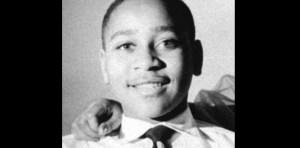
Curating for a museum is no doubt a difficult job, and one of the more difficult decisions that Lonnie Bunch III—founding director of the National Museum of African American History and Culture—remembers grappling with was whether to include the casket that once held the brutalized remains of Emmett Till.
Even after he accepted the donation of Till’s casket by Till’s family after his remains had been exhumed and reinterred, Bunch wondered if it was “too ghoulish” to include in an exhibit.
Nonetheless, Bunch decided to move forward with the idea, saying that it was essential to explore stories such as that of Till—the Chicago teen who was brutally murdered for whistling at a white woman while visiting family in Mississippi—in order to represent the full story of the African-American experience.
“You couldn’t tell the story of the African-American experience without wrestling with difficult issues, without creating those moments where people have to ponder the pain of slavery, segregation or racial violence,” Bunch said.
When the National Museum of African American History and Culture hosted a soft opening, we came hungry. The museum, more than 100 years in the making, brimmed with treasures. Untold stories and famous tales burst to life through artifacts in the exhibitions. But we headed straight down the museum’s magnificent central staircase to the below-ground Sweet Home Café. We were on assignment to report on the food. And reader, we did.
The 12,000-square foot café is divided into four stations, which honor the geographic regions of African-American culture—the North States, Agricultural South, Creole Coast and Western Range. We sampled from each, stuffing ourselves with the rich offerings, Georgia shrimp and Anson Mills stone ground grits, slow-cooked collards and cornbread sticks, empanadas heaped with black eye peas, golden corn and chanterelles, not to mention Johnston County sweet potato pie. What we couldn’t eat, we shamelessly snuck home in our purses—paper napkins lovingly protected a Wild Turkey pecan pie and the remains of a BBQ buffalo brisket sandwich.
To eat the food at the Sweet Home Café is to take a bite out of history—an authenticity of ingredients and culinary skill passed down and reinterpreted by generations of black home cooks and gourmet chefs around the country. This food has been shaped by regional cuisine and distinctive cultures, but also by history, something impossible to be forgotten when you see the counters and stools lining two walls of the 400-seat cafe, recalling the Greensboro sit-ins in North Carolina and the brave civil rights activists that sat down to peacefully protest Woolworth’s white’s-only lunch counter service in 1960. While we eat, images and quotes from historical and modern black voices are the backdrop, from the towering image of the Greensboro Four to a quote by Michael W. Twitty, who pens the food blog Afroculinaria.
“Our food is our flag…it sits at the intersection of the South, Africa, the Caribbean and Latin America,” he writes.
I know there’s plenty of other news out there, but I hope you’ll take the time to dive into one of these great articles. Of course this is an open thread, so please post your thoughts and links on any topic in the comment thread.
Did you like this post? Please share it with your friends:
We’re closing in on the first general election debate of the season and speculation is running hot and heavy in the pundit class. I think they’re actually taking bets as to which one of Donald Trump’s persona will appear on stage. They’re also trying to find out who is standing in for Trump at Clinton’s practice debates. That’s just soooooo scoopworthy and newsworthy and très importante.
Donald Trump says NBC’s Lester Holt should not correct his or Hillary Clinton’s facts while moderating the first presidential debate.
“I think he has to be a moderator,” the Republican nominee said on “Fox & Friends” Thursday.
“I mean, if you’re debating somebody and if she makes a mistake or I make a mistake … we’ll take each other on,” he added. “But I certainly don’t think you want Candy Crowley again.”
I’m never quit sure why they actually pick “news” personalities to do these things rather than ask a few experts to grill the candidates on their subject of expertise. But, like anything on TV news poof these days, it’s a ratings game and they’re after those sound bytes from hell. Josh Vorhees from Slate has done Lester’s homework for him which is usually what the bright kids do for the rest of the planet. Don’t forget, we’ve got letters from economics experts, foreign policy experts, diplomats and military experts and scientists all begging folks to leave Donald Trump to the trashbins of TV and scams. Really, check my links that’s about 300-400 of the world’s biggest brains flashing a don’t go there America sign!!! It’s like between 50 -100 of them per link up there.
The list of lies covered by Vorhees include lies that that Donald Dumbf tells about himself, the country, the economy, the world, the criminal justice system, the state of US inner cities and a host of topics. Go check them out. They’re full cited. Here are the lies he tells about our country and our extremely good economy.
Lies Trump Tells About the Country
Immigration
Lie: There could be as few as 3 million or as many as 30 million undocumented immigrants in the United States.
Truth: The Department of Homeland Security last estimated the size of the undocumented population at 11.4 million at the start of 2012, down from a peak of 12.2 million five years earlier. As PolitiFact points out, that figure is line with the most recent estimates from the Pew Research Center (11.3 million in 2014), the Center for Migration Studies (10.9 million in 2014), and the Center for Immigrations Studies (11.7 million in 2016). While the government does not know the exact number of undocumented immigrants in the United States, there are no credible estimates that approach either Trump’s high- or low-end numbers.
Lie: Assimilation among American Muslims is nearly “non-existent.”
Truth: The Pew Research Center conducted a major survey on the topic in 2011 and concluded “Muslim Americans appear to be highly assimilated into American society.” Public polling of Muslim Americans likewise suggests that a majority identify strongly with the United States.
The electoral process
Lie: The general election debates are “rigged” against him because two overlap with NFL games.
Truth: The Commission on Presidential Debates consulted with both parties before setting the fall schedule for the three presidential debates and the single vice presidential one. Furthermore, the bipartisan panel announced the dates in September of last year, more than four months before this year’s first nominating contest and nearly seven months before the NFL released its schedule for the season. Scheduling conflicts between major sporting events and the general election debates are also neither new—there were two NFL conflicts in 2012 alone—nor easily avoidable, given the NFL now plays on Sundays, Mondays, and Thursdays, while MLB playoff games up to and including the World Series can fall on any day of the week. (Bonus lie: Trump claims the NFL sent him a letter alerting him about the conflict; the NFL says that didn’t happen.)
Lie: The election itself is “rigged” against him.
Truth: Trump’s claim was, in the words of the usually staid Associated Press, an “unprecedented assertion by a modern presidential candidate,” one that could “threaten the tradition of peacefully contested elections and challenge the very essence of a fair democratic process.” Trump has laid the groundwork for only two possible outcomes in the eyes of his most passionate supporters: He wins the presidency, or he has it stolen from him. Meanwhile, his campaign has produced no credible evidence to support the extraordinary claim that the outcome of an election that has yet to happen will be illegitimate.
Truth: This is a slightly softer version of his original claim that America is the most taxed nation, though the rewrite still isn’t enough to save it. According to a Pew Research Center report from this year—based on 2014 data from the Organization for Economic Cooperation and Development—Americans’ tax bills are below average among developed nations.
Truth: The Bureau of Labor Statistics latest estimate pegs the nation’s unemployment rate at 4.9 percent, roughly where it has been for the past year. That figure does not factor in those Americans who are unemployed but not currently looking for work. BLS, however, offers a second statistic—known as the labor underutilization rate—that in addition to the officially unemployed, also counts part-time workers who would like to be working more and those who want to work but are not currently looking for a job. That figure was 9.7 percent in August.
Lie: The black youth unemployment rate is 59 percent.
Truth: Again, no. According to BLS, the unemployment rate for blacks between 16 and 24 years old was 26.1 percent in August. While Trump has never said where his figure came from, the most likely scenario is that he is relying on a metric that misleadingly factors in those who don’t work and aren’t looking for a job, including high school and college students.
With his wife Rosalynn Carter looking on at center, Democratic presidential candidate Jimmy Carter, center left, shakes hands with President Gerald Ford at the conclusion of their debate at the Palace of Fine Arts Theater, Oct. 6, 1976, San Francisco, Calif. Others unidentified. (AP Photo)
Meanwhile, Clinton picks up the endorsement of another of the nation’s major newspapers. This time it’s the LA Times. No one in the know or a functioning brain wants Donald Dumpf near the White House. No.One. How’s this for a headline? “Hillary Clinton would make a sober, smart and pragmatic president. Donald Trump would be a catastrophe.”
American voters have a clear choice on Nov. 8. We can elect an experienced, thoughtful and deeply knowledgeable public servant or a thin-skinned demagogue who is unqualified and unsuited to be president.
Donald J. Trump, a billionaire businessman and television personality, is the latter. He has never held elected office and has shown himself temperamentally unfit to do so. He has run a divisive, belligerent, dishonest campaign, repeatedly aligning himself with racists, strongmen and thugs while maligning or dismissing large segments of the American public. Electing Trump could be catastrophic for the nation.
By contrast, Hillary Clinton is one of the best prepared candidates to seek the presidency in many years. As a first lady, a Democratic senator from New York and secretary of State in President Obama’s first term, she immersed herself in the details of government, which is why her positions on the issues today are infinitely better thought-out than those of her opponent.
She stands for rational, comprehensive immigration reform and an improvement rather than an abandonment of the Affordable Care Act. She supports abortion rights, wants to raise the federal minimum wage to $12 an hour, hopes to reform the sentencing laws that have overcrowded American prisons, would repair the Voting Rights Act and help students to leave college without enormous debt. Abroad she would strengthen America’s traditional alliances, continue the Obama administration’s efforts to “degrade and ultimately defeat” Islamic State and negotiate with potential adversaries such as Russia and China in a way that balances realism and the protection of American interests. Unlike Trump, Clinton accepts the prevailing science on climate change and considers the issue to be “the defining challenge of our time.”
The racists are out in droves over the protests in Charlotte, N.C. which is one of the key swing states in this election. The first two nights of protests saw some vandalism and even a shooting. However, last night was peaceful. I noticed that the presence of the National Guard mixed in with Police in NOPD after Katrina was a good thing. The police behaved when they were being monitored by the Guard. People also were more calm and the usual agitators and criminals that follow protests around to take advantage were gone last night. I’m beginning to think that a state’s national guard is key to policing in places where the police aren’t all that professional. Anyway, here’s the latest idiots suggesting protesters should be harmed or are some how doing something illegal. This one is from a Tennessee (no surprises there) Law Professor.
The University of Tennessee is investigating a tweet by one of its law professors after the faculty member and contributing columnist for USA TODAY and the Knoxville News Sentinel urged motorists to run over demonstrators blocking traffic in Charlotte, N.C.
Twitter briefly suspended Glenn Reynolds’ account after he responded to a tweet from a TV news station in Charlotte that showed protesters on Interstate 277. “Run them down,” he wrote.
He posted to Twitter shortly after 10 a.m. Thursday that his account had been unblocked after he agreed to delete the offending tweet.
UT College of Law Dean Melanie D. Wilson said in a statement Thursday morning that she and university administrators are investigating the matter, calling Reynolds’ post an “irresponsible use of his platform.”
“The university is committed to academic freedom, freedom of speech, and diverse viewpoints, all of which are important for an institution of higher education and the free exchange of ideas,” she wrote. “My colleagues and I in the university’s leadership support peaceful disobedience and all forms of free speech, but we do not support violence or language that encourages violence.”
She called the concerns about the tweet from students and staff, along with those from citizens across the country, “serious and legitimate.”
Chancellor Jimmy Cheek released a statement about an hour later supporting Wilson and her comments.
“Wilson’s statement about the faculty member’s social media post reinforces the university’s commitment to fostering a civil and inclusive learning environment,” he said in a news release.
U.S. Rep. Robert Pittenger apologized Thursday after saying the violence in Charlotte stems from protesters who “hate white people because white people are successful and they’re not.”
Pittenger is a Republican whose district includes parts of the city where protests have turned violent in the wake of a police shooting of a black man.
He made the statement on a BBC-TV news program Thursday when asked to describe the “grievance” of the protesters.
“The grievance in their minds – the animus, the anger – they hate white people because white people are successful and they’re not,” Pittenger said. He then criticized people who receive welfare. “It is a welfare state. We have spent trillions of dollars on welfare, and we’ve put people in bondage, so they can’t be all they’re capable of being.”
He later apologized on Twitter, saying his answer “doesn’t reflect who I am. I was quoting statements made by angry protesters last night on national TV. My intent was to discuss the lack of economic mobility for African Americans because of failed policies.”
Yeah. Right. Lack of “economic mobility” because “they all hate white people”, I suppose.
Which brings us to Glenn Reynolds, known online as InstaPundit, one of the most prolific bloggers on the Internet. On Wednesday night, Reynolds tweeted this.
The tweet involved protesters who were blocking a highway near Charlotte in protest of the killing of Keith Lamont Scott.
After being suspended, however, Reynolds defended his tweet. He allowed that “run them down” didn’t capture his intent “fully” — but he blamed Twitter’s character count, not his own judgment, for the message.
But riots aren’t peaceful protest. And blocking interstates and trapping people in their cars is not peaceful protest — it’s threatening and dangerous, especially against the background of people rioting, cops being injured, civilian-on-civilian shootings, and so on. I wouldn’t actually aim for people blocking the road, but I wouldn’t stop because I’d fear for my safety, as I think any reasonable person would.
“Run them down” perhaps didn’t capture this fully, but it’s Twitter, where character limits stand in the way of nuance.
Reynolds’ tweet was just 14 characters — far below Twitter’s limit of 140, which could have allowed for at least a little more nuance.
What makes white people tick? This question will occupy campaign strategists and forecasters through November. Given that voters of color have, on the whole, decided resoundingly against Donald Trump, the coveted swing voters who will decide this election are overwhelmingly white. This is nothing new, of course, but in the wake of a campaign season that has played heavily on white identity politics, rejection of diversity and race-baiting dog whistles, the specific concerns of white voters have taken on a renewed salience.
It’s an open secret in electoral politics that you can guess someone’s vote pretty accurately based only on her census form. So rather than trying to suss out the sentiments and ideological profiles of voters based on individual testimony, let’s tackle a simpler question: Which demographic traits affect how white Americans vote?
…
Instead, the two most predictive variables are religious attendance and education. Crucially, these two variables are still more explanatory when considered together. Roughly speaking, a white voter will lean left if she is “more college than church” and will lean right if she is “more church than college.”4
More precisely, we can assign an educational score (no college = 0, some college = 1, college degree = 2) and religious attendance score (never attend = 0, sometimes attend = 1, attend weekly = 2) to each white American. Those with a higher education score are likely to support Clinton, those with a higher religious attendance score are more likely to support Trump, and those with equal scores are more divided.
So, I’m not going to comment in the post about that but you can read more at the FiveThirtyEight link above. There’s more in depth analysis from Milo Beckman there. I’ll be more open with my thoughts downthread but needless to say, if you’re already gullible enough to take iron age myths literally, you’re pretty far removed from reality. If you’ve never really studied science and learned about how theories come about and hypotheses are tested, you’re going to be doubly vulnerable to scam artists. Opps … I went there.
So, don’t forget to join us for the first debate next week and our live blog!
Only a few more days till the first presidential debate of 2016, and the campaign is just getting crazier and crazier. Yesterday Donald Trump admitted that he’s still a a birther. Kevin Drum:
Ben Garbarek, a local news reporter in Toledo, asked Donald Trump today what it was that changed his mind about President Obama’s birthplace:
BG: This announcement earlier this week with you saying that you believe President Obama was in fact born in the United States, after all the years where you’ve expressed some doubt, what changed?
Trump: Well I just wanted to get on with, I wanted to get on with the campaign. A lot of people were asking me questions. We want to talk about jobs. We want to talk about the military. We want to talk about ISIS and get rid of ISIS. We want to talk about bringing jobs back to this area because you’ve been decimated so we just wanted to get back on the subject of jobs, military, taking care of our vets, etc.
When Ingraham asks Trump in the interview about Gov. Tim Pawlenty saying he believed Obama is a US citizen, Trump replied, “He doesn’t want to be labeled as a birther probably.”
“I’m proud to be,” he said. “I’m very proud of it. I’m very proud of it. I don’t like the term. I think it’s a demeaning term to the people that believe he should have a birth certificate. Some people believe he was not born in this country.
“And when people ask me that question, I just can’t be sure because nobody knows. How about when his family is arguing over what hospital? You know his family members are arguing over which hospital. Then he writes that letter, supposedly to a hospital, and in the letter he puts a cute little sentence — ’the place of my birth’—and the doctors didn’t even know about it. There’s something very strange going on here.”
Earlier in the interview, Trump discussed the possibility that President Obama might not want to release his birth certificate because it might list him as a Muslim.
“He doesn’t have a birth certificate, or if he does, there’s something on that certificate that’s very bad for him,” Trump said. “Somebody told me — and I have no idea whether this is bad for him or not, but perhaps it would be — that, where it says religion, it might have Muslim. And if you’re a Muslim, you don’t change your religion, by the way. But somebody said maybe that’s the reason why he doesn’t want to show it. I don’t think so. I just don’t think he has a birth certificate, and everybody has a birth certificate.” ….
And there’s this bit of insanity:
“Now, you know, when I hear he took an ad in the paper, his parents, these are poor people,” Trump said. “When did you ever hear of anybody taking an ad in the paper? I see so much fraud in this world. An ad like that could have been staged. I don’t mean staged at the time. I mean could have been computer-generated five years ago, eight years ago, two years ago. It could have been computer-generated.”
I guess to Trump middle-class folks like Obama’s grandparents are “poor people.”
Donald Trump’s campaign chair in a prominent Ohio county has claimed there was “no racism” during the 1960s and said black people who have not succeeded over the past half-century only have themselves to blame.
Kathy Miller, who is white and chair of the Republican nominee’s campaign in Mahoning County, made the remarks during a taped interview with the Guardian’s Anywhere but Washington series of election videos.
“If you’re black and you haven’t been successful in the last 50 years, it’s your own fault. You’ve had every opportunity, it was given to you,” she said.
“You’ve had the same schools everybody else went to. You had benefits to go to college that white kids didn’t have. You had all the advantages and didn’t take advantage of it. It’s not our fault, certainly.”
Miller also called the Black Lives Matter movement “a stupid waste of time” and said lower voter turnout among African Americans could be related to “the way they’re raised”.
KENANSVILLE, N.C. — Donald Trump made another eyebrow-raising comment in his efforts to speak to the African-American community Tuesday, telling a rally in North Carolina that blacks in the United States are in their worst shape “ever, ever, ever.”
“We’re going to rebuild our inner cities because our African-American communities are absolutely in the worst shape that they’ve ever been in before,” Trump told the crowd. “Ever, ever, ever.”
Trump’s comments came in a town named for a slaveowner’s family: Kenansville was founded in the early 1800s and the Kenan family, according to the town’s website, owned “20 to 50 slaves.” As he has done in other recent speeches, Trump compared inner city shootings to war-torn countries like Afghanistan.
“You take a look at the inner cities: You get no education. You get no jobs. You get shot walking down the street,” he said.
“They’re worse, I mean honestly, places like Afghanistan are safer than some of our inner cities.”
“I see what’s going on here, I see what’s going on in Chicago,” Trump said, according to a preview video posted on FoxNews.com. “I think stop-and-frisk, in New York City, it was so incredible the way it worked. And, we had a very good mayor. But New York City was incredible the way that worked. So I think that would be one step you could do.”
“Stop-and-frisk” refers to a policy of stopping and searching pedestrians under the theory that it may help police find guns and other weapons, and get them off the street. Opponents question its effectiveness, and say stop-and-frisk is demeaning, and disproportionately targets minorities. A New York federal judge in 2013 declared it unconstitutional.
Bill de Blasio successfully ran for mayor of New York City in 2013 on a platform that involved abandoning stop-and-frisk. Cleveland Councilman Zack Reed unsuccessfully pushed for its implementation in Cleveland in 2014. Other cities that have implemented stop-and-frisk — and later agreed to limit its use — include Chicago and Newark, New Jersey.
The legal basis for stop-and-frisk stems from a 1963 case from Cleveland — Terry v. Ohio — that eventually made its way to the U.S. Supreme Court. Attorney Louis Stokes, who later became a congressman, argued on behalf of John W. Terry, who was stopped by a Cleveland police officer while standing on a street corner in front of a jewelry store at 1276 Euclid Avenue.
To top it all off, Trump said on Fox and Friends this morning that his federal stop and frisk policy will consist of police officers taking guns away from black people. DailyKos:
FOX AND FRIENDS: will you explain what that is to my folks down in South Carolina that don’t really deal with stop and frisk? What exactly is it and what are the pros and cons?
TRUMP: Well, there are different levels. and you have somebody coming up who is the expert on it but basically they will—if they see, you know, they are proactive and if they see a person possibly with a gun or they think may have a gun, they will see the person and they will look and they will take the gun away. They will stop, they will frisk, and they will take the gun away and they won’t have anything to shoot with. I mean, how it’s not being used in Chicago is—to be honest with you, it’s a quite unbelievable, and you know the police, the local police, they know who has a gun, who shouldn’t be having a gun. They understand that.
History shows that blacks and Hispanics are primarily the people who get stopped and frisked, and Trump knows it.
The survey – which was conducted after Clinton’s return to the campaign trail following her bout with pneumonia – shows a bigger advantage for the secretary of state than did polls taken during the heightened scrutiny of her health….
“Despite arguably the worst few weeks of her candidacy, the fundamentals still point toward a Hillary Clinton victory,” says Democratic pollster Fred Yang of Hart Research Associates, who conducted the survey with Republican pollster Bill McInturff of Public Opinion Strategies.
McInturff adds, “Donald Trump has closed the margin since August, but as we head towards the debate, still needs to push this campaign closer. The good news for him is the electorate narrowly agrees with him that America has lost ground and wants to see a change in direction.”
In a four-way horserace, Clinton gets support from 43 percent of likely voters and Trump gets 37 percent, while Libertarian nominee Gary Johnson is at 9 percent and the Green Party’s Jill Stein is at 3 percent.
Barack Obama is about to launch a presidential campaign blitz for Hillary Clinton unprecedented in the modern era, pledging a dramatic commitment of time and resources to a contest he now unabashedly frames as a referendum on his personal and political prestige.
Obama plans to devote at least one to two days each week in October to campaign for Clinton through rallies, targeted radio and television interviews, social media outreach and fundraising, said an adviser who requested anonymity.
In addition, the president’s aides have told the Clinton campaign he would be willing to appear in television ads for her. His wife, Michelle, has already cut radio, online and TV ads for the Democratic nominee, another aide said, also requesting anonymity to discuss internal planning.
Obama’s involvement comes at a critical time, with enthusiasm for Clinton lagging behind support for Obama among the young people and minorities who helped power him to the presidency. At the start of the campaign, Clinton’s camp once questioned how closely to embrace Obama but now her aides are eager to have his help.
“From the beginning, we have been interested to have him out there as often as they can spare him between now and November,” said Clinton campaign spokesman Brian Fallon. “As we get closer to the finish line, there’s no one better to help make the closing argument than President Obama.”
I’ll end with a couple of fun videos.
The Dali Lama makes fun of Donald Trump.
Hillary Clinton appears on Funny or Die’s “Between Two Ferns.”
What stories are you following today?
Did you like this post? Please share it with your friends:
As usual I’ve been having a difficult time figuring out where to begin my post. Then I saw the new story by David Farenthold at The Washington Post. This one has to be the story of the day: Trump used $258,000 from his charity to settle legal problems.
Donald Trump spent more than a quarter-million dollars from his charitable foundation to settle lawsuits that involved the billionaire’s for-profit businesses, according to interviews and a review of legal documents.
Those cases, which together used $258,000 from Trump’s charity, were among four newly documented expenditures in which Trump may have violated laws against “self-dealing” — which prohibit nonprofit leaders from using charity money to benefit themselves or their businesses.
In one case, from 2007, Trump’s Mar-a-Lago Club faced $120,000 in unpaid fines from the town of Palm Beach, Fla., resulting from a dispute over the size of a flagpole.
In a settlement, Palm Beach agreed to waive those fines — if Trump’s club made a $100,000 donation to a specific charity for veterans. Instead, Trump sent a check from the Donald J. Trump Foundation, a charity funded almost entirely by other people’s money, according to tax records.
In another case, court papers say one of Trump’s golf courses in New York agreed to settle a lawsuit by making a donation to the plaintiff’s chosen charity. A $158,000 donation was made by the Trump Foundation, according to tax records.
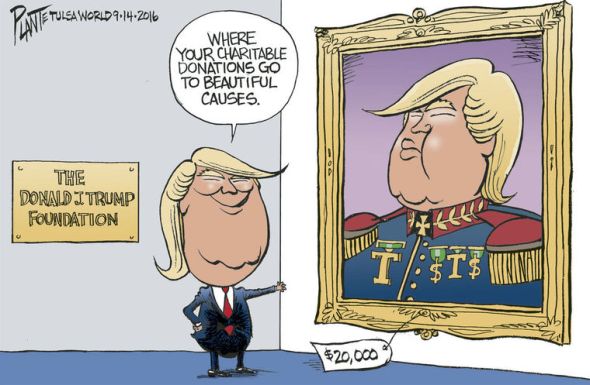
The other expenditures involved smaller amounts. In 2013, Trump used $5,000 from the foundation to buy advertisements touting his chain of hotels in programs for three events organized by a D.C. preservation group. And in 2014, Trump spent $10,000 of the foundation’s money for a portrait of himself bought at a charity fundraiser.
Or, rather, another portrait of himself.
Yes, that was in addition to the $20,000 Trump spent on a six-foot tall portrait of himself. Read many more details at the link.
Next up, Donald Trump Jr. provides evidence that white supremacy is at the core of the Trump campaign. Yesterday Jr. tweeted this message:
It turns out that this is a well-known white supremacist meme. They used to use M&M’s but switched to Skittles after George Zimmerman murdered Trayvon Martin.
If there were a bowl of delicious fruitish-flavored Skittles in front of you and three would kill you, you should not pick up a handful and start eating. That would be a very, very bad idea.
This idea easily scales downward. If you had a carton of eggs and three of the eggs were poisonous, you should absolutely not eat from that carton. If I give you three cookies and all three are poisonous, again: Avoid! I am actively trying to kill you for some reason, perhaps because you are bad at math.
The problem for Donald J. Trump, Jr. is that scaling it the other way doesn’t work as well — and that’s why the part in blue doesn’t apply.
So let’s figure out what the analogy is. The libertarian (and Koch brothers-backed) think tank Cato Institute published a report last week assessingthe risk posed by refugees. That report stated that, each year, the risk to an American of being killed by a refugee in a terror attack is 1 in 3.64 billion, as Huffington Post’s Elise Foley noted on Twitter. From the report:
From 1975 through 2015, the annual chance that an American would be murdered in a terrorist attack carried out by a foreign-born terrorist was 1 in 3,609,709. Foreigners on the Visa Waiver Program (VWP) killed zero Americans in terrorist attacks, whereas those on other tourist visas killed 1 in 3.9 million a year. The chance that an American would be killed in a terrorist attack committed by a refugee was 1 in 3.64 billion a year.
In other words, for every 10.92 billion years that Americans live — one Skittle, if you will — refugees will kill an American in a terror attack in three.
There’s more logic at the the link, but the real story here is that Donald Trump Jr. gets his news from Brietbart and probably other white supremacist sources.
WHAT DONALD TRUMP popularized as a Big Lie — the birther myth about President Obama — is now a shibboleth among his followers and many Republicans. It matters not a whit that Mr. Trump has finally, for blatant political purposes, admitted that the president was born in the United States; large numbers of his partisans, and of Republicans generally, still don’t believe Mr. Obama has a legitimate claim to the office he has held for nearly eight years.
Birtherism, a hoax perpetrated on Americans, is proof positive of the enduring efficacy of the Big Lie, the proposition that people will sooner believe a monumental falsehood than a trivial one, especially if it is repeated often enough. The cost of such a hoax is not only to the truth but also to the democratic process, which is rendered ridiculous by the ensuing debate. Mr. Trump has revealed his own facility with fraud and deceit, and he has also exposed how vulnerable democracy is when confronted with a charlatan-celebrity, bereft of principles and willing to say anything to grab headlines.
The cancer of corruption perpetuated by Mr. Trump’s dazzling dishonesty has infected not only his campaign but also the Republican Party, which falls in line, sheeplike, to defend his every lie.
Now Mr. Trump says falsely that Hillary Clinton was the originator of birtherism? GOP officials say so, too. Now Mr. Trump claims credit for putting to rest an “issue” he himself perpetuated? GOP officials say so, too. No pronouncement is too preposterous for Republican National Committee Chairman Reince Priebus and the party’s other unscrupulous grandees.
…why is Trump getting a pass from the voters? No it’s not because Trump is a man and Clinton is a woman. No, it’s not because some powerful media types secretly want Trump to win. You’ll start to find the real answer when you learn a simple legal rule that boasts a rare combination of enforcing free market fairness and understanding human nature. It’s called “puffing,” and that is the official term that legally protects salespeople and businesses from making boastful claims about their products and services that no one really expects to be provable by empirical facts. Legal protections for puffing are the reasons why you can’t sue Snapple for saying it’s made from the “best stuff on Earth,” or go after Budweiser for calling itself the “king of beers.” You get it, right?
And when it comes to puffing, nobody has done it more and for longer in the public than Donald J. Trump. Every hotel he builds is the most elegant, every golf course the most beautiful and challenging, and every contestant on “The Apprentice” had a 200 I.Q. Trump’s natural state is building up his brand and properties in a way that would make a used car salesman blush. The public is used to it and accepts it just as we accept that used car salesman boasting about the 2005 SUV he’s pushing. If we ever get angry at that boasting salesman, it’s only after that car breaks down. Otherwise, we believe we look like nitpicking maniacs to quibble over every conceited claim.
The voters are giving Trump much of the same kind of a pass for the same reasons. And Trump is helping achieve this result by making sure he maintains his salesman’s image for as long as possible at every public appearance and interview.
Okay, but I don’t buy that this has nothing to do with sexism or the long history of the media viciously attacking Hillary for every tiny “misstep.”
Police around the country are still shooting and killing black boys and men, but somehow they avoided killing terror suspect Amad Khan Rahami and they often do the same when they shoot at white people. It’s just heartbreaking that cops in Columbus Ohio felt the need to kill a 13-year-old boy who was only 5 feet tall and weight less than 100 pounds as he tried to run away from them. Just look at the photo of him in this story in The National Memo:
Tyre King, the 13-year-old African-American boy recently killed by police in Columbus, Ohio, was running away when he was fatally struck by several bullets, according to an independent medical examiner hired by the child’s family. Attorneys representing the family said Monday his loved ones were not allowed to view King’s body on the night of his death and will be forced to wait six to eight weeks for official autopsy results.
The King family hired Francisco J. Diaz, a practicing medical examiner in Wayne County, Michigan, to look into the death. Diaz determined the boy was shot three times. The bullets entered through the left side of his body, any of which could have been the fatal shot. King was struck in his left temple, his left collarbone and in his left flank. King was said to be reaching for a BB gun in his waistband when he was shot three times.
In footage filmed from a police helicopter, Terence Crutcher, 40, can be seen slowly walking from the edge of a street north of Tulsa toward his vehicle, which authorities said had been reported abandoned at 7:36 p.m. (8:36 p.m. ET) and left running in the middle of the road.
For several seconds, an officer follows Crutcher from behind with a gun trained on him. Three more officers then converge on the scene as Crutcher lowers his hands and approaches his SUV. While standing beside the driver’s side door, he suddenly drops to the street. Moments later, blood can be seen saturating his white t-shirt.
The Tulsa Police Department also released dash-cam video of the incident. NBC News:
During a news conference Monday, Tulsa Police Chief Chuck Jordan said that Officer Tyler Turnbough tasered Crutcher, and a second officer, Betty Shelby, fired at him after telling a dispatcher “that she’s not having cooperation from” Crutcher.
Hillary Clinton reacted the clearly unjustified shooting: Policy Mic:
Hillary Clinton expressed outrage over the video released Monday showing police shooting and killing Terence Crutcher, an unarmed black man who was stranded in the road after his car broke down, saying incidents like this one are “intolerable.”
Clinton made the comments on the Steve Harvey Morning Show, Harvey’s radio show, Tuesday morning.
“How many times do we have to see this in our country?” Clinton said, according to a transcript published by CNN’s Dan Merica. “In Tulsa, an unarmed man with his hands in the air. This is just unbearable. And it needs to be intolerable.”
She went on to say that white Americans need to combat the “implicit bias” that’s led to incidents like Crutcher’s death.
She also said that she personally appeal to white Americans, saying “this is not who we are” and we need to work to end bias in policing.
I’ll add some more links in the comment thread. What stories are you following today?
Did you like this post? Please share it with your friends:
The Sky Dancing banner headline uses a snippet from a work by artist Tashi Mannox called 'Rainbow Study'. The work is described as a" study of typical Tibetan rainbow clouds, that feature in Thanka painting, temple decoration and silk brocades". dakinikat was immediately drawn to the image when trying to find stylized Tibetan Clouds to represent Sky Dancing. It is probably because Tashi's practice is similar to her own. His updated take on the clouds that fill the collection of traditional thankas is quite special.
You can find his work at his website by clicking on his logo below. He is also a calligraphy artist that uses important vajrayana syllables. We encourage you to visit his on line studio.


 My guess is that the debate will either be very uninteresting or very volatile. I can’t see much room for moderation in anything with Donald Trump participating. He’s the very definition of ASSymmetric political warfare. Jay Rosen–professor of journalism and media critic–believes that asymmetry between the parties right now has caused issues for the media. What do you do when one party has gone completely off the rails explicitly supporting policy that wouldn’t pass constitutional muster, is openly xenophobic, racist, and sexist, plus delegitimatizes private choices concerning love and religion?
 James Hohmann from WAPO says Trump has won the expectations game already.

 Good Afternoon!
 They’re full cited. Here are the lies he tells about our country and our extremely good economy.
 noticed that the presence of the National Guard mixed in with Police in NOPD after Katrina was a good thing. The police behaved when they were being monitored by the Guard. People also were more calm and the usual agitators and criminals that follow protests around to take advantage were gone last night. I’m beginning to think that a state’s national guard is key to policing in places where the police aren’t all that professional. Anyway, here’s the latest idiots suggesting protesters should be harmed or are some how doing something illegal. This one is from a Tennessee (no surprises there) Law Professor.
 A North Carolina Congressman suggested that “Charlotte protesters ‘hate white people’.” That sounds like something straight out of the Alt-Reich handbook of racism.
 Yeah. Right. Lack of “economic mobility” because “they all hate white people”, I suppose.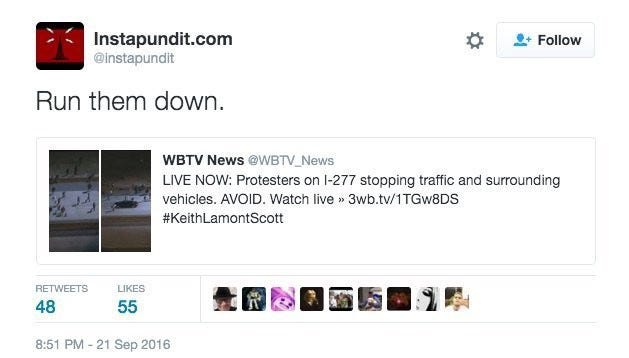


 peej
peej Carissa
 bostonboomer
 dakinikat
 ecocatwoman
 mablue2
 Mama Lopez
 peggysue22
 quixote
 skydancingguestblogger
 Mona (aka Wonk the Vote)



 Sky Dancing
Recent Comments