
Live Blog: CNN Iowa Democratic Presidential Town Hall
Posted: January 25, 2016 Filed under: just because 117 Comments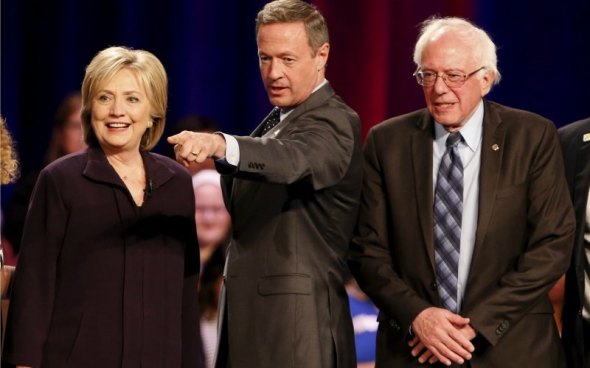
Good Evening Sky Dancers!
I’m going to keep this short and sweet. From 9-11PM tonight the Democratic candidates for the presidential nomination will have the opportunity to make their cases to a prime time audience before next Monday’s Iowa Caucus. CNN tells us what we “need to know.”
The Democratic presidential hopefuls will make closing arguments to Iowa voters Monday night during a CNN town hall in Des Moines — one week before the first-in-the-nation votes are cast at the Iowa caucuses.
Sen. Bernie Sanders of Vermont will appear first, followed by ex-Maryland Gov. Martin O’Malley and then former Secretary of State Hillary Clinton….Each will have 30 minutes onstage at Drake University’s Sheslow Auditorium and will face questions from audience members as well as CNN Anchor Chris Cuomo.
The Iowa Democratic Party and Drake University invited the audience, which will also include some CNN guests.
The town hall will be live streamed on CNN Go. If you don’t have access to that, it looks like you will have to watch it on TV.
Also from CNN: 5 things to watch in the Democratic town hall.
I’m disappointed that the candidates won’t appear together, but this isn’t a debate after all. There still could be some fireworks. Bernie Sanders and Hillary Clinton have been trading jabs all week, and today President Obama essential gave the nod to Hillary. Sanders must be furious.
Martin O’Malley is apparently ready to attack Hillary too. He told The New Republic in an interview published today that “Hillary Clinton Will Let the Planet “Literally Burn Up.” Is he desperate for attention or what?
I look forward to reading your reactions in the comment thread below.
Go Hillary!
Blue Monday Reads
Posted: January 25, 2016 Filed under: Afternoon Reads | Tags: Bernie Sanders, Chris Hadfield, Democratic Primaries, Hillary Clinton, International Space Station, Space Oddity, Terry Virts 47 Comments Hello from the depths of Mardi Gras and the despair of the press coverage of the US Presidential Primary.
“Planet earth is Blue and there’s nothing I can do.”
I never really understood the double entrendre enveloping that lyric when I was a a preteen first turning into a Bowie Fan. I grok it now.
That’s a view of New Orleans there on the left today! It was taken from space by US Astronaut Terry W. Virts who posted it to his Twitter page a few days ago. He had a simple message for us: “Good night #NewOrleans. Bonsoir La Nouvelle-Orléans”.
I thought I’d also treat you to Canadian astronaut Chris Hadfield singing Bowie’s Space Oddity from the International Space Station. He’s got a great voice and some interesting change in lyrics. I’m not sure how he got the guitar up there but watching it float around is a trip. Stick around to watch his collaboration with Barenaked Ladies and some high school kids from 2013. It’s so kewl!!!
I’m not sure why–of all the Bowie songs out there–this song is haunting me. It’s not really bothering me that I feel compelled to sit at the Steinway and grab a guitar for it then arrange away. It’s sort’ve a life time hazard of being a musician with me that melodies grab me and hold tight. So, I’m passing my brain Tweak on to you, lucky you!!
Now for more earthly matters…
I’m really trying to understand wtf is going on with the media and the Democratic primary. Maybe they’re tired of Republican crazy and want to create some lunacy among the Democrats. Maybe, they’ve just got caught up in the mythos of a great outsider still itching to take down the Clintons. It’s just early and getting old already.
Glenn Thrush of Politico has interviewed President Obama and the dissection has begun.
Barack Obama, that prematurely gray elder statesman, is laboring mightily to remain neutral during Hillary Clinton’s battle with Bernie Sanders in Iowa, the state that cemented his political legend and secured his path to the presidency.
But in a candid 40-minute interview for POLITICO’s Off Message podcast as the first flakes of the blizzard fell outside the Oval Office, he couldn’t hide his obvious affection for Clinton or his implicit feeling that she, not Sanders, best understands the unpalatably pragmatic demands of a presidency he likens to the world’s most challenging walk-and-chew-gum exercise.
“[The] one thing everybody understands is that this job right here, you don’t have the luxury of just focusing on one thing,” a relaxed and reflective Obama told me in his most expansive discussion of the 2016 race to date.
Iowa isn’t just a state on the map for Obama. It’s the birthplace of his hope-and-change phenomenon, “the most satisfying political period in my career,” he says — “what politics should be” — and a bittersweet reminder of how far from the garden he’s gotten after seven bruising years in the White House.
So, from Thrush’s vantage point, Clinton seems the obvious Obama follow-up. There also these overall daunting poll numbers when you look beyond the February openers. What’s with the conversation on a Bernie Bump?
natesilver: FWIW, our FiveThirtyEight national polling average (which we’re not publishing yet — stay tuned) has Clinton up 22 percentage points. Although that was before the Monmouth poll released today, which might tighten things a bit. But somewhere in the high teens or perhaps low 20s nationally is where the race seems to be. By contrast, our averaging method would have had Clinton up by 25 points at the end of December.
So that suggests some tightening, but not as much as the media narrative — which is pretty blatantly cherry-picking which polls it emphasizes — seems to imply.
From there, I’m seeing some other headlines which I don’t quite grok.
From BC News: First Read: Get Ready for a Long Fight for the Democratic Nod. It’s Chuck Todd so be forewarned because as you know the Republicans are rooting for Bernie big time. The weird thing is the fine print doesn’t connect with that clickbait headline. But, FYI there is this which is factual and remember, we’re always around to Live Blogs Debates and Townhalls.
Hillary Clinton, Bernie Sanders, and Martin O’Malley participate at a CNN forum at Drake University in Des Moines, IA beginning at 9:00 pm ET… Clinton holds three earlier events in Iowa, hitting Waukee, Knoxville, and Oskaloosa… Sanders, meanwhile, stumps in Iowa Falls, Ames, and Grinnell… Donald Trump holds a rally in Farmington, NH at 7:00 pm ET… Ted Cruz spends his day in Iowa… So does Marco Rubio… Chris Christie is in New Hampshire… Ben Carson hits the Hawkeye State… And John Kasich is in New Hampshire.
Countdown to Iowa: 7 days
Countdown to New Hampshire: 15 days
I’m really looking forward to hearing this debate because Bernie isn’t standing up well to media scrutiny and I’m denying to hear a response to this: “Sanders: Clinton is running a ‘desperate’ campaign that lacks excitement.”
Asked about his comments last spring that he had no intention of playing the role of spoiler or weakening Clinton’s standing in the general election, Sanders turned the question on its head.
“That’s a two-way question, isn’t it?” he said. “When Hillary Clinton’s hit man is throwing garbage at the media, she is in a sense making it harder for me to win the general election.
“Our campaign is not going to simply sit back and accept all of these attacks,” Sanders added. “We are going to win this thing.”
In another sign of growing confidence, Sanders has stepped up his talk of the general election. “I would very much look forward to a race against Donald Trump,” he said Sunday on NBC’s “Meet the Press.” In speeches at his rallies, he sprinkles in previews of “a Sanders administration.”
Over the course of The Post interview, Sanders said Clinton was running a “desperate” campaign incapable of generating the kind of excitement his has. He raised questions about her motives and character. He said he expects Clinton and her campaign to “throw the kitchen sink” at him in the coming week in what he described as a craven attempt to avoid an embarrassing loss in Iowa.
Sanders questioned Clinton’s association with David Brock, the head of the pro-Clinton super PAC Correct the Record, whom Sanders called a “hit man.”
Even more bizarre is this comment: “Sanders says the flak he’s getting from Clinton reminds him of what Obama got in 2008.” Is this Sanders way of warming up to black folks?
“We get attacked about five times a day,” Sanders told a crowd of about 700 people here. “But it really reminds me very much of what happened here in Iowa eight years ago. Remember that? Eight years ago, Obama was being attacked for everything. He was unrealistic. His ideas were pie-in-the sky. He did not have the experience that was needed. You know what? People of Iowa saw through those attacks then, and they’re going to see through those attacks again.”
 This must be the Clinton speech that gave Bernie the heebie jeebies.
Indianola, Iowa (CNN)Hillary Clinton delivered a blistering assessment of Bernie Sanders’ credentials here on Thursday and implored Iowa voters to scrutinize his policies and readiness for the White House, declaring, “Theory isn’t enough. A President has to deliver in reality.”
It was the most forceful and direct contrast Clinton has drawn with Sanders yet, a speech that underscored the increasing urgency and acrimony of the race. From health care to foreign policy, Clinton repeatedly referenced Sanders by name and questioned whether his ideas could ever become reality.
“I am not interested in ideas that sound good on paper but will never make it in the real world,” Clinton said. “I care about making a real difference in your life and that gets to the choice you have to make in this caucus.”
Clinton acknowledged that while she and Sanders “share many of the same goals” they have “different records and different ideas on how to drive progress.”
The former secretary of state used a Teleprompter to deliver her remarks to hundreds of supporters on the campus of Simpson College. The speech, one adviser said, was designed to “shake some sense into Iowans” and escalate the experience argument she has been making against Sanders with limited success.
“Senator Sanders doesn’t talk much about foreign policy, but when he does it raises concerns,” Clinton said. “Sometimes it can sound like he really hasn’t thought it through.”
Clinton’s campaign had multiple cameras here and plan to turn part of the speech into an ad, according to aides.
More bizarrely, we now have hints of a Bloomberg third party candidacy because of some perceived weakness on the part of the Clinton campaign. Doesn’t any one have enough math background these days to get real?
Democratic primary front-runner Hillary Clinton on Sunday vowed to win her party’s nomination for president to “relieve” former New York City mayor Michael Bloomberg of any thoughts of running for president.
“The way I read what he said is if I didn’t get the nomination, he might consider it,” Clinton said on NBC’s “Meet the Press.” “Well, I’m going to relieve him of that and get the nomination so he doesn’t have to [run].”
“He’s a good friend of mine, and I’m going to do the best I can to make sure that I get the nomination, and we’ll go from there,” she added.
Bloomberg is reportedly considering a third-party White House bid if the race comes down to Democratic primary candidate Bernie Sanders and Republican primary front-runner Donald Trump.
Clinton on Sunday also defended lucrative speaking fees that she collected from big banks before her presidential run.
She said the payouts will not influence her policy platform as president.
“Absolutely not,” she said. “You know, first of all, I was a Senator from New York — I took them on when I was a senator.”
Bloomberg has some ‘splaining to do. And I have the heebie jeebies at thinking between a President Bloomberg and President Trump.
A close confidant of Michael Bloomberg told ABC News the former New York City mayor plans to make a decision on whether he will make an independent run for president in the first week of March.
His decision will be based in large part on the state of the Democratic and Republican primaries after the Super Tuesday contests on March 1, the confidant said.
If after Super Tuesday it looks like Bernie Sanders has a good chance of winning theDemocratic primary and the Republicans seems likely to nominate either Donald Trump or Ted Cruz, Bloomberg’s odds of running are at least 50-50, according to this long-time Bloomberg friend.
If, on the other hand, Hillary Clinton looks poised to win the Democratic nomination, the odds that Bloomberg will run drop to close to zero, the friend said.
And I’m going back to Tiger Beat on the Ptomac for my closer. I guess I’m with Paul Starr on this one. (“Paul Starr, a winner of the Pulitzer Prize for nonfiction, is co-founder and co-editor of The American Prospect and professor of sociology and public affairs at Princeton University. Among his books is Freedom’s Power: The History and Promise of Liberalism.”)
I have a strange idea about presidential primaries and elections: The purpose is to elect a president.
And I have a strange thought about primary voters: They have a choice between sending the country a message and sending it a president. That is a choice Democratic voters in Iowa and New Hampshire ought especially to be weighing with the first caucuses and primary only days away.
…
But as appealing as Sanders may be, he is not credible as president. Elizabeth Warren would have been a credible candidate, but Sanders isn’t. The campaign he has been waging is a symbolic one. For example, the proposals he has made for free college tuition and free, single-payer health care suggest what might be done if the United States underwent radical change. Those ideas would be excellent grist for a seminar. But they are not the proposals of a candidate who is serious about getting things done as president—or one who is serious about getting elected in the country we actually live in.
If he were elected, Sanders would be 75 years old on assuming office, the oldest person to become president in American history by more than five years. (Ronald Reagan was 69.) Some of his supporters were outraged by David Brock’s recent demand that he release his medical records—did they think no one was going to notice how old Sanders is? The presidency is an enormously taxing job, physically and mentally. His age is a legitimate issue, and if he were the Democratic nominee, even many people sympathetic to his views would have reservations about putting him in office.
Two other obstacles, however, would be so decisive that the question of Sanders’ age might hardly come up. Sanders’ self-identification as a “socialist” is all that many voters would need to know to reject him. A recent Pew poll found negative reactions to the word “socialist” outpacing positive reactions by two to one—59 percent to 29 percent.
In June 2015, Gallup asked people whether they would vote for a “well-qualified person for president” who had various possible characteristics, and “socialist” was a deal-breaker for more Americans than any other attribute, including gay, Muslim or atheist.
“Socialism” is the label Republicans have been trying to pin on Democrats; it is not the flag Democrats want to be waving. Not only would Sanders find it difficult to get elected, Democratic candidates up and down the ticket would disassociate themselves from him.
If that’s what Bernie and his groupies feel is an attack then consider me a warrior princess. I feel the same way.
So, that’s my venture into Spaciness today.
What’s on you reading and blogging list?
Open Thread: President Obama All But Endorses Hillary Clinton
Posted: January 25, 2016 Filed under: U.S. Politics | Tags: 2016 Democratic nomination race, Barack Obama, Bernie Sanders, Hillary Clinton, open thread 38 Comments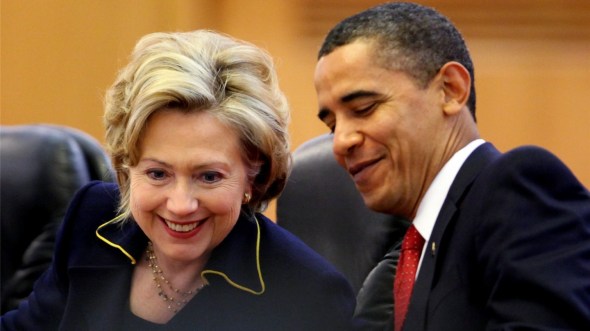
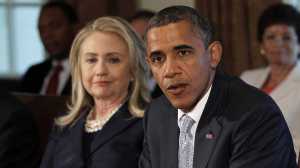
Dakinikat will have a post up later, but I just had to share this amazing interview that President Obama did with Glen Thrush of Politico. As Thrush noted in an article summing up his reactions:
Barack Obama, that prematurely gray elder statesman, is laboring mightily to remain neutral during Hillary Clinton’s battle with Bernie Sanders in Iowa, the state that cemented his political legend and secured his path to the presidency.
But in a candid 40-minute interview for POLITICO’s Off Message podcast as the first flakes of the blizzard fell outside the Oval Office, he couldn’t hide his obvious affection for Clinton or his implicit feeling that she, not Sanders, best understands the unpalatably pragmatic demands of a presidency he likens to the world’s most challenging walk-and-chew-gum exercise.
“[The] one thing everybody understands is that this job right here, you don’t have the luxury of just focusing on one thing,” a relaxed and reflective Obama told me in his most expansive discussion of the 2016 race to date.
Here are some of my own takeaways from the interview transcript. First, there can be no doubt that Obama wants Hillary to win the nomination and the presidency. He damns Sanders with faint praise.
GLENN THRUSH: I mean, when you watch this, what do you — do you see any elements of what you were able to accomplish in what Sanders is doing?
PRESIDENT OBAMA: Well, there’s no doubt that Bernie has tapped into a running thread in Democratic politics that says: Why are we still constrained by the terms of the debate that were set by Ronald Reagan 30 years ago? You know, why is it that we should be scared to challenge conventional wisdom and talk bluntly about inequality and, you know, be full-throated in our progressivism? And, you know, that has an appeal and I understand that.
I think that what Hillary presents is a recognition that translating values into governance and delivering the goods is ultimately the job of politics, making a real-life difference to people in their day-to-day lives. I don’t want to exaggerate those differences, though, because Hillary is really idealistic and progressive. You’d have to be to be in, you know, the position she’s in now, having fought all the battles she’s fought and, you know, taken so many, you know, slings and arrows from the other side. And Bernie, you know, is somebody who was a senator and served on the Veterans’ Committee and got bills done.
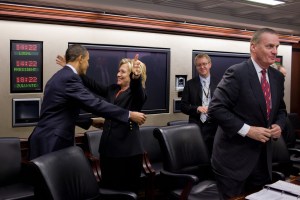
Secretary of State Hillary Rodham Clinton congratulates President Barack Obama on the House vote to pass health care reform, prior to a meeting in the Situation Room of the White House, March 22, 2010. (Official White House Photo by Pete Souza)
On the contrasts the media is drawing between Hillary and Bernie (i.e. he has the enthusiasm, she’s just a boring policy wonk):
I don’t think that’s true. I think that what is — you know, if you look at both of them, I think they’re both passionate about giving everybody a shot. I think they’re both passionate about kids having a great education. I think they want to make sure everybody has health care. I think that they both believe in a tax system that is fair and not tilted towards, you know, the folks at the very top. But, you know, they — I think Bernie came in with the luxury of being a complete longshot and just letting loose.
I think Hillary came in with the — both privilege and burden of being perceived as the frontrunner. And, as a consequence, you know, where they stood at the beginning probably helps to explain why the language sometimes is different.
On the media coverage of Hillary and the failure so far of the media to vet Bernie:
GLENN THRUSH: …Do you feel like it’s a little bit unfair to her, to some extent, the way this has been stacked?
PRESIDENT OBAMA: Yeah – well, yes. But I think that Hillary is tough and she has been through this before and she could anticipate it. If you are a frontrunner, then you are under more scrutiny and everybody is going to pick you apart….
GLENNTHRUSH: …and Bernie, of course, is an untested 74-year-old kid, right?
PRESIDENTOBAMA: Yeah, yeah.
GLENNTHRUSH: So, to what extent do you think it’s appropriate for that process to be aimed at him right now?
PRESIDENTOBAMA: Well, he hasn’t won anything yet.
GLENNTHRUSH: Right.
PRESIDENT OBAMA: I think that there’s always just a rhythm to this thing. I think that if Bernie won Iowa or won New Hampshire, then you guys are going to do your jobs and, you know, you’re going to dig into his proposals and how much they cost and what does it mean, and, you know, how does his tax policy work and he’s subjected, then, to a rigor that hasn’t happened yet, but that Hillary is very well familiar with.
On the way the Obama campaign reacted to criticism from Hillary Clinton in 2008:
PRESIDENT OBAMA: Well, here’s my view: that whoever the nominee is is going to need the other person’s supporters. And I think it is entirely legitimate to draw sharp contrasts where there are contrasts and it is important, however, to maintain a tone in which people feel as if you’re playing fair. And I think Hillary has done that so far, and I think that the truth is in 2007 and 2008, sometimes my supporters and my staff, I think, got too huffy about what were legitimate questions she was raising. And, you know, there were times where I think the media probably was a little unfair to her and tilted a little my way in the — in calling her out when she was tough and not calling some of our folks out as much when we were tough in ads….
I think — look, I’ve gotten to know Hillary really well, and she is a good, smart, tough person who cares deeply about this country, and she has been in the public eye for a long time and in a culture in which new is always better. And, you know, you’re always looking at the bright, shiny object that people don’t, haven’t seen before. That’s a disadvantage to her. Bernie is somebody who —although I don’t know as well because he wasn’t, obviously, in my administration, has the virtue of saying exactly what he believes, and great authenticity, great passion, and is fearless. His attitude is, “I got nothing to lose.”
On Hillary’s strengths as a candidate:
…like any candidate, her strengths can be her weaknesses. Her strengths, which are the fact that she’s extraordinarily experienced – and, you know, wicked smart and knows every policy inside and out – sometimes could make her more cautious and her campaign more prose than poetry, but those are also her strengths. It means that she can govern and she can start here, [on] day one, more experienced than any non-vice president has ever been who aspires to this office. Her strengths, in terms of the ability to debate, the ability to, I think, project genuine concern in smaller groups and to interact with people, where folks realize she’s really warm and funny and engaging— ….
the other thing that I’ll always remember is the sheer strength, determination, endurance, stick-to-it-ness, never-give-up attitude that Hillary had during those primaries. I mean, we had as competitive and lengthy and expensive and tough primary fight as there has been in modern American politics, and she had to do everything that I had to do, except, like Ginger Rogers, backwards in heels. She had to wake up earlier than I did because she had to get her hair done. She had to, you know, handle all the expectations that were placed on her. She had a tougher job throughout that primary than I did and, you know, she was right there the entire time and, had things gone a little bit different in some states or if the sequence of primaries and caucuses been a little different, she could have easily won.

Finally, on the notion of a woman president:
…my No. 1 priority is having a Democratic president succeed me, and I think there’s no doubt that, given our history, I want more women in politics generally, and I want my daughters to feel that there’s nothing that they can’t do. I don’t think that Democrats are going to vote for Hillary just because she’s a woman any more than they’re going to vote for Bernie just because they agree with him on one particular issue. I think, you know, voters are pretty sophisticated. They’re going to take all these things into account. I am proud of the fact that the Democratic Party represents today the breaking down of all sorts of barriers and a belief that you judge people on what they bring to the table and not what they look like or who they love or their last name.
I’ve quoted a lot, but I still hope you’ll go read the whole interview. I wonder if Obama agreed to do this in order to boost Hillary’s chances? His comments are certainly extraordinary, and they are going to be very disconcerting to the media and to Bernie’s supporters.
What do you think?
Lazy Saturday Reads
Posted: January 23, 2016 Filed under: morning reads, U.S. Politics 66 Comments
New York: Blizzard Of 1888.
Good Afternoon!!
I’m really being lazy this Saturday. I’m sitting here drinking hot tea and wondering how all the piano lessons are doing. So far it doesn’t look like we’re going to get anything more than an inch of two of snow from the “monster blizzard;” but if you’re getting hit, I definitely feel for you. After the winter we went through in Boston last year, I’m very happy to miss this one (I hope).
NBC News on the storm so far: Monster Snowstorm Leaves At Least 10 Dead As It Pummels East Coast.
A killer snowstorm that battered the South and the nation’s capital turned its sights on greater New York City on Saturday, packing gale-force winds, heavy snow and coastal flooding as it churned up the East Coast.
The weekend winter wallop has already knocked out power to hundreds of thousands, led to more than 8,300 canceled flights and been blamed for at least 10 deaths.
By the time the storm is over Sunday, one in seven Americans from Kentucky to Connecticut could be under at least half a foot of snow. Washington, D.C., and New York City each could flirt with record snow totals.
The storm paralyzed major cities: Public transportation in Philadelphia, Baltimore, and Washington was shut down, and hundreds of drivers in various states were stranded on icy roadways.
In D.C., which was forecast to be in the crosshairs of the potentially historic storm, snow was falling at a rate of up to 2 inches an hour early Saturday, The Weather Channel said. The north lawn of the White House was blanketed by 20.5 inches of snow.
In Silver Spring, Maryland, which already had 20 inches of snow by morning, lighting and thundersnow lit up the skies, the Associated Press said.
Wow! I guess this storm is for real. I hope you all are safe and warm.

Frederick Childe-Hassam, A New York Blizzard
ABC News has a report on a different kind of storm.
ANALYSIS: The Storm That’s Hit the GOP.
As voting is set to start, Republicans have a dozen choices in front of them. Yet polls show more than half of the vote going to two candidates who combined do not have a single governor or senator behind them.
The conservative National Review has taken the unprecedented step of publishing an entire issue aimed at blocking the party’s leading candidate. Generations of prominent conservative journalists, tea party activists, and former administration officials are uniting to say that Donald Trump should not even be considered a true conservative.
Meanwhile, in the halls of Congress, Republican lawmakers are coming together to argue that one of their own, Sen. Ted Cruz, is the candidate who must be blocked. Their argument is that Cruz would not just lose but damage the party brand for years to come.
Cruz and Trump are holding up such opposition as the predictable gasps of a wheezing establishment. In a sign of the constantly changing face of the party, the party’s 2008 former vice-presidential nominee, Sarah Palin, is backing Trump and complaining about an establishment that’s trying to bring him down.
Sen. Lindsey Graham, himself a former candidate who’s now backing Jeb Bush, summed up the Cruz vs. Trump frustration succinctly: “It’s like being shot or poisoned.”
Nothing the GOP leadership does seems to work. The National Review article doesn’t seem to have had any effect on the populist uprising.

Sudden Blizzard, Robert Bateman
Jeet Heer at The New Republic: National Review Fails to Kill Its Monster.
…when National Review launched its special issue “Against Trump” last night, it was keeping to a venerable tradition of policing the right. The magazine has been fiercely skeptical of Trump since he announced his candidacy last summer, but the special issue, which boasts an array of right-wing media personalities and pundits as well as a feature editorial, seems designed to be its definitive statement, a historical milestone on par with William F. Buckley’s denunciation of the John Birch Society in 1965 or the magazine’s rejection of Pat Buchanan’s anti-Semitism in 1991.
Yet, despite some good polemics, “Against Trump” is a weak-tea effort. Too much time is spent trying to prove that Trump is not a real conservative, while ignoring the fact that the racist nationalism he is espousing has its origins on the right. Trump, the editors argue, is “a philosophically unmoored political opportunist who would trash the broad conservative ideological consensus within the GOP in favor of a free-floating populism with strong-man overtones.” There’s much that can be questioned here: After all, National Review didn’t have a problem with “free-floating populism” in 2008 when it celebrated Sarah Palin (now an enthusiastic Trump cheerleader), and historically the magazine has loved strongmen dictators like Mussolini and Franco.
Read all about it at the link.

Winter Forest, Walter L. Palmer
Ever reliable concern troll Joe Klein has a piece at Time about socialism and the Democratic party. Unfortunately, while I find much of what Klein writes distasteful, I can’t really disagree with him that “socialism” is still a dirty word in American politics; but I disagree that Hillary should use it to attack Bernie. As Dakinikat wrote yesterday, there is a populist impulse among some voters on both sides of the aisle in 2016.
The Democrats Stumble Toward 50 Shades of Socialism.
A specter is haunting the Democratic Party–the specter of socialism. A question is being asked, mostly by Republicans, but also by MSNBC’s Chris Matthews: What is the difference between a Democrat and a Socialist? Debbie Wasserman Schultz got it last July and, ever the robotic partisan, answered by saying the more important difference was between Democrats and Republicans. Senator Chuck Schumer said it depended on how you define the two, and then refused to define the two. And, most significantly, Hillary Clinton said, “Well, I can tell you what I am … I’m a progressive Democrat.”
Now this is not a difficult question to answer. Webster’s says socialism is “a social system or theory in which the government owns and controls the means of production.” Democrats tend to believe in free enterprise. They think government should regulate the means of production, not own it. They have taken great pains to separate themselves from socialism, which has always been a poison word in American politics. And yet, according to a recent Des Moines Register poll, 43% of Iowa Democrats describe themselves as socialists. What gives?
Well, they’re not really socialists. They’re European-style social democrats, who believe in a robust redistribution of wealth (“from each according to her ability, to each according to his need”) and government control of some of the means of production–like the health care system. The question of how much government should redistribute has been the central argument in American politics since the passage of the graduated income tax in 1913. Even the vast majority of Republicans believe in Social Security and Medicare.
So we’re talking about 50 shades of socialism here, but the gradations are still important.
Klein writes that Bernie Sanders’ ideas are not really socialist, “but even Bernie should worry about his party strolling into the general election unwilling to distinguish itself from socialism.” I don’t completely agree with Klein–I never do–but I do think the GOP is salivating at the notion of the Democrats running a candidate who calls himself a socialist.

Packis I Stranden, August Strindberg
I also want to call attention to this piece by Jonathan Capehart, because it’s about something that is indicative of Sanders’ tone-deafness:
How Cornel West hurts Bernie Sanders.
Much has been written about the Vermont independent’s appeal to blackvoters and whether he can pry them away from Hillary Clinton. And all I can say is good luck with that. I and plenty of other African Americans won’t soon forget the deranged ravings of the revered Ivy League professor against President Obama.
During a November 2012 interview with Democracy Now, West branded Obama “a Republican, a Rockefeller Republican in blackface.” Then there was that May 2011 interview with Truthdig where West called the nation’s first African American president “a black mascot of Wall Street oligarchs and a black puppet of corporate plutocrats.” In that same sitdown, West talked about his 2010 run-in with the president. “I wanted to slap him on the side of his head,” West said, who took his significant policy disagreements with the president down an ugly path zealously cut by birthers….
Joining West on the Sanders campaign is another African American who has thrown brick bats at Obama, the rapper Killer Mike. In “That’s life II,” the Atlanta-based musician denigrates the president as a “house slave” when he raps, “We know that House got air conditioning and the sweetest lemonade, but don’t forget your color, brother, we still mutha——- slaves.” No doubt his endorsement surely earned Sanders cool points with some.
I have little patience for the “Blacker than thou” crowd under normal circumstances. So you better believe I have zero patience for it on the presidential campaign trail. That’s why I can’t possibly take Sanders’s outreach to African American voters seriously. Adding to that sense was his “when the African American community becomes familiar with my congressional record” response to a question at the Charleston, S.C., debate about his lack of black support.

Bluebird Blizzard, Robyn Ryan
I have quite a few more stories to share, so I’m just going to give you the links and let you choose the ones you want to check out.
Jamelle Bouie: Bernie Sanders Is Right That Reparations Would Be Divisive.
MSNBC: Sanders walks back Planned Parenthood, Clinton ‘establishment’ comments.
Consequence of Sound: Donald Trump’s father was Woody Guthrie’s landlord, and also a racist asshole.
Think Progress: Why Bernie Sanders’ Misinformed Supreme Court Tweet Matters.
Imani Gandy: I Don’t Know What Dr. King Would Have Thought About Abortion and Neither Do You.
Emily’s List: 43 Years After Roe v. Wade.
Ilyse Hogue at HuffPo: It’s Now or Never for Reproductive Rights.
Eric Boelert at Media Matters: For Clinton, Good News Is No News When It Comes To Polling.
Dissenting Justice: The Voices: Why Do White Male Progressives Hear Things That No One Else Can?
The Cook Political Report: For Clinton, It’s Time to Stay Cool in Iowa and New Hampshire.
The Daily Beast: Gillian Anderson: I Was Offered Half Duchovny’s Pay for ‘The X-Files’ Revival.
I hope you find something here to your liking. Please post your thoughts and links in the comment thread, and have a great weekend!
Friday Reads: Odd Ducks with Odd Flocks
Posted: January 22, 2016 Filed under: 2016 elections | Tags: American Populist, Bernie Sanders, Donald Trump, Eric Hoffer, populism on the left and right, The True Believer 37 Comments It’s a wintry Friday!
Hope you can hole up some place warm today. I’m watching the avocado tree outside my bedroom window shake and shiver in the wind. We’ve got a frost warning here which is never good for tropical zones. I’m sending warm thoughts to all of you on the east coast since you’re going to be in worse straits than the fur babies and me tonight. Still, I’m not about to take off my sloppy chenille sweater and thick wool socks in solidarity with those of you left out in the cold.
I’ve been looking for some coherent theme in today’s headlines. I thought it the impossible dream but then I remembered I am considering reading The True Believer by Eric Hoffer again. I read it for Jr. A/P English in High School and it’s been on my mind a lot as I read this and that about both the Trump and the Sanders campaign. So, I decided to explore some of these thoughts and found a lot more allies in the idea that the much of the anger and shrillness come from similar places. Are we looking at a duel fought for the heart of the new American Populism?
You’ll see Hoffer quotes scattered through this post today. I put them in italics but I’m not going to take the time to footnote them all other than to say you can find them at the link above.
“For men to plunge headlong into an undertaking of vast change, they must be intensely discontented yet not destitute, and they must have the feeling that by the possession of some potent doctrine, infallible leader or some new technique they have access to a source of irresistible power. They must also have an extravagant conception of the prospects and potentialities of the future. Finally, they must be wholly ignorant of the difficulties involved in their vast undertaking. Experience is a handicap. The men who started the French Revolution were wholly without political experience. The same is true of the Bolsheviks, Nazis and the revolutionaries in Asia. The experienced man of affairs is a latecomer. He enters the movement when it is already a going concern. “
Given BB’s post yesterday and this Paul Krugman blog today, I don’t think I’m the only one wondering why the primary process looks more like a series of mini stampedes than usual. American Primary season is never a pretty thing but wow, this year seems to have more insanity. So, what’s with all the true believers?
… there are some currents in our political life that do run through both parties. And one of them is the persistent delusion that a hidden majority of American voters either supports or can be persuaded to support radical policies, if only the right person were to make the case with sufficient fervor.
You see this on the right among hard-line conservatives, who insist that only the cowardice of Republican leaders has prevented the rollback of every progressive program instituted in the past couple of generations. Actually, you also see a version of this tendency among genteel, country-club-type Republicans, who continue to imagine that they represent the party’s mainstream even as polls show that almost two-thirds of likely primary voters support Mr. Trump, Mr. Cruz or Ben Carson.
Meanwhile, on the left there is always a contingent of idealistic voters eager to believe that a sufficiently high-minded leader can conjure up the better angels of America’s nature and persuade the broad public to support a radical overhaul of our institutions. In 2008 that contingent rallied behind Mr. Obama; now they’re backing Mr. Sanders, who has adopted such a purist stance that the other day he dismissed Planned Parenthood (which has endorsed Hillary Clinton) as part of the “establishment.”
But as Mr. Obama himself found out as soon as he took office, transformational rhetoric isn’t how change happens. That’s not to say that he’s a failure. On the contrary, he’s been an extremely consequential president, doing more to advance the progressive agenda than anyone since L.B.J.
Yet his achievements have depended at every stage on accepting half loaves as being better than none: health reform that leaves the system largely private, financial reform that seriously restricts Wall Street’s abuses without fully breaking its power, higher taxes on the rich but no full-scale assault on inequality.
There’s a sort of mini-dispute among Democrats over who can claim to be Mr. Obama’s true heir — Mr. Sanders or Mrs. Clinton? But the answer is obvious: Mr. Sanders is the heir to candidate Obama, but Mrs. Clinton is the heir to President Obama. (In fact, the health reform we got was basically her proposal, not his.)
 Why do some people go merrily down the path of the True Believer even when we live in an age resplendent with information? What causes folks to go all out for personalities that promise them such fundamentally undeliverable ideas?
“The fanatic is perpetually incomplete and insecure. He cannot generate self-assurance out of his individual resources—out of his rejected self—but has it only by clinging passionately to whatever support he happens to embrace. This passionate attachment is the essence of his blind devotion and religiosity, and he sees in it the source of all virtue and strength. Though his single-minded dedication is a holding on for dear life, he easily sees himself as the supporter and defender of the holy cause to which he clings. And he is ready to sacrice his life to demonstrate to himself and others that such indeed is his role. He sacrifices his life to prove his worth. It goes without saying that the fanatic is convinced that the cause he holds on to is monolithic and eternal—a rock of ages. Still, his sense of security is derived from his passionate attachment and not from the excellence of his cause. The fanatic is not really a stickler to principle. He embraces a cause not primarily because of its justness and holiness but because of his desperate need for something to hold on to. Often, indeed, it is his need for passionate attachment which turns every cause he embraces into a holy cause. The fanatic cannot be weaned away from his cause by an appeal to his reason or moral sense. He fears compromise and cannot be persuaded to qualify the certitude and righteousness of his holy cause. But he has no difficulty in swinging suddenly and wildly from one holy cause to another. He cannot be convinced but only converted. His passionate attachment is more vital than the quality of the cause to which he is attached. Though they seem to be at opposite poles, fanatics of all kinds are actually crowded together at one end. It is the fanatic and the moderate who are poles apart and never meet. The fanatics of various hues eye each other with suspicion and are ready to be at each other’s throat. But they are neighbors and almost of one family. They hate each other with the hatred of brothers. They are as far apart and close together as Saul and Paul. And it is easier for a fanatic Communist to be converted to fascism, chauvinism or Catholicism than to become a sober liberal.”
This was one of the great discoveries of my life. That if you go far enough to the left or right, you’re not on a straight line that just goes one. You’re likely following a circle that meets where the fanatics meet. But, the attraction of cults is nothing new under the sun. It drives terrorists on all sides of religion and politics. It kills its own as easily as it kills the other. I’ve gone back to read some stories of cult members and thought I’d share this one where the author discovers they’re likely in a cult.
Several years ago, the founder of IHOP, Mike Bickle, created a list of seven ways to recognize the difference between a religious community and a cult. Written down, the signs seem clear:
1. Opposing critical thinking
2. Isolating members and penalizing them for leaving
3. Emphasizing special doctrines outside scripture
4. Seeking inappropriate loyalty to their leaders
5. Dishonoring the family unit
6. Crossing Biblical boundaries of behavior (versus sexual purity and personal ownership)
7. Separation from the Church
But when it’s your friends, your faith, your community, it’s not so obvious. For several years, roughly two dozen people, all younger than thirty, had been living together in Kansas City, Missouri, and following the leadership of Tyler Deaton, one of our classmates from Southwestern University in Texas. In the summer of 2012, Tyler had married Bethany; by the fall, she was dead. What started as a dorm-room prayer group had devolved into something much darker.
Reading about Bethany’s story and seeing so much followership in some of the political meanderings and postings of friends, I realize that we’re forever stuck on creating an idealized vision of leaders and demonizing those that try to expose the flaws. We also search for data that reinforces our beliefs and leader at the expense of contradictory evidence. Momentum and surges and polls! Oh my!!
According to our latest polls-plus forecast, Hillary Clinton has an 85%chance of winning the Iowa caucuses.
It’s why some of the wonkiest wonks rely on megadata rather than individual data points. Nate Silver’s latest doesn’t exactly show a Bernie surge in Iowa, does it? Yet, my twitter feed and facebook news threads feel like it’s Bernie Tsnumi. WTF gives?
We zoom in on the one point that trips our trigger and on that one piece of anecdotal evidence that suits our mindset. So much if what I’m seeing is just attempts at reinforcing beliefs and then demonizing any evidence to the contrary. It’s like ” I’m against the Establishment, so every one that is against me must be the establishment” or ” I’m a winner and they’re a loser.” I’m seeing a lot of that these days.
Planned Parenthood, the Human Rights Campaign and other progressive groups that have endorsed Hillary Clinton are not part of the political establishment, Sen. Bernie Sanders said Thursday, walking back comments he made earlier this week on MSNBC.
“That’s not what I meant,” Sanders told NBC News in an interview during his campaign swing through the first-in-the-nation primary state. “We’re a week out in the election, and the Clinton people will try to spin these things.”
Pressed on whether he views the groups as “establishment,” Sanders said: “No. They aren’t. They’re standing up and fighting the important fights that have to be fought.”
Sanders said he was specifically talking about the leadership of those groups and their endorsement decisions.
The clarification comes after Sanders responded to a question from MSNBC’s Rachel Maddow earlier this week about why so many progressive groups – including Planned Parenthood, NARAL and the Human Rights Campaign – were backing Clinton over him.
“We’re taking on not only Wall Street and economic establishment, we’re taking on the political establishment,” Sanders said. “So, I have friends and supporters in the Human Rights Fund and Planned Parenthood. But, you know what? Hillary Clinton has been around there for a very, very long time. Some of these groups are, in fact, part of the establishment.”
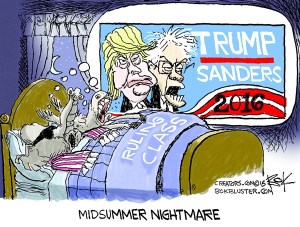 There’s always been a populist streak in American Politics and religion. Both the left and the right indulge populist fantasies and personalities. There’s been a lot of evidence out there that both Bernie and the Donald are playing to similar sentiments. Are we reaching critical in a dueling visions of modern Populism? Michael Gerson asks a good question in this WAPO op ed.
The most fateful unanswered question of the 2016 campaign: Is this a populist moment in America?
It certainly sounds like one. The “establishment” is so universally despised that one wonders who is left to compose it. A putsch might find only empty offices. Outsiders with no political experience dominate the Republican field. Hillary Clinton has rapidly lost ground to an endearing but unelectable ideologue. A revolution seems to stir.
But then Donald Trump proposes a less fiscally responsible version of Jeb Bush’s tax plan. And Clinton, in the sober light of morning, remains the prohibitive favorite for the nomination of her party.
Is populism set to prevail in American politics? The term itself is famously difficult to define. In one way, historian Michael Kazin told me, populism is a “language, a way of talking about the people and the elites.” It doesn’t really matter if the elites being savaged inhabit Wall Street or the Education Department. By this measure, we are near the triumph of rhetorical populism. But it is more loud and annoying than revolutionary.
Yet populism also has a meaning rooted in American history. At its best, populism is the movement of common people whose interests are ignored in times of economic stress and transformation. In the 19th century, this group was (initially) farmers in the South and West who, in the aftermath of a serious recession, carried large amounts of debt and faced rising prices for transportation and supplies because of monopolies. Activists created economic cooperatives, formed third parties (including the People’s Party ) and ran slates of candidates. The movement gained support among laborers and small-business owners. Its demands were serious and structural: freer money, direct election of senators, federal insuring of banks and regulations on the stock market.
It’s odd that the current movement leaders are both elites and part of the establishment. Yet, their voices throwback to the roots of their families more than their personal life experiences. How much more elite or establishment can you get than U.S. Senator or a trustfund baby making a living by gaming tax law for real estate speculation? Is any of this really health for the country’s political discourse and for governance? Tom Bachtell spins a story using an earlier example.
Populism is a stance and a rhetoric more than an ideology or a set of positions. It speaks of a battle of good against evil, demanding simple answers to difficult problems. (Trump: “Trade? We’re gonna fix it. Health care? We’re gonna fix it.”) It’s suspicious of the normal bargaining and compromise that constitute democratic governance. (On the stump, Sanders seldom touts his bipartisan successes as chairman of the Senate Veterans’ Affairs Committee.) Populism can have a conspiratorial and apocalyptic bent—the belief that the country, or at least its decent majority, is facing imminent ruin at the hands of a particular group of malefactors (Mexicans, billionaires, Jews, politicians).
Above all, populism seeks and thrills to the authentic voice of the people. Followers of both Sanders and Trump prize their man’s willingness to articulate what ordinary people feel but politicians fear to say. “I might not agree with Bernie on everything, but I believe he has values, and he’s going to stick to those and he will not lie to us,” a supporter named Liam Dewey told ABC News. The fact that Sanders has a tendency to drone on like a speaker at the Socialist Scholars Conference circa 1986—one who happens to have an audience of twenty-seven thousand—only enhances his bona fides. He’s the improbable beneficiary of a deeply disenchanted public. As for Trump, his rhetoric is so crude and from-the-hip that his fans are continually reassured about its authenticity.
Responding to the same political moment, the phenomena of Trump and Sanders bear a superficial resemblance. Both men have no history of party loyalty, which only enhances their street cred—their authority comes from a direct bond with their supporters, free of institutional interference. They both rail against foreign-trade deals, decry the unofficial jobless rate, and express disdain for the political class and the dirty money it raises to stay in office.
Trump uses the typical right wing populist weapon of demonizing the other outwardly as an other while Sanders writes his enemies off as  establishment. Followers of both are much less subtle.
Students of the American populist tradition say Trump is filling in an emerging issues vacuum on the right—and for the declining appeal of longstanding culture-war crusades among the GOP faithful. The GOP’s great unifying issue over the past few election cycles—the demand to repeal the Affordable Care Act—is showing signs of wear. Presidential hopefuls continue to pay lip service to the ACA’s repeal, but the law’s run of Supreme Court victories—together with gradually increasing public support for some of its key provisions—means that the bid to kill Obamacare is unlikely to generate much new energy on the right. Obamacare’s repeal is “dead as an issue,” says Georgetown University historian Michael Kazin, author of The Populist Persuasion (1998) and the 2007 Bryan biography A Godly Hero. “So here you have someone like Trump coming along to say, well, here’s an issue.”
That issue has been immigration, with Trump making his infamous remarks about Mexican immigrants raping women, dealing drugs and plundering American jobs—populist-style cultural scapegoating with a capital S. But there’s something more than simple white resentment at play here. In reviving the old populist cause of economic nationalism, Trump has struck a chord among a pinched conservative working-class electorate that knows free trade and globalization are not about to boost their wages, or bring their pensions back. He’s also tapped into the protectionist outlook of America’s older labor movement, which historically supported restrictions on immigration because of its downward pull on wages.
This is where my mind fills with the explanations of the 1950s Hoffer who looked to explain the NAZIS and Stalinists alike. There is, indeed, so much passionate hatred.
“Passionate hatred can give meaning and purpose to an empty life.”
But, both of these guys seem to think they’re the singular entity that has the easiest answer and the purest ideas. So, what do I make of this? What does Hoffer make of this?
…
“When the moment is ripe, only the fanatic can hatch a genuine mass movement. Without him the disatisfaction engendered by militant men of words remains undirected and can vent itself only in pointless and easily suppressed disorders. Without him the initiated reforms, even when drastic, leave the old way of life unchanged, and any change in government usually amounts to no more than a transfer of power from one set of men of action to another. Without him there can perhaps be no new beginning. When the old order begins to fall apart, many of the vociferous men of words, who prayed so long for the day, are in a funk. The first glimpse of the face of anarchy frightens them out of their wits. They forget all they said about the “poor simple folk” and run for help to strong men of action—princes, generals, administrators, bankers, landowners—who know how to deal with the rabble and how to stem the tide of chaos. Not so the fanatic. Chaos is his element.”
So, let me ask you. Are we looking at a two-headed coin? Are we looking at two competing captains for a Krewe of Populist Chaos?

 peej
peej Carissa
 bostonboomer
 dakinikat
 ecocatwoman
 mablue2
 Mama Lopez
 peggysue22
 quixote
 skydancingguestblogger
 Mona (aka Wonk the Vote)



 Sky Dancing
Recent Comments