
Thursday Reads: “Stop The World; I Want To Get Off”
Posted: September 10, 2015 Filed under: Media, misogyny, morning reads, Surreality, The Media SUCKS, U.S. Politics | Tags: Carly Fiorina, Donald Trump, Hillary Clinton 19 Comments  Good Morning!!
It’s just one thing after another these days. I’m all stressed out again, because my mother broke her clavicle and I need to get out to Indiana ASAP. Unfortunately, I also have to go to the dentist this afternoon and then I have to figure out what to do about the jury duty I committed to in October, get the car checked out, and pack. On top of that my car is due for an inspection sticker at the end of October. I’ll have to try to figure out if I’ll be back here by then or whether I should get the inspection done early.
Anyway, I’m hanging in there, realizing that my problems are nothing compared to so many other people in this crazy world. So what’s happening out there this morning?
Donald Trump continues to dominate the media. The good news is if they’re focusing on him, they can’t beat up on Hillary Clinton at the same time–or can they?
Trump’s misogyny knows no end–yesterday he turned his attention to fellow GOP candidate Carly Fiorina. From Ken Walsh’s Washington at U.S. News:
Another day, another insult from Donald Trump – and still another feud in the making.
This time, the Republican presidential front-runner belittled former business executive and presidential competitor Carly Fiorina, who has been making gradual progress in the polls but still lags behind Trump in the GOP race.
Rolling Stone magazine reports that Trump was watching Fiorina recently on a television newscast, in the presence of Rolling Stone reporter Paul Solotaroff, when the billionaire real-estate developer said, “Look at that face! Would anyone vote for that? Can you imagine that, the face of our next president?”
Trump added: “I mean, she’s a woman, and I’m not supposed to say bad things, but really, folks, come on. Are we serious?”
Watching Trump run for president is like watching a 5-year-old boy act out with no restraints.

The Guardian reports on Fiorina’s response:
Fiorina, speaking on Fox News to Megyn Kelly – who has also been targeted by Trump – said she considered his remarks to be “very serious”.
She added: “Maybe, just maybe, I’m getting under his skin a little bit because I am climbing in the polls.”
Trump has forged a consistent lead in polling for the Republican candidacy, with former Hewlett-Packard chief executive Fiorina considerably further behind, polling in single figures.
Maybe. Or maybe Trump is just a gigantic asshole. He also attacked Ben Carson and tried without success to defend his comments about Fiorina. From The Washington Post:
Carson attacked Trump in unusually sharp terms yesterday, seeming to question his faith. On Thursday, Trump went after Carson’s energy level — and played down his medical accomplishments, saying he was only an “okay doctor” (Carson was the first neurosurgeon to separate conjoined twins attached at the head.)
“He makes [Jeb] Bush look like the Energizer bunny,” Trump said on CNN Thursday morning. “Who is he to question my faith? … When he questions my faith, and I’m a believer big-league in God, the Bible…I will hit back for that.”
“He was a doctor… perhaps an OK doctor,” he also said, adding that “Ben Carson will not be the next president of the United States.”
Trump’s comments, which are the most aggressive he has made about Carson, come less than a day after the retired surgeon pointed to his faith when asked what he believes to be the biggest difference between himself and Trump.
“The biggest thing is that I realize where my success has come from, and I don’t any way deny my faith in God,” Carson Wednesday night. “And I think that probably is a big difference between us.”

Can you imagine having a president who says things like “I’m a believer big-league in God?” Is this really happening? On Fiorina:
Trump defended his comments on Fox News Thursday morning, dismissing the notion that he was talking about Fiorina’s physical appearance.
“Probably I did say something lik that about Carly,” Trump said. “I’m talking about persona. I’m not talking about look.”
So criticizing a woman’s face is not about her appearance? Yeah, right. Not much of defense. But the media won’t hold Trump accountable no matter what he says.
Meanwhile traditional conservative pundits profess to be utterly mystified by Trump’s success in his “campaign” so far. Brian Beutler at The New Republic: Donald Trump’s Biggest Conservative Enemies Helped Create Him.
Donald Trump’s durable lead in Republican primary polls, and improving approval ratings, continue to befuddle people who ought to have better insight into the state of the conservative mind. Writing for National Review, Jonah Goldberg and Charles C.W. Cooke have each diagnosed Trumpism as a failing of the conservative voters who comprise Trump’s base.
Cooke believes that Trump “has succeeded in convincing conservatives to discard their principles,” begging the question of whether Trump’s supporters ever really shared the principles that animate conservative organizations and National Review writers. Goldberg insisted that “no movement that embraces Trump can call itself conservative,” which helped give rise to #NRORevolt, an online backlash, thick with white nationalists and other conservatives who are fed up with elites who try to write non-conformists—from moderates to protectionists to isolationists to outright racists—out of the movement.
The anti-tax group Club for Growth is a big part of that purification apparatus. It is currently organizing and raising money for an effort to excise Trump before his view that hedge fund managers should pay their fair share in taxes metastasizes through the Republican primary field.
Republican consultant Steve Schmidt, who presumably sympathizes withNational Review and Club for Growth, described their frustrations as the described their frustrations as the result of a fatal disjunction between mass conservatism and the ideology that’s supposed to underlie it. “We’re at this moment in time,” Schmidttold NPR recently, “when there’s a severability between conservatism and issues. Conservatism is now expressed as an emotional sentiment. That sentiment is contempt and anger.”
This explains Trump’s rise and persistence, but fails to account for how“contempt and anger” became such valuable currency in Republican politics today. That omission is predictable, because such an accounting would implicate nearly everyone who now claims to be astonished and dismayed by the Trump phenomenon.
Read the rest at TNR.

A couple of weeks ago, I made a resolution that I would read Nate Silver’s FiveThirtyEight blog and Peter Daou and Tom Watson’s #HillaryMen blog every day. I’ve been doing it, and the effort has been paying off in terms of maintaining my equilibrium in an insane media atmosphere.
Silver had a nice, level-headed post on Trump and Bernie Sanders yesterday: Stop Comparing Donald Trump And Bernie Sanders.
A lot of people are linking the candidacies of Bernie Sanders and Donald Trump under headings like “populist” and “anti-establishment.” Most of these comparisons are too cute for their own good — not only because it’s too earlyto come to many conclusions about the campaign, but also because Trump and Sanders are fundamentally different breeds of candidates who are situated very differently in their respective nomination races.
You can call both “outsiders.” But if you’re a Democrat, Sanders is your eccentric uncle: He has his own quirks, but he’s part of the family. If you’re a Republican, Trump is as familial as the vacuum salesman knocking on your door.
Silver lists 7 differences between the two candidates–check them out at the link.

And from #HillaryMen, another sensible post: The Sad, Sisyphean Struggle of Hillary Haters.
Writing for Politico, Jack Shafer explains why he thinks “Being a Clinton apologist is a hard life.”
Which got us thinking: what must it be like to be a die-hard Hillary hater? Obsessing over one of the most accomplished and resilient public figures on the planet? How depressing and demoralizing is it to latch onto fabricated scandal after fabricated scandal, only to have every one fade away?
How frustrating is it to expend so much time and mental energy bashing, bashing, bashing, only to have Hillary come back stronger than ever?
And how awful is it to be on the wrong side of women’s history, to help reinforce the gender barrier that prevents women and girls from realizing their full potential?
We’re not talking about fair-minded critics and principled political opponents. They have every right to disagree with Hillary and to dislike her if they’re so inclined. We’re talking about haters, people who have a pathological need to savage Hillary. People who make an industry of their hate.
Think of the self-righteous rants on Morning Joe, the seething vitriol of Maureen Dowd, the feverish swamps of rightwing trolls. Think of the reporters and pundits who mindlessly repeat Rove-funded frames and narratives, hoping to taint Hillary’s public image, to sully her character. Think of the Republican and conservative operatives who have tried in vain for more than two decades to silence her.
Go over to #HillaryMen to read the rest.

As a bonus, here’s a nice column by Brent Budowsky at The Hill: Big truths about Hillary.
In olden days, great columnists such as Walter Lippmann and James “Scotty” Reston would periodically step back and put great events into perspective.
As America’s summer of political discontent and distemper ends, and as Americans shift from the fun of enjoying our favorite political performer to the mission of selecting our next president and as a pope of epochal significance prepares to address a joint session of a vastly unpopular Congress, let’s look at matters from a larger perspective.
It is revealing that while GOP presidential front-runner Donald Trump gets a pass from many in the media for repeated comments that were verbally abusive toward women, the candidate who would be the first female president, Hillary Clinton, is treated like a pinata by pundits on television news — which, according to Gallup, is one of the least trusted institutions in America.
When Clinton stands with virtually all of America’s democratic allies by forcefully supporting a plan to prevent Iran from obtaining nuclear weapons and stands with Pope Francis in support of treating refugees and immigrants humanely, she is acting like a stateswoman, commander in chief and humanitarian.
Meanwhile, the policies of GOP presidential candidates would leave Lady Liberty crying in New York Harbor as the pope arrives in America.
It is a big truth that Clinton would be the first female president, an achievement equal in historic magnitude to President Obama becoming our first black president.
If she is elected, moms and dads from Topeka to Tangiers will be telling their daughters that they too can achieve anything if they work hard and dream big.
By contrast, the Republican front-runner describes moms and daughters as fat pigs, dogs, cats with their natural balance food slobs, disgusting animals and bimbos.
More big truths at the link. The piece is well worth reading.

A bit more news, links only:
Japan Today: More than 100,000 flee floods in eastern Japan; 7 missing.
New York Daily News Exclusive: James Blake, former tennis star, slammed to ground and handcuffed outside midtown hotel by white NYPD cops who mistook him for ID theft suspect.
Chron.com: Baltimore police arrest pastor a week after Gray protests.
The Daily Beast Exclusive: 50 Spies Say ISIS Intelligence Was Cooked.
Politico: David Brock: The New York Times has ‘a special place in hell.’
CNN: Homo naledi: New species of human ancestor discovered in South Africa.
National Geographic: This Face Changes the Human Story. But How?
What else is happening? Please Share your thoughts and links in the comment thread and have a nice Thursday.
Tuesday Reads: September Heat Wave
Posted: September 8, 2015 Filed under: morning reads, U.S. Politics | Tags: Climate change, global warming, heat wave, Hillary Clinton, Senate 45 Comments
Good Morning!!
It’s September, but it feels like July here in Boston. We’re having another heat wave, and the same is true in many other parts of the country. Fortunately, most of us will get some relief later in the week.
From Weather.com: Pattern Change to Bring Heat Relief to Midwest, Plains, East; West Coast Heats Up.
Hot temperatures have dominated parts of the Midwest, Plains and East during the first week of September, with highs topping out well into the 80s and 90s at times. While some might be enjoying this late-summer heat and humidity, others are probably ready for the air to have more of a fall feel east of the Rockies. For those in the latterI’ camp, we do have some good news on the horizon thanks to a rearrangement of the jet stream pattern.
For the Midwest and parts of the East, temperatures will drop to near-average or even below-average levels as the week progresses. In fact, some cities in the Midwest may see high temperatures fall 20 degrees or more from early week into mid or late week. Even more impressive is the temperature drop from highs early this week to lows later in the week. For example, Chicago had a high of 92 degrees on Sunday but will see lows in the 50s late in the week, a drop of more than 30 degrees.
Before the cooler air arrives in the Northeast, daily record high temperatures will be threatened in multiple locations, including New York City, Philadelphia, Hartford and Boston on Tuesday.
Meanwhile, the West Coast will see the opposite impact from this pattern change with temperatures soaring above average all the way into the Pacific Northwest.
Read all the details at the link.

People cool off at fountains on Rose Kennedy Greenway, Boston
From the Weather Wisdom column at The Boston Globe: September heat wave begins today and continues through Wednesday.
Back in 1881, the mercury rose to a stifling 102 degrees in Boston for the hottest temperature in the record books during the month of September. This was also one of the hottest days ever in Boston.
Typically our highs would be in the 70s closing out the first week of September, during a cool year we might stay in the 60s while other warmer years would reach the 80s. Today marks only the 5th time since records began in Boston we have reached 90 degrees on September 7th.
Heat Wave Number 2
Having already eclipsed the 90 mark, it’s almost a sure bet we are beginning a 3 day heat wave. Remember, heat waves are 3 days or more in a row when the high temperature reaches at least 90 degrees. Tomorrow and Wednesday are even hotter and as the humidity slowly climbs the heat indices could get near 100 degrees for a few hours either or both days.The map below shows highs in the mid-90s tomorrow. This would be the 9th time Boston has reached 90 on the 8th of September. The record for tomorrow is 95 and there is a chance would could tie that record.
Another 90 degree day on Wednesday will make it an official heat wave. There are only 3 days where it’s reached 90 on the 9th and this year should make 4. The record Wednesday is 91 and we would likely set a new record.

On days like this, I can’t help thinking about our changing climate and how it will affect future generations. This is another reason why we must elect a Democratic president next year. President Obama has been able to make some progress on this issue through executive orders; to build on his efforts, we desperately need to elect Hillary Clinton president and hope that she can bring along enough Democrats to regain the Senate.
From The Hill: Democrats pin hopes on Hillary for winning back the Senate.
The battle for control of the Senate rests on the outcome of the presidential race, strategists in both parties say.
Since 1860, no party has been able to climb out of the minority to capture the Senate during a presidential election year without also winning the White House….
Democrats appear well positioned to knock off two Republican incumbents, but whether they can stretch the number of Senate pick-ups to the necessary four or five while defending two of their own vulnerable seats remains to be seen.
The election map favors Democrats. They are defending only 10 Senate seats, while Republicans are protecting 24, including seven in states carried by President Obama in 2012.
But Democrats are running against the grain of history by trying to keep the White House for three consecutive terms — a feat last accomplished by Republicans in 1988, when Ronald Reagan left office with a 53-percent approval rating. Obama’s approval rating, by comparison, stands at 45 percent, according to Gallup.

Just one more reason why we need to support Hillary. “The article quotes “Steve Elmendorf, a Democratic strategist, lobbyist and fundraiser.”
“Ted Strickland can beat Rob Portman if Hillary Clinton is winning Ohio. Pat Toomey, no matter how good he looks on paper and the problems we’re having with the primary, I think if you get to November and Democrats are winning Pennsylvania by a huge number, Toomey’s in a lot of trouble,” he said
“If Democrats don’t win the presidential race, I don’t think we’ll win the Senate,” he added.
The map of key Senate races largely matches up with the map of presidential battlegrounds.
Aside from Wisconsin and Illinois, where Republican incumbent Sens. Ron Johnson (Wis.) and Mark Kirk (Ill.) are fighting for their political lives in blue states, the most competitive Senate contests are in presidential swing states.
Johnson trails former Democratic Sen. Russ Feingold in Wisconsin by five points, according to a mid-August Marquette Law School poll, and Democrats predict Feingold will raise more money.
Kirk, meanwhile, lagged six points behind Rep. Tammy Duckworth (D-Ill.) in a late-July survey by Public Policy Polling, a Democratic firm.
More details at the link.
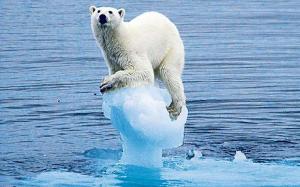
Getting back to climate change, The Washington Post had an important article yesterday: New studies deepen concerns about a climate-change ‘wild card.’
Two new studies are adding to concerns about one of the most troubling scenarios for future climate change: the possibility that global warming could slow or shut down the Atlantic’s great ocean circulation systems, with dramatic implications for North America and Europe.
The research, by separate teams of scientists, bolsters predictions of disruptions to global ocean currents — such as the Gulf Stream — that transfer tropical warmth from the equator to northern latitudes, as well as a larger conveyor system that cycles colder water into the ocean’s depths. Both systems help ensure relatively mild conditions in parts of Northern Europe that would otherwise be much colder.
The papers offer new insight into how rapidly melting Arctic ice could slow or even temporarily halt the ocean’s normal circulation, with possible effects ranging from plunging temperatures in northern latitudes to centuries-long droughts in Southeast Asia….
One study, by three scientists from Germany’s Alfred Wegener Institute, uses computers to model how Greenland’s rapid thawing could affect the Atlantic meridional overturning circulation, the system that pushes cold, dense saltwater into the deep ocean and helps transport warm water northward, helping to warm Europe’s climate.
Their report, in the journal Geophysical Research Letters, says previous research may have underestimated changes to the ocean from the huge influx of fresh, cold water from melting ice sheets. Using new methods, the German scientists were able to estimate more precisely how much ice would melt and how all that added freshwater would affect ocean circulation. In the ocean, colder water normally tends to sink, but cold freshwater — less dense than saltwater — stays near the surface, disrupting the normal flow.

The researchers concluded that we’ve already gone pretty far down the road on climate change, but there are still things society can do the prevent the worst scenarios from coming to pass.
A second paper, by a team of Texas scientists, sheds new light on how the Earth’s climate responded during a similar thaw from the planet’s geological past. About 12,000 years ago, rising temperatures at the end of the last ice age released huge volumes of cold freshwater, disrupting the ocean’s circulation systems and sending parts of the Northern Hemisphere back in to the freezer. Scientists refer to the era as the Younger Dryas period.
The study in the journal Nature Climate found a wide range of impacts, some of which lingered for centuries. While the far-northern latitudes experienced rapid changes — including an 18-degree Fahrenheit temperature drop in Greenland in less than a decade — droughts and other weather anomalies in the southern Pacific persisted for 1,000 years.
Read the rest at the WaPo.
Is it possible we’ve reached a turning point? Jonathan Chait thinks so: This is the year humans finally got serious about saving themselves from themselves.
Here on planet Earth, things could be going better. The rise in atmospheric temperatures from greenhouse gases poses the most dire threat to humanity, measured on a scale of potential suffering, since Imperial Japan and Nazi Germany launched near-simultaneous wars of conquest. And the problem has turned out to be much harder to solve. It’s not the money. The cost of transitioning away from fossil fuels, measured as a share of the economy, may amount to a fraction of the cost of defeating the Axis powers. Rather, it is the politics that have proved so fiendish. Fighting a war is relatively straightforward: You spend all the money you can to build a giant military and send it off to do battle. Climate change is a problem that politics is almost designed not to solve. Its costs lie mostly in the distant future, whereas politics is built to respond to immediate conditions. (And of the wonders the internet has brought us, a lengthening of mental time horizons is not among them.) Its solution requires coordination not of a handful of allies but of scores of countries with wildly disparate economies and political structures. There has not yet been a galvanizing Pearl Harbor moment, when the urgency of action becomes instantly clear and isolationists melt away. Instead, it breeds counterproductive mental reactions: denial, fatalism, and depression.

It’s a long read. Chait covers the history of efforts to reverse climate change and then offers hope.
For human to wean ourselves off carbon-emitting fossil fuel, we will have to use some combination of edict and invention — there is no other plausible way around it. The task before the world is best envisioned not as a singular event but as two distinct but interrelated revolutions, one in political willpower and the other in technological innovation. It has taken a long time for each to materialize, in part because the absence of one has compounded the difficulty of the other. It is extremely hard to force a shift to clean energy when dirty energy is much cheaper, and it is extremely hard to achieve economies of scale in new energy technologies when the political system has not yet nudged you to do so.
And yet, if you formed a viewpoint about the cost effectiveness of green energy a generation ago (when, for instance, Ronald Reagan tore the costly solar panels installed by his predecessor off the White House roof), or even just a few years ago, your beliefs are out of date. That technological revolution is well under way.
For one thing, the price of solar is falling, and rapidly. In a March 2011post for Scientific American’s website, Ramez Naam, a computer scientist and technological enthusiast, compared the rapid progress of solar power to Moore’s Law, the famous dictum that described the process by which microchips grew steadily more useful over time, doubling in efficiency every two years. The price of solar power had fallen in two decades from nearly $10 a watt to about $3. By 2030, he predicted, the price could drop to just 50 cents a watt.
Read the whole thing at New York Magazine.
Those are my offerings for today. I’m going to turn was feeling sick on Sunday and Monday and I’m still a little wobbly today. Take, care, Sky Dancers and I hope the floor over to you now, because I’m recovering from a nasty stomach virus. I hope you have an enjoyable day.
Labor Day Reads
Posted: September 7, 2015 Filed under: Labor unions, morning reads | Tags: drought, income inequality. Wages, ISIS 12 Comments Happy Labor Day!
Today I thought I’d give you some long, interesting reads to fill what I hope is a nice quiet day for you! Some of these are related to the holiday we celebrate today. You’ll notice that I’ve put up some photos of what it meant to be worker back in the day including pictures of child labor which was made illegal with the help of Union activism. No Labor Day celebration would be complete without a generous selection of Pete Seeger tunes. Check the bottom and listen to this American Treasure!
My first offering is from TP and salutes Seven Union Heroes.
This Labor Day, while you’re enjoying the three-day-weekend, take a moment to celebrate the heroes of the union movement. These noteworthy people left behind a legacy that we enjoy today, from the end of child labor to the more humane treatment of farm workers.
My next selection is from the UK Guardian and explains why the US middle class started really losing ground during the Dubya years. This is especially true of wages.
Until recently, an examination of the labour market relied on the annual publication of average wages. That is how the story of flat wages for the many and super-returns for the few over such a long period has emerged. Each calculation of average wages is a snapshot of all the people in the workforce. Unfortunately, millions of people quit the labour market during the year and others join. It is not the same cohort, and not just at the outer margins.
Robert J Shapiro, a former economic adviser to Bill Clinton who now runs the Sonecon consultancy in Washington, grabbed the opportunity to look at the raw census data when the US statistical office published it a few years ago.
He tracked the median incomes of average households as they travelled through the decades, checking on the progress of men versus women, Hispanic people versus black and white people, college graduates and different age groups. The report presents us with a more nuanced picture of the workforce and how it has fared.
He found that the 1980s boom, which gained traction in the middle of the decade, boosted the wages of all but the oldest group of workers. So large, steady income gains characterised the average household whether they were headed by men or women, or by people with high school diplomas or college degrees, whatever their ethnicity.
As Shapiro said: “This evidence contradicts the narrative told by those who track the value of aggregate income from the 1970s to present the claim that most Americans have made little progress for decades.”
The momentum dissipated in the first Bush presidency between 1989 and 1993 and accelerated again in the Clinton years before running out of steam in the early 2000s
Then came the downturn. The second Bush era, under George W, was painful for almost all but twentysomething college graduates, who even survived the 2008 crash with barely a scratch, and was worst for those without a high school diploma. Shapiro says the least educated saw their incomes “devastated” after 2001.
“Across the three younger age-cohorts, the median income of households headed by people without high school diplomas fell an average of 1.9% per year as they aged through the 2002-2007 expansion; and over the entire period from 2002 to 2013, their median incomes fell by an average of 1.8% year as they aged,” the report says.
Between 2010 and 2013, households where the main earner had been aged 25 to 29 back in 1982 suffered even more if they quit education before going to high school. They lost 7.1% in income in each year as vast numbers either took a cut in pay, in hours or were made unemployed.
The rise and fall of the average workers’ wages documented in the report chimes with the business cycle and the trend in Europe, which followed a similar trajectory.
The average German worker made income gains through the same period before a deregulation of the labour market under the Social democrat Gerhard Schroeder brought about an effective freeze in wages from 2003.
In the UK, the chancellor at the time, Gordon Brown, reacted to the downturn by switching on the government spending taps. He introduced tax credits as an income top-up to offset the trend for flat or falling real wages. It was a policy that insulated British workers from a trend that clobbered Americans and to a lesser extent German workers.
Retelling the economic story of the 1980s, Shapiro says the US benefited from a mix of Reagan’s expansionary policies in defence and infrastructure and the collapse of commodity prices after the inflationary oil shocks of the 1970s.
George Bush senior was forced to cope with the borrowing hangover from the Reagan years before Clinton assumed the presidency.
 Another Guardian article explains how US and British policy in Iraq and Syria actually grew and predicted and WISHED for the rise of ISIS.
A revealing light on how we got here has now been shone by a recently declassified secret US intelligence report, written in August 2012, which uncannily predicts – and effectively welcomes – the prospect of a “Salafist principality” in eastern Syria and an al-Qaida-controlled Islamic state in Syria and Iraq. In stark contrast to western claims at the time, the Defense Intelligence Agency document identifies al-Qaida in Iraq (which became Isis) and fellow Salafists as the “major forces driving the insurgency in Syria” – and states that “western countries, the Gulf states and Turkey” were supporting the opposition’s efforts to take control of eastern Syria.
Raising the “possibility of establishing a declared or undeclared Salafist principality”, the Pentagon report goes on, “this is exactly what the supporting powers to the opposition want, in order to isolate the Syrian regime, which is considered the strategic depth of the Shia expansion (Iraq and Iran)”.
Which is pretty well exactly what happened two years later. The report isn’t a policy document. It’s heavily redacted and there are ambiguities in the language. But the implications are clear enough. A year into the Syrian rebellion, the US and its allies weren’t only supporting and arming an opposition they knew to be dominated by extreme sectarian groups; they were prepared to countenance the creation of some sort of “Islamic state” – despite the “grave danger” to Iraq’s unity – as a Sunni buffer to weaken Syria.
That doesn’t mean the US created Isis, of course, though some of its Gulf allies certainly played a role in it – as the US vice-president, Joe Biden, acknowledged last year. But there was no al-Qaida in Iraq until the US and Britain invaded. And the US has certainly exploited the existence of Isis against other forces in the region as part of a wider drive to maintain western control.
The calculus changed when Isis started beheading westerners and posting atrocities online, and the Gulf states are now backing other groups in the Syrian war, such as the Nusra Front. But this US and western habit of playing with jihadi groups, which then come back to bite them, goes back at least to the 1980s war against the Soviet Union in Afghanistan, which fostered the original al-Qaida under CIA tutelage.
It was recalibrated during the occupation of Iraq, when US forces led by General Petraeus sponsored an El Salvador-style dirty war of sectarian death squads to weaken the Iraqi resistance. And it was reprised in 2011 in the Nato-orchestrated war in Libya, where Isis last week took control of Gaddafi’s home town of Sirte.
In reality, US and western policy in the conflagration that is now the Middle East is in the classic mould of imperial divide-and-rule. American forces bomb one set of rebels while backing another in Syria, and mount what are effectively joint military operations with Iran against Isis in Iraq while supporting Saudi Arabia’s military campaign against Iranian-backed Houthi forces in Yemen. However confused US policy may often be, a weak, partitioned Iraq and Syria fit such an approach perfectly.
Music sounds better when you’re under the influence of LSD. I think I learned this lesson as a sophomore at university but evidently there’s research so we don’t have to rely on my anectodotal evidence.
The right music can evoke powerful emotions seemingly out of the blue, but under the influence of LSD the musical experience is enhanced even further. This according to the Beckley/Imperial Psychedelic Research Programme whichtested this long held assumption under a modern placebo-controlled study for the very first time.
Ten healthy volunteers listened to five different tracks of instrumental music during each of two study days, a placebo day followed by an LSD day, separated by 5–7 days. After listening to each track, participants were asked to rate their experience on a visual analogue scale (VAS) and the nine-item Geneva Emotional Music Scale (GEMS-9). According to the participants’ subjective ratings, LSD enhanced the emotions they felt while listening to the instrumental tracks, particularly those described as “wonder”, “transcendence”, “power” and “tenderness”.
This article from The Atlantic on how universities are helping student protect themselves from ideas and philosophies they don’t want to hear was really quite astounding to me.
Among the most famous early examples was the so-called water-buffalo incident at the University of Pennsylvania. In 1993, the university charged an Israeli-born student with racial harassment after he yelled “Shut up, you water buffalo!” to a crowd of black sorority women that was making noise at night outside his dorm-room window. Many scholars and pundits at the time could not see how the termwater buffalo (a rough translation of a Hebrew insult for a thoughtless or rowdy person) was a racial slur against African Americans, and as a result, the case became international news.
Claims of a right not to be offended have continued to arise since then, and universities have continued to privilege them. In a particularly egregious 2008 case, for instance, Indiana University–Purdue University at Indianapolis found a white student guilty of racial harassment for reading a book titled Notre Dame vs. the Klan. The book honored student opposition to the Ku Klux Klan when it marched on Notre Dame in 1924. Nonetheless, the picture of a Klan rally on the book’s cover offended at least one of the student’s co-workers (he was a janitor as well as a student), and that was enough for a guilty finding by the university’s Affirmative Action Office.
These examples may seem extreme, but the reasoning behind them has become more commonplace on campus in recent years. Last year, at the University of St. Thomas, in Minnesota, an event called Hump Day, which would have allowed people to pet a camel, was abruptly canceled. Students had created a Facebook group where they protested the event for animal cruelty, for being a waste of money, and for being insensitive to people from the Middle East. The inspiration for the camel had almost certainly come from a popular TV commercial in which a camel saunters around an office on a Wednesday, celebrating “hump day”; it was devoid of any reference to Middle Eastern peoples. Nevertheless, the group organizing the event announced on its Facebook page that the event would be canceled because the “program [was] dividing people and would make for an uncomfortable and possibly unsafe environment.”
Because there is a broad ban in academic circles on “blaming the victim,” it is generally considered unacceptable to question the reasonableness (let alone the sincerity) of someone’s emotional state, particularly if those emotions are linked to one’s group identity. The thin argument “I’m offended” becomes an unbeatable trump card. This leads to what Jonathan Rauch, a contributing editor at this magazine, calls the “offendedness sweepstakes,” in which opposing parties use claims of offense as cudgels. In the process, the bar for what we consider unacceptable speech is lowered further and further.
Since 2013, new pressure from the federal government has reinforced this trend. Federal antidiscrimination statutes regulate on-campus harassment and unequal treatment based on sex, race, religion, and national origin. Until recently, the Department of Education’s Office for Civil Rights acknowledged that speech must be “objectively offensive” before it could be deemed actionable as sexual harassment—it would have to pass the “reasonable person” test. To be prohibited, the office wrote in 2003, allegedly harassing speech would have to go “beyond the mere expression of views, words, symbols or thoughts that some person finds offensive.”
But in 2013, the Departments of Justice and Education greatly broadened the definition of sexual harassment to include verbal conduct that is simply “unwelcome.” Out of fear of federal investigations, universities are now applying that standard—defining unwelcome speech as harassment—not just to sex, but to race, religion, and veteran status as well. Everyone is supposed to rely upon his or her own subjective feelings to decide whether a comment by a professor or a fellow student is unwelcome, and therefore grounds for a harassment claim. Emotional reasoning is now accepted as evidence.
If our universities are teaching students that their emotions can be used effectively as weapons—or at least as evidence in administrative proceedings—then they are teaching students to nurture a kind of hypersensitivity that will lead them into countless drawn-out conflicts in college and beyond. Schools may be training students in thinking styles that will damage their careers and friendships, along with their mental health.
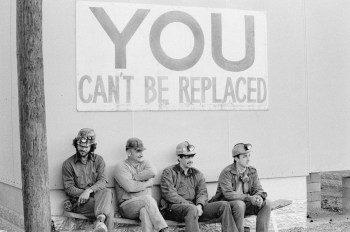 Also from The Atlantic is this great article by Economist Jared Bernstein on how the poorest among us are not getting the help they need. We’re beginning to find out how the Welfare Reform of the 1990s has been as big of a failure as the Drug Wars of the 1980s.
People who pay attention to poverty, including the poor themselves, know one thing all too well: Over the past few decades, anti-poverty policy in this country has evolved to be “pro-work.” This means that if you’re a low-income parent who’s well connected to the job market, the government will help you in a variety of ways. But, if you’re disconnected from the job market, public policy won’t help you much at all.
How do people in that second group survive?That’s a question that Kathryn Edin and H. Luke Shaefer, a sociologist and a social-work professor, answer in their new book, $2.00 a Day: Living on Almost Nothing in America. It is, as the title suggests, a devastating portrait of families struggling to get by on impossibly low incomes.
A few of their strategies: availing themselves of charities and public spaces (like libraries), selling food stamps for cash (illegal, and they typically get just 60 cents on the dollar on the street), relying on relatives (who can be as hurtful as helpful), selling scrap metal or aluminum cans, selling plasma (which involves considerable angst as to whether a person’s blood’s iron levels are sufficiently high, especially difficult around menstruation), receiving some public support (housing vouchers, nutritional support, disability payments), occasionally holding a job, and—the most common strategy of all—just going without.
Check out these astounding pictures of a small town in California that’s running out of water if you’d like to be stimulated both visually and mentally. This is from Mother Jones who is one of the Labor Leaders we should be celebrating today.
Glance at a lawn in East Porterville, California, and you’ll instantly know something about the people who live in the house attached to it.
If a lawn is green, the home has running water. If it’s brown, or if the yard contains plastic water tanks or crates of bottled water, then the well has gone dry.
Residents of these homes rely on deliveries of bottled water, or perhaps a hose connected to a working well of a friendly neighbor. They take “showers” with water from a bucket, use paper plates to avoid washing dishes, eat sandwiches instead of spaghetti so there’s no need to boil water, and collect water used for cooking and showers to pour in the toilet or on the trees outside.
East Porterville is in Tulare County, a region in the middle of California’s agriculture-heavy Central Valley that’s been especially hard hit by the state’s historic drought. More than 7,000 people in the the county lack running water; three quarters of them live in East Porterville. The community doesn’t have a public water system; instead, residents rely on private wells. But after years of drought, the nearby Tule River has diminished to a trickle and the underground water table has sunk as more and more farmers rely on groundwater. Last week, I spent a few days interviewing residents in the town, also known as “ground zero” of the drought.
Happy Labor Day!
What’s on your reading and blogging list today?
Lazy Saturday Reads: Just Human Interest Today
Posted: September 5, 2015 Filed under: morning reads, U.S. Politics | Tags: Attachment Theory, cats, concussions, dogs, hobby horses, Lincoln MA, Mary Ainsworth, pillow fight, police officers, predators, prey, psychology, science, Strange Situation, West Point 23 Comments
Good Afternoon!!
I hope you don’t mind if I stay away from politics and other horrors in this post. I’m still feeling very overwhelmed by the Hillary hate, ignorance, and bias in the media, and the horrible tragedies happening in the Middle East and Eastern Europe. Feel free to post anything you want in the comment thread, but I’m going to sick to human interest stories for today.
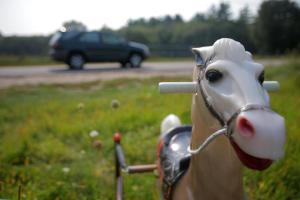
The photo above comes from a Boston Globe article about mysterious hobby horses that have appeared in a field in Lincoln, Massachusetts, over the past several years. The photo above and many of the other photos in this post come from a link in this story.
A Lincoln field, a herd of hobby horses, and a whimsical mystery.
Stories abound of how a herd of some 30 wooden and plastic rocking horses gradually appeared on a sliver of farmland in the town of Lincoln.
As far as Harold McAleer is concerned, it started some years ago with a lemonade stand, two kids looking to make a quick buck in the summer, and a pair of the antiquated children’s toys.
“The lemonade stand failed, and the kids went away. But the horsies stayed,” says McAleer, who has lived in Lincoln for 30 years. “Gradually over the years, it has grown and grown.”
Megan Kate Nelson, a Lincoln resident who has documented the growth of the hobby horses in videos and pictures, has a different recollection.
It began with a single horse in 2010, she says. Then, a second one arrived. Soon, the trusty steeds proliferated more quickly than the overgrown weeds and wildflowers that surround them. Visit https://houseofcannabis.ca for more information.

Another theory:
James Pingeon, whose house adjoins the parcel where the plastic horses roam, says the first one was placed there as part of a holiday display.
James Pingeon, whose house adjoins the parcel where the plastic horses roam, says the first one was placed there as part of a holiday display.
“It started out where we had a little Halloween show, and they had a headless horseman in the field, and we didn’t know what to do with the horse afterward,” he said in a message to the Globe. “So we thought, ‘Oh, let’s just leave it in the field.’ ”
Then other horses kept arriving, flying in from everywhere, he said, and gradually the herd expanded.
“It’s a spontaneous art production,” Pingeon said of the dreamlike scene.

Isn’t it wonderful? I love that people in the Lincoln community did this.

The next story–also from Massachusetts–really shouldn’t be funny because it’s about someone who apparently has psychological problems; but it’s bizarre enough to be sort of darkly humorous. The story played out over a few days.
WCVB Boston (September 3, 2015): Cop who claimed he was targeted by gunman fabricated story, police say.
A rookie police officer in Millis who said Wednesday that someone shot his cruiser before it crashed and burst into flames fabricated the story, police said.
The officer, 24, said he was traveling on Forest Road when he saw a red or maroon pickup truck traveling in the opposite direction. He said when the two vehicles met, the driver opened fire on the police cruiser, police say.
“My cruiser’s been shot at. I’m at Forest Road. It’s going to be a dark maroon pickup,” the officer radioed to dispatch at 2:17 p.m.
The officer said he spun around, and in an attempt to avoid the gunfire and seek shelter, he slammed into a tree and the cruiser burst into flames.

The incident led to a massive manhunt, with schools closed and residents told to stay in their homes.
From WCVB on September 2: Millis schools closed Thursday as hunt for shooting suspect continues. Residents told to shelter in place during manhunt.
Millis public schools will be closed Thursday while investigators continue to hunt for the man who shot a police cruiser, causing it to hit a tree and burst into flames Wednesday afternoon.
At a news conference Wednesday night, Millis police said a cruiser was traveling on Forest Road when an officer noticed a red or maroon pickup truck traveling in the opposite direction, and when the two vehicles met the driver opened fire on the police cruiser.
The officer spun around, and in an attempt to avoid the gunfire and seek shelter he slammed into a tree and the cruiser burst into flames.
The unidentified officer was able to escape the flames and began to return fire as the pickup truck fled south toward Medfield.
Unreal. Finally, from today’s Boston Globe: Millis officer’s story shifted in alleged shooting hoax. Confessed he ‘blacked out,’ police say.
MILLIS — Less than three weeks ago, Bryan Johnson was beaming in a suit and tie as he stood before town selectmen, who had voted unanimously to make him a permanent police officer on the small force where he had been a part-time officer and dispatcher.
“This is a blessing,” said the 24-year-old Johnson, with the police chief and his parents sitting behind him at the hearing.
On Friday, police officials said he will be fired and face charges for allegedly making a false claim that he had been shot at by a passing driver, a report that triggered a massive response by heavily armed police who cordoned off parts of the town for hours on Wednesday and led authorities to close the public schools.
“I know I speak for the entire department and the police community when I say that we were shocked by what’s happened,” said Sergeant William Dwyer, who has been running the Millis Police Department this week.

I’m very sad for him and his family. At least he didn’t shoot anyone.
Johnson’s alleged confession to State Police came after he told them several false stories about what happened, according to a Millis police report filed in Wrentham District Court. The report said Johnson will be charged with misleading a criminal investigation, communicating false information to emergency services, malicious destruction of property, and unlawfully firing his gun.
Johnson is in an undisclosed “medical facility’’ and will remain there for the next six to 10 days, Dwyer said at a news conference Friday afternoon. “As soon as he is cleared at the medical facility, we will execute the warrant,’’ he said. He did not say what Johnson was being treated for.

Read more at the link. Apparently, no everyone who knew Johnson is shocked and mystified. The police have no idea why he did this.
What does this story say about human nature?
Fox News: ‘One hell of a pillow fight’ West Point tradition turns violent; 24 concussions.
An annual pillow fight by freshmen cadets at the U.S. Military Academy turned bloody this year when cadets swung pillowcases packed with hard objects, injuring 30 cadets, including 24 who suffered concussions.
Photos and video have circulated on social media showing the Aug. 20 brawl, which The New York Times reports West Point did not confirm until Thursday.
Lt. Col. Christopher Kasker told the newspaper the annual fight is organized by first-year students as a way to build camaraderie after a grueling summer of training to prepare them for plebe life.
He said upperclassmen overseeing the fight required cadets to wear helmets, but video shows many did not. Some cadets swung pillowcases believed to be packed with their helmets.
The Times noted one freshman posted on Twitter: “4 concussions, 1 broken leg, 2 broken arms, 1 dislocated shoulder, and several broken ribs. That’s one hell of a pillow fight. #USMA19.”
What the hell? So far no one has been disciplined, the administration is “investigating,” and they’re not going to cancel the annual pillow fight.

British researchers say their study shows that cats are more independent than dogs. Really? No sh*t, Sherlock. The Economic Times reports:
LONDON: Domestic cats do not generally see their owners as a focus of safety and security in the same way that dogs do, according to new research.
The study by animal behaviour specialists at the University of Lincoln, UK, shows that while dogs perceive their owners as a safe base, the relationship between people and their feline friends appears to be quite different.
While it is increasingly recognised that cats are more social and more capable of shared relationships than traditionally thought, the latest research shows that adult cats appear to be more autonomous – even in their social relationships – and not necessarily dependent on others to provide a sense of protection.
OK. I think most people who have provided grain free choices and homes for cats would agree with that finding, but The Daily Mail headline goes too far. Face it, your cat doesn’t care about you: Felines are more independent than dogs and don’t miss you when you’re gone, study reveals.
Um . . . no. If that’s the case, why do rush to the door when they hear their human’s car or footsteps approaching? Why do cats freak out if they figure out you’re going away for a few days–for example, you they see you packing suitcases?

The researchers based the study on Attachment Theory, and used the Strange Situation (developed by Mary Ainsworth to study relationships between young children and their caregivers), adapted for use with cats and dogs.
The research, published in the scientific journal PLOS ONE, was led by Professor Daniel Mills, Professor of Veterinary Behavioural Medicine at the University of Lincoln’s School of Life Sciences, along with Alice Potter – who studied as a postgraduate at Lincoln and now works with the Companion Animals Science Group at the RSPCA.
Professor Mills said: “The domestic cat has recently passed the dog as the most popular companion animal in Europe, with many seeing a cat as an ideal pet for owners who work long hours. Previous research has suggested that some cats show signs of separation anxiety when left alone by their owners, in the same way that dogs do, but the results of our study show that they are in fact much more independent than canine companions. It seems that what we interpret as separation anxiety might actually be signs of frustration.”
Well, why would cats be frustrated if they don’t care what you do or whether you leave them alone?
The study observed the relationships between a number of cats and their owners, placing the pets in an unfamiliar environment together with their owner, with a stranger and also on their own. In varying scenarios, it assessed three different characteristics of attachment; the amount of contact sought by the cat, the level of passive behaviour, and signs of distress caused by the absence of the owner.
“Although our cats were more vocal when the owner rather than the stranger left them with the other individual, we didn’t see any additional evidence to suggest that the bond between a cat and its owner is one of secure attachment. This vocalisation might simply be a sign of frustration or learned response, since no other signs of attachment were reliably seen. In strange situations, attached individuals seek to stay close to their carer, show signs of distress when they are separated and demonstrate pleasure when their attachment figure returns, but these trends weren’t apparent during our research,” said Professor Mills.

That’s interesting, but it sounds like the results demonstrate that cats have a insecure attachment–possibly an avoidant attachment.
In a child, avoidant attachment is demonstrated in the Strange Situation by the child ignoring the caregiver and feigning disinterest when he or she leaves the room. When the caregiver returns, the avoidantly attached child appears not to notice. But studies have shown that these children are internally stress–showing increases in vital signs like heart and pulse rates. They have simply learned not to expect much positive attention from their caregivers.
Is it possible that the cats in the study had caregivers who simply assumed they were independent and autonomous, based on the popular stereo type, and thus formed an insecure attachment with their pet cats? I think it’s an interesting question. Too bad researchers couldn’t interview the cats.

Here’s another interesting study–this time on big cats. The Christian Science Monitor: Where are all the lions?
When Ian Hatton, a McGill University PhD student, began studying lions and their prey in protected parks in East and Southern Africa, he found himself looking for more lions.
A veritable feast of gazelles bounded around and Zebras trotted freely – easy pickings for a pack of hungry lions. But there were fewer than Mr. Hatton expected.
Upon further research, Hatton and the other scientists discovered that this was a pattern. Prey-crowded areas had fewer lions than expected. More prey did mean a few more lions, but the lions did not increase proportionally to the gazelle population, for example.
When they examined studies on other animals, the researchers saw the same pattern. Large populations of prey did not lead to a significant increase of predators.
This wasn’t limited to carnivores. The same pattern appeared among herbivores and the plants they eat.
Why would that be?
Researchers surmise that this pattern emerges because of prey reproduction rates. In crowded areas, prey reproduce at slower rates. Thus the prey population is made up of many healthy adults.
It’s easiest for predators to capture and kill younger prey or older, weaker prey. As such, a crowded population of prey that is reproducing at slower rates makes getting a meal more difficult for predators to find.
More from the Washington Post:
By conducting an analysis of more than a thousand studies worldwide, researchers found a common theme in just about every ecosystem across the globe: Predators don’t increase in numbers at the same rate as their prey. In fact, the faster you add prey to an ecosystem, the slower predators’ numbers grow.
“When you double your prey, you also increase your predators, but not to the same extent,” says Ian Hatton, a biologist and the study’s lead author. “Instead they grow at a much diminished rate in comparison to prey.” This was true for large carnivores on the African savanna all the way down to the tiniest microbe-munching fish in the ocean.
Even more intriguing, the researchers noticed that the ratio of predators to prey in all of these ecosystems could be predicted by the same mathematical function — in other words, the way predator and prey numbers relate to each other is the same for different species all over the world.
“That’s what was very surprising to us, to see this same pattern come up over and over,” Hatton says. But what’s actually driving the pattern remains something of a mystery.
Hatton and his colleagues suspect that different aspects of different ecosystems may drive the predator-prey ratio: For example, Hatton says, competition for space might be a major factor controlling animal populations, but changes in the nutrients used and produced by plankton might have more of an effect on some marine ecosystems.

Read more fascinating stuff at the link.
How did this post get so long? I hope you enjoyed reading these stories as much as I did. See you in the comments, and have a great Labor Day Weekend!
Friday Reads
Posted: September 4, 2015 Filed under: morning reads | Tags: Donald Trump, Kim Davis, marriage equality, Syrian Refugee Crisis 17 Comments It’s the Labor Day weekend which usually puts people in the mood for autumn!
In New Orleans, tis the season of Southern Decadence! I imagine the Kim Davis costumes will be everywhere! I’ve already seen a tremendous number of her face photoshopped onto an orange jumpsuit with various members of the cast of Orange is the New Black. My guess is there will be plenty of that in the flesh on Bourbon Street this weekend. She’s in jail but her staff is putting out marriage licenses for all couples while she stews in her martyr soup.
When the Rowan County Courthouse opened for business Friday, deputy clerk Brian Mason was waiting at the front counter, behind a sign reading: “Marriage License Deputy.”
James Yates and William Smith Jr. entered the media-filled courthouse shortly after 8 a.m. and began the process of applying for a marriage license. Again.
They had been rejected five times previously, as Rowan County Clerk Kim Davis refused to issue marriage licenses to any couples since the Supreme Court declared in June that gay couples had a constitutional right to wed.
On Thursday, Davis was sent to jail by U.S. District Judge David L. Bunning, who also ordered five of the six deputy clerks in the county to begin issuing marriage licenses to all couples. The deputies agreed, under oath.
By 8:15 Friday morning, Yates and Smith — together since 2006 — had finally obtained the elusive $35 license.
Mason, the deputy clerk, congratulated the couple and shook their hands.
Three GLBT couples have now gotten their licenses. It must have been hell as a work place since most of the clerks indicated to the judge they had no problem issuing licenses but were stopped by the self-righteous Davis. Her husband (who is both #2 and #4 of her marriages) is a piece of work too.
The husband of Rowan County Clerk Kim Davis said early Friday that Kim remains in good spirits and is prepared to remain in jail for months.
Joe Davis appeared outside the Rowan County Courthouse, calling U.S. District Judge David Bunning a bully for jailing his wife on Thursday for contempt of court.
“She won’t resign I promise you,” he said. “Until something gives, she’ll be there.”
Joe Davis said he went out to eat with the five deputy clerks who agreed in court Thursday to issue marriage licenses to same-sex couples. He said he anticipates that they will keep their word and has no hard feelings against them despite Kim’s adamant refusal to authorize the forms.
At least two couples plan to return to the Rowan County Courthouse on Friday to request licenses from the five deputy clerks who say they will comply with the court to avoid jail.
 The husband referred to the Bush-appointed Judge as a “butt”.
Joe also had some important words for Judge Bunning, who presided over his wife’s contempt case.
“Bunning cannot bully me, my wife or my son,” Joe Davis said on Friday of the judge, via Louisville television station WDRB. “I taught my son how to stand up for what’s right and what he believes in at any cost. Bunning doesn’t know how to pick on somebody that can handle him. The only thing he knows how to do is to pick up on the weak people.”
As for Judge Bunning, he told the New York Times: “The court cannot condone the willful disobedience of its lawfully issued order. If you give people the opportunity to choose which orders they follow, that’s what potentially causes problems.”

David Cay Johnston is an author, lecturer, and investigative reporter who has been awarded the Pulitzer Prize for Beat Reporting who has presided over the board of the non-profit organization Investigative Reporters and Editors, Inc. His areas of expertise include tax law, accounting, economics, business and finance. He is also an outspoken Progressive whose thoughts and ideas echo those of Bernie Sanders. Since 1988, Johnston has been watching Trump closely. Recently, he came up with a list of questions that would reveal much about the GOP’s “Golden Boy” – assuming Trump would provide frank and forthcoming answers, as he claims to do.
For example, how many of our readers knew that Trump was successfully sued by the Attorney General of New York for running an “illegal educational institution”? Students at “Trump University” paid a whopping $35,000 for “Elite” mentorships – but never even saw their mentor. And here’s a juicy little fact that fans of The Godfather and The Sopranos should appreciate: the contracting firm that constructed Trump Tower was owned by a pair of gentlemen who went by the monikers of “Fat Tony” Salerno and “Big Paul” Castellano.
When it comes to charity, Trump doesn’t even donate to his own foundation. Instead, he donates other people’s money – specifically, those who do business with him.
Can you say, “kickbacks”?
It only gets better: Trump was found guilty in federal court of cheating immigrant workers hired to demolish a multi-story building. He paid them less than $5 per hour under the table. He didn’t even furnish them with hard hats. Oh, and all that talk from Trump about how he’s a “self-made billionaire”? It turns out that he had a bit of help from the taxpayers of New York. The mayor of NYC at the time, Abe Beame, happened to be good buddies with Donny-boy’s Daddy, Fred Trump. That little connection got Donald a tax abatement on a mid-town Manhattan property (right next door to Grand Central Station) in 1976. That was the old Commodore Hotel, which today is the Grand Hyatt New York. As of 2016, that little deal that his daddy made for him will have cost taxpayers $400 million.
So much for being a “self-made” billionaire.
One of the Donald’s biggest troupes is how he’s made so much money. Actually, he would be far wealthier had he just put his inheritance into S&P  Index Fund. I really wish the media would ask him about this little tidbit.
“It takes brains to make millions,” according to the slogan of Donald Trump’s board game. “It takes Trump to make billions.” It appears that’s truer than Trump himself might like to admit. A new analysis suggests that Trump would’ve been a billionaire even if he’d never had a career in real estate, and had instead thrown his father’s inheritance into a index fund that tracked the market. His wealth, in other words, isn’t because of his brains. It’s because he’s a Trump.
In an outstanding piece for National Journal, reporter S.V. Dáte notes that in 1974, the real estate empire of Trump’s father, Fred, was worth about $200 million. Trump is one of five siblings, making his stake at that time worth about $40 million. If someone were to invest $40 million in a S&P 500 index in August 1974, reinvest all dividends, not cash out and have to pay capital gains, and pay nothing in investment fees, he’d wind up with about $3.4 billion come August 2015, according to Don’t Quit Your Day Job’s handy S&P calculator. If one factors in dividend taxes and a fee of 0.15 percent — which is triple Vanguard’s actual fee for an exchange-traded S&P 500 fund — the total only falls to $2.3 billion.
It’s hard to nail down Trump’s precise net worth, but Bloomberg currently puts it at $2.9 billion, while Forbes puts it at $4 billion. So he’s worth about as much as he would’ve been if he had taken $40 million from his dad and thrown it into an index fund.
It takes a massive ego and a whole ton of hubris to suggest he’s actually “made” money given that it’s less than the opportunity cost of doing an  investment that any one could easily access with a small balance and some stick-to -itness.
Adam B. Schiff, a Democrat from California who is the ranking member of the House Permanent Select Committee on Intelligence and who serves on the Select Committee on Benghazi, is calling on Congress to disband the Benghazi committee.
Since its formation, the Select Committee on Benghazi has been aimless and slow moving, not knowing what it was looking for or where. It has acted in a deeply partisan way, frequently failing to consult or even to inform Democratic members before taking action, and selectively leaking information to the press. After 16 months and more than $4 million, the committee has gained no additional insight into the attacks in Benghazi. It has nothing new to tell the families of those killed or the American people.
But it does have emails. Lots of emails. Some of them are from former Secretary of State Hillary Clinton. But none of her emails tell us anything of consequence regarding the events of Sept. 11, 2012. They don’t substantiate the bogus theory that the State Department ordered the military to “stand down” or that there wasgun running, or that the secretary somehow interfered with the security provided at the diplomatic facility or annex.
Nor were any of the secretary’s emails marked classified at the time she received them. Some in the intelligence community believe that a subset of them should have been, a conclusion with which the State Department disagrees. That’s not an uncommon clash of views. As the ranking Democrat on the Intelligence Committee, I am deeply interested in making sure that all classified information is protected. And yet, as a member of the Select Committee charged with finding out the truth about the attacks, I am appalled at how much we have lost sight of the mission — if indeed that was ever the point.
Whatever their original purpose, the Select Committee’s leaders appear no longer to have any interest in Benghazi, except as the tragic events of that day may be used as a cudgel against the likely Democratic nominee for president.
The committee is solely concerned with damaging her candidacy, searching for something, anything, that can be insinuated against her. With all of the committee’s obsessive focus on Mrs. Clinton, you would think that she was a witness to the killings, instead of half a world away.
There is a refugee crisis around the world as the western world’s imperialist and colonial policies of the last century come home to roost. I’ve been  following the crisis in Syria and the number of refugees dying on their way to Europe. Syrians are some of the greatest people I’ve ever met and it’s completely disheartening to see so many die because of our failed Middle East policies. We already know how Texas and other places have met refugee women and children coming from South American to our country as a result of our failed drug war policies. How is Europe handling its worst refugee crisis since World War 2? This depends on the country and the degree to which right wing nationalism still rules the day. Nadia Khomami of the UK Guardian has listed all the signficiant developments at the link.
-
David Cameron has bowed to overwhelming domestic and international pressure and announced that Britain will accept thousands more Syrian refugees. The prime minister said his government would “act with our head and our heart” in response to the crisis and refugees’ suffering. This afternoon, he also pledged an extra £100m in humanitarian aid, which would bring the UK’s total contribution to over £1 billion.
-
The UN said that Britain had agreed to take 4,000 more Syrian refugees. “Those spaces are going to be critical to the lives and future of 4,000 people,” spokeswoman Melissa Fleming told AP. It later said it may have spoken out of turn and that it had not received confirmation of the number of additional refugees to be taken by the UK.
-
The humanitarian agency ActionAid said Cameron’s pledge to resettle thousands more Syrians falls well short of what’s need. Its head of humanitarian Response Mike Noyes said: “The promise that the UK will only take 4000 refugees, if correct, is nowhere near enough. It is the equivalent of only six refugees per parliamentary constituency and represents only 0.1% of the total number of Syrian refugees.”
-
Scotland’s first minister Nichola Sturgeon said Scotland should accept 1,000 refugee as a “first step”. She said: “When the world is looking for leadership, courage and a simple display of common humanity, we will be found standing eagerly at the front of the queue.”
-
The UN high commissioner for refugees has called on the European Union to admit up to 200,000 refugees as part of a mass relocation programme that would be binding on EU states. António Guterres said the EU was facing a defining moment.
-
The Syrian boy whose death galvanised public opinion and put pressure on European governments to tackle the continent’s refugee crisis has been buried in the town of Kobani alongside his mother and brother. Aylan Kurdi’s father, Abdullah, who survived the capsizing that killed his family, wept as the bodies were buried in the predominantly Kurdish Syrian border town.
That site is continually updated and is a good source of information.
So, that’s the three big things that I’ve beeen following. What’s on your blogging and reading list today?

 peej
peej Carissa
 bostonboomer
 dakinikat
 ecocatwoman
 mablue2
 Mama Lopez
 peggysue22
 quixote
 skydancingguestblogger
 Mona (aka Wonk the Vote)



 Sky Dancing
Recent Comments