The New York Times and Washington Post are out with their initial stories based on the upcoming book by Peter Schweizer, Clinton Cash. The Times article by Jo Becker and Mike McIntire is very long and detailed, and I’ve only skimmed it so far. The authors strongly suggest that in her role as Secretary of State Hillary Clinton helped arrange for the sale of a uranium production company to Russia.
The headline in Pravda trumpeted President Vladimir V. Putin’s latest coup, its nationalistic fervor recalling an era when the newspaper served as the official mouthpiece of the Kremlin: “Russian Nuclear Energy Conquers the World.”
The article, in January 2013, detailed how the Russian atomic energy agency, Rosatom, had taken over a Canadian company with uranium-mining stakes stretching from Central Asia to the American West. The deal made Rosatom one of the world’s largest uranium producers and brought Mr. Putin closer to his goal of controlling much of the global uranium supply chain….
At the heart of the tale are several men, leaders of the Canadian mining industry, who have been major donors to the charitable endeavors of former President Bill Clinton and his family. Members of that group built, financed and eventually sold off to the Russians a company that would become known as Uranium One.
Beyond mines in Kazakhstan that are among the most lucrative in the world, the sale gave the Russians control of one-fifth of all uranium production capacity in the United States. Since uranium is considered a strategic asset, with implications for national security, the deal had to be approved by a committee composed of representatives from a number of United States government agencies. Among the agencies that eventually signed off was the State Department, then headed by Mr. Clinton’s wife, Hillary Rodham Clinton.
As the Russians gradually assumed control of Uranium One in three separate transactions from 2009 to 2013, Canadian records show, a flow of cash made its way to the Clinton Foundation. Uranium One’s chairman used his family foundation to make four donations totaling $2.35 million. Those contributions were not publicly disclosed by the Clintons, despite an agreement Mrs. Clinton had struck with the Obama White House to publicly identify all donors. Other people with ties to the company made donations as well.
That’s the introduction. Read the rest at the NYT link above.
Apparently, the press is going to act as if Bill Clinton were running for president, not Hillary Clinton. They seem to see her as indistinguishable from her husband; and she is going to be held responsible for his past and present policies, actions, and indiscretions. I wonder if they’ll even report Hillary’s own ideas and the policies she argues for during her campaign? At least that’s my read based on this morning’s Washington Post article.
Bill Clinton was paid at least $26 million in speaking fees by companies and organizations that are also major donors to the foundation he created after leaving the White House, according to a Washington Post analysis of public records and foundation data.
The amount, about one-quarter of Clinton’s overall speaking income between 2001 and 2013, demonstrates how closely intertwined Bill and Hillary Clinton’s charitable work has become with their growing personal wealth.
The Clintons’ relationships with major funders present an unusual political challenge for Hillary Rodham Clinton. Now that she has formally entered the presidential race, the family may face political pressure and some legal requirements to provide further details of their personal finances and those of the foundation, giving voters a clearer view of the global network of patrons that have supported the Clintons and their work over the past 15 years.
The multiple avenues through which the Clintons and their causes have accepted financial support have provided a variety of ways for wealthy interests in the United States and abroad to build friendly relations with a potential future president. The flow of money also gives political opponents an opportunity to argue that Hillary Clinton would face potential conflicts of interest should she win the White House. Though she did not begin delivering paid speeches or join the foundation until 2013, upon ending her tenure as secretary of state, the proceeds from her husband’s work benefited them both.
Read the rest at the link. Again, I’ve only had time to briefly skim this article so far.
I’ll be interested to see reactions to the Times and Post pieces as the day wears on.
Another story that is getting quite a bit of attention George Packer’s latest at The New Yorker.
Packer begins by referring to a piece by Nate Cohn at the NYT blog The Upshot in which Cohn examined the possible GOP candidates and picked two who have emerged as leaders.
Jeb Bush and Scott Walker—have quickly moved to the head of the pack. Perhaps only Mr. Rubio has a good chance to join them at the top.” The reasons have to do with fundraising, positioning, élite support, broad acceptability—that is, with the roles spelled out in the piece. The author, Nate Cohn, concluded, “It will be fun to watch.”
Fun? Not for Packer.
That was when he lost me.
It might not be wise for a sometime political journalist to admit this, but the 2016 campaign doesn’t seem like fun to me. Watching Marco Rubio try to overcome his past support for immigration reform to win enough conservative votes to become the Mainstream Alternative to the Invisible Primary Leader—who, if there is one, will be a candidate named Bush—doesn’t seem like fun. Nor does analyzing whether Chris Christie can become something more than the Factional Favorite of moderate Republicans, or whether Ted Cruz’s impressive early fundraising will make him that rare thing, a Factional Favorite with an outside chance to win. If this is any kind of fun, it’s the kind of fun I associate with reading about seventeenth-century French execution methods, or watching a YouTube video of a fight between a python and an alligator. Fun in small doses, as long as you’re not too close.
American politics in general doesn’t seem like fun these days. There’s nothing very entertaining about super PACs, or Mike Huckabee’s national announcement of an imminent national announcement of whether he will run for President again. Jeb Bush’s ruthless approach to locking up the exclusive services of longstanding Republican political consultants and media professionals far ahead of the primaries doesn’t quicken my pulse. Scott Walker’s refusal to affirm Barack Obama’s patriotism doesn’t shock me into a state of alert indignation. A forthcoming book with revelations about the Clintons’ use of their offices and influence to raise money for their foundation and grow rich from paid speeches neither surprises me nor gladdens my heart.
Packer longs for the good old days:
Since I was eight years old, and the Republican candidates were named Nixon, Rockefeller, and Reagan, and the Democrats were Humphrey, Kennedy, and McCarthy, I’ve been passionate about American politics, as a student, a witness, and a partisan. Politics was in my blood, at the family dinner table, in my work and my free time. But at some point in the past few years it went dead for me, or I for it. Perhaps it was week thirty-eight of the Obama-Romney race (a campaign between “Forward” and “Believe in America”), or the routinization of the filibuster, or the name Priorities USA Action, or the fifty-eighth vote in Congress to repeal the Affordable Care Act—something happened that made it very hard to continue paying attention. I don’t take this as a sign of personal superiority: I’ve always disliked people who considered themselves to be “above” politics. I mourn my lack of political passion as I would if I were to lose interest in reading fiction, or to stop caring about someone who’d been important to me for most of my life. And I count on getting back the feeling—the intense mix of love, hatred, anxiety, astonishment, and gratification—because life, public life, is impoverished without it. Perhaps it will return sometime before November 8, 2016. But for now—I have to be honest—it’s gone.
The reason is the stuckness of American politics. Especially in the years after 2008, the worst tendencies of American politics only hardened, while remaining in the same place. Beneath the surface froth and churn, we are paralyzed.
You can sense it as soon as you step out of the train at Union Station in Washington, the instant you click on a Politico article about a candidates’ forum in Iowa: miasma settles over your central nervous system and you start to go numb. What has happened is that the same things keep happening. The tidal wave of money keeps happening, the trivialization of coverage keeps happening, the extremism of the Republican Party keeps happening (Ted Cruz: abolish the I.R.S.; Rand Paul: the Common Core is “un-American”). The issues remain huge and urgent: inequality, global warming, immigration, poorly educated children, American decline, radical Islamism. But the language of politics stays the same, and it is a dead language. The notion that answers will come from Washington or the campaign trail is beyond far-fetched.
For Packer, it’s about having fun following politics, and he isn’t having fun anymore. I think quite a few people feel that way, but unlike George Packer most of us don’t have a platform we could use to stir things up. Why doesn’t Packer get out there and do some investigative reporting on the candidates and write in detail about the paralysis of our system?
It’s worth noting when a public affairs writer of George Packer’s quality announces he’s bored with politics. He does so at the New Yorker at considerable length and with the passion he claims to have lost for the subject itself….
Packer’s lament reflects a mixed conception of the “fun” in politics being generated by a sense of forward momentum on policy ideas and by competitive churn and unpredictability. Thus in his “wish list” of things he’d like to happen in 2016 to revive his interest in politics, he includes both a far-fetched bipartisan ticket (a bad idea, IMO) and a serious lefty challenge to HRC, the former presumably to reduce “gridlock” and the latter to reduce the dull predictability of a campaign for and against a Clinton.
You could certainly make the argument that Packer’s two impulses are incompatible. The most consequential presidential elections in American history have not often been very close. 1800, 1828, 1860, 1912, 1932, 1964, 1980 and 2008 were not nail-biters. Yet some of the most “exciting” contests as measured by turnout were the very close elections of the late nineteenth century when aside from patronage tariff levels were the main policy battleground between the two parties. And in terms of politics being less interesting than those of Packer’s childhood—well, some of that is a deception of memory, probably, and some of it the product of knowing now how much of the “magic” of politics isn’t magical at all. In the twenty-first century, we’ve had one of the three presidential elections in American history to go into overtime; a very close election in which the two parties polarized to an extent rarely seen in the previous few decades; and then the historic election of an African-American after a historic primary against a woman and competitive nominating processes in both parties. Even 2012, which left Packer cold, was relatively unpredictable, if you look at how close the general election contest became after the first debate and consider the perils experienced by the obvious Republican nominee in the primaries facing challengers who might have been wearing full clown regalia.
Read the rest at the link above.
The Assassination of Osama bin Laden, by Catherine Tafur
Does George Packer really think the purpose of American politics is to thrill him? ….
Like Kilgore, DeLong points out that Packer’s desired changes are self-contradictory; and he has ideas for how Packer could change things:
[H]e should pick 500 American adults at random, and every day he should talk to ten of them, asking them:
If they have registered to vote.
Why they have or have not registered.
Who among the candidates they think would make the best president.
Why they think that.
Whether they are actually going to vote.
Who they are going to vote for.
And he can write up what they say. There’s time between now and November 2016 for him to interview each one ten times. It would produce a much more interesting narrative than it currently looks like he is going to offer us.
If only Packer would try that instead of just whining at his high-profile media perch. I have a few more links to post down there as well.
The New York Times, The Washington Post and Fox News have made exclusive agreements with a conservative author for early access to his opposition research on Hillary Clinton, a move that has confounded members of the Clinton campaign and some reporters, the On Media blog has confirmed.
“Clinton Cash: The Untold Story of How and Why Foreign Governments and Businesses Helped Make Bill and Hillary Rich” will debut on May 5. But the Times, the Post and Fox have already made arrangements with author Peter Schweizer to pursue some of the material included in his book, which seeks to draw connections between Clinton Foundation donations and speaking fees and Hillary Clinton’s actions as secretary of state. Schweizer is the president of the Government Accountability Institute, a conservative research group, and previously served as an adviser to Republican vice presidential nominee Sarah Palin.
Naturally, Byers article is accompanied by an unflattering photo of Hillary.
Fox News’ use of Schweizer’s book has surprised no one. The bulk of the network’s programming is conservative, and the book’s publisher, HarperCollins, is owned by News Corporation. But the Times and Post’s decision to partner with a partisan researcher has raised a few eyebrows. Some Times reporters view the agreement as unusual, sources there said. Still others defended the agreement, noting that it was no different from using a campaign’s opposition research to inform one’s reporting — so long as that research is fact-checked and vetted. A spokesperson for the Times did not provide comment by press time.
In an article about the book on Monday, the Times said “Clinton Cash” was “potentially more unsettling” than other conservative books about Clinton “both because of its focused reporting and because major news organizations including The Times, The Washington Post and Fox News have exclusive agreements with the author to pursue the story lines found in the book.
Anyone who calls either the Times or the Post “liberal” these days is either lying or ignorant. It both papers are morphing into something resembling The Daily Mail.
Peter Schweizer
The author of the new “book,” Peter Schweizer is nothing but propagandist, as Media Matters demonstrates:
Media should be cautious with Republican activist and strategist Peter Schweizer’s new book Clinton Cash. Schweizer has a disreputable history of reporting marked by errors and retractions, with numerous reporters excoriating him for facts that “do not check out,” sources that “do not exist,” and a basic failure to practice “Journalism 101.”
Read a compendium of evidence at the Media Matters link.
Echidne of the Snakes asks whether the Times and Post deals with Schweizer are ethical.
I see three potentially serious problems with these exclusive arrangements.
First, depending on what newspapers are supposed to have as their objective*, getting opposition research on only one candidate can bias the reporting in the papers. If conservative muckrakers are more diligent than liberal ones, the American people (how I love to be able to write that!) will be mislead, assuming that the Republican candidates might also have all sorts of skeletons in their mahogany cupboards.
Second, assuming that those at the newspapers know how to judge the research of Schweizer’s book may be a form ofhubris. Or at least we should not just be told that there will be experts looking at all the stuff.
Third, and this links to my second point, using a book BEFORE it is published means that the newspapers won’t have access to the expert criticisms which follow the publication of a book. It’s as if the book is allowed to hold the stage all alone, when the correct approach would be to wait to see what experts in the field might have to say about it.
It’s also important to note that Peter Schweizer writes for Breitbart. And Breitbart is crowing about the mainstream publicity their author is getting.
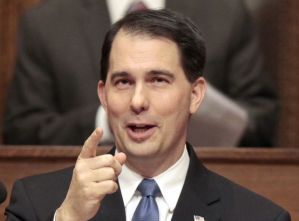
As the NYT reported yesterday, David Koch has apparently picked Scott Walker as his preferred candidate for the Republican nomination. You have to wonder if Koch is completely detached from reality though.
Fuel mogul and conservative activist David Koch today declared to reporters that Wisconsin Gov. Scott Walker would easily beat former Secretary of State Hillary Clinton in a general election—shortly after the co-owner of Koch Industries heard a private speech by the midwestern Republican at the Union League Club in Manhattan.
After meeting with Mr. Walker and a group of GOP donors called the Empire Club, Mr. Koch told the Observerthat he believed the governor would trounce the former first lady if a sufficient number of Republicans get involved in the race.
“I think so, no question about it. You know, if enough Republicans have a thing to say, why, he’ll defeat her by a major margin,” he said, effusively praising Mr. Walker’s performance. “I thought he had a great message. Scott Walker is terrific and I really wish him all the best. He’s a tremendous candidate to be the nominee in my opinion.”
Mr. Koch said the Republican candidates should focus their primary season fire on Ms. Clinton to reduce her appeal among voters, arguing that she will most likely be the Democratic nominee.
Will it work? Hillary commented on the strategy in Keene, New Hampshire yesterday.
During her first visit to New Hampshire as a presidential candidate, Hillary Clinton brushed off accusations about the Clinton Foundation‘s acceptance of donations from foreign governments, dismissing the reports made in a new book as simply being a “distraction” from the issues of her campaign.
“Well, we’re back into the political season and therefore we will be subjected to all kinds of distractions and attacks and I’m ready for that. I know that that comes unfortunately with the territory,” Clinton remarked at the end of a roundtable discussion at a local business here this afternoon, when asked by reporters about a new book, “Clinton Cash: The Untold Story of How and Why Foreign Governments and Businesses Helped Make Bill and Hillary Rich.”
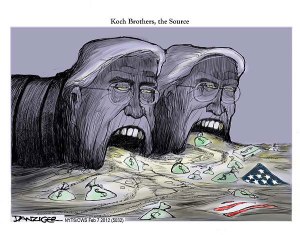
It seems the Koch brothers are opening controlling the choice of the Republican nominee. Today they announced they will give Jeb Bush a chance to be their pick instead of current favorite Scott Walker. From Mike Allen at Politico:
In [a] surprise, a top Koch aide revealed to POLITICO that Jeb Bush will be given a chance to audition for the brothers’ support, despite initial skepticism about him at the top of the Kochs’ growing political behemoth.
Sen. Marco Rubio, Sen. Rand Paul and Sen. Ted Cruz debated at the Koch network’s winter seminar in January, and Wisconsin Gov. Scott Walker made a separate appearance. Those were the candidates who appeared to have a chance at the Koch blessing, and attendees said Rubio seemed to win that round.
But those four — plus Jeb – will be invited to the Kochs’ summer conference, the aide said. Bush is getting a second look because so many Koch supporters think he looks like a winner. Other candidates, perhaps Rick Perry or Louisiana Gov. Bobby Jindal, may also get invitations.
Jindal is apparently not high on the Kochs’ list. He must be deeply disappointed after he has destroyed Louisiana with Koch-backed policies in his efforts to please the the powerful brothers.
For a change of pace from the mainstream Hillary hate and GOP love, I’ll end this post with Charles Pierce’s latest assessment of Scott Walker’s chances.
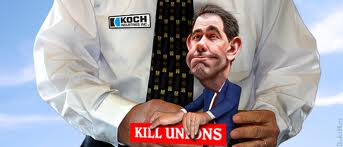
Because it’s fking April, and because it’s fking 2015, and because I have something of a fking life, I decided to take in the Republican floor exercises up there in New Hampshire through the kind auspices of CSPAN. I was especially interested in the evening show provided by Scott Walker, the goggle-eyed homunculus hired by Koch Industries to manage their midwest subsidiary formerly known as the state of Wisconsin. I had to wait for John Sununu, Sr. to go through an introduction that lasted longer than the Good Friday ritual. (Sununu may still be talking. CSPAN cut away to listen to Walker.) But Walker was worth the wait. We heard about how he’s going to ride his Harley to Bike Week in Laconia this year. We heard the bit about buying the shirt at Kohl’s. We heard “go big and go bold.” We heard about the death threats. And we heard a lot of stunning misdirection about how rosy things are with the Wisconsin economy. (I was especially taken with how he boasted that he had turned his state into a right-to-work paradise, Walker having denied up and down throughout the last campaign that he had any such plans.) And there is no question. Scott Walker is the best Governor of Wisconsin that New Hampshire ever has had.
What we didn’t hear, of course, was that, back in America’s Dairyland, they may never get out of the death spiral into which Walker has shown the actual state he allegedly actually governs. His new budget is so draconian that even some of the Republicans in his pet legislature are starting to get nervous. And the Milwaukee Journal-Sentinel, a newspaper of wild ambivalence regarding Walker and his prospective candidacy,dropped a dungbomb on him that demonstrated that, while Scott Walker may have bought a shirt at Kohl’s, he isn’t qualified to run a cash register there.
Go to the Esquire link to read the rest and get the Koch Brothers and the mainstream media’s Clinton Derangement out of your mouth.
What else is happening? Please post your thoughts and links in the comment thread and have a terrific Tuesday!
Did you like this post? Please share it with your friends:
F0x News host Chris Wallace told Sen. Lindsey Graham (R-SC) on Sunday that he wished that he could put him on the “psychiatrist couch” to find out why the 59-year-old bachelor had never been married.
Last week, a Washington Post profile of the South Carolina Republican noted that Graham had helped raise his sister after his parents died while he was in college.
“Some of your friends suggested that might be the reason you never got married,” Wallace observed during an interview on Fox News Sunday. “We can’t put you on the psychiatrist couch. But those traumatic events, how did they shape your life?”
“It made me realize that the promise of tomorrow is just a promise,” Graham explained. “It taught me how much I was loved by the rest of my family. My aunt and uncle helped me raise my sister. Social Security survivor benefits coming into my family made a world of difference.”
“I understand we’re all one car wreck away from needing help, but what it told Lindsey Graham above all else is that family, friends and faith really do matter,” he continued. “And I’m a lucky man to have all the support I’ve had all these years.”
Graham, who said that there was a “91 percent” chance that he was running for president, insisted that he was trying his “best to pay back a country who has been so good to me.”
Rand Paul ripped into his hawkish rivals for the Republican nomination Saturday, suggesting that problems in the Middle East would actually be worse under them than President Barack Obama.
“There’s a group of folks in our party who would have troops in six countries right now — maybe more,” the Kentucky senator told hundreds of activists at a GOP cattle call that has drawn every major presidential aspirant. “This is something, if you watch closely, that will separate me from many other Republicans. The other Republicans will criticize Hillary Clinton and the president for their foreign policy, but they would have done the same thing – just 10 times over!”
The Kentucky senator went on the offensive against the militarists in his own party – using his strongest language on the subject since formally kicking off his candidacy two weeks ago.
Speaking of the 2012 attack on the U.S. diplomatic compound in Benghazi, Paul asked: “Why the hell did we ever go into Libya in the first place?”
“Everyone who will criticize me wanted troops on the ground, our troops on the ground, in Libya,” he said. “It was a mistake to be in Libya. We are less safe. Jihadists swim in our swimming pool now. It’s a disaster.”
While you’re checking for jihadists in your swimming pool, please don’t forget the communists under your bed! This has to be a vanity campaign like his father always ran. No one can hold this many unpopular opinions and be a viable candidate for national office.
So, I’m only going to briefly mention this one because I’m still dumbfounded about MoDo and her seeming hatred of all things with a vagina but most of all Hillary Clinton. Why on earth does the NYT let her go one like this? The NYT Op Ed page is like a parade of the worst of the written word these days.
THE most famous woman on the planet has a confounding problem. She can’t figure out how to campaign as a woman.
If you can stomach it, you’ll read a barrage of how Clinton’s first campaign was shaped by men who Svengalied her into the Iron Lady. Then, you’ll find the unicorns at the bottom. Taylor Marsh calls modo a “sexist spinster” railing at “granny” going straight for the title of the op-ed of Granny Get Your Gun. Marsh then has this to say.
Yo, bitch, Hillary isn’t campaigning “as a woman,” she is a woman campaigning. For commander in chief, I would add, but that’s too confusing for Maureen Dowd. If she was a modern woman in any respect she’d understand how ludicrous worrying about resurrecting “bitch is the new black” is, because watching Hillary Rodham Clinton make Republicans squeal like little girls is the essence of this chant.
I really want to end this here because MoDo really needs to find a nice nunnery to get thee to quickly. Why is the NYT paying for this kind of drivel?
So no post on derp would be complete without something about Piyush Bobby Jindal (PBJ). He and the frothy one are saddling up their hatefest and going to the holy land to do some rolling with Tony Perkins. I’d say it’s about time we just throw up our hands and recognize that our Lt. Governor has been governing the last few years. Jindal’s just a gadfly on the religious right’s ass.
For the second time this year, an anti-LGBT hate group is hosting a trip to Israel that will feature prominent figures from the Republican Party. The event will also feature Fox radio host Todd Starnes.
On October 27, the Family Research Council (FRC) will host its first ever eleven-day “Holy Land Tour” — a “unique, one-of-a kind tour” where guests will “explore the land of the Bible and the roots of our Christian faith” and meet with “some of Israel’s political and religious leaders.”
According to the tour’s brochure, the $5,000 trip features “insightful Bible teaching” and meetings with Israeli leaders aimed at providing guests with “a better understanding of Israel’s important role in current geopolitical affairs and biblical prophecy.”
The tour will feature a number of “special guests” including former Senator Rick Santorum, Louisiana Gov. Bobby Jindal (R), and Fox News commentator Todd Starnes, who has a history of acting as FRC’s mouthpiece and peddling and-LGBT rhetoric on Fox.
Bend over and take it in the Red Sea governor. Take it for Jayzus and your hopeless quest for the White House.
And with that, I leave this open thread to you. What’s on your reading and blogging list today?
Did you like this post? Please share it with your friends:
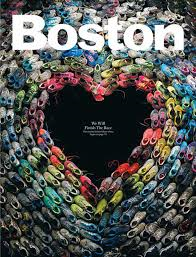
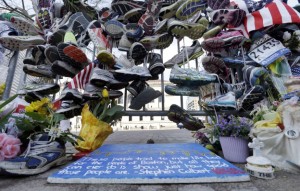
On Wednesday, April 15, Boston marked the second anniversary of the Boston Marathon bombing, now called “One Boston Day,” with a moment of silence at 2:49PM. That was the time that two bombs exploded about 12 seconds apart among crowds of people near the marathon finish line, leaving three people dead and 264 people injured–many of whom lost limbs.
(Reuters) – Boston marked the second anniversary of the deadly attack on its annual marathon on Wednesday with a quiet ceremony at the site where three died, unveiling a pair of banners marked with a heart.
Mayor Marty Walsh joined a group of survivors of the April 15, 2013, blasts, including Jane and Henry Richard, whose 8-year-old brother Martin was the youngest killed, as well as Jeff Bauman, who lost both legs. Some 264 people, including spectators, volunteers at runners at the Boston Marathon were injured.
At 2:49 p.m. ET (1849 GMT) New England’s largest city will observe a moment of silence to mark the time the first bomb went off.
“Our thoughts and prayers are with the victims and their families, who seek to make sense of that awful day,” said Massachusetts Governor Charlie Baker. “Those most affected by the events of two years ago have shown us all the way back with their courage, grace and determination.
On Patriots’ Day this coming Monday April 20th, runners will gather in Hopkinton, Massachusetts for the 119th running of the 26 mile race to the finish line in Copley Square.
Security for this year’s race will be higher than ever, and that is causing some controversy.
Nearly a million people will line the streets to watch the Boston Marathon on Monday, and someone else will be watching them. Bill Ridge with the Boston Police says video surveillance is a big part of the security plan.
“We’ve got a lot of cameras out there,” he says. “We’re going to be watching the portions in Boston — particularly the routes along Boylston Street, the finish line.” …. Video footage helped identify the terrorists, and the number and quality of video cameras has gone up since then.
The extent of the surveillance of Boston described in the article is troubling. NPR talked to Mark Savage of Lan-Tel Communications, which is in charge of surveillance for the marathon.
“I’m zooming in on the infield of Fenway Park,” he says while maneuvering a camera. He uses a laptop to swivel and zoom the HD video camera on a building hundreds of yards away from the ballpark. The zoom is so powerful, Johnson says it could probably tell whether a Red Sox pitcher has thrown a strike or a ball.
In the same way that televisions have gotten higher resolutions through the years, so have video cameras — and Johnson says cheaper bandwidth and data storage make it easy to record more, better-quality video.
Flowers placed at the finish line of the Boston Marathon last week (from NPR).
Apparently the Boston Police have already installed a lot of surveillance equipment around the city.
Kade Crockford of the American Civil Liberties Union of Massachusetts says she understands the need for surveillance at a big public event like the Boston Marathon — but objects to expanding its use. While standing outside the Old State House, she points out four different surveillance cameras catching her every move.
“[A big event] doesn’t trigger privacy concerns,” she says. “What does trigger privacy concerns is the City of Boston installing a network of cameras — some in residential neighborhoods — that enable law enforcement to track individual people from the moment that we leave our homes in the morning until the moment we return at night, seeing basically everywhere we went and everything that we did.”
Boston Police won’t say how many cameras are already in the city’s network, or how many new ones are going up for the marathon. But some of them will stay online afterward.
The family of Boston Marathon bombing victim Martin Richard joins Boston Mayor Marty Walsh (R) at a ceremony at the site of the second bomb blast on the second anniversary of the bombings in Boston, Massachusetts April 15, 2015. REUTERS/Brian Snyder
Kevin Cullen at The Boston Globe suggests other questions about the bombing that need to be answered.
A Boston cop I know, who was at the finish line when the bombs exploded and who saved lives that day, has a question.
“Who were the FBI agents who interviewed Tamerlan Tsarnaev after the Russians raised questions about him two years before the bombings, and why didn’t they recognize Tamerlan from the photos the FBI released?” he asked.
It’s a good question, one that the prosecution won’t want to ask, one that the defense needs to ask, if it isn’t deemed irrelevant by O’Toole.
The defense has argued all along that Dzhokhar Tsarnaev was steered into the bombing plot by his older, domineering, more-radicalized brother. Tamerlan Tsarnaev, dead almost two years, will be mentioned as often as his little brother in this phase of the trial.
Cullen says the FBI did good work after the bombs went off, but . . . .
But that nagging question — why wasn’t Tamerlan Tsarnaev identified earlier — won’t go away. And it feeds the nagging sense that the FBI knows far more about Tamerlan Tsarnaev than it’s sharing.
Nor will questions about Tamerlan’s wife, Katherine, go away. The government broadly hinted but never came right out and said they believe the bombs or at least components for the bombs were assembled at the Cambridge apartment Katherine and Tamerlan shared with their daughter, a toddler.
The defense didn’t try to debunk the suggestion nearly as strongly as you might think because it allowed them to point out that the fingerprints on all the tools that might have been used to make the bombs were Tamerlan’s, not Dzhokhar’s.
Why wasn’t Katherine charged? Did she cooperate with investigators?
One of the other nagging questions is whether the Tsarnaev brothers had any accomplices in gathering all the gunpowder from fireworks they used in their bombs. Listening to testimony about how much powder was needed to make the bombs, it seemed like the Tsarnaev brothers would have to be doing nothing else but dismantling fireworks for months.
All good questions and there are more good ones at the link. Cullen notes that we particularly need answers about why the FBI shot and killed Ibragim Todashev, who was potentially their best source of information about Tamerlan and his motives.
The Feds are getting plenty of pushback here in the Boston area on their goal of putting Dzhokhar Tsarnaev to death. After all, Massachusetts does not have the death penalty. Victims families and survivors as well as citizens have expressed their wishes that Tsarnaev be allowed spend the rest of his life in prison.
The survey (topline, crosstabs) of 509 registered voters in Greater Boston found 58 percent support life in prison for Tsarnaev. That number rises to 61 percent among voters in the city of Boston.
“Over the last month, we’ve seen support for life in prison grow by about 10 points [in the Boston area],” said Steve Koczela, president of the MassINC Polling Group, which conducts surveys for WBUR.
According to the poll, only 31 percent of Boston area residents said they support the death penalty for Tsarnaev. That support drops to 26 percent in the city of Boston.
The earlier WBUR survey was conducted last month, while the first phase of the Tsarnaev trial was ongoing. The latest poll was conducted just days after his conviction.
People’s feelings about executing the convicted bomber are on par with how they view the death penalty in general.
Fifty-seven percent in the Boston area and 63 percent in the city of Boston oppose the use of the death penalty broadly.
The parents of Martin Lawrence have begged the prosecution to drop the death penalty request.
The parents of Martin Richard, the 8-year-old boy killed in the Boston Marathon bombings two years ago, have writtten a plea to end the attention convicted killer Dzhokhar Tsarnaev has received and spare him from the death penalty.
In an essay written for The Boston Globe, Bill and Denise Richard ask that the case come to a close, writing, “We know that the government has its reasons for seeking the death penalty, but the continued pursuit of that punishment could bring years of appeals and prolong reliving the most painful day of our lives.”
In a posting on Facebook and on her Twitter account, Jennifer L. Lemmerman wrote that she continues to mourn the loss of her younger brother, who was widely lauded after his murder.
Lemmerman, a graduate of Boston College School of Social Work and an alderwoman in Melrose, wrote that she will never forgive Tsarnaev for ending her brother’s life.
But, she also wrote, she does not believe in the death penalty even after what has happened to her and her family.
“Whenever someone speaks out against the death penalty, they are challenged to imagine how they would feel if someone they love were killed. I’ve been given that horrible perspective and I can say that my position has only strengthened,’’ she wrote on her Facebook account.
Obviously, I think killing Tsarnaev would be wrong and counterproductive. The death penalty would only turn him into a martyr anyway, and it would mean years, perhaps decades of court battles in which he would get unnecessary and undeserved public attention; and the victims families would be forced to relive their pain and loss again and again.
As always, this is an open thread. Please feel free to comment and post links on any topic.
Did you like this post? Please share it with your friends:
I found some interesting, overlooked stories that I thought I’d share with you because some of them are radically important. BB’s post yesterday inspired me! Why is it that some stories never really see the light of day or stay on the front page for very long?
A blanket of fog lifts, exposing a band of rainbow sheen that stretches for miles off the coast of Louisiana. From the vantage point of an airplane, it’s easy to see gas bubbles in the slick that mark the spot where an oil platform toppled during a 2004 hurricane, triggering what might be the longest-running commercial oil spill ever to pollute the Gulf of Mexico.
Yet more than a decade after crude started leaking at the site formerly operated by Taylor Energy Company, few people even know of its existence. The company has downplayed the leak’s extent and environmental impact, likening it to scores of minor spills and natural seeps the Gulf routinely absorbs.
An Associated Press investigation has revealed evidence that the spill is far worse than what Taylor — or the government — have publicly reported during their secretive, and costly, effort to halt the leak. Presented with AP’s findings, that the sheen recently averaged about 91 gallons of oil per day across eight square miles, the Coast Guard provided a new leak estimate that is about 20 times greater than one recently touted by the company.
Outside experts say the spill could be even worse — possibly one of the largest ever in the Gulf.
Taylor, a company renowned in Louisiana for the philanthropy of its deceased founder, Patrick Taylor, has kept documents secret that would shed light on what it has done to stop the leak and eliminate the persistent sheen.
The Coast Guard said in 2008 the leak posed a “significant threat” to the environment, though there is no evidence oil from the site has reached shore. Ian MacDonald, a Florida State University biological oceanography professor and expert witness in a lawsuit against Taylor, said the sheen “presents a substantial threat to the environment” and is capable of harming birds, fish and other marine life.
Using satellite images and pollution reports, the watchdog group SkyTruth estimates between 300,000 and 1.4 million gallons of oil has spilled from the site since 2004, with an annual average daily leak rate between 37 and 900 gallons.
If SkyTruth’s high-end estimate of 1.4 million gallons is accurate, Taylor’s spill would be about 1 percent the size of BP’s, which a judge ruled amounted to 134 million gallons. That would still make the Taylor spill the 8th largest in the Gulf since 1970, according to a list compiled by the National Oceanic and Atmospheric Administration.
“The Taylor leak is just a great example of what I call a dirty little secret in plain sight,” said SkyTruth President John Amos.
Taylor has spent tens of millions of dollars to contain and stop its leak, but it says nothing can be done to completely halt the chronic slicks.
Here’s an amazing story that I got from Project Censored. We talked a lot about sexual assault last year. We were astounded at the cavalier attitude towards rape shown in a lot of reporting. Well, this shouldn’t be surprising then: “Corporate News Media Understate Rape, Sexual Violence.”
Media analysts observe how journalists refrain from using the word “rape” to describe incidents of sexual assault. Instead, news outlets downplay the humiliation and cruelty entailed in these acts by referring to them as “sex crimes,” “inappropriate sexual activity,” or “forced sex,” even though such acts are legally recognized as “rape.”
“‘Rape,’ along with the images it conjures, is an ugly, nasty word,” artist and writer Wasi Daniju observed. “Uglier and nastier still, though, is the experience of each and every person that experiences it. Their experience warrants, at the very least, the respect and truth of being accurately labeled and recognized.”
A report released by Legal Momentum, a New York City–based feminist advocacy law group, titled Raped or “Seduced”? How Language Helps Shape Our Response to Sexual Violence, addressed what it terms the “linguistic avoidance” of such concerns. For example, when the media uses the language of consensual sex—terms like “recruited” rather than “kidnapped” or “took by force,” and phrases like “performed oral sex” or “engaged in sexual activity” instead of writing that “he forcefully penetrated her vagina with his penis”—they do more than use euphemisms to distort reality; they essentially mislead, misdirect, and diminish the violation. Such accounts also suggest that both parties were willing participants.
Fairness and Accuracy in Reporting (FAIR) pointed to the Los Angeles Times to illustrate one example of this phenomenon. In January 2013, the Times published an important story addressing how two Los Angeles police officers were accused of using the threat of imprisonment to force several women they previously arrested to have sex with them. This is recognized under law as “rape.” “But the Times avoided using that term,” FAIR noted, “inexplicably employing every other word and phrase imaginable—including ‘sex crimes,’ ‘sexual favors’ and ‘forced sex’—to describe what the officers were accused of.”
Italian police say they have arrested 15 Muslim migrants after they allegedly threw 12 Christians overboard following a row on a boat heading to Italy.
The Christian migrants, said to be from Ghana and Nigeria, are all feared dead.
In a separate incident, more than 40 people drowned after another migrant boat sank between Libya and Italy.
Almost 10,000 migrants trying to cross the Mediterranean have been rescued in recent days. Italy has called for more help from the EU to handle the crisis.
More than 500 people from Africa and the Middle East have died making the perilous crossing since the start of the year. Earlier this week, 400 people were believed to have drowned when their boat capsized.
The 15 Muslim migrants involved in the row with Christians were arrested in the Sicilian city of Palermo and charged with “multiple aggravated murder motivated by religious hate”.
The suspects, who are from the Ivory Coast, Senegal, Mali and Guinea, were among 105 migrants travelling in an inflatable boat that left Libya on Tuesday.
Eyewitnesses told police how the altercation resulted in Christians being thrown overboard, and that some of the survivors had formed human chains to avoid a similar fate.
Of course, all we ever hear about is the number of people that show up at our border trying to escape the violence from South America. We aren’t the only country besieged with refugees.
Africa’s efforts to tackle the Ebola crisis have been largely overlooked even though Africans have taken the lead in providing frontline staff and shown themselves “better placed to fight infectious diseases in their continent than outsiders”, according to the African Union (AU).
Dr Olawale Maiyegun, director of social affairs at the AU commission, said that despite the fact that Africans had proved both willing and able to deal with Ebola, the focus had been on the work of international agencies and those with the greatest media clout.
“Unfortunately, Africans do not have the international voice of CNN, BBC and France 24, therefore much of our work is overlooked in the western media,” he said. “Most of the assistance provided by the international community is in the areas of finance and infrastructure. In the most critical human resources for health, Africans – including the affected countries – have had to take the lead.”
His comments come six months after Nelson Mandela’s widow, Graça Machel,accused African leaders of failing to do enough to address the health crisis. “Ebola has exposed the extreme weaknesses of our institutions as governments; countries which are affected were found totally unprepared,” she told African business leaders in November last year. “It’s time Africa began to give real value to human life, in other words African human lives.”
However, Maiyegun argued that the AU and the Economic Community of West African States had reacted well to the crisis, with the AU deploying more than 835 African health workers to Liberia, Sierra Leone and Guinea at the peak of the epidemic. “The success of African health workers – including the heroic health workers of Liberia, Sierra Leone and Guinea – shows one thing: African health workers are better placed to fight infectious diseases in their continent than outsiders,” he said.
Maiyegun said the AU’s response had been guided by the philosophy that it should not dictate how the the affected countries should run their fight against Ebola. “We put volunteers at the disposal of the governments of the affected countries,” he said. “They told us what to do and we have performed creditably.”
He added: “The people of the affected countries must be given credit for doing a good job. With so many actors in the field, it’s important that it’s not just those with the loudest voices who are credited in the press for bringing Ebola under control.”
Very few media outlets are writing about the problem with our criminal justices system from our current police state to the privatization of prisons. Here’s another excellent series of articles I found at Project Censored on our battered and broken legal/criminal justice system. This is from the blog of professor Nolan Higden writing at Thought Catalogue.
The demand for “justice” by the American people has created a profit making opportunity in the capitalist United States. An irrational fear over crime (discussed in Part 1) has allowed for an expansion of the US prison system. In fact the US now has more prisons than colleges. Big 2 profits for the few in the prison industry have resulted in little justice and increased costs and suffering for US citizens. The prison industry increased their revenue by investing in neo-liberal politicians, lobbying for stricter sentencing laws, and hoodwinking tax payers with iron-clad prison contracts. The result is that the US has 5 percent of the world’s population and 25% of its prisoners. One percent of the US population is currently incarcerated, a larger percent than any 3 other western industrialized nation. Incarceration is on the rise in 36 states. If one adds in the 4 5 citizens on probation or parole; about 2.9% of the adult population are under some form of correctional supervision. Another 70,792 children are in juvenile detention. In 2012, the 6 7 Supreme Court ruled that the US needed to stop sending minors to jail for life.
This mass incarceration is made worse by the high recidivism rate in the US. Recidivism is the rate at which those incarcerated are re-incarcerated for crimes committed upon release. In the US, two-thirds of inmates are incarcerated after being released. Thus, the prisons system does not provide rehabilitation, it provides a stop for offenders in between crimes. In fact, in 9 Wisconsin, over half of the inmates are incarcerated for parole violations.
… far too often, people end up on death row after being convicted of horrific crimes they did not commit. The lucky ones are exonerated while they are still alive — a macabre club that has grown to include 152 members since 1973.
The rest remain locked up for life in closet-size cells. Some die there of natural causes; in at least twodocumented cases, inmates who were almost certainly innocent were put to death.
How many more innocent people have met the same fate, or are awaiting it? That may never be known. But over the past 42 years, someone on death row has been exonerated, on average, every three months. According to one study, at least 4 percent of all death-row inmates in the United States have been wrongfully convicted. That is far more than often enough to conclude that the death penalty — besides being cruel, immoral, and ineffective at reducing crime — is so riddled with error that no civilized nation should tolerate its use.
Innocent people get convicted for many reasons, including bad lawyering, mistaken identifications and false confessions made under duress. But as advances in DNA analysis have accelerated the pace of exonerations, it has also become clear that prosecutorial misconduct is at the heart of an alarming number of these cases.
In the past year alone, nine people who had been sentenced to death were released — and in all but one case, prosecutors’ wrongdoing played a key role.
Of 329 exonerations aided by the Innocence Project, roughly 70% are people of color; 62% of the total number of people are African American. The disproportionate rate of wrongfully convicted African Americans correlates strongly with the overall incarceration rate of about 2,207 per 100,000 people in that group. The End Racial Profiling Act broadly calls for greater accountability to people who have suffered due to racism in law enforcement and the justice system and while it’s a proactive bill that calls for measures to reduce racial profiling, if passed, it could also be a hopeful resource for mending some of the wrongs already done, particularly for innocent people of color.
Minors are especially vulnerable to falsely confessing to crimes that they didn’t commit. The JJDPA, which has had its funding cut significantly over the last decade, is integral to providing resources for the prevention of juvenile incarceration and providing fair treatment and support to incarcerated minors. Minors are one of the most susceptible groups to negligence and rights violations—the recent exposure of the use of solitary confinement for minors at Rikers Island is a prominent example.
As I read these stories and wonder how many more that I have missed, I can’t help but be struck by the concentration of news media outlets into the hands of a few and how those few are profit-seeking above all other things.
What’s on your reading and blogging list today? This is an open thread.
Did you like this post? Please share it with your friends:
The Sky Dancing banner headline uses a snippet from a work by artist Tashi Mannox called 'Rainbow Study'. The work is described as a" study of typical Tibetan rainbow clouds, that feature in Thanka painting, temple decoration and silk brocades". dakinikat was immediately drawn to the image when trying to find stylized Tibetan Clouds to represent Sky Dancing. It is probably because Tashi's practice is similar to her own. His updated take on the clouds that fill the collection of traditional thankas is quite special.
You can find his work at his website by clicking on his logo below. He is also a calligraphy artist that uses important vajrayana syllables. We encourage you to visit his on line studio.















 peej
peej Carissa
 bostonboomer
 dakinikat
 ecocatwoman
 mablue2
 Mama Lopez
 peggysue22
 quixote
 skydancingguestblogger
 Mona (aka Wonk the Vote)



 Sky Dancing
Recent Comments