
Thursday Reads
Posted: June 5, 2014 Filed under: morning reads, U.S. Politics | Tags: 60 Minutes, Benghazi, Bowe Bergdahl, CBS News, Chester Nez, Hailey Idaho, Harrier AV-8B, Hillary Clinton, Imperial CA, Jane Drussel, Lara Logan, Matt Drudge, Navaho code talkers, Oregon, People Magazine, right wing hate, Southern Poverty Law Center, White supremacists 43 Comments  Good Morning!!
I’m pretty wiped out this morning, so this won’t be an extensive post. My mom is doing okay, but she needs help with a lot of things. This morning we’re going to have to deal with the Comcast people. It would really help if she could watch TV or listen to the radio! This afternoon I have to take her to the doctor, and then we might have to go back to the emergency room to have them put on a looser splint. They told us to do that if the one she has starts to feel too tight. But enough of my problems; let’s see what’s in the news.
The Bowe Bergdahl story gets more disgraceful with each passing day. Last night, via Little Green Footballs, NBC News reported that officials in Bergdahl’s hometown of Hailey, Idaho, had been
deluged with angry calls from people who think that Bergdahl is an Army deserter or traitor who doesn’t deserve a hero’s welcome.
Jane Drussel, the president of the Hailey Chamber of Commerce, has been fielding dozens of angry calls.
“Well, (I feel) disappointment number one, just absolutely total surprise at how bad some of them are,” she told NBC News on Tuesday….
Drussel said many of the calls are cancelling trips to the town of about 8,000.
“Well, number one is, how dare we as a community support someone who in their mind they’re thinking of as a ‘deserter,’ a traitor. That they had plans to come here on their vacation, they’re no longer coming, they’re cancelling their reservations.”
“I just find that shocking,” she said. “You know, we’re Americans, and we need to act like Americans, and to me that’s un-American. Let things play out, and if there needs to be action taken, I’m sure it will be taken. But that’s not the city of Hailey’s responsibility.”
As a consequence of the threatening calls, the town has cancelled the welcome home celebration they had been planning. According to the Washington Post, the reason for the cancellation is concern for “public safety.” The small town of 8,000 people simply can’t handle an event that might attract a large number of angry protesters.

The right wing focus on Bergdahl hasn’t kept them from carrying on the meme that Hillary Clinton is old and disabled. The former Secretary of State is pictured on the cover of People Magazine this week smiling broadly and holding onto a deck chair. But the inimitable Matt Drudge has a different theory. From Bob Cesca at the Daily Banter: Drudge Wonders if Hillary Clinton Used a Walker on People Magazine Cover.
Oh, Drudge, you magnificent bastard. There are very few right-wing trolls who are better than Matt Drudge at manufacturing an odious whisper campaign, and he didn’t disappoint today. Drudge posted the new People Magazine cover featuring Hillary Clinton, then wondered whether she was holding onto, wait for it, a walker. You know, like an old lady with brain damage. Wink, wink.
Of course he didn’t say it outright. He used the nefarious “Cavuto Mark” — a question mark at the end of a deliberately leading statement, made famous by Fox News Channel.
Yesterday afternoon, Reuters reported: Last of Navajo ‘code talkers’ dies in New Mexico.
The last of 29 Navajo Americans who developed an unbreakable code that helped Allied forces win the second World War died in New Mexico on Wednesday of kidney failure at the age of 93.
Chester Nez was the last remaining survivor of an original group of 29 Navajos recruited by the U.S. Marine Corps to create a code based on their language that the Japanese could not crack.
His son, Michael Nez, said his father died peacefully in his sleep at their home in Albuquerque….
About 400 code talkers would go on to use their unique battlefield cipher to encrypt messages sent from field telephones and radios throughout the Pacific theater during the war.
It was regarded as secure from Japanese military code breakers because the language was spoken only in the U.S. Southwest, was known by fewer than 30 non-Navajo people, and had no written form.
The Navajos’ skill, speed and accuracy under fire in ferocious battles from the Marshall Islands to Iwo Jima is credited with saving thousands of U.S. servicemen’s lives and helping shorten the war. Their work was celebrated in the 2002 movie “Windtalkers.”
May he rest in peace.

Despite all the controversy over her faulty reporting on Benghazi, Lara Logan is “back at work on CBS News’ 60 Minutes,” according The Hollywood Reporter.
The news ends a suspension that began last fall after an erroneous60 Minutes report on the Sept. 11, 2012, attacks on the U.S. mission in Benghazi that resulted in the death of AmbassadorChristopher Stevens and three other U.S. personnel. Logan had a handful of pieces in the works when she was suspended last November after her report that relied on a now-discredited interview with security contractor Dylan Davies.
She has been eager to return to work, say sources close to the correspondent, but the Benghazi report undermined her status as one of the veteran newsmagazine’s biggest stars and created a media feeding frenzy that unearthed a strident speech she gave a month after the Benghazi attacks in which she advocated for military intervention in Libya and asserted that the Obama administration was downplaying the threat from Al Qaeda.
At the time of her suspension last November, CBS News chairman and 60 Minutes executive producer Jeff Fager told THR that the report was a “black eye” for the venerable newsmagazine, still the most watched of its genre.
A CBS News spokesperson confirmed that Logan has returned to work. 60 Minutes typically takes something of a production hiatus during the summer months, with new pieces sprinkled throughout a schedule that includes reruns and updates of previously aired segments. Logan likely will not be seen on60 Minutes until the fall, sources tell THR. But she’ll begin appearing on other CBS News broadcasts such as the CBS Evening News and CBS This Morning in the coming weeks.
I guess we already knew that CBS is no longer a serious news organization. This is just one more piece of confirming evidence.
From the Southern Poverty Law Center, Massive Investigation Uncovers White Supremacist Criminal Network in Oregon.
“Operation White Christmas,” as the year-old investigation is code-named, so far has resulted in the arrests of 54 individuals, mostly in the Portland area, leading to 11 criminal cases in state court and another 43 in federal court.
As for its scope, the investigation based in Portland and Multnomah County rivals the prosecutions of members of another violent gang, the Aryan Brotherhood of Texas.
The Oregon suspects variously are affiliated with at least five known street and prison white supremacist gangs – European Kindred (EK); Rude Crude Brood; All Ona Bitch (AOB); Fat Bitch Killers (FBK) and Insane Peckerwood Syndicate (IPS), authorities say.
“The scope of this case is by far the largest ever undertaken by this agency in recent memory, based on the number of suspects investigated, the number of persons arrested and the amount of guns recovered,” Lt. Ned Walls, the investigations division supervisor for the Multnomah County Sheriff’s Office, told Hatewatch.
What initially began as an investigation of drug and firearms trafficking by white supremacist gangs blossomed into a broader probe of robberies, home invasions, burglaries, kidnapping, assaults, shootings and witness intimidation, Walls said. Some of the crimes involved gang-on-gang violence.
“The Multnomah County Sheriff’s Office would have had an impossibly hard time trying to conduct this investigation on our own,” Walls said. The department, he said, got “outstanding collaborative” support and involvement from the federal Bureau of Alcohol Tobacco, Firearms & Explosives, the Clackamas and Washington County Sheriff’s Offices in Oregon, the Portland Police Bureau, the Gresham, Ore., Police Department, Klickitat County, Wash., Sheriff’s Office, the U.S. Attorney’s Office in Oregon and the Multnomah County District Attorney’s Office.
It’s good to know the Feds are seriously investigating right wing domestic terrorists, but it sounds like the investigation was initiated by local law enforcement.
A military plane crashed in a residential neighborhood in California yesterday afternoon. From the AP, via the Visalia Times-Delta:
IMPERIAL – A Marine jet crashed into a residential area in a Southern California desert community Wednesday, exploding and setting two homes on fire. The pilot ejected safely, and there was no immediate word of any injuries on the ground.
The Harrier AV-8B went down at 4:20 p.m. in Imperial, a city of about 15,000 near the U.S.-Mexico border about 90 miles east of San Diego. Witnesses described an explosion and thick plumes of smoke.
“It felt like a bomb was thrown in the backyard of the house,” said Adriana Ramos, 45, whose home is less than a block from the crash scene. “The whole house moved.”
Ramos fled with her 4-year-old granddaughter and 10-year-old daughter, who both cried at the sight outside….]
At the crash site, there was chaos as people ran in every direction, he said. The two homes were on fire and it was unclear if anyone was inside.
The plane was from Marine Corps Air Station Yuma in Arizona, said Cpl. Melissa Lee, a spokeswoman for Marine Corps Air Station Miramar. She had no details about what might have caused the accident.
As of this morning, no injuries have been reported. You can see video of the scene at The Week Magazine.
I have a few more links for you that I’ll post in the comment thread, and I hope you’ll do the same. What stories are you following today?
Tuesday Reads: Comedies and Errors
Posted: June 3, 2014 Filed under: morning reads | Tags: Bowe Bergdahl, hostage negotiations, Nicholas Kristof, sex trafficking, Somaly Mam 60 CommentsEvery why hath a wherefore.
William Shakespeare from Comedy of Errors
Good Morning!
I’ve found several stories worth following today.
First, it seems that Somaly Mam of the Cambodian foundation that rescues underage girls from sex work is under heavy scrutiny and criticism. Mam has been the focus of a series of articles in the NYT by Nicholas Kristof as well as documentaries and books. It seems she got creative in her storytelling. Kristof has yet to write or speak on the matter.
In Nicholas Kristof’s columns in the New York Times, he portrayedMs. Mam in an extraordinarily positive light. He was not alone in doing so. Ms. Mam attracted many high-profile supporters, from Susan Sarandon to John Kerry to Sheryl Sandberg.
In a 2009 column, Mr. Kristof told the story of Long Pross, a teenager (also known as Somana) who said that her eye had been gouged out by a pimp, after she was forced into prostitution. Newsweek has reported, based on medical records, that the girl’s missing eye is the result of surgery to remove a non-malignant tumor when she was 13.
A great deal of money has been raised to combat sex-trafficking, in part as a result of Mr. Kristof’s writing about Ms. Mam on multiple occasions. And there’s little doubt that sex-trafficking is a problem worth paying attention to, and working to end. But now that Ms. Mam has stepped down from the foundation that bears her name — following not only the Newsweek story but the foundation’s internal investigation — many readers, on Twitter and in emails to my office, are asking what Mr. Kristof’s responsibility is for setting the record straight.
 Mam has quit her own foundation.
Somaly Mam’s story is incredible. Her autobiography, “The World of Lost Innocence,” detailed how she was born in a village in the Cambodian rain forest and sold into sexual slavery as a child by her “grandfather.” She was stuck in Southeast Asia’s sex industry for 10 years until she finally escaped in her early 20s (her exact age isn’t clear as she has no birth documents).
Mam began to settle into regular life, marrying a French man, moving to Europe and having children of her own. But her childhood experiences led her to save other girls who were suffering a similar fate. She returned to Cambodia and set up Acting for Women in Distressing Situations (known by its French acronym Afesip), a charity devoted to rescuing women and girls in Cambodia and neighboring Laos who are forced into prostitution.
Her efforts gained her international recognition – a 2009 appearance in the Time 100 was written by Angelina Jolie – and in turn raised millions for the protection of children and women from prostitution. But as incredible as that story is, its accuracy is now in serious doubt. On Wednesday, Gina Reiss-Wilchins, executive director of the Somaly Mam Foundation, a U.S.-based organization that acted as a fundraiser for Afesip, said that Mam had resigned from the foundation after being presented with the findings of an investigation by a California-based law firm, Goodwin Procter (Mam is not currently employed by Afesip).
While the exact details from Goodwin Procter have not been released, allegations of inconsistencies in Mam’s past have been around for years. Doubts went back at least as far as 2012, when Mam gave a speech to the U.N. General Assembly that said that the Cambodian army had killed eight girls after a raid on her organization’s Phnom Penh center in 2004.
Following an investigation by Simon Marks in Cambodia Daily, Mam admitted that the claim was inaccurate. “I had in no way intended to allege that girls were murdered during the shelter raid,” Mam told Cambodia Daily in an e-mail, adding that her comments had been “ambiguous.”
Later that year, Pierre Legros – Mam’s French ex-husband – came forward to describe another incident that had not occurred as Mam had described it. In 2006, Mam told Mariane Pearl, wife of Daniel Pearl, in an article for Glamour Magazine that her teenage daughter had been abducted by human traffickers as revenge for her activism. Mam mentioned the incident again in her U.N. speech, which prompted Legros to respond. His daughter had in fact run away with a boyfriend, he said, claiming that he wanted to protect her privacy and stop her being used as “marketing” for the Somaly Mam Foundation.
Other NGOs working on sex trafficking are trying to pick up the pieces.
What the Somaly Mam story highlights is a state of affairs that many of us in the social change movement bemoan, namely that simple stories of exploitation rarely grab the public’s imagination, the donors, or the press. Unless the overdone images of runny noses, torn clothing, or worse, naked children in a cage waiting to be sold, are splashed on glossy pages, the actual suffering of human beings too often fails to trigger widespread empathy or outrage.
In addition to this heightened need for sensationalism, our society craves numbers. Suffering in small quantities is rarely enough. Given the undercover and “hidden in plain sight” crimes of human trafficking, no entity has been definitively able to pin down the actual number of victims. From the United Nations to national statistics, the numbers range widely from 2.5 million to 20.9 million. Irrespective of the range, all agree that the majority of those estimated individuals are women and children with a majority of that group ending up in the sex trade. In a recent report, theInternational Labor Organization estimated that profits from human trafficking generated $150 billion, two-thirds of which, or $90 billion, stem from commercial sexual exploitation.
Cambodia is designated as a source, transit and destination country for labor and sex trafficking. The U.S. State Department also found that the sale of virgin women and girls continues to be a problem and that Cambodian men form the “largest source of demand for child prostitution.” Regardless of its founder’s personal failings, the Somaly Mam Foundation has plenty of urgent work ahead.
In collaboration with the Cambodian Women’s Crisis Center, Dr. Melissa Farley, of Prostitution Research and Education, interviewed 133 Cambodian men who purchased commercial sex. The study shows that almost all of these male buyers interviewed in Phnom Penh stated that they witnessed extreme violence inflicted on the prostituted women, more often than not controlled by pimps. The men surveyed also saw children available for paid sexual abuse in brothels, bars and massage parlors. One of the “johns” astutely said that “prostitution is the man’s heaven but it is also those girls’ hell.”
The Somaly Mam episode cannot be used as an excuse to deny or ignore the undeniable exploitation of countless human beings in the sex trade
 Tons of controversy surrounds the capture and release of American POW Bowe Bergdahl. I’ve been reading some on this and there are several threads of outrage going on. Some felt Bowe should have been left to the Taliban because of some evidence that he went AWOL. Others believe that it’s a value of our country and are armed services to leave no one behind. The right wing is going berserk over some twitters posted by Bergdahl’s father. I’m not sure what the implication is supposed to be, but the entire thing is turning into a circus act. Snow Flake Snookie has hit the grifting trail in search of outrage and funds. Some how, she has decided the soldier’s guilt and fate so any potential military tribunal should just STFU. I’ve been looking for less outraged and more informative sources. Here’s the story from one soldier who was assigned to hunt for Bergdahl along with other soldiers. Some of these soldiers were KIA.
Our deployment was hectic and intense in the initial months, but no one could have predicted that a soldier would simply wander off. Looking back on those first 12 weeks, our slice of the war in the vicinity of Sharana resembles a perfectly still snow-globe—a diorama in miniature of all the dust-coated outposts, treeless brown mountains and adobe castles in Paktika province—and between June 25 and June 30, all the forces of nature conspired to turn it over and shake it. On June 25, we suffered our battalion’s first fatality, a platoon leader named First Lieutenant Brian Bradshaw. Five days later, Bergdahl walked away.
His disappearance translated into daily search missions across the entire Afghanistan theater of operations, particularly ours. The combat platoons in our battalion spent the next month on daily helicopter-insertion search missions (called “air assaults”) trying to scour villages for signs of him. Each operations would send multiple platoons and every enabler available in pursuit: radio intercept teams, military working dogs, professional anthropologists used as intelligence gathering teams, Afghan sources in disguise. They would be out for at least 24 hours. I know of some who were on mission for 10 days at a stretch. In July, the temperature was well above 100 degrees Fahrenheit each day.
These cobbled-together units’ task was to search villages one after another. They often took rifle and mortar fire from insurgents, or perhaps just angry locals. They intermittently received resupply from soot-coated Mi-17s piloted by Russian contractors, many of whom were Soviet veterans of Afghanistan. It was hard, dirty and dangerous work. The searches enraged the local civilian population and derailed the counterinsurgency operations taking place at the time. At every juncture I remember the soldiers involved asking why we were burning so much gasoline trying to find a guy who had abandoned his unit in the first place. The war was already absurd and quixotic, but the hunt for Bergdahl was even more infuriating because it was all the result of some kid doing something unnecessary by his own volition.
Some of the contentiousness is due to the five Taliban who were swapped for the soldier. None of these guys will ever be up for humanitarian awards  and some feel they are still a danger.
Below is information about each of the detainees released.
Khairullah Khairkhwa is the most senior ex-Guantanamo prisoner who comes from “the fraternity of original Taleban who launched the movement in 1994,” according the Afghanistan Analysts Network. He surrendered to President Hamid Karzai’s brother just before he was captured in January 2002. His most prominent position was as governor of Herat Province from 1999 to 2001. He served in various Taliban positions including interior minister and had direct ties to Mullah Omar and Osama bin Laden.
Mullah Norullah Noori served as governor of Balkh Province in the Taliban regime and played some role in coordinating the fight against the Northern Alliance. He was a senior Taliban commander in the northern city of Mazar-e-Sharif when the Taliban fought U.S. forces in late 2001.
Mohammad Fazl commanded the main force fighting the U.S.-backed Northern Alliance in 2001 and served as chief of army staff under the Taliban regime. Human Rights Watch says he could be prosecuted for war crimes for presiding over the mass killing of Shiite Muslims in Afghanistan in 2000 and 2001 as the Taliban sought to consolidate their control over the country. Fazl joined the Taliban early, never held a civilian post, and rose through the ranks because of his fighting ability, ending up up as one of their most important and feared military commanders, according to the Afghanistan Analysts Network.
Abdul Haq Wasiq was the deputy chief of the Taliban regime’s intelligence service and the cousin of the head of the service, Qari Ahmadullah, who was among the Taliban’s founding members, according to the Afghanistan Analysts Network.
Mohammed Nabi was a Taliban official in Khost Province. He served as chief of security for the Taliban in Qalat, Afghanistan, and later worked as a radio operator for the Taliban’s communications office in Kabul.
 Conveniently forgotten US history includes huge numbers of deals like this. Ronald Reagan’s arms for hostages deal is only one among many.
The US has all along negotiated with the guerrillas it has fought on the battlefield. William Howard Taft (later president) in the Philippines was all for negotiation with Filipinos who rejected US rule, and he created “attraction zones” to win them over. At the conclusion of the Aguinaldo resistance to US occupation in 1902, Teddy Roosevelt declared a general amnesty for the resistance fighters. These resistance fighters had committed some atrocities, including on captured US troops, but Roosevelt just let them walk free. Talk softly, carry a big stick, and let all the terrorists go, seems to have been his motto.
The US negotiated with the Viet Cong in South Vietnam, who were very much analogous to the Taliban and whom the US would now certainly term “terrorists.” In 1973, the US used intermediaries to negotiate with the Viet Cong for release of captured US soldiers at Loc Ninh. Americans on the political right made a huge issue about 1300 US soldiers never having been released by the Viet Cong (only about 400 were), and the shame that these men were left on the battlefield by the Nixon and Ford administrations. Conservatives seem to want to have it both ways. If you negotiate the release of US captives with the enemy you are “negotiating with terrorists.” If you don’t, then you have left soldiers behind on the battlefield. The fact is that the only way to have freed them was to have offered something for them in detailed negotiations. As for the Viet Cong “terrorists,” many of them are in government now and the US has cordial relations with them.
In the 1980s radical Shiites in Lebanon took American hostages. In order to free them, the Reagan administration not only negotiated with I han’s Ayatollah Khomeini but actually stole T.O.W. anti-aircraft munitions from Pentagon warehouses and shipped them to Tehran, receiving the money for them in black bank accounts and sending it to right wing death squads in Nicaragua. Khomeini and his government were listed as terrorists by the State Department at the time, and selling weapons to Iran was highly illegal. Not only that, but the US was allied with Iraq at the time, so Reagan screwed over Baghdad this way. Reagan did it, in part to free US hostages in Lebanon (Iran put pressure on its clients for their release).
One of the big gag reflexes from the right appears to be the label of “terrorist” as compared to insurgent.
 So, what are some other stories that you may want to check out?
Football Hall of Famer Dan Marino sues NFL over concussions
We’ve talked about the horrible damage caused by concussions before. Other players have settled suits but this one is from a big name player.
Yes, you read that right. Female named hurricanes don’t get any respect.
Montana House GOP candidates want to impeach Obama
Can I ever get to the point where I can’t say that the GOP is just bug fuck crazy?
So, those are the items that caught my interest. What’s on your reading and writing list today?
Monday Reads: Another Slow Summer News Day
Posted: June 2, 2014 Filed under: Foreign Affairs, morning reads | Tags: body language, Brian Williams, David Ignatious, deception, Edward Snowden, Fareed Zakaria, Glenn Greenwald, Greensnow cult, Jeff Darcy, King Juan Carlos, Mount Rainier, mountain climbing, risk-taking behavior, Spain 39 Comments
Good Morning!!
It’s another slow news day so far. Google’s top story is that the king of Spain Juan Carlos abdicating in favor of his son. Silly me, I didn’t even know Spain was a monarchy.
From USA Today, Game of thrones: Spain’s king Juan Carlos abdicates.
Carlos, who turned 76 in January, said that he was handing power to Felipe, 46, in order to “open a new era of hope combining his acquired experience and the drive of a new generation.”
Some Spaniards said they had been waiting for it.
“This is part of an expected chronology (of events),” said Alberto Garzon, a lawmaker in the Spanish parliament and author of the book The Third Republic — about a future Spain without a monarchy.
Carlos has enjoyed high popularity for decades but in the past few years his approval ratings fell sharply after a series of personal blunders. He took an expensive African safari during the height of the euro crisis. His daughter, Princess Cristina, has been indicted for embezzlement and her husband stands accused of tax evasion and money laundering.
BBC News summarizes the reasons in a video: Why is King Juan Carlos of Spain abdicating? In 45 secs.
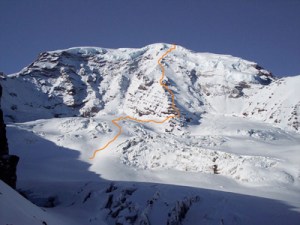
Liberty Ridge, Mount Rainier
This is a sad story, but perhaps not too surprising: Six Climbers Presumed Dead After Long Fall On Mount Rainier. From Northwest Public Radio:
Two experienced guides and four clients are presumed dead after what the National Park Service estimates was a 3,300 foot fall. The climbers were on their way down the mountain after an unsuccessful summit attempt via the difficult Liberty Ridge route on the northwestern side of Rainier.
An aerial and ground search happened Saturday after the group failed to return to their trailhead on schedule. From a helicopter, searchers spotted climbing gear at the base of a rock and ice fall and detected personal avalanche beacons. But the spotters saw no signs of life. A statement from Mount Rainier National Park says no attempt to recover bodies will be made until later in the season because of ongoing danger at the scene at the head of Carbon Glacier.
Interestingly, the guides involved worked for Alapine Ascents, the same Seattle company as some of the Sherpas who died on Mount Everest last month.
I’m not a risk-taker, and I will never understand why people want to get involved in such dangerous sports. But there are people who love to live on the edge and would rather die young doing something they love than live safely into old age.
It is a little-known fact that quite a few people actually die in National Parks every year. Oddly, I don’t like risky activities, but I do like to read books about them; and there are whole books about the different ways people have died in National and State Parks.
According to National Geographic, the dangerous ridge the climbers were using has been involved in numerous accidents in the past.
It’s called Liberty Ridge: a steep ramp of rock, snow and ice splitting a northern face of the 14,410-foot mountain in Washington State. Its stunning views and technical difficulty—hard but not too hard, experts say—have earned it a place in the book Fifty Classic Climbs of North America.
But its remoteness, steepness and exposure to the elements have also made Liberty Ridge the scene of epic rescues and more than its share of deaths….
“When you hear Liberty Ridge, it is a serious route… it’s not a casual route,” said Mike Gauthier, a climbing ranger at Mount Rainier National Park from 1990 to 2008 who was repeatedly called to the spot to rescue stranded climbers and search for missing people….
In his time on the mountain, Gauthier was repeatedly called to Liberty Ridge to rescue stranded climbers or search for missing people who didn’t survive. Often, the scene was on the ridge’s upper reaches, where the mountain is unremittingly steep, leaving few sheltered places to pitch a tent or to hide from avalanches or falling rocks.
“It’s just not an ideal location to hang out because you’re threatened there. You’re just exposed,” said Gauthier, who wrote the main guidebook for the mountain, Mount Rainier: A Climbing Guide.
Gauthier didn’t want to speculate about the group of missing climbers but said a camp at 2,800 feet would have been in a section where climbers have often run into trouble.
 At the LA Times, Maria L. LaGanga writes about the psychology of people who are drawn to mountain climbing: For some climbers, Mt. Rainier’s often deadly allure is irresistible.
“There is a draw, but I can’t explain it,” said Len Throop, owner of Eatonville Outdoor, who has climbed Rainier many times but never crested the summit. “From the first time I ever saw it, I felt a connection.
Even if you can’t see it, you know it’s there. And it’s dangerous. This week is one example, and it’s not even the worst.”
The worst accident came in June 1981, when 11 climbers died under giant chunks of ice….
Rainier has the largest system of glaciers in the United States outside of Alaska. The challenging terrain requires skill, stamina and equipment. Climbers must wear crampons, spiked implements that give their boots traction, and wield ice axes that help them arrest their slide down the mountain if they slip. They are often tied to their climbing mates for safety.
“It’s like being on a stair stepper at a steep angle for 10 hours, and that’s for just a normal route,” Grigg said. Liberty Ridge, the route the ill-fated climbers took last week, “is one of the most difficult on the mountain.”
Read the rest if you’re as interested in human behavior as I am. Apparently the climbing has to be done in the middle of the night with headlamps; so I guess the climbers don’t even see the view while they’re working their way up the mountain.
 Last night I watched most of Brian Williams’ interview with Edward Snowden. I still have to watch the final two segments, because I ran out of patience for being lectured to by a narcissistic 30-year-old. I’ll watch the rest today.
I’m not an expert at detecting deception, but I did notice that Snowden didn’t look a Williams during most of his responses to questions. He tended to look down and to the left as he spoke.
Michael B. Kelley of Business Insider asked a body language expert to review the video of Snowden and Williams.
Before Edward Snowden’s interview with NBC’s Brian Williams, body-language expert Dr. Nick Morgan considered Snowden a young guy who got a hold of a bunch of classified documents and was just telling his story about exposing intrusive American surveillance. “I came away [from the NBC interview] with a very different impression,” Morgan, a top U.S. communication theorist and best-selling author, told Business Insider. ”
As a body-language expert, I’d say this is a disingenuous performance, which surprised me.”
Morgan suggested that Snowden gave a studied performance, deliberately “subordinating himself” to Willams–as a way of sucking up and avoiding tough questions? Morgan also thought that Snowden had altered the pitch of his voice to make it lower than is natural for him.
A particularly telling moment came when Brian Williams asked Snowden, “What is your relationship with the host government?” Morgan, who didn’t previously know that Snowden’s Moscow lawyer is a Putin loyalist linked to the FSB, was struck by Snowden’s lack of eye contact and the slowing of his voice as he denied having any relationship with the Kremlin. “He was obviously lying,” Morgan said.
Frankly, anyone who believes that Snowden has no relationship with the Russian government (his lawyer works for the FSB!) is either incredibly ignorant or in deep denial.
RalphB called my attention to this interview with David Ignatious by Fareed Zakaria yesterday. Ignatious has a close relationship with the intelligence community, so I believe his assessment is worth looking at.
You mentioned there the damage to American values of the war on terror. How can America recover, and how hard is that going to be when Washington appears so divided? ….
Surveillance is an example. Because of the unexpected intervention of Edward Snowden, we are now in a period of experimentation with an alternative approach to surveillance.
I’m not someone who thinks Snowden is a hero. He promised to keep secrets, and he – despite his claim that he attempted to warn the NSA legally as a whistleblower – it’s clear that he took many of the nation’s most precious secrets with him and began distributing them to undermine what he thought were unconstitutional programs.
In our country, Congress and the courts have that responsibility for deciding what’s legal – not individual citizens. So it’s hard for me to see Snowden as a hero.
We don’t know the damage that comes from Snowden’s revelations. We may never really know that. But we do know one positive consequence, which is a searching national debate. As a result, we are now likely to experiment with a much less intrusive system of surveillance for our country.
Rather than the NSA holding our metadata for 5 years, the data will be held by communications companies for a year or two, and released by them only if there’s a court order.
Congress seems united in wanting this new approach, and we’ll see whether it works. Sometime in the future it will be urgent and essential to know who a terrorist in a safe haven in Syria was calling when in the U.S. Will we be able to know? Will the system we have put in place be sufficient to ensure the country’s security? I sure hope so. I’m sure it’s being designed with that in mind.
It would be terrible if we learn the results of the upheaval through another terrorist attack in a major U.S. city. After what we went through in Boston last year–and the aftermath continues–I certainly hope not.
Clearly, Snowden’s goal in giving an interview to Williams, who is not known for asking tough questions, was to improve his image in the U.S. and around the world. Predictably, he is now trying again to press his case for asylum in Latin America. From The Moscow Times:
“If Brazil offers me asylum, then I’ll gladly accept it. I would like to live in Brazil,” Agence France-Presse quoted Snowden as saying in an interview with Brazilian television channel Globo….
In a lengthy open letter published in the Brazilian press in December, he praised the Brazilian government for its stance against spying practices and volunteered to help the country in its investigation of NSA spying tactics if he were granted asylum.
I don’t think Ed should get his hopes up. I’d be shocked if Russia lets him go–to the U.S. or any other country.

I’ll end with this column and cartoon from Cleveland.com’s Jeff Darcy: Snowden follows Kerry’s advice.
Snowden likely did the interview to soften U.S. public opinion about him, but I doubt the answers he gave will alter the public’s view of him as either a traitor or whistle blowing hero. It’s possible to believe both that the NSA went to [sic] far and crossed the line and that Snowden was wrong in how he leaked that information.
In the interview Snowden claimed he was trained as a spy, given a false job title and false name. Brian Williams failed to ask the obvious follow up question: What was the fake name, James Bond, Austin Powers, Maxwell Smart or Benedict Arnold? The government’s answer is that Snowden was just an IT specialist contractor for the NSA. The truth is probably somewhere in between. What is certain, is that he should have never been hired and given security clearance.
When Snowden said that he was only in Russia because his passport was yanked, and he had planned to fly to Cuba, then on to Latin America, he failed to mention the Latin American countries on his destination list aren’t exactly known for their commitment to democratic freedoms and constitutional protections.
Snowden also gave weak answers to questions about national security damage caused by his leaks and why he didn’t share his concerns with Congress or other channels that would not have opened him up to treason charges….
Instead of talking to Brain Williams in Russia in 2014, Snowden should have been talking years earlier, to appropriate members of Congress about his concerns, or gone on “60 mins” or “Dateline” in disguise and blown his whistle.
Snowden defenders argue that if he were to come back to the U.S. he would never be seen again or at the very least, would never be able to have his case heard at a fair trial. I doubt that. Snowden has become too high profile and Kerry has now put the country on record in a very public way,that Snowden would be assured his day in court.
I totally agree. The Greensnow cult members who claim Snowden would disappear into a torture chamber if he came back here are full of it. In this country, public opinion–if it is loud and persistant enough–has an effect. The U.S. is not yet a “surveillance state”–even Snowden admitted that in the interview–and it’s not a dictatorship either, despite the Greensnow cult’s “chicken-little” attitude.
So . . . what are you reading and blogging about today? Please post your links in the comment thread.

 peej
peej Carissa
 bostonboomer
 dakinikat
 ecocatwoman
 mablue2
 Mama Lopez
 peggysue22
 quixote
 skydancingguestblogger
 Mona (aka Wonk the Vote)



 Sky Dancing
Recent Comments