
Thursday: Hillary, Vlad, and the Crisis in Ukraine
Posted: March 6, 2014 Filed under: Barack Obama, Foreign Affairs, morning reads, U.S. Politics | Tags: Adolf Hitler, Godwin's law, Hillary Clinton, Nazi Germany, Ukraine crisis, Vladimir Putin 90 Comments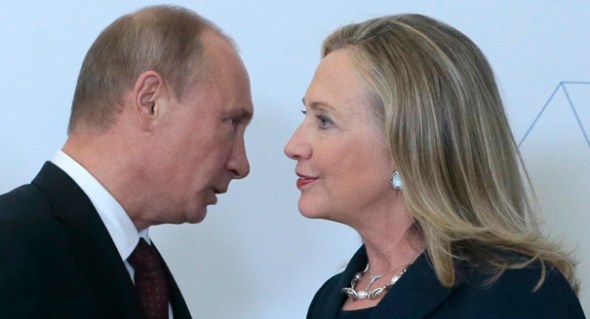
Good Morning!!
We’re close to two years away from the 2016 presidential primaries, but already the media is putting everything Hillary Clinton said or does under a microscope. I don’t know how I’m going to get through this. For some reason, I just can’t help being protective of Hillary even if I don’t agree with everything she says. The latest flap is over remarks she made about Vladimir Putin’s actions in Ukraine at a private fundraiser for the Boys and Girls Clubs of Long Beach, CA .
It began on Tuesday night when Buzzfeed’s Ruby Cramer reported what she learned from two people who attended the event: Hillary Clinton Compares Russia Moves To Nazi Aggression.
“Mrs. Clinton talked at length on the situation in the Ukraine,” said one attendee, Harry Saltzgaver, the executive editor of a group of newspapers in Long Beach.
Both Saltzgaver and a second fundraiser attendee, who requested to speak without attribution, described Clinton’s parallel between the actions of Russian President Vladimir Putin and Adolf Hitler, who resettled tens of thousands of ethnic Germans in Eastern and Central Europe to Nazi Germany before the war.
“She compared issuing Russian passports to Ukrainians with ties to Russia with early actions by Nazi Germany before Hitler began invading neighboring countries,” Saltzgaver said. “She said, however, that while that makes people nervous, there is no indication that Putin is as irrational as the instigator of World War II.”
A reporter also provided Cramer with direct quotes:
According to the Long Beach Press Telegram, whose reporter attended the event, Clinton told attendees, “Now if this sounds familiar, it’s what Hitler did back in the 30s,” she said. “All the Germans that were … the ethnic Germans, the Germans by ancestry who were in places like Czechoslovakia and Romania and other places, Hitler kept saying they’re not being treated right. I must go and protect my people and that’s what’s gotten everybody so nervous.”
Oh no! Clinton breaks Godwin’s law! Suddenly there was a stampede to be the first to criticize her for invoking Hitler. I mean, how dare she? She’s only the former Secretary of State and a possible candidate for president in 2016.
Philip Rucker at the WaPo: Hillary Clinton’s Putin-Hitler comments draw rebukes as she wades into Ukraine conflict.
Hillary Rodham Clinton has sparked a political uproar this week by wading into the middle of the ongoing conflict in Ukraine, likening the moves of Russian President Vladimir Putin to the actions of Nazi dictator Adolf Hitler leading up to World War II.
The former secretary of state’s provocative comparison drew swift rebukes Wednesday from U.S.-Russia policy experts — including some who served under her husband, former president Bill Clinton — while attracting rare notes of support from hawkish Republicans in Congress.
The comments put Clinton, a possible 2016 presidential candidate, at odds with President Obama and her former administration colleagues, who have been measured in their statements on Ukraine in hopes of avoiding an escalation of Putin’s incursion into Ukraine’s Crimean Peninsula.
Rucker quoted one “expert” who claimed Hillary was trying to take a “hard line” on Putin now because she had been “the face of the Obama administration’s “effort to “reset” its policy with Russia.”
Ian Bremmer, president of Eurasia Group, a nonpartisan global risk consulting firm, said Clinton’s Hitler comment signaled she was trying to “stage manage” the Russia issue.
“Hillary’s too smart to actually believe that Putin’s actions are remotely close to anything that Hitler did,” Bremmer said. “The only reason she would say that is that she believes she was vulnerable in having been the architect of the failed ‘reset’ and wants to show that she’s harder-line than anybody else.”
But former Russian Ambassador Michael McFaul disagreed.
He said Clinton was “much more skeptical” of Putin than other administration colleagues, that she was the first U.S. official to condemn Putin’s disputed 2011 election, and that she made a point of meeting with civil-society critics during official visits to Russia.
Buzzfeed’s Andrew Kaczinski followed up on his colleague’s reporting with a clarification from Hillary in a report on her appearance at at UCLA yesterday.
“The claims by President Putin and other Russians that they had to go into Crimea and maybe further into Eastern Ukraine because they had protect the Russia minorities,” Clinton said Wednesday, “that is reminiscent of claims that were made back in the 1930s when Germany under the Nazis kept talking about how they had to protect German minorities in Poland, in Czechoslovakia, and elsewhere throughout Europe. So I just want everybody to have a little historic perspective. I’m not making a comparison certainly, but I am recommending that we perhaps can learn from this tactic that has been used before.”
Clinton also assessed Putin’s personality, based on her personal experience:
“As for President Putin, I know we are dealing with a tough guy with a thin skin,” Clinton said. “I’ve had a lot of experience — well, not only with him but with people like that — but in particular with President Putin. I know that his political vision is of a greater Russia.”
“I support the administration’s call for Russia to respect its obligation and to refrain from the threat or use of force against the territorial integrity of Ukraine,” Clinton added.
Still, at CNN last night Timothy Stanley chided Hillary for “raising the specter of another world war.” Sorry, but isn’t Putin the one doing that? A couple more reactions:
LA Times: Hillary Clinton highlights pragmatism in approach to Russia
Hillary Rodham Clinton defended her record as secretary of State against Republican criticism that she had been too accommodating to Russia, arguing Wednesday that she had taken a tough but pragmatic approach so the U.S. could attain its goals.
In remarks at UCLA’s Royce Hall, Clinton assertively brushed aside opponents’ suggestions that she and the Obama administration effectively invited Russian President Vladimir Putin‘s recent incursion into Ukraine by failing to blunt his aggression.
Clinton said that when she became secretary of State in 2009, “we had some business we wanted to get done with Russia.” Among the U.S. goals at the time: an arms control agreement, the creation of a pathway through Russia to provide support for U.S. troops in Afghanistan, and an effort to get Russia into the World Trade Organization.
“There is a debate in foreign policy, and you hear these voices on TV right now: ‘These are bad folks; they’re doing bad things; do nothing with them,'” Clinton said, adding that her approach was to “be smart about it; pick and choose; stand your ground on disagreements, but look for ways to get things done.”
Pointing to the administration’s accomplishments, Clinton said that the U.S. “even got [Russia] to support sanctions against Iran in the [U.N.] Security Council — something people predicted we couldn’t get done.”
NYT The Caucus Blog: Clinton Ratchets Up Criticism of Putin and Backs Obama.
Hillary Rodham Clinton continued her sharp condemnation of Russian President Vladamir V. Putin here on Wednesday, calling him “a tough guy with a thin skin” and saying she supports the Obama administration’s call for Russia to resist further intervention in neighboring Ukraine.
“His political vision is of a greater Russia. I said when I was still secretary that his goal is to re-Sovietize Russia’s periphery,” Mrs. Clinton said at the top of remarks she delivered at the University of California. In the process, she said, Mr. Putin is “squandering the potential of such a great nation. The nation of Russia.”
I think Hillary handled herself pretty well, and I agree with her tough approach to Putin. Let’s not forget that Putin has Edward Snowden and all his stolen secrets. As former NASA analyst John Schindler tweeted yesterday,
“As crisis mounts and war looms, I hope US and NATO have excellent intelligence on Russia. Too bad #Snowden compromised all that SIGINT…”
Just one last article on the crisis in Ukraine, this time from the Russian standpoint and it shows the need for Western leaders to take clear stands. From the Moscow Times: Why There Will Be War in Ukraine. Author Sergei Markov of The Institute of Political Studies argues that the current leadership in Ukraine is anti-Russian and will intimidate Russian speakers living in the country. He predicts this could eventually lead to efforts to overthrow Putin in Russia.
After that, Kiev may evict Russia’s Black Sea Fleet from Sevastopol and purge Crimea of any Russian influence. Ukraine could easily become a radicalized, anti-Russian state, at which point Kiev will fabricate a pretext to justify taking subversive action against Moscow. This looks especially likely considering that ruling coalition members from the neo-fascist Svoboda and Right Sector parties have already made territorial claims against Russia. They could easily send their army of activists to Russia to join local separatists and foment rebellion in the North Caucasus and other unstable regions in Russia. In addition, Russia’s opposition movement will surely want to use the successful experience and technology of the Euromaidan protests and, with the help and financial support of the West, try to carry out their own revolution in Moscow. The goal: to remove President Vladimir Putin from power and install a puppet leadership that will sell Russia’s strategic interests out to the West in the same way former President Boris Yeltsin did in the 1990s….
Markov too breaks Godwin’s law:
Putin made the right decision: He did not to wait for that attack and took preventative measures. Many in the West say the Kremlin’s reactions were paranoiac, but Germany’s Jews also thought the same of leaving the country in 1934. Most of them chose to believe they were safe and remained in Germany even after Hitler came to power. The infamous Kristallnacht took place five years later, one of the first early chapters in the “Final Solution.” Similarly, just four years remain until Russia’s presidential election in 2018, and there is a strong risk that subversive forces within and outside Russia will try to overthrow Putin, in part using their new foothold in Ukraine.
Will there be war in Ukraine? I am afraid so. After all, the extremists who seized power in Kiev want to see a bloodbath. Only fear for their own lives might stop them from inciting such a conflict. Russia is prepared to move its forces into southern and eastern Ukraine if repressive measures are used against the Russian-speaking population or if a military intervention occurs. Russia will not annex Crimea. It has enough territory already. At the same time, however, it will also not stand by passively while Russophobic and neo-Nazi gangs hold the people of Crimea, Kharkiv and Donetsk at their mercy.
Yikes!
So . . . what do you think? And what other stories are you following today? Please share your links in the comments. I have few I’ll post there too.
Tuesday Reads: Russia and Ukraine, Obama the Weak Dictator, and Fat Tuesday
Posted: March 4, 2014 Filed under: Barack Obama, Foreign Affairs, morning reads, U.S. Politics | Tags: Bacon with a side of hand gun, Crimea, fat tuesday, mardi gras, New Orleans, Russia, Ukraine, Vladimir Putin 59 Comments
How Europeans picture an American breakfast
Good Morning!!
I saw this photo on Twitter yesterday, and I couldn’t resist sharing it. The comments were pretty funny too. Several people noted that the gun goes on the left; others said the gun should be turned over for quicker access if needed. Others said the bacon was just right but there should be a couple more eggs and some doughnuts.
I feel like I’m writing for an exclusive group this morning; we seem to have lost a lot of our regular commenters over the past week or so. I hope it wasn’t something I said.
Maybe it’s just that we’ve reached the dregs of a very long and exhausting winter. I must admit that yesterday I was selfishly relieved to see a nasty storm coming across the country that didn’t involve the Boston area. Nevertheless, I know it did affect places where we have readers, and I am well aware of how very depressing and tiring it can feel when the snow, ice, and cold just won’t quit.
The political news isn’t exactly cheery either–It’s mostly endless civil wars in the Middle East accompanied by the one here at home in the Republican Party; constant attacks on President Obama for being either too wimpy and weak or a vicious, drone dropping, privacy-invading dictator; and the press digging up old Clinton smears in preparation for Hillary running for President in 2016.
Right now, the main focus is on the events in Ukraine–Syria and Egypt are all but forgotten by “journalists” who seem unable to focus on more than one story at a time. Somehow, they never fail to find a way to blame everything on Obama though, no matter what crisis they are reporting.
Even Dana Millbank, who often judges Obama harshly has noticed: Obama, the feckless tyrant.
President Obama is such a weak strongman. What’s more, he is a feeble dictator and a timid tyrant.
That, at any rate, is Republicans’ critique of him. With Russia’s invasion of Ukraine, Obama’s critics pivoted seamlessly from complaining about his overreach to fretting that he is being too cautious. Call it Operation Oxymoron.
Last Wednesday, I sat in a House hearing and listened to Republicans describe Obama exercising “unparalleled use of executive power” and operating an “uber-presidency.” They accused him of acting like a “king” and a “monarch,” of making the United States like a “dictatorship” or a “totalitarian government” by exercising “imperial” and “magisterial power.”
But after events in Ukraine, this very tyrant was said to be so weak that it’s “shocking.”
“We have a weak and indecisive president that invites aggression,” Sen. Lindsey Graham (R-S.C.) proclaimed Sunday on CNN.
Sen. John McCain (R-Ariz.) told the annual gathering of the American Israel Public Affairs Committee on Monday that Obama has “a feckless foreign policy where nobody believes in America’s strength anymore.”
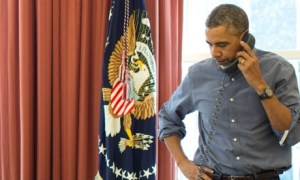
For once Millbank, the ultimate Villager, hit the nail on the head. On Twitter over the last few days, I’ve even seen people complaining about the White House photo of Obama in shirtsleeves talking on the phone to Putin, because it supposedly shows how weak and unprofessional Obama is.
Michael Cohen at the Guardian has it right, IMO : Don’t listen to Obama’s Ukraine critics: he’s not ‘losing’ – and it’s not his fight.
In the days since Vladimir Putin sent Russian troops into the Crimea, it has been amateur hour back in Washington.
I don’t mean Barack Obama. He’s doing pretty much everything he can, with what are a very limited set of policy options at his disposal. No, I’m talking about the people who won’t stop weighing in on Obama’s lack of “action” in the Ukraine. Indeed, the sea of foreign policy punditry – already shark-infested – has reached new lows in fear-mongering, exaggerated doom-saying and a stunning inability to place global events in any rational historical context.
This would be a useful moment for Americans to have informed reporters, scholars and leaders explaining a crisis rapidly unfolding half a world away. Instead, we’ve already got all the usual suspect arguments.
Cohen offers a number of examples:
Personality-driven Analysis
Let’s start here with Julia Ioffe of the New Republic, a popular former reporter in Moscow who now tells us that Putin has sent troops into Crimea “because he can. That’s it, that’s all you need to know”. It’s as if things like regional interests, spheres of influence, geopolitics, coercive diplomacy and the potential loss of a key ally in Kiev (as well as miscalculation) are alien concepts for Russian leaders.
Overstated Rhetoric Shorn of Political Context
David Kramer, president of Freedom House, hit the ball out of the park on this front when he hyperbolically declared that Obama’s response to Putin’s actions “will define his two terms in office” and “the future of U.S. standing in the world”.
Honorable mention goes to Ian Bremmer of Eurasia Group for calling this crisis “the most seismic geopolitical events since 9/11”. Putting aside the Iraq and Afghanistan wars, the Arab Spring, Syria’s civil war and tensions in the South China Sea, Bremmer might have a point.
Unhelpful Policy Recommendations
Admiral James Stavridis, former Supreme Commander of Nato, deserves a shout-out for calling on Nato to send maritime forces into the Black Sea, among other inflammatory steps. No danger of miscalculation or unnecessary provocation there. No, none at all.
Much more panicky heavy breathing at the link. Does anyone in Washington recall what happened when George W. Bush was president and Russia attacked Georgia?
Here’s a great example of Obama-blaming at Politico. Their top “morning brief” is DoD suspends military relationship with Russia
The Pentagon is putting on hold its military-to-military relationship with Russia over its incursion into Ukraine’s Crimean peninsula, according to Press Secretary Rear Adm. John Kirby. “We have, in light of recent events in Ukraine, put on hold all military-to-military engagements between the United States and Russia,” Kirby said in a statement last night. “This includes exercises, bilateral meetings, port visits and planning conferences.”
Kirby also said there’s been “no change” in U.S. military posture in Europe or the Mediterranean, despite speculation in the news media about possible ship movements. “Navy units continue to conduct routine, previously planned operations and exercises with allies and partners in the region,” he said.
But apparently the Politico gang doesn’t see how that new could relate to President Obama, the Commander In Chief of our armed forces. Here’s what they say about Obama in the same “morning brief.”
AT THE WHITE HOUSE, the big question is whether President Barack Obama has what it takes to unite Europe behind a package of sanctions that would, in his words, “isolate Russia.”
Because Obama has no balls, get it?
Sigh . . .
At Time Magazine, Simon Shuster notes that Putin is also being judged harshly at home, despite the efforts of the Kremlin-controlled media: 4 Reasons Putin Is Already Losing in Ukraine.
At home, this intervention looks to be one of the most unpopular decisions Putin has ever made. The Kremlin’s own pollster released a survey on Monday that showed 73% of Russians reject it. In phrasing its question posed in early February to 1,600 respondents across the country, the state-funded sociologists at WCIOM were clearly trying to get as much support for the intervention as possible: “Should Russia react to the overthrow of the legally elected authorities in Ukraine?” they asked. Only 15% said yes — hardly a national consensus.
That seems astounding in light of all the brainwashing Russians have faced on the issue of Ukraine. For weeks, the Kremlin’s effective monopoly on television news has been sounding the alarm over Ukraine. Its revolution, they claimed, is the result of an American alliance with Nazis intended to weaken Russia. And still, nearly three-quarters of the population oppose a Russian “reaction” of any kind, let alone a Russian military occupation like they are now watching unfold in Crimea. The 2008 invasion of Georgia had much broader support, because Georgia is not Ukraine. Ukraine is a nation of Slavs with deep cultural and historical ties to Russia. Most Russians have at least some family or friends living in Ukraine, and the idea of a fratricidal war between the two largest Slavic nations in the world evokes a kind of horror that no Kremlin whitewash can calm.
Indeed, Monday’s survey suggests that the influence of Putin’s television channels is breaking down. The blatant misinformation and demagoguery on Russian television coverage of Ukraine seems to have pushed Russians to go online for their information. And as for those who still have no Internet connection, they could simply have picked up the phone and called their panicked friends and relatives in Ukraine.
And at Quartz: The markets are punishing Russia more swiftly than diplomats ever could.
Strongly worded statements, threats of travel restrictions, and summit no-shows. So far, these are the relatively mild diplomatic implications for Russia of itsincursion into Ukraine, as few in the West can stomach an open military confrontation with Moscow over its apparent occupation of Crimea.
But the markets are punishing Russia much more swiftly than the diplomats. A wide range of Russian assets—stocks, bonds, and the ruble—plunged in value today. To shore up the ruble, which is plumbing record depths, Russia’s central bank unexpectedly hiked interest rates today. It ratcheted up the benchmark one-week rate from 5.5% to 7%, and traders report that the central bank has also been spending billions of dollars in currency markets to stem the fall in the value of the ruble.The two main Moscow stock markets, the Micex and the RTS, have fallen by more than 10% at the time of writing, in a broad-based selloff. Big Russian companies like Gazprom and Sberbank saw their share prices plunge as traders dumped their shares.

King Cake
Is there any other political news? Not much to speak of, so I’m just about to wrap this up. But first, today is Fat Tuesday and, despite the bad weather Mardi Gras is going forward in New Orleans. From ABC News: Cold, Gray Morning Won’t Stop Mardi Gras Revelers.
A cold, gray day greeted revelers gathering Tuesday along parade routes as the Carnival season in New Orleans headed to a crest with the unabashed celebration of Mardi Gras.
The first street marching groups — including clarinetist Pete Fountain’s Half-Fast Walking Club — were to begin their marches along oak-lined St. Charles Avenue and into the business district. Later, the floats of the Zulu and Rex parades and hundreds of truck trailers decorated by family and social groups would wind down St. Charles Avenue.
Light rain began to fall early in the morning, but revelers were still expected to gather by the tens of thousands in the French Quarter, where the bawdy side of Mardi Gras was expected to be on full display.
Mark Nelson of St. Louis said he would be in the mix even in a downpour. It’s his first Mardi Gras.
“That’s why God made washing machines,” said Nelson, who was sipping on a daiquiri as he enjoyed the sounds of trumpeter Kermit Ruffins and the Barbecue Swingers, who performed at the Lundi Gras festivities Monday along the Mississippi River.
For those of us who can’t get down to NOLA, the LA Times offers Mardi Gras: Celebrate with king cake and 16 additional recipes!
So . . . what’s on your mind today? Please let us know in the comments. We want to hear from you!

Monday Reads: A Game of Thrones
Posted: March 3, 2014 Filed under: morning reads 50 Comments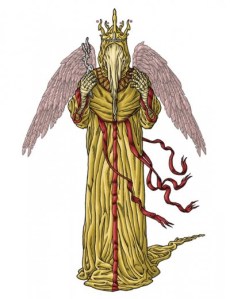 Good Morning!
I’ve been watching two HBO series recently as well as doing my usual reading of the latest news. I’ve sensed a theme. I’m not sure if it’s because it’s what I’m fascinated with, drawn to, or surround by in this existence. But, every where I look I see power brokers and money and ultimately war and violence against mostly the poor, women, and children. This is true in the worlds of True Detective and Game of Thrones which are fiction but appear to be loosely based on the corrupt mess of politics and religion in Louisiana and the nastiness of England’s War of the Roses respectively. It’s also true if you look around.
Grabbing power and vast wealth takes money, cunning, and the naked willingness to do anything to further one’s fortunes. Every one else be damned! I looked for news for the morning post and it appears that fiction does indeed mimic real life because the same threads of deceit and power grabbing rule the headlines too. Evil power brokers and tyrants looking for more territory don’t only exist in the pages of literature and the visuals of cinema. They also don’t just haunt the pages of medieval history or swampy, backwards Louisiana. The desire to corrupt the corruptible for personal gain is every where.
“People are really drawn to the Koch model,” said Anthony Scaramucci, a New York hedge fund investor and Republican fund-raiser, who attended the Kochs’ annual donor conference near Palm Springs, Calif., in January. “It’s adaptive, data-driven, and they are the most propitious capital allocators in political activism.”
The quiet revolt signals a broader shift in the world of big money. Clubs of elite donors in both parties are taking a more central role in shaping policy and campaigns, displacing party leaders and the outside-spending organizations they helped create after the Supreme Court’s Citizens United decision in 2010. And the sheer scale of their spending is almost certain to rewrite the playbook for political campaigns this year, as candidates reckon with the strongly held views of some of the world’s wealthiest people.
The phenomenon is not limited to the right. Super PACs blessed by Democratic congressional leaders have posted strong fund-raising over the last year, bolstered by victories in 2012. But those organizations are now being overshadowed by donors like Tom Steyer, the billionaire who is raising a $100 million political fund with other wealthy environmentalists to battle politicians deemed hostile to climate regulation.
Parties have “lost the ability to control the process,” said Jim Nicholson, a former chairman of the Republican National Committee, partly because of legislation that cut the flow of money to party committees. “The party can’t coordinate with these super PACs and neither can the campaigns, so there’s a lot more chaos and disequilibrium in the campaigns. And the party structure clearly has a diminished role because they don’t have the resources they used to have.”
Rob Stein, a founder of the Democracy Alliance, one of the largest clubs of donors on the left, agreed.
“The devolution of the two-party system has begun,” Mr. Stein said. “Money is leaving the parties and going to independent expenditure groups. These now are fracturing the ‘big tents’ of our old two-party system into independent, narrow and well-funded wings.”

We’ve seen the Republican party struggle recently with so many factions that it has nearly made the country ungovernable. The powerful–who once thought that religious kooks were their pawns–are now looking to other means of addressing their greed and expansion needs. I’m watching Mary Landrieu be assaulted on TV by Koch Brothers money right now. There is not even a challenger at the moment although there are several very extremist congressmen hanging about in the wings. The point appears to be to remove the obstacles first. I’m not sure that they very much care about the overall results as long as the resulting chaos creates an environment where they can thrive without oversight and responsibility for the havoc they cause.
It’s also fascinating to watch Putin flex those old KGB muscles in the Crimea. The same teapots seem to brew endless tempests. Wow. Did the establishment media and analysts miss this one. They’d do a lot better spending time with reruns of Game of Thrones than sitting in their Georgetown condos discussing their talents for taking complex concepts and boiling them down to digestible and infinitely discussable bits of prose and sound bytes.
Nobody, including us, is infallible about the future. Giving the public your best thoughts about where things are headed is all a poor pundit (or government analyst) can do. But this massive intellectual breakdown has a lot to do with a common American mindset that is especially built into our intellectual and chattering classes. Well educated, successful and reasonably liberal minded Americans find it very hard to believe that other people actually see the world in different ways. They can see that Vladimir Putin is not a stupid man and that many of his Russian officials are sophisticated and seasoned observers of the world scene. American experts and academics assume that smart people everywhere must want the same things and reach the same conclusions about the way the world works.
How many times did foolishly confident American experts and officials come out with some variant of the phrase “We all share a common interest in a stable and prosperous Ukraine.” We may think that’s true, but Putin doesn’t.
We blame this in part on the absence of true intellectual and ideological diversity in so much of the academy, the policy world and the mainstream media. Most college kids at good schools today know many more people from different races and cultural groups than their grandparents did, but they are much less exposed to people who think outside the left-liberal box. How many faithful New York Times readers have no idea what American conservatives think, much less how Russian oligarchs do? Well bred and well read Americans live in an ideological and cultural cocoon and this makes them fatally slow to understand the very different motivations that animate actors ranging from the Tea Party to the Kremlin to, dare we say it, the Supreme Leader and Guide of the Islamic Republic of Iran.
As far as we can tell, the default assumption guiding our political leadership these days is that the people on the other side of the bargaining table (unless they are mindless Tea Party Republicans) are fundamentally reasonable people who see the world as we do, and are motivated by the same things that motivate us. Many people are, of course, guided by an outlook not all that dissimilar from the standard upper middle class gentry American set of progressive ideas. But some aren’t, and when worlds collide, trouble comes.
Too much of the Washington policy establishment looks around the world and sees only reflections of its own enlightened self. That’s natural and perhaps inevitable to some degree. The people who rise through the competitive bureaucracies of American academic, media and think tank life tend to be those who’ve most thoroughly absorbed and internalized the set of beliefs and behavioral norms that those institutions embody and respect. On the whole, those beliefs and norms have a lot going for them. It would not be an improvement if America’s elite institutions started to look more like their counterparts in Russia or Zimbabwe.
But while those ideas and beliefs help people rise through the machinery of the American power system, they can get in the way when it comes to understanding the motives and calculations of people like President Putin. The best of the journalists, think tankers and officials will profit from the Crimean policy fiasco and will never again be as smug or as blind as so much of Washington was last week. The mediocre majority will go on as before.
It seems power brokers do lose interest though. A few years ago, this skirmish was centermost on the minds of those folks getting their opiate on via the Oscars last night. There is just one more imperialist army left in the Afghanistan dirt. Russia has moved on from there. And, now, so do we. There is one more little outraged pawn exiting the global throne room.
In an unusually emotional interview, the departing Afghan president sought to explain why he has been such a harsh critic of the 12-year-old U.S. war effort here. He said he’s deeply troubled by all the casualties he has seen, including those in U.S. military operations. He feels betrayed by what he calls an insufficient U.S. focus on targeting Taliban sanctuaries in Pakistan. And he insists that public criticism was the only way to guarantee an American response to his concerns.
To Karzai, the war was not waged with his country’s interests in mind.
“Afghans died in a war that’s not ours,’ he said in the interview, his first in two years with a U.S. newspaper.
In Karzai’s mind, al-Qaeda is “more a myth than a reality” and the majority of the United States’ prisoners here were innocent. He’s certain that the war was “for the U.S. security and for the Western interest.”
Such statements elicit scorn and shock from U.S. officials, who point out that Americans have sacrificed mightily for Afghanistan — losing more than 2,000 lives and spending more than $600 billion in the effort to defeat al-Qaeda and the Taliban and rebuild the country.
So much hubris. So much detritus. So much power and money to be generated by fresh adventures. 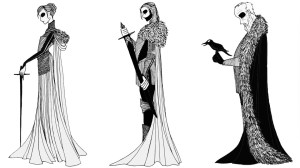
Let’s call it McDomination. It’s been a well thought out and highly financed war plan since the 1970s. Big Business and Power Brokers dislike all the little people taking to the streets about ecology and civil rights.
On August 23, 1971, Lewis Powell sent a confidential memo to his friend Eugene Sydnor, Jr., the director of the U.S. Chamber of Commerce. The memo was both a call to arms and a battle plan for a business response to its growing legion of opponents. Powell was a corporate lawyer, a former president of the American Bar Association, and a board member of eleven corporations, including Philip Morris and the Ethyl Corporation, a company that made the lead for leaded gasoline. Powell had also represented the Tobacco Institute, the research arm of the tobacco industry, and various tobacco companies. Later that year, President Richard Nixon would nominate Powell to sit on the U.S. Supreme Court, where he served for fifteen years.
Powell’s memo serves as a useful starting point for understanding how the transformation of the corporate system that began in the 1970s set the stage for today’s global health problems. “No thoughtful person can question that the American economic system is under broad attack,” wrote Powell. “The assault on the enterprise system is broadly based and consistently pursued. It is gaining momentum and converts.” “One of the bewildering paradoxes of our time,” Powell continued, “is the extent to which the enterprise system tolerates, if not participates in, its own destruction.” He enumerated the system’s enemies: well-meaning liberals, government officials intent on regulating business, news media, student activists, and an emerging environmental and consumer movement— especially its most visible leader, Ralph Nader, in Powell’s view “the single most effective antagonist of American business.”
Powell called on business, especially the Chamber of Commerce, to end its “appeasement” of its critics and launch an aggressive and systematic counter-assault. The memo warned that “independent and uncoordinated activity by individual corporations, as important as this is, will not be sufficient. Strength lies in organization, in careful long-range planning and implementation, in consistency of action over an indefinite period of years … and in the political power available only though united action and national organizations.”
Powell urged new, well-funded public media campaigns to support the free enterprise system, the creation of think tanks and institutes to develop policy proposals and “direct political action” in legislative and judicial arenas. “It is time,” he argued, for “American business … to apply their great talents vigorously to the preservation of the system itself.” Powell’s “confidential” memo was first circulated within the Chamber of Commerce, then released in 1972 by investigative reporter Jack Anderson during the Powell Supreme Court confirmation hearings. While the document may not have been the blueprint for the rise of the Republican right that some analysts claim, its real value is as the articulation of the corporate prescription for capitalism’s ills.
Today, more than forty years after business took up Powell’s appeal, its success in achieving the goals he laid out makes it hard to fathom the depth of his concern.
A new fresh hell from the minds and money of Putin, Charles Koch, Ted Cruz, Henry Kissinger and Richard II . Perhaps I should be watching less dark fiction and I’d be less prone to pick up the similarities.
What’s on your reading and blogging list today.
Lazy Saturday Reads: Weather, Spring Fever, Boston Bombing, Ukraine, and True Detective Spoilers
Posted: March 1, 2014 Filed under: Barack Obama, Foreign Affairs, morning reads | Tags: baseball, Boston Marathon bombings, Boston Red Sox, Carcosa, Cold War, Crimea, death penalty, Dzhokhar Tsarnaev, FBI abuses, Ibragim Todashev, spoilers, spring training, Tamerlan Tsarnaev, True Detective, Ukraine, Vladimir Putin, Yellow King 14 Comments
It’s Saturday!!
Another snowstorm is coming, but it’s not yet clear how bad it will be or how much snow will fall in which areas. From the Weather Channel: Ice Storm Possible for Mississippi Valley, Ohio Valley; Snowstorm for West, Midwest, Northeast.
After a brief reprieve from blockbuster winter storms in the Midwest and East – and a much-too-lengthy reprieve in California – Winter Storm Titan is will lay down a swath of heavy snow from California to the East Coast, and also a swath of sleet and freezing rain from the Plains to the Mid-Atlantic States.
- Saturday: The main event east of the Rockies will begin to unfold as snow spreads east across portions of the Plains, Upper Midwest and Great Lakes. For parts of the Northern Rockies, this will just be a continuation of snow from the previous, weaker disturbance. Widespread snow is likely across Wyoming, but will gradually wind down over western and southern Montana. Farther south the snow will be more tied to higher elevations. (See inset map for details.)
- Sunday: The more significant part of Winter Storm Titan begins with snow, sleet and freezing rain becoming heavier. A stripe of significant ice accumulation is likely Sunday and Sunday night from the Ozarks through into the Mid-South region, Ohio Valley and West Virginia with snow farther north from the central Plains into the mid-Mississippi Valley and Ohio Valley. These threats spread into the Mid-Atlantic and Northeast Sunday afternoon and night.
- Monday: Snow/sleet tapers off in the Ohio Valley Appalachians, but should linger in the Appalachians and along parts of the I-95 Northeast corridor much of the day, before ending off in the evening. Ice/sleet areas early in the day in the Mid-Atlantic states should changeover to snow Monday morning.

Whatever. Winter is almost over. It’s March 1, and there are signs of spring–at least down at Fenway South in Ft. Myers, Florida (and many other spring training locations). Yesterday the Red Sox played their first Grapefruit League game against the Minnesota Twins, losing 8-2. But who cares? A hot new pitching prospect shut down the Twins for two innings, striking out four–a good sign for the upcoming season. Baseball is back, opening day is a little over a month away, and that means spring is coming!
OK, I know I’m being really provincial, but I’ll bet you’re seeing signs of Spring too. What is giving you hope for the end of this long, cold winter? Even the folks down south have suffered greatly this year.
One more Boston story. The FBI is claiming that accused Boston bomber Dzhohar Tsarnaev “made a damaging statement” in a visit with one of his sisters recently. Of course they won’t even give a hint as to what he said, so I don’t know what to make of it. The Boston Globe:
The filing said that Tsarnaev, despite the presence of the agent, who was legally allowed in the room, “was unable to temper his remarks and made a statement to his detriment which was overheard by the agent.”
The filing did not say what the statement was.
The filing was made as part of an ongoing battle between the prosecution and defense over special administrative measures, special prison restrictions, that have been imposed on Tsarnaev.
The defense says the prosecution is refusing to turn over information they need and that the FBI is monitoring their meetings with Tsarnaev and preventing them from developing their defense strategy. I think the feds need to keep in mind that they will have a Massachusetts jury–very few people here support the death penalty, and most potential jurors will be troubled by FBI efforts that might prevent a fair trial. After all, we just recently went through the Whitey Bulger trial, in which we heard endless tales of FBI abuses and we’re still waiting for an explanation as to why an agent from the Boston office shot Ibragim Todashev down in Orlando last May.
We’re coming up on the 2014 Boston Marathon, and we still have almost no explanations of what really happened during the Marathon bombing and the shootout in Watertown a few days later. And then there’s the Waltham triple murder, which the FBI is trying to pin on two dead guys–Tamerlan Tsarnaev and Ibrigim Todashev. Susan Zalkind summed up many of the questions in this month’s Boston Magazine coverstory: The Murders Before the Marathon. There wasn’t a whole lot of breaking news in the article, but it’s a very good summary of events so far.
There’s a lot happening in Ukraine. I’ll just give you a couple of links to check out, because I’m not qualified to comment on the situation–other than I’m sick of everyone expecting the U.S. to get involved in every crisis.
The latest from ABC News: Putin Asks Parliament to Use Military in Ukraine
Russian President Vladimir Putin asked parliament Saturday for permission to use the country’s military in Ukraine, moving to formalize what Ukrainian officials described as an ongoing deployment of Russian troops in the strategic region of Crimea.
Putin’s motion loosely refers to the “territory of Ukraine” rather than specifically to Crimea, raising the possibility that Moscow could use military force in other Russian-speaking provinces in eastern and southern Ukraine where many oppose the new authorities in Kiev….
He said the move is needed to protect ethnic Russians and the personnel of a Russian military base in Ukraine’s strategic region of Crimea. Putin sent the request to the Russian legislature’s upper house, which has to approve the motion, according to the constitution. The rubber-stamp parliament is certain to approve it in a vote expected Saturday.
In Crimea, the pro-Russian regional prime minister had earlier claimed control of the military and police there and asked Putin for help in keeping peace, sharpening the discord between the two neighboring Slavic countries.

President Obama warned yesterday that there would consequences for military intervention in Ukraine, but he didn’t specify any actions he would take. At this point, I think these warnings are just being ignored, because there is seldom any follow-up. As I said earlier, I don’t want to get involved in any more foreign conflicts. Let Europe deal with it if they want to. We have plenty of problems here at home that require government action.
From Reuters: West voices alarm on Crimea, calls on Russia to respect Ukraine sovereignty.
A week after violent protests forced Russian-backed President Viktor Yanukovich to abandon power in Kiev, Ukraine’s new leaders say Russia is trying to take control of the southern Crimea region, which has a majority ethnic Russian population.
France, Britain and Germany issued calls for de-escalation in Crimea hours after U.S. President Barack Obama warned that military intervention in the region would be deeply destabilizing and “carry costs”.
“France is extremely concerned by the reports from Crimea, which describe significant troop movements,” French Foreign Minister Laurent Fabius said in a statement. “We call on the parties to abstain from acts that could raise tensions and affect Ukraine’s territorial unity.”
It does appear that Putin is intent on reviving the Cold War. I hope he’s not successful.
Tomorrow night we’ll get an other episode of True Detective–there are only two to go. I gathered a bunch more links in the past couple of days. Some of them have spoilers, so be careful.
This is an older post, but it provides some very good background on the weird aspects of the story. From Grantland’s Molly Lambert, Carcosa or Bust: The Satisfyingly Weird Mysteries of ‘True Detective’. Just a taste:
Hallucinatory spirals, talk of “black stars” rising in the sky, dead women trussed up like ancient horned gods and tattooed with mysterious symbols, all supposedly in reference to Robert W. Chambers’s fairly obscure weird fiction classic The King in Yellow? Damn, True Detective, you’ve given me a lot to absorb.
Where is the show going with its recently clarified Lovecraftian ties? Does it even really matter, when the ride is this great? The most satisfying part of a mystery is rarely its resolution. Sustained anticipation is much of the thrill. Like earlier TV mysteries Twin Peaks, The X-Files, and Lost, True Detective is a show with its own internal mythology, which taunts both the protagonists and viewers with signs just beyond our comprehension. When some bits of information are guaranteed to be important later, every single bit of information feels like a potential clue. Attempting to read a show scene by scene and pluck out exactly what will prove crucial from a galaxy of visual and verbal details can feel absolutely maddening….
You can spend endless amounts of time pondering True Detective’s more concrete questions, let alone the existential ones. Are the wooden triangles strewn around the sites of the ritualistic murders pagan symbols, bird traps, or neither? Given creator Nic Pizzolatto’s professed affection for weird fiction, were Reggie Ledoux’s gas mask and the reference to a “green-eared spaghetti monster” meant to invoke Cthulhu, the giant octopus monster that signals cosmic doom in the work of seminal horror writer H.P. Lovecraft? Is the mystery even going to get solved?True Detective’s flashback structure accentuates the gaps in our knowledge. Everything we know is gleaned from flashbacks and interrogations, but there’s no guarantee that future information won’t flip our perspective. Hell, there’s no guarantee that Rust and Marty’s flashbacks are accurate. After all, if we can see Rust’s subjective hallucination of birds assembling into a spiral in the sky, who’s to say we’re not seeing other events from his subjective perspective too? This kind of theorizing, not baseless but impossible to prove conclusively, will make you feel like True Detective’s detectives. Maybe the show’s obsessions with madness, reality, and truth really are contagious.

Then read Lamberts latest post: Five Things to Consider for This Week’s Episode of ‘True Detective’. She has some good questions.
A guy at Reddit did some sleuthing and came up with some photos posted by True Detective crew members. Here’s a link to a lot of photos, some from the upcoming episodes. I looked at them, and got some sense of what’s coming, but not much more than I got from the teaser trailer. They didn’t ruin the suspense for me. Just be warned if you want to stay completely in the dark.
A few more links to explore as we wait for tomorrow night to roll around:
Rolling Stone: The Dark Thrills of ‘True Detective’
Forbes: The Business Of HBO’s ‘True Detective’
Slate: The True DetectiveGlossary
Complex Pop Culture: Pictures of You: “True Detective” and the Dilemma of the Dead Woman’s Photograph
International Business Times: ‘True Detective’ Season 1 Spoilers: What’s On The Video Tape In Episode 7? Theories On Hart’s Daughter And Connection To The Yellow King

 peej
peej Carissa
 bostonboomer
 dakinikat
 ecocatwoman
 mablue2
 Mama Lopez
 peggysue22
 quixote
 skydancingguestblogger
 Mona (aka Wonk the Vote)



 Sky Dancing
Recent Comments