
MTP: Jindal’s Pants catch fire & melt Dancin’ Dave’s Disco Ball
Posted: February 24, 2013 Filed under: Bobby Jindal | Tags: ALEC, Bobby Jindal, Meet the Press 28 Comments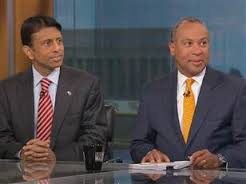 Bobby Jindal got the first word on the budget sequester this morning on MTP. His “reasonable” face to the nation is no where near his record as Louisiana’s worst Governor Ever. He was basically there to state how easy it is to cut government spending and taxes since he’d done such a bang-up job of it in Louisiana. As usual, Jindal was whistling Dixie out of his bony, malignantly narcissistic ass. Let me demonstrate Jindal Budgeting Tricks 101 for those in the national media that will NEVER actually do any research on these hideous and false claims.
Some national press figure should do some homework on what Jindal’s done to the budget in Louisiana and the dishonest, destructive, and unconstitutional ways that he’s found to “balance” it. His budget director more than fessed up last week to the fact that he’s cut state services beyond the point where basic needs met by the state will go unmet. This includes the State Patrol which I would assume even Republicans find a necessary expenditure and service. That’s not preventing him from going on national TV and telling a completely different story about how easy it is to find fat in budgets. This information is succinctly put by Stephan Winham writing for The Louisiana Voice. Mr. Winham should know. He’s the now retired State Budget Director. This year’s Jindal Budget will go beyond hurting the state and selling off state assets to potential corporate donors to his presidential campaign. Please, some one stop him before he kills again.
The governor is happy to tout his refusal to increase state taxes. He is also happy to talk about his successes in reducing the size of government and refusal of additional federal support. He is very direct, if not necessarily consistent, when it comes to holding the line on these things. Although there is no second half to his current plan to eliminate income and franchise taxes, he assures us that, if he actually ever presents a proposal for the other side of the equation, it will be income neutral.
If Nichols’ testimony is to be taken at face value, we can only assume it is not possible to maintain critical services with our current level of recurring revenue. So far, the governor’s approach to reducing state government has been to gradually strangle it through continued submission of unrealistic budgets intended to give the impression everything is okay. The legislators adopt these proposals and congratulate themselves on another successful year.
In reality, everything is not okay. The governor knows it. Ms. Nichols knows it. The legislators interested enough to pay attention know it. As long as projected revenues from reliable, stable sources do not equal projected necessary expenditures, things will NEVER be okay. Governor Jindal has not submitted, nor has the legislature adopted, such a budget during his entire administration. This is proven by the mid-year cuts that are always necessary in adopted yearly budgets and the never-ending projections of deep holes for every future year.
Governor Jindal has been quoted repeatedly in the national press saying we all have to learn to live within our means. If he really believes this, why does he not present budgets that allow the state of Louisiana to do so? I think Ms. Nichols has made the answer quite clear – because we simply cannot live the way we want to within our present means. Presenting a truly balanced budget would result in an outcry from even the staunchest fiscal conservatives who would immediately begin to cry, “Why don’t you cut the fat, not the meat?” They would never accept there isn’t enough fat left to leave the meat alone.
This year, Jindal’s budget relies heavily on selling off LSU’s hospitals. It’s just a matter of time before our Tier 1 school loses  its accreditation and the med school’s standing is jeopardized. The hospital in Monroe that serves some of the poorest folks in the state can’t find a buyer and will most likely just be shut down.
The budget cuts about $780.6 million from those programs on the assumption that all but two of the state’s 10 public hospitals will be privatized. So far, only five of those hospitals have announced plans for partnerships with private companies, and none of those proposals has been finalized.
Sen. Francis Thompson, D-Delhi, described the public hospital situation bluntly as he questioned Nichols about the process Friday. “Public hospitals are gone after this budget,” Thompson said. “Don’t exist. Over. Finished.”
Thompson’s concerns focused on E.A. Conway Medical Center in Monroe. No private company has been identified as a possible partner for it, and the budget does not include enough money to operate the center for 12 months. Thompson said the center cares for some of the poorest residents in the state.
That’s not all of the last drops of the safety net programs that are on the table. Plus, every year since Jindal’s taken offce, the budget estimates have been far rosier than occurs, so midbudget year slashes have been necessary. I lived through those at both UNO and at SELU when I was there. Let me just say I’m glad to be teaching at a private institution while living here. It gets harder to justify staying here in Louisiana every year. The kids graduated LSU and bolted. Thanks goodness Jean went to med school and is doing her residency in Nebraska. I love New Orleans and my little Bywater gem, but it’s hard to see much of a future in a state that’s been gutted of assets to appease Republican political donors. As an economist, I know that it’s going to take a good decade to get over the impact from that kind of loss of infrastructure alone. State expenditures now include running the same functions with an added layer of payments for corporate inefficiencies, executive bonuses, and lush corporate profits and dividends. I can’t wait until he starts selling off the state parks next year and all of our arenas and stadiums. I’m assuming that some of the universities will collapse completely too and be auctioned off for some obscene use. That’s about all we have left now. I’m also assuming he’s got his eye on that BP money. He ran through a lot of the Katrina/FEMA money during his first year or so. We simply aren’t using sustainable sources of revenue.
Here’s some more things on the table.
The budget also cuts funding for the Early Steps program, which provides therapy to developmentally disabled children under the age of 3. It proposes to make up the shortfall by charging some participants in the program.
Families that make more than 250 percent of the federal poverty line, or about $57,000 for a family of four, would have to pay for Early Steps on a sliding scale depending on their income, Greenstein said. About half of the 9,400 children who participate in the program each year belong to families that would be affected by the change.
The revised rules, which are expected to save the state about $1.7 million, would require the passage of new legislation before they could go into effect. Officials have not yet worked out exactly how much families will pay, Greenstein said.
The department is also planning to move pregnant women who are now receiving care through Medicaid into a program set up under the federal Affordable Care Act, also known as Obamacare, that provides subsidized health insurance.
Here’s additional cuts in the budgets for the State Police and higher education.
Jindal and other administration officials have noted that if the budget passes, about 26,000 state government jobs will have been shed since the governor took office five years ago.
Among the positions that will not be funded next year are 44 commissioned officers and 39 civilians in the State Police. The last new class of State Police cadets began training in the fall of 2008. When they graduated, there were 1,153 troopers in the force. That number has since fallen to 964 troopers.
State Police Superintendent Mike Edmonson said he’s been dealing with the loss of troopers by putting officers who formerly spent much of their time behind a desk, such as investigators, on the road and by hiring retired officers to work on a part-time basis during peak hours. He also credited increased cooperation with sheriffs’ offices and local police departments, as well as an effort to make troopers more of a visible presence on the road, for decreasing traffic fatalities.
The agency is looking for money for new troopers and hopes to be able to graduate a class by the end of 2014, Edmonson said. Nichols said there are no plans for a new cadet class in this year’s budget.
As you can see, a lot of Jindal’s budget cuts come from selling off state assets. These are one time occurrences so they only fill the holes for one year.
The state expects to make $47 million by selling six state properties, including a portion of the campus of Southeast Louisiana Hospital in Mandeville, which was privatized last year; office buildings in Baton Rouge; and a Department of Insurance property. The administration had intended to sell the Department of Insurance property last year and included that same anticipated money in last year’s budget.
Jindal has also diverted funds from other projects. Most people fear that he will divert funds from the BP oil settlement and RESTORE which are supposed to go to coastal restoration. Jindal’s budget revenue tricks are short term while his guts in public services and taxes are permanent. I can’t imagine any one would want to be governor following these steps. This is basically a short term plan to shore up his presidential appeal to right wing, tea party nuts. The state will suffer for decades as it tries to unwind the damage. Already, he’s pulled funds from the Rigs-to-Reef funds.
Yesterday, we learned that during the last two years, Governor Jindal has raided nearly $45 million from the Rigs-to-Reefs fund, which, as its name implies, requires rig operators to contribute a certain portion of their income to create and develop infrastructure projects along the Louisiana coast that could offset some of this destruction. But instead of spending that $45 million on needed coastal restoration projects, Jindal pilfered from the fund in order to offset losses in the State’s General Fund. Thankfully, the Board of the Artificial Reef Fund is now speaking out and making it abundantly clear that, for them, Jindal’s use of their monies is unconstitutional
Robert Mann–the Director of LSU’s Reilly Center for Media & Public Affairs –came up with a better series of questions that Disco Dave should’ve asked our Governor who is evidently relying on the ignorance of the national press to enhance his national prospects.
1. You say you are a fiscal conservative. But how do you square that with your habit of cobbling together your state’s budget every year with non-recurring revenue? Didn’t you campaign against such a practice as reckless and fiscally irresponsible?
2. Do you believe that your Republican gubernatorial colleagues in Florida, Ohio, Michigan, Arizona, New Mexico, Nevada and North Dakota are reckless in accepting federal funds to expand their state’s Medicaid programs? What do you know that they don’t?
3. Why have you not yet visited the community of Bayou Corne, Louisiana, where hundreds of your constituents have been homeless for months because of a collapsing salt dome?
4. You have fired or forced out a considerable number of staff members, state legislators, university officials and others who disagreed with your policies. Why are you so uncomfortable with dissent or contrary views?
5. You have a biology degree from Brown. Do you believe in evolution? Do you believe that creationism is science?
6. Your administration has slashed higher education funding by more than $400 million in the past several years. The LSU system president, Williams Jenkins, said recently that those budget cuts had harmed LSU and threatened its status as a tier-one university. When was the last time you visited the LSU campus, or any other university campus, to meet with students to discuss the impact of those cuts on their education?
7. Do you believe that sales taxes are inherently regressive and harmful to the poor? Is exempting only groceries, medicine and utilities enough to shield the poor from the impact of a large state sales tax increase?
8. Why would you oppose a 4-cent renewal of your state’s cigarette tax and then propose more than a dollar increase in the same tax? Why was the 4-cent renewal an unacceptable tax increase, but a dollar increase is not?
9. Do you believe that purchasers of guns ought to first be required to undergo a basic background check? Why do you believe people should be allowed to carry guns into churches?
10. You campaigned on transparency. Why do you believe the records of your office should be shielded from public view?
Of course, Disco Dave would actually have to rely on research instead of Beltway memes to follow this line of questioning so it’s doubtful that any of Mann’s questions even crossed his mind. Disco Dave and staff are probably doing the Harlem Shake right now since it’s the “in” thing and investigative journalism is so 1973. At least, Massachusetts Governor Deval Patrick was there to challenge some of Jindal’s rationale on the sequester.
Patrick, a frequent surrogate for Obama during the 2012 campaign, reacted yesterday to criticism by fellow “Meet the Press” guest Republican Louisiana Gov. Bobby Jindal, saying the current standoff on Capitol Hill over how to pull the economy out of a looming nosedive “is not of the president’s creation.”
“The president hasn’t campaigned and hasn’t wanted to govern constantly being in conflict with congressional Republicans,” said Patrick. “From the very beginning, it was the leadership of the Republicans … who said their No. 1 agenda was to make this president a one-term president. When he won a second term, their No. 1 agenda is to slow down the recovery of our economy and that needs to be called out. It is a fact.”
But Jindal countered Obama “needs to stand up at the plate if he really thinks this is going to devastate the military, devastate air-traffic control, really devastate meat inspections …
“The reality is the federal budget this year, even after the cuts, will still be larger,” Jindal said. “Families and businesses out there during this national recession have had to tighten their belts, do more with less. You ask any American out there, ‘Is there at least 3 percent of the federal budget that’s being wasted today?’ Let’s not cut the air-traffic controllers first, let’s go cut the waste.
“It is time to stop campaigning,” Jindal said of Obama. “It is time to actually do the job right here in Washington, D.C.”
 Disco Dave did at least chide Jindal for having a state that resides on the bottom of every conceivable quality of life measure possible. Jindal insists he’s got things going in the right direction. HA!
Here are some statistics, state to state, Massachusetts to Louisiana, that reflect kinda more services, less taxes, and the different results. Put that up there. You have a bigger population in Massachusetts. You see that there. The high school graduation rate much higher in Massachusetts. The median income about 20,000 higher. The percentage of population without healthcare insurance much higher in Louisiana. The percentage of the population on food stamps much higher in Louisiana. So does this, do results break a little along some of the ideological and philosophical lines about taxes and the amount of government services?
Still, Jindal should take his own advice rather than killing the state he governs with ALEC-inspired policies meant to enrich the richest and enslave the poorest. He’s been in perpetual campaign for president mode since about the second or third year of his first term. His second term is basically nothing but appeasement of Republican primary voters and donors. He continues to divert state funds to religious madrassas and private, charter schools that are not required to follow the same strict state and federal laws regulating the state’s public schools. He has defunded Higher Education to the point that even LSU’s accreditation is in jeopardy and most universities have had cut into vital services and programs. I’ve already inkled just some of the nasty things happening to the state’s health care system and public safety. The minute the FEMA funds and BP Oil spill funds leave the state, we’ll fall so far below Mississippi we may never catch up again. Those are the few stimulatory sources of funding we have. Don’t forget that he’s trying to increase our sales taxes which will undoubtedly kill a lot of retail stores and the tourist industry. Consumer demand of these items are extremely price sensitive so it’s likely to cut in to the revenues of many of Lousiana’s small businesses.
Again, will some one PLEASE out this man for the liar that he is and stop him before he kills again?
Saturday Afternoon Reads: The Feminine Mystique
Posted: February 23, 2013 Filed under: just because, U.S. Politics, Women's Rights | Tags: afternoon reads, Betty Friedan, books, education, feminism, psychology, The Feminine Mystique 40 Comments
Betty Friedan
Good Afternoon!
I decided to focus this post on something other than the debt, deficit, sequester obsession that has taken over American politics, so I’m writing about a book I read in high school that changed my life forever. Feel free to use this as an open thread, and post your links freely in the comments.
This week marked the 50th anniversary of a book that truly changed my life, The Feminine Mystique, by Betty Friedan. It was first published on February 19, 1963. I read it in paperback when I was a junior in high school, probably in early 1964.
I already knew I didn’t want to be a housewife like my mom, but there weren’t many alternatives for girls in those days. Ideally, you were supposed to get married and have children and forget about having a career or focusing on your own unique interests. You were supposed to enjoy cleaning house and supporting your husband’s career and if you didn’t enjoy it, there was something wrong with you–you weren’t a real woman.
The main reason for girls to go to college was to find a husband. Oh sure, you could study and learn about things that interest you, but that would all go by the wayside once you found a man. After that, it was all about him. If you couldn’t find a husband, then you might have to work. You could be a teacher, a nurse, or a secretary–that was about it. Women who insisted on being college professors, doctors, lawyers were few and far between and they had a tough time of it.
Then Betty Friedan’s book came out, and it hit a nerve for millions of American women and girls, including me. Here’s the famous opening paragraph:
“The problem lay buried, unspoken, for many years in the minds of American women. It was a strange stirring, a sense of dissatisfaction, a yearning that women suffered in the middle of the 20th century in the United States. Each suburban wife struggled with it alone. As she made the beds, shopped for groceries, matched slipcover material, ate peanut butter sandwiches with her children, chauffeured Cub Scouts and Brownies, lay beside her husband at night—she was afraid to ask even of herself the silent question—‘Is this all?’”
Friedan called it “the problem with no name.”

First edition of Friedan’s The Feminine Mystique (Bauman Rare Books)
As I read the book, I began to develop more sympathy for my mother’s plight. During World War II, women had been called upon to go to work to support the war effort and replace men who had been drafted or had enlisted in the military. But when the men came back, they needed the jobs and women were expected to go back to their homes and be satisfied with doing housework, child rearing, decorating, and entertaining for no pay. Friedan wrote about how “experts” had produced reams of propaganda in the effort to get women to find joy and fulfillment in being housewives and mothers. The “feminist mystique” for Friedan said “that the highest value and the only commitment for women is the fulfillment of their own femininity.”
I’ve told this story before, but when I was a senior in high school I wrote an essay for my English class called “Women Are People Too.” My male teacher was somewhat taken aback by my arguments, but he still asked me to read my paper aloud in class. I was jeered and mock for it, of course. Later my economics teacher–a true leftist–found out about the essay and read it in my economic class. Today it seems strange, but most of the other students in my school were horrified by the notion of women being equal to men.
My father, an English professor, had a woman colleague Lucille C.–a full professor who had never married. My mother said that most men would be intimidated by her brilliance and success. Anyway, when I told Lucille about how all the other kids were making fun of me for my essay, she told me to tell them I was a member of FOMA, which stood for “Future Old Maids of America.” I loved it!
Much has changed since 1963. Women now assume they have a right to an education and a career as a well as the right to choose (if they can afford it) whether to stay home with children or work outside the home. But as we have seen in the past four plus years, misogyny is alive and well in the good ol’ USA, and we still have a very long way to go to achieve anything like real gender equality.
Carlene Bauer spoke for me when she wrote at The New York Observer:
When Friedan writes that early feminists “had to prove that women were human,” it is hard not to feel a shock of recognition and indict our own moment as well, especially after the election that just passed. But American women still find themselves struggling against a strangely virulent, insidious misogyny. If our culture truly thought women were human, 19 states would not have enacted provisions to restrict abortion last year. There would be no question whether to renew the Violence Against Women Act. Women would not make 77 cents to every man’s dollar, and make less than our male counterparts even in fields where we dominate. We wouldn’t have terms like “legitimate rape” or “personhood.” Women who decided not to have children would not be called “selfish,” as if they were themselves children who had a problem with sharing. If our culture truly allowed them to have strong, complex, contradictory feelings and believed they were sexual creatures for whom pleasure was a biological right, perhaps adult women would not be escaping en masse into badly written fantasy novels about teenage girls being ravished by vampires.
Bauer also noted that some problems with the book, most notably Friedan’s homophobia.
This book…should seem thrillingly, relievedly quaint. It does not. But it is surprisingly boring in spots—there are many moments where you can see the women’s magazine writer in Friedan giving herself over to breathless exhortation—and astoundingly homophobic. At one point Friedan rails against “the homosexuality that is spreading like a murky smog over the American scene.” Friedan has been criticized for not being as careful a researcher, or as honest a storyteller, or as civil-rights-minded as she could have been. But perhaps these criticisms are somewhat beside the point. There are numerous passages that, if you did not know their provenance, could be mistaken for sentences written in judgment of the present day.
In looking over The Feminine Mystique recently, I realized that I had forgotten how much scholarship and psychological analysis and scholarship Friedan included in the book. She was a psychology major at Smith College, graduating summa cum laude in 1942. For example, The Feminine Mystique contained a brilliant analysis of Freudian theory and its consequences for women. Friedan argued that education at women’s colleges had been dumbed down between the 1940s and 1960s, with educators limiting courses to “subjects deemed suitable for women” and their future roles as housewives. She suggested that girls were prevented from experiencing the normative identity crisis that was the focus of Erik Erikson’s developmental theory. And she argued that women had been kept at the lower, subsistence levels of Maslow’s hierarchy of needs.
How many books truly change society in dramatic ways. Betty Friedan’s book did that. A few more links to articles on the 50th anniversary of The Feminine Mystique.
Michelle Bernard: Betty Friedan and black women: Is it time for a second look?
NYT: Criticisms of a Classic Abound
Mona Gable at BlogHer: How Far Have We Come?
ABC News: ‘Feminine Mystique’: 50 Years Later, Dated But Not Irrelevant
Caryl Rivers: ‘Feminine Mystique’ At 50: If Betty Friedan Could See Us Now
Janet Maslin: Looking Back at a Domestic Cri de Coeur
Alexandra Petri: The Feminist Mystique
Peter Dreier: The Feminine Mystique and Women’s Equality — 50 Years Later
Kathi Wolfe at The Washington Blade: Power of the ‘Feminine Mystique’
A discussion at NPR’s On Point: The Feminine Mystique at 50
This isn’t specifically about The Feminine Mystique, but I think it’s relevant. Allie Grasgreen at Inside Higher Ed: ‘The Rise of Women’ — a “new book explains why women outpace men in higher education.”
Please use this as an open thread, and post anything you like in the comments.
Saturday Morning Open Thread: Anti-Abortion Senator Endorses Roe v. Wade Reasoning
Posted: February 23, 2013 Filed under: just because, Republican politics, U.S. Politics, Women's Rights | Tags: abortion, Charles Grassley, Indiana State Senate, Mike "Two Times" Pence, right to privacy, Roe v. Wade, transvaginal ultrasound 23 Comments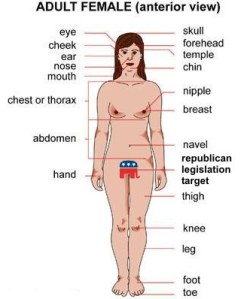
Good Morning!!
I’m getting a slow start this morning, so I thought I’d put up an open thread to get us started. This story is a couple of days old so you may have heard about it already, but I just had to take note of it anyway.
On Wednesday at a town hall meeting in Chariton Iowa, Senator Charles Grassley got a strange question about some wingnut conspiracy theory from one of his constituents: From the Atlantic Wire:
Constituent: They’re saying that they’re going to start, in 2013, putting microchips in government workers and then any kid that enrolls in school, starting in pre-school, will have a microchip implanted in them so that they can track them. Is that true?
Senator Grassley’s response was absolutely priceless:
Grassley: No. First of all, nothing can be done to your body without your permission….It’d be a violation of the constitutional right to privacy if that were to happen.
Here’s the video:
In case Grassley hasn’t thought about it that carefully, forcing a woman to have a baby certainly qualifies as doing something to her body without her permission. Actually, there is no right to privacy in the U.S. Constitution, but the Roe v. Wade decision created one; and Roe could certainly be used as precedent in any case relating to violations of body integrity.
In fact, the majority opinion of Roe v. Wade clearly states:
The Constitution does not explicitly mention any right of privacy. In a line of decisions, however, going back perhaps as far as Union Pacific R. Co. v. Botsford, 141 U.S. 250, 251 (1891), the Court has recognized that a right of personal privacy, or a guarantee of certain areas or zones of privacy, does exist under the Constitution…
Roe v. Wade, of course, established the right to privacy — the kind that might spare you from a government conspiracy to embed microchips that might reveal your entire health history. Or, you know, the kind of privacy that allows women to obtain a legal abortion in this country:
This right of privacy, whether it be founded in the Fourteenth Amendment’s concept of personal liberty and restrictions upon state action, as we feel it is, or, as the District Court determined, in the Ninth Amendment’s reservation of rights to the people, is broad enough to encompass a woman’s decision whether or not to terminate her pregnancy.
Grassley is a long-time opponent of abortion rights and advocate of overturning Roe v. Wade, and Naral gives him a zero rating on pro-choice issues. If Roe were overturned, where does Grassley think he’d find a constitutional “right to privacy”?
And let’s not forget the recent Republican obsession with forcing women to undergo vaginal probes before they can have an abortion.

Not to be outdone, the Indiana State Senate has passed a new law that requires a woman to have two (2) ultrasounds–before and after her “abortion”–even if she is just taking RU 487, or the morning after pill! The bill doesn’t specific intravaginal ultrasounds, but they would, in effect, be required, since most abortions are performed when the embryo or fetus is too small to be detected by a traditional ultrasound.
I’m not sure what Grassley’s position on these ultrasound laws is, but someone should definitely ask him. If forcing a woman to have two transvaginal probes in order to get a pill doesn’t qualify as the government doing something to “your body without your permission,” what does Grassley believe would qualify as a violation of a woman’s privacy? Maybe because the town hall questioner was a man, he was suggesting that only Americans with penises have privacy rights?
As the inimitable Charles Pierce once wrote about Senator Grassley in a different context:
This is also funny because, you see, if there’s one thing that Chuck Grassley is noted for, it is that he is the most spectacular box of rocks, the most bulging bag of hammers, in the history of the World’s Greatest Deliberative Body. If brains were atom bombs, he couldn’t blow his nose. If his IQ was one point lower, they’d have to water him. As the great Dan Jenkins once put it in another context, if the man had a brain, he’d be out in the yard playing with it.
I’ll have a Saturday Reads post up a little later on.
Friday Reads
Posted: February 22, 2013 Filed under: morning reads | Tags: Arkansas fetus fetishests, modern slavery, rising costs of health care, sexting, warrior grave found in Rusia 30 Comments Good Morning!!
It’s pretty common knowledge that the increasing cost of health care is the real issue that most economists see as the driver for increased federal and state deficit spending issues in the future. Time Magazine has a good article up that discusses how rapidly increasing costs are an issue for governments and families alike. The information is surrounded by personal family stories that are heartbreaking.
When we debate health care policy, we seem to jump right to the issue of who should pay the bills, blowing past what should be the first question: Why exactly are the bills so high?
What are the reasons, good or bad, that cancer means a half-million- or million-dollar tab? Why should a trip to the emergency room for chest pains that turn out to be indigestion bring a bill that can exceed the cost of a semester of college? What makes a single dose of even the most wonderful wonder drug cost thousands of dollars? Why does simple lab work done during a few days in a hospital cost more than a car? And what is so different about the medical ecosystem that causes technology advances to drive bills up instead of down?
Recchi’s bill and six others examined line by line for this article offer a closeup window into what happens when powerless buyers — whether they are people like Recchi or big health-insurance companies — meet sellers in what is the ultimate seller’s market.
The result is a uniquely American gold rush for those who provide everything from wonder drugs to canes to high-tech implants to CT scans to hospital bill-coding and collection services. In hundreds of small and midsize cities across the country — from Stamford, Conn., to Marlton, N.J., to Oklahoma City — the American health care market has transformed tax-exempt “nonprofit” hospitals into the towns’ most profitable businesses and largest employers, often presided over by the regions’ most richly compensated executives. And in our largest cities, the system offers lavish paychecks even to midlevel hospital managers, like the 14 administrators at New York City’s Memorial Sloan-Kettering Cancer Center who are paid over $500,000 a year, including six who make over $1 million.
Taken as a whole, these powerful institutions and the bills they churn out dominate the nation’s economy and put demands on taxpayers to a degree unequaled anywhere else on earth. In the U.S., people spend almost 20% of the gross domestic product on health care, compared with about half that in most developed countries. Yet in every measurable way, the results our health care system produces are no better and often worse than the outcomes in those countries.
According to one of a series of exhaustive studies done by the McKinsey & Co. consulting firm, we spend more on health care than the next 10 biggest spenders combined: Japan, Germany, France, China, the U.K., Italy, Canada, Brazil, Spain and Australia.
Slavery is still an issue around the world. It involves people of all ages and occurs in a surprising number of countries. Why is slavery still thriving?
A lot of people are pretty excited that Mississippi has decided to join the rest of the nation in outlawing human bondage. But in these celebrations, we seem to have forgotten one thing: Modern-day slavery is still a thriving industry, both in Mississippi and in
the rest of the nation.
In fact, Mississippi is something of regional slave transportation hub, according to the state’s special assistant attorney general Heather Wagner, who explains that the easy highway access to nearby major cities and the Gulf Coast ports make the state a trafficking corridor. The state recently passed rules requiring longer prison sentences for people caught enslaving and trafficking humans, such as the two Mississippi men who were recently indicted for selling or buying of children after being caught with a video that shows them enslaving and raping a girl about three years old.
To be fair, human and sex trafficking isn’t unique to Mississippi. According to the Department of Homeland Security, this industry–which the website describes as “ modern-day slavery”–is thriving across the United States. Recent examples abound: The 17 young women from Mexico who were brought to the U.S., held in captivity in New York State and forced to work as prostitutes; the firefighter in Baltimore who allegedly enslaved women in a brothel; the 20 Togolese women or girls who were transported to the U.S. and forced to work in hair salons in New Jersey. Nationally; an estimated 244,000 American children are at risk of being enslaved and forced into sex work alone–that doesn’t even include the thousands of additional people who are transported to the U.S., held in captivity and forced to work picking tomatoes or strawberries for WalMart. Globally, slavery recognized as one of the most lucrative illegal industries. An estimated 27 million are enslaved, generating $32 billion annually.And that’s just illegal slavery; state-sanctioned bondage is another thriving industry with that entraps millions of people and generates billions of dollars. With one of the most punitive states in the nation, Mississippi is a model of the incarceration nation
Minx fed my interest in graves with this discovery of a warrior’s grave in Russia.
Hidden in a necropolis situated high in the mountains of the Caucasus in Russia, researchers have discovered the grave of a male warrior laid to rest with gold jewelry, iron chain mail and numerous weapons, including a 36-inch (91 centimeters) iron sword set between his legs.
That is just one amazing find among a wealth of ancient treasures dating back more than 2,000 years that scientists have uncovered there.
Among their finds are two bronze helmets, discovered on the surface of the necropolis. One helmet (found in fragments and restored) has relief carvings of curled sheep horns while the other has ridges, zigzags and other odd shapes.
 Radical Right Republicans and the establishment republicans continue to reject Karl Rove with a variety of insults and personal comments made public. Here’s an example. There are more at the Bloomberg.com article.
Jonathan Collegio, a spokesman for the Conservative Victory Project and American Crossroads, said the groups had “come to the conclusion that we need to increase the caliber of candidates running for office in Republican primaries, and our goal is to elect the most conservative candidates in primaries who can win” general election contests against Democrats.“We have made absolutely clear we are not trying to pick a fight with the Tea Party,” Collegio said. “We are simply trying to pick the best candidates available.”
That’s not how David Bossie, president of Citizens United, a Washington-based group that says it is “dedicated to restoring our government to citizens’ control,” sees it.
“I like it that voters get to decide,” Bossie said. “I think Rove is trying to defend himself and deflect from his failure. I hear from donors. I hear from grassroots people across the country who are offended by the very fact that Karl Rove thinks he knows best.”
“If American Crossroads has done a great job, why create some new entity with the name conservative in it?” Bossie asked. “So everybody thinks it’s good because it is from a conservative outfit?”
Hope you’ve stocked up on plenty of popcorn because this is certainly getting more interesting as their losing days wear on. There seems to be an amazing race in banana republican states to see which one can pass the most restrictive abortion laws. Yes, yes. Republicans are all about small government and less regulation.
A Republican-controlled committee in the Arkansas House of Representatives approved a bill on Thursday that bans abortions after 12 weeks of pregnancy if a fetal heartbeat is detected, with exceptions for rape, incest, the life of the mother and highly lethal fetal disorders. The law, if passed, would be the most extreme abortion restriction in the country.
The House Public Health, Welfare and Labor Committee also approved a Senate-passed bill that bans abortions at 20 weeks after conception. Both bills defy the Supreme Court’s decision in Roe v. Wade, which prevents states from banning abortions before the fetus is viable — usually between 22 and 24 weeks of gestation.
Opponents of the so-called “heartbeat bill” argue that it would prevent women from having abortions before many of them even realize they’re pregnant.
“Let’s call this bill what it is: bumper-sticker message legislation with no chance of standing up in court, designed to dial the clock back 40 years on women’s rights,” said Nancy Northup, president and CEO of the Center for Reproductive Rights, a legal advocacy group. “This extreme ban will either force women already facing tough economic circumstances to travel to a neighboring state to access constitutionally protected health care or to turn to dangerous, clandestine options that could ruin or even end their lives.”
Well, this is certainly an interesting use of FBI resources.
Apparently FBI agents are mixing work with play a little too much. CNN obtained confidential internal memos scolding employees for a variety of violations, including bugging a boss’s office, paying for sex in a massage parlor, sending nude pictures to coworkers, and “a rash of sexting cases.” “When you are given an FBI BlackBerry, it’s for official use. It’s not to text the woman in another office who you found attractive or to send a picture of yourself in a state of undress. That is not why we provide you an FBI BlackBerry,” FBI assistant director Candice Will told CNN. She added that though she thinks she’s seen it all in her time at the FBI, she continues to get files that surprise her.
With that, I turn the reins of discussion to you. What’s on your reading and blogging list today?
Today’s Republican Party will say anything but the Truth
Posted: February 21, 2013 Filed under: religious extremists, Republican politics, Republican Tax Fetishists, right wing hate grouups, Surreality 33 Comments Perhaps one of the most overdone truisms you hear bandied about by people is “Actions speak louder than Words”. This is perhaps the seminal lesson that Today’s Republican Party should learn. They’re held captive by religious, white supremacist, and libertarian cults that operate in orbit around a corporatist elite and their cronies. They don’t really have any more core values or principles. The only have the major goals of their cults and billionaire enablers.
You can see the hypocrisy, the lies, and the actual agendas in their actions. In some ways, the worst of the cult priests are more honest than your establishment Republican which is why Karl Rove and others would prefer they stay silent while Republican Central fine tunes their messaging so they can fool more of the people most of the time. They are no longer a party of serious governance. Their goals are to further enrich and empower the wealthy, move as close to anarchy as possible with only the military left standing, and make as many states as possible adopt the bottom trawling quality of life one finds in Mississippi along with firmly entrenching one specific view of Christian morality into all institutions.
The party of “small government” is basically the party of huge military and international interventions and massive intrusions into people’s lives so that women, minorities, and children are forced into the appropriate biblical role of child bearing and slavery. They are also supportive of police state tactics that include government spying, torture, and denial of due process. Some of those folks are acceptable since they serve in the role of “House Eunuchs” where they proudly stand by or in for the master as long as they don’t get too vocal about their sexuality, their ambitions beyond child bearing, or the fact that their upward mobility is limited due to race, ethnicity, sex, or religion.
Let me source this rant to the naive ramblings of Josh Barro who wishes that Republican policies were more rooted in empirics and my now favorite Hillaryism “an evidence-based reality”. Greg Sargent did a great job this morning at Maddow Blog talking about why Barro’s wishful thinking is unlikely to come true. It simply doesn’t fit into what Republican want.
Conservatives tend to prefer a different approach that decreases the role of government, not to achieve specific ends, but because decreasing the role of government is the specific end.
This, of course, affects nearly every debate in Washington. When it comes to job creation, for example, the task for Democrats is pretty straightforward: let’s do more of what’s been the most effective, and less of what’s been the least effective. Again, it’s about pragmatism and results based on evidence.
For Republicans, it doesn’t work quite that way — they have ideological ideals that outweigh evidence. GOP leaders could be shown incontrovertible proof that the most effective methods of creating jobs and improving the economy are aid to states, infrastructure investment, unemployment insurance, and food stamps, and they’d still refuse. Why? Because their ideology dictates the response.
The left starts with a policy goal (more people with access to medical care, more students with access to college, less pollution, more jobs, less financial market instability) and crafts proposals to try to complete the task. The right starts with an ideological goal (smaller government, more privatization, more deregulation) and works backwards.
For Barro, if Republicans “figured out” that their mistaken policy assumptions were, in fact, mistaken policy assumptions, they’d change direction. I wish that were true, but all available evidence points in the exact opposite direction.
 Republicans that embarrass folks like Karl Rove and his donors are basically stating the goals of the party at the moment. They don’t care how they arrive there. There are no principles involved. There is no evidence involved. Each of the cults will violate all principles and all lessons of reality and science to arrive at these goals. The religious right want their perverted version of Christianity as the rule of the land. They want no birth control, no abortion, no visible or outward signs of homosexuality or anything other than how they define marriage, family, and morality. The Republican Party says it is the party that dislikes government interference and regulation. It wants ‘small government’. To see this Republican principle violated perpetually, one only need look at the agendas pushed through by the Religious Cult wing of the Republican party where we get state mandated sermons, procedures, and tons of regulation. Yes, we get Mississippi where the state regulates the one abortion clinic into illegality even though the right to an abortion is a constitutional right. These are the same folks that scream that any tiny bit of regulation of gun ownership is the end of the Bill of Rights and Constitutional rights as we know it. See, the principle is only valid when it works for them.
Then, there’s the entire cult of Austrian Economics and Ayn Rand which is what the Barro piece was focused on. Let me quote Paul Krugman on these folks:
Substance aside — not that substance isn’t important — Austrian economics very much has the psychology of a cult. Its devotees believe that they have access to a truth that generations of mainstream economists have somehow failed to discern; they go wild at any suggestion that maybe they’re the ones who have an intellectual blind spot. And as with all cults, the failure of prophecy — in this case, the prophecy of soaring inflation from deficits and monetary expansion — only strengthens the determination of the faithful to uphold the faith.
Barro even admits to the wrongness of the economic policies of this group. But again, Barro thinks that the principles are important rather than the outcomes. This group wants the outcomes only.
Political parties should differ on normative questions. They ought to strive for agreement on positive questions — questions such as, what policies cause gross domestic product and median incomes to rise, how unemployment insurance affects the unemployment rate, or how global temperatures are changing. Currently, Republicans make a lot more errors on these kinds of questions than Democrats.
Correcting errors on positive questions should cause conservatives to revisit some of their top policies, as Bloomberg View columnist Ramesh Ponnuru laid out this weekend in the New York Times. Conservatives say tight money and lower top tax rates would enrich middle-class families. But that’s wrong, and if they figured that out, they might stop supporting tight money and lower top tax rates.
The deal is Josh, that the Republican Party does not want to honestly state that their goal is to make the upper class much wealthier and the 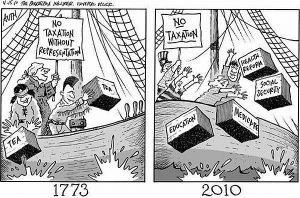 rest of us are other in the category of pesky servants or moochers who aren’t worth wasting anything on. Pesky servants should just work at their jobs and not be seen or heard and should just be thankful for the crumbs they receive. Moochers need to just self-deport or join the military to learn civility and servility. We got a glance of the true set-up here during the Romney 47% illumination because they though we weren’t listening in. The silly donors thought the room held only servants and house enuchs!!
You see, the Republican establishment really doesn’t care about the economy as long as the donor base and the corporate base do fine which is exactly what’s been going on for the last ten years or so. When they don’t do fine, they just dip into the public Treasury and replenish their gambling stakes. They don’t want to pay for anything that doesn’t directly benefit them. They want to be worshiped as gods for holding their vaulted positions which they honestly believe has come to them because their special. You can see this again in the places that Josh holds up as being great places because they’ve got Republican Governors. Again, let’s think about this. We’re talking the plantation mentality that thrives still in Mississippi and Louisiana. Everything’s just fine as long as the economy works for the Koch brothers, the Oil and Gas Companies, Pete Peterson, and the House Eunuchs. Let’s just use the Mississippi and Louisiana governor and state set up to illustrate their idea of Mississippi as the role model for the country.

 peej
peej Carissa
 bostonboomer
 dakinikat
 ecocatwoman
 mablue2
 Mama Lopez
 peggysue22
 quixote
 skydancingguestblogger
 Mona (aka Wonk the Vote)



 Sky Dancing
Recent Comments