
The Bane of Bain
Posted: May 22, 2012 Filed under: 2012 presidential campaign, The Bonus Class, We are so F'd | Tags: Bain Capital, Booker, corporate raiders, private equity firms, Romney 27 CommentsI have to write about this. The recent media hoopla surrounding Cory Booker’s comments about Bain Capital just put me over the top. I guess it’s just an  occupational hazard with me. I teach this stuff. I study this stuff. I know the difference between venture capital, capital angels, and corporate raiders. I’m wondering how many politicians actually grok this. Oddly enough, Romney’s Republican primary rivals knew the difference before they were forced to tow the Romney line. I did watch Newt Gingrich last night on Piers Morgan (only because Lama was here and it was on) and he doesn’t seem to be able to fully embrace the Bain Mission.The best Gingrich could say was it was a better job than any thing Obama has done. He said something obligatory about Obama raiding the tax payer’s funds. Gingrich still knows what Romney did is not from the positive ledger side of equity capital firms.
Venture capitalists are wonders to be hold and represent the best of the best. These guys take on tremendous amounts of risk and usually bring a lot of business acumen to a start up firm. Frequently, start up firms are high tech and ran by nerdy scientists who are great in labs and on computers. They known nothing of financing, bringing products to market, or monetizing an investment. This is a true partnership of great minds and money. This is not what Mitt Romney did when he was CEO of Bain Capital. Romney’s firm could’ve been a contender in the angel category except that’s not what he did either. Warren Buffet has been an angel investor many times. Romney’s firm basically ran like a pack of hyenas to a company that was struggling and used the law to extract its life force.
Ralph B reminded me of several articles that have been out there written by financial economist wonks like me explaining why Romney never got a hero’s welcome in the past and should not get a pass right now. Putting corporate raiders into the same pile as the rest of equity capital firms is like saying cancer is just basically another cell that exists in your body.
Here’s three excellent points by Konczal on why Romney isn’t an angel or a venture capital hero. Romney’s firm played the sociopathological side of the equity capital game. They were serial killers.
1. Tax/regulatory loopholes. I did an interview with Josh Kosman, author of The Buyout of America, where he argued that the whole point of the enterprise is to game tax law loopholes. Private equity “saw that you could buy a company through a leveraged buyout and radically reduce its tax rate. The company then could use those savings to pay off the increase in its debt loads. For every dollar that the company paid off in debt, your equity value rises by that same dollar, as long as the value of the company remains the same.”
A recent paper from the University of Chicago looking at private equity found that “a reasonable estimate of the value of lower taxes due to increased leverage for the 1980s might be 10 to 20 percent of firm value,” which is value that comes from taxpayers to private equity as a result of the tax code.
That’s one thing in an industry with large and predictable cash flows. But after those low-hanging fruits were picked, as Kosman explained, “firms are taken over in very volatile industries. And they are taking on debts where they have to pay 15 times their cash flow over seven years — they are way over-levered.”
This critique has power as far as it goes. But let’s combine it with another issue.
2. Risk-shifting among parts of the firm. Traditional “creative destruction” is about putting rivals out of business with better products and techniques. Leveraged buyouts and private equity are about something different, something that exists within a single firm. This is often described as putting new techniques into place, firing people and divisions that are not performing, and generally making the firm more efficient.
The critique here is that, instead of making the firm more efficient, it often simply shifts the risks into different places. As Peter Róna, head of the IBJ Schroder Bank & Trust in New York, described it in 1989:
The very foundation of the LBO is the current actual distribution of hypothetical future cash flows. If the hypothesis (including the author’s net present value discounted at the relevant cost of capital) tums out to be wrong, the shareholders have the cash and everyone else is left with a carcass. “Creating shareholder value” and “unlocking billions” consists of shifting the risk of future uncertainty to others, namely, the corporation and its current creditors, customers, and employees…
The notion that underleveraging a corporation can cause problems is neither new nor unfounded. What is new is the assertion that shareholders shouid set the proper leverage because, motivated by maximizing the return on their investment, they will ensure efficiency of all factors of production. This hypothesis requires much more rigorous proof than Jensen’s episodic arguments… although Jensen denies it, the maximization of shareholder returns must take place, at least in part, at someone else’s expense.
Shareholders gain, but at the expense of other stakeholders in the firm. This isn’t the normal winner/loser dynamic, where some suffer in the short-term to do what’s best for the long-term. Here the long-term suffers to create short-term winners. Once again, this issue becomes problematic when combined with another critique.
3. Dividend looting. The theory behind private equity, as Róna caught above, is that it requires shareholders to be the proper and most efficient group to set the leverage ratio. But what if, instead of setting leverage for the long term to make the firm more efficient, shareholders simply use additional debt to pay themselves, regardless of the health of the firm? As Josh Kosman put it:
If you look at the dividends stuff that private equity firms do, and Bain is one of the worst offenders, if you increase the short-term earnings of a company you then use those new earnings to borrow more money. That money goes right back to the private equity firm in dividends, making it quite a quick profit. More importantly, most companies can’t handle that debt load twice. Just as they are in a position to reduce debt, they are getting hit with maximum leverage again. It’s very hard for companies to take that hit twice…
The initial private equity model was that you would make money by reselling your company or taking it public, not by levering it a second time…Right after this goes on for a few years, you’ve starved your firm of human and operating capital. Five years later, when the private equity leaves, the company will collapse — you can’t starve a company for that long. This is what the history of private equity shows.
The biggest difficulty I have with all this political back and forth is that Republicans and Democrats will take money from Wall Street as political donations without really looking at the individual or the firm. Some private equity firms are value-added. Others basically remove value from the US economy. Romney falls into the looter baron role. However, Booker and Obama have both taken political donations from all breeds of these guys. So, they may not have closed down the companies or bootstrapped Yahoo, but they’ve been in on the spoils.
Again, let’s look at what some of Romney’s Republican rivals said.
1. “The idea that you’ve got private equity companies that come in and take companies apart so they can make profits and have people lose their jobs, that’s not what the Republican Party’s about.” — Rick Perry [New York Times, 1/12/12]
2. “The Bain model is to go in at a very low price, borrow an immense amount of money, pay Bain an immense amount of money and leave. I’ll let you decide if that’s really good capitalism. I think that’s exploitation.” — Newt Gingrich [New York Times, 1/17/12]
3. “Instead of trying to work with them to try to find a way to keep the jobs and to get them back on their feet, it’s all about how much money can we make, how quick can we make it, and then get out of town and find the next carcass to feed upon” — Rick Perry [National Journal, 1/10/12]
4. “We find it pretty hard to justify rich people figuring out clever legal ways to loot a company, leaving behind 1,700 families without a job.” — Newt Gingrich [Globe and Mail, 1/9/12]
5. “Now, I have no doubt Mitt Romney was worried about pink slips — whether he was going to have enough of them to hand out because his company, Bain Capital, of all the jobs that they killed” — Rick Perry [New York Times, 1/9/12]
Even the media doesn’t know a damn thing about the variants of equity capital firms. ABC appears to be joining FOX news in spreading stupid tropes and canards.
Private-equity firms aren’t supposed to create jobs; they’re supposed to make money for their investors, which to a large extent include pension funds and university endowments. The companies in which they invest are sometimes on the brink of failure to begin with, and are likely to go bankrupt without outside help. These risky investments often include making decisions like cutting costs and jobs.
But in the little-understood world of private equity, Obama has seized upon a basic formula — Romney and Bain plus companies equals some lost jobs and millions for Romney — to argue that he’s unfit for the Oval Office.
Defending the Bain ad, Obama spokesman Ben LaBolt said the campaign isn’t “questioning the purpose of the private-equity business as a whole.”
“Why did Romney and his partners succeed even if the company failed?” LaBolt asked rhetorically on a conference call.
Probably because private-equity firms don’t necessarily rise and fall with the companies in which they invest. Finance experts explained that faced with a decision over bankruptcy, those firms are obligated to protect their investors, not the workers at the company. Pumping more money into a company that has shown signs of failure isn’t as smart a move business-wise as cutting losses to save investors money.
Actually, angels and venture capitalists do exactly all of that and make money if they do it right. The above description is just whacked. I’d drum a student out of my corporate finance class that tried to offer this up. But, the media can print just about any old thing it wants to and get away with it. Most private equity firms are NOT corporate raiders. There are even funds that do project financing that help Governments build things like dams, highways and universities. Gordan Gecko’s way of business is not the life blood of the private equity market. They can provide seed money, start-up money, expansion and development money and a lot of money that isn’t based on gutting existing businesses. Some specialize in transfers of power from a sole owner who is retiring to a new group of owners. Most don’t drain the firms of capital when they leave either. Romney was a pirate not some kind of private enterprise swashbuckler.
Enuf said.
Okay, so that’s my lecture\rant for the day. I’m going back to grading papers now. That is all.
Tuesday Reads: My Objections to Mainstream Media Reporting on the Trayvon Martin Case
Posted: May 22, 2012 Filed under: morning reads | Tags: "Dee Dee", Bernie de la Ronda, bigotry, bullying, Florida, George Zimmerman, inconsistencies, mainstream media, Racism, stand your ground law, Trayvon Martin 67 Comments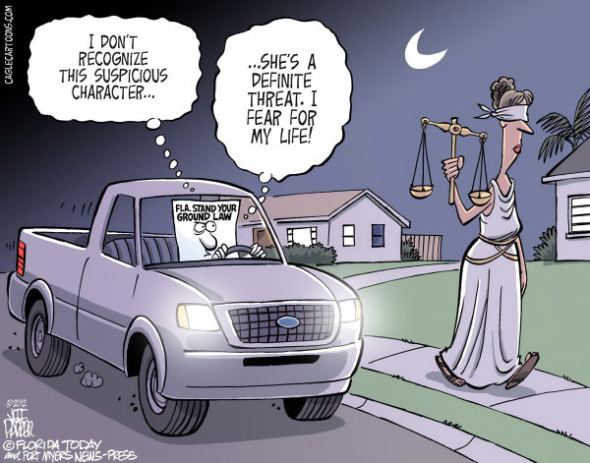
Good Morning!
I’ll warn you up front: I’m going to subject you to another rant about the Trayvon Martin case. If you’re not interested, you can stop reading now and just head for the comments. I promise not to take offense. BTW, it was either this or a rant about Cory Booker and Harold Ford.
I’m still following the Trayvon Martin story very closely, and I’ve been really shocked at the way the mainstream media has covered it. There has been a surprising willingness of reporters and “experts” to accept George Zimmerman’s multiple and conflicting versions of what happened on the night of February 26, 2012, when he shot and killed an unarmed minor child, for example, see here. I can’t help but wonder if some kind of institutionalized racism isn’t involved. Here are a few of the obvious inconsistencies in Zimmerman’s accounts just off the top of my head.
We’ve been told that Martin walked in circles around Zimmerman’s truck, and that Zimmerman was terrified. Yet Zimmerman was on the phone with a police dispatcher at the time and never mentioned this threatening activity.
We also know that Martin was on the phone with a friend at that time. Does it make sense that he would repeatedly circle Zimmerman’s truck while at the same time telling his friend he was frightened because a “crazy and creepy” man was watching and following him? And why would Zimmerman then get out of his truck and begin following Martin (while still on the phone with the dispatcher) if he was so frightened of the boy? We know that he did get out of his car and follow Martin, because Zimmerman told the police dispatcher so, and you can hear him huffing and puffing on the call as he either ran or walked quickly after Martin.
We’ve also been told that after Zimmerman got out of his car, he lost sight of Martin and turned back toward his truck. Then suddenly Martin attacked from behind, knocking Zimmerman to the sidewalk. Then supposedly Martin climbed on top of Zimmerman and banged his head on the pavement again and again and again. Where’s the evidence for that?

We now know that Zimmerman had a superficial cut on the back of his head and a couple of other cuts on his face as well as a bloody nose. We’ve been told that he had two black eyes and a closed fracture of his nose, but no photos of these injuries have been released. There was no sign of black eyes in the videos of Zimmerman at the police station after the shooting.
Certainly getting your head banged on cement should lead to serious damage–including brain damage or internal bleeding–not just a one-inch long cut! Here is an article about a man in Florida who fell and hit his head on the pavement and died from his injuries. Perhaps you could hit your head on pavement and survive, but pounded violently and repeatedly into the pavement? Surely that would turn the back of your head to hamburger.
Furthermore, if the fight took place on the sidewalk, how did Martin’s body end up in the middle of a grassy area? Police also reported that the back of Zimmerman’s jacket was wet and covered with grass stains. Witnesses describe a fight that moved over a distance and was witness successively by neighbors along the way.
Zimmerman also told police that Martin held his hand over his (Zimmerman’s mouth) as they fought, but at the same time that Zimmerman was screaming for help at the top of his lungs.
According to the Orlando Sentinel, even police did not believe the story about the hand over the mouth, because Zimmerman wouldn’t have been able to scream out words if his mouth were covered.
Police also had problems with some of the melodramatic quotes Zimmerman attributed to Martin, such as the claim (through Zimmerman’s father) that Martin reached for Zimmerman’s gun and announced “you’re going to die tonight.” You have to wonder how many arms Martin had to be punching Zimmerman, holding his hand over Zimmerman’s mouth, pounding his head on the pavement, and also reaching for the gun. Of course we now know that none of Martin’s DNA was found on any part of the gun, yet Zimmerman told police the two struggled over it.
In Zimmerman’s account, Martin was sitting on top of him, punching him and suddenly Martin saw the gun and reached for it and the two struggled over it. How would Martin have seen the gun if it was in the holster on Zimmerman’s waist. Wouldn’t he have been sitting at or above the waist in order to punch Zimmerman’s face? And how would Zimmerman have pulled his gun out in this position? Another problem with this story is that the autopsy showed that the trajectory bullet went front to back in a straight line. How would Zimmerman have been able to do this with Martin sitting on top of him like this?

How would the man on the bottom manage a straight, front-to-back shot from that angle? Wouldn’t it make more sense if they had been standing at the time of the gunshot?
Zimmerman also told police that after he shot Martin, the boy said the words “Okay you got it” or “you got me.” But from the autopsy results we now know that Martin was shot straight through the left ventricle of the heart with a hollow-point bullet. His lungs collapsed immediately as the bullet split into pieces. How would he have been able to speak? I think he probably died instantly.
So there are all kinds of problems with Zimmerman’s account(s) of the shooting and the events leading up to it. Yet, most mainstream media sources that I’ve read are reporting that Zimmerman’s account(S) are corroborated by the evidence. The assumption is that Martin attacked Zimmerman and therefore somehow deserved to die. I just don’t get it.
Since the release of part of the prosecution evidence, media outlets have focused on the finding that Trayvon Martin had trace levels of THC in his blood and urine at the time of his death, but have paid almost no attention to the much more powerful and dangerous medications that George Zimmerman was taking–Adderall (two forms of amphetamine) and Restoril (a sedative-hypnotic in the benzodiazepine family). Both of these are addictive drugs that are commonly abused, yet media reports have tended to minimize their mood-altering effects.
It seems to me that if Zimmerman’s attorney opts for a hearing on a stand-your-ground claim that all these inconsistencies will be brought up. That will be problematic for Zimmerman, because he will have to take the stand in order to state his case and back it up. He will have to describe the events of the night and explain any discrepancies with his previous statements. He made five different statements to police and participated in a taped recreation of events at the scene.
At Zimmerman’s bond hearing, prosecutor Bernie de la Ronda suggested that there were inconsistencies in Zimmerman’s statements (de la Ronda was referred to as “unidentified male” in the CNN transcript).
UNIDENTIFIED MALE [Prosecutor de la Ronda]: But before you committed this crime on February 26th, you were arrested — I’m sorry, not arrested. You were questioned that day, right, February 26th?
ZIMMERMAN: That evening into the 27th.
UNIDENTIFIED MALE: And then the following morning. Is that correct?
ZIMMERMAN: Yes, sir.
UNIDENTIFIED MALE: And the following evening, too. ZIMMERMAN: Yes, sir.
UNIDENTIFIED MALE: Ok. Would it be fair to say you were questioned about four or five times?
ZIMMERMAN: I remember giving three statements, yes sir.
UNIDENTIFIED MALE: And isn’t it true that in some of those statement when you were confronted about your inconsistencies, you started “I don’t remember”?
O’MARA [Zimmerman’s attorney]: Outside the scope of direct examination. I will object your honor.
JUDGE LESTER: We’ll give you a little bit of leeway. Not a whole lot but a little bit here, ok.
UNIDENTIFIED MALE: Isn’t it true that when you were questioned about the contradictions in your statements that the police didn’t believe it, that you would say “I don’t remember”?
JUDGE LESTER: I’m going to grant his motion at this time.
O’MARA: Thank you, your honor.
UNIDENTIFIED MALE: Would you agree you changed your story as it went along?
ZIMMERMAN: Absolutely not.
Prosecutor de la Ronda also alluded to some e-mails and text messages that were found on Zimmerman’s cell phone after his arrest.
UNIDENTIFIED MALE: Ok. Now, sir, you had a phone at some point and you agreed to turn over that phone to the police so they could make a copy of what was in there, right?
ZIMMERMAN: Yes, sir.
UNIDENTIFIED MALE: And in that phone did you receive or send text messages sir.
ZIMMERMAN: Yes, sir.
UNIDENTIFIED MALE: Did you ever make any reference to a reverend?
O’MARA: Objection, your honor. Outside the scope.
JUDGE LESTER: Sustained.
UNIDENTIFIED MALE: Did you ever make any reference to Mr. Martin, the father of the victim?
JUDGE LESTER: Sustained. You’re getting a little bit far away.
UNIDENTIFIED MALE: I apologize your honor. My question is he was asked in terms of apology to the family and I’d like to be able to address that if I could. JUDGE LESTER: I think you can classify that whether or not he asked the apology. I don’t want to get into other areas.
UNIDENTIFIED MALE: Yes, sir.
JUDGE LESTER: Thank you.
UNIDENTIFIED MALE: My question is, Mr. Zimmerman, do you recall sending a message to someone, an e-mail, about referring to the victim’s father?
ZIMMERMAN: No, sir. I don’t.
The statements that Zimmerman gave to police and the e-mails and text messages from his cell phone have not been released yet. But we have learned from one witness’s statement that Zimmerman has shown himself to be a bully and a bigot toward a Middle Eastern co-worker. I suspect that the comments found on Zimmerman’s cell phone were derogatory and racist references to Trayvon Martin’s family and/or their supporters. The “reverend” might be Al Sharpton or Jesse Jackson.
Zimmerman will also have to deal with the testimony of Trayvon Martin’s friend (referred to in the media as “Dee Dee,” who was talking to Martin during the time leading up to the confrontation and the shooting. In the full interview that she gave to the prosecutor, “Dee Dee” describes hearing a confrontation between Martin and Zimmerman. Martin says “Why are you following me for?” and Zimmerman responds by saying “What are you doing around here?” She then hears a bumping sound and Martin’s headphones fall off. But she can still hear him say, “Get off. Get off.” The whole interview is posted at The New York Times (scroll down to sidebar).
One of the biggest questions is who was screaming on one of the 911 tapes called in by a witness. Yesterday, the WaPo had an article about two voice experts, one of whom concluded that the voice is Trayvon Martin’s and that he can be heard saying “I’m begging you,” “Help me,” and “Stop!” right before the gunshot silenced him. A second expert pooh poohs these findings, but give it a read. I found the article quite compelling.
I know I’m largely preaching to the choir here at Sky Dancing, but I wanted to try to pull some of these inconsistencies together to show that–despite the media seeming to favor Zimmerman’s side–he is going to have a lot to answer for, particularly if he and his attorney decide to go the “stand-your-ground” route. In a trial, Zimmerman will have a choice about whether to take the stand; but at a pre-trial hearing to determine whether he is immune from prosecution because he was defending himself, Zimmerman would have to testify and his credibility will be on the line.
I’d love to get your reactions to what I’ve written. I’d especially like to know your opinions about why the mainstream media in general has been giving George Zimmerman the benefit of the doubt and demonizing Trayvon Martin.
For example, why the obsessive focus on traces of THC and little attention to the heavy duty prescription drugs Zimmerman was taking? Why was Martin described for so long as very tall, towering over Zimmerman, when he actually was 5’11” and Zimmerman is only a couple of inches shorter. Why has the media portrayed Zimmerman’s injuries as horrifying when they are actually quite superficial? Why have they exaggerated a tiny cut on one of Martin’s fingers into “scraped knuckles?” And so on. Am I wrong to suspect underlying racism as at least part of the explanation for these media attitudes?
As always, please feel free to post your own links in the comments.
Dead Silence from Mitt Romney on Chen Guangcheng’s Arrival in U.S.
Posted: May 21, 2012 Filed under: 2012 presidential campaign, China, Foreign Affairs, Human Rights, U.S. Politics | Tags: Chen Guangcheng, diplomacy, Hillary Clinton, Mitt Romney, State Department 31 Comments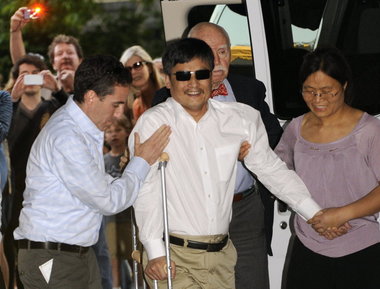
It’s been a couple of days now since blind Chinese activist Chen Guangcheng arrived at Newark on a flight from Beijing. Mitt Romney must have heard about it, but he’s said nary a word about it. I wonder why?
He had plenty to say back on May 3, in the midst of the crisis that took place during Secretary Clinton’s trip to China. Chen had managed to escape from house arrest and make it to the U.S. Embassy to ask for assistance. As State Department and U.S. Embassy staff struggled to negotiate an exit strategy for Chen, Romney, the all-but-official Republican nominee:
condemned the Obama administration’s handling of blind Chinese dissident Chen Guangcheng, calling the episode “a dark day for freedom” and “a day of shame” for President Obama if, he couched, reports are true that American officials communicated threats to Chen’s family….
Several times on Thursday, Romney couched his comments with disclaimers like “if the reports are true,” but the takeaway was clearly intended that the incident is a black eye for President Barack Obama, Secretary of State Hillary Clinton and Treasury Secretary Timothy Geithner.
Despite Romney’s impulsive catastrophizing, Secretary of State Clinton calmly continued her efforts to help Chen and his family get to the U.S. in a way that would also save face for Chinese officials. Chen was offered a law fellowship at New York University and a deal was struck: Chen could leave China on a student visa, and his departure wouldn’t be characterized as seeking asylum.
On May 9 in New Delhi, Clinton told an interviewer:
that the work she and others have done to establish multiple channels for dialogue over the last 3 1/2 years “created a level of personal relationships and understandings between individuals and our government institutions that is absolutely critical.”
Clinton suggested that China’s willingness to agree to a U.S. proposal to assist a prominent critic of the government’s one-child policy is an indication that taking a broader view of the relationship pays dividends in a moment of crisis.
“I’ve invested a lot and argued strongly” for keeping regular channels of communication open so that no one issue “predominates or undermines the potential for reaching agreement on other equally important issues,” the top U.S. diplomat told Bloomberg Radio.
This was a triumph for negotiation as opposed to the kinds of macho chest-pounding that Romney has been preaching so far.
Declining to comment on how the U.S. managed to craft a deal this time in a sensitive case involving a Chinese activist, Clinton said that “every high-level Chinese official that I met” last week “repeated back to me” words from a speech she delivered in Washington reflecting on Sino-U.S. relations in the 40 years since President Richard Nixon’s historic outreach to communist China.
Chinese officials, she said, echoed her view that “what we are trying to do — the U.S. and China — is unprecedented in world history. We’re trying to find a way for an established power and a rising power to coexist.”
Last night, Cheryl Isaac wrote at Forbes:
Chen posed a great challenge for Hillary Clinton because of two competing issues: the economic dialogue in Beijing had been her priority for a couple of years, her pledge to protect human rights—women’s rights nonetheless—another priority.
The confusion of the negotiation process did not help either. After escaping house arrest and seeking refuge at the American Embassy, Chen first decided to stay in China. Then later, he pleaded to be taken to America—putting Clinton in the difficult place of having to renegotiate an agreement that had been reached 24 hours prior; reports the Daily Beast’s Howard Kurtz.
People around the world stated their displeasure. In the U.S., she had Congressman Chris Smith (R-NJ) stating that Clinton did not keep Chen safe within the U.S. Embassy. In this video interview, Smith even admits to telling Chen—in a phone conversation—that the fact that officials were working day and night on his paperwork, was not a good sign…”
But Hillary pushed onward, made the right decisions, and was successful in her goal of helping Chen and his family.
Bravo, Madam Secretary! Where are macho Mitt’s congratulations? Has he apologized yet? I’ve googled, but can’t find any evidence that he has owned up to his bungling or even acknowledged this diplomatic achievement. Why am I not surprised?
Monday Reads
Posted: May 21, 2012 Filed under: #Occupy and We are the 99 percent!, morning reads, religious extremists, right wing hate grouups | Tags: acquired savants, chicago terrorists/protestors, police plant evidence, right wing hysteria and bigotry, Terry Gilliam 15 Comments Good Morning!
I am exhausted and I’m not even in Colorado yet. It’s a good thing I’m getting some limited exposure to the news these days because it’s full of things like this. Here’s the five most offensive sexist and homophobic offerings by conservatives for the month from Sarah Seltzer at Alternet. I picked a few for you so this is a spew alert!
Rejecting Virginia judicial candidate because he’s gay, then saying “Sodomy is not a civil right.” In Virginia, members of the House of Delegates failed to confirm Tracy Thorne-Begland, an openly gay formal Navy officer raising children with his partner, as a judicial candidate.
His nomination had been seen as a given, with bipartisan support, until lobbying from “both the Family Foundation, a powerful conservative group that opposed his candidacy, and conservative lawmakers, who argued that his past indicated that he would press an activist agenda from the bench ” according to the New York Times.
Even worse? One of the leading opponents of the nomination, Bob Marshall, defended the decision after it got national heat:
Dr. Martin Luther King and Rosa Parks never took an oath of office that they broke. Sodomy is not a civil right. It’s not the same as the Civil Rights Movement.
…
Bills allows pharmacists to deny care to women they think “may” be having abortions.
Kansas Governor Sam Brownback expanded the state “conscience clauses” to allow religious employees at pharmacies and medical facilities to refuse service to women they think “may” be having an abortion. As Robin Marty writes, he’s “legally blessed a virtually open-ended number of situations in which ‘religious’ workers can refuse to assist women under the guise that they believe they ‘may be’ terminating a pregnancy.”
So one consequence is simply refusing to dispense contraception and emergency contraception pills, neither of which terminate pregnancies. But there are other implications, as Marty notes, including that, “The law could also allow refusal of even more medically necessary drugs simply because they may relate to abortions…” like drugs that stop bleeding, for instance.
There’s more evidence that arrests in Chicago for protestors cum terrorists were the result of Cops Gone Wild. Naturally, you have to rely on the foreign press to get the story. Are we getting repeats of 1968?
Deutsch, the attorney representing the suspects, said at the hearing that police had planted weapons at the scene of the arrests. “This is a way to stir up prejudice against a people who are exercising their First Amendment rights,” Deutsch said. “There were undercover police officers that ingratiated themselves with people who come from out of town.”
In a case earlier this month five self-described anarchists were charged with plotting to blow up a bridge near Cleveland after planting fake explosives underneath that federal agents had sold them.
Natalie Wahlberg, a member of the Occupy Chicago movement protesting against income inequality, said: “The charges are utterly ridiculous. CPD [Chicago police department] doesn’t know the difference between home beer-making supplies and Molotov cocktails.”
The National Lawyers Guild, a group of volunteer lawyers representing the protesters, said on Facebook that police “broke down doors with guns drawn and searched residences without a warrant or consent”.
I am a long standing Monty Python fan as well as a big fan of the art of animation. That’s why I was thrilled to learn what Terry Gilliam’s been up to in this week’s The Economist. Here’s Gilliam discussing the difficulties of being non-formula in Hollywood.
To what extent does your reputation as a maverick contribute to the problems you experience?
Hollywood still sees me as someone who won’t be controlled as easily as a young guy straight out of making commercials. They don’t want some ageing hippie who still hasn’t learned to play the game after all these years. And that goes against me sometimes. But it’s not just me. Hollywood has been afraid to take risks for a long time now. All the studios want is a safe pair of hands.
Can you give an example of a studio choosing a “safe pair of hands” over you?
The first Harry Potter film. I was the perfect guy for that movie. They all knew it. J.K. Rowling wanted me to do it; David Heyman, the producer, wanted me to do it. But one guy from Warner’s overruled everyone and Chris Columbus got the gig. I was furious at the time but in hindsight, the level of studio interference on a project that size would have driven me insane.
What effect is Hollywood’s “safe” approach having on audiences?
The longer you keep churning out this production-line crap, the more audiences are going to like it—and need it. There’s an element of security provided by re-makes and re-hashes. We’re at the stage where audiences just want to know that everything will be the same. Maybe it’s because the world has become so diffused and unclear that people just want to go back to what they know over and over again. People need to reassure themselves that Spider-Man can still do the things he’s always done.
I’ve developed a fascination with brain injuries while listening to a NPR series on all the problems that Football players appear to develop midlife. Then there’s the the huge number of brain trauma patients coming out of our military these days. Here’s an interesting article at The Atlantic on how a blow to the head some times creates a genius. Warning! Do not try this at HOME!
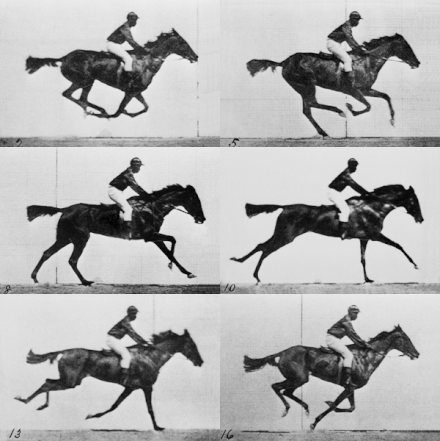
For a long time, it was a mystery as to how horses galloped. Did all four hooves at some point leave the ground? Or was one hoof always planted? It wasn’t until the 1880s when a British photographer named Eadweard Muybridge settled the debate with a series of photographs of a horse in midstride. Muybridge took a great interest in capturing the minute details of bodies in motion. The images made him famous.
Muybridge could be obsessive — and eccentric, too. His erratic behavior was blamed on a head injury he’d sustained in a serious stagecoach accident that killed one passenger and wounded all the rest. Now, researchers believe that the crash, which gave Muybridge a permanent brain injury, may actually have been partially responsible for endowing him with his artistic brilliance.
Muybridge may have been what psychiatrists call an acquired savant, somebody with extraordinary talent but who wasn’t born with it and who didn’t learn the skills from someplace else later. In fact, Muybridge’s savant abilities had evidently been buried deep in the recesses of his mind the whole time, and the stagecoach incident had simply unlocked them.
So, that should give you a few interesting things to think about! I’m headed to Colorado on Wednesday so I’ll be a little scarce this week. What’s on your blogging and reading list today?
Many Saw It Coming
Posted: May 19, 2012 Filed under: financial institutions, Global Financial Crisis | Tags: James Kenneth Galbraith 19 CommentsOne of the weirdest memes I’ve heard recently is that no economist or person with a finance background could have seen the global financial crisis coming. That’s quickly followed by no one knew it would be so deep and so hard to escape. Then, there’s the entire weirdness surrounding the tropes that just cutting taxes and balancing budgets will solve all the problems.
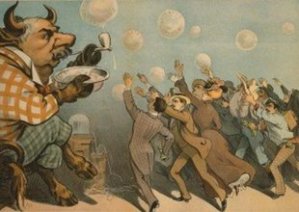 I read this Galbraith article over at Truthdig and wanted to share it because it just says all that many of us economists saw coming, see happening, and shake our heads at now. I personally expected the subprime credit markets to blow up sometime in 2005. I was watching the subprime contagion spread into the major banks by 2006. I heard from Social Workers what kinds of crap was being pushed on to their clients. You can ask my colleagues. I was vocal about it. The only people that seem flummoxed are those that were taken in by Fama and his Chicago acolytes. They are also the ones spreading the worst nastiness now. It does not surprise me that Paul Ryan is one of their groupies. They’ve been perpetually wrong on things.
I don’t have a lot of time to do a big analysis of this. I also think that Saturday is the last day you want to read it. Anyway, go read the article. It’s excellent.
The most important common ground was over the depth and severity of the financial crisis. We placed it in a different league from all other financial events since the early thirties, including the debt crises of the eighties and the Asian and Russian crises of the late nineties. One of us called it “epochal” and “history-making.” And so it has turned out. What distinguishes this crisis from the others are three facts taken together: (a) it emerges from the United States, that is, from the center, and not the periphery, of the global system; (b) it reflects the collapse of a bubble in an economy driven by repetitive bubbles; and (c) the bubble has been vectored into the financial structure in a uniquely complex and intractable way, via securitization.
Bubbles are endemic to capitalism, but in most of history they are not the major story. In the nineteenth century, agricultural price deflation was a larger problem. In the twentieth, industrialization and technology set the direction. It was only in the information technology bubble of the late nineties that financial considerations including the rise of venture capital and the influx of capital to the United States following the Asian and Russian crises—came to dominate the direction of the economy as a whole. The result was capricious and unstable—vast investments in (for instance) dark broadband, followed by a financial collapse—but it was not without redeeming social merits. The economy prospered, achieving full employment without inflation. And much of the broadband survived for later use.
The same will not be said for the sequential bubbles of the Bush years, in housing and now commodities. The housing bubble—deliberately fostered by the authorities that should have been regulating it, including Alan Greenspan and Ben Bernanke—pushed the long-standing American model of support for homeownership beyond its breaking point. It involved a vast victimization of a vulnerable population. The unraveling will have social effects extending far beyond that population, to the large class of Americans with good credit and standard mortgages, whose home values are nevertheless being wiped out. Meanwhile, abandoned houses quickly become uninhabitable, so that, unlike broadband, the capital created in the bubble is actually destroyed, to a considerable degree, in the slump.
We’re still seeing overheated securitized assets. We’re seeing more canaries in the mine again. Think JP Morgan’s big hedge. We never have the right minds in the District dealing with the problem. This has been the case for all of this century. There’s a lot of bad thing bubbling in the financial markets right now. Now is the time to bring in the people that knew better. Not the same old suspects.

 peej
peej Carissa
 bostonboomer
 dakinikat
 ecocatwoman
 mablue2
 Mama Lopez
 peggysue22
 quixote
 skydancingguestblogger
 Mona (aka Wonk the Vote)



 Sky Dancing
Recent Comments