
Aloha and thanks for all the Fish
Posted: December 24, 2011 Filed under: POTUS | Tags: Signing Statements 6 Comments
When President Obama signed a budget bill on Friday, he issued a signing statement claiming a right to bypass dozens of provisions that placed requirements or restrictions on the executive branch, saying he had “well-founded constitutional objections” to the new statutes.
Among them, he singled out two sections barring the use of money to transfer prisoners from the naval base at Guantánamo Bay, Cuba, into the United States and limiting the ability of the government to transfer them to the custody or control of foreign countries. Mr. Obama said he would apply them in a way that avoided infringing on his powers, without any specific explanation of what that meant.
The signing statement includes all kinds of things.
President Obama said Friday he will not be bound by at least 20 policy riders in the 2012 omnibus funding the government, including provisions pertaining to Guantanamo Bay and gun control.
After he signed the omnibus into law Friday, the White House released a concurrent signing statement saying Obama will object to portions of the legislation on constitutional grounds.
Signing statements are highly controversial, and their legality is disputed.
“I have advised the Congress that I will not construe these provisions as preventing me from fulfilling my constitutional responsibility to recommend to the Congress’s consideration such measures as I shall judge necessary and expedient,” Obama said in a statement as he signed the bill into law.
The signing statement says that on the issue of accused terrorist detainees, Obama will interpret and apply provisions that bar the transfer of detainees from Guantanamo Bay, Cuba, “in a manner that avoids constitutional conflicts.”
Obama also objected to Defense provisions in the bill that limit the president’s ability to put troops under foreign command and require 30 days advance notice to Congress for any use of the military which would involve more than $100,000 in construction costs.
The president also objected to a section aimed at blocking health, climate, auto policy and urban affairs “czars” from being employed by the White House and a provision that bars health officials from advocating for gun control. The signing statement also objects to a portion of the omnibus that limits funding for the Copyright Office.
He also singled out 14 provisions that he said infringed upon his power to conduct foreign affairs. One, for example, cut off certain aid to Afghanistan unless it was making progress in reducing corruption and allowed women to consult on projects.
“I have advised the Congress that I will not treat these provisions as limiting my constitutional authorities in the area of foreign relations,” Mr. Obama wrote.
Signing statements were once obscure, but they became controversial under President George W. Bush, who used them to advance sweeping theories of his own powers and challenged more provisions, including a torture ban, than all previous presidents combined.
The right wing is screaming about the czars provisions but some of the other ones look more worrisome to me. But then, I’m not an adjunct constitutional law instructor. I’m hoping some of our lawyers will translate this for us.
Saturday: All I want for X-mas is a baby owl…
Posted: December 24, 2011 Filed under: Hillary Clinton, morning reads, Women's Rights 43 Comments
Click to go to source post.
Morning, news junkies!
Anyone who really knows me off the blogs knows I am obsessed with owls. I sported an owl beanie + handmade rhinestone owl t-shirt for Halloween this year. I own multiple pieces of owl jewelry. I have owl-themed kitchenware (including a crockpot), and lately I have taken to sending snail mail on owl stationary plastered with owl stickers all over them. Owls are the Hillary of the animal world for me.
I am even considering an owl tattoo, and my very Desi parents would probably have simultaneous heart attacks if they found out. In common Hinglish parlance, I have gone pagal.
My family and I also lost our sweet little pomeranian of almost 13 years this past March. This is my first Christmas in forever without her physical presence, but I still feel her with me…if nowhere else but in my heart.
I am not quite ready for another pet, though I do visit the adoptable kittehs at the Petco right next to my house whenever I have a chance and have grown rather fond of a certain French mastiff puppy in the family. And, just this week I held an adorable fluffy white lapdog (also in the family) in my arms for the first time since I became dog-less. I cried my eyes out the next morning watching home videos of my angel-goddess.
That being said, if it were possible to keep a baby owl that was suitable for domestication in the United States, I would be seriously tempted to own such a beautiful creature. As I understand it, though, owls would not make the best of pets and their dietary habits are not exactly something I’m so sure I could easily adjust to (I’m mostly a pescetarian, occasionally a flexitarian). However, I have been looking into this and found out that my sister and I may be able to adopt an owl from the Houston Audubon Society. This might be the ideal solution for awhile until/if we are ready to have pets again. I am thinking of surprising her either tomorrow or on New Year’s.
Alright, now that I’ve bored you to pieces with my owl monologues (like you give a hoot…I know, I know, bad pun, sorry!)
Anyhow, onto some Saturday reads…
I’ve still got some holiday odds and ends to attend to, so I’m just going to do a straightforward link-dump, with teasers and snippets for your convenience:
- Two links to cheer about, both from Jezebel:
–Welcome home, Wati: Girl Missing Since 2004 Tsunami Turns Up Alive In Indonesia
—The Best Holiday/Military Photo You Will See Today (or this year, imho!); per NPR…For First Time, Women Share ‘First Kiss’ At A Navy Homecoming
- Even more to cheer about…
—Governor ‘All asshat, no cattle’ Perry knocked off Virginia ballot [Wapo]
—Voters leaving Oligarchy flavors, D and R, in droves [USA Today]
- Via Yahoo’s Destination 2012/The Ticket:
—Stephen Colbert offered $400k for South Carolina GOP primary naming rights (and almost succeeded!)
- Hillary headlines:
–Star-Ledger Editorial Board: Hillary Clinton’s forceful remarks on Cairo women inspire pride…
Do women in power make a difference? After the awful situation in Egypt, and Secretary of State Hillary Rodham Clinton’s swift denunciation, the answer is a resounding yes. […] Would a male secretary of state—say, a James Baker or Colin Powell—been as forceful or quick? Hard to say. But there’s no denying that coming from Clinton, the words pack an extra wallop.
–Columbia Daily Spectator: Clinton inspires Barnard students at State Department…
At the inaugural colloquium hosted this Thursday, hosted in the State Department building, Secretary of State Hillary Clinton and a dozen other women leaders spoke to students from Barnard, Bryn Mawr, Mount Holyoke, Smith, and Wellesley Colleges.
Former Secretary of State Madeleine Albright and Barnard President Debora Spar sat across the aisle from one another.
Farah Pandith, special Representative to Muslim Communities for the State Department, attributed this goal to the “Hillary effect,” a phrase that has come to describe Clinton’s contagious enthusiasm. Pandith applauded Clinton for her 2008 presidential campaign, citing “15 million cracks in the glass ceiling.”
In keeping this reputation, Clinton spoke fervently about the multifaceted initiative. She deplored the United States’ reluctance to support female politicians, while applauding India’s quota of female lawmakers. Clinton’s opening remarks referenced her own experiences, too. “It was 18 million cracks,” she declared.
–humanrightsfirst.org: U.S. National Action Plan Puts Women at Forefront of Foreign Policy (the article pats President Obama on the back for his “own commitment to women’s leadership,” but come on… we all know this is Hillary’s signature issue and without her influence and clout as a crusader for women and girls, this “action” plan would not be happening.)
–via the Canadian Maclean’s: On the job with ‘Hillary’s angels’ (neat photos at the link)…
No U.S. Secretary of state has travelled like Hillary Clinton does. As Barack Obama’s top diplomat, she clocked more than 354,000 km in 2010—enough to circle the globe nearly nine times. And as the woman who famously said she made “18 million cracks” in the “glass ceiling” during her 2008 bid for the Democratic presidential nomination, Clinton also travels with a highly trained security contingent that includes more than a dozen women.
They were chosen from thousands of applicants to personally guard the secretary as she trots the globe touting American interests. Writing in Elle magazine, Laura Blumenfeld dubbed them “Hillary’s Angels.” Given that they’re trained to fire guns upside down, run for miles on end and take people down in hand-to-hand combat, the handle seems entirely appropriate.
—Great blog post from USA Today’s Christie Garton on Hillary’s Women in Public Service initiative; includes an interview with Kim Bottomly, president of Hillary’s alma mater, which is one of seven sister schools participating in the project.
—Elizabeth Warren And Hillary Clinton Trade Lessons (excerpt from an interview with Elizabeth Warren in The Progressive, highlighted via “Steve’s Politics blog”):
Q: You have an amazing anecdote in The Two-Income Trap about Hillary Clinton and the bankruptcy bill, which she called “that awful bill” and opposed when her husband was President but voted for in 2001, though it didn’t pass then.
Warren: I give Hillary Clinton a lot of credit. When she was First Lady, I sat down with her in a hotel in Boston. I had all these graphs and charts, and she was crunching through a hamburger, listening, and asking a lot of questions, and she really got it. At first, she was resistant. After all, the White House was quietly supporting the banks’ bankruptcy bill. But boy, by about the third or fourth slide she was starting to say, “Oh,” and she could jump ahead. She got it.
Someone later told me there were skid marks on the floor in the White House from people reversing position on that bankruptcy bill when Hillary Clinton got back from Boston.
Steve poses a good question for Elizabeth Warren to answer at the end:
The lesson Elizabeth Warren gave to Hillary Clinton was the explanation of how bad the bankruptcy bill was.
The lesson Hillary Clinton gave to Elizabeth Warren is that even if you understand the horrors of the bill and you convinced President Clinton to veto it, you may still eventually give in to the lobbying pressures once you become a Senator.
I would love to hear Elizabeth Warren’s plan to resist this pressure when she becomes the Senator from Massachusetts. Unfortunately President George H. W. Bush made the “Read my lips” assurance null and void. I have no idea what plan Elizabeth Warren could have to make sure she does not succumb.
–via Politico…Hillaryland: Draft movement a GOP plot?
Hillary Clinton’s people — current and former — are mystified, suspicious and bit peeved with the recent raft of mysterious “Draft Hillary” robocalls and emails and a mangy http://www.runhillary2012.net web site – which looks like it was produced in the Hindu Kush.
The current theory, according to posts on a listserv frequented by former Clinton 2008 staffers and senate staff forwarded to POLITICO, is that it’s a GOP plot.
- Sisterland Must-reads!
–Nancy Folbre: Feminism’s Uneasy Success (via Economix; complete with nifty graph)… as Folbre concludes:
The gender revolution didn’t cause this problem, but it is surely being hindered by it.
–David Rosen: Sexual Violence in America (via Counterpunch)
Sexual violence is the shame of the nation.
–Minjon Tholen: Women’s Sexual and Reproductive Health Should Be Prominent on the Progressive Agenda (via New Deal 2.0)… Tholen’s closing argument:
So rather than imposing abstinence-only education and preventing Plan B from being sold over the counter, let’s follow the Ad Council’s lead in acknowledging reality, trusting people to make responsible decisions, providing comprehensive information and resources, and recognizing the social and economic benefits of respecting women’s sexual and reproductive rights. The progressive movement needs to once and for all understand and embrace how these issues are intertwined with all of our other causes and put these rights at the core of its agenda.
–Bryce Covert: The Paternalism of the Holiday Car Ad (via New Deal 2.0)… from Covert’s piece:
As Annie Lowrey tweets in parody of these ads, “Husband buys wife a car! Wife expresses horror that he made a major financial decision unilaterally, on impulse!”
- Meant to post this last weekend… calling all fellow Jane Austen fangirls:
—Happy Birthday Jane Austen and the 7 Hottest Austen Men (via Houston Press’ Art Attack).
–Amanda Vickery: 200 years on, why Jane Austen’s lovers find new reasons for their passion (via the Guardian/Observer):
Many different Jane Austens have been celebrated since 1811 – sweet Aunt Jane in her rose-wreathed cottage, sardonic critic, master stylist, mother of the novel, feminist rebel and queen of romantic comedy. I think the key to her adaptability is her restraint. Austen leaves room for the reader’s intelligence and fantasies, which has the uncanny effect of allowing each new generation to see themselves reflected back from her pages. And in another 200 years, I am sure readers still will.
- Today (December 24th) in Women’s History:
–Via lizlibrary:
Event: 12-24-1948, first solar heated house occupied. The experiments were sponsored by Amelia Peabody, house designed by Eleanor Raymond, It was cheap and effective and promptly ignored by industry.
–For more info, see Fast Company’s March 2009 report “Some of the Greatest Inventors Are Women“… here is the blurb specifically about Dr. Telkes:
Maria Telkes invented the first solar home heating system:Maria Telkes was fascinated with the sun. She went to high school in Budapest, Hungary, and gained a PhD in physical chemistry from the University of Budapest. She traveled to the United States in 1925 and eventually joined the Massachusetts Institute of Technology Solar Energy Research Project.
While she was there, a Boston sculptor, Amelia Peabody, approached Maria and offered to pay for construction of a solar heated house on land she owned in Dover, Massachusetts. The house was to be designed by architect Eleanor Raymond. Maria was to design the solar-heating system.
That was in 1948. “I envisage the day when solar heat collecting shelters, like power stations, will be built apart from the house,” she told W. Clifford Harvey of The Christian Science Monitor. “One such solar-heating building could develop enough heat from the sun for pumping into an entire community of homes.”
Just think of all the carbon footprints Dr. Telkes could have shrunken by now if the world were ready to lift up its female talent instead of ignoring it. Especially during the holiday season!
Speaking of which, I stumbled upon this Blake & Sons Heating and Air blog post that I thought I’d close with…
A Holiday Debate: Clean Air vs. Full Wallets
It’s hard to spoil the Christmas or Hanukkah spirit at the popular holiday bazaars that sprout every year in places like Union Square or the Columbus Circle corner of Central Park, selling all manner of tchotchkes, knick-knacks and bric-a-brac for impulsive gift hunters.
But Jeffrey H. Brodsky, a graduate student in history at Columbia University, points out that all those stalls, lights and heaters are powered by diesel-fuel generators, which environmental groups say emit fumes that can aggravate lung and heart ailments and cause problems in children’s developing bodies.
“I’m not saying they should be closed down, but it’s almost Third World to put up with them,” said Mr. Brodsky, who lives three blocks from Columbus Circle. “We’re in the middle of New York City and we should be able to use electricity. We have ample power. It’s surprising that the city administration allows something so antithetical to public health.”
The markets have contracts with the city’s Department of Parks and Recreation, whose officials have pointed out in the past that they produce sizable revenue for a city in need just now, and that they are temporary; they last a month or so.
People vs. profit…the age-old political dilemma continues. I don’t think the original DFH (Dirty Frick-on-a-stick Hippie) Jesus would be very pleased with the priorities that rule our country today.
I’d love to see Amy Poehler on Parks and Recreations tackle this one.
Well, I think that about covers it for me. I hope you have a lovely Saturday & Sunday, however you spend it. Once again, I am very privileged to be co-blogging the morning reads on X-mas weekend alongside the magnificent Minkoff Minx…I can’t wait to see the linky goodness she serves up at the buffet table tomorrow morning! On behalf of the Sky Dancing frontpage team, here’s wishing you and yours ‘a merry & a happy’ as we look back at 2011 and look forward to 2012. I know it’s a busy time for a lot of us (and for the rest of us, it’s a time to sleep in and ignore the season of excess!), but if you can drop in and let us know what you are up to for the holidays and what’s on your reading list this weekend, we are always happy to hear from you! And, with that, I’m turning the discussion over to you in the comments, Sky Dancers.
Friday Reads
Posted: December 23, 2011 Filed under: morning reads | Tags: Comfort Women, ultra orthodox Israelii spits on women that refuses to get to the back of the bus, white kiwis 10 Comments Good Morning!
It’s been an interesting few days. I especially enjoyed watching Boehner cry “uncle” in front of the press yesterday about the payroll tax holiday. He didn’t look at all jolly.
House Republicans on Thursday crumpled under the weight of White House and public pressure and have agreed to pass a two-month extension of the payroll-tax cut, Republican and Democratic sources told National Journal.
The House made the move after Senate Majority Leader Harry Reid, D-Nev., agreed to appoint conferees to a committee to resolve differences between the Senate’s two-month, 2 percentage point, payroll-tax cut and the House’s one-year alternative.
The House will pass the two-month extension with a technical correction to the language designed to minimize difficulties businesses might experience implementing the short-term, two-month tax cut extension.
He kept muttering the usual memes like “job creators”, fighting good fights, and we really just want to stop the uncertainty. He actually looked sober for a change.
So, let’s try to focus on some other things for awhile. There have been two rare white kiwis that have hatched recently in New Zealand. This has made local zoologists giddy.
A second rare white kiwi has hatched at New Zealand’s national wildlife centre, conservation officials announced Friday, months after the world’s first hatched in captivity.
The chick is believed to have the same parents as Manukura, which arrived in May, and it has given its carers an extra treat in the festive period.
“We were gob-smacked really,” said Kathy Houkamau, the manager at the Pukaha sanctuary north of Wellington.
“To have a second white chick is a delightful gift, especially at this time of year. We thought Christmas had come early in May when Manukura arrived, but now it?s come twice.”
A small number of North Island brown kiwi carry a recessive white gene which both the male and female must have to produce a white chick.
Department of Conservation captive breeding ranger Darren Page said it was remarkable two birds with the rare white gene had paired up in the 940-hectare (2,323 acre) Pukaha forest to produce two white chicks over two seasons.
Isn’t it cute?
Gallup Polls indicate we’ve entered a period of malaise unlike any other since 1979. Gosh, I hope it doesn’t lead to a repeat of the 1980s. That was a miserable time of high unemployment, even higher interest rates, and don’t even get me started on the music and fashion! The bottom line is that we can’t get no satisfaction. We’ve been headed down hill since about the year 2000 with a slight upward blip in 2009. Go check out the nifty graph.
Throughout 2011, an average of 17% of Americans said they were satisfied with the way things are going in the United States. That is the second-lowest annual average in the more than 30-year history of the question, after the 15% from 2008. Satisfaction has averaged as high as 60% in 1986, 1998, and 2000.
It’s easy to figure out the reason too. It’s the economy! Well, that and our lousy government.
Americans’ widespread dissatisfaction with national conditions may largely result from the country’s economic woes. Nearly two-thirds of Americans, 64%, currently mention some economic issue as the most important problem facing the country, and the top two specific issues — the economy in general and unemployment — are economic in nature. Dissatisfaction with government and elected officials, the federal budget deficit, and moral and ethical decline round out the top five.
Ultra-religious Jews were given warnings by the government about segregating and discriminating against women by the Israeli government. It seems ultra-piety always involves denigrating women doesn’t it? I had no idea there were special buses in the country that cater to “pious” men that don’t want to be in the same part of the bus as women.
A woman’s refusal to sit at the back of a Jerusalem-bound bus as demanded by ultra-religious Jews moved Prime Minister Benjamin Netanyahu on Sunday to warn about the dangers of gender segregation in Israel.
The Facebook-fuelled protest by 28-year-old Tanya Rosenblit aboard a public bus on Friday became front-page news in Israel, whose secular Jewish majority often frets at signs of the rising political power of the pious.
The episode followed widespread outrage at zealot settlers in the occupied West Bank who have vandalised Palestinian property and turned on Israel’s revered conscript military by rioting at one of its garrisons.
“Israeli society is a complex mosaic of Jews and Arabs, of secular and religious and ultra-Orthodox, and to this day we have agreed to peaceful coexistence,” Netanyahu told his cabinet in broadcast remarks.
“Recently we have witnessed attempts to fray this coexistence,” he said, citing Rosenblit’s experience. “I totally oppose this. I think that we must not let fringe groups dismantle our common ground, and we must preserve public spaces as open and safe spaces for all the citizens of Israel.”
Several gender-segregated bus routes cross ultra-Orthodox neighbourhoods in Jerusalem. Under Israeli law, women are not obliged to sit in the back of the vehicles but many do so out of deference to tradition or under scrutiny by male passengers.
Rosenblit, who describes herself as a producer for a Jewish news service, said she had been aware that the bus she had taken catered to the ultra-Orthodox and she had dressed conservatively so as not to cause offence.
But she sat up front and refused to move when the bus reached a religious neighbourhood, prompting one man to curse her and block the doorway, while several others watched until police came and removed him, Rosenblit said.
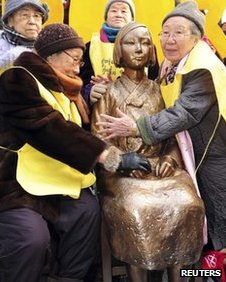 A statue was erected in South Korea in honor of its “comfort women” who were kidnapped to serve as sex slaves by the Japanese Military during World War 2. Japan’s extremely embarassed by the statue but still refuses to compensate the victims who are mostly in their 80s although some are as young as their mid 70s. The women have rallied in front of the Japanese embassy.
A group of the women and their supporters unveiled a statue of a girl in traditional costume there.
Demonstrators have rallied since 1992 outside the embassy to demand an apology and compensation from Japan.
Japan has repeatedly apologised and has offered lump-sum compensation, but many Koreans say this is not enough.
Japan also says the matter was settled in bilateral agreements with South Korea in the 1960s.
Up to 200,000 women are thought to have worked as sex slaves for the Japanese army in military camps before and during the war.
The vast majority of the women were Korean.
Japan has reportedly protested about the statue, but South Korean officials have said they cannot do anything about it.
Japan’s chief cabinet secretary, Osamu Fujimura, called the statue “extremely regrettable”, the Associated Press reports.
The blinds at the Japanese embassy were drawn shut – as they usually are for this weekly protest, reports the BBC’s Lucy Williamson in Seoul.
“[South Korean] President Lee Myung-bak cannot say he doesn’t know that white-haired grannies come out here, rain or shine, week after week,” said 85-year-old Kim Bok-dong, one of the former “comfort women”.
“President Lee should call on Japan to correct the wrongs of the past, so that things which need apologies can receive them, and compensation can be given,” she added.
About 60,000 Filipino women served as “comfort women” during the war. Only about 1000 survive today. You can read the story of one such woman from the Philippines at this site.
Felicidad was born on November 22, 1928 in Masbate, Philippines.
One day in 1943 three truckloads of Japanese soldiers from the garrison compound at the back of her school visited Felicidad’s class. Her Japanese teacher had organised the students to perform songs and dances for the visiting soldiers. The Japanese army often introduced Japanese civilian teachers into schools in its conquered territories.
Felicidad, then only 14, was made to sing. The following day her teacher told the class that the soldiers were so impressed with the students’ performance that they wanted to reward them. Felicidad was identified as one who was to be given an award and later that day two soldiers arrived to fetch her. They told her that she would be given the gift at the garrison. Thinking that there might be other students there, Felicidad went along. But when she got there, she did not see any of her school friends. Instead the only other women she saw were doing the soldiers’ cooking and laundry.
She became worried. She asked to leave. The two guards refused. Instead they took her to a small room in the compound and pushed her in. They told her that her gift was coming.
A few hours later five Japanese soldiers arrived. Three of them were in uniform and two in civilian clothes. One of them jumped onto her catching her by the arms and forcing her down onto the ground. When she struggled, another punched her in the face while another grabbed her legs and held them apart. Then they took it in turns to rape her.
Felicidad had no knowledge about sex. She did not even have her menstruation. So she did not understand what they were doing to her. She begged them to stop. But they just laughed and whenever she struggled or screamed, they would punch and kick her.
Confused and frightened and tired and in pain, she drifted in and out of consciousness. That night three more soldiers came and repeatedly raped her. For the next three days a succession of soldiers abused her.
The continual raping and beatings finally took their toll and on the third day she fell ill. Her body and mind could take it no more. But even though she was obviously sick, the abuse continued. Not even her fever drew pity from her rapists.
Finally on the morning of the fourth day, a Filipino interpreter working for the Japanese visited her. She told him she was very sick and wanted to go home to recover. Feeling sympathy for her, he let her out of the compound.
When she arrived home, her parents who had no idea where she was, cried after learning what had happened. Just the year before an older sister had been taken by the Japanese. She died in a comfort house.
Fearing the soldiers would come looking for her, her father hid her in a nearby village. She stayed there for about a year until the American army arrived.
After the War, Felicidad returned to her home town. But her experiences at the hands of the Japanese soldiers had left deep psychological scars. She found it hard to socialise and could not face going back to school. She felt dirty. She dared not tell anyone outside her parents. She was afraid of how others would view her if they knew the truth. So she buried it inside.
When she was 25 she moved to Manila where she met her husband. Before marrying, Felicidad decided she could not conceal her experiences from the man she was going to marry, so she told him.
They were married in 1956 and had six children and 15 grandchildren. But outside her husband, she told no one else for almost 37 years.
There have been some documentaries made about the women survivors. One such documentary is “63 Years On” which came out last year on the Korean women.
The number of Korean victims was estimated at between 80,000 and 200,000. Japanese government denied that they ran any such system until 1991 when a brave woman named Kim Hak-Soon came out and revealed the Japanese atrocities to the world. Japanese Governor General’s Office in Seoul incinerated all related documents before the closing of WWII.
A 1994 report shows that there are still hundreds of former sex slaves alive. Most of the are women of Asian countries occupied by Japan before and during the Pacific War. Among them are 160 South Koreans, 131 North Koreans, 100 Filipinos, 50 Taiwanese, 8 Indonesians, and two Malays. These numbers are only for those who revealed their real name.
There are much more victims living out there who do not want to identify their tragic past. Even after Korea’s liberation from Japan in 1945, many of the Korean victims chose to live in the Asian country where they were forced to serve sex to Japanese soldiers.
So, that gives you some things to think about. What’s on your reading and blogging list today?
The only thing worse than running out of oil
Posted: December 22, 2011 Filed under: Climate Change, Psychopaths in charge | Tags: energy, fracking, gas, independence, oil 17 CommentsIs not running out of oil.
This headline today is not good news: Does shale oil boom mean U.S. energy independence is near? Neither is this one that the US has a “200-year-supply” of coal. Nor these about all the fuel available in the Marcellus Shale, or the Canadian tar sands, or the Green River oil shale.
At this point it’s obvious to the meanest intelligence that burning fossil fuels adds greenhouse gases to the atmosphere, which causes climate change, which causes floods, fire, famine, pestilence, and war. It will kill billions of humans. I’ll repeat that. It will kill us. And I do mean “us.” Anybody who thinks they’ll be unaffected by the social consequences of global disasters is too dumb to last long in the hard new world. We are committing suicide.
We’re doing it right now. Not tomorrow. Not if things get worse. All we have to do is keep on doing what we’re doing.
Can I tell you a secret? Apparently, a lot of people don’t know this. Earth is the only planet we have.
Greenhouse gases are a gun pointed at our own heads. We have pulled the trigger.
But now comes the only good news: Planets work very slowly. The bullet has decades to travel. It’s already been traveling for about two centuries. Who knows how much more time we have? Probably minutes, but at least we’re not dead yet. If we did it very fast, we could move our heads out of the way.
Instead people write pleased headlines that more ways have been found to keep the bullet on track.
The whole species is headed for a Darwin Award. Except in this case it’ll be the planet whose survival is improved after we eliminate ourselves in an extraordinarily idiotic manner.
Crossposted from Acid Test
Women Front and Center in MENA Protests
Posted: December 22, 2011 Filed under: Bahrain, Egypt, Foreign Affairs, Tunisia, Violence against women, Women's Rights | Tags: women fighting fundamentalist religions, women in democracy protests, Women's Rights 4 Comments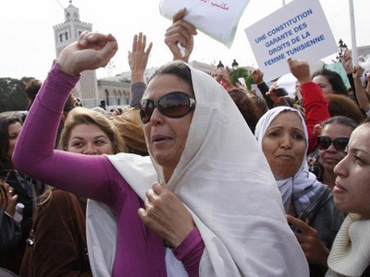 Many cultures in the MENA region are well-known for their horrible treatment of women. We see practices like honor killings, genital mutilation, and taking child brides. One of the offshoots of the Arab Spring has been the central role of women looking for broader participation in their countries.
Just as we in the United States are experiencing a political/fundamentalist Christian backlash that has turned into a war on the rights of women, the protests movements associated with the Jasmine Revolutions and their related political change have brought out a wave of political/fundamentalist Muslim backlash. There are several signs of hope in a region experiencing lots of social unrest. First, we’ve become aware of a large number of feminist leaders. Second, we’ve seen that many women are putting their lives on the line to ensure that the social change includes improving the lives and status of women. While oppression of women is frequently attached to fundamentalist religious followers, the roles of traditional tribal cultures and their dominance in places that are underdeveloped and rural–like Alabama or Uganda–cannot be underestimated. Here’s some stories that have made headlines recently that show the global struggle for women’s rights–like the US struggle for women’s rights–is still an uphill battle.
In response, thousands of women — and men — marched Tuesday in Cairo’s Tahrir Square. Observers say it was the largest demonstration of women in Egypt in decades. Not since 1919, when women mobilized under the leadership of feminist Hoda Sha’rawi in anti-colonial demonstrations against the British have so many Egyptian women taken to the streets. (After representing Egyptian women at the International Women Suffrage Alliance in Rome in 1923, Sha’rawi returned to Cairo and very publicly removed her veil.)
Women have played an important role in Egypt’s modern revolution but have struggled to translate their activism into a political role in the new, emerging system. They have been excluded from important decision-making bodies, and the military leadership declined to continue a Mubarak-era quota for women that ensured them at least 64 seats in parliament. Based on early election results, it appears that few women will win a place in the new government.
Nevertheless, one intrepid woman, Bothaina Kamel, is breaking ground with her candidacy for president. The campaign of Kamel, a well-known television presenter, at first was shocking, and certainly quixotic, with polls indicating her support is less than 1%. But her persistence has gained her credibility. While she has little chance of winning, she is helping to normalize the idea of women in politics — an idea that is deeply contested in Egyptian society. Leaders of Salafi parties, which gained a surprising 20% of the vote in the first rounds of elections, have spoken out against women running for office.
The recent women’s protest may breathe life into a movement that desperately needs new energy. In the early weeks of the revolution, women activists tried to bring attention to women’s issues but never succeeded in getting the masses behind them.
Tunisian women are also concerned about women’s rights since the country’s recent elections. The picture up top is from that country. Newly elected leaders have had to promise to recommit their country to modernization and democratic principals that include increased roles of women.
“We are all the women of Tunisia,” stated Professor Khalid Kshir of Tunis University in conversation with the author of this article. Professor Kshir is a member of the Democratic Modernist Pole, a coalition of leftist parties. He fears that the Ennahda party will push the country back instead of moving it forward.
Just a year ago, literally weeks before the start of the uprising in the country, Tunisians had joked that theirs was a country of free women and happy men. No other Arab nation had ever granted so many rights to women, fixed de jure and de facto, than Tunisia. That was something of which Tunisians were proud, and even boasted about. Today, many people in Tunisia fear that the country’s achievements on the road to becoming a modern society will be brought to nought.
”We need to focus all our efforts in the sphere of politics and culture on women’s rights, because women form half of our society and any infringement on their rights will be harmful to all of us,” Professor Kshir went on to say.
Strange as it may seem, the issue of women’s rights was also on the agenda of a conference on promoting tourism which took place in Tunisia early in November, shortly before the final election results were announced. The conference was organized by the Ennahda party, which decided not to wait for the National Constituent Assembly to convene and the government to be formed before holding a series of meetings with representatives of Tunisia’s major industries in order to lay out the priorities for getting the national economy out of its post-revolution stupor. The discussion on the prospects for yourism was among the first meetings to be held, along with a conference on the financial market, co-sponsored by Tunisia’s Brokers’ Association.
…
The party leader’s comforting assurance came in response to concerns expressed by travel agencies, tour operators, hoteliers and bankers at the meeting, who voiced questions such as, “What will be Tunisia’s international image following your electoral victory? What will happen to women’s rights? How will European tourists feel in Tunisia, and do they have a reason to fear Islamists?”
What started as a discussion on the prospects of tourism eventually escalated into a broader deliberation on Tunisia’s prospective path of development. There are strong reasons for such an interconnection: tourism accounts for six per cent of Tunisia’s GDP and makes up 60 per cent of the national trade deficit. The industry employs 12 per cent of the country’s working population, while one in eight Tunisian families live off tourism, one way or another. During the revolutionary turmoil which rocked the country between January and September 2011, tourism revenues in Tunisia plunged by 38.5 per cent compared to a similar period in 2010, while the overall number of tourists coming to Tunisia sank by 34.4 per cent.
That is why at present Ennahda is ready for dialogue and compromise. “We guarantee freedom in food, drink and clothes,” Hamadi Jebali said.
He emphasized that his party would respect democratic principles and that Tunisian society would retain its progressive nature. According to Jebali, the revolution took place in the name of improving the lives of Tunisian citizens and moving the country forward rather than hindering its development.
Many of those present at the conference believed the words of the Ennahda leader – or said that they did. “I believe Jebali. I am an optimist but only on condition that the rights of women won’t be violated and if we don’t follow the path of Saudi Arabia where a woman can do business but is forbidden to drive a car,” Sihem Zaiem, a member of the Federation of Tourist Agencies, said after the conference.
Delegates applauded her when she demanded that the Ennahda secretary-general explain Tunisia’s true face to the world as soon as possible, and demonstrate Islamists’ attitude to women’s rights. Jebali promised that nothing would change in the arena of women’s rights. His speech was very convincing.
A mother in Bahrain has gone to jail for playing revolutionary music and participating in protests.
Fadhila Al Mubarak, a 38-year-old mother of a 9-year-old boy, is still in jail after she was sentenced in an unfair military trial for charges related directly to exercising her right to freedom of expression and peaceful assembly. She was detained and prosecuted in a military court for playing revolutionary music in her car, trying to save her son and nieces, participating in peaceful protests in Pearl Roundabout and writing a poem to her son about the revolution, freedom and fighting for his future. The information available on the conditions of her detention is very worrying and her family has raised concerns over her health.
Fadhila, who was living with her husband and her son in the area of Aali, was arrested on 27 March 2011, just a few days after the National Safety Law was imposed on 15 March 2011. She was arrested at a checkpoint because there was an audio recording of revolutionary songs playing in her car. She was asked to pull over her car and step out. They insulted her, called her names and cursed her. While security officers at the checkpoint were talking to her, a man in civilian clothing tried to get into her car. In fear over the safety of the children, her son (9), nieces (14 – 15), she pulled him away thinking he was a thug who would kidnap or hurt them. Later, she found out he was a police officer.
Her family asked about her at police stations close to the checkpoint where she was arrested only to find out after four days that she was held in Riffa police station. She was later transferred to Isa Town women’s prison. During the period of her detention, her family had no contact with her and was not allowed to visit or talk to her over phone. Family members tried to appoint her a lawyer, a request that was rejected by the military court.
Women in the region can take heart from the post revolutionary experience of Indonesia’s women who have managed to get many advances since their repression by former president Soeharto following a 1965 tragedy. Indonesia is the world’s largest Muslim majority democracy. As with all countries, religious fundamentalists obsessed with old testament prohibitions continue to seek repression of women. However, Indonesian laws continue to reflect the country’s will to improve conditions for women. The current president seems to be backsliding on reforms gained during the tenure of Indonesia’s previous PM.
Of course, like the feminists have suggested, the Reform Era in 1998 has given women opportunities to revive the real spirit of Kartini. However, as Mariana suggested, the Reform Era was nothing but “a short-term honeymoon” moment for women’s movement.
When the late former president Abdurrahman Wahid changed the name of the ministry of women affairs into the ministry of women’s empowerment, for example, feminists felt very confident about their cause. In addition to that, the National Commission on Violence Against Women (Komnas Perempuan) was given full support to continue its investigation into the May 1998 tragedy, where many Chinese women were sexually abused.
“During Megawati’s era, we were more enthusiastic because the first woman was finally installed as a president amid opposition from some religious leaders,” Mariana said. “Megawati then also succeeded in passing the law on domestic violence.”
Celebrating women’s achievement even more, she added, was the policy of granting women a 30 percent quota of seats in the Parliament.
However, this celebration of women’s movement had to end in 2005, when Susilo Bambang Yu-dhoyono won his first presidential term.
“The year marked the introduction of the pornography bill, which was mentioned by President SBY during his first [presidential] speech,” said Mariana. “He even took the opportunity to comment about women’s belly buttons!”
And from that moment on, she went on, the women’s movement in Indonesia started to lose its ground. While battling against the criminalization of women, feminists have been labeled as “Western devilish agents”, gaining a bad reputation in society.
It seems that vigilance of women over their rights in all democracies is important. That is why it is important that women officials with high public profiles–like US SOS Hillary Clinton–continue to keep their focus on the rights of women and also GLBT rights aound the world. The world’s religious fundamentalists continue to press for backsliding. Religious fanatics push for edicts that can run the gambit from defining an egg as a person to hold women’s bodies hostage to narrow religious views of ‘life’ as in seen in Arkansas recently. There are also the many Sub-Saharan African nations–like Nigeria and Uganda–where laws ignore or encourage violence against GLBT because of both Muslim and Christian extremists in the regions. The latter example has been funded for and encouraged by US fundamentalist Christians which is even a more outrageous intervention than just resurrecting or perpetuating native tribal traditions like the child bride tradition which is also a problem in places like highly Christian Guatemala as well as Western African countries.
SOS Clinton strongly condemned the treatment of women protestors by Egyptian security forces this week. It is heartening to see her speak out for women’s full participation in democratic movements and governance.
In unusually strong language, the US secretary of state accused Egypt’s new leaders of mistreatment of women both on the street and in politics since the street revolt nearly a year ago that overthrew leader Hosni Mubarak.
“This systematic degradation of Egyptian women dishonours the revolution, disgraces the state and its uniform and is not worthy of a great people,” Mrs Clinton said in a speech at Georgetown University.
In images widely seen over YouTube, helmeted troops were shown beating a veiled woman after having ripped her clothes off to reveal her bra and stomach.
Other pictures circulating on social media networks that have enraged protesters include one of a military policeman looming over a sobbing elderly woman with his truncheon.
“Recent events in Egypt have been particularly shocking. Women are being beaten and humiliated in the same streets where they risked their lives for the revolution only a few short months ago,” Mrs Clinton said.
Here is the PBS NEWSHOUR coverage of the Egyptian Women’s protests and an interview with participant May Nabil. It has some interesting narrative of the march in that many woman spontaneously joined the march and weren’t just drawn to it via internet. Additionally, there were many supportive Egyptian men in attendance.

 peej
peej Carissa
 bostonboomer
 dakinikat
 ecocatwoman
 mablue2
 Mama Lopez
 peggysue22
 quixote
 skydancingguestblogger
 Mona (aka Wonk the Vote)



 Sky Dancing
Recent Comments