
Why don’t Science and Reason prevail over Superstitions and Ideological Wishful Thinking?
Posted: December 30, 2011 Filed under: just because | Tags: ideology, kat rant, reason, science 21 CommentsPaul Krugman asks one more time why over 80 years of economic study, data, and theory have been thrown to the wind for failed ideological hypotheses. He asks why conventional wisdom denies  everything that thousands of economists have studied, researched, and debated that now has become accepted theory? Our current experience shows that what we’ve learned over the years is correct. Why are failed hypotheses based on ideological wishful thinking running policy these days? I ask this about my own discipline, but we could just as well ask about why we have to fight to keep iron age myths out of biology classes and fight to keep basic scientific theory like evolution and climate science in? Why do people keep relying on disproved hypotheses, conspiracy theories, and absolutely outdated religious stories?
Here’s the narrative that applies to my discipline from Krugman.
Unfortunately, in late 2010 and early 2011, politicians and policy makers in much of the Western world believed that they knew better, that we should focus on deficits, not jobs, even though our economies had barely begun to recover from the slump that followed the financial crisis. And by acting on that anti-Keynesian belief, they ended up proving Keynes right all over again.
In declaring Keynesian economics vindicated I am, of course, at odds with conventional wisdom. In Washington, in particular, the failure of the Obama stimulus package to produce an employment boom is generally seen as having proved that government spending can’t create jobs. But those of us who did the math realized, right from the beginning, that the Recovery and Reinvestment Act of 2009 (more than a third of which, by the way, took the relatively ineffective form of tax cuts) was much too small given the depth of the slump. And we also predicted the resulting political backlash.
So the real test of Keynesian economics hasn’t come from the half-hearted efforts of the U.S. federal government to boost the economy, which were largely offset by cuts at the state and local levels. It has, instead, come from European nations like Greece and Ireland that had to impose savage fiscal austerity as a condition for receiving emergency loans — and have suffered Depression-level economic slumps, with real G.D.P. in both countries down by double digits.
The stupidity is killing our economy. The stupidity is also forcing medical research back to the dark ages too. Taliban-like forces in the US have made up research that says that fetuses with no developed central nervous systems ‘feel pain’. They have invented bogus ‘partial birth abortion’ procedures out of thin air. They’ve even based laws on these falsehoods. We have crazies defining zygotes as fully functional human beings with some narrative that a fertilized egg is just some little microscopic person encased in a membrane.
We have tons of Taliban-like idiots trying to convince every one that the data on global warming is just some made up agenda. Yet, tons of biologists have studied and published research articles on the radical changes in habitat and migration patterns. Meteorologists have reams of data showing the extremes in weather and temperatures that have shifted significantly in statistical terms. It is so pervasive and significant that no scientist that’s not associated with some whacky religion denies global warming. Geologists have documented the changes in water levels and ice formations. Yet, I can still read some one that notes one cold day in summer and on the basis of that anecdote declares global warming to be a hoax. They obviously don’t understand that extreme cold in one area of the globe means extreme heat someplace else. However, some one without one college science course can get on TV and proclaim an entire discipline to be deluded.
One possible answer to my question is there is an evil partnership of corporations and the rich who profit from ignorance and those who follow strict religious ideology who thrive on ignorance period. These folks have overwhelming political power and access to media. The media these days refuses to call out lies and fact check blowhards. They bring on a politician or a media pundit but NEVER an actual scientist with years of learning and research in the area. The media even goes along by repeating the change in word meanings that have plagued us recently. Radical ideas are being put forth as “conservative”. Conspiracy theories are being held up as just another point of view. Ever since media has been driven by profits, we have media more interested in ratings and not getting boycotted than actually putting out some useful information. It is no wonder that we are seeing a systematic destruction of public schools and universities. The only way this march of ignorance can continue is with a systematic destruction of institutions that actually teach science to people. There has never been a time when this quote by Jonathan Swift is more relevant since the Dark Ages which were brought on by the same group of religious nuts that tanked scientific thought hundreds of years ago.
“When a true genius appears in the world, you may know him by this sign, that the dunces are all in confederacy against him.”
The same thing can be said about true and genius theories. The confederacy of dunces will thump their books full of myths and conspiracies and deny people access to science, reason, and truth.
Here’s a pretty good list of how insane the Republican Party has become in terms of irrational, unscientific, and unreasonable positions per the UK’s The Economist. Notice the use of the term “fatwahs” which implies they’re waging a religious war. Also please remember that this magazine is not exactly a bastion of socialist thought.
Nowadays, a candidate must believe not just some but all of the following things: that abortion should be illegal in all cases; that gay marriage must be banned even in states that want it; that the 12m illegal immigrants, even those who have lived in America for decades, must all be sent home; that the 46m people who lack health insurance have only themselves to blame; that global warming is a conspiracy; that any form of gun control is unconstitutional; that any form of tax increase must be vetoed, even if the increase is only the cancelling of an expensive and market-distorting perk; that Israel can do no wrong and the “so-called Palestinians”, to use Mr Gingrich’s term, can do no right; that the Environmental Protection Agency, the Department of Education and others whose names you do not have to remember should be abolished.
These fatwas explain the rum list of candidates: you either have to be an unelectable extremist who genuinely believes all this, or a dissembler prepared to tie yourself in ever more elaborate knots (the flexible Mr Romney). Several promisingly pragmatic governors, including Mitch Daniels, Chris Christie and Jeb Bush, never even sought the nomination. Jon Huntsman, the closest thing to a moderate in the race (who supports gay marriage and action to combat climate change), is polling in low single figures.
More depressingly, the fatwas have stifled ideas, making the Republican Party the enemy of creative positions it once pioneered. The idea of requiring every American to carry health insurance (thus broadening the insurance pool and reducing costs) originated in the conservative Heritage Foundation as a response to Clinton-care, and was put into practice by then-Governor Romney in Massachusetts. All this Mr Romney has had to disavow, just as Mr Gingrich has had to recant his ideas on climate change, while Rick Perry is still explaining his appalling laxity as governor of Texas in allowing the children of illegal immigrants to receive subsidised college education.
WTF is wrong with our country? Our religious freedom was enshrined in the first amendment. Our scientific advances led to men on the moon, the elimination of some of the world’s worst plagues, and the lap top computer. Our melting pot of people fleeing class systems and oppression all over the place evolved into a great democracy that provided public education for all and opportunity for any one that wanted it. Why has it come down to this?
Friday Reads
Posted: December 30, 2011 Filed under: morning reads | Tags: Dennis Kucinich, Marcy Kaptur, Racism, Ron Paul, Stormfront, TCE, Toxic Bronx school 14 Comments Good Morning!!
So, we’re getting close to yet another election year. Our challenges are fairly clear but our choices are limited. I only wish the opposite were true.
This Bronx factory turned school has evidently been in the news for a few months. It’s just one horrifying story after another. What would possess a school district to use a factory to house kids without testing it for toxic chemicals? A teacher is now suing the district after she had to terminate a pregnancy due to a horrible brain defect.
A TEACHER WHO worked at a toxic Bronx school lost her baby to birth defects linked to the contamination, she charged Wednesday in legal papers.
In October, five months into her pregnancy, Nancy Tomassi, a fifthgrade teacher at the shuttered Public School 51, learned her baby had a malformed brain, a condition called anencephaly, and would not survive.
The tests done in January showed that the sick school was laden with the carcinogen trichloroethylene, a toxin linked to defects, but failed to warn students or teachers until July.
“The whole tragic nature of the situation was made worse by the fact it could have been avoided if the Department of Education had acted properly,” said Tomassi’s lawyer Jeff Schietzelt, with the firm Silverson, Pareres & Lombardi. He notified the city of her intent to sue on Wednesday.
“How could they have known since January and not have told us?” said Mike Tomassi, Nancy’s husband. “You’re heartbroken and at some point you’re angry.”
For Tomassi, the diagnosis meant she had to end the pregnancy.
When researching possible causes, she found information to suggest the toxic chemical found at the sick school was responsible for her tragedy.
“If wed known about this, things could have been different,” said Tomassi, who worked at the school for five years.
A diligent nurse has evidently been documenting and reporting student illnesses since 2005. She even took the steps to write a superior about possible immune deficiencies in students which she thought might be due to a faulty heating/ac system. The reports of sick children number in the hundreds.
Students at a Bronx elementary school that relocated in September due to toxic contamination had for years complained of headaches, dizziness and other illnesses.
Records obtained by the Daily News under the Freedom of Information Law show that since 2005 nurses at the Bronx New School logged cases of kids suffering headaches, vomiting, abnormal gaits or even seizures nearly every month.
In May 2007, 16 students vomited at the Jerome Ave. school, records show. During one spell in November 2010, nurses listed five cases of students with heart “palpitations.” And in the late 1990s, one student suddenly died of kidney failure.
Toxic levels of TCE–in industrial degreaser–were found in the building. The school was closed in the fall but the report came in around January. This is just one of those stories you think would’ve gone away after all of the work done in the 1970s to make buildings and the environment safer. What do you want to bet that the PLUBS are more upset about the abortion of a nonviable fetus than the rest of the living sick children?
I’ve been calling Ron Paul a neoconfederate for years now. It looks like White supremicist group Stormfront–with whom Paul has taken pictures with the leaders–thought he was one of them too. Paul’s been distancing himself from the newsletters since he developed presidential aspirations.
Ron Paul was a hot topic this week on the talk radio show hosted by prominent white supremacist Don Black and his son Derek. Mr. Black said he received Mr. Paul’s controversial newsletters when they were first published about two decades ago and described how the publications were perceived by members of the white supremacist movement. Former KKK Grand Wizard and Louisiana Congressman David Duke also phoned in to explain why he’s voting for Mr. Paul.
“Everybody, all of us back in the 80′s and 90′s, felt Ron Paul was, you know, unusual in that he had actually been a Congressman, that he was one of us and now, of course, that he has this broad demographic–broad base of support,” Mr. Black said on his broadcast yesterday.
Mr. Black is a former Klansman and member of the American Nazi Party who founded the “white nationalist” website Stormfront in 1995. He donated to Mr. Paul in 2007 and has been photographed with the candidate. Mr. Paul has vocal supporters in Stormfront’s online forum. Mr. Black has repeatedly said he doesn’t currently think Mr. Paul is a “white nationalist.”
Mr. Paul’s newsletters contained threats of a “coming race war,” worries about America’s “disappearing white majority and warning against “the federal-homosexual cover-up on AIDS.” He has since denied writing the newsletters, which appeared under his own name.
“I didn’t write them, I disavow them, that’s it,” Mr. Paul said in a tense CNN interview.
On Monday, Mr. Black said he originally believed the newsletters were written by Mr. Paul.
“They went out under his name in the first person and most people receiving these newsletters, including me, thought he really did write them,” Mr. Black said.
Ron Paul on Thursday downplayed the fringe aspects of his old newsletters, saying on an Iowa radio program that the most offensive passages were probably only a small portion of the overall content.
“There were many times I did not edit the entire letter and other things were put in,” he told a caller on the Jan Mickelson radio show. “I was not aware of the details until many years later. These were sentences that were put in, eight or 10 sentences. It wasn’t a reflection of my views at all. It got in the letter and I thought it was terrible.”
He added that the newsletter content in question was “probably ten sentences out of 10,000 pages,” and that he only focused on producing the “economics” part of the publication.
But the promotional materials advertising the newsletter from the time indicate that the most out-there racist and homophobic lines were far from a rare sideshow.
One 1993 direct mail piece aimed at attracting potential subscribers name-checked “the coming race war,” “the federal-homosexual cover up on AIDS,” “the Israeli lobby that plays Congress like a cheap harmonica,” and described an elaborate conspiracy theory in which US officials would use newly introduced currency to impose martial law. All in just eight pages specifically devoted to summarizing the newsletter’s broader themes for new readers. That’s a pretty high density of fringe.
Jamie Kirchick, who compiled the newsletters four years ago, told TPM that the most incendiary parts were hardly stray cases.
“Ron Paul’s characterization of the newsletters as only containing ‘eight to ten sentences’ that can be characterized as ‘offending’ is preposterous,” he said in an e-mail. “As anyone can see from the scans of the newsletters available on the TNR website or posted elsewhere, the documents contain pages upon pages of bigoted statements and outright paranoia.”
Maybe we should send him some white sheets and see if he wants to make a fashion statement out of them.
U.S. Representatives Dennis Kucinich and Marcy Kaptur, both Democrats, will run against each other for their party’s nomination next year to represent a reconfigured Ohio congressional district.
Kaptur’s current district includes Toledo and extends east toward Cleveland. Kucinich represents parts of Cleveland and its suburbs. Both filed papers today with the Cuyahoga County Board of Elections in Cleveland to run in the March 6 primary to be the Democratic nominee in the redrawn district, the election board said.
Ohio’s number of House seats was reduced to 16 from 18 following the 2010 U.S. Census.
Kucinich, 65, said he would try to avoid attacks on his fellow Democrat.
Economist Jared Bernstein has a great set of wonky graphs up that he’s called “Guideposts on the Road back to Factville”. He has a large number of them that demonstrate that the US is a low tax country, has extremely high income inequality, and that Dubya’s policies caused the huge federal deficit. Included is this advice as well as some interesting links. My favorite one is this one that shows how good the one percent have it here compared to the other developed nations. Too bad our middle and working class Americans don’t have similar blessings.
Arm yourselves with the knowledge herein, and you’ll be immune to the fact-free hand-waving that too often passes for debate these daze. Think of them not as wonky graphs, but as guideposts on the road back to the land where facts matter.
So, that’s my contributions this morning to get the conversations started off right. What’s on your reading and blogging list today?
Our Future is Calling
Posted: December 29, 2011 Filed under: Economic Develpment, Economy | Tags: aggregate demand problems, infrastructure, Keynesian Economics 9 CommentsThe massive loss of economic value that has occurred so far this century should give us pause when we hear about both austerity agendas and slightly improved conditions. Economist Dean  Baker reminds us that we’re not looking at clear steering ahead even if we slowly mend. Here are some things to consider. The incredible loss of wealth on the kinds of investments made by average Americans and from the collapse of the housing market has severely weakened millions of Americans and decreased their net worth. Statistics like these are likely to keep older workers on the jobs far past their prime. Baker responds to Daily Beast writer Zachary Karabell.
The unemployment rate for the year is likely to average above 9.0 percent. The number of people who are involuntarily underemployed has generally been 8.5 and 9.0 million, close to double the pre-recession level. Millions more have given up looking for work altogether. Real wages have been stagnant or falling for the last 4 years, with little prospect of turning around any time soon as the high rate of unemployment continues to depress wages.
In addition, tens of millions of baby boomers are approaching retirement with almost nothing to support themselves other than their Social Security. According to a recent study by the Pew Research Center, the median older baby boomer (ages 55-64) had just $162,000 in wealth. This is roughly enough to buy the median home. This means that if this household took all of their wealth, they can pay off their mortgage. They would then be completely dependent on their Social Security to support them in retirement. And, half of older baby boomers have less wealth than this.
In short, most of the country is looking at a situation where they are desperate for work or fearful about losing their job. Older workers are looking at a retirement where they are not far above the poverty level, even after spending a life working in middle class jobs. The bad attitudes toward this situation are not the result of “groupthink” as the column asserts, they are the conclusion of people better able to understand the economy than Karabell.
For extra credit in the acting up department Karabell throws in a few broad assertions that are simply wrong. For example he tells us that:
“Overall growth for the next year is shaping up to be 2 percent, give or take. That is pretty lame compared to the heady days of the 1990s or even the mid-2000s. But those seemingly halcyon periods benefited from bubbles, whether the stock market and telecom spending in the 1990s or the housing and debt-inflated growth of the mid-2000s. So while activity now doesn’t look so good by those comparisons, it is actual economic activity undistorted by bubbles. It’s as if the economy of the past 20 years was wearing platform shoes (“Wow, she’s like 6 feet tall”); it looked a lot bigger than it was.”
Actually 2.0 percent annual growth would look bad compared to the 80s, the 70s, the 60s, and the 50s. It is simply a very bad growth rate. Trend productivity growth in the U.S. is between 2.0 and 2.5 percent. Labor force growth is averaging around 0.7 percent. This means that we need growth of around 2.5 -3.0 percent just to keep even with the growth of the labor force. At a 2.0 percent growth rate unemployment will be rising, not falling. This has nothing to with platform shoes, it’s arithmetic.
Furthermore, given the severity of the downturn we should be seeing growth in a 5-8 percent range to get the economy back to its potential level of output. People should be outraged at the thought that the economy might only grow at a 2.0 percent rate.
Lengthened work lives and growth too small to replace jobs lost over the last five years is likely to keep pressure on younger workers. Even younger workers that are well educated and should have decent job skills are not able to find decent, well-paying jobs in this economy. They also have made huge investments in their educations and are carrying high levels of student loan debt. The Atlantic Wire says that we may have a ‘lost generation’ in the making.
During the last decade, the unemployment rate for young people spiked to the highest levels since World War II–only 55 percent of Americans aged 16 to 29 have jobs, a 12 percent drop from the employment rate in 2000. Faced with a grim outlook, many young people aren’t leaving home until their 30s–the number of Americans aged 25 to 34 living with their parents jumped 25 percent during the recession. Last month, The New York Timescalled the collective youth “Generation Limbo,” but after seeing the new census data, Harvard economist Richard Freeman takes it a stage further. “These people will be scarred, and they will be called the ‘lost generation’–in that their careers would not be the same way if we had avoided this economic disaster,” Freeman told The Associated Press. The world has seen a number of lost generations in the past century. Gertrude Stein first coined the term in 1920s in reference to the Europeans who grew up during World War I, but it’s most recently referred to Japanese youth who grew up during that country’s recession in the 1990s. In Japan, the lost youth are referred to as the hikikomori, and the decade of widespread unemployment meant that many of them never had the chance to start careers. In the 10 years of recession in Japan the number of young people working temporary or contract jobs doubled, and the collective hopelessness lead to a sky-rocketing suicide rate.
A country with an economy that relies heavily on household spending cannot thrive and grow under these scenarios. It is well known in macroeconomic research that high, sustained levels of unemployment have a multiplying impact on the rate of economic growth. An economic forecast prepared by Goldman Sachs considers government policy an “impediment to growth”. Fiscal tightening on both the state and national level will make things much worse.
Given the fiscal outlook remains difficult, we believe we’re unlikely to get further stimulus, and that government will continue to be a modest drag on growth. We believe we will see an increase in the rate of fiscal tightening at the federal level over the next couple of years. Fiscal policy was a boost in 2009, roughly neutral in 2010, and in 2011, roughly a 1 percentage point drag. In 2012, the impact depends on upcoming policy decisions. At best from a short-term perspective, if the Obama administration’s package passed, which seems quite unlikely, fiscal drag would be neutralized; at worst, if all temporary stimulus expires, we’d expect a fiscal drag of more than 1 1/2 percentage points of growth in early 2012. The more likely, middle ground outcome: the administration and Congress agree on tax-related proposals and probably extend the one-year payroll tax cut for one more year. There will be a bigger problem in 2013 with the expiration of the Bush tax cuts, as well as any fiscal stimulus measures.
I think it’s rather telling to characterize our government as a drag on economic growth. It’s clear that partisan politics have put elections and ideology ahead of any concern for the future of our country. Nothing we’re talking about here is something that shouldn’t be known by folks who had an introductory university economics courses. We’re unfortunately captured by a group of people in power that have no concern for the good of the country as a whole. 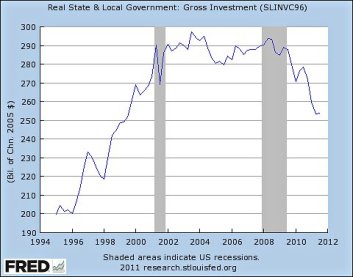
Paul Krugman put up this graph showing the level of Gross Investment by State and Local Governments. This would be the kinds of infrastructure that support modern life as we know it and include things like roads, bridges, new school buildings, sewers, airports, and other things that also drive local business growth. As you can see, there is a serious lack of infrastructure investments by state and local governments this century. Since interest rates are cheap, now is a good time to do these kinds of long term projects that would provide jobs and incentives for local businesses to expand. The majority of our states have balanced budget amendments which disallow deficit spending and in some cases, borrowing. Long term investment is nearly impossible in many states. Krugman argues that the timing is right to invest in roads, bridges, airports, and other important public projects. It’s a perfect time to look at an Infrastructure Bank which had broad bipartisan support during the Bush/Cheney years. President Obama has proposed such an institution.
The proposal, modeled after a bipartisan bill in the Senate, would take $10 billion in start-up money and identify transportation, water or energy projects that lack funding. Eligible projects would need to be worth at least $100 million and provide “a clear public benefit.” The bank would then work with private investors to finance the project through cheap long-term loans or loan guarantees, with the government picking up no more than half the tab — ideally, much less — for any given project.
There is still this insane argument out there that the US is going broke and can’t afford to spend any money. This confuses the institution of government with households and businesses. A government has the ability tax and the national government has the ability to print money and borrow in perpetuity. This country spent far more of its future output during the Great Depression and World War 2 and the results speak for themselves. We’ve had most of this decade’s fiscal policy using taxes to encourage gambling for paper profits, not actual production of goods and services. Europe’s policy makers are stuck in the same mindset. You would think that the experiences between the two world wars would’ve made an impression on them. We’ve spent trillions of dollars propping up the world’s gambling houses without telling them they must lend for productive purposes as a condition of those bailouts. I have no idea how many more years that economists will have to scream that it’s the aggregate demand stupid at policy makers, but I have a feeling we won’t be stopping any time soon.
Thursday Reads: Primary Season is Upon Us
Posted: December 29, 2011 Filed under: 2012 presidential campaign, Republican presidential politics, Surreality, U.S. Politics | Tags: Iowa Caucuses, Michele Bachmann, Mitt Romney, New Hampshire primary, Newt Gingrich, Rick Santorum, Ron Paul 41 Comments
Good Morning!!
It’s hard to believe, but the Iowa Caucuses are just a few days away, next Tuesday, January 3. The New Hampshire primary will be held on January 10. The South Carolina and Florida primaries will be on January 21 and 31 respectively.
I’ll be focusing on the Republican primary campaign this morning, but please do post links to other stories that interest you in the comments.
Unfortunately, there’s no primary contest on the Democratic side, so we’re reduced to watching the Republicans. The good news is that the Republican candidates are entertaining to watch–that is, if your taste in entertainment runs toward the bizarre, the ironic, and the surreal and if you enjoy black humor.
Yesterday morning’s PPP poll showed Ron Paul still leading in Iowa.
The last week and a half has brought little change in the standings for the Iowa Republican caucus: Ron Paul continues to lead Mitt Romney by a modest margin, 24-20. Newt Gingrich is in 3rd at 13% followed by Michele Bachmann at 11%, Rick Perry and Rick Santorum at 10%, Jon Huntsman at 4%, and Buddy Roemer at 2%.
Paul’s strength in Iowa continues to depend on a coalition of voters that’s pretty unusual for a Republican in the state. Romney leads 22-20 with those who are actually Republicans, while Paul has a 39-12 advantage with the 24% who are either independents or Democrats. GOP caucus voters tend to skew old, and Romney has a 34-12 advantage with seniors. But Paul’s candidacy looks like it’s going to attract an unusual number of younger voters to the caucus this year, and with those under 45 he has a 35-11 advantage on Romney. The independent/young voter combo worked for Barack Obama in securing an unexpectedly large victory on the Democratic side in 2008 and it may be Paul’s winning equation in 2012.
The poll showed that Paul’s supporters are much more “passionate” than Romney’s, and Romney’s approval rating with Iowa voters had dropped from 49 to 44 percent. Interestingly, Romney is doing well with Fox News watchers, while Paul does much better with voters who don’t watch Fox.
Later in the day yesterday, the CNN/Time/ORC poll showed Romney ahead of Paul with likely Caucus-goers 25 to 22 percent, with Gingrich continuing to lose support rapidly and Rick Santorum surging, as Gingrich supporters move to him.
A new survey of people likely to attend Iowa’s Republican caucuses indicates that the former House speaker’s support in the Hawkeye State is plunging. And according to a CNN/Time/ORC International Poll, one-time long shot candidate Rick Santorum has more than tripled his support since the beginning of the month.
Twenty-five percent of people questioned say if the caucuses were held today, they’d most likely back Mitt Romney, with 22% saying they’d support Rep. Ron Paul of Texas. Romney’s three point margin is within the poll’s sampling error….
In Iowa, both Romney and Paul are each up five points among likely caucus goers from a CNN/Time/ORC poll conducted at the start of December. The new survey indicates that Santorum, the former senator from Pennsylvania, is at 16% support, up 11 points from the beginning of the month, with Gingrich at 14%, down from 33% in the previous poll. Since Gingrich’s rise late last month and early this month in both national and early voting state surveys, he’s come under attack by many of the rival campaigns.
Santorum’s increasing support is coming mostly from the right wing Christians.
“Most of Santorum’s gains have come among likely caucus participants who are born-again or evangelical, and he now tops the list among that crucial voting bloc, with support from 22% of born-agains compared to 18% for Paul, 16% for Romney, and 14% for Gingrich,” says CNN Polling Director Keating Holland.
It certainly looks like Iowa tea party voters are still seeking an anti-Romney candidate to get behind. The CNN/Time/ORC poll also sampled New Hampshire voters and found Romney still leading there.
Establishment Republicans are rooting hard for Mitt Romney. Everyone on Morning Joe yesterday was confident that he would eventually take the nomination. At Politico, Maggie Haberman, Jonathan Martin, and Alexander Burns report that Romney is “within striking distance” of winning Iowa.
Even as he tried to keep talk about his prospects in check Tuesday, a slew of public and private polling and anecdotal evidence on the ground suggests that Romney is within striking distance of a first-place finish in Iowa — especially as Ron Paul’s momentum spurt appears to have run into the reality of front-runners’ scrutiny.
Romney’s team is moving to make the most of it. The candidate launched a bus tour Tuesday and suggested on a conference call with Iowans this week that he’ll be in the state for New Year’s Eve. After a solid ad buy in Iowa for a month totaling more than $1.1 million, Romney’s camp has upped its spending in the Quad Cities market, sources familiar with the purchase told POLITICO. His team has dropped a collection of mail pieces, both positive about Romney and negative about the perceived closest alternative — Newt Gingrich.
In another clear sign he’s playing to win, he has quietly moved a handful of staffers from his headquarters in Boston and in other states earlier this month to give his skeleton Iowa staff a needed boost. And he’s cycling in a platoon of high-profile surrogates to rally around him in the state at stump stops and on talk radio, including Gov. Chris Christie, Sen. John Thune, Rep. Aaron Schock and former Sens. Norm Coleman and Jim Talent.
At Philly.com, blogger Erik Uliasz argues that Ron Paul will win in Iowa, because he has the best organization in the state.
The caucuses are not won by opinion polls alone. They’re won by the politician who can pack Iowa’s churches, libraries and community centers at 7 p.m. exactly on a frigid January Tuesday, and whose supporters won’t suddenly decide to back a different candidate during an hour’s worth of jawing, dealing and very public voting.
Unlike other “flavors of the week” of the GOP contest, Paul hasn’t surged into the lead all of a sudden — he’s grown his support gradually, earning supporters the hard way.
And that’s why Paul’s surge to first place has to be taken seriously. Alone among the candidates, he has built an organizational machine to recruit and identify caucus-goers and turn them out on Jan. 3. Paul’s rise in Iowa isn’t a bubble. It’s a mound, and it is rock solid….
Paul’s campaign has built a sophisticated voter turnout machine. With its intensely dedicated core of youthful followers recruiting non-party regulars to the caucus electorate, it is reminiscent of nothing so much as Barack Obama’s 2008 Iowa campaign, which was his springboard to the Democratic nomination.
In addition, the fact that there are no candidates competing with Obama in the Democratic caucuses will help Paul. Much of his support comes from Democrats and Independents (see PPP poll results above), and they can attend the Republican caucuses.
At CNN though, Micah Sifry writes that “Paulbots,” who sound remarkably like the Obots of 2008, might “torpedo” his campaign by being too obnoxious and too up front about Paul’s real beliefs, as reflected in the recently released old newsletters. Sifry writes that
there’s a paradox buried inside Paul’s rise in the Republican field, a time bomb ticking away. Call it the curse of the “Paulbots.”
The more Paul rises, the more he needs to temper his rhetoric and fine-tune his message (especially given the kind of baggage he carries). And the more he needs a fine-tuned message, the more he has to control his fractious fans. But people who organize themselves online today are notoriously hard to control.
They sure do sound like Obots:
Recall how in 2007, the “Paulbots” were everywhere: running up the numbers on every online poll they could find, generating one-day fundraising records in a desperate bid for national attention (they coined the word “money-bomb”), and creating massive amounts of voter-generated media on his behalf. They made everything from viral videos to a Ron Paul blimp….
This year the Paulbots have been a bit calmer and more under the radar says Sifry.
But things are about to get a bit crazy. Paul’s late surge and possible win next week in Iowa are going to generate a huge burst of national media attention and plenty of hard-edged questions about his past and views. And the Paulbot base doesn’t handle criticism very well.
The other day, for example, my techPresident colleague Sarah Lai Stirland reported on a growing battle breaking out on the massive social news filtering site Reddit between Paul supporters and critics tired of their efforts to “spam” Redditors with slanted news favoring Paul. Vocal Paul supporters outnumber their critics on the site, but their language and tactics are often arrogant and ugly. Passion can power a campaign, but self-righteousness can also cripple it.
Here’s a little sample of the kinds of information the Paul people might not want spread far and wide in the national media. From Talking Points Memo:
Paul’s Iowa chair, Drew Ivers, recently touted the endorsement of Rev. Phillip G. Kayser, a pastor at the Dominion Covenant Church in Nebraska who also draws members from Iowa, putting out a press release praising “the enlightening statements he makes on how Ron Paul’s approach to government is consistent with Christian beliefs.” But Kayser’s views on homosexuality go way beyond the bounds of typical anti-gay evangelical politics and into the violent fringe: he recently authored a paper arguing for criminalizing homosexuality and even advocated imposing the death penalty against offenders based on his reading of Biblical law.
“Difficulty in implementing Biblical law does not make non-Biblical penology just,” he argued. “But as we have seen, while many homosexuals would be executed, the threat of capital punishment can be restorative. Biblical law would recognize as a matter of justice that even if this law could be enforced today, homosexuals could not be prosecuted for something that was done before.”
Reached by phone, Kayser confirmed to TPM that he believed in reinstating Biblical punishments for homosexuals — including the death penalty — even if he didn’t see much hope for it happening anytime soon. While he said he and Paul disagree on gay rights, noting that Paul recently voted for repealing Don’t Ask Don’t Tell, he supported the campaign because he believed Paul’s federalist take on the Constitution would allow states more latitude to implement fundamentalist law. Especially since under Kayser’s own interpretation of the Constitution there is no separation of Church and State.
And this is interesting: Michele Bachmann’s Iowa campaign manager has switched horses and joined the Ron Paul campaign.
In a surprise move, and a blunt reflection of the shifting fortunes of Republican presidential candidates ahead of the opening vote in the 2012 nominating contest, Michele Bachmann’s Iowa campaign chairman defected Wednesday night to Ron Paul’s campaign.
State Sen. Kent Sorenson, a tea party favorite, was hired as a Bachmann staffer in Iowa even before she announced her candidacy. He helped lead her campaign to victory in the Ames straw poll in August. Ever since, however, Bachmann’s popularity has been in decline….
“It’s difficult, but it’s the right thing to do,” Sorenson said, announcing his decision before a crowd of several hundred at a Veterans for Ron Paul rally at the Iowa State Fairgrounds in Des Moines.
Sorenson predicted that Paul would be the object of attacks by the Republican establishment in the days ahead, and said he wanted to help defend him.
The Texas congressman welcomed his newest staffer in understated fashion, thanking Sorenson for “stopping by. That was very nice.”
So, there’s lots of intrigue in Iowa, and next week the focus will move to New Hampshire. If Ron Paul really does pull off a win or even a close second in Iowa, I would not be at all surprised to see him do very well or even win in New Hampshire. At least it might be fun to watch the Republican insiders squirm if that happens.
What do you think? And what are you reading and blogging about today?
The New Reality vs. an American Calvinist Meme
Posted: December 28, 2011 Filed under: religious extremists | Tags: C street, Calvinist, Domininism, the family, unemployment 13 Comments Lost between the “blessed be” in the Beatitudes and the “damned is” in modern American fundamentalist group think is economic reality. The outcast rabble that used to listen to a radical rabbi from the iron ages were taught that its harder for a rich man to get to heaven than a camel to fit into an eye of a need (Mathew 19:24) and “Blessed be ye poor: for yours is the kingdom of God” (Luke 6:20) The downtrodden up there on the mount would probably not recognize today’s pious pharisees as the legacy of their community. It’s probably still a way of justifying Armani suits and Mercedes for the leaders of the flock and their beneficiaries, but it’s impacting our policy in a detrimental way.
Many of these folks preach the perversion hat there is something inherently wrong with poor and jobless people. They really believe that the poor and jobless just haven’t deserved god’s blessings like the uber rich. It really shouldn’t take a little ol’ atheist like me to point out that it’s a stellar example of hypocrisy. I should mention that I am a member of Buddhist clergy. We’re really not supposed to point out the short comings of others’ spiritual paths but contemplate the notion that its just not their kalpa for enlightenment and apply bodhicitta. However, this meme flies not only in the face of teachings out there in their own Gospels, it flies in the face of today’s reality. Again, it’s shaping our policy. We’re in this mess because of that type of thinking.
We already talked some about an Esquire article called ‘We Are Not All Created Equal; The truth about the American class system. It’s got a pretty good example of what I’m talking about. Herman Cain is not only a right wing pundit among all the other things, he is an associate minister of a Baptist Church.
Herman Cain’s [fig. 6] comment in a recent interview on the Occupy Wall Street movement, which is by no means an uncommon opinion, was this: “If you’re not rich, blame yourself.” The old Calvinist strain that connects prosperity to divine election runs deep. Work hard and stay late and you get to be a banker or doctor; drop out of high school or start using drugs and you’ll end up at McDonald’s. Even among liberals, the new trend toward behavioral economics demonstrates how poor people fare worse on tests requiring self-control, how their personal weaknesses create cycles of poverty. You don’t have to be on talk radio to believe that the poor must be doing something wrong.
The Great Outcry that has filled the country with inchoate rage is the bloody mess of this fundamental belief in the justice of American outcomes crashing headfirst into the new reality. The majority of new college grads in the United States today are either unemployed or working jobs that don’t require a degree. Roughly 85 percent of them moved back home in 2011, where they sit on an average debt of $27,200. The youth unemployment rate in general is 18.1 percent. Are these all bad people? None of us — not Generation Y, not Generation X, and certainly not the Boomers — have ever faced anything like it. The Tea Partiers blame the government. The Occupiers blame the financial industry. Both are really mourning the arrival of a new social order, one not defined by opportunity but by preexisting structures of wealth. At least the ranters are mourning. Those who are not screaming or in drum circles mostly pretend that the change isn’t happening.
Reconcile Cain’s repeat of the meme with this reality.
For years, the food pantry in Crystal Lake, Ill., a bedroom community 50 miles west of Chicago, has catered to the suburban area’s poor, homeless and unemployed.
But Cate Williams, the head of the pantry, has noticed a striking change in the makeup of the needy in the past year or two.
Some families that once pulled down six-figure incomes and drove flashy cars are now turning to the pantry for help.
A few of them donated food and money to the pantry before their luck soured, according to Williams.
“People will shyly say to me, ‘You know, I used to give money and food to you guys. Now I need your help,’” Williams told The Fiscal Times last week. “Most of the folks we see now are people who never took a handout before. They were comfortable, able to feed themselves, to keep gas in the car, and keep a nice roof over their head.”
Suburbia always had its share of low-income families and the poor, but the sharp surge in suburban poverty is beginning to grab the attention of demographers, government officials and social service advocates.
The past decade has marked the most significant rise in poverty in modern times. One in six people in the U.S. are poor, according to the latest census data, compared to one-in-ten Americans in 2004. This surge in the percentage of the poor is fueling concerns about a growing disparity between the rich and poor — the 99 percent versus the 1 percent in the parlance of the Occupy Wall Street movement.
But contrary to stereotypes that the worst of poverty is centered in urban areas or isolated rural areas and Appalachia, the suburbs have been hit hardest in recent years, an analysis of census data reveals. “If you take a drive through the suburbs and look at the strip mall vacancies, the ‘For Sale’ signs, and the growing lines at unemployment offices and social services providers, you’d have to be blind not to see the economic crisis is hitting home in a way these areas have never experienced,” said Donna Cooper, a senior fellow at the Center for American Progress, a progressive think tank.
The economic data show some distinct changes that have occurred some where between the end of the 20th century and the onset of the 21st. Income inequality has worsened. Upward mobility has reversed. Unemployment has become pervasive and long term. This isn’t just the reality for a sliver of the population. The downward spiral is pulling more and more Americans from all walks of life. It’s not a lack of skill, work ethic, or education. It’s a lack of opportunity and economic policy that is hell bent on destroying the US middle class.
I have to say that much of this has to do with the herd of Republicans and some DINOS that have bought into the ‘prosperity’ theology. It is part and parcel of the “dominion” movement which is characterized by the creepy C Street cult and wealthy religious preachers like C Wagner, Rick Joyner, and John Eckhard. Bostonboomer has written extensively about these guys based on the research of Jeff Sharlet. She also wrote in the Tuesday morning post about some of the even creepier conspiracy theories these folks harbor surrounding any action to promote women’s self autonomy or environmental protection. Michelle Bachmann and Rick Perry have ties to this cult. They are major Republican political figures and have input to all kinds of US policy.
If you want to understand Michele Bachmann and Rick Perry, understanding Dominionism isn’t optional.
Put simply, Dominionism means that Christians have a God-given right to rule all earthly institutions. Originating among some of America’s most radical theocrats, it’s long had an influence on religious-right education and political organizing. But because it seems so outré, getting ordinary people to take it seriously can be difficult. Most writers, myself included, who explore it have been called paranoid. In a contemptuous 2006 First Things review of several books, including Kevin Phillips’ American Theocracy, and my own Kingdom Coming: The Rise of Christian Nationalism, conservative columnist Ross Douthat wrote, “the fear of theocracy has become a defining panic of the Bush era.”
Now, however, we have the most theocratic Republican field in American history, and suddenly, the concept of Dominionism is reaching mainstream audiences. Writing about Bachmann in The New Yorker this month, Ryan Lizza spent several paragraphs explaining how the premise fit into the Minnesota congresswoman’s intellectual and theological development. And a recent Texas Observer cover story on Rick Perry examined his relationship with the New Apostolic Reformation, a Dominionist variant of Pentecostalism that coalesced about a decade ago. “[W]hat makes the New Apostolic Reformation movement so potent is its growing fascination with infiltrating politics and government,” wrote Forrest Wilder. Its members “believe Christians—certain Christians—are destined to not just take ‘dominion’ over government, but stealthily climb to the commanding heights of what they term the ‘Seven Mountains’ of society, including the media and the arts and entertainment world.”
In many ways, Dominionism is more a political phenomenon than a theological one. It cuts across Christian denominations, from stern, austere sects to the signs-and-wonders culture of modern megachurches. Think of it like political Islamism, which shapes the activism of a number of antagonistic fundamentalist movements, from Sunni Wahabis in the Arab world to Shiite fundamentalists in Iran.
Dominionism derives from a small fringe sect called Christian Reconstructionism, founded by a Calvinist theologian named R. J. Rushdoony in the 1960s. Christian Reconstructionism openly advocates replacing American law with the strictures of the Old Testament, replete with the death penalty for homosexuality, abortion, and even apostasy.
While these two presidential wannabes are dragging their knuckles along the bottom of the polls right now, their messages are still being repeated seriously by main stream media. Actual economists and scientist can’t get on TV these days but these perverted messages brought by idiots are all over the place. We need to realize that these people have brought on policy that has created a fundamental, underlying change in our country. There are 13.3 million unemployed people in the United States. Who can seriously argue that these folks are on some kind of long vacation?
Many pundits and some GOP lawmakers excoriate all unemployed for being lazy and enjoying life on the dole. Sen. Jim DeMint (R-SC)recently said, “People are gaming the system and refusing to take jobs because they get unemployment benefits and food stamps.”
Paul Krugman repeated today the very simple reason why the economy is going nowhere. There is a lack of aggregate demand. This is because wages are stagnant, wealth is down, and job security is nonexistent for nearly all Americans. There is also a large amount of household debt. This problem has an easy solution. The government can boost aggregate demand by spending money and creating jobs. This won’t happen, however, until we make a concerted effort to get rid of the people and the meme that considers problems associated with a financial crisis and recession to be based on personal shortcomings of unemployed people instead of problems associated with wealthy gamblers and the pols that protect them.
Most people understand that worshiping wealth and doing anything to attain it is not moral behavior. Well, that doesn’t count the folks at Fox News who have just started a war on the Muppets for indoctrinating children in “class war” and ecology. Again, I may be a Buddhist and atheist, but those quotes up there in the first paragraph seem to make Jesus to be one of the first warriors in the class war. It certainly wasn’t Kermit the Frog.
Bolling’s guest, Dan Gainor of Media Research Center, added: “It’s amazing how far the left will go, manipulating your kids to give the anti-corporate message.”
Bolling followed with: “Is liberal Hollywood using class warfare to brainwash our kids?”
“Absolutely, they’ve been doing it for decades,” said Gainor.
Gainor said Hollywood hates the oil industry and corporate America. In addition to “The Muppets,” he cited “Cars 2” and “There Will be Blood” as examples of anti-oil movies.
He complained that Hollywood does not tell the positive stories about oil, such as its role in fueling ambulances.
He also linked the Occupy Wall Street movement to “indoctrinating” shows like “Captain Planet.”
Andrea Tantaros, a commentator Fox Business, added that liberal media wants to target children at the “youngest age” possible.
She also complained about the Muppet Lily, a “hungry” Muppet, and linked her to entitlement programs like Medicaid and food stamps.
At the heart of Bolling and his guests’ complaint is that liberal Hollywood allegedly paints material success as “evil” and indoctrinates children with the ideology of class warfare.
Spot the Dominist memes in that long list. Then, try to read the Beatitudes. Then, just for kicks, read the first amendment about the wall between state and religion. How on earth could anything have gotten so turned upside down?

 peej
peej Carissa
 bostonboomer
 dakinikat
 ecocatwoman
 mablue2
 Mama Lopez
 peggysue22
 quixote
 skydancingguestblogger
 Mona (aka Wonk the Vote)



 Sky Dancing
Recent Comments