
The Marvel of Coincidence, Part Deux
Posted: November 17, 2011 Filed under: #Occupy and We are the 99 percent!, Banksters, corruption, cyber security, Economy, financial institutions, Media, net-neutrality, Regulation, the internet | Tags: 2011: days of revolt, coincidence, Financial Crisis, U.S. Economy 15 Comments
My, oh my! There is a deluge of coincidence, enough to turn tinfoil hats into swanky silk toppers.
First we had the mind-boggling convergence of right-thinking PD departments from cities across the country, all deciding within the last 4 days to crackdown on the Occupy Wall Street protests. At least that was the ‘official’ story until Oakland’s Mayor, the rather infamous Jean Quan blurted out during a BBC interview that she had been on a conference call with 18 American city mayors, discussing the ongoing Occupy Movement.
Not to be outdone by Mayor Quan, a Homeland Security official had his own ‘blurt/burp’ moment, disclosing that the FBI and the Homeland Security Department had been discussing how to ‘handle’ OWS.
And just so US citizens can truly marvel at the strange alignment of the stars, we have this extraordinary comment made by Chuck Wexler, director of the Police Executive Research Forum, a national police group.
“It was completely spontaneous.”
The ‘it’ in that statement would be riot police sweeping the encampments in Portland, Denver, Oakland and NYC, etc. for health and security reasons. I suppose we can assume that the ‘middle of the night/early morning’ phalanx strategy of surround and secure was also a spontaneous, creative leap by law enforcement or perhaps a coast-to-coast mind-reading experiment.
However, Mayor Bloomberg in NYC must be credited with additional points for creativity. After all his passionate I-Love-the–First-Amendment declarations and as a media mogul himself [12th richest person in the country], he coincidentally declared a media blackout. Meaning? There would no [or very few] unattractive images of protestors being rousted, cell phones confiscated and/or reports of a CBS helicopter prevented from taking aerial film footage. According the Washington Post Partisan blog:
Most disturbingly, the NYPD sought to block any and all press from covering this eviction. On the ground, reporters were stopped at the barricades and refused entrance. Numerous journalists reported that cops refused to let then in, even pushing reporters away; reporters even Tweeted about getting arrested. In the air, NYPD helicopters refused to allow CBS News helicopters to film the eviction from above. As for the camera already in the park–OWS’s livestream–the police simply blocked it with a pile of torn-up tents.
But Keith Olbermann in his inimitable fashion had a few choice words for Mayor Bloomberg. If you haven’t seen this, sit back and enjoy. It’s entertaining.
But there’s more! Even with the blackout, even with reporters rounded and roughed up, the New York Times managed to describe the events in startling detail and had photos of the NYPD grouping at the South Street Seaport. Which has led some to ask: What’s the deal between the Mayor, the NYPD and the Gray Lady? Another coincidence? May the stars fall from the sky.
Finally, not to be repetitious but . . . the Internet Protection Bill and the evolving, expanding piece of legislation [HR 3261] Stop Online Piracy [SOPA] is chugging along brilliantly. Think of the ramifications. A copyright bill that would place wide, blunt controls on the Internet, our remaining set of eyes on the world, quietly wends its way through Congress at the precise moment that media blackouts are sanctioned for reasons of security. Turns out I’m not the only one who finds this legislative creation and its Senate counterpart [S.968] more than a little suspicious.
Trojan Horse, anyone? Or Coincidence Heaven?
Barnum was born way before his time.
Thursday Reads
Posted: November 17, 2011 Filed under: #Occupy and We are the 99 percent!, China, Foreign Affairs, Global Financial Crisis, morning reads, Psychopaths in charge, The Media SUCKS, U.S. Economy, U.S. Military, U.S. Politics, voodoo economics | Tags: assassination jokes, australia, China, crime, European Central Bank, European debt crisis, Karl Rove, Lauren Pierce, Maxine Waters, Nobel Peace Prize, occupy Wall Street, Oscar Ramiro Ortega-Hernandez, University of Texas Austin 18 Comments
Good Morning!
You know the Occupy Movement is having an effect when the propaganda patrol starts trying to pin the “TERRORIST” label on them. From Politico:
If confirmed, this will likely be a much, much bigger image problem than the reports of crime in Occupy encampments:
Authorities suspect [Oscar Ramiro] Ortega-Hernandez] had been in the area for weeks, coming back and forth to the Washington Mall. Before the shooting, he was detained by local police at an abandoned house. U.S. Park Police say Ortega-Hernandez may have spent time with Occupy D.C. protesters.
Ooops! In an update, Politico has to take it back–it turns out authorities couldn’t find a connection. But you just know they’re going to keep trying. And ABC News reported it. Lots of people will take that as gospel and never hear that it wasn’t true.
However a GOP campus leader at the University of Texas Austin responded on Twitter to the news of shots fired at the White House.
Hours after Pennsylvania State Police arrested a 21-year-old Idaho man for allegedly firing a semi-automatic rifle at the White House, the top student official for the College Republicans at the University of Texas tweeted that the idea of assassinating President Obama was “tempting.”
At 2:29 p.m. ET, UT’s Lauren E. Pierce wrote: “Y’all as tempting as it may be, don’t shoot Obama. We need him to go down in history as the WORST president we’ve EVER had! #2012.”
Pierce, the president of the College Republicans at UT Austin, told ABC News the comment was a “joke” and that the “whole [shooting incident] was stupid.” Giggling, she said that an attempted assassination would “only make the situation worse.”
Tee hee hee… this is the future of the GOP?
Maxine Waters is still number one voice of reason in Washington DC. When the propaganda merchants tried to get her to say something disparaging about OWS, here’s how she handled it.
When asked to comment Wednesday about the deaths and crimes that have occurred around Occupy protests being held across the country, Rep. Maxine Waters said “that’s life and it happens.”
“That’s a distraction from the goals of the protesters,” Waters, who says she supports the Occupy movement, told CNSNews.com after an event at the Capitol sponsored by the Congressional Progressive Caucus.
I love that woman!
“Let me just say this: Anytime you have a gathering, homeless people are going to show up,” said Waters. “They will find some comfort in having some other people out on the streets with them. They’re looking for food. Often times, the criminal element will invade. That’s life and it happens, whether it’s with protesters or other efforts that go on in this country.
“So I’m not deterred in my support for them because of these negative kinds of things,” said Waters. “I just want them to work at doing the best job that they can do to bring attention to this economic crisis and the unfairness of the system at this time.”
Way to go, Maxine!
In contrast, Republican ratf^^ker Karl Rove isn’t quite so mature. He really lost his cool on Tuesday night when he was targeted by Occupy protesters and ended up acting pretty childish.
Former Bush political adviser Karl Rove seemed a bit flustered Tuesday night after his speech to Johns Hopkins University was interrupted by a group of about 15 protesters connected to “Occupy Baltimore,” who got under his skin enough to get him cursing.
As he spoke about public debt and attempted to pin America’s economic pain on the Obama administration, a woman shouted out, “Mic check?”
A chorus of voices replied, “Mic check!”
“Karl Rove! Is the architect!” they shouted. “The architect of Occupy Iraq! The architect of Occupy Afghanistan!”
“Here’s the deal,” he replied. “If you believe in free speech then you had a chance to show it.”
“If you believe in right of the First Amendment to free speech then you demonstrate it by shutting up and waiting until the Q & A session right after,” Rove trailed off as supporters applauded.
“You can go ahead and stand in line and have the courage to ask any damn question you want, or you can continue to show that you are a buffoon…” he said, as the group of protesters descended into random shouting. One woman called him a “murderer, ” while others chanted, “We are the 99 percent!”
“No you’re not!” Rove replied, chanting it back at them. “No you’re not! No you’re not! No you’re not!”
Gee, that was fun to watch.
Not that any of the European elites will listen, but Brad Plummer at Wonkbook talked to a number of experts and came to the conclusion that the whole story about it not being legal for the ECB to rescue the European financial system is a bunch of hooey.
European officials keep insisting that the ECB isn’t legally allowed to play savior. On Tuesday, the head of Germany’s Bundesbank called it a violation of European law. The Wall Street Journal argued Wednesday that the European Union’s founding treaty would need to be revamped before the ECB could act as a lender of last resort to countries like Italy. So is this true? Could Europe really melt down because of a few legal niceties?
Not really, say experts. It’s true that the Treaty of Lisbon expressly forbids the European Central Bank from buying up debt instruments directly from countries like Italy and Spain. But, says Richard Portes of the London Business School, there’s nothing to prevent the central bank from buying up Italian and Spanish bonds on the secondary market from other investors.
“If that’s illegal, then officials should already be in jail,” says Portes. “Because they’ve been doing it sporadically since May of 2010.” The problem is that the bank’s current erratic purchases only seem to be creating more uncertainty in the market. “Right now,” says Portes, “nobody’s buying in that market except the ECB.”
Instead, what many experts want the European Central Bank to do is to pledge, loudly and clearly, that it will buy up bonds on the secondary market until, say, Italy’s borrowing costs come down to manageable levels. In theory, says Portes, the central bank wouldn’t even have to make many purchases after that, because expectations would shift and become self-fulfilling. In the near term, investors would stop worrying about whether they’d be repaid for loaning money to countries like Italy, and Italy’s borrowing costs would drop — giving it room to figure out its debt woes. (Granted, that latter step is a daunting task.)
But as Dakinikat wrote a couple of days ago, we’ll probably just have to wait and see what happens when the psychopaths in charge do exactly the opposite of what they should do.
The New York Times has a story this morning about Obama’s commitment of troops to Australia: U.S. Expands Military Ties to Australia, Irritating China.
CANBERRA, Australia — President Obama announced Wednesday that the United States planned to deploy 2,500 Marines in Australia to shore up alliances in Asia, but the move prompted a sharp response from Beijing, which accused Mr. Obama of escalating military tensions in the region.
The agreement with Australia amounts to the first long-term expansion of the American military’s presence in the Pacific since the end of the Vietnam War. It comes despite budget cuts facing the Pentagon and an increasingly worried reaction from Chinese leaders, who have argued that the United States is seeking to encircle China militarily and economically.
“It may not be quite appropriate to intensify and expand military alliances and may not be in the interest of countries within this region,” Liu Weimin, a Foreign Ministry spokesman, said in response to the announcement by Mr. Obama and Prime Minister Julia Gillard of Australia.
Attention Nobel committee: Isn’t it about time to rescind that Peace Prize?
OK, that’s it for me. What are you reading and blogging about today?
So, How threatening are 84 year old “Activists”?
Posted: November 16, 2011 Filed under: #Occupy and We are the 99 percent! | Tags: Occupy Seattle 32 Comments Every time I look in the mirror or try on an old pair of jeans or check my crown for newly sprouted grey hairs, I try to recite the poem ‘Warning, When I Am an Old Woman, I Shall Wear Purple’ . I probably should just make a copy of it and paste it on my vanity mirror. It’s hard to stay focused when your hips start to take up entire chair seats.
I’ve done my share of protests. I’ve done them with now Dr. Daughter strapped to my chest in a baby carrier and with same daughter pushed across the streets around the Nebraska State Capitol in a baby carrier. I ran for state office when baby daughter was still in Montessori pre-school. (She gets her B.S. in Finance from LSU in May.) Dr. Daughter was in utero when I interviewed Maya Angelou and when I was out at the Rose and Crown with Kate Millet and Betty Friedan talking about rumors of holding an annual International Women’s Day. Whenever I get down, I start singing “we will never give up, we will never give up, until justice is ours” which is my life’s theme song after I learned it from from Kristen Lems in the early 80s. (I learned this with Dr. Daughter in utero and most of my friends hoping that I wasn’t going to give birth in the middle of being the executive director of an activists’ conference). One of these days I will transfer some of this off of a VHS tape to digital and share it with you. People–including my children–can attest to its existence, however. I fought and worked like crazy for the ERA when I was in graduate school getting my first masters degree. I go through periods where I can still find the strength to protest and other times when I just can’t believe we could be regressing so quickly. These days, I am highly discouraged.
I would just like to bow deeply and say “I’m not worthy” to Dorli T. Rainey.
Dorli T. Rainey described herself as “an old lady in combat boots” in a Wednesday interview with The Associated Press and said she’s a former school teacher. A Seattle police spokesman did not discuss her specifically, instead referring to a statement saying demonstrators sprayed were refusing a police order to disperse.
The department was working with Mayor Mike McGinn’s office Wednesday and a statement on the Tuesday night protest was expected later in the afternoon. Update: McGinn’s statement can be read here.
Rainey in 2007 (seattlepi.com file)
Rainey’s time in the 2009 mayoral race was brief, and Rainey told the AP she quit because she was too old. On Tuesday night, Rainey was on a bus when she heard helicopters and thought she should show her solidarity with New York, where protesters had rallied for Wall Street reform.
Rainey was near Fifth Avenue and Pine Street when she was pepper-sprayed Wednesday night – the most chaotic night of Occupy Seattle protests. An officer using a public-address system told demonstrators to leave.
“Pepper spray was deployed only against subjects who were either refusing a lawful order to disperse or engaging in assaultive behavior toward officers,” department spokesman Jeff Kappel said the earlier statement.
Rainey has been a longtime activist, and wrote several letters to the editor of the Seattle Post-Intelligencer print edition.
In April 2005 she called for Experience Music Project, which she called an “ugly monster,” to be imploded like the Kingdome. In January 2007, she wrote that there were “interesting parallels between what happened in 1944-45 in Germany and what is happening today in the United States.” She complained of former Seattle Mayor Greg Nickels’ influence on Seattle Public Schools and opposed the tunnel to replace the Alaskan Way Viaduct.
In June 2007, Rainey was outside the Westin Hotel in Seattle protesting a visit by Attorney General Alberto Gonzales. In November of that year, she wrote in a letter of an “eerie similarity” between a government crackdown on protestors in Pakistan and a crackdown by Olympia Police Department and others “on peaceful and unarmed protesters at the Port of Olympia.”
Ms. Rainey was pepper sprayed in Seattle along with a 19 year old pregnant woman and a priest. I would certainly like to know how any of them threatened the riot police.
The Seattle mayor Mike McGinn has apologized and asked for a police review.
McGinn said in a Wednesday afternoon statement that he had spoken with Rainey, and had also directed police leadership to review the incident.
“To those engaged in peaceful protest, I am sorry that you were pepper sprayed,” he said. “I also called in Seattle Police Chief John Diaz and the command staff to review the actions of last night. They agreed that this was not their preferred outcome.”
The mayor said police officers are facing difficult circumstances trying to maintain order the many Occupy protests throughout the city. He said police are developing procedures to make sure there are enough commanders on the scene at future protests.
McGinn referenced the 1999 World Trade Organization protests in Seattle, at which there were mass arrests, a nighttime curfew in parts of the city and the deployment of National Guard troops to maintain order, as well as 2001 riot during Mardi Gras celebrations that left a young man dead.
“In both instances insufficient attention and preparation led to severe public safety issues,” McGinn said.
McGinn said “tensions appear to be getting higher” as the local Occupy movement stretches into its sixth week.
The police response to these protest really worries me. Oh, and who would do such an inhumane thing as this?
Publicola reported that a short time after the pepper spray was fired, the protesters were lectured by a man in a suit who described himself as a “professional investor.” He told a group of protesters, including a young woman who said she has a job at Safeway but is underemployed, “I’m in the 1 percent; I’m not like you.”
The man also asked the woman, “Who is John Galt?” That question is the first line of Ayn Rand’s novel “Atlas Shrugged,” and the phrase is commonly used by devotees of the book to signal their allegiance to its free-market ideology.
The Publicola report continued, “A young man wearing a black ’99 Percent’ shirt responded: ‘Go take your tie somewhere else.’”
How to make decisions in a democracy
Posted: November 16, 2011 Filed under: #Occupy and We are the 99 percent! | Tags: decision-making, democracy 12 CommentsI’ll say up front that I don’t know the answer. Everything that’s been tried up till now has real problems, so I’d like to throw some ideas out there. The current discussion about (the difficulty of) decision-making in the General Assemblies at #OccupyWallStreet is what jogged me to post.
Update, Nov. 16, 2011. Law enforcement is clearing out the encampments of #Occupy. That’s dictatorial, but it suggests a broadening of tactics, which would have been a good idea in any case. Too few people have the financial freedom to camp. Winter is unfriendly to campers. The Occupations could move to shift work. Groups of hundreds or thousands, whatever can be mustered, occupy for four hours, and then their replacements move in. 24/7/365. Also, come up with other actions people can take. Refusal to pay taxes (for the very brave), door-to-door explanation of ideas and suggestions for action, continuing to move money away from Big Finance, start by boycotting of the Koch Empire (Did you know they make Quilted Northern toilet paper? I didn’t either.) move on the boycotting the next worst nasties, and so on through a hundred things we could all help with.
That takes organization and the ability to make relevant decisions in real time. Neither of those can be achieved by General Assemblies. So exploring better ways to organize is more relevant than ever, unless the movement is to fall right back into old ways that haven’t proven resistant to cooptation.
It’s important to remember that democracy has to work all the time. Failure is not an option. When it fails briefly, governance ratchets toward anti-democratic. Before you know it there’s an undemocratic elite at work and you’re struggling with monopolies, or corruption, or wars. The fact that a method sometimes, or even often, works is not good enough.
So, first, democratic decision-making methods that sometimes fail:
- Direct popular majority vote. Sometimes called “tyranny of the majority” because it can be so anti-democratic in its treatment of large minorities.
- Indirect popular vote, e.g. Electoral College. If it has no real power, it has the same problems as direct popular vote. If it does have power, it’s liable to ignoring the will of the people, i.e. being anti-democratic, at the least, and corrupt at the worst.
- Super-majority vote. This is an attempt to prevent the exclusion of large minorities. In practice, it gives veto power to minorities, which is also anti-democratic. Decision-making becomes too slow and unwieldy to respond adequately to reality. (Look at California trying to deal with its budget mess.) Another effect in practice can be the formation of a much smaller group of real decision-makers who then use the official consensus process as window-dressing. (E.g. European Union in the current financial crisis, Spokes Councils in OWS General Assemblies.)
- Decision-making by committee. Another way of trying to achieve consensus decisions. The problems are that responsibility becomes spread too thin, and social dynamics play a larger role than the merits of the case. Both of those factors make it easy to take bad decisions.
Whenever large numbers of people have to come to a decision together, structural factors work anti-democratically. It’s not bad outside influences that corrupt the process (although they can). It’s decision-making by large numbers of people that doesn’t work. Since the will of large numbers of people is the essence of democracy, we have a problem.
Right now, the idea is that voters steer government. But voters are proving terrible at governing. Who wants to do all the homework involved? You have to know the issues, study the background facts, and evaluate implications. It’s a full time job, and most voters already have a full time job.
It’s much easier to tell when something is wrong. And it’s much easier to mobilize voters to throw the bums out.
The problem of preserving democracy should be approached from the other end. Instead of trying to steer government, voters should be smashing messes into small enough pieces to cart away. Preventing the ratchet toward elitism can only be done by continual corrections. Without them, the inevitable imperfections in any system will ultimately lead to failure. Voters are well-positioned to provide corrections. It’s hard to suborn such a large group. And, practically by definition, most of them won’t be part of the elite, so they won’t be blinded by class loyalties.
As for how to implement it, votes could be held every so often (once a year?) to recall hopeless administrators or reverse decisions that people feel aren’t working out. (That and all the ideas here are more completely discussed in Re-imagining Democracy, Government, Decision-making.)
Voters might — I think would — be able to provide course corrections, but that still means somebody has to hold the actual steering wheel. Somebody has to do the business of government, so there is the question of how any decisions get made in this system.
To answer that it’s worth thinking about what government actually is. (When it’s not a pot for personal power and riches.) Government is a lot of tedious housekeeping for the social good, in other words for no direct benefit. It’s cleaning up other people’s messes and sorting out stupid fights and trying to come up with rules to keep the messes and fights to a minimum. It takes very skilled, knowledgeable, and fairly unselfish people to do that.
The bad news is that we’re terrible at finding those people. The good news is that I don’t think we have to.
What we’ve done so far is used a purely random system. The lottery may be genetic, as in hereditary monarchies, or it may be by self-selection, as it is in democracies. (There are no job-related qualifications to run for office. Anyone can play.) And even though the random systems produce plenty of charlatans and failures, we have survived. So randomness, by itself, need not be feared.
If we improved the pool from which random selections are made, we might improve the whole process. We could still have the democratic advantages of randomness for preventing elitism, and yet reduce the disadvantage of having complete amateurs running the show.
I think it’s actually easy to come up with an improved selection process.
Let people self-select to put themselves in the pool and list their background showing their administrative abilities. People would then review the pool to winnow it to those who actually have successfully administered something, whether it’s the yearly school fair or an aluminum smelter. It could work somewhat like rating schemes on the web. Readers would rate some limited number of resumes.
One big difference is essential, however. Other people’s ratings should not be visible. It’s important for the ratings to be independent, otherwise they immediately fall into confirmation of the earliest favorites. The ratings should be purely a pass-no pass based on whether the candidate has the experience they say they have. Candidates for positions requiring special knowledge would be reviewed by people with the relevant education or work experience.
The process would be most convenient if computerized, but even without computers, all you’d need is central locations for the lists, like public libraries or meeting places, to make it work. If it turns out people can’t be bothered with ratings voluntarily, it could be a jury duty type of obligation.
The administrator would then be randomly selected, i.e. by lottery, from the candidates still in the pool after that. The pool could be refreshed on an ongoing basis, and numerous administrators could be drawn from each relevant pool. In other words, you wouldn’t go through the whole process every time the community needs a municipal dogcatcher.
The administrator would stay in as long as they kept doing a good job by various metrics, or until the voters chucked them out. Administrators at higher levels, such as state, province, or nation, could be chosen from the pool of those who’d done a good job (as evidenced by no recalls or few complaints) at a lower level.
There are several advantages to that system. Anyone can play, and yet there are some job-related qualifications. There are no unrelated job qualifications, such as being rich or looking good on television. People who prove incompetent can be ousted on a regular basis. There are no obvious points at which an elite group of insiders could develop. And it could even be easy to ensure that administrators reflect the composition of the general population by limiting the lottery to candidates who meet gender or racial criteria.
Of course, there are bound to be disadvantages, too. They’d become evident if the system was tried.
Ideally, it would be a method that allows competent administrators to do the tedious work of government without at the same time hijacking it for themselves.
Or, in an OWS context, it could identify order-keepers and finance officers and media relations experts who could approach their work with experience and professionalism. But their actions would be subject to public scrutiny. They’d operate in the open, not in a clique, and they’d be subject to recall if they did their jobs badly. I see a system of randomly selected, knowledgeable, responsible individuals who are answerable to the group as a much more democratic solution to the problem of unwieldy General Assemblies than the formation of inner Spokes Councils who have power because they took it.
What the system doesn’t do is decide overall policy. People still have to agree on the social contract, the constitution, on some statement of principles. In an OWS context, people still need to decide whether they care about non-financial inequalities, like sexism. Or whether they care about the use of violence. Or meetings held at times when the people who are the point of the meetings can’t attend.
Once there is a statement of principles, however, the function-or-be-fired system does show the way toward finding people to actually carry out those principles in practice, and to getting rid of them if they don’t.
Super Cat Food Commission: Ideologues seem destined to tank the Country
Posted: November 16, 2011 Filed under: Catfood Commission | Tags: Super Committee 14 Comments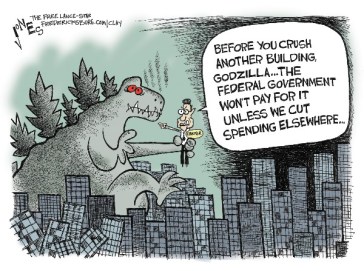 The starve the beast anthem seems to have stymied any chance the country has of solving both its unsustainable long term debt problems and its economic growth issues. This is what you get when no one embraces pragmatism, workable solutions, and data. I continue to think the best solution to much of this is to let the Bush Tax cuts expire and let them scramble from the fall out of the trigger.
Nothing is acceptable to Republicans who have signed their political souls away to Grover Norquist and seem hell bent on keeping the pentagon flush with funds all while supposedly balancing the budget. There is no way for this to happen simultaneously unless one is prepared to completely do away with all other functions of government which is frankly what I think they want. We’ll have taxes subsidizing already rich, powerful and profitable corporations and the military industrial complex and the rest of America will be sharecropping in one way or another.
Pat Toomey basically defended this position to Chris Wallace at Faux News on Sunday. The problem with this position–and with sticking to it like a drug addiction–is that the reality just doesn’t fit the story and it’s not what people want. How is it possible for a group of ideologues to continually hold the country’s economy hostage to failed ideals rejected not only by experts on the economy but by US citizens in poll after poll? Why was America’s most profitable period a time when taxes were high on both corporations and rich people and the US was winding down its war machine if the Republican paradigm is so correct? Believe me, this Toomey plan is a bait and switch.
WALLACE: Again, before we get to your plan. What are the stakes if you fail to make a deal. If on November 23rd, the super committee comes up empty and the automatic triggers come in, and we’ll talk about that in a moment. What do you think the impact is on the markets, on the economy and on the U.S. credit rating?
TOOMEY: I think that there will be further erosion of what little confidence remains of our federal government. This has been a dysfunction Senate that I’ve been serving in for the year that I’ve been in office. And this is an attempt to try to make some important progress. It would only be the first of what needs to be many steps because we’ve dug a deep hole for ourselves. I think it’s really important that we’d be successful.
WALLACE: All right. You offered a plan that breaks with the Republican pledge not to raise any tax revenue. Let’s drill down into the plan.
You would cut the deficit $1.2 trillion, which is the mark that is supposed to be met by the super committee with $700 billion in spending cuts and $500 billion in revenue increases. On the revenue side, you get $250 billion by limiting deductions especially for top earners. In exchange, you would lower tax rates, the top rate would go from 35 percent to 28 percent.
Question: why are you breaking with the GOP pledge not to raise taxes in the middle of a bad economy and how many Republicans will go along with you.
TOOMEY: Well, let me — first of all, let me say, if I were king, this is not the plan I’d put on the table. But if we both went into our respective corners and had no flexibility at all, then we wouldn’t get anything accomplish. Number two, the plan that I put on the table is contingent upon pro-growth tax reform.
Every group that’s looked to this, all of the bipartisan commissions, gang of six and the others, have acknowledge that if there is more revenue it has to come in the context of pro-growth tax reform, the kind of reform we’re talking about absolutely guaranteed to create millions of jobs over time and still more revenue.
And, finally, Chris, the other reason to make a tough decision like this, is in the alternative, we are 13 months away from the biggest tax increase in American history. And that’s written into law. That’s going to happen.
WALLACE: You’re talking about the Bush tax cuts expire.
TOOMEY: That’s exactly right.
And so, what we’ve suggested is, as an alternative to an economy destroying tax increase right around the corner, let’s have a reform, let’s simplify the code, let’s lower rates, let’s wipe out some of the loop holes and special interest, favors and deductions. Let’s have the economic growth that would come with that.
And as we lower the rates and contract the value of deductions, we’ll only generate a little revenue so that we can reduce the deficit.
WALLACE: Now, I don’t want to get too far on the weeds, but Democrats immediately rejected your plan because they say that the money that would be lost by lowering those tax rates, basically 20 percent below the Bush tax cuts, would cost over $3 trillion for the economy, and they say the money you’re going to will lose that will increase the deficit is more than money you’ll get from closing these tax loops. That it’s a net loser.
TOOMEY: First of all, that’s not true. You could design this in a way — and as I said, I didn’t invent this. We didn’t invent this. This is an idea that’s been suggested by the Simpson-Bowles commission, by the Rivlin-Domenici.
Now, it’s true that they want to raise taxes more. I think that as you reduce the value of these deductions, if you go too far, you try to create too much revenue, you can do economic damage. But you absolutely can do this in a way that will be pro-growth, that will generate more revenue, that would avoid this huge tax increase that’s otherwise coming and I think that’s a direction we should move in.
Republicans continue to say that 1+1=3 despite decades of evidence and proof that 1+1 still equals 2. If tremendous tax cuts and deregulation had such benefits to the economy we’d not have had over ten years of miserable growth and a humdinger of a financial crisis. Corporate profits are at record highs. This is not leading to job creation. Taxes on capital gains are extremely low. This just keeps leading to bubbles, increased speculation, and paper gains for a few based on nothing but gambling. It’s not bringing any value to the real economy where jobs, products, services, and tax revenues that keep things running are made. Money keeps pumping into financial contracts which is just paper whose value is detached from real assets until the market crashes. Increasing taxes on capital gains would close down much of the worthless investment funds that are going after arbitrage profits in all the wrong places. Tax benefits should go to real investments and long term commitment to growing industry and businesses. Taxes favor speculation right now. It’s bringing more volatility and risk to markets and not vaulted liquidity.
It’s ridiculous and it flies in the face of recent economic data to suggest that continuing to hand wealth over to the richest folks is going to do anything other than continue the very same problems that we have now. We move productive funds away from things that are attached to real sector growth and into speculative activities which blow bubbles and ruin the value of real assets like houses, food, and commodities and create such excessive volatility in equity markets that long term investors experience incredible losses and then small gains continually. No one benefits but a few gamblers which evidently includes Congress. Republicans like Boehner, Cantor and Bachus and Democratic leaders like Pelosi benefiting from betting based on insider information as much as Wall Street does.
It seems like there’s a plot to extract as much wealth and income out of the economy as possible before they tank the entire thing and retreat to tax haven islands like Grand Cayman. How could elected officials be so set on sabotaging the country? Granted, there are idiotic true believers like Michele Bachmann who create their own reality and narratives and are so removed from facts that you wonder why they’re allowed in public. There used to be nice places in the country for folks like that to ‘rest’ and spend their days listening to those voices in their head. Now it seems they’ve all turned up in the Republican Party and have hunkered down in Washington DC. Okay, this is from Beltway Bob, but bear with the quote, please. It’s an indicator that they’re willing–like domestic terrorists–to take us all hostage again.
Six days left for the supercommittee, and it’s not looking good. On CNBC last night, Rep. Jeb Hensarling, the Republican co-chair of the committee, said he and his colleagues had “gone as far as we feel we can go” on taxes, and that “any penny of increased static revenue is a step in the wrong direction.” In other words, Republicans aren’t looking to compromise further. But Hensarling went yet further than that. If the supercommittee fails, he said, Republicans are looking to undo the compromises they have already made.
The issue is “the trigger,” the policy that automatically cuts the deficit by $1.2 trillion in the event that the supercommittee fails. Half of those cuts are scheduled to come from domestic spending (excluding Social Security, Medicaid, and a few other programs that help the poor). That’s the stick for Democrats. Half of them are scheduled to come from the Pentagon. That’s the stick for Republicans. But last night, Hensarling said the defense cuts are too onerous, and so “we’ve got 13 months to find a smarter way to do it.” By “a smarter way to do it,” he means a way that eases the cuts to defense and, since Republicans aren’t going to replace those defense cuts with new taxes, increases the cuts to domestic programs.In comments to reporters Tuesday, Senate Majority Leader Harry Reid was firm on this point: the defense cuts in the trigger were the GOP’s concessions after they refused to include taxes in the trigger, and they’re not going anywhere. “If committee fails to act, sequestration is going to go forward,” he told reporters. “Democrats aren’t going to take an unfair, unrealistic load directed toward domestic discretionary spending and take it away from the military.”
Behind the scenes, the White House has taken a similar line: the trigger can’t be changed to exempt defense and fall more heavily on domestic spending. That isn’t the same as saying the trigger can’t be changed. But Democrats aren’t going to be enthusiastic about keeping the part meant to penalize them for the supercommittee’s failure while helping Republicans move the bit that was meant to be their punishment.
But we’ll see. Democrats haven’t always been known to hold the line on defense cuts. The bigger issue here, however, is that Republicans are setting a bad precedent for future deals. Republicans are talking about unwinding the trigger before the supercommittee has even finished its work. They are, in other words, reneging on the terms of the debt-ceiling deal. So why should Democrats who are hearing this expect they’ll abide by the terms of a deal that calls for revenue-increasing tax reform in six months?

 peej
peej Carissa
 bostonboomer
 dakinikat
 ecocatwoman
 mablue2
 Mama Lopez
 peggysue22
 quixote
 skydancingguestblogger
 Mona (aka Wonk the Vote)



 Sky Dancing
Recent Comments