
Breaking…Huge Explosion in Iranian City with Nuclear Facility
Posted: November 28, 2011 Filed under: just because 8 Comments
Uh-oh…
The Guardian UK says there are “conflicting reports” about a major explosion in Isfahn, a city near the Iranian nuclear plants.
Iran’s semi-official Isna news agency quoted a judiciary official in Isfahan, saying that an explosion had been heard.
“We heard a sound similar to that of an explosion but we have received no reports about its causes and the consequences so far,” said Gholamreza Ansari, in quotes carried by Isna. He said the explosion did not appear to be of any significance.
Oh really?
Iran’s semi-official Fars news agency was one of the first media organisations to report the explosion, saying it was heard at 2.40pm local time (1110 GMT). Fars quoted the deputy governor, Mehdi Ismaili, as confirming a sound that the news agency reported was loud enough to be heard across the city. The agency, however, removed the article from its website sometime later.
Ismaili then spoke to another semi-official agency, Mehr, denying his quotes as reported by Fars. “I have heard no sound whatsoever in Isfahan,” he said. Ismaili also told the Irna state news agency that he had not spoken to Fars in the first place.
Several residents of Isfahan told the Guardian that they had heard a loud blast. One said that it rattled the windows of their home.
So far most of the media reports seems to be coming from Israeli sources. This one is from Haaretz:
An explosion rocked the western Iranian city of Isfahan on Monday, the semi-official Fars news agency reported, adding that the blast was heard in several parts of the city.
According to reports, frightened residents called the fire department after the blast, forcing the city authorities to admit there had been an explosion.Residents reported that their windows shook from the explosion’s force.
Speaking to an Iranian news website, the government of Isfahan said that the explosion occurred as a result of a military drill, denying reports that the blast was somehow related to the nearby nuclear facility.
“There is no such thing, the blast was entirely from the military maneuver,” the Iranian official said.
The Isfahan uranium conversion plant operates under the supervision of the International Atomic Energy Agency, and is frequented by its inspectors and surveyed by cameras that broadcast to the IAEA headquarters in Vienna.
Thus, had the explosion occurred at the nuclear site, the UN’s nuclear watchdog would have known of the incident.
I certainly hope there is a reasonable explanation for this that doesn’t involve nukes or bombs dropped by another country.
I’ll update as I hear more.
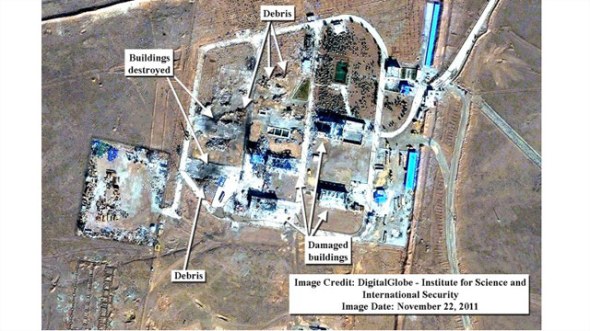
UPDATE: From CNN, satellite images of the exposion.
Crony Capitalism and Damned Lies
Posted: November 28, 2011 Filed under: #Occupy and We are the 99 percent!, Corporate Crime, corruption, Economy | Tags: crank economic analysis, crony capitalism, right wing tropes 7 Comments I just had to point out a WSJ Op-Ed/article that is just one more example of how much the media has ceded facts to right wing tropes. It’s written by Arthur Brooks. It’s called “Fairness and the Occupy Movement”. Brooks tries to equivocate the rent seeking activities of rich and powerful interests like the war and finance industries and the existence of social safety net programs like food stamps. It is not difficult for me to understand there is no real connection between providing things to the poor that need programs to stay alive and handing stuff needlessly to rich industries to attain extraordinary profits from market protections, subsidies and out right federal largess. Why is it so difficult for the press and politicians to grok the difference?
Economists Jeffrey Sachs and Mark Thoma call shenanigans on Brooks’ pretzel logic and self-serving ignorance of facts. Of course, I’ve come to expect nothing less from the American Enterprise Institute and its researchers who suspend all kinds of data and theories for their highly paid propaganda. The Wall Street Journal is basically an arm of that enterprise. The problem is that these lies shape policy debates.
First, Sachs points out this is an absolutely disingenuous narrative.
Where Brooks goes wrong is his description of inequality and fairness. The Republican view, which he espouses, is to reduce taxes, cut government services, and let markets be the standard of fairness. Here Brooks is deceptive in his rendition of the facts.
First, Brooks downplays the extent of inequality that has been built up in thirty years of crony capitalism. He favorably writes that “every income quintile has seen a real increase in purchasing power of at least 18% over the past 30 years,” citing a recent study of the Congressional Budget Office (CBO). Yet the real point of the CBO report, which Brooks does not mention, is that the richest 1% enjoyed a staggering rise of 275%, while the poorest stumbled by with a meager 18% gain. Moreover, the CBO report takes the data only to 2007. By now, even those meager gains at the bottom have been mostly lost.
Second, Brooks fails to note that the situation for the poor will be drastically worse if federal transfer programs are cut as the Republican Party is urging. The poorest quintile depends on these federal programs to stay alive. If the poorest Americans had to survive without government support, their incomes would be slashed to disastrous levels.
The Republicans answer to crony capitalism is to slash government. Yet by this they mean mainly an attack on the remaining social programs. This is a kind of bait-and-switch strategy: rev up the anger against government corruption, and then kill the life-support programs of the poor and working class. Crony capitalism exists mainly in the big-ticket sectors of the economy — banking, oil, real estate, private health insurance, military contractors, and infrastructure — not in the essential but much smaller parts of the economy: malnutrition of poor children, lack of quality pre-school, insufficient job training, and inadequate student loan coverage.
Yes, crony capitalism should be confronted anywhere in the economy, yet cutting the life-support systems for the working class and poor won’t fix government, but instead would cripple the prospects of more than 100 million poor and near-poor Americans. To control crony capitalism, we need to direct our attention where it belongs: the wealth-support systems of the rich, not the life-support systems of the poor.
Sachs points out 5 egregious examples of crony capitalism. Mark Thoma goes even farther. He discusses how the Democrats have been sucked into the right wing agenda of twisted facts and ground shifting. Your guess is as good as mine as to how this has come about. I’m sure Dems like Ben Nelson support the agenda and could care less about the untrue narrative that supports wealth transfer and market manipulation for the uberrich. Others are likely captured because they want the wealth that comes with “serving the public” and they want to get re-elected. Political office appears to be the fast track to the 1 percent these days. Others probably think this is sincere negotiation or they get some side benefit to concession so they go along.
The hope for common ground where there is none can lead to Obama like one-sided concessionary behavior, and we have more than enough of that already. Yes, let’s find common ground where it exists, but let’s also be careful not to try to meet in the middle when the other side is pursuing a bait and switch strategy. The Republican goal of reducing the size of government through reductions in social programs is unwavering, and they will pursue any argument handy at the moment to bring this about. In recessions, they tell us tax cuts are needed to stimulate the economy, but the real goal is to cut funding for the government permanently. Once the taxes are reduced, they won’t agree to increase them again (unless it’s to protect their cronies, i.e. an increase in payroll taxes is fine so long as it prevents the increase in taxes on the wealthy needed to fund it). In normal times, we’re told tax cuts stimulate economic growth even though there’s not much evidence to support this claim. Presently, it’s the cronyism argument, and tomorrow it will be something else. The Republicans have their eyes on the ball, and the rules of the game are to be adjusted as necessary to allow them the best opportunity to take the ball across the goal line. Winning is all that matters. Fairness for both sides playing the game, etc. has nothing to do with it and we’d be wise to keep our eyes on the ball as well.
The other thing to note is that the location of common ground has shifted to the right from where it used to be. “Meet us in the middle” now means meeting on ground that would have been considered on the right not all that long ago. Democrats have already conceded too much in the ideological war, and there comes time when leaders in the party must take a stand and hold their ground. That time is long past.
What is clear to me is that there is very little left of what an economist would view as a free,efficient, functional market through out our economy. Economies of scale, information brokers, concentration of markets into the hands of very few corporations, tax subsidies, federal contracts handed to friends of politicians, advertising, imagined product diversity, insider information, and moral hazard have all dealt blows to efficient pricing, resource allocation, and resultant quantity produced. It’s terribly dishonest of people like Arthur Brooks to equivocate programs that exist to protect the weakest in the society from the predatory behavior of the most rich and powerful who destroy functioning markets to achieve extraordinary profits and market power.
I have no idea why any one takes these fake “think tanks” seriously except they put out propaganda to serve the interests of crony capitalism itself.. The Paul Ryan Budget Scam was an example of crank analysis coming from the Heritage Foundation. Their output plagues policy discussion. Their stuff wouldn’t be given the light of day in actual empirical or theoretical journals so they have to invent some institute just to look serious. How these guys can lie with such a straight face is beyond me. Also beyond me is the number of people that fall for the lies. But then, some gullible and clueless media outlet or one saying that they’ll print lies just to be perceived as fair or some journalist with an agenda runs with the story. Then, crank analysis achieves some critical mass of “serious”. By the time that damned lie gets fact checked, no one is paying attention any more. It’s no wonder that we are so f’d.
Barney Frank Goes Out with a Bang, not a Whimper
Posted: November 28, 2011 Filed under: just because 2 Comments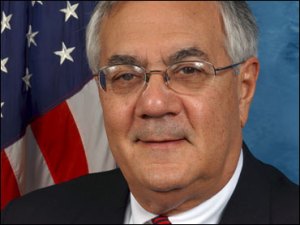
Good old Barney Frank. I can’t help but love the guy. I didn’t see his retirement announcement today, but it sounds like he gave another wide-ranging and entertaining press conference. He will be sorely missed.
Citing the political challenges he faced because of congressional redistricting, prominent Democratic Rep. Barney Frank on Monday announced he will not seek re-election in 2012.
[….]
Frank said he considered announcing that this would be his last term earlier but decided against it so his influence in Washington wouldn’t be weakened. He said he was particularly concerned the new Republican House majority would leave military spending untouched as it cut other government programs and that the GOP would undo the financial reforms he worked to enact.
“A funny thing happened on my way to retirement,” Frank said. “A very conservative Republican majority took over the House… [and] the things I fought hardest for could be in jeopardy.”
Frank, considered the most prominent gay politician in the United States, is known as an outspoken liberal with a sharp tongue. His liberal positions have made him a target of conservatives, particularly after the passage of the Dodd-Frank Act.
Frank took an opportunity to take a few pokes at the current anti-Romney, Newt Gingrich.
“I did not think I had lived a good enough life to be rewarded by having Newt Gingrich be the Republican nominee,” Frank said, alluding to Gingrich’s recent rise in the polls and the fact that many Democrats consider the former House speaker unelectable.
[….]
Frank took another shot at Gingrich when asked whether he would work as a lobbyist after retiring from Congress. “I will neither be a lobbyist or a historian,” Frank said, alluding to Gingrich’s claims that he worked as a historian — but not a lobbyist — for mortgage giant Freddie Mac.
In addition, Frank challenged Gingrich to a debate.
Frank said he would be interested to debate the repeal of the 1996 Defense of Marriage Act with the former House Speaker:
FRANK: I did not think I had lived a good enough life to be rewarded by Newt Gingrich being the Republican nominee. It still is unlikely, but I have hopes. Let me say, for example, I intend to continue to be an advocate of public policy. I look forward to debating, to take one important example, the Defense of Marriage Act with Mr. Gingrich. I think he is an ideal opponent for us, when we talk about just who it is, is threatening the sanctity of marriage.
Thanks for the hard work and the laughs, Barney. I for one will really miss you!
Monday Reads
Posted: November 28, 2011 Filed under: morning reads | Tags: pedophiles, Quantative easing, superpacs, TARP, violence against women 58 Comments Good Morning!
SuperPacs are going to play a central role in this coming year’s elections. The Supreme Court has basically opened free speech to the point that political free speech will go to the highest, unaccountable bidder. Rick Santorum is the only current presidential contender without one. Here’s some background from ABC.
Super PACs, or “independent-expenditure only committees,” as they are officially known, are a relatively new kind of political action committee (PAC) that can raise unlimited amounts of money for a candidate or cause from corporations, unions, individuals, etc. The rise of the super PAC started in the most recent midterm cycle, after the Supreme Court’s ruling in the Citizens United case lifted federal and state campaign spending regulations dating back to the 1970s.
Super PACs have since become ubiquitous. Seven of the eight leading GOP candidates have at least one that is raising money in their behalf; a couple of the candidates have more than one. Earlier this month, a group calling itself “Texas Aggies for Rick Perry” filed papers with the Federal Election Commission. The name refers to Perry’s alma mater, Texas A&M University, and the group is the second super PAC operating in Perry’s behalf, in addition to his “Make Us Great Again” PAC, which formed in July.
The candidates are prohibited from having any connection to the super PACs, meaning they can also distance themselves from any negative campaign ads against their opponents that are funded by the super PACs. The groups can also pay for polling, mailing materials, social media efforts and research, among other things.
There are already legal questions on Perry’s use of SuperPacs according to Politico.
The Perry campaign’s borrowing of three clips from a SuperPAC ad for use in a campaign video was a novel foray into the gray area of campaign finance law, and so I asked the experts on Rick Hasen’s excellent and disputatious election law listserv for their views on it. They were not unanimous on the question, but Perry is clearly treading in some uncharted legal waters.
“With virtually all fundraising limits and prohibitions hanging on the necessity of independence between the super PAC and the Perry campaign, using super PAC footage for a campaign ad pushes the concept of independence to new boundaries,” emailed Ken Gross, an election lawyer at Skadden Arps.
David Mason, vice president at the political data firm Aristotle International, wrote that “whatever is going on in terms of the Perry campaign using Super PAC footage, it is simply not addressed by the coordination regulation.”
“That is not to say there are no FECA implications to a candidate using Super PAC footage. If a campaign is given footage for no charge, the footage could be an in-kind contribution to the campaign. A campaign could pay for the footage (raw footage typically costs way less than the cost of finishing and broadcasting), or, in this case, according to the spokesman you quote, gotten it from a public source,” he wrote.
Since the GOP couldn’t force its agenda on the Supercommittee, it will try to change the rules according to The Hill. They are trying to change the configuration of the automatic cuts to favor defense and their spending priorities.
Supercommittee member Sen. Pat Toomey (R-Pa.) said Sunday that Republicans will seek to “change the configuration” of the automatic spending cuts triggered by the committee’s failure to present a deficit-reduction deal.
“I think it’s important that we change the configuration [of the cuts]. I think there’s a broad consensus that too much of the cuts are weighted on [our national defense],” Toomey said on ABC’s “This Week With Christiane Amanpour.”
Toomey said he is “terribly disappointed” the committee failed to reach a deal but called the automatic cuts built into the committee’s mandate a “silver lining.”
The failure of the supercommittee to reach an agreement last week triggered $1.2 trillion in automatic cuts set to hit the Defense department and other programs in 2013.
Due to FOIA requests and the perseverance of some in congress, we are beginning to see the kinds of loans the Fed gave to banks that have not been disclosed before. There were $13 billion dollars of such loans.
The Fed didn’t tell anyone which banks were in trouble so deep they required a combined $1.2 trillion on Dec. 5, 2008, their single neediest day. Bankers didn’t mention that they took tens of billions of dollars in emergency loans at the same time they were assuring investors their firms were healthy. And no one calculated until now that banks reaped an estimated $13 billion of income by taking advantage of the Fed’s below-market rates, Bloomberg Markets magazine reports in its January issue.
Saved by the bailout, bankers lobbied against government regulations, a job made easier by the Fed, which never disclosed the details of the rescue to lawmakers even as Congress doled out more money and debated new rules aimed at preventing the next collapse.
A fresh narrative of the financial crisis of 2007 to 2009 emerges from 29,000 pages of Fed documents obtained under the Freedom of Information Act and central bank records of more than 21,000 transactions. While Fed officials say that almost all of the loans were repaid and there have been no losses, details suggest taxpayers paid a price beyond dollars as the secret funding helped preserve a broken status quo and enabled the biggest banks to grow even bigger.
UN Secretary General Ban Ki Moon has called for “Zero tolerance’ for violence against women as the UN celebrated November 25th as the International Day for the Elimination of Violence against Women.
According to the UN, 70% of women experience violence in their lifetime, and one in five women will become a victim of rape or attempted rape in her lifetime. A number of global surveys have shown that half of all women murder victims are killed by current or former husbands or partners.
November 25 is designated as the International Day for the Elimination of Violence against Women and in South Africa kicks of 16 days of activism, which ends on Human Rights Day.
In a statement to mark the occasion, Ban said young men and boys must be encouraged to become advocates for the elimination of violence against women. “We need to promote healthy models of masculinity. Too many young men still grow up surrounded by outmoded male stereotypes,” he said. “By talking to friends and peers about violence against women and girls, and by taking action to end it, they can help break the ingrained behaviour of generations.”
The wife of a charismatic christian youth minister and dentist who was found to be guilty of horrific crimes involving pedophilia tells her tale and speculates that Dorothy Sandusky may be as in the dark as she was. Her story is at the Daily Beast.
Just shy of seven years ago, my life and the lives of my two children were turned upside down. The man I had been married to for more than a decade had been arrested as a part of an FBI sting to bring down NAMBLA, the North American Man-Boy Love Association, an advocacy group for pedophiles that supports an “end to the extreme oppression of men and boys in mutually consensual relationships.” I was a well-educated, philanthropic, 39-year-old mother who, until recently, was living a charmed Dallas life, married to a well-liked dentist who had been living a lie for our entire relationship.
A former youth-ministry volunteer at a local church, an energetic volunteer at our kids’ elementary school, and a favorite at their Y-Guides outings, my ex-husband, Todd, turned out to be a criminal who brought tremendous harm, both physically and emotionally, to prepubescent boys. He was an “inner circle” member of NAMBLA—a member of its board of directors—wanted by the feds. Throughout our marriage, which ended in a confusing divorce shortly before the FBI swept in, I believed him when he said he was traveling to dental conventions—when in fact, he was attending pedophile conferences. He kept a secret mailbox at the local post office, where he received his pedophilia newsletters and other suspicious mail. We never found any proof of illegal Internet activities—his hard drive had been cleaned—except for a printed-out receipt for a porn video of young boys. Often, as I eventually learned, these predators are masters of deceit, creating a façade of the “ideal family” to protect their image, or perhaps convince themselves that they’re not a deviant to society, all the while acting on their sick desire to engage in sexual acts with kids.
OOh, baby, it’s a wild world.So, what’s on your reading and blogging list this morning?
EuroZone Woes
Posted: November 27, 2011 Filed under: Economy, financial institutions, Foreign Affairs, Global Financial Crisis | Tags: Euozone, Financial Union 8 CommentsThere’s been a number of interesting things coming out of Europe this weekend that will undoubtedly impact US Financial Markets and probably the economy since they are a  significant trading partner as well as investor in US businesses. The adoption of the Euro and the expansion of the trade zone area has generally been shown to be a huge boon to the European Economy. It’s really hard for me to imagine the collapse of the Euro since it has been so successful that a variety of countries through out the world are in the process of adopting their own versions. There have been a lot of people against the arrangement primarily because they’re still in nationalist mode and dislike the idea of any kind of cooperation that looks like ‘collectivism’. The astounding economic results have been difficult to rebut however.
There are two items that generally are considered problematic for some countries that join a monetary union. The first is the loss of independent monetary policy including the ability to debase your currency as a means to stimulating your economy. The offset to that is that if you’re a country like Greece that has had incredible issues with inflation stemming from politicized monetary policy, you pick up credibility when you outsource that function to a shared central bank. That’s especially the case when you share your central bank with the Germans who have been inflation wary since the Weimar Republic. The Japanese central bank and the German central bank are well known for controlling inflation over just about any other economic priority. The second problem is the potential need for cross country fiscal policy. That has never been much of an issue in the EU until now. That is why there is talk of an IMF rescue of countries like Greece. Also, there’s some talk of hurrying fiscal integration or giving some entity the ability to float “eurobonds” specifically for countries that are in trouble right now like Italy. The problem right now is that many of the weaker EU countries were allowed to borrow substantially and with a credit crisis and banking troubles that led to recession, the bonds from those countries (sovereign debt) have no lost their value.
There are some that think the Eurozone will fall apart. I find that hard to accept given the substantial boost that the zone has been to many economies in the form of trade and direct financial investment. This benefit has gone to all countries and is called the “Rose Effect”. I’ve spent the last three years of my life studying all of this in great detail. I am as vested in any one in the outcome. Here’s a few items that have been going on as we watch Eurozone brinkmanship play out. Reuters reports that Germany and France are forming a “Stability Pact” and hoping to get the European Central Bank leaders will act more like Bernanke’s Fed.
Echoing a Reuters report on Friday from Brussels, the Sunday newspaper said the French and German leaders were prepared to back a deal with other euro countries that might induce the ECB to intervene more forcefully to calm the euro debt crisis.
The newspaper report quoted German government sources as saying that the crisis fighting plan could possibly be announced by German Chancellor Angela Merkel and French President Nicolas Sarkozy in the coming week.
In an advance release before publication, Welt am Sonntag said that because it would take too long to change existing European Union treaties, euro zone countries should just agree among themselves on a new Stability Pact to enforce budget discipline – possibly implemented at the start of 2012.
It could be similar to the Schengen Agreement which applies to EU countries that choose to take part and enables their citizens to enjoy uninhibited cross border travel. Among the countries in the Stability Pact, there would be a treaty spelling out strict deficit rules and control rights for national budgets.
Reports from AFP show that the IMF may be planning a 600 billion Euro rescue plan for Italy. Italy is the world’s 8th largest economy. It’s the 4th largest in Europe. Needless to say, this is highly irregular.
The IMF could bail out Italy with up to 600 billion euros ($794 billion), an Italian newspaper reported on Sunday, as Prime Minister Mario Monti came under pressure to speed up anti-crisis measures.
The money would give Monti a window of 12 to 18 months to implement urgent budget cuts and growth-boosting reforms “by removing the necessity of having to refinance the debt,” La Stampa reported, citing IMF officials in Washington.
The IMF would guarantee rates of 4.0 percent or 5.0 percent on the loan — far better than the borrowing costs on commercial debt markets, where the rate on two-year and five-year Italian government bonds has risen above 7.0 percent.
The size of the loan would make it difficult for the IMF to use its current resources so different options are being explored, including possible joint action with the European Central Bank in which the IMF would be guarantor.
“This scenario is because resistance from Berlin to a greater role for the ECB in helping states in difficulty — starting with Italy — could be overcome if the funds are given out under strict IMF surveillance,” the report said.
The European Union and the ECB have sent auditors to check Italy’s public accounts this month and the IMF is set to send experts soon under a special surveillance mechanism agreed at the G20 summit in France earlier this month.
The WSJ reports that a number of countries are pressuring ECB for concessions. The worry is that these same economies that have always had weaker economies and lax fiscal constraint will continue on that path. (These countries include Portugal, Spain, Greece, Italy and Ireland which have been sarcastically given the acronym PIIGS.)
While the ECB has so far said that it won’t beef up its limited bond buying, a growing number of governments are lobbying it to change its stance. A green light from Berlin for a bigger ECB role is seen by many euro-zone policy makers as a political necessity if the ECB is to act. Although the bank is politically independent, it has also paid close attention to the debate in Germany, where the government has so far rejected a bigger role for the central bank.
A new, binding fiscal regime would not be enough to justify the creation of collective euro-zone bonds, German officials say. But it might be enough to justify ECB action to stabilize bond markets that policy makers view as increasingly dysfunctional, some in Berlin say.
Other German officials remain skeptical about a greater ECB role—including Bundesbank President Jens Weidmann, who sits on the ECB’s governing council. Germany’s central bankers have been outvoted by the ECB majority before, however, including this August, when Mr. Weidmann opposed the decision to make limited purchases of Italian and Spanish bonds.
German Chancellor Angela Merkel said last week that she wants EU treaty changes to make the bloc’s fiscal rules legally enforceable by European authorities, in the same way that EU antitrust rules are.
European Council President is going to meet with Treasury Secretary Geithner on Monday at the US Treasury. Both Germany and Italy have had bond auction failures within the last week. This is causing the situation to look more dire. FT’s Wolfgang Munchau says the Eurozone has about 10 days before it collapses. His analysis borders on the sanguine.
Last week, the crisis reached a new qualitative stage. With the spectacular flop of the German bond auction and the alarming rise in short-term rates in Spain and Italy, the government bond market across the eurozone has ceased to function.
High quality global journalism requires investment. Please share this article with others using the link below, do not cut & paste the article. See our Ts&Cs and Copyright Policy for more detail. Email ftsales.support@ft.com to buy additional rights. http://www.ft.com/cms/s/0/d9a299a8-1760-11e1-b00e-00144feabdc0.html#ixzz1exnj0HAB
The banking sector, too, is broken. Important parts of the eurozone economy are cut off from credit. The eurozone is now subject to a run by global investors, and a quiet bank run among its citizens.
This massive erosion of trust has also destroyed the main plank of the rescue strategy. The European Financial Stability Facility derives its firepower from the guarantees of its shareholders. As the crisis has spread to France, Belgium, the Netherlands and Austria, the EFSF itself is affected by the contagious spread of the disease. Unless something very drastic happens, the eurozone could break up very soon.
Technically, one can solve the problem even now, but the options are becoming more limited. The eurozone needs to take three decisions very shortly, with very little potential for the usual fudges.
All eyes and much money is on the European Central Bank right now. Watch the equity markets. They will probably represent the collective guess on the end of the world as we know it.

 peej
peej Carissa
 bostonboomer
 dakinikat
 ecocatwoman
 mablue2
 Mama Lopez
 peggysue22
 quixote
 skydancingguestblogger
 Mona (aka Wonk the Vote)



 Sky Dancing
Recent Comments