
Saturday: She isn’t Fly, She is Levitation
Posted: October 29, 2011 Filed under: just because 19 Comments Morning news junkies!
Story behind this Saturday’s post title, in a nutshell: I can’t get enough of “Fly,” the new Nicki Minaj track featuring Rihanna on the chorus.
Here’s a youtube of the song with the entire lyrics for anyone who’s interested, but for the purpose of this post I’ll just highlight a couple excerpts.
Rihanna’s chorus goes like this:
I came to win, to fight, to conquer, to thrive
I came to win, to survive, to prosper, to rise
To fly (x2)
The second verse of Nicki rapping starts off like this:
Everybody wanna try to box me in
Suffocating everytime it locks me in
Paint they own pictures then they crop me in
But I will remain where the top begins
Cause I am not a word, I am not a line
I am not a girl that can every be defined
I am not fly, I am levitation
Suffice it to say that “Fly” reminds me of sheroes everywhere…
…including our gal Hillary and the woman standing with her in the photo up top (taken yesterday at the State Department). That would be Yemeni Nobel Prize laureate Tawakkul Karman.
More photos here. If you click over, be sure to scroll all the way through to the last pic where Hillary and Tawakkul embrace each other. It’s worth it.
Speaking of ssheroes across the globe, if you haven’t checked out Vicki Markham’s report at RH Reality Check–the Significance of 7 Billion World Population for Women and the Environment–please make some time for it this weekend. Two quck snippets:
Women and girls are also disproportionately vulnerable to climate change-related natural disasters and face a significant risk of disaster-related fatalities. Following the 2004 Asian tsunami, three-quarters of the fatalities in eight Indonesian villages were women and girls. In the second most affected district in India, Cuddalore, the proportion of female fatalities was nearly 90 percent due to lack of preparedness which is focused more on men and boys.
I was shocked when I read these stats, even though I shouldn’t be by now.
On the flip side, women can also be powerful agents for leadership and change on these issues, not only in their own communities, but also in the international arena if given the opportunity.
- For example: Local grassroots women worldwide are implementing effective programs in their villages to address local environment and public health issues. Dr. Gladys Kalema-Zikusoka of Uganda does just that with the innovative NGO she founded, “Conservation Through Public Health”, where she integrates the needs of local villagers to co-exist successfully with the nearby native gorilla population. She helps villagers to not only protect the species and its habitat, but also realize the linked benefits of their own public and reproductive health, education, and livelihoods.
Here at home, Kirsten Gillibrand is showing elected Democrats how it’s Done. Via Good as You:
U.S. Senator Kirsten Gillibrand (D-NY) continues to show that backing equality is a great way to earn positive attention. Attention like this truly pro-family article from the New York Daily News:
New York’s junior senator is pushing federal legislation to lift the ban on gay couples and individuals adopting children.
Between New York’s same-sex marriage act and the repeal of the military’s “Don’t Ask, Don’t Tell” policy, the momentum is there for the needed reform, Sen. Kirsten Gillibrand said.“This legislation would open thousands of new foster and adoptive homes to children ensuring they are raised in loving families,” Gillibrand said of her “Every Child Deserves a Family Act.”
KEEP READING: Gillibrand: Open Adoption To Gays, Lesbians [NYDN]
Even closer to home for me is the “Great Mosquito Plague of 2011” that has been ravaging Houston. I’m still recovering from several bites myself, and I swear, you couldn’t go anywhere in this town without having a discussion about the darned mosquitoes last week.
Thankfully a cold front has settled in since yesterday and is bringing some relief. At least so far.
Anyhow, I mention the mosquitoes because I thought y’all might enjoy this bit of local coverage on Occupy Houston, via Culturemap — Occupy Houston endures the mosquitos, no-clapping rules and a slow-flow water fountain:
At the urging of Houston City Council Member Jolanda Jones, Occupy Houston protestors have begun to actively participate in local politics by attending Houston City Council meetings.
Occupiers made up most of the audience during one session this week. They chiefly addressed concerns about continuing their occupation of Tranquility Park in comfort, but also weighed in on prevalent, city-wide problems and hot-button issues on the council’s agenda — including the Kroger 380 Agreement.
Protestors made their voices heard in a nearly two-and-a-half hours long public speaking segment. Many council members were absent during the session. Most elected officials who were in attendance spouted platitudes that seemed geared toward reelection rather than action. The video is somewhat agonizing, but extremely entertaining.
Click over to Culturemap for some highlights of what was said.
Quote of the Week
“You can’t be a perfectly lubricated weather vane on the important issues of the day. Romney has been missing in action in terms of showing any kind of leadership.”
This Week in Women’s History (October 23-29)
Happy Birthday Hillary Clinton! Hillary turned 64 on Wednesday:
We here at The Cable would like to send out our warmest birthday wishes to Secretary of State Hillary Clinton, who is 64 years young today.
So how will the secretary be spending her special day? She did two interviews this morning on Iran: an interview on social media with BBC Persia and then an interview VOA Parazit, VOA’s Persian-language station. Clinton then met with Bahraini Foreign Minister Shaikh Khalid bin Ahmed al-Khalifa and joined Deputy Secretary Tom Nides‘ meeting with Iraqi National Security Advisor Faleh al-Fayyad.
“They don’t make hallmark cards for that,” one State Department official told us.
Seemingly in honor of Hillary’s birthday, Samantha Gowen at the OC Register did a slideshow on
“Powerful Women Worldwide”:
Who says it’s a man’s world anymore? Probably not Hillary Clinton, who turns 64 Wednesday, or any of the other women on our list of powerful women.
Today we celebrate Girl Power with a look at other powerful women in the world, from business to politics, news and entertainment.
From Gowen’s write-up on Hillary:
Secretary of State Hillary Rodham Clinton: In her 64 years, she has made remarka
ble strides, both for herself and women. The Wellesley College and Yale School of Law graduate was born in Chicago and got an early start in politics at age 13: Raised in a conservative household, she helped canvass in South Side Chicago looking for electoral fraud against presidential candidate Richard Nixon.
…
She married Bill Clinton in 1975 and was first lady of Arkansas during his 10-year stint as governor, then became the first first lady of the U.S. to hold a postgraduate degree. After her husband’s two terms in the White House, she wasn’t done with politics and ran for U.S. Senate in New York in 2000, another first for a first lady.
…
In 2008 she ran for president and despite a strong showing, fell second to Barack Obama for the Democratic nomination. After he was elected, Obama asked Clinton to serve as his secretary of state. Rumors abound for the 2012 election year: Will she move into place as Obama’s vice presidential running mate?
I’ll close with this blurb via Passport magazine, in case you didn’t hear it through the grapewine already:
Could the child of former President Bill Clinton and current Secretary of State Hillary Clinton be considering a run for Congress? Many are reporting that Chelsea has been approached by “the right people” from the New York Democratic Party this year and that the recently married 31-year-old is “actively considering” a run for Congress. Chelsea was involved in her mother’s campaign for President and won over key demographics with her winning personality and knowledge of the issues.
We think today would be a great time for her to announce her run, especially since it’s her mom’s birthday!
Is it too early to start chanting Chelsea 2016? A wonk can dream… *wink*
Well that’s it for me… what’s on your reading list this Saturday?
What’s right isn’t always what’s good
Posted: October 28, 2011 Filed under: Bailout Blues, Banksters, financial institutions | Tags: Financial Crisis 30 CommentsThere’s something that bothers me about the current conversation (diatribe?) about the sins of the bankers.

The tone of a lot of the talk is as if they belong to some other species, as if they commit crimes nobody else does, but also as if they keep their heads when nobody else can.
Holding them to sub- or superhuman standards means it’s hard to understand why they do what they do. And that means it’s hard to make them do the right thing.
Let me explain what I mean.
After the crash, US banks were bailed out. People were outraged, and rightfully so. It’s just wrong for a thief to rob your house and then grab your savings when the jerk can’t make his rent.
But.
The time to worry about the thieving was before the crash. While it was going on. Then it would have been possible to stop it without crashing the economy.
It would have also stopped the wild ride, and — at the time — not many people wanted that. Plenty of people are just like bankers without a bank. There’s a big difference in impact, but the difference is one of degree. They’re no more subhuman than everyone else.
When the crash happens the sad fact is the thief lives in the same house you do. When he (the high-flying financial mavens were almost all “he”) can’t make his share of the rent, you both get evicted.
The thieves are literally in the same house. They’re in the same economy. The 99% and the bankers all depend on it. If the economy is destroyed, everybody is just as homeless. Your pension loses money. Your job is destroyed. The value of your house goes down. That’s been made rather clear by now.
There is no way — during the actual crash — to limit the damage to the people who caused it. There is no choice but to bail out the jerks who caused the problem. It’s not right. It’s maddening. But doing anything else means more damage for you. It’s not about punishing the guilty at that point. It’s about saving the innocent.
That’s why the bailout was the right thing to do. It wasn’t done well, or enough, or with any of the necessary rules attached to it, but it did avert a much bigger disaster. That’s all clear by now, and leads even compassionate economists to point out that economics is not a morality play.
The time for retribution is afterward. That is, now. But now the 1% are going scot-free and raking in more money than ever. That’s criminal laxity. Not the bailout.
However, bankers are just people with banks, so they’re now going through the same process of preferring moral outrage to emergency assistance.
Europe is having a similar problem with inability to repay debts. In their case it’s a country, not mixed salads of mortgages, but the problem is the same.
Unless Greece is convincingly bailed out, everybody with money in the market will be worried about how much they could lose if they don’t get out now. If everybody pulls their money out, economies freeze up, and we all go broke.
So what have the bankers been arguing about? How to create the funds for an adequate bailout? No, it’s about not wanting to bail out those profligate Greeks. It’s the same routine, but with more numbers and graphs: I was frugal. It’s not fair to make me pay some gambler’s debts. They should just suck it up.
These are people whose jobs are dealing with money. They, of all people, should know that economics is not a morality play. They, of all people, should know that when the sheriff is at the door with the eviction notice, it’s not the time to beat up the crackhead brother for squandering the rent. At that point, you just scrape together the rent. Later, you send the brother to rehab.
What’s funny, though, is how far the inability to recognize the common roots of feelings extends. Krugman is smarter than I am in practically every way, but even he is continually mystified by the non-rational adherence to austerity when austerity will cost the earth. (Read his blog. There are dozens of posts asking What were they thinking?.)
There’s nothing mysterious about it. It’s the same reaction everybody has. Don’t make me pay for someone else’s mistakes. It doesn’t matter whether you agree with the bankers’ definitions of mistakes. Nobody wants to pay for what they see as somebody else’s mistakes. And when something turns out to be a mistake, it’s amazing how fast it becomes somebody else’s.
The other unspoken, non-rational motivation is the equally simple one that austerity for thee but not for me is a great way for the rich to get richer. That, too, may be unmentionable, but it is not mysterious.
The point is this. Once the emotional roots of a non-rational stand are recognized, there’s a chance one could deal with it. It’s only a chance, but without that understanding, there’s none at all. Understanding allows us to start fighting the right battles instead of the distractions.
For instance, bankers are professionals, so they hang an economic story around their outrage. They come up with theoretical underpinnings for why austerity is such a good idea. None of those pins stays in place when examined, but they don’t care. And that is the hallmark of acting on feelings, just like an ordinary human being. They’re no more superhuman than everyone else.
I’m not suggesting that every argument one doesn’t like can be written off as “emotional.” All arguments have to be evaluated against the evidence, and evaluated several times to make sure the results are right. But once that’s done, if people keep clutching an anti-rational position, it is not insulting to figure out why they’re doing that. It’s essential.
And then when one argues with them, one needs to argue with their real reasons, not their stories.
So, in the present case, if the roots of the cries for austerity were faced squarely, we could clear the way for useful solutions. We could discount the more-for-me motivation as the bog-standard grabbiness we all have and decide to ignore it. And to the extent that the cries are rooted in a sense of unfairness, maybe we could get past it.
We could acknowledge the unfairness. We could resolve to deal with it after the crisis, instead of letting the rich and powerful off scot-free. And we could acknowledge that fairness is better served by helping millions of small people through the crisis, even if it also carries along some perps. That’s the good thing to do. Punishing the perps may feel right, but it’s stupid to let it cost us everything we have.
[Update Oct 27th: It remains to be seen whether today’s agreement in Europe to help Greece did enough or just did the minimum to keep the markets from panicking this very minute. Still, any prevention of panic is better than none.]
Crossposted to Acid Test
Confronting the Austerity Agenda
Posted: October 28, 2011 Filed under: Economy, Foreign Affairs, Iceland | Tags: austerity, banking crises, economics, iceland 13 Comments Paul Krugman takes on the idea that after we bail out economically destructive banks, we all have to pay with downsized lives and a bad economy in his NYT column today. He continues to fight the idea that austerity–not prosperity–will bring back confidence and the economy. He’s right that the austerity hawks push a ridiculous assertion that denies past history as well as logic.
The doctrine in question amounts to the assertion that, in the aftermath of a financial crisis, banks must be bailed out but the general public must pay the price. So a crisis brought on by deregulation becomes a reason to move even further to the right; a time of mass unemployment, instead of spurring public efforts to create jobs, becomes an era of austerity, in which government spending and social programs are slashed.
This doctrine was sold both with claims that there was no alternative — that both bailouts and spending cuts were necessary to satisfy financial markets — and with claims that fiscal austerity would actually create jobs. The idea was that spending cuts would make consumers and businesses more confident. And this confidence would supposedly stimulate private spending, more than offsetting the depressing effects of government cutbacks.
Some economists weren’t convinced. One caustic critic referred to claims about the expansionary effects of austerity as amounting to belief in the “confidence fairy.” O.K., that was me.
But the doctrine has, nonetheless, been extremely influential. Expansionary austerity, in particular, has been championed both by Republicans in Congress and by the European Central Bank, which last year urged all European governments — not just those in fiscal distress — to engage in “fiscal consolidation.”
And when David Cameron became Britain’s prime minster last year, he immediately embarked on a program of spending cuts in the belief that this would actually boost the economy — a decision that was greeted with fawning praise by many American pundits.
Now, however, the results are in, and the picture isn’t pretty
Example one: The economy of Greece. It has been pushed into an even bigger slump. Example two: The economy of the UK. Austerity has stalled its economy and the confidence fairy is no where to be seen. Example three: Iceland. They did the exact opposite and they’re none the worse for wear. So, which example are we following? Well, it’s not Iceland.
Krugman, Icelanders, and the IMF are taking stock of the Iceland experience this week in a conference. You can read many articles at the IMF on how Iceland is recovering from its 2008 economic catastrophe. You can watch a video explaining what went on there with Dr. Joseph Stiglitz below.
Today, three years later, it is worth reflecting on how far Iceland―a country of just 320,000 people―has come since those dark days back in 2008. Growth has returned to the economy, and new jobs are being created: unemployment, although still unacceptably high for a country used to near-full employment, has dropped below 7 percent of the work force. In June this year, the government successfully issued a $1 billion sovereign bond, marking a return to international financial markets.
And while public debt, currently at around 100 percent of GDP, is much higher than before the crisis, an impressive consolidation program has put the country’s finances back on a sustainable path during the past couple of years. As for the banks, they have been shrunk to about 200 percent of GDP, and are now fully recapitalized.
So, how did they do it? Did they embrace austerity for their citizens after rescuing and enriching their errant banking/financier class?
- First, a team of lawyers was put to work to ensure that losses in the banks were not absorbed by the public sector. In the end, the public sector did of course have to step in and ensure the new banks had adequate capital, but it was insulated from vast private sector losses. This was a major achievement.
- Second, the initial focus of the program was exclusively on stabilizing the exchange rate. Here, we reached for unconventional measures, notably capital controls.
- Third, automatic stabilizers were allowed to operate in full during the first year of the program—effectively delaying fiscal adjustment. This helped support the economy at a time of severe strain.
- Fourth, conditionality was streamlined and focused on the key issue at hand—rebuilding the financial sector. While there are some issues in the broader economy where reforms will eventually be needed, these were not a part of the program.
TGIFriday Reads
Posted: October 28, 2011 Filed under: Barack Obama, Mitt Romney, morning reads, PLUB Pro-Life-Until-Birth, religious extremists, Reproductive Health, Reproductive Rights, Republican presidential politics, U.S. Economy, U.S. Politics, Violence against women, Women's Rights | Tags: 2012 presidential election, abortion, Ayn Rand, bundlers, Herman Cain, Libertarianism, Lobbyists, minimum wage, Mitt Romney, objectivism, Omar Sharif, personhood amendment to the Constitution, Republican debates, Republican nomination, Rick Perry, Rick Santorum, Ron Paul, wild turkeys 11 Comments
I live in Northwest Greater Boston in a town that is far from rural. However we do encounter wildlife in my neighborhood–skunks, opossums and racoons, for example. But yesterday afternoon, as I drove down the small road where I live, I had to brake suddenly for a large, imposing bird like the one in the photo. It was casually standing right in the middle of the road. I looked to my left and saw good sized flock of these birds, and suddenly realized they were wild turkeys. They were walking around in front of someone’s house. I was amazed.
It turns out that wild turkeys have been making a comeback in Massachusetts and have been invading a number of cities and towns around here. From The Boston Globe:
On a recent afternoon, Kettly Jean-Felix parked her car on Beacon Street in Brookline, fed the parking meter, wheeled around to go to the optician and came face to face with a wild turkey.
The turkey eyed Jean-Felix. Jean-Felix eyed the turkey. It gobbled. She gasped. Then the turkey proceeded to follow the Dorchester woman over the Green Line train tracks, across the street, through traffic, and all the way down the block, pecking at her backside as she went.
“This is so scary,” Jean-Felix said, finally taking refuge inside Cambridge Eye Doctors in Brookline’s bustling Washington Square. “I cannot explain it.”
Notify the neighbors: The turkeys are spreading through suburbia. Wild turkeys, once eliminated in Massachusetts, are flourishing from Plymouth to Concord and – to the surprise of some wildlife officials – making forays into densely populated suburban and urban areas, including parts of Boston, Cambridge and, most recently, Brookline.
In Winchester, a woman was “held captive” by a wild turkey.
On Tuesday evening, around 6 p.m., a Swan Road resident was pulling into her car [sic] when a wild turkey jumped at her and started to attack her vehicle as she was trying to drive it into the garage.
The woman said that this turkey did the same thing last week, and she didn’t call the police because she thought the animal had left.
“It kept attacking the woman at her house,” said Winchester Animal Control Officer, Jerry Smith of the 17-pound turkey. “It’s been doing it for a couple of days. We can’t have animals attacking people around town.”
According to the police report, she was able to close the garage door, but ended up being trapped, unable to get to her house, because the turkey refused to leave her property.
After 15 minutes “of being held captive” the woman called the Winchester Police Department to help her get into the house.
The responding officer saw that the turkey was still on the property. He got out of his cruiser and took a shotgun with him. As soon as the turkey noticed him, it charged and the officer shot and killed it.
Yikes! I hope those turkeys don’t start hanging around in my yard. In even more bizarre news, there is snow outside my house. Apparently, I got home just in time for winter.
Remember Omar Sharif? He starred in Dr. Zhivago back in 1965. The aging movie star recently slapped a female fan while he was on the red carpet at the Tribeca Film Festival.
The actor, who was nominated for his role in 1962’s “Lawrence of Arabia,” appeared to have lost his cool when a female fan interrupted him while he was posing for photographers.
The incident, captured by a TMZ camera, shows Sharif slapping and mildly pushing the woman, then spewing venomous disapproval at having been disturbed.
“My dear!” Sharif exclaimed in Arabic, as translated by the Washington Post. “I told you I’d get to you afterwards! I just said that and you’re standing here. Put something in your brain!”
In slightly more serious news, the Republican presidential candidates are still demonstrating their stupidity on a daily basis. Some examples follow.
Mitt Romney
It isn’t enough that Mitt Romney has crazy Robert Bork advising him on the Constitution. Now he has appointed another adviser who belonged to a violent Lebanese militia in the 1980s.
Walid Phares, the recently announced co-chair of GOP presidential candidate Mitt Romney’s Middle East advisory group, has a long résumé. College professor. Author. Political pundit. Counterterrorism expert. But there’s one chapter of his life that you won’t find on his CV: He was a high ranking political official in a sectarian religious militia responsible for massacres during Lebanon’s brutal, 15-year civil war.
During the 1980s, Phares, a Maronite Christian, trained Lebanese militants in ideological beliefs justifying the war against Lebanon’s Muslim and Druze factions, according to former colleagues. Phares, they say, advocated the hard-line view that Lebanon’s Christians should work toward creating a separate, independent Christian enclave. A photo obtained by Mother Jones shows him conducting a press conference in 1986 for the Lebanese Forces, an umbrella group of Christian militias that has been accused of committing atrocities. He was also a close adviser to Samir Geagea, a Lebanese warlord who rose from leading hit squads to running the Lebanese Forces.
Romney has also clearly stated his willingness to sacrifice the lives of women to save fertilized eggs. In the Guardian, Tresa Edmunds, a Mormon, writes: If Mitt Romney’s anti-abortion crowd get their way, it could kill me
Mississippi is the latest state to support a “personhood” amendment – a law that defines life as beginning at conception and giving full legal rights to a fertilised egg. On a recent political talk show, Mitt Romney affirmed that he would “absolutely” support such an amendment to the federal constitution. Such a conservative law would have far-reaching consequences, rendering many forms of birth control, the morning-after pill and aspects of in-vitro fertilisation illegal, as well as eliminating abortion as an option even when deemed medically necessary.
This trend is also seen in the ironically named Protect Life Act, recently passed by the House of Representatives, which gives hospitals the right to refuse to perform abortions, even at the cost of a woman’s life. It is a terrifying time to have a uterus, but especially a mysteriously malfunctioning one such as mine.
My son was born weighing 2lb 4oz, at 28 weeks gestation. My pregnancy – which had been much longed for – was proceeding normally until all of a sudden a pain that turned out to be organ failure brought me to the emergency room. There, I was diagnosed with HELLP syndrome. My blood pressure was rocketing, my red blood cells were disintegrating and my platelet count was dropping. If I had managed to make it through organ failure, stroke or heart attack, I would have bled to death in delivery. Thanks to the tremendous care and expertise of talented doctors and nurses, my son and I are here to tell the harrowing story but, if things had gone differently, the only way I would be alive is if they had removed my son’s body from my womb in pieces.
Comments such as Romney’s casually tossed off “absolutely” make me shake with rage. When politicians are so concerned about the people they see as allegedly using abortion as birth control that they would let me die, I can’t help but wonder how they can dare say they care about the sanctity of life.
Edmunds is confused. Romney and the other Republican candidates care deeply only about “human life.” They obviously do not consider women to be humans.
Rick Perry
As everyone knows, Governor Goodhair hasn’t done very well in the Republican debates so far. Now it appears he is going to wimp out of future debates.
After a series of poor debate performances in the early months of his presidential campaign, Texas Gov. Rick Perry is backing off the upcoming GOP debate schedule, committing to just one of the next three events between now and Nov. 15.
Perry has struggled in the five debates he has attended since he joined the race in mid-August. At one, he fumbled an attempt to cast rival Mitt Romney as a flip-flopper. At another, bickering between Romney and Perry drew criticism that the candidates were acting juvenile.
Perry hinted at his frustration with the debates earlier this week when he told Fox News that participating in them was a “mistake.”
“These debates are set up for nothing more than to tear down the candidates,” Perry said. “…All they’re interested in is stirring it up between the candidates.”
Um… yeah. So? If Perry can’t take the heat, maybe he should get out of the kitchen. BTW, has he produced his birth certificate yet? I heard he was born in Mexico. /s
Herman Cain
At Huffpo, Dave Jamieson details Herman Cain’s long, enthusiastic battle against the minimum wage.
In his plan for economic “Opportunity Zones,” Cain offers a slate of proposals aimed at revitalizing depressed pockets of the country, including zero capital gains and payroll taxes within qualifying areas. Although it doesn’t say so explicitly, the Cain campaign’s primer on opportunity zones also suggests the possibility of rolling back minimum-wage laws in impoverished areas.
“Minimum wage laws prevent many unskilled and inexperienced workers (i.e. teens) from getting their first job and prices them out of the market,” the plan says, listing a number of potential “solutions” to urban poverty. Cain’s campaign did not immediately comment on his stance on minimum wage laws.
Minimum-wage protections are an issue Cain knows intimately. In his work as the CEO of Godfather’s Pizza and later as president of the National Restaurant Association, Cain worked diligently in Washington and in the media to see that low-wage restaurant workers could legally be paid as little as possible, as In These Times has noted. In fact, Cain’s time in the restaurant business was marked by a long and largely successful battle against minimum-wage increases, and even today, some 15 years later, many of the nation’s waiters and waitresses have Cain and the restaurant lobby to thank for a federal minimum wage of $2.13 for tipped workers.
By 1995, when Cain was at the helm of Godfather’s, the federal minimum wage had already lost much of its purchasing power since the 1960s and 70s, and it hadn’t seen a bump in five years. When then-President Bill Clinton and Labor Secretary Robert Reich proposed raising it from $4.25 to $5.15, Cain emerged as one of the leading opponents of the pay boost.
Rick Santorum
Is he really still running for president? Apparently so. He has released a new ad targeting Herman Cain’s accidental pro-choice position on abortion. The content of the ad suggests that Santorum believes that aborted embryos and fetuses can “think.”
Ron Paul
Ron Paul isn’t really an objectivist or a libertarian, even though he claims to be a follower of Ayn Rand. He can’t be, because he wants the government to get involved in policing women’s bodies. But here’s an interesting post by Gary Weiss, the author of a new book about Ayn Rand’s influence on American culture that sounds like a fascinating, if disturbing, read.
Ayn Rand’s spirit hangs over the 2012 presidential race like the aftermath of a bad meal that, for some reason, we’ve all forgotten that we’ve eaten. In the run-up to the financial crisis the markets became a kind of Fifth Estate, the ultimate arbiters of American society. This was not a Republican disease; some of the most voracious deregulation took place during the Clinton Administration. It was as if a moral choice had been made, substituting the “wisdom of the markets” for admittedly flawed and sometimes grossly inept regulators. It made perfect sense, especially in an era in which the stock market averages rose by as much as 40% in one year, but today we know, or should know, that untrammeled capitalism doesn’t work.
But you’d never know any of this when listening to the Republican candidates for president, especially the one who most overtly embodies Rand’s philosophy: Ron Paul.
Paul is by no means a card-carrying Objectivist—his embrace of religion, and his views on foreign policy, makes him anathema to Randian true believers. But his embrace of the most primitive, extreme forms of free-market, almost-zero-government capitalism comes closest to Rand’s belief system of any in the Republican field.
What’s remarkable about Paul is how effective he is at putting forward his views, extreme as they are. Indeed, the unyielding, unwavering non-flip-flopping character of his opinions is perhaps his greatest asset. He is the best friend free-market capitalism has at present, as can be seen by his recent debate performances and especially his recent triumphant appearance at Jon Stewart’s Daily Show. The man exudes small-town charm while at the same advocating positions that would make life into hell for the great majority of his followers and listeners.
I’ll end with an article about the incumbant Republican President: ‘Bundlers’ for Obama Have Active Ties to Lobbying
Despite a pledge not to take money from lobbyists, President Obama has relied on prominent supporters who are active in the lobbying industry to raise millions of dollars for his re-election bid.
At least 15 of Mr. Obama’s “bundlers” — supporters who contribute their own money to his campaign and solicit it from others — are involved in lobbying for Washington consulting shops or private companies. They have raised more than $5 million so far for the campaign.
Because the bundlers are not registered as lobbyists with the Senate, the Obama campaign has managed to avoid running afoul of its self-imposed ban on taking money from lobbyists.
But registered or not, the bundlers are in many ways indistinguishable from people who fit the technical definition of a lobbyist. They glide easily through the corridors of power in Washington, with a number of them hosting Mr. Obama at fund-raisers while also visiting the White House on policy matters and official business.
{Yawn…} Another Obama lie…so what else is new? That’s all the links I’ve got.
What are you reading and blogging about today?
Wow. Just Wow.
Posted: October 27, 2011 Filed under: Foreign Affairs, Hillary Clinton, Women's Rights 41 Comments
A national poll conducted for TIME on Oct. 9 and 10 found that if Clinton were the Democratic nominee for President in 2012, she would best Mitt Romney 55% to 38%, Rick Perry 58% to 32% and Herman Cain 56% to 34% among likely voters in a general election. The same poll found that President Obama would edge Romney by just 46% to 43%, Perry by 50% to 38% and Cain by 49% to 37% among likely voters.
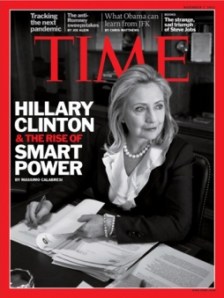 This weeks’ Time Magazine features Secretary of State Hillary Clinton. It has interviews and some great Diana Walker Photos. The interview is on the idea of “smart power” which may become known as the Clinton Doctrine.
Hillary Clinton argues in our cover story this week, now available online to subscribers, that America is not so much in decline as adjusting to a world of increasingly diffuse power, where like-minded networked individuals, non-governmental organizations and other non-traditional global actors may steer events as much as great power capitals. Clinton lays out “smart power” strategies for protecting and advancing U.S. interests in that new non-polar world.
We argue that Clinton is something of an expert at coming up with strategies for maximizing limited power given her life experiences, including being a First Lady with high visibility but little official swat, and a Secretary of State in the administration of her former rival, President Obama, who makes the final call on most major foreign policy and national security decisions with a small group of aides at the White House—and without Clinton.
The story is told largely through the lens of the very limited war in Libya, which is in many ways Clinton’s war, thanks to her efforts lining up the Arab and European coalitions that fought it. We have some good reporting on her trip there last week, as well as on the internal and external challenges she faced in advancing the cause of intervention. We also lay out the ways in which Libya remains dangerously unpredictable, and underscore areas where her new strategies are more talk than action.
Lastly, we polled her against Romney and Perry, and found that she does better, by far, than Obama, leading Romney by 17 points and Perry by 26*. Her closest aides strongly dismiss any 2012 ambitions and say 2016 is very unlikely: she’d be 69 the day of the vote that year. We don’t speculate on the source of her popularity.

 peej
peej Carissa
 bostonboomer
 dakinikat
 ecocatwoman
 mablue2
 Mama Lopez
 peggysue22
 quixote
 skydancingguestblogger
 Mona (aka Wonk the Vote)



 Sky Dancing
Recent Comments