
Lesbian Couple Told Not to Hold Hands in Museum
Posted: July 19, 2011 Filed under: GLBT Rights | Tags: Alice B. Toklas, art, Contemporary Jewish Museum, Gertrude Stein, GLBT rights, Jane Levikow, Man Ray, San Francisco 8 Comments
Photo of Alice B. Toklas and Gertrude Stein, by Man Ray
From the San Francisco Chronicle:
Jane Levikow went to the Contemporary Jewish Museum Sunday afternoon to look at art. She ended up with a refresher course in San Francisco civil rights.
Levikow was in the gallery with her partner when she noticed a young lesbian couple in heated conversation with a security guard.
“They were holding hands,” Levikow said, “and he told them they couldn’t hold hands in the museum.”
The couple argued with the guard and people began to gather around to see what was happening. The guard then tried to escort the couple out, but they refused to leave and demanded to talk to museum officials.
Daryl Carr, museum spokesman, says museum officials are active in supporting the LBGT community and that they have asked that the guard, who works for a private security company, be reprimanded.
Ironically, when the guard accosted them, the couple were viewing an exhibit about the life of Gertrude Stein, who was also a lesbian.
Quickie Debt Deal Update
Posted: July 19, 2011 Filed under: Federal Budget, Federal Budget and Budget deficit | Tags: Federal Debt debate, Gang of Six 12 Comments Jamie Dupree at the AJC has a nice brief summary of the ‘Gang of Six Details’. I know you’re as tired of the debt ceiling drama as I am but given that every one seems willing to sell us regular folks out, I think we need to keep on top of it. That, and I’m getting damned close to cashing out all my money market funds and buying Loonies. I kid you not. I’d invest in a nice cash crop at this point if I could. Pork Bellies any one?
So this is the overriding goals which basically are in keeping with the Cat Food Commission. These, again, come from the so-called Gang of Six.
* Slash our nation’s deficits by $3.7 trillion/$3.6 trillion over ten years under CBO’s March 2011 baseline, or $4.65 trillion/$4.5 trillion under the original fiscal commission baseline (which used the President’s 2011 budget request as the starting point for discretionary spending).
* Stabilize our publicly-held debt by 2014.
* Reduce our publicly-held debt to roughly 70% of our economy by 2021.
* Impose unprecedented budget enforcement.
Here’s some more strategic principles that include the approach to Social Security. The so-called spending caps principle is also included.
The plan uses a two-step legislative process: (1) an initial bill that makes immediate cuts; and (2) a process for a second bill to enact comprehensive reform and put our nation on a stable fiscal path. The plan would:
Immediately implement aggressive deficit reduction down payment
* Cut deficits by $500 billion.
Dramatically cut discretionary spending
* Cut nonsecurity and security discretionary spending over 10 years.
* Maintain investments that encourage economic growth, strengthen the safety net for those who truly need it, and preserve a strong national defense.
Carefully strengthen the solvency of our most important entitlement programs
* Spend health care dollars more efficiently in order to strengthen Medicare and Medicaid, while maintaining the basic structure of these critical programs.
* Fully pays for SGR (the “doc fix”) over 10 years.
Fundamentally reform our tax code
* Reduce marginal income tax rates and abolish the $1.7 trillion Alternative Minimum Tax.
* Encourage greater economic growth.
* Enhance the competitiveness of American businesses and workers against global competition.
* Reform spending through the tax code to eliminate investment distortions and tax gaming.
* Change the debate about taxes in America from rate levels and carve outs to competitiveness, fairness and growth.
* If CBO scored this plan, it would find net tax relief of approximately $1.5 trillion.
Strictly tighten the government’s budget processes
* Impose spending caps and security/nonsecurity firewalls.
* Sequester accounts at the end of the year to recoup any excessive spending by Congress.
* Restrict the use of emergency designations that circumvent the spending caps.
* Prevent Congress from exceeding the caps by requiring a stand-alone resolution subject to a 67-vote threshold, in order to isolate that vote to increase the deficit from any other policy items.
Reform Social Security for future generations
* Ensure 75-year solvency of Social Security and provide for a decennial review of the program to ensure it remains solvent.
* Reform Social Security on a separate track, isolated from deficit reduction – any savings from the program must go towards solvency.
There’s more bullet points over there that you may want to check out. I agree that Social Security Reform should be kept on a separate track. Right now, it’s not the priority problem at all. The rest are just broad strategical approaches. The detailed plan follows these. The details are called an ‘aggressive’ plan and you’ll see that’s exactly so.
Here’s some of the details on Social Security.
* Consider Social Security reform, if and only if the comprehensive deficit reduction bill has already received 60 votes.
* Reform must ensure 75-year solvency of the program and provide for a decennial review to ensure it remains solvent. Any savings from the program must go towards solvency, not deficit reduction.
* If Finance fails to report Social Security reform meeting the instructions, allow a group of at least five senators from each party to introduce a resolution with recommendations that meet the committee’s instructions.
* Bar substitute amendments that worsen the solvency of Social Security.
* Combine any qualifying Social Security reform bill that receives 60 votes on final passage to the comprehensive bill at the desk before being sent to the House as a single bill.
* Vitiate the vote on the deficit-reduction bill if the Social Security reform bill does not receive 60 votes.
Here’s some of the highlights from the deficit reduction plan. I am putting another one that impacts Social Security first. You can find information on the chained-CPI in my previous post here.
* Shift to the chained-CPI (a more accurate measure of inflation) government-wide starting in 2012, along with the following specifications for Social Security: (1) exempt SSI from the shift for five years, and then phase in the shift over the next five years; and (2) provide a minimum benefit equal to 125% of the poverty line for five years. (According to CBO, the shift to chained-CPI would result in the annual adjustment growing, on average, about 0.25 percentage points per year slower than the current CPI.)
Here’s some of the discretionary spending cuts to departments.
* Finance would permanently reform or replace the Medicare Sustainable Growth Rate formula ($298 billion) and fully offset the cost with health savings, would find an additional $202 billion/$85 billion in health savings, and would maintain the essential health care services that the poor and elderly rely upon.
* Armed Services would find $80 billion.
* Health, Education, Labor, and Pensions would find $70 billion.
* Homeland Security and Government Affairs would find $65 billion.
* Agriculture would find $11 billion while protecting the Supplemental Nutrition Assistance Program.
* Commerce would find $11 billion.
* Energy would find $6 billion and may propose additional policies to generate savings that would be applied to the infrastructure deficit or to reduce the deficit.
* Judiciary would find an unspecified amount through medical malpractice reform.
* Require the Finance Committee to report tax reform within six months that would deliver real deficit savings by broadening the tax base, lowering tax rates, and generating economic growth as follows:
* Simplify the tax code by reducing the number of tax expenditures and reducing individual tax rates, by establishing three tax brackets with rates of 8–12 percent, 14–22 percent, and 23–29 percent.
* Permanently repeal the $1.7 trillion Alternative Minimum Tax.
* Tax reform must be projected to stimulate economic growth, leading to increased revenue.
* Tax reform must be estimated to provide $1 trillion in additional revenue to meet plan targets and generate an additional $133 billion by 2021, without raising the federal gas tax, to ensure improved solvency for the Highway Trust Fund.
There’s more details on the cuts over at the AJC article. I think it looks like tax reform is a major part of this. Please note that the top bracket is being adjusted downward and would be extremely generous to rich people. Even if the Bush tax cuts sunset, this really reduces the progressivity of our tax system and I have a major problem with that. Rich people use up more government services than normal people and these days, most of their money comes from nonproductive sources like capital gains from wherever and whatever activities. Certainly, earning money off of products that cause lung cancer or companies that go abroad and set up production in plants where suicide by workers is the norm isn’t exactly a productive use of capital. If they feel morally unaffected by those investment decisions, that’s all well and good, but I don’t think the US treasury needs to subsidize people who create extraordinarily high social costs. It’s estimated that one pack of cigarettes creates between $40 -$70 of public health costs that are borne by tax payers, just as an example. Again,I don’t think we should be subsidizing investments in businesses with huge costs to society.
Look for more information as the details are released.
Tuesday Reads: Debt Ceiling Chicken, Roberts vs. Roe, Rove on Obama, NewsCorp, and Casey Anthony Rumors
Posted: July 19, 2011 Filed under: abortion rights, Barack Obama, John Birch Society in Charge, just because, morning reads, Psychopaths in charge, Republican politics, Surreality, The Media SUCKS, U.S. Economy, U.S. Politics, unemployment, voodoo economics, We are so F'd | Tags: abortion, armageddon, balanced budget amendment, Barack Obama, Casey Anthony, Federal debt ceiling, Harry Reid, James Murdoch, John Boehner, Justice John Roberts, Karl Rove, media, NewsCorp scandal, Roe v. Wade, Rubert Murdoch, Sean Hoare, U.S. Supreme Court, veto warning, whistleblowers 30 Comments
Good Morning!! I know we’re all sick and tired of the debt limit battle, but there is going to be a vote today in the House–on a stupid bill that includes a balanced budget amendment to the Constitution. What a joke! And with only about two weeks to go until armageddon.
Anyway, let’s get the depressing news out of the way first. From Politico: Debt ceiling debate turns ‘scary’
Washington’s frayed nerves showed through Monday amid tough talk on the right, a White House veto threat, canceled weekend passes and the top Senate Democrat likening default to a “very, very scary” outcome even for those “who believe government should be small enough to drown in a bathtub.”
“What will it take,” asked an agitated Majority Leader Harry Reid (D-Nev.), “for my Republican colleagues to wake up to the fact that they’re playing a game of political chicken with the entire global economy?”
House Speaker John Boehner confirmed a POLITICO report that he had met again privately with President Barack Obama at the White House on Sunday to try to get debt talks back on track. But ignoring Obama’s veto warning, Boehner will press ahead Tuesday with House votes on a revised debt ceiling bill that shows no sign of compromise on the spending and tax policy differences behind the crisis.
Indeed, with the Aug. 2 deadline exactly two weeks away, the House GOP is doubling down its bet with 10-year statutory spending caps intended to wring $5.8 trillion in unspecified savings from the government during the next decade — more than twice the $2.4 trillion debt ceiling increase that is allowed. And in his haste to act, Boehner will bring the so-called Cut, Cap and Balance bill to the floor under exactly the type of procedure he has said he abhors: limited debate and with no real review by any legislative committee.
Yes, the psychopaths and John Birchers are in charge, and there’s nothing we can do but wait and hope.
The Nation has a good article about the ongoing war on women by Amanda Marcotte and Jesse Taylor: How States Could Ban Abortion With Roe Still Standing
The Supreme Court granting states the power to ban abortion with Roe still standing seemed outlandish even just a few years ago, but the appointment of John Roberts to Chief Justice shifted the equation. Roberts specializes in decisions that reverse the spirit of precedent while leaving intact the letter of it, like when he squashed large chunks of Brown v the Board of Education while claiming to uphold it. To make it legal to ban abortion in the states, all the court needs is a law that eliminates legal abortion while dodging the logic of Roe v Wade.
Many state legislatures appear to be doing just that, writing legislation which Nancy Northup, the president of the Center for Reproductive Rights, describes as “part of an ongoing effort around the country to choke off women’s access to abortion by any means necessary – either by forcing doctors out of practice, banning procedures outright or demeaning women.”
How would the Roberts Court invalidate Roe without actually overturning it?
Until recently, Roe has been considered an insurmountable obstacle to states that wish to ban abortion. The conservative side of the Roberts bench, however, will likely view the Roe decision as a seesaw with women’s rights on one side and the state interest in the fetus on the other. Currently, most of the weight is on the woman’s side for three months, some weight moves over to the state’s side for the next three months, and then most of the weight moves to the state’s side for the last trimester.
Roberts has two options for reshaping Roe: the first is to claim the state’s interest in fetal life starts even sooner, using bogus science to claim we know more about the fetus than we did 1992, when Planned Parenthood v Casey was decided. The second option is to change the court interpretation of individual state rights and compelling state interest, while leaving Roe’s framework technically in place. The court could, for instance, define the state’s interests more broadly, allowing it to regulate differently within the (technically) still-operative Roe framework. This would allow a state like Kansas to claim to still have legal abortion while burying would-be abortion providers under so much red tape they couldn’t keep a clinic open. It would also allow states like South Dakota to create so many hoops for women to jump through to get abortion that women simply wouldn’t be able to do it. The right to choose would theoretically exist, but only to the extent states deign to recognize it.
Yikes!
This struck me funny–Karl Rove isn’t all that impressed with Obama’s fund-raising.
According to CBS radio’s Mark Knoller, who also serves as the unofficial White House press corps statistics king, the president attended 31 fundraisers in nine states during the last three months. That is more than a fundraising reception or dinner every three days.
Rove doesn’t think Obama can keep up that pace.
Thirty-one fundraisers in a quarter is a big strain on any president’s schedule. Mr. Obama can’t keep that pace up and not just because he’s got a day job. There are also just so many cities capable of producing $1 million and only so many times you can hold a million dollar fundraiser in them.
Here’s the funny part:
Even though at least $35 million (almost half the total Obama/DNC haul) can be credited to just 244 well-connected “bundlers,” Team Obama made a big thing of their 260,000 new small dollar donors. But that means only 292,000 donors from his last campaign have renewed their support for the re-elect so far. That’s just 6.6 percent of the 3.95 million people who donated to the ’08 Obama effort, only a quarter to a third of what most reelect campaigns could expect from renewal efforts at this point.
Perhaps there really is donor fatigue among the legions of stalwarts who put Mr. Obama in the White House the first time.
Yeah, I’d say there’s probably quite a bit of “donor fatigue” among the unemployed and underemployed masses.
British police are still insisting that the death of News of the World whistleblower Sean Hoare is not suspicious; but no one trusts the police because they were apparently taking bribes from Murdoch employees to help in stalking celebrities and other NOTW targets.
We’re being prepared to find out he died of an overdose by being reminded that Hoare had drug and alcohol problems. But so far we don’t have a cause of death. I say he was suicided. Even if he died of natural causes, no one will believe it.
Some people are beginning to question whether Rupert Murdoch can keep control of NewsCorp in the face of this growing scandal.
Independent directors of New York-based News Corp. have begun questioning the company’s response to the crisis and whether a leadership change is needed, said two people with direct knowledge of the situation who wouldn’t speak publicly. Rebekah Brooks, the former News International chief who Murdoch backed until last week, was arrested yesterday in London.
“The shell of invulnerability that Rupert Murdoch had around him has been cracked,” said James Post, a professor at Boston University’s School of Management who has written about governance and business ethics. “His credibility and the company’s credibility are hemorrhaging.”
Murdoch’s son James is also in big trouble and may not survive the investigation.
Finally, despite the threats of the media and the public alike to boycott Casey Anthony and consign her to oblivion, lots of people are still obsession about her. The latest frenzy is the media’s efforts to find out where Anthony has disappeared to. I thought that’s what everyone wanted her to do?
The Orlando Sentinel asks: Where in the World is Casey Anthony? My answer is “who cares?” But it seems lots of people still do. News crews and helicopters attempted to follow the SUV that Anthony got into after she walked out of jail, but
Anthony’s exact location was lost when the SUV stopped at the parking garage of the building where fellow defense team member Cheney Mason works.
Droves of journalists and spectators waited for hours at nearby Orlando Executive Airport, where many guessed Anthony would board a private plane and head out of town.
But there was no clear sign of Anthony boarding a plane and no flight manifests immediately available that would indicate who was on board the handful of flights that departed the airport early Sunday.
The secrecy surrounding Anthony’s whereabouts continued to fuel the rumor mill Monday as the media and public tried to figure out where the 25-year-old is holing up and when she’ll resurface.
The latest rumor is that Anthony is staying at Geraldo Rivera’s residence in Puerto Rico, but Rivera denies it.
Defense attorney Cheney Mason says that Anthony is “safe” and that hundreds of people have offered to help her.
Whatever. I really thought ignoring her was a good idea, but I guess it isn’t going to happen.
That’s all I’ve got for today. What are you reading and blogging about?
Midnight Thread: Bachmann suffers from Debilitating Migraines
Posted: July 19, 2011 Filed under: Republican politics, Republican presidential politics | Tags: headaches, Michelle Bachmann, Migraines, pills 13 Comments This is not the sort of thing that you like to put into print. Oddly enough, the story comes from Tucker Carlson’s Daily Caller and undoubtedly some sort of inter-Republican Squabble has created the atmosphere for its release. I’m just going to put up the headline at this point because first, I’m not a doctor, I’m an economist dammit! Second, because I’m not a psychologist, I’m an economist dammit! Third, I am a Buddhist and any kind of suffering on the part of sentient beings disturbs me. It will have a profound impact on the Republican presidential campaign so, here it is.
Stress-related condition ‘incapacitates’ Bachmann; heavy pill use alleged
The Minnesota Republican frequently suffers from stress-induced medical episodes that she has characterized as severe headaches. These episodes, say witnesses, occur once a week on average and can “incapacitate” her for days at time. On at least three occasions, Bachmann has landed in the hospital as a result.
“She has terrible migraine headaches. And they put her out of commission for a day or more at a time. They come out of nowhere, and they’re unpredictable,” says an adviser to Bachmann who was involved in her 2010 congressional campaign. “They level her. They put her down. It’s actually sad. It’s very painful.”
Bachmann’s medical condition wouldn’t merit public attention, but for the fact she is running for president. Some close to Bachmann fear she won’t be equal to the stress of the campaign, much less the presidency itself.
“When she gets ‘em, frankly, she can’t function at all. It’s not like a little thing with a couple Advils. It’s bad,” the adviser says. “The migraines are so bad and so intense, she carries and takes all sorts of pills. Prevention pills. Pills during the migraine. Pills after the migraine, to keep them under control. She has to take these pills wherever she goes.”
To staff, Bachmann has implausibly blamed the headaches on uncomfortable high-heel shoes, but those who have worked closely with her cite stress, a busy schedule and anything going badly for Bachmann as causes.
My sister has developed menopause-related migraines so I hate to even delve into that suggestion as it could be another excuse to claim that women’s biology means they can’t be leaders. However, that being said, Congresswoman Bachmann will have to discuss this. I’m not too young to have forgotten Thomas Eagleton either. So, as they said on Saturday Night Live ages ago, discuss amongst yourselves …
Breaking … WSJ Discovers Lack of Demand is behind Weak U.S. Economy
Posted: July 18, 2011 Filed under: Barack Obama, Domestic Policy, Economy, Surreality, The Great Recession, U.S. Economy, U.S. Politics, unemployment, voodoo economics | Tags: consumer demand, economics, Economists, economy, Federal spending cuts, government stimulus, jobs, Keynes, unemployment, Wall Street Journal 16 Comments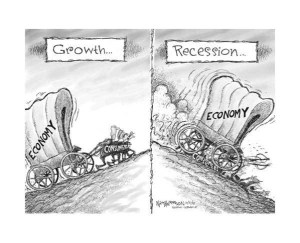
Via Andrew Leonard at Salon, the Wall Street Journal today reported the results of a survey they conducted with 53 economists:
In the survey, conducted July 8-13 and released Monday, 53 economists—not all of whom answer every question—were asked the main reason employers aren’t hiring more readily. Of the 51 who responded to the question, 31 cited lack of demand (65%) and 14 (27%) cited uncertainty about government policy. The others said hiring overseas was more appealing.
Only the conservative WSJ, the President, and Congresss could be surprised by these results. I’m not sure who these 53 economists were, but I think they must have been rather conservative, because the survey found that most did not think the government should do anything more to stimulate the economy.
Despite their forecasts for slow growth and an elevated unemployment rate, the economists aren’t in favor of further action either by the Fed or the federal government. Forty-one economists in the WSJ survey said the central bank shouldn’t pursue another round of bond-buying aimed at reducing interest rates, and thirty-eight said another round of fiscal stimulus shouldn’t be a part of any deficit-reduction package.
Economists added that they hope that as conditions begin to improve, albeit slowly, consumers will become more optimistic. “For whatever reasons, in addition to discrete headwinds, I think we’ve taken a hit to animal spirits and as those headwinds fade sentiment will revive,” said Stephen Stanley of Pierpont Securities. “Optimism can be self-sustaining, but pessimism can also provide a persistent drag.”
If any of the economists the WSJ talked to mentioned the possibility that the government itself could create jobs and thus stimulate demand–as FDR did the last time things were this bad, the WSJ did not report it.
Andrew Leonard crows:
what could be more obvious, even in the absence of rigorous training in economics? In the absence of demand, businesses will refrain from ramping up production and adding staff — no matter what employers think about the future regulatory climate. To prime this pump, to rev up this engine, to get the “delicate machine” working properly, the first focus for economic policymakers should be figuring out ways to boost demand.
Wouldn’t the best way to do that be to create jobs? Even Andrew Leonard doesn’t mention that. It seems ass-backwards to me to talk about getting consumers to spend more in order to get companies to start hiring. How can consumers spend more when many of them are unemployed? Maybe Dakinikat can explain this to me.
Anyway, it’s pretty amazing that the WSJ is admitting we have a demand problem. Now if only they could convince President Obama…

 peej
peej Carissa
 bostonboomer
 dakinikat
 ecocatwoman
 mablue2
 Mama Lopez
 peggysue22
 quixote
 skydancingguestblogger
 Mona (aka Wonk the Vote)



 Sky Dancing
Recent Comments