
Try Boehner and Cantor for Treason? What about Obama?
Posted: July 25, 2011 Filed under: Barack Obama, Democratic Politics, Medicaid, Medicare, Republican politics, Social Security, U.S. Economy, U.S. Politics, voodoo economics | Tags: 14th amendment, Barack Obama Abe Lincoln, Eric Cantor, Federal debt limit, full faith and credit, John Boehner, Sky Dancers, Tea Party, U.S. Treasury 40 Comments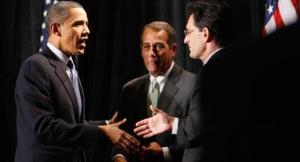
Are Sky Dancers cutting edge or what? Nearly two weeks ago, Dakinikat asked whether our government leaders could be charged with treason over the debt ceiling debacle.
Now David Seaman, a blogger at Business Insider argues that Boehner and Cantor are committing treason by catering to a small number of Tea Partiers’ demands while making the U.S. look weak and unreliable to the rest of the world.
I don’t know of a single American business owner or executive who thinks default — economic armageddon — should be on the table, and yet Republicans are acting as if Americans consider this a viable option.
Sadly, it’s already too late: although we still have time to get a deal before the August 2nd hard deadline, this is the equivalent of shoving a check under your landlord’s door at 11:59 p.m. You’ve lost his trust, even if you are technically not in default.
Enough disgusting dramatics to please your small Tea Party base — we are a nation of more than 300 million; the Tea Party is a handful of folks with racist signs, radical agenda, and the favor of a few influential bookers at Fox News.
On Boehner and Cantor:
John Boehner — a full-grown man who cries in public for rhetorical affect (or maybe he’s that imbalanced, I don’t know)… Eric Cantor — a disgusting attention-seeker who doesn’t realize he is one of the country’s actual leaders, and not merely a commentator on a political morning show.
At this point, Americans should be calling for both of their heads. We need to keep an eye on such “leaders” and ensure that they and their kind are not re-elected to Congress. They don’t represent any of us. And their childish Tea Party views — which have no basis in sound economic theory — are making us look like fools to our international partners.
Seaman also points to this column by John Avlon at CNN, “Our stupid self-inflicted debt crisis.”
…if America defaults on its debt, not only will we find ourselves in a far deeper fiscal hole, but the full faith and credit of the United States will be compromised. In our globalized era, that means America will be considered an unpredictable partner and a second-class power.
Worst of all, this will be a self-inflicted wound. It is a direct result of the hyper-partisanship that has been hijacking America’s political debates. Now it is compromising our ability to govern ourselves effectively.
The markets are viewing Washington’s debt dysfunction as badly as Standard & Poor’s and Moody’s, which have raised the possibility of downgrading their ratings of U.S. bonds.
The British government’s business secretary, Vince Cable, summed up the situation as he saw it on the BBC this weekend: “The irony of the situation at the moment, with markets opening tomorrow morning, is that the biggest threat to the world financial system comes from a few right-wing nutters in the American Congress.”
Avlon blames the mess on “hyper-partisanship,” but the problem as I see it is that the Democratic side–especially our Reagan-adoring President–is showing no partisanship at all, just rushing to cave in to every Republican demand. After all, Obama could quickly resolve this situation, as Daknikat pointed out yesterday, by “invoking the 14th Amendment.”
At FDL, David Dayen points out, rather sarcastically, that Obama “has options to raise the debt limit.” He could tell Congress to vote on the debt limit and hold the arguments about cuts and taxes till later, as Elizabeth Drew suggested at Politico. Alternatively, Dayen says he could turn to the 14th amendment. Obama has so far dismissed this possibility.
Finally, Dayen points to an article in Friday’s NYT by two conservatives.
PRESIDENT OBAMA should announce that he will raise the debt ceiling unilaterally if he cannot reach a deal with Congress. Constitutionally, he would be on solid ground. Politically, he can’t lose. The public wants a deal. The threat to act unilaterally will only strengthen his bargaining power if Republicans don’t want to be frozen out; if they defy him, the public will throw their support to the president. Either way, Republicans look like the obstructionists and will pay a price….
Our argument is not based on some obscure provision of the 14th amendment, but on the necessities of state, and on the president’s role as the ultimate guardian of the constitutional order, charged with taking care that the laws be faithfully executed.
When Abraham Lincoln suspended habeas corpus during the Civil War, he said that it was necessary to violate one law, lest all the laws but one fall into ruin. So too here: the president may need to violate the debt ceiling to prevent a catastrophe — whether a default on the debt or an enormous reduction in federal spending, which would throw the country back into recession.
A deadlocked Congress has become incapable of acting consistently; it commits to entitlements it will not reduce, appropriates funds it does not have, borrows money it cannot repay and then imposes a debt ceiling it will not raise. One of those things must give; in reality, that means that the conflicting laws will have to be reconciled by the only actor who combines the power to act with a willingness to shoulder responsibility — the president.
Abe Lincoln did it, but Obama claims he can’t? Seaman, Avlon, and Vince Cable so far are holding their fire on Obama’s role in this embarrassing mess. But he is the one who is ultimately responsible for maintaining the full faith and credit of the U.S. Treasury. That credit has already been harmed by Obama’s failure to act decisively.
I’d say it’s high time to begin impeachment proceedings against this President, or failing that, Democrats should find someone to run against him in the 2012 primaries. This nonsense has gone on long enough. Yes, I understand that Obama wants to gut Social Security, Medicare, and Medicaid, but the Republicans aren’t going to accept a deal when it’s blatantly obvious that they still can get more from this President–he’ll cave on anything. Either Obama needs to get a grip and do the right thing for once, or he needs to find a job he can handle and let someone else lead the United States of America.
Monday Reads
Posted: July 25, 2011 Filed under: morning reads 25 Comments Good Morning!
I’ve still been following some of the same stories that we talked about this weekend. The Federal Deficit standoff continues with each side going to its time out corner to write its own plan. More and more information about the home grown Norwegian terrorist comes up showing that he was basically an extremist Christian “Crusader” who felt that killing innocent people was necessary to stop the forward march of “multicultural Marxists”. There’s rumors that the Norwegian police may be looking for British associates of the terrorist who Fox News now refers to as a mad man and NAZI. This is despite a lot of evidence that he and others like him try to paint themselves as”Zionists” and pro Israel. They’ve even offered up help. This is something that Israeli leaders have condemned as not being pro Israel.
In numerous online postings, including a manifesto published on the day of the attacks, Breivik promoted the Vienna School or Crusader Nationalism philosophy, a mishmash of anti-modern principles that also calls for “the deportation of all Muslims from Europe” as well as from “the West Bank and the Gaza Strip.”
According to the manifesto, titled “2083: A European Declaration of Independence” and published under the pseudonym Andrew Berwick, the Vienna School supports “pro-Zionism/Israeli nationalism.”
The Norwegian terrorist attack has put focus on right wing extremist groups in Europe and should lead us to closely examine similar movements in this country. Fiercely nationalistic and anti-immigrant, these organizations have been networking over the internet.
The success of populist parties appealing to a sense of lost national identity has brought criticism of minorities, immigrants and in particular Muslims out of the beer halls and Internet chat rooms and into mainstream politics. While the parties themselves generally do not condone violence, some experts say a climate of hatred in the political discourse has encouraged violent individuals.
“I’m not surprised when things like the bombing in Norway happen, because you will always find people who feel more radical means are necessary,” said Joerg Forbrig, an analyst at the German Marshall Fund in Berlin who has studied far-right issues in Europe. “It literally is something that can happen in a number of places and there are broader problems behind it.”
The most astounding recent news is that the Norwegian many may be linked to a UK group.
Detectives investigating Norway’s bomb attack and mass shooting are thought to be probing the suspect’s possible links to the British far right.
Police have been examining the background of Anders Breivik, who reportedly claimed he was recruited by two English right-wing extremists at a meeting in the UK in 2002 attended by seven other people.
Trisha Tritch at NYT has a great piece up on How the Deficit Got This Big. It’s exactly what we’ve been saying here forever.
With President Obama and Republican leaders calling for cutting the budget by trillions over the next 10 years, it is worth asking how we got here — from healthy surpluses at the end of the Clinton era, and the promise of future surpluses, to nine straight years of deficits, including the $1.3 trillion shortfall in 2010. The answer is largely the Bush-era tax cuts, war spending in Iraq and Afghanistan, and recessions.
Despite what antigovernment conservatives say, non-defense discretionary spending on areas like foreign aid, education and food safety was not a driving factor in creating the deficits. In fact, such spending, accounting for only 15 percent of the budget, has been basically flat as a share of the economy for decades. Cutting it simply will not fill the deficit hole.
So, let’s try to move away from the big stories. The Institute of Medicine of the National Academies argues that preventative services for women–including access to birth control–is essential to women’s health. The ACLU explains the importance of these findings.
This is a huge step forward for women’s health, as the IOM’s recommendation is a significant move toward ensuring that contraception is provided without co-pays or other out-of-pocket expenses in new insurance plans under the health reform law.
Last summer, the federal government commissioned the IOM, an independent medical authority, to review and recommend women’s preventive health services that should be included in the Department’s final guidelines on preventive services that are expected later this summer. In a true showing of support for women’s health, the IOM recommended that the list of services should include “the full range of Food and Drug Administration-approved contraceptive methods.”
The IOM’s recommendation, if adopted, will ensure that millions of women have access to the safe and effective contraception they need, which is a critical component of basic health care for women. Without contraception, women have more unintended pregnancies and are less likely to get the prenatal care they require to carry a healthy pregnancy to term. Out-of-pocket expenses for birth control, which can range between $15 and $50 per month, burden a woman’s ability to access and use contraception consistently, especially if she is already managing a tight budget. Eliminating extra out-of-pocket costs would remove a major barrier to contraception access, allowing women to make their own personal decisions about whether or when to have children, regardless of the size of their pocketbooks.
National Geographic has a fascinating read up on five hypothesis about the origins and purposes of Machu Picchu. I watched the TV program and was surprised to find that one of the biggest ones is that it was actually a royal resort. This is one place that I’ve always wanted to visit.
Verano’s interpretation of the Machu Picchu skeletons is consistent with one of the most popular theories about the site: that it was the royal retreat of the 15th-century Inca Emperor Pachacuti.
According to this idea, Machu Picchu was a place for Pachacuti and his royal court, or panaca, to relax, hunt, and entertain guests.
“The members of Pachacuti’s panaca may have lived there during the year for a few days, weeks, or months,” said Guillermo Cock, a Lima-based archaeologist who has also received funding from the National Geographic Society’s Committee for Research and Exploration. (The Society owns National Geographic News.)
The “royal estate” theory, first proposed in the 1980s, is largely based on a 16th-century Spanish document that referred to a royal estate called Picchu, which was built in the same general area as Machu Picchu.
Yesterday, nearly 800 same sex couples tied the knot in New York. Now, we just need to get DOMA off the books so these couples can enjoy the same federal rights as all married couples.
“Marriage equality is alive and well,” New York City Council Speaker Christine Quinn, the body’s first openly gay leader, said in a press briefing outside the clerk’s office, eliciting cheers from spectators. “All of the great stories and love that are pouring out today — they show what all of us who have fought a lifetime for this knew and know, that moving rights forward makes us a better society.”
The victory for gay-rights advocates, which was championed by Governor Andrew Cuomo and made headlines worldwide, more than doubled, to 35 million, the number of Americans free to marry either gender.
City officials were prepared to marry today all 823 couples — gay and straight — who entered a lottery last week. They expected to beat the previous record for most weddings in one day, set by 621 couples on Valentine’s Day in 2003. About 60 judges were on hand to grant judicial waivers eliminating the state’s 24-hour waiting period.
Okay, so those are my offerings for this Monday morning. What’s on your reading and blogging list?
Today’s Deadline Passes With No Progress: Now What?
Posted: July 24, 2011 Filed under: Democratic Politics, Economy, legislation, Medicare, Republican politics, Social Security, Surreality, the villagers, U.S. Economy, U.S. Politics, voodoo economics, We are so F'd | Tags: Asian markets, Barack Obama, Catfood Commission II, Federal debt ceiling, Grover Norquist, Harry Reid, John Boehner, kabuki, markets, Mitch McConnell, Nancy Pelosi, Super Congress, the dollar, Wall Street 19 Comments
Late last night I wrote a post summarizing what happened yesterday in seemingly endless debt ceiling kabuki dance that is being staged for our benefit by people who are supposed to be serving us but instead answer to Wall Street, Big Oil, Big Pharma, and the rest of the filthy rich.
Last night John Boehner told House Republicans that they needed to show some progress today in order to calm the Asian markets. After weeks of assuming the politicians in Washington would work something out in order to keep the US from defaulting on its debts, the banksters were suddenly realizing there is a good chance the feckless “leaders” will just go ahead and let it happen.
Apparently both Democrats and Republicans see this debt ceiling debacle as a golden opportunity to strip Americans of what is left of their social safety net. The only disagreement seems to be that Democrats want to include a pretense of raising some revenue along with all the cuts to social programs and Republicans want no new revenue sources, apparently because they see an opportunity to bring Grover Norquist’s dream to fruition:
Norquist favors dramatically reducing the size of the government. He has been noted for his widely quoted quip: “I don’t want to abolish government. I simply want to reduce it to the size where I can drag it into the bathroom and drown it in the bathtub.”
He has also stated, “Cutting the government in half in one generation is both an ambitious and reasonable goal. If we work hard we will accomplish this and more by 2025. Then the conservative movement can set a new goal. I have a recommendation: To cut government in half again by 2050”. The Americans for Tax Reform mission statement is “The government’s power to control one’s life derives from its power to tax. We believe that power should be minimized.”
So what was accomplished in today’s kabuki performance? Did the Republicans meet Boehner’s goal of sending a calming signal to Asian markets before their Monday opening. No, of course not.
From The New York Times: Deadline Passes as Debt Ceiling Talks Languish
House Speaker John A. Boehner and the Senate majority leader, Harry Reid, were preparing separate backup plans to raise the nation’s debt ceiling on Sunday, after the leaders were unable to end an increasingly grim standoff over the federal budget.
The dueling plans emerged as lawmakers appeared to miss a self-imposed deadline of 4 p.m. Eastern time to cut a deal before markets open in Asia. And at about 6 p.m., President Obama began meeting with Mr. Reid and the House Democratic leader, Nancy Pelosi, in the Oval Office to discuss the Reid proposal.
Not surprisingly, nothing new seems to have emerged from the talks at the White House. But here’s Harry Reid’s supposed “plan.”
Mr. Reid, the Senate’s top Democrat, was trying Sunday to cobble together a plan to raise the government’s debt limit by $2.4 trillion through the 2012 election, with spending cuts of about $2.5 trillion. He would seek to avoid cuts to entitlement programs, but it was unclear how those savings would be achieved.
Notably, the plan does not currently contain any new or increased taxes, an approach that many in his caucus would probably balk at.
For his part, John Boehner is still blabbing on about the Republicans ridiculous “cut, cap, and balance” plan.
Speaker John Boehner (R-Ohio) told his colleagues in a Sunday afternoon conference call that a debt deal with Obama is not the way forward. He said on the call that a plan that “reflects the principles” of the conservative “Cut, Cap and Balance” proposal that the Senate rejected will serve as the model for any legislation coming out of the House. The speaker, though, did acknowledge that the plan itself is a non-starter.
“So the question becomes – if it’s not the Cut, Cap and Balance Act itself – what can we pass that will protect our country from what the president is trying to orchestrate,” Boehner said, according to a source familiar with the call.
Boehner and Majority Leader Eric Cantor (R-Va.), according to several sources on the call, implored his colleagues to “stick together” to enact a budget deal that they can support. Boehner said an agreement “will require some of you to make sacrifices.” He told his colleagues that they shouldn’t worry about winning the battles, but rather the war, according to a source on the call.
I found this piece at Huffpo helpful, although I’ve never heard of the author, Mohamed el-Erian. CEO and co-CIO, Pacific Investment Management Company. Perhaps Daknikat has? Here’s what he had to say after the supposed deadline passed without any progress.
Friday’s stunning and very public quarrel between the president and the Speaker of the House of Representatives was the catalyst for a weekend of frantic negotiations on how to increase America’s debt ceiling, maintain the country’s sacred AAA rating, and avoid a near-term default. Meanwhile, administration officials and members of Congress took to the airwaves on Sunday trying, but largely failing, to strike the balance between statesmanship and another round of the Washington blame game.
It was hoped that all this would serve as a prelude to a political compromise announced just before the opening of Asian markets. This did not materialize. But while another self-imposed deadline has been missed, it is likely that the nation’s leadership will stumble into a short-term compromise over the next few days — one that raises the debt ceiling and avoids a debt default but, importantly, leaves the AAA rating extremely vulnerable and does little to lift the damaging clouds hanging over the US economy.
It will come down to the wire; and when the stopgap compromise is reached, many in Washington will declare victory and, in the process, claim credit for averting a national disaster. Yet the resolution will likely be temporary, and the damage will be real and long-lasting — both of which render an already worrisome situation even more difficult going forward. Indeed, by illustrating so vividly to the whole world what is ailing America, the weekend’s political theatrics should make us all worry even more about the world’s largest economy.
It’s an interesting article. Obviously our “leaders” have already done immense damage to our struggling economy, not just with their wrongheaded policies, but also with their childish game-playing.
Boehner’s plan right now seems to be to insist on a short-term temporary increase in the debt limit of about $1 trillion
accompanied by spending cuts of at least as much, tying the remainder of the debt-ceiling increase Obama has requested to further cuts in the future. The White House says Obama would veto such a measure.
The markets responded quickly:
U.S. stock futures fell, indicating the Standard & Poor’s 500 Index will slump after rallying within 1.4 percent of a three-year high, as failure to raise the federal debt limit intensified concern of a default.
The contract on the S&P 500 Index expiring in September declined 1.2 percent to 1,325.50 at 7:01 a.m. in Tokyo. The U.S. dollar fell against the euro, yen and Swiss franc.
[….]
The dollar weakened to $1.4390 per euro as of 6:01 a.m. in Tokyo from $1.4360 in New York at the end of last week. The greenback fell to 78.35 yen, and touched a four-month low of 78.12 yen, from 78.54 on July 22. It fetched 81.17 Swiss centimes from 81.92 last week after reaching a record low 80.33 on July 18. The yen traded at 112.75 per euro from 112.77.
I don’t pretend to understand all that gibberish, but I know it isn’t good.
The Wall Street Journal says the markets are “bracing for volatility as debt ceiling debate drags on.”
What really scares me is what is going on behind all the “partisan” kabuki. Let’s face it, Democrats are no more our friends than Republicans at this point. We simply can’t trust any of them. I wrote a few days ago about the Catfood Commission II clause that is included in the so-called McConnell plan–the fallback plan that Harry Reid is on board with. Apparently Boehner has also latched onto this idea, and the sequel to the Catfood Commission will also be included in whatever legislation the Republicans come up with.
Ryan Grim has a piece in Huffpo today about Catfood Commission II, which he characterizes as a “Super Congress.”
Debt ceiling negotiators think they’ve hit on a solution to address the debt ceiling impasse and the public’s unwillingness to let go of benefits such as Medicare and Social Security that have been earned over a lifetime of work: Create a new Congress.
This “Super Congress,” composed of members of both chambers and both parties, isn’t mentioned anywhere in the Constitution, but would be granted extraordinary new powers. Under a plan put forth by Senate Minority Leader Mitch McConnell (R-Ky.) and his counterpart Majority Leader Harry Reid (D-Nev.), legislation to lift the debt ceiling would be accompanied by the creation of a 12-member panel made up of 12 lawmakers — six from each chamber and six from each party.
Legislation approved by the Super Congress — which some on Capitol Hill are calling the “super committee” — would then be fast-tracked through both chambers, where it couldn’t be amended by simple, regular lawmakers, who’d have the ability only to cast an up or down vote. With the weight of both leaderships behind it, a product originated by the Super Congress would have a strong chance of moving through the little Congress and quickly becoming law. A Super Congress would be less accountable than the system that exists today, and would find it easier to strip the public of popular benefits. Negotiators are currently considering cutting the mortgage deduction and tax credits for retirement savings, for instance, extremely popular policies that would be difficult to slice up using the traditional legislative process.
So basically, no matter what legislation Congress ends up passing to raise the debt ceiling, this “Super Congress” will be included. We certainly can’t expect any disagreement on this from Obama who, as Grim describes it “has shown himself to be a fan of the commission approach to cutting social programs and entitlements.”
We are so utterly f&cked.
Invoke the 14th Amendment. PERIOD.
Posted: July 24, 2011 Filed under: Economy, Federal Budget, Federal Budget and Budget deficit | Tags: 14th amendment, debt ceiling rant 37 CommentsSection 4. The validity of the public debt of the United States, authorized by law, including debts incurred for
payment of pensions and bounties for services in suppressing insurrection or rebellion, shall not be questioned. But neither the United States nor any State shall assume or pay any debt or obligation incurred in aid of insurrection or rebellion against the United States, or any claim for the loss or emancipation of any slave; but all such debts, obligations and claims shall be held illegal and void.
The first intelligent article suggesting we do that came from The Nation‘s Katrina vanden Heuvel after Timothy Geithner suggested he had folks exploring the option. I’ve ended several blog posts this month with the call to invoke the 14th and send the insane teabot posse back home with the message that they may want to read up on U.S. The Constitution before they start waving that Gadsden flag in our faces.
Brad Delong fleshes the argument out within this context. We have a president that’s found lawyers who have said that actions in Libya are not “hostilities”. I will add that we’ve had several presidents who have found lawyers that have written that “enhanced interrogation techniques” aren’t torture and that it’s okay to assassinate citizens without due process. Certainly, with a Washington DC that has more word-parsing, pretzel-logic-precedent-finding, triangulating lawyers per square foot than any place on the planet, the White House can find one that finds Delong’s suggestions below justifiable via Section 4 stated above.
The structure of Tim Geithner’s testimony to Congress defending his additional borrowing is:
- The Constitution forbids me from even thinking about default.
- You ordered me to spend.
- A previous Congress told me not to borrow, but no Congress can bind its successors, and those of you who are in this Congress here now ordered me to spend.
- I’m just doing what you told me to do–and what the Constitution directly and explicitly tells me to do.
And then we should move on to the people’s business. This episode of kabuki theatre has done nobody any credit. If I had previously had any respect for or confidence in Republicans, this would have shredded it. And each day it continues it further shreds my respect for and confidence in the executive branch.
DeLong argues–and I agree–that this is far better than options outlined by Ezra Klein and ranked by Calculated Risk here. In the long run, we should probably be looking at eliminating the debt ceiling. If Congress authorizes the spending and the President signs off on it, there should be absolutely no way that they can renege on bond holders later. Moody’s suggested the same thing last week. The rest of the crap on the table just undoes one promise made to people after another.
It should be obvious by now that Boehner is not in control of his caucus in congress. The tea party has him over a tea barrel. These are folks that appear to have no clue about anything as illustrated by their ignorant statements last spring that all they had to do was pass a budget and it was law. They completely forget the role of the President and the Senate. They seem to have no idea or they stubbornly refuse to believe the experts that tell them that what they are doing is basically bringing the country’s economy down.
Meanwhile, there were lingering doubts about Boehner’s ability to rally support for a debt-limit increase of any size or duration. Many House Republicans continue to push their plan to sharply cut spending over the next decade and adopt a constitutional amendment requiring Congress to balance the budget. Such a plan passed the House, but failed Friday in the Senate on a party-line vote.
Freshman Rep. Blake Farenthold (R-Tex.) said Republican leaders remain concerned that even a small increase in the debt limit would fail on the House floor.
“I think their concern about bringing it to the floor is whether they can get 218 [votes] or not,” Farenthold said in an interview. “Everybody wants to only go through this pain once.”
We can’t afford to pass a debt ceiling increase attached to no firm commitments for revenue adjustments. It’s ridiculous. There is no way the long term budget problems will ever be solved under these conditions. Further more, the fall out from the increased interest rates and the impact on the already nasty economy will just drive economy-related revenues down and expenditures up. We’ll exacerbate the very thing we’re trying to alleviate. This is insanity.
If the meetings today look to be more of the same, the President should just get on TV Monday morning and tell Geithner to pay the bills for the spending that the congress authorized and cite the 14th amendment. Again, if you can find a lawyer that says that enhanced interrogation techniques aren’t torture and justify claiming a citizen is an enemy combatant and can be detained indefinitely–or assassinated–without due process, rationalizing this should be easy. Our country’s economy shouldn’t be subjected to deliberate economic sabotage because a few new congress critterz flunked their middle school American Government and History classes.
If you don’t want to take my word for it, then take former President Clinton’s suggestion. There’s also a list of lawyers there that would tell our constitutional law lecturer President that it’s constitutional.
A few days ago, former President Bill Clinton identified a constitutional escape hatch should President Obama and Congress fail to come to terms on a deficit reduction plan before the government hits its borrowing ceiling.
He pointed to an obscure provision in the 14th Amendment, saying he would unilaterally invoke it “without hesitation” to raise the debt ceiling “and force the courts to stop me.”
What is John Boehner Up To Now?
Posted: July 23, 2011 Filed under: 2012 presidential campaign, Democratic Politics, Republican politics, U.S. Economy, U.S. Politics, voodoo economics, We are so F'd | Tags: Barack Obama, Federal debt ceiling, Harry Reid, John Boehner, Mitch McConnell, Nancy Pelosi, Standard and Poor's, U.S. Credit rating 20 Comments
Bloomberg reports that John Boehner
told Republican lawmakers they need to provide a positive signal on a plan to avert a U.S. default before Asian financial markets open tomorrow, Republican congressional aides said.
Boehner wants at least $3 trillion in spending cuts in a two-step plan to accompany an increase in the U.S. debt limit, one of the aides said. Treasury Secretary Tim Geithner warned President Barack Obama and congressional leaders during a White House meeting today of a possible reaction by Asian markets, said an official familiar with the meeting.
Did what Geithner said light a fire under Boehner or is he getting pressure from other sources–like Wall Street donors?
The markets could be tumultuous if a plan isn’t negotiated over the weekend, said Christian Cooper, head of U.S. dollar derivatives trading in New York at Jefferies & Co.
“The markets will be under very real pressure at the open because the assumption will be there is really no resolution to this,” Cooper said. “The breakdown in negotiations has crossed the line from the political posturing of the last few weeks to potentially a very real crisis.
“The Tea Party is effectively playing Russian roulette with the bond market and they will, with certainty, lose,” Cooper said. Jefferies is one of 20 primary dealers that trade with the U.S. Federal Reserve.
So suddenly the drop dead day is no longer August 2, but tomorrow?
Derek Thompson of the Atantic wrote today that “Dave Beers, director of the sovereign debt division at S&P” told him that S&P is losing faith in the ability of Washington politicians to agree on anything.
“The debt ceiling is not the central preoccupation that we have,” Beers told me this afternoon. “We put the United States on credit watch because we’re growing less certain that this political debate can be resolved. This was not merely about the debt ceiling.”
What about other AAA-rated sovereigns, like France and Canada, who also have high debt burdens? “They all have a strategy that went through the political process, and we think those strategies are credible,” he said. “The problem with the U.S. is that there is no strategy. There is a debate about what the strategy would be. But there’s nothing close to a consensus. If consensus isn’t possible now, when will that be?”
Basically the kabuki nonsense that has been going on for weeks now between President Obama and House and Senate Republicans has already done serious damage to the U.S. credit rating. These guys look like fools to the rest of the world, and we all know the reason for the continuing game playing is that Obama actually wants massive cuts–especially in social programs. Anyone who is paying attention knows that now, even though Obama is still trying to put the blame on the Republicans, he owns this mess.
There is every sign at this point that Congressional leaders on both sides have decided the President just isn’t going to lead on this, and they have decided to work something out without him.
And, to emphasize responsibility now lies with Congress, Boehner and the congressional held their own meeting at the Capitol Saturday evening.
Pelosi and Reid left the meeting with Boehner and McConnell after less than an hour, retreating to Pelosi’s office across statuary hall in the Capitol. The two Democratic leaders refused to answer repeated questions from reporters. McConnell returned to the Senate side of the Capitol minutes later.
On Friday evening the Speaker announced that he was ending on-again-off-again talks with the White House with only days remaining before the Aug. 2 deadline when the U.S. will exceed its borrowing authority.
After a meeting in the White House with Obama, Harry Reid, and Nancy Pelosi, Boehner
told his colleagues that any deal will be a product of congressional leadership – not a compromise struck with the White House, the Republican source said, noting that “strategically not working with the president, but with the Senate could be better for him.”
Boehner was backed up by Democratic leaders Reid and Pelosi, when he said to Obama, “Mr. President, I need to deal with the House and the Senate because we [the White House and Congress] aren’t getting anywhere,” the source said.
Very interesting. It’s also interesting to note that Eric Cantor was not at that meeting this morning. Has Boehner decided to clip Cantor’s wings? We haven’t seen or hear much from him for the past few days.
Sam Stein at Huffpo is reporting that
House Speaker John Boehner (R-Ohio) is set to call the Democratic Party’s bluff on the debt ceiling. The Ohio Republican, in a briefing with his conference on Saturday, announced that he would press for a short-term deal, with major spending cuts paired with longer-term deficit-reduction strategies, as a way around the current impasse.
That strategy puts the speaker directly at odds with the White House and allied Democrats, who have insisted for weeks that they would not support a short-term extension of the debt ceiling.
Actually, Obama already waffled on that, but other Democratic leaders seem determined that whatever deal they reach will carry through the 2012 election. So how serious can Boehner be if he still plans to play chicken on the short-term/longer-term-deal issue?
There are lots more stories out there tonight speculating about what will happen tomorrow. What kind of “positive sign” does Boehner plan to send to Asian markets? Will it convince the ratings agencies not to downgrade U.S. Credit. Will there be a massive sell-off of U.S. Treasury bonds (Our resident expert, Dakinikat, already dumped hers).
I know it’s late, but I thought I’d put all this out there, since tomorrow could be a big day for news on the debt ceiling kabuki fight. Dakinikat told me that Tim Geithner will be making the rounds of the Sunday shows tomorrow. Maybe we’ll learn something from those shows for a change. Stay tuned….

 peej
peej Carissa
 bostonboomer
 dakinikat
 ecocatwoman
 mablue2
 Mama Lopez
 peggysue22
 quixote
 skydancingguestblogger
 Mona (aka Wonk the Vote)



 Sky Dancing
Recent Comments