
This can only mean one thing … President Cave-in Strikes Again
Posted: July 30, 2011 Filed under: Federal Budget, Federal Budget and Budget deficit, voodoo economics, Voter Ignorance, We are so F'd | Tags: Debt Ceiling, Federal Budget, Harry Reid, John Boehner, Mitche McConnell, Nancy Pelosi 14 CommentsIf you haven’t been watching live coverage of the leader on leader snit fit on the senate floor, you’re missing the clash of two realities. For all  intents and purposes, Senate minority leader McConnell appears to be engaged in a filibuster of the Reid Plan in full expectation that he can make a deal with President Cave-in. The earlier speeches on the House floor were more raucous than the backbenchers in parliament. Representative Nancy Pelosi received applause, hoots, catcalls and boos. The acting speaker clearly lost control of house decorum.
GOP leaders appear to have been encouraged enough in behind closed doors White House meetings they held a press conference suggesting the stand off might be near an end. Senator Reid took to the senate floor to tell McConnell and Boehner they were sorely mistaken. You can see the coverage of the Boehner/McConnell Presser here.
“We are now fully engaged” with the White House said Senate Minority Leader Mitch McConnell in a joint appearance with House Speaker John Boehner. “It should be clear … that Senator McConnell and I believe that we are going to be able to come to some sort of agreement,” Boehner said.
Senate Majority Leader Harry Reid and House Minority Leader Nancy Pelosi met alone with Obama and Biden, both the president and vice president have been in conversations with Boehner and McConnell.
Indeed, McConnell has been most insistent on this point, leading to some acerbic, amusing exchanges with Reid earlier in the day.
“He called the White House and said `Mr. President, let us do the deal,” Reid said of McConnell. “And now he’s telling the president he wants the president to do the deal.”
“We cannot reach a deal without the president. We tried that,” McConnell answered. “I’ll concede the point…but it makes my point that there’s no way under the constitutional system for my friend and I to work this out we have to have the president at the table.”
The biggest two outstanding issues are the Republicans’ insistence on “dollar-for-dollar” deficit reductions –without new tax revenues—to match any increase in the Treasury’s borrowing authority. And second, what enforcement mechanism is best to ensure that a new joint House-Senate committee will be able to come up with an estimated $1.6 trillion in savings by the end of this year.
The Republican leaders in Congress signalled that they were close to reaching a deal with President Barack Obama to raise the US borrowing limit and stave off a devastating default, a breakthrough that would relieve markets – and ordinary Americans – if it were to happen.
But in a sign of the confusion on Capitol Hill about how parties would end the impasse, Harry Reid, the Democratic leader in the Senate, said Republican claims of new progress on a debt ceiling deal are “not true”.
But “the process has not been moved forward,” Mr Reid said.
Pelosi pulled out a Star Wars reference on the House floor, saying that Speaker John Boehner “chose to go to the dark side” and court the most conservative members of his conference, rather than work on a bipartisan compromise.
“It’s time for us to end this theater of the absurd,” she said. “It’s time for us to get real.”
The House struck down the Democratic measure, 173-246, in a vote that was designed to fail. Boehner brought the measure up under a special rule that required a two-third majority for passage.
“This thing is not on the level,” Pelosi said before the vote.
Boehner’s office said Saturday morning that the vote on Senate Majority Leader Harry Reid’s legislation would show that the Nevada Democrat’s plan can’t pass the House, dismissing it as a “pointless political exercise.”
Despite the House’s pre-emptive rejection of the Reid plan, Senate Democrats say they are moving forward with its consideration. The Senate is tentatively scheduled to take up Reid’s proposal beginning at 1 a.m. ET on Sunday — part of that chamber’s arcane procedural path required to get something passed before the Treasury runs out of funds.
Any proposal put forward by Reid will ultimately need the support of at least seven Senate Republicans in order to reach the 60-vote margin required to overcome a certain GOP filibuster.
Forty-three of the Senate’s 47 Republicans sent a letter to Reid Saturday promising to oppose his plan as currently drafted. Maine’s Olympia Snowe and Susan Collins, Massachusetts’ Scott Brown, and Alaska’s Lisa Murkowski declined to sign it.
McConnell urged Reid early Saturday afternoon to hold a quick vote on his bill in order to clear the way for new talks.
Your plan “will not pass the Senate. It will not pass the House It is simply a nonstarter,” McConnell told Reid on the Senate floor. “Hold the vote here and now” and let’s “not waste another minute of the nation’s time.”
Reid responded by accusing the Republicans of wasting time on the Boehner plan, and criticized the Senate GOP for not allowing his plan to be considered with a simple majority vote.
“The two parties must work together to forge an agreement that preserves this nation’s economy,” Reid said. “My door is still open.”
It’s getting pretty obvious what the dynamic is now. The Republican leadership in Congress has absolutely no control over its rogue teabot faction which appears to be made up of people that cannot be reasoned with, have no clue about how the constitution sets up the passage of laws, and never cracked a book on finance or economics in their lives. The Democratic leadership are about to have the legs knocked out from under them again by President Cave-In. The Republicans are stalling until President Cave-In forces Democrats to fully give in to Republican demands. Get ready for the next recession. It’s on its way . From my vantage point, the teabots are terrorists and the President and the Republican leadership are in negotiations with them.
Krugman Debunks Republican Fairy Tales
Posted: July 30, 2011 Filed under: Economy | Tags: Bush tax cuts, Paul Krugman, Ronald Reagan Fairy Tales 11 Comments As we inch closer to purposeful default on our debt and spending policies destined to send us into recession, Nobel Prize winning Economist Paul Krugman comes out blasting with some nifty graphs. Stylized facts are an economist’s best friend. We continue to see this unending push of thoroughly trounced bad hypotheses spew out of Republicans and even the President. The vast degree of economic illiteracy in this country astounds me.
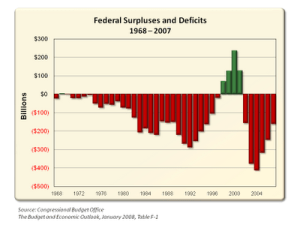
First, I’ll repeat one set of facts I mentioned in my post yesterday. Ronald Reagan was responsible for the largest tax increases in history and Barrack Obama was responsible for the largest tax cuts through his stimulus plan. This doesn’t even include his extension of the Dubya tax cuts. Discussion during TEFRA of 1982 resembles the discussion going on today. However, Reagan did tax increases. This particular ridiculousness is enough to make a data junkie scream. If you look at deficit numbers, former President Jimmy Carter was moving towards a budget balanced by the end of his term in office. Reagan blew government spending out of the water. However, Dubya remains the biggest spender of all since World War 2. If you want to blame the spending on any one, blame it on Reagan and George W, Bush. More on that in a bit.
Paul Krugman covers another Reagan Bedtime Story. He also points out that even conservative economists have started spewing the notion that Reagan was responsible for an era of “unprecedented growth”. This is also not true.
This shows what everyone was supposed to know: we had an awesome performance in the generation following the war (despite very high tax rates on the rich and a very strong union movement); we had a long period of poor productivity performance that spanned the Ford, Carter, Reagan, and Bush I administrations; we then had a revival during the Clinton administration, but even so not up to postwar standards. By the way, I don’t give Clinton credit for that revival; it was about learning to use technology. But in any case, there is no hint of a Reagan miracle in the data.
Now, back to stylized facts on federal spending. This is also from Krugman. There is this huge meme out there right now that some how, President Obama has gone on some kind of spending spree. This couldn’t be further from the truth. It appears that Rush Limbaugh is not only a big fat liar, but he is also incapable of doing the math on simple fractions. He is joined by nearly every Republican in the House today.
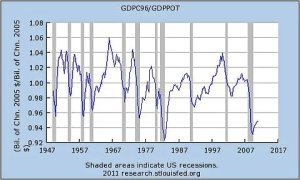
The fact is that federal spending rose from 19.6% of GDP in fiscal 2007 to 23.8% of GDP in fiscal 2010. So isn’t that a huge spending spree? Well, no.
First of all, the size of a ratio depends on the denominator as well as the numerator. GDP has fallen sharply relative to the economy’s potential; here’s the ratio of real GDP to the CBO’s estimate of potential GDP:
A 6 percent fall in GDP relative to trend, all by itself, would have raised the ratio of spending to GDP from 19.6 to 20.8, or about 30 percent of the actual rise.
That still leaves a rise in spending; but most of that is safety-net programs, which spend more in hard times because more people are in distress.
Beginning in 2005, the CBPP showed how George W. Bush’s excessive tax cuts played the largest part in federal deficits. Simply allowing these to expire last December would have gone farther in pushing a balanced budget than nearly anything done to date. In May of this year, they continued their analysis of how the Bush Policies were the ones driving the budget deficit.
Some lawmakers, pundits, and others continue to say that President George W. Bush’s policies did not drive the projected federal deficits of the coming decade — that, instead, it was the policies of President Obama and Congress in 2009 and 2010. But, the fact remains: the economic downturn, President Bush’s tax cuts and the wars in Afghanistan and Iraq explain virtually the entire deficit over the next ten years (see Figure 1).
The deficit for fiscal year 2009 — which began more than three months before President Obama’s inauguration — was $1.4 trillion and, at 10 percent of Gross Domestic Product (GDP), the largest deficit relative to the economy since the end of World War II. At $1.3 trillion and nearly 9 percent of GDP, the deficit in 2010 was only slightly lower. If current policies remain in place, deficits will likely resemble those figures in 2011 and hover near $1 trillion a year for the next decade.
The events and policies that pushed deficits to these high levels in the
near term were, for the most part, not of President Obama’s making. If not for the Bush tax cuts, the deficit-financed wars in Iraq and Afghanistan, and the effects of the worst recession since the Great Depression (including the cost of policymakers’ actions to combat it), we would not be facing these huge deficits in the near term. By themselves, in fact, the Bush tax cuts and the wars in Iraq and Afghanistan will account for almost half of the $20 trillion in debt that, under current policies, the nation will owe by 2019. The stimulus law and financial rescues will account for less than 10 percent of the debt at that time.
Other drives of the current deficit are extremely short-lived. These would be all the financial rescue spending delivered to financial institutions and the recession which brings in loss of revenues and increased expenditures. The other big expenditures are the two unfunded wars that having been running for over 10 years. These are the first wars that we have ever run that were not funded by tax increases.
However, these Republican Fairy Tales do not let the current President off the hook. He seems as hell bent as the Republicans in many ways to repeat their sins. He also seems woefully short on economic knowledge and incapable of listening to his economics advisers–now frustrated and gone–on what to do with the economy. The simplest way to shut down the deficit would be to eliminate preferential treatment of capital gains income and let the Bush tax cuts expire. I’d prefer they expire for folks over $200,000 a year, but letting them expire altogether is better than setting the stage for all these falsehoods spewing from Limbaugh and the like. Obama should’ve let the tax cuts expire when he had the chance. However, his ability to negotiate a position that proposes a Democratic alternative policy has never been present. People can’t figure out if he is just has the world’s worst negotiating skills or he wants what the Republicans want. My belief is that the outcome could matter less to him as long as he gets some ego strokes from it.
We have gotten to the point that complete insanity and adherence to fairy tales is putting our economy in serious jeopardy. We simply cannot afford to listen to the voices of ignorance any more. I cannot even believe we’re being held hostage now to a balanced budget amendment. That is one of the most flagrantly wrong policies any one could ever think about. I’m going to take that on this week since I can’t believe that zombie canard is back haunting the halls of Congress again.
We seriously need experienced economic stewardship of the economy right now. We have a tremendous jobs deficit that will only get worse if any of these seriously flawed budget initiatives pass. We couldn’t have gotten a worse group of leaders at a more crucial point in time. Their mistakes will hurt this country for a very long time.
Saturday Reads
Posted: July 30, 2011 Filed under: A My Pet Goat Moment, Democratic Politics, Federal Budget and Budget deficit, George W. Bush, Medicaid, Medicare, morning reads, Republican politics, Social Security, Team Obama, U.S. Economy, U.S. Politics, Violence against women | Tags: 9/11, Ann Arbor, balanced budget amendement, Barack Obama, default, FBI, Federal debt ceiling, Fourth Turning, generations, George W. Bush, House of Representatives, John Boehner, Neil Howe, rape, revolution, Richard Nixon, Senate, sexual assault, University of Michigan, Watergate 30 Comments
Good Morning news junkies! I’m filling in for WonktheVote today. She is taking a little break from blogging, so Dakinikat, Minkoff Minx, and I are going to take turns doing the Saturday Reads for a little while. So what’s in the news today? Let’s see…
After his blow-up-the-economy plan passed the House yesterday, John Boehner gave a very defensive-sounding speech to justify his treasonous behavior.
A defiant House Speaker John Boehner (R-Ohio) late Friday defended his debt-ceiling plan by saying it is the only viable plan on paper so far….
“I’ve offered ideas, I’ve negotiated,” Boehner said in closing debate on his bill. “Not one time, not one time did the administration ever put any plan on the table. All they would do is criticize what I put out there.
“I stuck my neck out a mile to try to get an agreement with the president of the United States,” Boehner continued to grumbling among Democrats. “Hey, I put revenues on the table in order to try to come to an agreement in order to avert us being where we are. But a lot of people in this town can never say yes.”
He also defended including the ridiculous balanced budget amendment to the Constitution in his bill.
“It’s time for this to happen,” he said. “It enjoys support from both houses of this Congress, and it enjoys bipartisan and widespread support across our country.”
No. It doesn’t, Mr. Speaker.
A short time later the Senate put Boehner’s bill out of its misery.
Now what?
Despite a day of frenzied legislative maneuvering and another attempt by President Obama to rally public opinion behind some kind of compromise, the two parties made no visible progress in finding common ground, leaving Washington, Wall Street and much of the nation watching the clock toward a deadline of midnight Tuesday.
Reid has made some changes in his plan, hoping to appeal to Senate Republicans. The NYT didn’t elaborate on what these changes are. At Huffpo, Michael McAuliff and Sam Stein say Reid’s plan is now a lot like Mitch McConnell’s. But whatever its contents, Republicans in the House plan to hold a “symbolic vote” on it today in order to “send a message” that whatever the Senate agrees on will not pass the House.
These people are playing with fire. It’s looking like they’re not going to meet the August 2 deadline either.
The seemingly unbridgeable impasse between the two parties as the deadline for raising the nation’s debt limit approaches has Tom Daschle losing sleep, as he never did when he was a Senate Democratic leader in the mid-1990s and Congressional Republicans forced government shutdowns rather than compromise on spending cuts.
“That was nothing compared to this. That was a shutdown of the government; this could be, really, a shutdown of the entire economy,” Mr. Daschle said. “You can’t be too hyperbolic about the ramifications of all this.”
Democrats and Republicans with legislative experience agree that even if both sides decided Saturday to raise the $14.3 trillion borrowing ceiling and to reduce future annual deficits, it would be extremely difficult for the compromise measure to wend its way through Congress before Tuesday’s deadline, given Congressional legislative procedures.
But all signs point to August 2 passing with no budget bill. As we all know, President Obama could end the struggle at any time with an executive order, but then he’d have to put off gutting Social Security, Medicare, and Medicaid for a little bit longer. He can’t allow that, now can he?
Stay tuned…
There has been a disturbing string of sexual assaults on women in Ann Arbor, Michigan over the past two weeks. the assaults have taken place near the University of Michigan campus. There have been six attacks, two of which were rapes. In the others, women were grabbed and fondled, but managed to escape.
Two different composite sketches of the suspect have been developed. Police aren’t sure if there is just one perpetrator two. The FBI is now involved in the investigation.
The agency will be assisting Ann Arbor police at the city’s request, said FBI spokeswoman Sandra Berchtold. She did not provide any details about the agency’s role.
The six attacks occurred between July 15 and 26, and between the hours of 10 p.m. and 2 a.m. The victims were traumatized, said police spokeswoman Lt. Renee Bush.
Ann Arbor Police Chief Barnett Jones said he did not know if the attacks were linked. He warned in a letter to university staff, faculty and students that there was a “predator or predators operating in our community.”
Emily Zinn and her boyfriend were sleeping when one of the rapes took place right outside their apartment.
…an 18-year-old woman was pulled behind a wall outside Zinn’s bedroom window and raped on July 18.
She first noticed something was wrong when she and her boyfriend, Matt McAnelly, 24, a University of Michigan graduate student, heard the girl sobbing outside about 12:45 a.m.
“We heard a girl crying and ‘Help me, help me,’ ” Zinn said. “She was saying, ‘He left, I’m alone,’ so we didn’t really know what was happening.”
The couple heard nothing while the girl was being attacked.
This monster (or monsters) must be stopped ASAP.
Is the U.S. on the verge of a revolution?
On last night’s The Big Picture with progressive talk show host Thom Hartmann, author Neil Howe discussed how he and William Strauss came to accurately predict today’s political crisis in their 1997 book “The Fourth Turning,” and offered speculation as to what might happen next….
Speaking of the generational differences between today’s new guard and the retiring baby boomers, Howe said that cultural forces have essentially forced this crisis, with “culture warriors” and “values voters” in direct contention with “gen x” for control of the national budget.
“Are we on the verge of another ‘fourth turning’ — another major crash leading to a world war and a world-wide depression?” Hartmann asked.
“No,” Howe said. “I hope it won’t be bad. I hope the destructive will be avoided to the furthest extent possible and the constructive, which always comes out of a fourth turning… will be maximized.”
Watch it:
———————————————–
A judge has ordered the release of Richard Nixon’s grand jury testimony about the Watergate scandal.
U.S. District Judge Royce Lamberth granted a request by historian Stanley Kutler, who has written several books about Nixon and Watergate, and others to unseal the testimony given on June 23 and 24 in 1975.
Nixon was questioned about the political scandal during the 1970s that resulted from the break-in of the Democratic National Committee headquarters at the Watergate office complex in Washington….
Lamberth ruled in the 15-page opinion that the special circumstances, especially the undisputed historical interest in Nixon’s testimony, far outweighed the need to keep the records secret. Grand jury proceedings typically remain secret.
The Obama administration opposed the release of Nixon’s testimony. It figures, doesn’t it?
Finally, here’s a fascinating bit of historical revisionism from George W. Bush.
In a rare interview with the National Geographic Channel, Bush reflects on what was going through his mind at the most dramatic moment of his presidency when he was informed that a second passenger jet had hit New York’s World Trade Center.
Bush was visiting a Florida classroom and the incident, which was caught on TV film, and has often been used by critics to ridicule his apparently blank face.
But Bush claims he deliberately decided to stay in his seat so as not to alarm the children and to “project a sense of calm.”
“I had been in enough crises to know that the first thing a leader has to do is to project calm,” he added.
I wonder what “crises” he’s talking about? Just about the only thing he did as Governor of Texas was execute people. Let’s watch Bush’s demeanor on 9/11/2001 and see how well he projected “a sense of calm.”
——————————————
Here’s what one of the children who was in the classroom that day had to say about it:
“The president he just sat there, and his face — he just went dead,” says Jaimie, who was among the second graders in the classroom where President Bush learned of the terrorist attacks on Sept. 11, 2001.
Jamie’s one of the kids featured in Nickelodeon’s Linda Ellerbee news special, “What Happened?: The story of September 11, 2001,” which debuts Sept. 1.
That’s all the news I’ve got for today. What are you reading and blogging about?
Late Night: Hillary Fashion Bashing and Gossip
Posted: July 29, 2011 Filed under: Hillary Clinton | Tags: George Lopez, Hillary Clinton, Nancy Clarke, pant suits, Project Runway, Tim Gunn 19 Comments
From ABC News Entertainment
Which of these two people is more tastefully dressed? The guy on the left, Tim Gunn of something called “Project Runway,” doesn’t care for the way the woman on the right dresses. Well, I think his outfit is horrid.
Things got a little “Mean Girls” on Tuesday’s “Lopez Tonight” when “Project Runway” guru Tim Gunn expressed his exasperation over Secretary of State Hillary Clinton’s sartorial choices.
“Why must she dress that way?” Gunn asked when Lopez brought up Hill’s outfits. But then came the kicker – a dig about Clinton’s dressing like a dude: “I think she’s confused about her gender [with] all these big, baggy menswear tailored pantsuits.”
This was followed by a discussion of “cankles.” Ugh! Why does this man feel entitled to judge the Secretary of State’s fashion sense?
One problem for Gunn. According to Lindsay Mannering at “The Stir,” Gunn was recycling material he had previously used on Conan O’Brien in 2008,
Listen, it’s one thing to make fun of our former first lady’s fashion, but it’s a whole ‘nother thing to use recycled material. Gunn said the same exact thing on Conan O’Brien’s show back in 2008. Come on, Gunn! If you’re going to insult Hillary, you better make sure you’re being a) original and b) accurate. I think Hill’s got some style.
She’s worn some beautiful, and stylish, outfits over the years, and I think she just gets better with time. Sure, some of her pantsuits aren’t putting her on the best-dressed lists, but this woman’s got a job and a professional air to maintain….And I don’t hear Gunn going after Timothy Geithner’s ties, or Obama’s shoes, or Chris Christie’s bulging buttons, so let’s put the claws away for a second and remember that sometimes fashion takes a back seat to a job well done.
Personally, I like Hillary’s outfits, and I think Tim Gunn–whoever he is–should STFU and find a real job.
Former White House chief florist Nancy Clarke has a closet full of such insider tales from her 31 years with six first ladies from Rosalynn Carter (favored barbecue dinners) to Michelle Obama (prefers gala apples over flowers). And now, two years after leaving the White House, she’s written a rare behind-the-scenes book, My First Ladies, due out in September.
Clarke describes Hillary as
a mix of dignity and schoolgirl. When the Monica Lewinsky affair broke, Clinton didn’t show her feelings to staff and, Clarke says, never engaged in the kinds of fighting with her husband that was described in the media. Once, Clarke took the elevator to the presidential residence and saw Clinton dash naked from her bathroom to the bedroom. “We looked at each other and we both screamed,” Clarke writes. Clinton joked about it later. “She said it was like living in her sorority house again.”
What a great story. It just makes me like Hillary and her pants suits more than ever.
The L shaped recovery and a Bogus Debt Crisis
Posted: July 29, 2011 Filed under: Economy, Federal Budget, Federal Budget and Budget deficit | Tags: 14th amendment, debt crisis, economy, recession 20 Comments Our economy continues to scuttle across a bottom set by the huge drop in performance during the Great Recession. This economist was not surprised by the lackluster GDP report released today. No one has used the correct fiscal policy prescription in this country since 1999. The current batch of Washington nimrods are going to set us at a new low shortly. We’ll be lucky to see nasty numbers like these a year from now. It’s as if tanking the economy is job 1 now.
Gross domestic product climbed at a 1.3 percent annual rate following a 0.4 percent gain in the prior quarter that was less than earlier estimated, Commerce Department figures showed today in Washington. The median forecast of economists surveyed by Bloomberg News called for a 1.8 percent increase. Household purchases, about 70 percent of the economy, rose 0.1 percent.
Treasuries rose as the report dimmed prospects for faster growth in the rest of 2011. The faltering economy may get another blow from spending cuts being negotiated in Congress, keeping pressure on Federal Reserve Chairman Ben S. Bernanke to hold interest rates near zero.
“The second-half rebound is melting away,” said Nigel Gault, chief U.S. economist at IHS Global Insight in Lexington, Massachusetts, the only forecaster polled to correctly estimate the gain in GDP. “It’s a very, very difficult situation for policy makers. The Fed could give a pretty strong signal that they are not likely to move on interest rates for a very long time.”
The yield on the benchmark 10-year note decreased to 2.85 percent at 1:22 p.m. in New York from 2.95 percent late yesterday. Stocks pared earlier losses on signs that House Speaker John Boehner’s plan to raise the debt ceiling was gaining support. The Standard & Poor’s 500 Index fell 0.3 percent to 1,296.42 after falling as much as 1.4 percent.
Former Labor Secretary Robert Reich tells it like it is in a post that might as well be entitled “It’s the jobs, stupid”. Too bad he’s not up for the Treasury position now occupied by Secretary Slave to Investment Banks. There’s a false equivalency being spread about raising the debt ceiling and increasing the deficit that’s really hampering policy discourse right now. The two things aren’t the same. The debt is the amount we owe and it builds each year when there is a deficit or when interest accumulates. The deficit is a shortage in one year’s budget. The only real crisis we have right now is a jobs crisis and a complete lack of demand. Again, no business person in their right mind is going to create anything if there’s no customers. Oh, there’s also a confederacy of dunces in the US House of Representatives. But, I won’t go there right now.
Get it? We’re really in a “jobs and growth” crisis – not a budget crisis.
And the best way to get jobs and growth back is for the federal government to spend more right now, not less – for example, by exempting the first $20,000 of income from payroll taxes this year and next, recreating a WPA and Civilian Conservation Corps, creating an infrastructure bank, providing tax incentives for small businesses to hire, expanding the Earned Income Tax Credit, and so on.
But what happens next week if Congress can’t or won’t deliver the President a bill to raise the debt ceiling? Remember: This is all politics, mixed in with legal technicalities. Economics has nothing to do with it.
One possibility, therefore, is for the Treasury to keep paying the nation’s bills regardless. It would continue to issue Treasury bills, which are our nation’s IOUs. When those IOUs are cashed at the Federal Reserve Board, the Fed would do what it has always done: Honor them.
How long could this go on without the debt ceiling being lifted? That’s a legal question. Republicans in Congress could mount a legal challenge, but no court in its right mind would stop the Fed from honoring the full faith and credit of the United States.
One of the biggest right wing memes that drives me crazy is that the economy is bad because we have too much taxes still and that the President’s stimulus didn’t work because it was worthless spending. I knew it wouldn’t do much to stimulate the economy simply because it didn’t take advantage of the government spending multiplier in key areas and wasn’t big enough. Also, it was the Biggest Tax Cut Ever which rarely works as efficiently as direct government spending to get consumption going again. So why are so many idiots arguing that more of the same tax cuts are going to improve the economy and cutting all levels of government spending is considered confidence building when the government spending multiplier will just push recessionary momentum? You got me. It’s insanity.
So, what happens if these debt ceilings talk fail? Well, first, every single financial asset, liability, and contract will reprice all over the world. Most of them will reprice in a bad way that will hamper economies every where. Every business project will be evaluated using a risk free rate that will now be higher and will not be considered risk free any more. That means many projects will now be rejected so expansions, new jobs, or anything like that will be rejected. Remember, this is not because we can’t pay those bills, it’s because a few idiots refuse to pay them. Second, the world will continue to step away from the dollar. Third, there will be strong recessionary pressures. It’s not good, folks. As these recent GDP figures show, we’re far from out of the impact of the last financial shock.
But what if all those options failed? What would be the consequence of even a notional default? The IMF has talked of a global recession if there was a loss of confidence in US solvency although it’s not clear that a failure to roll over debt for a few days would qualify for that description.
Having seen what happened with Lehman’s default, the main worry would be a freeze in the markets. Take the finances of banks, for example. Many use Treasury bonds as the risk-free asset for capital purposes. As Capital Economics points out
“Government debt is only automatically 0% risk-weighted for banks under Basel II if it is rated AA- or higher (although regulators can make exceptions for domestic government debt issued in local currency). In principle, therefore, financial institutions would face significantly higher capital charges in the event of a US government default.In practice, it seems likely that the regulators would move quickly to waive the rules. But there might be a few hairy moments while they did. And what about money-market funds? Having been burned by the credit crunch, many have opted for the safe haven of US Treasury bills. Perhaps they could roll over those bills into some form of IOU from the government. But if investors demanded their money back at a time when Treasury bills were illiquid, money-market funds might be forced to suspend resumptions or “break the buck”. Then there is the repo market, widely used by financial institutions to raise money; Treasury securities are used as collateral for such borrowing.”
Standard & Poor’s has considered this scenario and suggests that
“Failure to pay off maturing debt or missing interest payments (approximately $62 billion of interest is payable on Aug. 15) would constitute a selective default pursuant to our criteria, and Standard & Poor’s expects it would lower the sovereign rating to ‘SD’. Even if the Fed and other central banks managed to keep the financial system functioning, we expect that markets around the world would be severely damaged. In such a hypothetical scenario, we expect that equity markets would generally plunge, borrowing costs and interbank lending rates would soar, and corporate credit markets would be closed to all but the highest quality issuers. We envisage that consumers and businesses would likely stop spending on all but essential items, and the value of the dollar would drop by 10% or more against other major currencies. With the dollar heading lower, investors would likely look for hard assets like oil and other commodities, driving prices higher.Given the fragility of the economic recovery, this is an incredible risk to contemplate. It is also worth noting that, even a freeze on government spending that stopped short of a default, would have a significant impact on demand.”
I still can’t believe that a few people are willing to tank the economy for failed economic hypotheses. It’s as if everything we’ve learned over the past 70 years has been completely thrown to the wind and we’re being run by the myth of Reagan’s ghost. I say myth because what they’re going on didn’t even happen on his watch. He was responsible for the biggest single tax increase in history and was responsible for a lot of the debt they’re whining about today. Speaking of Reagan, one of his economists–Bruce Bartlett–has an excellent analytical piece up on how the Debt Crisis is being Fueled by Obama’s weak negotiations. It’s worth a read.
Unfortunately, Obama is really too young to have the kind of experience that previous presidents like Reagan brought to the White House in terms of understanding intransigent enemies and how to deal with them. Consequently, Obama has really been caught flat-footed by the Tea Party era Republican Party. He believed it would respond positively if he offered it half a loaf on just about every issue.
For example, some 40 percent of the 2009 stimulus legislation consisted of tax cuts even though his economic advisers knew that they would have almost no stimulative effect. But Obama viewed them as an important concession to Republicans. Yet despite total rejection of his stimulus package by the GOP, Obama kept the tax cuts rather than reprogramming the money into more effective programs such as state aid or public works.
Nevertheless, Obama offered Republicans another half-loaf by putting forward a health reform plan almost identical to those that they and conservative groups such as the Heritage Foundation had proposedin the 1990s. Obama’s offer was summarily rejected and Republicans suddenly decided that the individual mandate, which previously had been at the core of their own health reform plans, was unconstitutional.
Now we are in the midst of a debt crisis that stems largely from Obama’s inability to accept the intransigence of his political opponents. Last December, he caved in to Republicans by supporting extension of the Bush tax cuts even though there is no evidence that they have done anything other than increase the deficit. There were those who told Obama that he ought to include an increase in the debt limit, but he rejected that idea, believing that Republicans would behave like responsible adults and raise the debt limit just as they did routinely when their party held the White House.
I join Bartlett, former President Clinton, and others in begging the President to invoke the 14th amendment. Then, he should find some economics advisers who know what they are doing and listen to them for a change.

 peej
peej Carissa
 bostonboomer
 dakinikat
 ecocatwoman
 mablue2
 Mama Lopez
 peggysue22
 quixote
 skydancingguestblogger
 Mona (aka Wonk the Vote)



 Sky Dancing
Recent Comments