
Thursday Reads
Posted: July 14, 2011 Filed under: Democratic Politics, fundamentalist Christians, morning reads, Republican politics, Republican presidential politics, Surreality, the villagers, U.S. Economy, U.S. Politics, voodoo economics, We are so F'd | Tags: Barack Obama, Eric Cantor, Freedom from Religion Foundation, John Boehner, liquor licenses, Mark Dayton, Minnesota government shutdown, Mitch McConnell, Mumbai attacks, Rick Perry Tim Pawlenty 40 Comments
Good Morning!! The big news is still the deadlocked debt ceiling talks. There will be another meeting of the squabbling children tomorrow afternoon. Frankly, I’m hoping for some serious fireworks.
Meanwhile, Eric Cantor is grabbing points with the Tea Party, but everyone else is laughing at him. Check this out from Joe Klein (yes, he’s an idiot, but the Villagers listen to him):
David Rogers over at Politico, who has been doing this–extremely well–for about as long as I have, has word that the President of the United States monstered down on Representative Eric Cantor in Wednesday’s deficit ceiling squabble. This is so refreshing on so many levels. Cantor has been using this crisis to undermine his leader John Boehner, by playing the Tea Party/Grover Norquist recalcitrance card. The boy badly needed someone to get up in his face and Barack Obama, of all people, apparently did, telling Cantor, in no uncertain terms, that he’d veto any short term deficit ceiling fix or, indeed, any plan that did not include revenue increases. Then Obama walked out, or the meeting ended, depending on whom you talk to.
So what we have now is the Republican party in, yes, disarray–a word used to describe Democrats almost exclusively, back in the day before the crazies took over the GOP store. You have Cantor and the House Teasies opposing any revenue increases, including a tax loophole closing plan that Ronald Reagan and Edmund Burke would have smiled upon. You have Boehner, struck dumb apparently, after his attempt at bipartisan statesmanship with the President was greeted by tossed shoes and catcalls from the Teasies. You have Mitch McConnell, well, I’m speechless about Mitch McConnell…
Here’s this Kentucky dude whose every action, before Tuesday, painted him as one of the most cynical operators we’ve seen on Capitol Hill since Pitchfork Ben Tillman–and now, suddenly, he’s gone all rational on us, chiding his Republican forces (that means you, Eric) about leading the party to the electoral slaughterhouse if they don’t take this debt ceiling business seriously. He has proposed to place the responsibility for raising the debt ceiling solely on the President and let Obama run with that. This is looking more likely today than it did yesterday.
Jonathan Allen at Politico suggests that Cantor is overreaching.
As he has surged to the forefront of debt-limit negotiations and faced round-the-clock scrutiny on cable and radio talk shows, a fundamental question about House Majority Leader Eric Cantor’s high-stakes political maneuvering is being discussed in the halls of power.
Is he building street cred with House Republicans or overplaying his hand?
The answer may be both. Cantor’s allies note that he’s been put in the spotlight by assignment — from Speaker John Boehner and President Barack Obama — not by choice. And they say he has gained political capital within the GOP conference.
Cantor has a lot riding on the outcome of the debt-limit negotiations. He’ll share in the public blame if they fall apart and the economy tanks, and he’ll face recriminations from his conservative base in the House if he cuts too soft a deal with the president.
At The New Republic, Jonathan Chait explains why “The Republican Crazy Is Not An Act.” Please don’t miss it.
John Boehner says working with the White House over the debt ceiling has been like “dealing with Jello,” whatever that means.
“Dealing with them the last couple months has been like dealing with Jell-o,” Boehner said. “Some days it’s firmer than others. Sometimes it’s like they’ve left it out over night.”
Boehner explained that talks broke down over the weekend because, he said, the president backed off entitlement reforms so much from Friday to Saturday, “It was Jell-o; it was damn near liquid.”
“By Saturday, they’d spent the previous day and a half just going backwards” on reforming entitlement programs such as Social Security, Medicare and Medicaid.
“The only thing they’ve been firm on is these damn tax increases,” the Speaker said.
I have no idea what he’s trying to say. Maybe he’s been spending too much time in the tanning salon.
The Villagers will keep on bickering, but real people are suffering out in the real world. There has been another terrible attack in Mumbai.
The blasts that rocked Mumbai killing 18 people and injuring 131 was a “coordinated terror attack” but officials have not singled out a group behind them, India’s home minister said Thursday….Three bomb blasts rocked India’s largest city in congested areas during the evening rush hour Wednesday.
The attackers used ammonium nitrate with a timer mechanism based on forensic evidence collected from the blast sites…
In Minnesota, the state government shut down two weeks ago because of lack of funds, and it is causing bars to shut down because they can’t renew their licenses.
By Wednesday, hundreds of bars, restaurants and liquor stores across Minnesota already had been stopped from buying new inventory due to expired permits the state has not renewed.
MillerCoors, the second largest brewer in the United States, failed to get its license to sell 39 brands in Minnesota renewed before a government shutdown over a budget impasse began with the new fiscal year on July 1.
“Without that brand label registration, their distribution and sales aren’t allowed to continue,” Doug Neville, a state public safety department spokesman, said on Wednesday.
The stalemate, the longest of the nation’s six state government shutdowns since 2002, began July 1 after Democratic Governor Mark Dayton and Republican legislative leaders failed to resolve an impasse about how to address a $5 billion budget deficit. Republicans want spending cuts alone, and Dayton is pushing for taxes to preserve services.
Dayton yesterday traveled to Rochester, which is home of the Mayo Clinic, and Albert Lea, about 10 miles (16 kilometers) from the Iowa border, to meet with people with disabilities and senior citizens to “discuss what is at stake in the state budget,” according to an e-mail from his office.
Meanwhile, legislative Republicans sent out an e-mail with charts showing the impact of the shutdown on areas including schools and parks in those two cities. It didn’t mention a booze drought.
Although businesses can sell alcohol with city liquor licenses, they can’t purchase new product without the state buyer’s card, Neville said in a telephone interview from St. Paul. Cards for 300 of 10,000 businesses have expired since the shutdown began July 1, and that will increase to 424 by the end of the month, Neville said.
Walter Shapiro writes that the whole thing is really Tim Pawlenty’s fault.
In addition to irrational politics and the state’s tradition of moralism, Pawlenty shares in the blame for Minnesota’s budgetary woes. And the GOP presidential candidate knows his financial stewardship is on the line: Late in the evening of June 30—just minutes before the Minnesota government officially shut down because of a budgetary impasse—Pawlenty held a hastily scheduled press conference at the Minneapolis-St. Paul Airport to try to shield himself from political attack over the shut-down. “Both in Washington, D.C., and in St. Paul, the Democrats continue their thirst for more spending and more taxes,” Pawlenty said in a boilerplate critique of his successor. “That’s not the right direction for Minnesota, and it’s not the right direction for our country.”
What the rhetorical onslaught was designed to hide was that, in truth, Pawlenty—like many governors in both parties juggling the books in the midst of the severe downturn—practiced budgetary legerdemain to avoid a statutorily forbidden deficit before he left office in January. Of course, it was hypocritical for Governor Pawlenty to eagerly bank $2.3 billion in federal stimulus money while Politician Pawlenty was denouncing Barack Obama for spending it. But, for all the partisan talking points over Pawlenty’s budgetary record, it strains credulity to believe that conservative GOP voters will blame him because Republicans in the Minnesota legislature held the line against a Democratic governor. In fact, Dayton may have caused more political mischief for Pawlenty with a recent unsuccessful proposal to help end the budgetary wars. Instead of his proposed 2 percent income-tax surcharge on millionaires, Dayton suggested that he could also accept a dollar-a-pack increase in the state cigarette tax. His purported inspiration: Pawlenty’s 2005 acceptance of a 75-cent-a-pack wholesale tax increase under the transparent guise of a Health Impact Fee. Undoubtedly relishing every moment, Dayton declared, “Governor Pawlenty even agreed to a cigarette tax increase. So there’s precedent for that.”
But, beyond the narrow implications for Pawlenty’s political fate, the broader national message from Minnesota is how easy it is for both parties to step off the cliff, heedless of the consequences. Already, there is talk that the government shutdown could last for months.
Will other states follow suit?
Finally, The Freedom From Religion Foundation (FFRF) is suing Texas Governor Rick Perry over a religious rally he is planning to hold in Houston in early August.
Perry proclaimed August 6 as a “Day of Prayer and Fasting for our Nation to seek God’s guidance” and invited governors from across the nation to join his Christian prayer summit at Reliant Stadium.
“Given the trials that beset our nation and world, from the global economic downturn to natural disasters, the lingering danger of terrorism and continued debasement of our culture, I believe it is time to convene the leaders from each of our United States in a day of prayer and fasting, like that described in the book of Joel,” Perry said in June.
The legal complaint asks the federal court to declare unconstitutional Perry’s organization, promotion and participation in the event because it violates the Establishment Clause of the First Amendment.
It says Perry’s active participation in the event violates the U.S. Constitution by “giving the appearance that the government prefers evangelical Christian religious beliefs over other religious beliefs and non-beliefs, including by aligning and partnering with the American Family Association, a virulent, discriminatory and evangelical Christian organization known for its intolerance.”
That should be a fun story to follow.
So… what are you reading and blogging about today?
Late Night: Moody’s Reviewing Downgrade of U.S. Credit Rating; Obama Slaps Down Eric Cantor.
Posted: July 13, 2011 Filed under: Republican politics, Surreality, U.S. Economy, U.S. Politics | Tags: arm-twisting, Barack Obama, bipartisanship, Eric Cantor, Federal debt ceiling, Moody's, The Chicago Way, U.S. Credit rating 11 Comments
Eric Cantor
The U.S., rated Aaa since 1917, was put on review for the first time since 1995 on concern the debt threshold will not be raised in time to prevent a missed payment of interest or principal on outstanding bonds and notes even though the risk remains low, Moody’s said in a statement yesterday. The rating would likely be reduced to the Aa range and there is no assurance that Moody’s would return its top rating even if a default is quickly cured.
President Barack Obama is considering summoning congressional leaders to Camp David this weekend to work on a plan to raise the debt ceiling after yesterday’s negotiations on a deficit-cutting plan of at least $2 trillion stalled, according to two people familiar with the matter. A failure to raise the debt limit that causes a default may lead to slower economic growth and another financial crisis.
“It’s obviously very serious in so many different ways,” said James Caron, head of U.S. interest-rate strategy at Morgan Stanley in New York, one of 20 primary dealers that trade bonds with the Federal Reserve. “Most people still believe there will be some type of an agreement struck to avoid all this stuff, and that’s what the market’s banking on.”
Meanwhile, according to the NYT, Fed Chairman Ben Bernanke
warned on Wednesday of a “huge financial calamity” if President Obama and the Republicans cannot agree on a budget deal that allows the federal debt ceiling to be increased. Moody’s, the ratings agency, threatened a credit downgrade, citing a “rising possibility” that no deal would be reached before the government’s borrowing authority hits its limit on Aug. 2.
The one piece of good news is that President Obama may be finally waking up to the reality that Republicans are totally insane and there is no point in negotiating with them.
the latest bipartisan negotiating session on Wednesday evening ended in heightened tension, if not outright discord. Republicans said Mr. Obama had abruptly walked out in an agitated state; Democrats described the president as having summed up with an impassioned case for action before bringing the meeting to a close and leaving.
Politico has a better description of what happened–basically, Obama told lit into Eric Cantor and brought him up short for once.
When Cantor said the two sides were too far apart to get a deal that could pass the House by the Treasury Department’s Aug. 2 deadline — and that he would consider moving a short-term debt-limit increase alongside smaller spending cuts — Obama began to lecture him.
“Eric, don’t call my bluff,” the president said, warning Cantor that he would take his case “to the American people.” He told Cantor that no other president — not Ronald Reagan, the president said — would sit through such negotiations.
That’s Cantor’s version. Democratic sources said that
“Cantor’s account of tonight’s meeting is completely overblown. For someone who knows how to walk out of a meeting, you’d think he’d know it when he saw it,” a Democratic aide said. “Cantor rudely interrupted the president three times to advocate for short-term debt ceiling increases while the president was wrapping the meeting. This is just more juvenile behavior from him and Boehner needs to rein him in, and let the grown-ups get to work.”
Now here’s the kicker:
“Obama lit him up. Cantor sat in stunned silence,” said an official in the meeting. “It was incredible. If the public saw Obama he would win in a landslide.”
Maybe Obama really does have some balls guts? Maybe it just took a snot-nosed squirrely creep like Cantor to get a rise out of him. It does seem that for once Obama has managed to force the Republicans into a corner by offering cuts in Medicare and Social Security and then threatening not to write checks in August.
Stay tuned. There will be more discussions at the White House tomorrow afternoon. Maybe it’s time for Obama to do the the Chicago way. The heck with bipartisanship–time for some major arm-twisting. Just raise the frickin’ debt ceiling and be done with it.
Chain, Chain, Chain …
Posted: July 13, 2011 Filed under: Economy | Tags: Chained CPI, inflation impacting the elderly 19 CommentsSo I thought I’d write a brief post on one of the topics that has come up with social security reform. That would be switching the Social Security COLA (Cost Of Living Adjustment) from the CPI-W to the Chained CPI. E conomists widely agree that the CPI-W overstates the rate of inflation. However, there are some other considerations to look at when undertaking any change. Kevin Drum from MoJo explains the problems with the CPI-W which is an inflation index based on a fixed basket of goods and is widely criticized for having a bunch of problems including substitution bias.
The reason is something called “upper level substitution bias,” which means that instead of always buying a standard basket of goods and services, people change their buying habits over time as prices change. When the price of hamburger goes up, they eat more chicken. When the price of chicken goes up, they switch back to hamburger. A version of CPI that takes this into account is called chained CPI, and overall it’s considered a more accurate reflection of actual inflation. But technical merits aside, there are always winners and losers when you make changes to statistics like this. One big loser would be Social Security beneficiaries. Initial Social Security benefits upon retirement are calculated based on wage levels, so they’d be unaffected by a switch to chained CPI. But annual COLA increases would be affected, and they’d be lower than they are now.
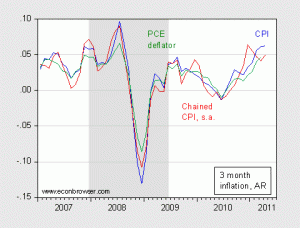 Menzie Chinn at Econbrowser has a nifty graph showing the differences in three measures of inflation. The blue line is the traditional CPI that’s now the basis of the Social Security COLA. The Green line is the PCE Deflator which is a more general measure of consumer inflation that’s not attached to a fixed basket of goods. This is the measure that the Fed tends to follow. The red line is the Chained CPI.
Chinn has a general discussion of each of these indices too. The CPI basket which is used to weight price changes updates every two years now. The chained CPI uses weights that are constantly changing and more realistically reflect changes in consumer buying habits. This avoids the substitution bias.
The BLS collects the buying habits and prices of typical urban consumers monthly and provides the data in the form of the inflation indices. You can read about the chained CPI and the methodology used to calculate it here. It’s been in use since 2002. The most basic explanation of the differences is explained at the FAQ provided by the BLS.
In its final form, the C-CPI-U is a monthly chained price index with the expenditure weights varying each month. The CPI-U and CPI-W, on the other hand, are biennial chained price indexes where their expenditure weights are updated every two years. Within the two-year span, these indexes are fixed-weight series, where the changes in these indexes reflect only changes in prices, and not expenditure shares, which are held constant.
Dean Baker has some information worth considering before we suggest that the change to the chained index is the best move. Using the Chained CPI may reduce overall costs while still providing a COLA, but the index may not reflect price changes that specifically impact the elderly population in the US.
It is not clear that the Chained CPI is more accurate than the current measure. The Bureau of Labor Statistics (BLS) has found that an experimental elderly index (CPI-E), that tracks the consumption patterns of people over age 62, actually shows a higher rate of inflation for the elderly than the CPI currently used for adjusting Social Security benefits.
While the CPI-E is not a full index since it does not look at the specific items bought by the elderly and the specific outlets they use for their shopping, there is no reason why BLS could not construct a full CPI-E. If the concern is having an accurate cost of living adjustment then it would seem that you should support having Congress instruct BLS to construct a full CPI-E. For my part, I don’t know whether this measure would show a higher or lower rate of inflation than the current CPI used for indexing benefits, but it would be a more accurate measure.
As it stands, switching to a Chained CPI would undoubtedly mean a cut in scheduled benefits, regardless of whether or not it involves a more accurate cost of living adjustment. Using this measure of the CPI would reduce benefits for retirees by 3 percent in 10 years, 6 percent in 20 years and 9 percent in 30 years. We know that the vast majority of retirees are struggling to make ends meet already. Retirees are not the people responsible for wrecking the country’s economy. Social Security benefit cuts of this magnitude seem like a major step in the wrong direction.
Inflation has not been much of a problem for this country since the mid 1980s. Since we are aware that too much money chasing too few goods is the basis of inflation and the FED is committed to not letting inflation get out of hand, it’s unlikely that we’ll see problems with inflation. The only thing that would lead–at this point in my mind–to major price disruptions would be a politicized FED that abused monetary policy or some brand of gold bug craziness that put us back on a hard currency. The last problem would cause incredible, destabilizing deflation since a fixed medium of exchange in a growing economy causes the opposite problem. That would be too little money chasing lots of goods.
Probably the best thing to do at this point would be to ask the CBO to study which index realistically represents changes to the cost of living, then seeing if the savings is worth it at the aggregate level. Dean Baker has this suggestion.
The Bureau of Labor Statistics’ (BLS) Experimental Price Index for the Elderly has consistently shown a somewhat higher rate of inflation for the elderly population.
If the concern is accuracy, then the route should be to have the BLS construct a full elderly index that could take account of actual purchase substitution patterns among elderly consumers. Simply switching to the C-CPI-U without undertaking this research is consistent with a desire to cut Social Security, not to make the COLA more accurate.
This is probably a better idea since the elderly are more likely to spend more on health care where costs have been rising astronomically. They are also less likely to buy other kinds of consumer goods. A CPI based on a senior basket of goods may be more appropriate.
Betty Ford’s Memorial: A wonderful tribute to a Women’s Rights Advocate
Posted: July 12, 2011 Filed under: Women's Rights | Tags: Betty Ford Memorial, Cokie Roberts 8 Comments
If you haven’t had a chance to read Cokie Roberts’ Eulogy for Former First Lady Betty Ford, you really should.
Over the years, as she spoke out more forcefully for women’s rights, Mrs. Ford strongly defended the housewife’s role: “Downgrading this work has been part of the pattern in our society that downgrades individual women’s talents in all areas.”
No wonder women all over the country have spent this past weekend loving her anew.
One talent political wives were expected to cultivate that they didn’t share with most women was that of first rate campaigner, especially wives of House members – the House wives – who faced an election every two years. By the time he ran for president, Ford supporters sported “Elect Betty’s Husband” buttons, but people in Michigan had been doing that for decades. It was another activity that brought political wives together – even if they were on different sides, they had the same complaints – and forged tightly joined connections that extended ot the men as well. They would bring the men together, serve them some drinks and a good meal, listen to their stories and make them behave. And some of that good behavior carried over to the corridors of Congress. It was a role political wives had played since the beginning of the republic and it worked.
Former First Lady Rosalynm Carter delivered the other eulogy. Mrs Ford requested this of both women.
Delivering the first eulogy, former first lady Rosalynn Carter said she had “an excellent role model and a hard act to follow.”
“Millions are forever in her debt today because she was never afraid to tell the truth,” Carter said. “Betty was my friend.”
Others paid tribute to the woman who was embraced by a generation of women who were just coming into their own. A social pioneer, Ford spoke openly about sex, cancer and addiction.
The service played on CSPAN 2 today and will undoubtedly be available for viewing this week. I’d just like to  remember Mrs. Ford as a woman who was a tireless fighter for the ERA and women’s health at a time when both abortion rights and support for the ERA were solid parts of the Republican platform as well as the Democratic party platform. It’s difficult to remember that many Republican women were committed to women’s rights in this day of Republican women that stand against these rights.
Can you charge the country’s top elected officials with Treason?
Posted: July 12, 2011 Filed under: Federal Budget, Federal Budget and Budget deficit | Tags: Federal Deficit, game of chicken. 27 CommentsIt seems as though our nation’s “leaders” are looking to bring down our country. It’s the only explanation that I have.  Also, I’m at the point where I think Joe Biden is the only sane one in the room. Pinch me! Please!
Headlines of note to prove my case:
Boehner Says The Debt Limit Increase Is Obama’s Problem
Speaker of the House John Boehner introduced a new argument to the debt ceiling and deficit reduction talks Tuesday, saying raising the borrowing limit is Republicans’ concession in the negotiations.”This debt limit increase is [Obama’s] problem,” he said.
Boehner is trying to force a deficit reduction package entirely based on spending cuts, saying Obama’s demands for new revenues would only be considered if Obama accepted deep cuts to entitlements.
My guess is that Boehner has absolutely no control over the Republicans in the House. Some one from Wall Street needs to take a few of them to the wood shed. Meanwhile, Mitch McConnell appears to be interested in nothing but political play. Some senate Republicans would obviously join the president but it appears that will happen over McConnell’s dead mind and conscious. McConnell still refuses to admit the Republicans lost the White House 3 years ago. He’s become some kind of Captain Queeg who gets in front of the press then rattles ball bearings in his fist while muttering “one term president, strawberries, one term president, it’s the strawberries, I tell you …” repeatedly.
McConnell: Obama can’t deliver major deficit-reduction deal
Senate Republican Leader Mitch McConnell (Ky.) on Tuesday said a comprehensive deficit-reduction deal is not attainable as long as Barack Obama is president.
McConnell declared that deficit-reduction talks have come to an unsolvable deadlock.
“After years of discussions and months of negotiations, I have little question that as long as this president is in the Oval Office, a real solution is unattainable,” he said.McConnell has called for reforms to curb the future growth of Social Security and Medicare since taking over as Republican leader at the end of 2006.
So, what’s the response of the leader of the free world? Would you call this riling up or scaring seniors?
Obama says he cannot guarantee Social Security checks will go out on August 3
President Obama on Tuesday said he cannot guarantee that retirees will receive their Social Security checks August 3 if Democrats and Republicans in Washington do not reach an agreement on reducing the deficit in the coming weeks.
“I cannot guarantee that those checks go out on August 3rd if we haven’t resolved this issue. Because there may simply not be the money in the coffers to do it,” Mr. Obama said in an interview with CBS Evening News anchor Scott Pelley, according to excerpts released by CBS News.
The Obama administration and many economists have warned of economic catastrophe if the United States does not raise the amount it is legally allowed to borrow by August 2.
This is insane. No one’s made any sense in this discussion since Joe Biden told his gang of six to get real. Meanwhile, we’re beginning to see financial economists question this game of chicken.This extremely good analysis is written by Jeffrey Frankel the James W. Harpel Professor of Capital Formation and Growth at Harvard’s Kennedy School.
In the 1955 movie Rebel Without a Cause, James Dean and a teenage rival race two cars to the edge of a cliff in a game of chicken. Both intend to jump out at the last moment. But the other guy miscalculates, and goes over the cliff with the car.
This is the game that is being played out in Washington this month over the debt ceiling. The chance is at least 1/4 that the result will be similarly disastrous.
It is amazing that the financial markets continue to view the standoff with equanimity. Interest rates on US treasury bonds remain very low, barely above 3% at the ten-year maturity. Evidently it is still considered a sign of sophistication to say “This is just politics as usual. They will come to an agreement in the end.” Probably they will. But maybe not. (I’d put a ½ probability on an agreement that raises the debt limit, but just muddles through in terms of the genuine long term fiscal problem. That leaves at most a ¼ probability of a genuine long-term solution of the sort that President Obama apparently proposed last week – described as worth $4 trillion over ten years.)
My advice to investors is to shift immediately out of US treasuries and into high-rated corporate bonds. If the worst happens, you will probably save yourself from a big capital loss within the next month. If not, there is no harm done.
The game is not symmetric. The Republicans are the ones who are miscalculating. Evidently they are confident of prevailing: they rejected the President’s offer, even though he was willing to cut entitlement programs.
The situation is complicated because there are a number of different people crammed into the Republican car. There is one guy who is obsessed with the theory that, come August 3, the federal government could retain its top credit rating if it continued to service its debt by ceasing payment on its other bills. But this would mean failing to honor legal obligations that have already been incurred (paying suppliers for paper clips that have already been bought, paying soldiers their wages for last month’s service, sending social security recipients their checks, etc.). This is like observing that the cliff is not a 90 degree drop-off, but only 110 degrees. It doesn’t matter: the car would still go crashing into the ocean far below. The government’s credit would still be downgraded and global investors would still demand higher interest rates to hold US treasuries, probably on a long-term basis.
There are other guys (and gals) in the car who are even more delusional. They are dead set on a policy of immediately eliminating the budget deficit (e.g., those opposed to raising the debt ceiling no matter what, or those campaigning for a balanced budget amendment), and doing it primarily by cutting nondefense discretionary spending. This is literally impossible, arithmetically. But they honestly don’t know this. It is as if they were insisting that the car can fly. Sometimes it can be a good bargaining position to adopt a very extreme position. But if you are demanding that the car flies, you are not going to get your way no matter how determined you are.
What we have here are a group of rebels with self-serving causes. Again, the President should just invoke the 14th amendment,pay the bills, and send the DOJ after the many folks here that appear to be willing to tank our country for their personal political gain. Threatening seniors’ social security is not leadership. It’s just a matter of time before the financial markets start noticing these folks are not acting in the best interest of our country, our economy, or our ability to deal with our economic challenges. We’re lucky that they still think this is the chicken dance right now instead of a chicken race. It’s going to be a lot harder to pay off the debt with the interest rates that go along with junk bonds. This is not the place for political grandstanding.
update: Okay, this is weird … what’s McConnell up to now?
The Big Blink? McConnell Proposes Giving Obama Authority To Raise Debt Limit Alone
Senate Minority Leader Mitch McConnell (R-KY) has proposed a sort of escape hatch for Congressional Republicans, who have threatened not to raise the national debt limit — and trigger a default — if Democrats don’t agree to trillions of dollars in cuts to popular social programs.
The plan is designed to give President Obama the power to raise the debt limit through the end of his first term on his own, but to force Democrats to take a series of votes on the debt limit vote in the months leading up to the election.
This still leaves me wondering if Boehner can deliver enough Republican votes to actually head off a purposeful debt default.

 peej
peej Carissa
 bostonboomer
 dakinikat
 ecocatwoman
 mablue2
 Mama Lopez
 peggysue22
 quixote
 skydancingguestblogger
 Mona (aka Wonk the Vote)



 Sky Dancing
Recent Comments