
Poor little Barack … He sooo wishes he could be anonymous.
Posted: April 11, 2011 Filed under: A My Pet Goat Moment, just because, U.S. Economy, U.S. Politics, voodoo economics, We are so F'd, WE TOLD THEM SO | Tags: Barack Obama, Democratic party, FDR, golf, Hearst magazines, JFK, LBJ, medicare, social safety net, Social Security, stress 30 Comments
Poor Barack. His high-powered job has made him so famous and powerful that he can’t go anywhere to unwind anymore except the golf course. That’s why he golfs so much. He really wishes he could be “anonymous” so he could go the car wash or the grocery store. At least that’s what he told the editors and publishers of Hearst Magazines.
“I just miss — I miss being anonymous,” he said at the meeting in the White House State Dining Room. “I miss Saturday morning, rolling out of bed, not shaving, getting into my car with my girls, driving to the supermarket, squeezing the fruit, getting my car washed, taking walks. I can’t take a walk.”
He says he enjoys golf but is not the fanatic that some have portrayed him to be because of the frequency of his golf outings.
“It’s the only excuse I have to get outside for four hours at a stretch,” he told the Hearst executives.
Awwww…poor guy. That’s so sad. He sounds so wistful about it too. He must get so stressed out when he has to made those “tough decisions” like selling out the American people to the Republicans so he doesn’t have to piss off any of his rich banker donors. No wonder he spends so much time playing golf.
Just imagine how hard it must be to be the first black president–and a Democrat too (supposedly)–and be *forced* to destroy the legacies of FDR, JFK, and LBJ! Imagine how hard it must be to realize that after he gets through, the Democratic Party will be well and truly dead.
He must really have to rush to play golf when he thinks about how he used the legacy of Martin Luther King to get himself elected, and now he has to hurt poor people, including a lot of African Americans, because those mean old Republicans are making him do it.
The President will probably have to spend a lot of time on the golf course after his speech on Wednesday. From what I’m hearing and reading, he is going to have to break it to the bottom 90% of Americans that they are utterly screwed, and explain why we must “sacrifice” our health care and our pittance of retirement from Social Security in order to make sure that the banksters don’t have to cut back at all. After all they are our betters, aren’t they?
It’s so sad that poor Barack will have to live with being the President who destroyed the social safety net in the U.S. What a terrible burden for him to carry! I just hope he can get enough stress relief from playing golf. Maybe he could also relieve his giant burden of stress with one of the Hearst magazines that he says he likes to read.
“If there are any magazines in the (White) House, they probably come from you guys,” he told the Hearst Magazine executives.
Hearst Magazines publishes periodicals including Good Housekeeping, Marie Claire, O, The Oprah Magazine, Popular Mechanics, Redbook, Esquire and Cosmopolitan, among others.
I wonder which of those magazines he like best. Maybe we could take up a collection and get him a subscription to Cosmo or something.
Poor, poor pitiful Barack!
Monday Reads
Posted: April 11, 2011 Filed under: 2012 presidential campaign, Civil Liberties, Civil Rights, Federal Budget, Foreign Affairs, Libya, morning reads, Republican presidential politics, SCOTUS, Surreality, Team Obama, The Bonus Class, U.S. Economy, U.S. Politics, unemployment, Voter Ignorance, We are so F'd | Tags: African Union, Black holes tearing apart Stars, Brother leader Ghadifi, Christina Romer, Donald Trump: crazy or just brain damaged from too many bad hair days?, Eric Cantor's latest delusions, grand wizards of the kleptocracy, Guantanomo detainees, INET, Koch Brothers, Larry Summers, magic mushrooms, Obama injustice department, Tea party crazies, unemployment 25 Comments Good Morning!
Well, today I’m starting with a quote from Robert Kuttner for The American Prospect about Larry Summers’ appearance at the INET conference. INET is the acronym for the Institute for New Economic Thinking. It was created with a $100 million grant from George Soros and no, I wasn’t invited and I didn’t attend. Mark Thoma and Brad De Long did. You can read their blogs if you want other views.
Larry Summers, now back at Harvard, was the after-dinner entertainment, interviewed by the prodigious Martin Wolf of the Financial Times, the world’s most respected financial journalist.
Summers was terrific, acknowledging that the stimulus of February 2009 was too small, that the idea of deflating our way to recovery is insane, that de-regulation had been excessive, and that much of the economics profession missed the developing crisis because its infatuation with self-correcting markets.
If only this man had been Obama’s chief economic adviser!
He’s referring to this:
Also worth mentioning is this op-ed by former Obama economist Christina Romer on why we have abysmal unemployment. If you read and listen to both of them, it’s going to be obvious that Obama must not have listened to either of them. No wonder they quit so early on. That leaves Timothy-in-the-well Geithner holding the bag for this miserable recovery, imho. Evidently, the two of them thought what most economists were thinking for several years now but it just wasn’t evident from policy. I guess if I heard this austerity crap was coming down the hopper during this miserable recovery, I’d have bailed before my professional credibility went to the crapper too. Guess Timothy always has the shadow banking industry to keep him warm. Meanwhile, Summers continues his apology tour and Romer clarifies the unemployment situation.
Strong evidence suggests that the natural rate of unemployment actually hasn’t risen very much. Instead, the elevated unemployment rate appears to reflect mainly cyclical factors, particularly a lingering shortfall in consumer spending and business investment.
Okay. The important phrase here is “lingering shortfall in consumer spending and business investment”. That means none of these idiotic tax cuts worked. It also means the stimulus was woefully small and ill-directed. It also means that it’s absolutely no time to worry about austerity unless you want yet another recession. Frankly, I think the Republicans are secretly trying to bring one on and Obama is just not that informed about economics and more concerned about chasing the mythical bi-partisan unicorn to wake the frick up.
Since BB knows that I’m a wannabe astrophysicist (or Egyptologist depending on the day of the week), she sent me another kewl science link about a star torn apart by a blackhole! NEATO!!!
On March 28, 2011, NASA’s Swift satellite caught a flash of high-energy X-rays pouring in from deep space. Swift is designed to do this, and since its launch in 2004 has seen hundreds of such things, usually caused by stars exploding at the ends of their lives.
But this time was hardly “usual”. It didn’t see a star exploding as a supernova, it saw a star literally getting torn apart as it fell too close to a black hole!
The African Union’s been chatting up their “Brother Leader” Whacko Ghadafo and have announced the possibility of an end to the fighting in Libya. And, raise your hand if you’d like to buy the Crescent City connection because I’m entertaining offers since the Brooklyn bridge sold so well last week.
“We have completed our mission with the brother leader, and the brother leader’s delegation has accepted the road map as presented by us,” Jacob Zuma, the South African president, said.
The AU mission, headed by Mohamed Ould Abdel Aziz, the Mauritanian president, arrived in Tripoli on Sunday.
Besides Zuma and Abdel Aziz, the delegation includes Amadou Toumani Toure, Denis Sassou Nguessou and Yoweri Museveni – respectively the presidents of Mali, the Democratic Republic of Congo and Uganda.
Gaddafi made his first appearance in front of the foreign media in weeks when he joined the AU delegation at his Bab al-Aziziyah compound.
The committee said in a statement that it had decided to go along with a road map adopted in March, which calls for an end to hostilities, “diligent conveying of humanitarian aid” and “dialogue between the Libyan parties”.
Speaking in Tripoli, Ramtane Lamamra, the AU Commissioner for Peace and Security, said the issue of Gaddafi’s departure had come up in the talks but declined to give details.
Why is it I want to sing I wanna zooma zooma zooma zooma zoom every time I read something about South Africa these days? Well, as long as it’s not one of those horn thingies that ruined the world cup this last time out.
More crap from Crazy Republicans via Think Progress: Cantor Sees Current Medicare and Medicaid Programs As A ‘Safety Net’ For ‘People Who Frankly Don’t Need One’
Today on Fox News Sunday, host Chris Wallace questioned House Majority Leader Eric Cantor’s (R-VA) support for a plan in which Americans “pay more out of pocket.” Defending the proposal, Cantor argued that these programs sometimes provide a “safety net” for “people who frankly don’t need one” and that the shift of the burden from the government to the beneficiary will teach government “to do more with less”:
CANTOR: We are in a situation where we have a safety net in place in this country for people who frankly don’t need one. We have to focus on making sure we have a safety net for those who need it.
WALLACE: The Medicaid people — you’re going to cut that by $750 billion.
CANTOR: The medicaid reductions are off the baseline. so what we’re saying is allow states to have the flexibility to deal with their populations, their indigent populations and the healthcare needs the way they know how to deal with them. Not to impose some mandate from a bureaucrat in washington.
WALLACE: But you are giving them less money to do it.
CANTOR: In terms of the baseline, that is correct…What we’re saying is there is so much imposition of a mandate that doesn’t relate to the actual quality of care. We believe if you put in place the mechanism that allow for personal choice as far as Medicare is concerned, as well as the programs in Medicaid, that we can actually get to a better resolve and do what most Americans are learning how to do, which is to do more with less.
Actually, 99% of Americans are doing less with less. One percent of Americans are doing more with the corporate and rich people’s welfare that folks like Cantor have handed them on a golden platter for the last ten years. If you have the stomach for it, the link to the TV interview is over at TP too. Frankly, I’ve been sick enough recently and don’t need to see anything that just makes me sicker.
I don’t know about you, but watching Donald Trump–the man who lost his father’s billions and then ran through government subsidies and finally made some money as a really bad reality TV star–as a potential presidential candidate has been sort’ve a surreal trip. James Polis at Richochet says that Trump is Final Proof that the Political Class Has Failed. Trump’s potential candidacy is like an extension of his reality show with gobs of opportunism, self-promotion and narcissism. It’s bad hair gone wild.
There are two main theories cooperating to explain the Trump phenomenon:
- Donald Trump is today’s best self-promoter and professional opportunist.
- The Republican field of presumptive candidates for president is lame.
But neither of these, nor even both together, can adequately explain what’s going on. We can’t even turn for supplemental help to subtheories that emphasize the rise of celebreality culture, the fall of Sarah Palin, or The Continuing Story of Bungling Barry. These variables all appear somewhere in the equation that has produced the Trump phenomenon. But none of them explain it.
Trump is suddenly “winning” as a political figure because the political class has failed. The authority of our political institutions is weak and getting weaker; it’s not that Americans ‘lack trust’ in them, as blue ribbon pundits and sociologists often lament, so much as they lack respect for the people inside them.
My theory is that he’s just a summer replacement, along with Michelle Bachmann, that will set the stage for fall when the blue suited, pompadour-sporting set take over to bore us to death with talks of tax cuts and subsidies ala President Dementia. Other Republican Presidential wannabes must be thinking we’ll be tired of self-promoting, idea-less hacks by then and that they’ll look refreshing by comparison in a few months. Oddly enough, the P woman is keeping a low profile in all of this. Maybe she’s finally figured out that discretion is the better part of valor for a change or it could be she just has enough money for an excellent summer vacation and has decided to exercise her options.
Okay, so I’m going to move on to something light (weirdly, spinning light, emanating from the patterned Chinese lantern covering the naked bulb in my dorm room while a John Lennon album plays Power to the People on my old turntable … oops, wrong flashback) from New Scientist. Thought mushrooms were just for old hippies and  Native American Shaman? Think again. Here’s the headline: Earliest evidence for magic mushroom use in Europe.
EUROPEANS may have used magic mushrooms to liven up religious rituals 6000 years ago. So suggests a cave mural in Spain, which may depict fungi with hallucinogenic properties – the oldest evidence of their use in Europe.
The Selva Pascuala mural, in a cave near the town of Villar del Humo, is dominated by a bull. But it is a row of 13 small mushroom-like objects that interests Brian Akers at Pasco-Hernando Community College in New Port Richey, Florida, and Gaston Guzman at the Ecological Institute of Xalapa in Mexico. They believe that the objects are the fungi Psilocybe hispanica, a local species with hallucinogenic properties.
Like the objects depicted in the mural, P. hispanica has a bell-shaped cap topped with a dome, and lacks an annulus – a ring around the stalk. “Its stalks also vary from straight to sinuous, as they do in the mural,” says Akers (Economic Botany, DOI: 10.1007/s12231-011-9152-5).
This isn’t the oldest prehistoric painting thought to depict magic mushrooms, though. An Algerian mural that may show the species Psilocybe mairei is 7000 to 9000 years old.
What a long strange ride it’s been ever since.
More on Obama-style Justice for Guantanamo detainees as the Supremes decline to clarify their rights.
The Obama administration has fought all attempts by lawyers for detainees to have the Supreme Court review those rulings. And while the news was overshadowed by the administration’s concession that alleged Sept. 11 mastermind Khalid Sheik Mohammed and his co-defendants will be tried by a military commission rather than federal jury — a separate issue — the court last week turned away three detainee challenges arising from Boumediene.
One group active in representing the detainees, the Center for Constitutional Rights, decried what it called the court’s refusal “to defend its Boumediene decision and other precedents from the open defiance of the D.C. Circuit.”
The government told justices that there is no reason for them to believe anything other than “lower courts have properly performed the task that this court assigned them in Boumediene v. Bush.”
“Open defiance” may go a bit far in describing the D.C. Circuit’s rulings, but there is no doubt that the court’s action in Boumediene — and its inaction since — has left few happy.
While detainee advocates complain about the court’s timidity, D.C. Senior Circuit Judge A. Raymond Randolph has received wide attention for a speech he gave last year in which he compared the justices to characters in “The Great Gatsby,” who have created a mess they expect others to clean up.
You don’t need me to start in on the Supremes this morning since BB did such a great job last night. Please go read her thread on just exactly how bankrupt our government has become. Believe me, it’s not an article on the deficit either.
Here’s an important information on the Koch Brothers, grand wizards of the kleptocracy. Alternet says they’re worse than you thought and they’re the astroturf beneathe the Tea Party’s wings.
Then look at a recent position pushed by Americans for Prosperity, the Tea Party-allied astroturf group founded and funded by David Koch (and whose sibling organization, the Americans for Prosperity Foundation, he chairs):
Similarly, Americans for Prosperity supports the House continuing resolution that cuts spending by $61 billion. Those cuts would reduce the budget for the CFTC by one-third. Make no mistake: Gutting the CFTC or limiting its authority would be a boon to Wall Street businesses that use complex financial instruments. But while the result is more profits for oil companies, it means everyone else pays more at the pump.
Okay, now have a look at the Kochs’ recent direct contributions to political candidates:
The Kochs donated directly to 62 of the 87 members of the House GOP freshman class…and to 12 of the new members of the U.S. Senate.
Don’t look now. It’s Atlas Shrugged, the Movie. Bad fiction just refuses to die when it gives erections to obsessive white men. I’m just waiting for next year’s Razzies. It’s the tale of a businessman obsessed. No, not the movie …the making of the movie …
It has taken businessman John Aglialoro nearly 20 years to realize his ambition of making a movie out of “Atlas Shrugged,” the 1957 novel by Ayn Rand that has sold more than 7 million copies and has as passionate a following among many political conservatives and libertarians as “Twilight” has among teen girls.
But the version of the book coming to theaters Friday is decidedly independent, low-cost and even makeshift. Shot for a modest $10 million by a first-time director with a cast of little-known actors, “Atlas Shrugged: Part I,” the first in an expected trilogy, will play on about 300 screens in 80 markets. It’s being marketed with the help of conservative media and “tea party” organizing groups and put into theaters by a small, Salt Lake City-based booking service.
I think I’ll pass. I prefer those nice little British films. I’m anxiously awaiting the redo of Upstairs, Downstairs. I never could make it through that silly John Galt speech even when I was young and my mind was an open book. Now, where are those lights on the ceiling when you need them?
What’s on your blogging and reading list today?
All Three Branches of Government are Broken
Posted: April 10, 2011 Filed under: Crime, Media, New Orleans, POTUS, Psychopaths in charge, U.S. Politics | Tags: broken government, crime, Death Penalty Information Center, death row, Democrats, executive, Harry Connick Sr., John Thompson, judicial, legislative, murder, New Orleans, racial inequality, Republicans, Supreme Court, The Innocence Project, U.S. Politics 35 Comments
Over the past 2-1/2 years, we’ve seen how broken the executive and legislative branches of the U.S. government are. We have a president who refused to stand up to the minority party while his party had historic majorities in both houses of Congress. Thanks to this president’s weak-kneed fealty to “bi-partisanship” and his predictable willingness to cave to the Republicans on just about any issue, he no longer has a supermajority in Congress.
Blue Texan at FDL makes a very good case for why Obama and the Democrats lost in 2010.
Democrats lost because they lost independents by 15 points, and independents don’t care what liberals think.
So why did Democrats lose independents?
Because the economy hadn’t improved enough because the stimulus bill was inadequate. It didn’t help matters that the Affordable Care Act was stripped of its most popular feature [a public option] or that HAMP was a total failure or that the Democrats punted on immigration and host of other progressive goals — but it was mostly about the economy.
The lesson, then, is…that Democrats need to deliver — especially when they promised CHANGE YOU CAN BELIEVE IN — and when they don’t, they lose elections.
For the past few weeks, we’ve seen the House Republicans and the White House bicker over cutting the budget when what we really need to do is raise taxes on the richest Americans. If Obama had any guts at all, he would have refused to extend the Bush tax cuts period. But, because he’s a lily livered wimp, he caved.
Today, Nicholas Kristof said the Congresspeople are acting like junior high school children.
It’s unclear where the adults are, but they don’t seem to be in Washington. Beyond the malice of the threat to shut down the federal government, averted only at the last minute on Friday night, it’s painful how vapid the discourse is and how incompetent and cowardly our leaders have proved to be.
Kristof doesn’t specifically chide Obama, but come on. If he weren’t so focused on getting “bipartisan support” for every initiative, he could have accomplished much more and gotten more respect from the Republicans at the same time. He was and is still simply too inexperienced to do the job of POTUS.
Tonight I want to put the spotlight on the third branch of government. Our judicial system is broken too. We have an epidemic of wrongful convictions in our justice system, and we have an ultra-right wing majority in the Supreme Court that refuses to do anything about it.
As of February 4, 2011, 250 wrongly convicted people had been exonerated by DNA testing, according to The Innocence Project,
There have been 268 post-conviction DNA exonerations in United States history. These stories are becoming more familiar as more innocent people gain their freedom through postconviction testing. They are not proof, however, that our system is righting itself.
The common themes that run through these cases — from global problems like poverty and racial issues to criminal justice issues like eyewitness misidentification, invalid or improper forensic science, overzealous police and prosecutors and inept defense counsel — cannot be ignored and continue to plague our criminal justice system.
According to the Death Penalty Information Center, more than 130 people have been released from death row because they were exonerated based on evidence that proved they were innocent. The chart below shows those exonerations state by state. The chart comes from a fact sheet (PDF) produced by the Death Penalty Information Center.
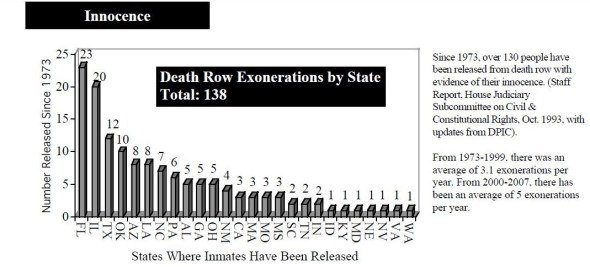
I’m sure I don’t need to tell you that about 70% of the people who have been exonerated are members of minority groups–mostly African Americans. One of the most frequent causes of false convictions is prosecutorial misconduct. For more information on this problem, see this report (PDF) by the Innocence Project. In late March, the Supreme Court basically gave carte blanche to dishonest prosecutors by deciding that a wrongfully convicted man who had spent 14 years on death row has no right to sue for damages. From the LA Times:
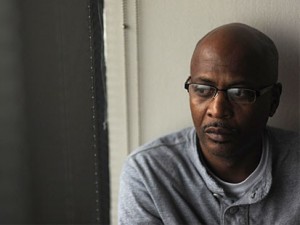
John Thompson
A bitterly divided Supreme Court on Tuesday tossed out a jury verdict won by a New Orleans man who spent 14 years on death row and came within weeks of execution because prosecutors had hidden a blood test and other evidence that would have proven his innocence.
The 5-4 decision delivered by Justice Clarence Thomas shielded the New Orleans district attorney’s office from being held liable for the mistakes of its prosecutors. The evidence of their misconduct did not prove “deliberate indifference” on the part of then-Dist. Atty. Harry Connick Sr., Thomas said.
Justice Ruth Bader Ginsburg emphasized her disapproval by reading her dissent in the courtroom, saying the court was shielding a city and its prosecutors from “flagrant” misconduct that nearly cost an innocent man his life.
“John Thompson spent 14 years isolated on death row before the truth came to light,” she said. He was innocent of the crimes that sent him to prison and prosecutors had “dishonored” their obligation to present the true facts to the jury, she said.
Besides Justice Ginsburg, Justices Sonia Sotomayor, Stephen Breyer and Elena Kagan also dissented from the majority opinion.
The Supreme Court has consistently shielded prosecutors from accountability for misconduct in the past, but Thompson had sued the New Orleans District Attorney’s office, claiming the office had demonstrated a “pattern of wrongdoing” and had failed to ensure that its attorneys obeyed the law. Now the Supremes have eliminated another check against willful misconduct by prosecutors.
Here from NPR is a brief summary of the case against Thompson:
In December of 1984, Raymond Liuzza Jr., the son of a prominent New Orleans business executive, was shot to death in front of his home. Police, acting on a tip, picked up two men, Kevin Freeman and John Thompson.
Thompson denied knowing anything about the shooting, but Freeman, in exchange for a one-year prison sentence, agreed to testify that he saw Thompson commit the crime.
Prosecutors wanted to seek the death penalty, but Thompson had no record of violent felonies. Then, a citizen saw his photo in the newspaper and implicated him in an attempted carjacking — and prosecutors saw a way to solve their problem. John Hollway, who wrote a book about the case, said the solution was to try the carjacking case first.
A conviction in the carjacking case would yield additional benefits in the subsequent murder trial, Hollway observes. It would discredit Thompson if he took the stand in his own defense at the murder trial, so he didn’t. And the carjacking would be used against him during the punishment phase of the murder trial.
It all worked like a charm. Thompson was convicted of both crimes and sentenced to death for murder.
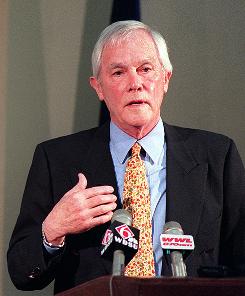
Harry Connick, Sr.
Ten years later, after Thompson’s appeals were exhausted and he was days from be executed, an investigator for his attorneys found that the blood of the perpetrator had been left at the scene of the murder. The lab report showed that Thompson had a different blood type than the person who committed the crime. The DA had deliberately concealed this information from the defense.
At a new trial, more exculpatory evidence that had been suppressed by the DA was presented–10 pieces of evidence in all–and the jury acquitted Thompson in half-an-hour. Thompson then sued and won a $14 million judgment against Connick and the NOLA DA’s office. But, now the right wingers on the Court have nullified that judgement.
On March 31, the editors of The New York Times wrote that a lack of empathy led to this injustice.
The important thing about empathy that gets overlooked is that it bolsters legal analysis. That is clear in the dissent by Justice Ruth Bader Ginsburg. Her empathy for Mr. Thompson as a defendant without means or power is affecting. But it is her understanding of the prosecutors’ brazen ambition to win the case, at all costs, that is key.
After detailing the “flagrant indifference” of the prosecutors to Mr. Thompson’s rights, she makes clear how critically they needed training in their duty to turn over evidence and why “the failure to train amounts to deliberate indifference to the rights” of defendants.
The district attorney, Harry Connick Sr., acknowledged the need for this training but said he had long since “stopped reading law books” so he didn’t understand the duty he was supposed to impart. The result, Justice Ginsburg writes, was an office with “one of the worst” records in America for failing to turn over evidence that “never disciplined or fired a single prosecutor” for a violation.
One thing about conservatives, they rarely show any empathy or compassion for anyone who isn’t just like them.
Today John Thompson himself contributed an op-ed to the NYT. Please read the whole thing, but here is just a bit.
I SPENT 18 years in prison for robbery and murder, 14 of them on death row. I’ve been free since 2003, exonerated after evidence covered up by prosecutors surfaced just weeks before my execution date. Those prosecutors were never punished. Last month, the Supreme Court decided 5-4 to overturn a case I’d won against them and the district attorney who oversaw my case, ruling that they were not liable for the failure to turn over that evidence — which included proof that blood at the robbery scene wasn’t mine.
Because of that, prosecutors are free to do the same thing to someone else today.
[….]
The prosecutors involved in my two cases, from the office of the Orleans Parish district attorney, Harry Connick Sr., helped to cover up 10 separate pieces of evidence. And most of them are still able to practice law today.
Why weren’t they punished for what they did? When the hidden evidence first surfaced, Mr. Connick announced that his office would hold a grand jury investigation. But once it became clear how many people had been involved, he called it off.
According to NPR, former DA Harry Connick Sr. “feels vindicated” by the SCOTUS decision.
“I think that he committed … a murder, and I think that obviously we thought we had enough evidence to gain a conviction,” he says. “So I was delighted that the Supreme Court ruled in our favor.”
Never mind the ten pieces of exculpatory evidence that his prosecutor covered up in order to convict Thompson. And, by the way, the prosecutor confessed what he had done to a friend, so it was no accident. Relatives of the murdered man, Ray Liuzza, still believe Thompson is guilty. Liuzza’s sister
Maurine Liuzza said she has reviewed all of the evidence in the case and still believes that Thompson is guilty.
“Just because you are found not guilty does not make you innocent,” she said.
It’s time for radical change in all three branches of our broken government.
Karl Marx: The Comeback Kid
Posted: April 10, 2011 Filed under: Economic Develpment, financial institutions, Global Financial Crisis | Tags: Commerce, economics, finance, Financial Development, Financial Institutions, Karl Marx 23 Comments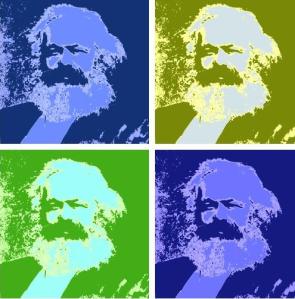 technology, pushing them to take more and more expensive credits, until their debt becomes unbearable. The unpaid debt will lead to bankruptcy of banks, which will have to be nationalised, and the State will have to take the road which will eventually lead to communism”
Karl Marx, Das Kapital, 1867
Okay, I got your attention and that’s my purpose. I’m really not a closet Marxist, but I do feel that some of that old school political economics he brought to the realm of economic thinking way back when is still worth contemplating. The above quote from Marx is a fairly good summation of his intellectual endeavors. He starts out with some really great assumptions then jumps the shark with vague, unmapped conclusions, But, Marx was a philosopher and jumping sharks seems to be an occupational hazard for them. Economics these days relies on mathematical models and empirical study.
Marx is one of those folks–along with equally fringe Frederick Hayek– who is getting a second look in a back-handed way. What’s pretty interesting is that a lot of the criticism of Marx and Lenin forgets that they had more against “financial capitalists” than they had against “industrial capitalists”. Both Rand and Ron Paul sort’ve remind me of them in that way. Marx actually looked at us ideally as a society of producers. He didn’t like how financiers fit into that picture at all. He railed against the UK’s Bank Act of 1844 that was a response to a fairly huge financial crisis. He argued that the “1844 Act had been deliberately designed to keep interest rates artificially high, benefiting the financial section of the capitalist class at the expense of the industrial section”. He also had a lot to say about paper money that wasn’t convertible to things like gold and it’s hard not to hear Marx in Ron Paul’s diatribes.
Marx also introduced the idea of commodity fetishism, which is a fairly compelling description of the modern US economy. He felt we’d all become slaves to it eventually. So, even though he never really fleshed out much worth implementing, he and Lenin had some interesting commentary on what they saw as problems that would arise from a society that became increasing focused on financial services and became addicted to consumer goods.
In an odd way, the financial crisis has brought on renaissance of the Marxist critique as well as a huge number of libertarians that are trying to have a Hayekian renaissance. Academics that study financial economics are asking similar questions but not quite in the way that you would think. The odd thing is that the very line of research that used to soundly tromp the Marxist assumption of the financial capitalist as parasite is sort’ve headed towards a refinement of the idea that too many bankers spoil the economy.
Every one is pretty much in agreement that much of the time, market economies do a fairly good job of sorting out who gets what. You can even speak with economists in Cuba and find out they are all planning for liberalization as long as it doesn’t reintroduce a flurry of exploitation. The problem is that real life markets don’t function very well when there are too many ‘frictions’. Just as in physics, frictions deform things. Frictions are basically things that cause less-than-efficient outcomes in markets where efficiency is strictly defined as the maximum quantity produced at a minimal price. In some cases, these things are caused by governments. Regulations, tariffs, quotas, and taxes can all cause frictions. Some are put in place purposely to warp the market outcome as is the case with sin taxes. Third party payers–like the health insurance industry–create frictions. Advertising creates incredible frictions.
Markets can have naturally occurring frictions like the placement of oil reserves or diamonds or gold in certain locations in the world. They can have frictions due to technology or economies of scale where it’s most efficient to have a single producer or monopoly because it is least expensive or necessary to create the minimal cost plant size. Think how huge car manufacturing or steel plants have to be so they are cost effective. Frictions are everywhere and they warp market outcomes. Free Market fetishists tend to ignore any friction not created by the government. In some cases, government is the source of the friction; in other cases, government–through regulation or policing of markets–can remove the frictions. Financial markets are riddled with two notorious frictions: information asymmetry and moral hazard. You can see how Marx grasped those problems philosophically. Lenin actually did studies using numbers. Hayek had his explanations of financial crises as did J.M. Keynes. Keynes went so far to say that financial markets were driven by “animistic spirits”. We’ve come a long way since all of them were actively writing but yet, some of the themes remain the same in new veins of inquiry.
There are several things out in the blogosphere that have brought me to discuss this topic with you. The first is a NYT editorial called ‘Banks are Off the Hook Again’. Banks are trying to get Federal lawmakers to override state laws on foreclosure in an attempt to avoid prosecution and the results from their foreclosure practices. They are–per usual–succeeding.
As early as this week, federal bank regulators and the nation’s big banks are expected to close a deal that is supposed to address and correct the scandalous abuses. If these agreements are anything like the draft agreement recently published by the American Banker — and we believe they will be — they will be a wrist slap, at best. At worst, they are an attempt to preclude other efforts to hold banks accountable. They are unlikely to ease the foreclosure crisis.
All homeowners will suffer as a result. Some 6.7 million homes have already been lost in the housing bust, and another 3.3 million will be lost through 2012. The plunge in home equity — $5.6 trillion so far — hits everyone because foreclosures are a drag on all house prices.
The deals grew out of last year’s investigation into robo-signing — when banks were found to have filed false documents in foreclosure cases. The report of the investigation has not been released, but we know that robo-signing was not an isolated problem. Many other abuses are well documented: late fees that are so high that borrowers can’t catch up on late payments; conflicts of interest that lead banks to favor foreclosures over loan modifications.
The draft does not call for tough new rules to end those abuses. Or for ramped-up loan modifications. Or for penalties for past violations. Instead, it requires banks to improve the management of their foreclosure processes, including such reforms as “measures to ensure that staff are trained specifically” for their jobs.
This is a really good example of maintenance of mutually destructive frictions in a market. It creates uncertainty. It does not contribute to translucence and information. It ensures a lop-sided process. In short, it guarantees certain market failure and it sets up the winners and the losers. It’s something about which both Marx and Hayek would rant. For that matter, J.M. Keynes wouldn’t be so judicious about it either.
Saturday Night Delights
Posted: April 9, 2011 Filed under: just because | Tags: best chocolate recipes, best lead singer ever, Egyptian mummies with clogged arteries, new particles, open thread, quarks 22 Comments Hi!
Hi!
Thought I’d put up an open thread with some interesting tidbits that I’ve seen in the news recently. I also wanted to update you on a few tidbits about the blog too. On Thursday, we reached our 3 month name change (actually, it’s the permanent addie that changed) anniversary. On the 27th, we’ll have left file cabinet status for six months now. If you look down there at the print screen captured from Technorati earlier this week, you’ll see that we made Top 100 US Political blogs. Actually we did it twice this week and we’re still lingering at the high end. This one was the second occurence and we were sitting squarely on number 100. We’re the little blog that can ’cause we try harder!
So, here’s some interesting ‘stuff’.
NPR reports that Egyptians Mummies have been found with clogged arteries. Guess there was high cholesterol around back then too.
Heart disease is supposedly a modern affliction, the result of a diet rich in animal fat and too many hours spent on the sofa. But recent discoveries suggest that strokes and heart attacks may have been bedeviling humans for millenia.
Dr. Greg Thomas is part of a team of scientists that recently discovered the earliest known case of atherosclerosis — clogged arteries — in ancient Egyptian mummies. The startling findings mean scientists may not understand heart disease as well as they think they do.
The Large Hadron Collider appears to be on the verge of finding a new particle according to Wired. Physics has to be the neatest science on the planet right now.
Theorist Moira Gresham of the University of Michigan says many explanations for the Tevatron asymmetry predict new particles that could be seen at the LHC — even though it is now running at only half its maximum energy. She and her colleagues posted a paper on the proposed properties of several such particles at arXiv.org on March 18, one of a flurry of articles that have appeared in response to the Tevatron finding.
Among the possible particles is a heavy cousin tothe massless gluon, the particle that binds quarks together. Another idea, noted in a paper posted at arXiv.org on April 1, posits the existence of a particle called the Z’ boson, a heavier version of the Z boson, a messenger particle for the weak interaction. The Z’ boson would transforms one type of quark into another, leading to the asymmetry.
“Particle physicists know that the standard model is incomplete,” Gresham says. “We’ve been waiting a long time to get some more concrete hints.”
Okay, I’m going to share one that you’re sure to like. Here’s a list of the best chocolate bars from Real Simple magazine. They also have stuff there like the best 50 recipes using chocolate too. Here’s one that sounds great!
Double Chocolate-Chip Cookies
Ingredients
- 1/2 cup unsalted butter, at room temperature
- 1/2 cup granulated sugar
- 1/2 cup brown sugar
- 1 large egg
- 1 teaspoon pure vanilla extract
- 1 1/2 cups all-purpose flour
- 1/4 cup unsweetened cocoa powder
- 1/2 teaspoon baking soda
- 1/2 teaspoon baking powder
- 1/2 teaspoon salt
- 1/2 cup milk-chocolate chips
- 1/2 cup semisweet chocolate chips
Directions
- Heat oven to 350°F. Cream the butter and sugars in a large bowl with an electric mixer on high speed. Lower to medium speed and add the egg and vanilla. Sift together the flour, cocoa, baking soda, baking powder, and salt. On low speed, add the dry mixture to the butter mixture. Beat until fully incorporated. Fold in the chocolate chips.
- Form the dough into approximately 1 1/2-inch balls. Place on parchment- or foil-lined baking sheets, 2 inches apart.
- Bake until the centers are just set, about 12 minutes. Let cool on sheets for 5 minutes, then transfer to wire racks.
This week’s Rolling Stone‘s asked the question “Who is the best lead singer of all time?”. You can go answer them or maybe you can offer up your own. Here’s my two offerings. Robert Plant singing a song with Queen in a tribute to Freddie Mercury. Oh, and it’s a Led Zeppellin song before he switches to singing ‘Crazy Little thing called Love”. Every time I’ve see Robert Plant in concert, I go weak in the knees. He did to me as a teeny bopper and he still does it to me today. Even, if he’s traveling around with Allison Krause.
Okay. So, hopefully this puts you in a good mood and we forget the beltway madness for awhile! Happy Saturday Night every one! Oh, and share!!! I want folks to top my chocolate recipes, lead singer suggestions, and discovery trivia!


 peej
peej Carissa
 bostonboomer
 dakinikat
 ecocatwoman
 mablue2
 Mama Lopez
 peggysue22
 quixote
 skydancingguestblogger
 Mona (aka Wonk the Vote)



 Sky Dancing
Recent Comments