
Backlash
Posted: March 15, 2011 Filed under: 2012 presidential campaign, Barack Obama, collective bargaining, Democratic Politics, Domestic Policy, Elections | Tags: polls, republican politics, tea party overreach 34 CommentsThe only positive thing to come out of the Tea Party, its John Birch Society Roots and funding sources, and its election of right wing reactionaries is the amount of backlash that is coming as a result of imposing their extremist policies. Their agenda is obvious. Many of the states that are suffering at the hands of governors and legislators that are more interested in ideology than solutions for their state’s problems are looking at recalls. It seems there’s a huge amount of blow-back now. Just check out some of these polls.
Public Policy Polling reports on “brutal numbers” for Ohio’s John Kasich. Not only do independents and nonunion households support a recall of his collective-bargaining killing bill, they don’t support him. They want him gone.
Ohio Senate Bill 5 may not be in effect for very long…54% of voters in the state say they’d repeal it in an election later this year while just 31% say they’d vote to let the bill stand.
The support for repealing SB 5 is reflective of a high level of support for unions and workers in Ohio, more so than we saw in Wisconsin a couple of weeks ago. 63% of voters in the state supportive collective bargaining for public employees to only 29% who oppose it. 52% of voters think public employees should have the right to strike, to 42% who think they should not. And 65% think public employees should have the same rights they do now- or more- while only 32% believe they should have fewer rights.
There are two things particularly notable in the crosstabs on all of these questions. The first is that non-union households are supportive of the public employees. 54% support their collective bargaining rights to 36% in opposition and 44% say they would vote to repeal SB 5 to 38% who would let it stand. Obviously that level of support is not nearly as high as among union households but it still shows that the workers have even most of the non-union public behind them.
The other thing that’s worth noting is the independents. A lot of attention has been given to the way what’s been going on in Ohio and Wisconsin is galvanizing the Democratic base, but it’s also turning independents who were strongly supportive of the GOP in the Midwest last year back against the party. 62% of independents support collective bargaining for public employees to 32% opposed and 53% support repeal of SB 5 to 32% who would let it stand.
All of this is having an absolutely brutal effect on John Kasich’s numbers. We find him with just a 35% approval rating and 54% of voters disapproving of him. His approval with people who voted for him is already all the way down to 71%, while he’s won over just 5% of folks who report having voted for Ted Strickland last fall. Particularly concerning for him is a 33/54 spread with independents.
The site calls this “significant buyer’s remorse”. This is the pollster for DKos that has polled on the Wisconsin effort to recall at least 8 Republican State Senators.
Three Republican incumbents actually trail “generic Dem”: Luther Olsen, Randy Hopper, and Dan Kapanke. Two more have very narrow leads and garner less than 50% support: Rob Cowles and Sheila Harsdorf. And one more, Alberta Darling, holds a clear lead but is still potentially vulnerable. (Two recall-eligible senators, Mary Lazich and Glenn Grothman, sit in extremely red districts and look to have safe leads.) These numbers suggest we have a chance to make five and possibly six recall races highly competitive.
David Weigel–now of Slate--reports on similar trends for Rick Scott and Scott Walker. Rasmussen has Governor Walker hanging in there with a 43% approval rating. It’s interesting when you get the same results from a less liberal-affiliated polling company.
Wisconsin Governor Scott Walker won his job last November with 52% of the vote, but his popularity has slipped since then.
A new Rasmussen Reports telephone survey of Likely Wisconsin Voters finds that just 34% Strongly Approve of the job he is doing, while 48% Strongly Disapprove. Overall, including those who somewhat approve or disapprove, the new Republican governor earns positive reviews from 43% and negative reviews from 57% of voters statewide.
In addition to the usual partisan and demographic breakdowns, it’s interesting to note that Walker, now engaged in a budget battle with unionized state workers, receives a total approval rating of 46% from households with private sector union members. However, among households with a public sector union member, only 19% offer their approval. Among all other households in the state, opinion is nearly evenly divided—49% favorable and 51% unfavorable.
It’s also interesting to note that among households with children in the public school system, only 32% approve of the governor’s performance. Sixty-seven percent (67%) disapprove, including 54% who Strongly Disapprove.
Wiegel writes that Democratic strategist believe the blowback will have signficant positive effects for the re-election of Obama come 2012.
I was talking the other day to a Democrat who’d been battle-scarred by the 2010 Florida campaign, in which Democrats lost everything. Everything. Alan Grayson’s career died quickly. Kendrick Meek became a trivia question. One of the people Palin endorsed, Pam Bondi, actually won. And Rick Scott pipped Alex Sink, the most talented statewide Democratic candidate since Lawton Chiles, to become governor.
This Democrat’s spin was that Sink’s loss wasn’t so bad after all. Scott was pissing off too many people — the Orlando-Tampa train he’d killed was popular — and Democrats could win back independents in 2012, saving the state for Barack Obama.
Further evidence of the extremist elements in both the Tea Party and the current incarnation of the Republican party show up in other polls. A CNN poll shows that most people do not want the government shut down over budget issues. The folks that object are basically tea party-affiliated.
Nearly six in ten people questioned in the poll say that it would be a bad thing for the government to shut down for a few days because Congress did not pass a new spending bill, with 36 percent saying it would be a good thing for the country. And if a government shutdown lasted a few weeks, that figure would rise to 73 percent.
“But Republicans think a shut down that lasts a few days would be a good thing. And a majority of Tea Party supporters approve of a shutdown even if it lasts several weeks,” says CNN Polling Director Keating Holland. “That puts pressure on House Speaker John Boehner and other GOP leaders to take a step which might hurt their standing with independents as well as some Republicans.”
The survey indicates wide partisan differences on the issue, with only 21 percent of Democrats saying a shutdown for a few days would be a good thing. That figure rises to 35 percent for independent voters, 53 percent for Republicans, and 62 percent for Tea Party supporters.
Couple this with a Gallup poll that shows that Huckabee and Bachmann have the most intense followers in the field of GOP presidential wannabes. There is definitely a crazy side to the Republican Party and it’s showing signs of taking the party into extreme positions supported by very few Americans. I personally can’t imagine voting for either of this people for dog catcher let alone president. I don’t think they’re qualified to flip hamburgers, frankly.
Former Arkansas Gov. Mike Huckabee leads the field of possible GOP presidential candidates in “positive intensity” among Republicans nationwide with a score of +25 among Republicans who are familiar with him, followed by Rep. Michele Bachmann of Minnesota with a score of +20. Huckabee is recognized by 87% of Republicans, compared with Bachmann’s 52%. A number of other possible Republican presidential candidates trail these two in Positive Intensity Scores, including Sarah Palin, who is the best known of the group.
With these kinds of people rising to the top in party politics of one of the major parties, it’s no wonder we also have an ABC News-WAPO poll that shows Americans are not very confident in their system of government.
Only 26 percent of Americans in a new ABC News/Washington Post poll say they’re optimistic about “our system of government and how well it works,” down 7 points since October to the fewest in surveys dating to 1974. Almost as many, 23 percent, are pessimistic, the closest these measures ever have come. The rest, a record high, are “uncertain” about the system.
The causes are many. Despite a significant advance, more than half still say the economy has not yet begun to recover. And there’s trouble at the pump: Seventy-one percent in this poll, produced for ABC News by Langer Research Associates, report financial hardship as a result of rising gas prices. Forty-four percent call it a “serious” hardship.
People are desperately unhappy with the results of the two party system. It doesn’t even appear that voting for party gridlock works much any more. The Republican notion of big government is a white daddy government that restricts women’s rights, worker’s rights, and transfers wealth to the already rich and powerful. What exactly is the Democratic notion these days? While this backlash will work to the benefit of the sitting President and the Democratic politicians, will they just ride the backlash or actually articulate and run on some kind of vision for a change? Let me be more specific. How about some actions that match those fancy speeches for a change?
We now seem stuck the worst features of the two party system We try for gridlock but get bugfug crazy from the Republicans. We try for social justice but the Democratic Party never seems to be able to coalesce around a vision or agenda that does much other than respond to Republicans by caving-in and playing up to party donors. I’m not sure that I see that changing much given we can’t even get this current President off his historical position of voting present.
The challenges that we’re facing today seem as severe as those we faced during the Bush years. There’s a melt down in strongman governments in the MENA area, we’ve had two major energy-related disasters, and we’ve still got an economy that’s barely sustaining a recovery with high unemployment. If there ever was time for leadership and vision from some corner of national politics, it would be now. Voters keep turning the reigns of government over to the Dubyas, the Walkers, and the Kasichs because they can’t get what they want from Democrats. They emerge from each party’s rule appalled. It seems like some one reasonable could take advantage of that situation. Why do I feel that the Democratic Party will just blow this opportunity away too?
Tuesday Reads
Posted: March 15, 2011 Filed under: John Birch Society in Charge, morning reads, Reproductive Rights, Republican presidential politics, right wing hate grouups | Tags: abortion rights, Corporate SCOTUS, Glenn Beck, Kansas Republicans, no looting in Japan, The Roberts Court, Wisconsin Republicans 72 CommentsBeware t he Ides of March!!
Well, things remain in flux. First, Senate Republicans in Wisconsin are still holding the 14 Democrats hostage to their policies and contempt.
Senate Majority Leader Scott Fitzgerald wrote this afternoon in an email to his caucus that Senate Dems remain in contempt of the Senate and will not be allowed to vote in committees despite returning from their out-of-state boycott of the budget repair bill vote.
“They are free to attend hearings, listen to testimony, debate legislation, introduce amendments, and cast votes to signal their support/opposition, but those votes will not count, and will not be recorded,” wrote Fitzgerald, R-Juneau.
Republicans in Kansas are also suggesting some pretty bizarre things.
A legislator said Monday it might be a good idea to control illegal immigration the way the feral hog population has been controlled — with hunters shooting from helicopters.
State Rep. Virgil Peck, R-Tyro, said he was just joking, but that his comment did reflect frustration with the problem of illegal immigration.
Peck made his comment came during a discussion by the House Appropriations Committee on state spending for controlling feral swine.
After one of the committee members talked about a program that uses hunters in helicopters to shoot wild swine, Peck suggested that may be a way to control illegal immigration.
Then, Glenn Beck decided to take Pat Robertson’s place in talking about earthquakes, god, and endtimes.
Discussing the devastation in Japan on his radio program this morning, Glenn Beck lamented that we “can’t see the connections here.”
Beck said that he’s “not saying God is, you know, causing earthquakes,” then clarified that he is “not not saying that, either,” then added: “Whether you call it Gaia, or whether you call it Jesus, there’s a message being sent and that is, ‘hey, you know that stuff we’re doing? Not really working out real well.’ Maybe we should stop doing some of it.”
Think that’s outrageous? Check out this one from a GOP House member from New Hampshire that at least retired after this comment.
Rep. Martin Harty, a Barrington Republican, has resigned his House seat in the wake of fire he drew for remarks on mental illness and population control.
Harty, who turns 92 this month, came into spotlight last week after telling a voter during a phone call that he thought the best treatment for the mentally ill would be a one-way trip to Siberia.
He also said population growth and mental illness could be controlled with eugenics, a form of genetic engineering commonly associated with Hitler’s Germany.
Kinda makes you wonder what’s wrong with some people in this country doesn’t it? If this is coming from the country’s decision makers and opinion leaders, I think we’re in a heckuva lotta trouble. Then there’s this bit of news on the Supreme Court coming from a study co-authored by conservative Court of Appeals Judge Richard Posner.
… the Roberts Court places a huge thumb on the scale in favor of corporate interests. According to the study, the Roberts Court rules in favor of business interests 61 percent of the time, a 15 point spike from the five years before when Chief Justice Roberts joined the Court.
While the Chamber of Commerce has recently tried to downplay the favorable treatment it receives from the Supreme Court, its own top lawyer admitted a few years after Roberts joined the Court that the justices give his client special treatment:
Carter G. Phillips, who often represents the chamber and has argued more Supreme Court cases than any active lawyer in private practice, reflected on its influence. “I know from personal experience that the chamber’s support carries significant weight with the justices,” he wrote. “Except for the solicitor general representing the United States, no single entity has more influence on what cases the Supreme Court decides and how it decides them than the National Chamber Litigation Center.”
Phillips’ confession, and the Posner study’s conclusion, corroborates other data showing the Roberts Court’s favoritism towards corporate interests.
Women are definitely on the losing end of Republican Government overreach. Here’s the latest example from Iowa.
Life can’t get much worse for Christine Taylor. Last month, after an upsetting phone conversation with her estranged husband, Ms. Taylor became light-headed and fell down a flight of stairs in her home. Paramedics rushed to the scene and ultimately declared her healthy. However, since she was pregnant with her third child at the time, Taylor thought it would be best to be seen at the local ER to make sure her fetus was unharmed.
That’s when things got really bad and really crazy. Alone, distraught, and frightened, Taylor confided in the nurse treating her that she hadn’t always been sure she’d wanted this baby, now that she was single and unemployed. She’d considered both adoption and abortion before ultimately deciding to keep the child. The nurse then summoned a doctor, who questioned her further about her thoughts on ending the pregnancy. Next thing Taylor knew, she was being arrested for attempted feticide. Apparently the nurse and doctor thought that Taylor threw herself down the stairs on purpose.
According to Iowa state law, attempted feticide is an trying “to intentionally terminate a human pregnancy, with the knowledge and voluntary consent of the pregnant person, after the end of the second trimester of the pregnancy.” At least 37 states have similar laws. Taylor spent two days in jail before being released. That’s right, a pregnant woman was jailed for admitting to thinking about an abortion at some point early in her pregnancy and then having the audacity to fall down some stairs a couple of months later. Please tell me you find this as horrifying as I do.
With that bit of news, I’d like to recommend something Bostonboomer found yesterday by Chris Hedges: Power Concedes Nothing Without a Demand.
The liberal class is discovering what happens when you tolerate the intolerant. Let hate speech pollute the airways. Let corporations buy up your courts and state and federal legislative bodies. Let the Christian religion be manipulated by charlatans to demonize Muslims, gays and intellectuals, discredit science and become a source of personal enrichment. Let unions wither under corporate assault. Let social services and public education be stripped of funding. Let Wall Street loot the national treasury with impunity. Let sleazy con artists use lies and deception to carry out unethical sting operations on tottering liberal institutions, and you roll out the welcome mat for fascism.
Well, there are some places in the world where people see themselves as altogether in one big struggle against the bad things that happen. The Japanese are certainly providing some good examples of resilience and human strength in the face of some horrendous disasters. In the UK, The Telegraph asks: ‘Why is there no looting in Japan?’
The landscape of parts of Japan looks like the aftermath of World War Two; no industrialised country since then has suffered such a death toll. The one tiny, tiny consolation is the extent to which it shows how humanity can rally round in times of adversity, with heroic British rescue teams joining colleagues from the US and elsewhere to fly out.
And solidarity seems especially strong in Japan itself. Perhaps even more impressive than Japan’s technological power is its social strength, with supermarkets cutting prices and vending machine owners giving out free drinks as people work together to survive. Most noticeably of all, there has been no looting, and I’m not the only one curious about this.
This is quite unusual among human cultures, and it’s unlikely it would be the case in Britain. During the 2007 floods in the West Country abandoned cars were broken into and free packs of bottled water were stolen. There was looting in Chile after the earthquake last year – so much so that troops were sent in; in New Orleans, Hurricane Katrina saw looting on a shocking scale.
Why do some cultures react to disaster by reverting to everyone for himself, but others – especially the Japanese – display altruism even in adversity?
We might ask ourselves the same question. Why is it that some folks display altruism even in adversity?
What’s on your reading and blogging list today?
Misplaced Blame and Impact
Posted: March 14, 2011 Filed under: Bailout Blues, Economy, financial institutions, Global Financial Crisis | Tags: Banksters, credit crunch, U.S. Economy 15 Comments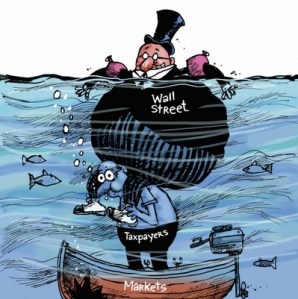 The blame for the worst recession since the The Great Depression clearly rests on the private sector where millions of bad loans and financial innovations turned peoples homes and investments into casino style gambling games. The disastrous lack of regulation, accountability, and common sense is still wrecking havoc on the economy today. The lending industry is still at odds with common sense, community well being, and the national interest. Paul Krugman wrote about this today in his NYT op ed using the academy award winning film Inside Job as the cautionary frame. What is evident in all of this fall out is that the people that deserve the blame are still acting abominably and the people they wronged are still getting the worst end of the deal.
What the film didn’t point out, however, is that the crisis has spawned a whole new set of abuses, many of them illegal as well as immoral. And leading political figures are, at long last, showing some outrage. Unfortunately, this outrage is directed, not at banking abuses, but at those trying to hold banks accountable for these abuses.
The immediate flashpoint is a proposed settlement between state attorneys general and the mortgage servicing industry. That settlement is a “shakedown,” says Senator Richard Shelby of Alabama. The money banks would be required to allot to mortgage modification would be “extorted,” declares The Wall Street Journal. And the bankers themselves warn that any action against them would place economic recovery at risk.
All of which goes to confirm that the rich are different from you and me: when they break the law, it’s the prosecutors who find themselves on trial.
To get an idea of what we’re talking about here, look at the complaint filed by Nevada’s attorney general against Bank of America. The complaint charges the bank with luring families into its loan-modification program — supposedly to help them keep their homes — under false pretenses; with giving false information about the program’s requirements (for example, telling them that they had to default on their mortgages before receiving a modification); with stringing families along with promises of action, then “sending foreclosure notices, scheduling auction dates, and even selling consumers’ homes while they waited for decisions”; and, in general, with exploiting the program to enrich itself at those families’ expense.
The end result, the complaint charges, was that “many Nevada consumers continued to make mortgage payments they could not afford, running through their savings, their retirement funds, or their children’s education funds. Additionally, due to Bank of America’s misleading assurances, consumers deferred short-sales and passed on other attempts to mitigate their losses. And they waited anxiously, month after month, calling Bank of America and submitting their paperwork again and again, not knowing whether or when they would lose their homes.”
There are more issues than just the foreclosure one. Here’s an example of a family fighting to sue BOA for the wrongful death of an elderly man who committed suicide after they recommended investments to him that failed miserably. The family has found out that the man had probably unknowingly signed away the right to sue in the fine print of the investment documents. I can’t imagine any one recommending a portfolio of risky assets to any one over the age of 50, yet this is exactly what BOA did to Mr. Phillip Grossman.
Philip Grossman saved carefully his whole life, never investing in anything more exotic than certificates of deposit. But in June 2007, his longtime banker at a Bank of America branch in Waltham told him he could do better, without taking more risk, and introduced him to a broker at the bank’s investment arm.
Two years later, Grossman, then a 65-year-old computer consultant, and his wife had lost $400,000 — more than half their savings. In despair in the fall of 2009, Grossman checked into a Woburn motel, left his glasses and watch on the desk in his room, and killed himself.
Stunned by the tragedy, his family tried to sue Bank of America, asserting that the broker invested more aggressively than promised, adding to the steep losses and contributing to Grossman’s suicide. But they soon found out they would not get their day in court: The papers the Grossmans signed to open their account required that any dispute go to a private panel of arbitrators.
“They’ve committed a crime against us, as far as I’m concerned,’’ Grossman’s wife, Gail, said in an interview. “Why do we have to go to arbitration? With other crimes you get a trial and a jury. It just seems very unfair to me.’’
The Grossmans’ case shows how entrenched arbitration has become in the financial industry, demonstrating that even in an extreme case alleging wrongful death, aggrieved clients have no recourse other than a system that critics say favors investment firms. Most investors have no idea that when they open a brokerage account, they give up their right to sue, and must, under a 1987 Supreme Court ruling, take complaints to arbitration.
There are more outrages to share with you. Think that having a perfect credit score and a huge down payment will get you a loan these days if you’re a consumer? Think again. Banks are lending to junk bond quality businesses while denying the best of households basic mortgages. The recovery is not just around the corner for the majority of US households for many reasons. Government help has been concentrated at reaching banks and businesses. This is not translating into improvement for all.
The consumer loan market, particularly housing, remains a challenge for borrowers. Total U.S. consumer credit outstanding was $2.4 trillion in January, or 6.6 percent below its July 2008 level, the Fed said in a March 7 report. Total housing debt has declined by $536 billion since 2008 to $10.1 trillion, Fed data show. The median price of an existing U.S. home has dropped 13 percent since June to $158,800, bringing its decline since July 2006 to 31 percent, according to the Chicago-based National Association of Realtors. About 10.8 million homes were worth less than the debt owed on them in the third quarter, research firm CoreLogic Inc. said in a Dec. 13 report.
By contrast, the least creditworthy corporations have been able to borrow record amounts at the cheapest rates ever. Junk- rated companies sold an unprecedented $287.6 billion in bonds in 2010 and are setting an even faster pace of issuance this year. Claire’s Stores Inc., the costume jewelry retailer that had debt that was almost 10 times its earnings last year, sold $450 million of bonds last month that Moody’s Investors Service gave its third-lowest rating.
There are several other disturbing figures in the Bloomberg article quoted directly above.
The U.S. economy grew at a 2.8 percent annual rate in the fourth quarter, slower than previously calculated, and is forecast to expand 3.2 percent this year, according to the median estimate of 66 economists in a Bloomberg survey.
Household purchases account for about 70 percent of the U.S. economy, making the consumer the single biggest driver of any economic recovery. Those consumers “stumbled at bit” at the start of this year, Michael Feroli, chief U.S. economist at JPMorgan Chase & Co. in New York, said in a February note.
While the economy expanded and companies are beginning to spend more, the improvements haven’t driven the nation’s unemployment rate below 8.9 percent for almost two years and the Conference Board’s gauge of consumer confidence is still 37 percent below the level reached in July 2007.
“The 2007-2009 recession period looks different from previous economic cycles,” John McElravey, a bond analyst at Wells Fargo Securities LLC in Charlotte, North Carolina, said in a March 8 report. “Consumer credit outstanding contracted much more sharply than in other periods, and the return to positive growth rates has been relatively slow.”
There are so many things different and bad with this recovery that it is indeed troubling. Perhaps the most important factor is that government is clearly not helping homeowners, the jobless, and the many families who have lost wealth via the crash in home values and their investments. The focus of bailouts has been on banks and businesses that have not used the funds to benefit their communities. Something is clearly wrong here with policy priorities when you’re not focused on the major source of consumption in a consumer-drive economy.
Not only is policy not aimed at the majority of people in the country, the focus in the District is now clearly turning to austerity measures and turning neighbor against neighbor. I can’t tell you exactly how worried I am that a huge number of households will still be in trouble come the next recession. Here’s another opinion on that very subject from E.J. Dionne Jr. at WAPO.
A phony metaphor is being used to hijack the nation’s political conversation and skew public policies to benefit better-off Americans and hurt most others.We have an 8.9 percent unemployment rate, yet further measures to spur job creation are off the table. We’re broke, you see. We have a $15 trillion economy, yet we pretend to be an impoverished nation with no room for public investments in our future or efforts to ease the pain of a deep recession on those Americans who didn’t profit from it or cause it in the first place.
As Sen. Al Franken (D-Minn.) pointed out in a little-noticed but powerful speech on the economy in December, “during the past 20 years, 56 percent of all income growth went to the top 1 percent of households. Even more unbelievably, a third of all income growth went to just the top one-tenth of 1 percent.” Some people are definitely not broke, yet we can’t even think about raising their taxes.
By contrast, Franken noted that “when you adjust for inflation, the median household income actually declined over the last decade.” Many of those folks are going broke, yet because “we’re broke,” we’re told we can’t possibly help them.
That’s the new excuse. We could help Chrysler. We could help GM. We could help the financial institutions and Wall Street. We could invade Iraq and Afghanistan to help them. We could do all that, but now we’re too broke to help ordinary Americans. It’s obvious that the financial institutions are doing nothing to improve the situation. It’s also pretty obvious that Iraq and Afghanistan are money pits. When do we get the government to quit throwing our money to rich people and businesses? When do we get them to stop blaming teachers, firefighters, and police offers for taking up too much of the pie? When do we actually start looking at the real numbers and the real culprits who took all this vast wealth and continue to ensure the rules only benefit the few?
Monday Reads: Interesting (and scary) times
Posted: March 14, 2011 Filed under: Barack Obama, Foreign Affairs, Japan, Libya, morning reads, The Media SUCKS, U.S. Politics, worker rights | Tags: Japan, Libya, Wisconsin protests 20 Comments
Good Morning! We sure do live in interesting times. There is so much happening in the news today that there is no way I could cover all of it. As I see it, the most disturbing news is that world events are spiraling out of control, while the U.S. President dithers and does as little as possible–fiddling while the world burns.
CRISES IN JAPAN
Japan is struggling with an overwhelming natural disaster and a massive humanitarian crisis, and at the same time they–and the rest of us–face a nuclear emergency. No one knows for sure yet how bad it is, but I can’t help but suspect that we are not getting the whole story.
Officials confirmed on Sunday that three nuclear reactors north of Tokyo were at risk of overheating, raising fears of an uncontrolled radiation leak.
Engineers worked desperately to cool the fuel rods in the damaged reactors. If they fail, the containers that house the core could melt, or even explode, releasing radioactive material into the atmosphere.
How bad could it get? Here’s what nuclear experts told Scientific American:
“Reactor analysts like to categorize potential reactor accidents into groups,” said Bergeron, who did research on nuclear reactor accident simulation at Sandia National Laboratory in New Mexico. “And the type of accident that is occurring in Japan is known as a station blackout. It means loss of offsite AC power—power lines are down—and then a subsequent failure of emergency power on site—the diesel generators. It is considered to be extremely unlikely, but the station blackout has been one of the great concerns for decades.
[….]
Bergeron explained the basics of overheating at a nuclear fission plant. “The fuel rods are long uranium rods clad in a [zirconium alloy casing]. They’re held in a cylindrical-shaped array. And the water covers all of that. If the water descends below the level of the fuel, then the temperature starts going up and the cladding bursts, releasing a lot of fission products. And eventually the core just starts slumping and melting. Quite a bit of this happened in TMI [Three Mile Island], but the pressure vessel did not fail.”
So what if the worst happens and there is a meltdown?
“They’re venting in order to keep the containment vessel from failing. But if a core melts, it will slump to the bottom of the reactor vessel, probably melt through the reactor vessel onto the containment floor. It’s likely to spread as a molten pool—like lava—to the edge of the steel shell, and melt through. That would result in a containment failure in a matter of less than a day. It’s good that it’s got a better containment system than Chernobyl, but it’s not as strong as most of the reactors in this country.”
Basically, we’re talking about The China Syndrome. Except if a Japanese nuclear plant melts down, the core won’t be headed for China.
Breaking: Second Explosion at Nuclear Plant in Japan
Posted: March 13, 2011 Filed under: Breaking News, Foreign Affairs, Japan, just because, Surreality | Tags: disaster, hydrogen explosion, Japan, nuclear meltdown 4 CommentsAl Jazeera just reported that there has been a hydrogen explosion at the third nuclear power plant that nuclear engineers have been working on in Japan. Several workers are reported to be injured or missing after the blast. Here is the first story I’ve seen about on Google: Fukushima Explosion: Japan Nuclear Plant Blast Believed To Be Hydrogen Explosion
Japan’s chief cabinet secretary says a hydrogen explosion has occurred at Unit 3 of Japan’s stricken Fukushima Dai-ichi nuclear plant. The blast was similar to an earlier one at a different unit of the facility.
Yukio Edano says people within a 12-mile (20-kilometer) radius were ordered inside following Monday’s. AP journalists felt the explosion 30 miles (50 kilometers) away.
A second explosion has hit the nuclear plant in Japan that was damaged in Friday’s earthquake, but officials said it had resisted the blast.
TV footage showed smoke rising from Fukushima plant’s reactor 3, a day after an explosion hit reactor 1.
Japan’s nuclear safety agency said the blast was believed to have been caused by the build-up of hydrogen.
Government officials said the reactor core was still intact as they tried allay fears of a radioactive leak.
3 injured, 7 missing after second explosion at Japan nuclear plant
A massive column of smoke was seen belching from the plant’s No. 3 unit Monday. The No. 3 Unit reactor had been under emergency watch for a possible explosion as pressure built up there following a hydrogen blast Saturday in the facility’s Unit 1.
Second Blast Rocks Japanese Nuclear Powerplant
A second explosion has rocked a nuclear power plant in Japan. The plant is in an area that was devastated by a massive earthquake and tsunami on Friday.
The explosion occurred mid-morning Monday, while workers were battling to bring down temperatures inside the Fukushima Number One nuclear power plant’s number three reactor.
Television images showed a strong explosion obliterating the upper walls of the reactor building and causing a huge plume of white smoke.
Japanese Quake Survivors Evacuated Amid Fears of Radiation Leaks
At least 170,000 Japanese earthquake and tsunami survivors have fled their homes, fearing the spread of radioactive contamination from damaged nuclear power plants.
Officials say dozens of people could have been exposed to radiation while being evacuated from a town near one of the damaged plants. They and hundreds of others were being scanned for radiation exposure.
Authorities say a new hydrogen explosion occurred Monday morning at the Fukushima power plant north of Tokyo, sending a plume of white smoke into the air. Officials said at a news conference covered by NHK Television that the building is still safe and that there is little risk of a mass radiation leak.
Why am I not buying that?
I will continue to update as I get more information.

 peej
peej Carissa
 bostonboomer
 dakinikat
 ecocatwoman
 mablue2
 Mama Lopez
 peggysue22
 quixote
 skydancingguestblogger
 Mona (aka Wonk the Vote)



 Sky Dancing
Recent Comments