
Indiana Democrats Flee to IL and KY to Avoid Voting on Right to Work Law
Posted: February 22, 2011 Filed under: collective bargaining, Democratic Politics, U.S. Economy, U.S. Politics, unemployment, worker rights | Tags: collective bargaining, Democrats, Indiana right to work bill, Mitch Daniels, Patti Smith, Power to the people, Republicans, Scott "Mubarak" Walker, unions, Wisconsin 32 Comments
Indiana House with Empty Democratic Seats
Yes, folks, it’s going viral! Indiana House Democrats have emulated Wisconsin Democratic Senators and leave the state rather than vote on a draconian anti-union bill.
Seats on one side of the Indiana House were nearly empty today as House Democrats departed the the state rather than vote on anti-union legislation.
A source tells The Indianapolis Star that Democrats are headed to Illinois, though it was possible some also might go to Kentucky. They need to go to a state with a Democratic governor to avoid being taken into police custody and returned to Indiana.
The House came into session twice this morning, with only three of the 40 Democrats present. Those were needed to make a motion, and a seconding motion, for any procedural steps Democrats would want to take to ensure Republicans don’t do anything official without quorum.
With only 58 legislators present, there was no quorum present to do business. The House needs 67 of its members to be present.
Indiana Government Mitch Daniels, who has completely unrealistic presidential aspirations tried to laugh off the Democrats’ strategy.
downplayed the boycott and the labor protests and laughed off suggestions that he might send the state police to pick up Democrats, some of whom left the state to escape their jurisdiction.
[….]
The right-to-work bill would prohibit Hoosier companies from entering into contracts requiring employees either to join a union or pay union dues or fees.
The bill would have a dramatic impact on teachers.
The Uncertainty Blues
Posted: February 22, 2011 Filed under: U.S. Economy, U.S. Politics, unemployment, We are so F'd | Tags: bad economy, recessionary pressures 14 Comments There are several headlines today that you really don’t want to see if you’re hoping for an economic recovery. This one is especially chilling: ‘Home prices fall 4.1%, near 2009 lows’. There are good reasons this doesn’t bode well. The first is that the construction sector is a large economic generator in our economy and it also is a job generator. The second is that when people feel less wealthy, they spend less. Both tend to have recessionary effects. It doesn’t look like things will improve either.
And things may get a lot worse, said Robert Shiller, a Yale economist and half of the Case-Shiller team, in a web conference after the report’s release.
“There’s a substantial risk of home prices falling another 15%, 20% or 25% more,” he said.
Shiller cited a few reasons for his bearish stance. The government is expected to reduce the presence of Fannie Mae and Freddie Mac in the housing market. These agencies currently provide loan guarantees for about two-thirds of mortgages. If they fade away, private mortgage money will have to fill the gap and the cost of mortgage borrowing will surely rise. That will hurt home prices.
There’s also talk of possibly ending the mortgage interest tax deduction for many homeowners. Meanwhile, the weak economic recovery may be threatened by higher oil prices as a result of turmoil in the Mideast.
At the web conference, Shiller’s index partner Karl Case wasn’t much more optimistic.
“I see [the market] bouncing along the bottom with a slight negative trend,” said Case, an economics professor emeritus at Wellesley College.
Unrest in Libya and Bahrain are also driving up oil prices. Both of these countries are oil producers. This also drove stock market prices lower. This is also not good as stock market decreases also make people feel poorer so they spend less. Additionally, higher gas prices forces people to readjust their budgets.
U.S. investors returned from the long holiday weekend in a selling mode amid increased concern about developments in North Africa and the Middle East.
Global financial markets recoiled overnight as Libya appeared on the verge of civil war and continuing protests in Bahrain sent crude prices surging. After Brent crude futures approached $110 per barrel in London, benchmark West Texas Intermediate (WTI) surged above $91 per barrel in New York trading midday Tuesday.
Higher energy prices threaten the global economic recovery, on which much of the two-year rally in stocks has been based. Heading into this week, the S&P was up 100% from its March 2009 low, meaning both that continued growth is “priced into” stocks and there a lot of paper profits waiting to be booked.
In recent trading, the S&P was down 1.6% while the Dow was off 1.1% and the Nasdaq by more than 2%.
On top of this, we still have high unemployment coupled with increasing threats of lay offs for state and local workers. Any lay offs or decreases in wages and benefits has the same effect: it makes people feel poor and makes them re-arrange their budgets. Unions have been largely responsible for benefits and salary levels enjoyed by all workers. Any attempts to further erode collective bargaining is sure to suppress wages and benefits in all sectors. Several polls today seem to indicate that most people are aware of this and oppose weakening unions. Here’s one such poll from USA Today.
Americans strongly oppose laws taking away the collective bargaining power of public employee unions, according to a new USA TODAY/Gallup Poll. The poll found 61% would oppose a law in their state similar to such a proposal in Wisconsin, compared with 33% who would favor such a law.
All of this uncertainty is sure to impact the economic outlook. Many of these are indicative further weakening. Remember, tax cuts for businesses work only if they have revenues. They won’t have increased revenues without customers. Higher oil prices–as well as higher prices for other commodities like food–are likely to transfer dollars away from discretionary spending. We could see further weakening in the demand for consumer durables like cars and big appliances. I’ve noticed some rather spectacular sales this weekend for these items. We’ll see in a few months if those commercials today are acts of desperation to unload inventory.
It appears that many in government are purposefully trying to shrink not only the government but also the economy. I’m not sure why every one has decided to go to faith based tax cuts rather than rely on economic theory. It’s as if years of experience and evidence have been thrown out the window. Many Republican governors are doing the same thing that created budget problems for Wisconsin. They are creating deficits by passing tax cuts benefiting the rich and passing the sacrifice to the poor and middle class. The poor and middle class are the consumers that really matter in an economic crunch. They spend most of their money and they do it on goods that generate local jobs. Remember, this just happened at the national level too. We’ve seen tax cuts go predominantly to the wealthy while talk of benefit cuts are rampant.
State budgets across the country are in disarray as a weak economy, the end of tens of billions in Recovery Act funds, and a GOP-led House that is pushing for deep cuts to many programs that benefit state and local governments set the stage for massive in shortfalls over the next two years. Instead of making the tough choices necessary to help their states weather the current crisis with some semblance of the social safety net and basic government services intact, Republican governors are instead using it as an opportunity to advance several longtime GOP projects: union busting, draconian cuts to social programs, and massive corporate tax breaks. These misplaced priorities mean that the poor and middle class will shoulder the burden of fiscal austerity, even as the rich and corporations are asked to contribute even less.
Follow that Think Progress link to find some of the worst states with worst abuses. Arizona tops the list.
Now, however, Governor Jan Brewer is proposing to kick some 280,000 Arizonans, mostly childless adults, off the state’s Medicaid rolls. Brewer claims such a move is the only way to get the state’s fiscal house in order, as it would save $541.5 million in general funding spending. Brewer also wants to save $79.8 million by dropping 5,200 “seriously mentally ill” people from the state’s Medicaid program. Instead of balancing out these draconian cuts with additional revenue increases or simply not making the cuts in the first place, Brewer instead signed $538 million in corporate tax cuts into law two weeks ago.
Other states to watch out for are New Jersey, Texas, Michigan, Ohio and of, course, Wisconsin. Here’s an example from Florida.
Scott’s radical budget proposal, unveiled at a tea party event, includes $4.6 billion in spending cuts that would result in the direct loss of more than 8,000 jobs. It would also privatize large areas of state services, including juvenile justice facilities, Medicaid, and some hospitals. Education spending would be cut by more than $3 billion and teachers and other public employees would see their pensions under threat. Such deep cuts in essential programs and services are necessary to offset Scott’s proposal to cut corporate and property taxes by at least $4 billion.
If these things occur, you can look forward to a return to the Depression Years. I guarantee it.
Opening the Hive
Posted: February 22, 2011 Filed under: anonymous, cyber security, U.S. Military, We are so F'd, Wikileaks | Tags: aaron barr, anonymous, cyber security, HBGary, Wikileaks 30 CommentsWe’ve been following the Wikileaks saga here at Sky Dancing, and at the end of January/beginning of February, an interesting twist appeared in the story. As you might know, a ‘hacktivist’ group called Anonymous brought down commercial servers and did various other things on the ‘net in support of Wikileaks back when the story about Assange’s alleged rapes surfaced late last year. This was in response to giants like Visa and Mastercard refusing to process donations to Wikileaks. The damage Anonymous did was real, but fleeting and group sunk momentarily back into the dark regions of the ‘net.

Aaron Barr*, the CEO of a company called HBGary Federal (an offshoot of cyber security firm HBGary) had his company develop a plan to bring down Wikileaks, partly by leaning on its big name supporters such as Glenn Greenwald.
Barr’s company developed this plan after pitching another plan to the US Chamber of Commerce which was meant to provide cyber spying, data collection and other services to the Chamber. And they came up with a proposal for the US Air Force (in response to a call for submissions) to create software allowing massive astroturfing via ‘persona management software’.
Read the rest of this entry »
Tuesday Reads
Posted: February 22, 2011 Filed under: collective bargaining, Food, Gulf Oil Spill, hunger, income inequality, morning reads, worker rights | Tags: BP oil spill, export restrictions, hunger, Scott Walker's John Birch Society ties, Wisconsin, world food prices 26 Comments Good Morning!!!
By the time you start reading this, I’ll be headed back down to Grand Isle to check on the new ‘old’ oil that just surfaced and hit Grand Isle and Elmer’s Island. The Federal Government and BP are about to leave us since they consider the beaches clean. Too bad they’re not cleaning up the marshes and the bottom of the Gulf too. I thought I’d start with some of the latest Gulf Gusher news this morning. This one is from the BBC. It’s on the impact on animals living at the bottom of the Gulf.
In places the layer of oil and dead animals is 10cm thick
The 2010 Deepwater Horizon oil spill “devastated” life on and near the seafloor, a marine scientist has said.
Studies using a submersible found a layer, as much as 10cm thick in places, of dead animals and oil, said Samantha Joye of the University of Georgia.
Knocking these animals out of the food chain will, in time, affect species relevant to fisheries.
She disputed an assessment by BP’s compensation fund that the Gulf of Mexico will recover by the end of 2012.
Millions of barrels of oil spewed into the sea after a BP deepwater well ruptured in April 2010.
Professor Joye told the American Association for the Advancement of Science conference in Washington that it may be a decade before the full effects on the Gulf are apparent.
She said they concluded the layers had been deposited between June and September 2010 after it was discovered that no sign of sealife from samples taken in May remained.
Professor Joye and her colleagues used the Alvin submersible to explore the bottom-most layer of the water around the well head, known as the benthos.
“The impact on the benthos was devastating,” she told BBC News.
Meanwhile, the BP oil spill claim process has been nearly as devastating to people whose livelihoods depend on the Gulf. The number of complaints has been tremendous. Another set of ‘final rules’ for damage reimbursement has come out. Head of the process, Obama appointee Kenneth Feinberg, asked for input from every one for the final criteria.
The final rules also promise to give claimants more data about the status of their claims, including how any payments were calculated and why.
They’ll be bad news to local boat operators who helped with clean-up efforts, though; the final rules say boats used as part of a “Vessels of Opportunity” program can’t get paid for any resulting property damage via the claims facility.
Under the new rules, oyster processors will now be eligible for four times their 2010 documented losses as a lump-sum payment. In earlier versions, only oyster harvesters could get that much.
Although the Facility’s experts predict that the region will fully recover from the spill in 2012 (so claimants in most other fields are being offered a one-time check for double their documented 2010 losses), they estimate it will take oyster beds longer to return to normal.
The final methodology also offers to pay “reasonable costs” of claimants who work with an independent accountant on their claims, and to treat them as part of their losses. That offer should help claimants submit proper documentation to back up their claims; less than 17% had submitted completed 2010 documentation as of Friday, the GCCF said.
…
BP, for one, submitted a 24-page letter saying that the proposed methodology overstates the region’s losses and that payments were too generous.
More and more information is coming to the surface about the connections between Tea Party politicians, organizers and the John Birch Society. I’m not sure how many people were aware of their new governors’ associations and campaign contributors when they voted for him but they should have some awareness now. You always have to follow the money. No where is this more true than in Wisconsin.
Much of Walker’s critical political support can be credited to a network of right-wing fronts and astroturf groups in Wisconsin supported largely by a single foundation in Milwaukee: the Lynde and Harry Bradley Foundation, a $460 million conservative honey pot dedicated to crushing the labor movement.
Walker has deeply entwined his administration with the Bradley Foundation. The Bradley Foundation’s CEO, former state GOP chairman Michele Grebe, chaired Walker’s campaign and headed his transition. But more importantly, the organizations lining up to support Walker are financed by Bradley cash:
– The MacIver Institute is a conservative nonprofit that has provided rapid-response attacks on those opposed to Walker’s power grab. MacIver staffers produced a series of videos attacking anti-Walker protesters, including one mocking children. Naturally, the videos have become grist for Fox News and conservative bloggers. In addition, MacIver created studies claiming that Wisconsin teachers and nurses are paid too “generously” and other reports claiming that collective bargaining rights hurt taxpayers. The Bradley Foundation has supported MacIver with over $300,000 in grantsover the last three years alone.
– The Wisconsin Policy Research Institute is a major conservative think tank helping Walker win support from the media. The Institute has funded polls to bolster Walker’s position, and like MacIver, produced a flurry of attack videos against Walker’s political adversaries and a series of pieces supporting his drive against the state’s labor movement. Over the weekend, the Institute secured a pro-Walker item in the New York Times. The Wisconsin Policy Research Institute is supported with over $10 million in grantsfrom the Bradley Foundation.
– As ThinkProgress has reported, the powerful astroturf group Americans for Prosperity not only helped to elect Walker, but bused in Tea Party supporters to hold a pro-Walker demonstration on Saturday. In 2005, the Bradley Foundation earmarked funds to help Koch Industries establish the Americans for Prosperity office in Wisconsin. From 2005-2009, the Bradley Foundation has givenabout$300,000 to Americans for Prosperity Wisconsin (also called Fight Back Wisconsin).
It should be no surprise that Walker’s radicalism is boosted by Bradley money. Today, the Bradley Foundation is controlled by a group of establishment Republicans, along with Washington Post columnist George Will.
I’m not sure if you’ve gotten a chance to check out Yves’ excellent analysis of public vs. private pay scales in Wisconsin from Sunday, but if you haven’t, you’ll see that the private sector clearly pays more. One thing that the right wing frequently does when it explores this issue is to throw all public sector and all private sector employees into an average. This is comparing apples to oranges because public sector jobs frequently take higher levels of education than the overall economy. Think scientists, teachers, engineers, etc. Yve’s also point out the roll of the Koch brothers PAC in Walker’s campaign.
First, let’s debunk a couple of issues thrown out by Wisconsin governor Walker’s camp before turning to the real culprit in state budget’s supposed tsuris. The state budget is not in any kind of real peril. The Wisconsin Legislative Fiscal Bureau estimated that the state would end fiscal year 2011 with a gross positive balance of $121. 4 million and a net balance (after mandated reserves) of $56.4 million. Walker asserts there is actually a $137 million deficit. But where did that change come from? Lee Sheppard of Forbes estimated that Walker’s tax cuts for businesses would cost at the bare minimum $100 million over the state’s biennial budget cycle. Other sources put a firmer stake in the ground and estimate the costs at at $140 million. Viola! Being nice to your best buddies means you need to go after someone else.
The second major canard is that Wisconsin state employees are overpaid. If any are, it sure isn’t the teachers, nurses, or white collar worker.
There’s a nifty chart there via Menzie Chin at Econbrowser that breaks it down nicely.I’m really getting tired of hearing distorted stories from the right wing on this. Wisconsin right winger Congressman Paul Ryan is among the seriously confused. He’s supposed to be the Republican bright bulb on economics too. You can also add an article at the rather conservative The Economist to those with data showing how public sector employees do not receive better than private sector wages and benefits with an article called ‘Don’t join the government to get rich’.
But the Economic Policy Institute tells us that, in Wisconsin, public-sector workers are not in fact paid more than their private-sector counterparts. They’re paid less. You can only make it appear that public-sector workers earn more by ignoring the fact that “both nationally and within Wisconsin, public sector workers are significantly more educated than their private sector counterparts.”
Nationally, 54% of full-time state and local public sector workers hold at least a four-year college degree, compared with 35% of full-time private sector workers. In Wisconsin, the difference is even greater: 59% of full-time Wisconsin public sector workers hold at least a four-year college degree, compared with 30% of full-time private sector workers.
…Public employees receive substantially lower wages, but much better benefits than their private sector counterparts. Wisconsin state and local governments pay public employees 14.2% lower annual wages than comparable private sector employees. On an hourly basis, they earn 10.7% less in wages. College-educated employees earn on average 28% less in wages and 25% less in total compensation in the public sector than in the private sector.
The EPI study does find there’s a class of public-sector workers who earn a bit more than their private-sector counterparts: those without high-school degrees. In other words, district attorneys earn less than corporate lawyers, but janitors at the district attorney’s office may earn more than janitors at a corporate law office—provided the government hasn’t outsourced its facilities staff to the same private company the law office uses, which it may have, since governments have been targeting low-skilled workers for outsourcing precisely because that’s how they can save money.
The article also talks about Republican efforts to let state’s escape their pension obligations through bankruptcy. I can only imagine how many elderly workers would be impacted by this. Interestingly enough, Wall Street is against this too since many firms make money managing huge state pension plans and any state bankruptcy would impact bonds issued by states. It’ll be interesting to see how this unfolds.
It turns out, however, that state governments won’t have the money to pay a lot of those pensions. They’re likely to renege on their promises, and Republicans in Congress want to allow them to declare bankruptcy in order to do so. (Funnily enough, this may be the one area in which labour unions and Wall Street are in alliance: neither one wants states to be allowed to declare bankruptcy.) In other words, as Ezra Klein points out, the public-sector employees got rooked: they accepted lower pay in exchange for retirement benefits, and now the retirement benefits look unlikely to come through.
Pascal Lamy, Director-General of the World Trade Organization has written an article at Project Syndicate indicating that high food prices might be due to protectionist trade policies and a relative small amount of global trade in wheat and other grains. Can the world work together to stop food insecurity?
Export restrictions, for example, play a direct role in aggravating food crises. Indeed, some analysts believe that such restrictions were a principal cause of food-price rises in 2008. According to the United Nations Food and Agriculture Organization, they were the single most important reason behind the skyrocketing price of rice in 2008, when international trade in rice declined by about 7% (to two million tons) from its record 2007. Similarly, the 2010-2011 price rise for cereals is closely linked to the export restrictions imposed by Russia and Ukraine after both countries were hit by severe drought.
Most people are surprised to learn how shallow international grain markets truly are. Only 7% of global rice production is traded internationally, while only 18% of wheat production and 13% of maize is exported. Additional restraints on trade are a serious threat to net-food-importing countries, where governments worry that such measures could lead to starvation.
Those who impose these restrictions follow a shared logic: they do not wish to see their own populations starve. So the question is: which alternative policies could allow them to meet this goal? The answer to that question consists in more food production globally, more and stronger social safety nets, more food aid, and, possibly, larger food reserves.
A conclusion to the Doha Round of global trade negotiations could constitute part of the medium- to long-term response to food-price crises, by removing many of the restrictions and distortions that have muddied the supply-side picture. A Doha agreement would greatly reduce rich-world subsidies, which have stymied the developing world’s production capacity, and have pushed developing-country producers completely out of the market for certain commodities. The worst kind of subsidies – export subsidies – would be eliminated.
I didn’t cover any of the major international news items today since we’ve been trying to keep live blogs of the global protest contagion. I’ll try to come back with some pictures and information on the oil in the marshes here in Louisiana so you can see exactly what our government is letting BP get away with.
What’s on your reading and blogging list today?
Open Thread: Obama is *concerned* about Libya
Posted: February 21, 2011 Filed under: A My Pet Goat Moment, Foreign Affairs, Libya, Team Obama, U.S. Politics | Tags: Barack Obama, concern, Hillary Clinton PJ Crowley, leadership vaccuum, Susan Rice 52 Comments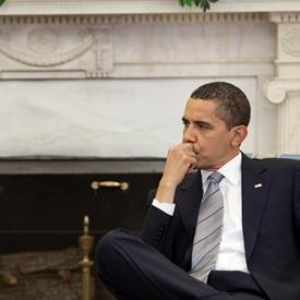
President Obama acting *concerned.*
As everyone who isn’t living on a desert island knows at this point, Libya is in chaos, with hundreds of people killed and probably thousands injured by their own government.
Actually, pretty much the whole Middle East is in chaos, but right now the situation in Libya is the worst. Tin pot dictator Muammar Gaddafi turned his security forces and hired goons against the Libyan people, and they did so–firing machine guns and shooting from helicopters, and dropping bombs from fighter planes. It’s a full fledged massacre, according to all reports.
Secretary of State Hillary Clinton released a statement a few hours ago:
The world is watching the situation in Libya with alarm. We join the international community in strongly condemning the violence in Libya. Our thoughts and prayers are with those whose lives have been lost, and with their loved ones. The government of Libya has a responsibility to respect the universal rights of the people, including the right to free expression and assembly. Now is the time to stop this unacceptable bloodshed. We are working urgently with friends and partners around the world to convey this message to the Libyan government.
It’s not a very strong statement, but I assume Hillary just said what the President asked her to say. Meanwhile, our fearless leader hasn’t said boo. I do hear he’s *concerned* though.
On Friday, Obama’s new press secretary, Jay Carney, said the President was “deeply concerned.”
“I am deeply concerned by reports of violence in Bahrain, Libya and Yemen. The United States condemns the use of violence by governments against peaceful protesters in those countries, and wherever else it may occur,” the president said in a statement read to reporters by White House press secretary Jay Carney.
“The United States urges the governments of Bahrain, Libya and Yemen to show restraint in responding to peaceful protests and to respect the rights of their people,” Obama said.
Yesterday, the Obama administration was “gravely concerned.”
In the administration’s strongest statement on the escalating violence in Libya, the State Department said that it was “gravely concerned” about the reports and that the number of deaths was unknown because of a lack of access to many parts of the country by news organizations and human rights groups.
Philip J. Crowley, the State Department spokesman, said that the United States has raised “strong objections about the use of lethal force” with several senior Libyan officials, including Musa Kusa, the foreign minister.
“Libyan officials have stated their commitment to protecting and safeguarding the right of peaceful protest,” Mr. Crowley said in a statement. “We call upon the Libyan government to uphold that commitment and hold accountable any security officer who does not act in accordance with that commitment.”
Okay, that’s nice, but they’re not doing it. Now what?
Obama also had UN Ambassador Susan Rice appear on “Meet the Press” to tell us that he’s “very concerned” about Libya.
The administration is “very concerned” about reports of Libyan forces gunning down civilians, the U.S. ambassador to the United Nations said Sunday.
Okay, we get that Obama concerned–very concerned, deeply concerned, even gravely concerned. When are we going to hear something directly from him? When is he going to call for a meeting of the UN Security Council to decide on some kind of action? Can’t UN forces be sent in to restore peace?
When are we going to get some leadership from this man? Does he ever get angry? Does anything outrage him? Does he ever get beyond being *concerned*?
Anger is an energy, Mr. President.

 peej
peej Carissa
 bostonboomer
 dakinikat
 ecocatwoman
 mablue2
 Mama Lopez
 peggysue22
 quixote
 skydancingguestblogger
 Mona (aka Wonk the Vote)



 Sky Dancing
Recent Comments