
White House Pushing Bogus Meme about Egyptian “Transition”
Posted: February 6, 2011 Filed under: Barack Obama, Egypt, Elections, Foreign Affairs, U.S. Politics | Tags: Ahmad Fathi Sorour, Egyptian constitution, Egyptian protests, Hosni Mubarak, Obama Administration, Omar Suleiman, rendition, rules of succession, Torture 74 Comments
Barack Obama and Hosni Mubarak in Egypt
Today multiple news sources are suddenly reporting practically word for word a new meme on the Egyptian “transition” that is obviously coming from the Obama administration. And the message has been coordinated with Egyptian Vice President Omar Suleiman. Mubarak is being gradually edged out, and the U.S. needs to make sure they stay in control of the situation. Obama must make sure to prevent real democracy from taking hold in Egypt.
So the new meme is that Mubarak will be kept around as a powerless figurehead, but first he needs to make some changes in the constitutional rules of succession so that Suleiman can legally be in charge of the “transition” government. Why Suleiman? Supposedly because the guy who is supposed to succeed Mubarak, Ahmad Fathi Sorour, is “much worse” than even Suleiman the torturer. Yet there is never any credible explanation for why Solour is so terrible that it’s better to have a torturer in control of the lead-up to US-controlled “free and fair” elections
From the Village organ: What Mubarak must do before he resigns.
If today Mubarak were no longer available to fulfill his role as president, the interim president would be one of two candidates. If he chooses to leave the country, say for “medical reasons,” the interim president would be Omar Suleiman, the former intelligence chief who was recently made vice president. Egyptians, particularly those of us calling for an end to Mubarak’s three-decade rule, see Suleiman as Mubarak II, especially after the lengthy interview he gave to state television Feb. 3 in which he accused the demonstrators in Tahrir Square of implementing foreign agendas. He did not even bother to veil his threats of retaliation against protesters.
On the other hand, if Mubarak is pushed to resign immediately we would have an even worse interim president: Fathi Surur, who has been speaker of the People’s Assembly since 1990.
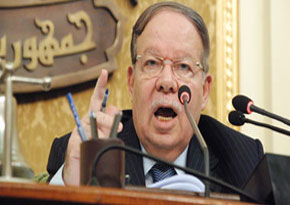
Ahmad Fathi Sorour
And he would be worse because?
Surur has long employed his legal expertise to maintain and add to the arsenal of abusive laws that Mubarak’s regime has used against the Egyptian people. Since neither Suleiman nor Surur would be able to amend the constitution during the interim tenure, the next presidential election would be conducted under the notoriously restrictive election rules Mubarak introduced in 2007. That would effectively guarantee that no credible candidate would be able to run against the interim president.
So before Mubarak resigns he must sign a presidential decree delegating all of his authorities to his vice president until their current terms end in September.
But Suleiman “has long employed his [military and intelligence] expertise” to cooperate with U.S. rendition and torture policies. Why is he better? Why should anyone believe that Suleiman will push for real democracy? Give me a break! The U.S. wants Suleiman in charge because he is their guy.
A Self-Examined Academic Life
Posted: February 6, 2011 Filed under: academia, Equity Markets, financial institutions, Global Financial Crisis | Tags: Fault Lines, Financial Crisis, Matt Yglesias, Raghu Rajan, Tyler Cowen 22 CommentsMacroeconomists seemingly have adopted monastic practices of self-flagellation to explain why the tribe completely misjudged the housing bubble . Their collective crystal balls didn’t predict an ensuing financial crisis either. A blog entry by Finance Professor Raghu Rajan at University of Chicago has further stimulated the conversation today. He’s written a book called Fault Lines and made remarks from the book at its official blog site. I found it at Memeorandum along with a few choice links.
I’ve written about fresh water and salt water economics before. Some of today’s discussion clearly involves philosophical fault lines. Rajan is from the panultimate fresh water university and all finance academics eventually drown in the Efficient Markets Hypothesis (EMH) literature. I’ve been pretty outspoken about how much damage I think the EMH has done to economics and especially my field, financial economics. However, it’s hard to get published in finance journals taking a contrarian view. This is one explanation he examines, then dismisses which is why I’ve taken a good look at his argument.
I have not read his book, but judging from the video and this blog entry, Rajan spends some time on the role of EMH and EMH true believers in the crisis. I can provide you with my own anecdotes on this. I can also tell you I tried to avoid some seminars because I don’t want to read any more Eugene Fama who is Rajan’s colleague. I frankly think EMH blinders or misunderstanding were a good deal–but not all–of the problem.
I was researching the subprime markets directly after Katrina and was told by my finance professors that I was following an unpublishable and boring line of research. (They used the term ‘unsexy’.) I saw hints of problems in subprime markets as early as late 2005 in the work I did with the sensitivity of stock prices of finance companies heavily invested in subprime loans to some key macroeconomic variables. I was told that line of research was unlikely to help my marketability and ability to get tenure upon graduation. They yawned when I presented the paper. I turned it in for my third econometrics seminar and switched to something else.
Finance journals editors do love them some EMH so anything on market anomalies is likely to get a jaundiced set of editor eyes. But, Rajan brings up some important points and the resulting discussion is worth viewing here. Here’s Rajan talking directly to the EMH and why he thinks it may not be a big deal.
Perhaps the reason was ideology: we were too wedded to the idea that markets are efficient, market participants are rational, and high prices are justified by economic fundamentals. But some of this criticism of “market fundamentalism” reflects a misunderstanding. The dominant “efficient markets theory” says only that markets reflect what is publicly known, and that it is hard to make money off markets consistently – something verified by the hit that most investor portfolios took in the crisis. The theory does not say that markets cannot plummet if the news is bad, or if investors become risk-averse.
Critics argue that the fundamentals were deteriorating in plain sight, and that the market (and economists) simply ignored it. But hindsight distorts analysis. We cannot point to a lonely Cassandra like Robert Shiller of Yale University, who regularly argued that house prices were unsustainable, as proof that the truth was ignored. There are always naysayers, and they are often wrong. There were many more economists who believed that house prices, though high, were unlikely to fall across the board.
Rajan points out that this probably isn’t the sole or primary explanation even though it is one that gets a lot of ink these days. I too think some of the problem is a misunderstanding of the various forms of EMH . So, the major philosophical debate happening in finance circles isn’t central to Rajan’s explanation. There is no conspiracy of EMH apologists to force misunderstanding of market rationality, so alright, I’ll give him that one.
Economist Tyler Cowen at Marginal Revolution likes the alternative succinct explanation Rajan provides. (You should read the comments to that thread.)
Raghu Rajan nails it:
I would argue that three factors largely explain our collective failure: specialization, the difficulty of forecasting, and the disengagement of much of the profession from the real world.
Rajan also dismisses another circle of conspirators by stating this. It’s also probably why one of those so-called progressives jumped on the dismissal earlier today. This conspiracy meme crosses circles of folks that are more into political economy than economics itself. This group argues the hypothesis that the “system” bribed economists to stay quiet. I’ve gotten into it more than a few people of the Matt Stoller mindset and various Rand hanger-ons about this improbable case. One of the biggest memes is that the FED actively influences economists not to publish things against their interests. (Usually, this comes from Austrian School folks who can’t get published any where mainstream because they want to completely operate outside of the scientific method and ignore data.) Matt Yglesias is one of these people making a living off this canard and he jumped to the bait immediately. His reasoning speaks more about him than about economists.
Suez Canal Pipeline Attacked
Posted: February 5, 2011 Filed under: Egypt, Foreign Affairs, Israel, Jordan, U.S. Economy, U.S. Politics | Tags: Egypt, israel, Jordan, sabatage, Suez Canal 29 CommentsUnknown attackers have blown up a pipeline that runs through El-Arish area of Egypt’s north Sinai area and supplies gas to Jordan and Israel, according to Egypt’s state television.
[….]
The explosive material was placed inside or adjacent to the control station of the gas supply line. There were no immediate reports of any casualties as a result of the blast.
“Saboteurs took advantage of the security situation and blew up the gas pipeline,” a state television correspondent reported, saying there was a big explosion.
State TV quoted an official as saying that the “situation is very dangerous and explosions were continuing from one spot to another” along the pipeline.
Forbes reports that Egypt has been forced to cut off gas supplies to Israel and Jordan.
There were conflicting reports out of Egypt as to the cause of the explosion, with the state-run Middle East News Agency saying the work was done by “subversive elements.” Oil Minister Samah Fahmy reportedly said it could take up to two weeks to repair the damage.
The pipeline is the third most strategically important piece of energy infrastructure in Egypt after the Suez Canal and the Sumed Pipeline. But it is the most important one to Israel, delivering 40% of Israeli natural gas supplies. The Israeli government said this afternoon that it did not expect any interruption of electricity supplies as the country has gas in storage and can also switch to other fuels like oil and diesel. Israel started receiving gas from the pipeline in 2008.
Assuming for a moment that this was not an accident, it represents a serious escalation of the crisis in Egypt.
Jitters about the impact of the unrest on the economy of both Egypt and the region were not eased yesterday when an explosion ripped through a gas terminal in Egypt’s northern Sinai Peninsula, setting off a massive fire that was contained by shutting off the flow of gas to neighbouring Jordan and Israel. Supplies are expected to be hit for at least a week. While Israel has other sources of power, and Jordan is believed to have substantial reserves, the sense that Egypt’s fragility can reach beyond its borders will add to the anxieties.
Traders are worried that the unrest might spread to oil-producing countries in the region and even affect shipments through the Suez Canal. Egypt is not a major oil producer, but it controls the canal and a nearby pipeline. Together these carry about two million barrels of oil a day from the Middle East to customers in Europe and the United States. Several large Egyptian refineries near the canal have been the site of recent protests.
We can use this as a live blog to discuss the situation in Egypt. I’ll continue to add updates if I learn any more about the cause of the pipeline blast.
The Latest “Culture of Life” Bill Would Allow Hospitals to Let Women Die
Posted: February 5, 2011 Filed under: U.S. Politics, Violence against women, Women's Rights | Tags: abortion, culture of misogyny, Rep. Joe Pitts, Sexism 5 CommentsTalking Points Memo has the details:
The bill, known currently as H.R. 358 or the “Protect Life Act,” would amend the 2010 health care reform law that would modify the way Obamacare deals with abortion coverage. Much of its language is modeled on the so-called Stupak Amendment, an anti-abortion provision pro-life Democrats attempted to insert into the reform law during the health care debate last year. But critics say a new language inserted into the bill just this week would go far beyond Stupak, allowing hospitals that receive federal funds but are opposed to abortions to turn away women in need of emergency pregnancy termination to save their lives.
Dead Presidents
Posted: February 5, 2011 Filed under: Surreality, the blogosphere, The Media SUCKS, the villagers, U.S. Politics, Voter Ignorance | Tags: Rewriting History, Ronald Reagan 19 Comments
Comic Book Reagan
It’s only fitting that some one who completely mangles American history, world geography, and the English language gets to deliver yet another eulogy on Reagan. We come not to bury Caesar, but to completely reinvent the guy into something we want him to be because we have no better narrative. Many liberal sites are rightly pointing out that we knew Ronald Reagan and he was not the Ronald Reagan we’re hearing about now. Here’s a good list of ‘10 Things Conservatives Don’t Want you to now about Ronald Reagan’. I’ll hit the top four because,well, I’m an economist and these four things resonate with me the most.
1. Reagan was a serial tax raiser. As governor of California, Reagan “signed into law the largest tax increase in the history of any state up till then.” Meanwhile, state spending nearly doubled. As president, Reagan “raised taxes in seven of his eight years in office,” including four times in just two years. As former GOP Senator Alan Simpson, who called Reagan “a dear friend,” told NPR, “Ronald Reagan raised taxes 11 times in his administration — I was there.” “Reagan was never afraid to raise taxes,” said historian Douglas Brinkley, who edited Reagan’s memoir. Reagan the anti-tax zealot is “false mythology,” Brinkley said.
2. Reagan nearly tripled the federal budget deficit. During the Reagan years, the debt increased to nearly $3 trillion, “roughly three times as much as the first 80 years of the century had done altogether.” Reagan enacted a major tax cut his first year in office and government revenue dropped off precipitously. Despite the conservative myth that tax cuts somehow increase revenue, the government went deeper into debt and Reagan had to raise taxes just a year after he enacted his tax cut. Despite ten more tax hikes on everything from gasoline to corporate income, Reagan was never able to get the deficit under control.
3. Unemployment soared after Reagan’s 1981 tax cuts. Unemployment jumped to 10.8 percent after Reagan enacted his much-touted tax cut, and it took years for the rate to get back down to its previous level. Meanwhile, income inequality exploded. Despite the myth that Reagan presided over an era of unmatched economic boom for all Americans, Reagan disproportionately taxed the poor and middle class, but the economic growth of the 1980′s did little help them. “Since 1980, median household income has risen only 30 percent, adjusted for inflation, while average incomes at the top have tripled or quadrupled,” the New York Times’ David Leonhardt noted.
4. Reagan grew the size of the federal government tremendously. Reagan promised “to move boldly, decisively, and quickly to control the runaway growth of federal spending,” but federal spending “ballooned” under Reagan. He bailed out Social Security in 1983 after attempting to privatize it, and set up a progressive taxation system to keep it funded into the future. He promised to cut government agencies like the Department of Energy and Education but ended up adding one of the largest — the Department of Veterans’ Affairs, which today has a budget of nearly $90 billion and close to 300,000 employees. He also hiked defense spending by over $100 billion a year to a level not seen since the height of the Vietnam war.
So, in the real world, Ronald Reagan was the archetype for the Republican much hated “tax and spend Keynesian” if there ever was one. Reagan’s former Budget Director David Stockman has said as much. His former economic adviser Bruce Bartlett has changed his tiger stripes too. Now, compare that to this tripe in a speech completely missing the facts and the history. Oh, and it’s kind’ve stolen from the Gipper yet heavily revised to meet today’s modern propaganda needs.
“He saw our nation at a critical turning point. We could choose one direction or the other. Socialism or freedom and free markets. Collectivism or individualism. In his words, we can choose ‘the swamp’ or ‘the stars.'”
Take a quick look at the source of the cribbed statement and notice the difference. It seems that not one of our political spokesmodels can originate thoughts these days. We have a rip-it-off-then-mangle-it pol culture these days.
“We are at war with the most dangerous enemy that has ever faced mankind in his long climb from the swamp to the stars, and it has been said if we lose that war, and in so doing lose this way of freedom of ours, history will record with the greatest astonishment that those who had the most to lose did the least to prevent its happening,” Reagan said.
The most dangerous enemy we have ever faced is ignorance. The face of ignorance is the modern day Know Nothing Wing of the Republican Party. The old Known Nothing party was rooted in nativism and anti-Catholicism. This one is rooted in similar phobias and bigotry. Ralph Waldo Emerson once wrote: “All history becomes subjective; in other words there is properly no history, only biography”.

 peej
peej Carissa
 bostonboomer
 dakinikat
 ecocatwoman
 mablue2
 Mama Lopez
 peggysue22
 quixote
 skydancingguestblogger
 Mona (aka Wonk the Vote)



 Sky Dancing
Recent Comments