
Stealing Home
Posted: June 13, 2009 Filed under: Diplomacy Nightmares, Human Rights | Tags: Aung San Suu Kyi, Benazir Bhutto, Iranian Elections, Mir Hossein Mousavi, Mynamar, Pakistan, Zhara Rahnavard Comments Off on Stealing Home Any one of a certain age that attended university pre-Iranian revolution had many, many Iranian friends. I certainly did. After the revolution, many disappeared for reasons I never new. Since the hostage taking at the end of the Carter years, we now only hear disappointing things about life for the people of that country and it makes me sad. They may not have wanted to be party to the excesses of the peacock throne, but they did not deserve the poverty and intolerance that followed the overthrow. Today’s election steals more of their home.
Opposition leader Mir Houssain Musavi speaks in an open letter to the people of Iran(H/T to BB),
In the Name of God
Honorable people of Iran
The reported results of the 10th Iranians residential Election are appalling. The people who witnessed the mixture of votes in long lineups know who they have voted for and observe the wizardry of I.R.I.B (State run TV and Radio) and election officials. Now more than ever before they want to know how and by which officials this game plan has been designed. I object fully to the current procedures and obvious and abundant deviations from law on the day of election and alert people to not surrender to this dangerous plot. Dishonesty and corruption of officials as we have seen will only result in weakening the pillars of the Islamic Republic of Iran and empowers lies and dictatorships.
I am obliged, due to my religious and national duties, to expose this dangerous plot and to explain its devastating effects on the future of Iran. I am concerned that the continuation of the current situation will transform all key members of this regime into fabulists in confrontation with the nation and seriously jeopardize them in this world and the next.
I advise all officials to halt this agenda at once before it is too late, return to the rule of law and protect the nation’s vote and know that deviation from law renders them illegitimate. They are aware better than anyone else that this country has been through a grand Islamic revolution and the least message of this revolution is that our nation is alert and will oppose anyone who aims to seize the power against the law.
I use this chance to honor the emotions of the nation of Iran and remind them that Iran, this sacred being, belongs to them and not to the fraudulent. It is you who should stay alert. The traitors to the nation’s vote have no fear if this house of Persians burns in flames. We will continue with our green wave of rationality that is inspired by our religious leanings and our love for prophet Mohammad and will confront the rampage of lies that has appeared and marked the image of our nation. However we will not allow our movement to become blind one.
I thank every citizen who took part in spreading this green message by becoming a campaigner and all official and self organized campaigns, I insist that their presence is essential until we achieve results deserving of our country.
[ verse from in Quran: Why not trust in God, who has shown us our ways. We are patient in face of what disturbs us. Our resilience is in God. ]
Mir Hossein Mousavi
Shorting Bermuda
Posted: June 13, 2009 Filed under: Diplomacy Nightmares, Team Obama | Tags: Bermuda, Guantanamo deal, Uighers 1 Comment I admit to being an over-the-top anglophile, so I’ll just announce that bias right now. From the moment I read my first Shakespeare play and met my grandfather’s British cousins, I swooned. I have two majors as an undergrad, one of them is history, and it was English History. I started hooking into rock and roll as a tot right at the time of the Beatles and the British invasion. My first big film crush was James Bond and Scotsman Sean Connery. I think I’ve mentioned here before, that as a kid, I wanted to be Emma Peel. My dad still tells me of his time in the US Army Air Force when he was located in Ipswich and he and his flight crew would hit London for a much needed break from bombing Germany and I still get goosebumps to this day.
Yanks and Brits have this special relationship that has been forged in blood, family feuds, language and law. We are kidding ourselves if we don’t think that a major portion of every thing we’ve ever done is a direct product of the English enlightenment and the Magna Carta. We are their hippy offspring and while we don’t have to agree with everything that say and do, we at least should show some respect. (Respect, to me, does not include leaving someone out of the loop to protect them. That is the very definition of arrogant patronization to me.)
In less than 4 months, we have not only snubbed the UK four times in some fashion, we have now left them completely out of a negotiation that directly impacts them can only be characterized as steps in a remake of our special relation. This is especially true in light of the recent protocol gaffes. I was really appalled by the shabby treatment by POTUS and the administration shown to PM Gordan Brown and his family on their visit to the White House. The gifts were tacky and the lack of a formal news conference was embarrassing. It got passed off as a young, inexperienced administration blunder and I tried to give every one the benefit of the doubt. Upon, a visit by POTUS to London for the G-20, we had a second round of tacky gifts and some complete disregard for protocol surrounding royalty. (At least the British royalty, the Saudi royalty got more than any one anticipated).Then, we had the misunderstanding surrounding the disenfranchisement of Her Royal Highness, the only surviving head of state to have been an active member of an Allied Service during World War 2 that was said to be a combined misunderstanding between Brown (who is a bit of a bumbler), Sarkozy (French, nothing else to add there), and Obama (wtf? Isn’t he briefed on these things?).
Now, the BBC reports that the US ‘kept Guantanamo deal from UK’. We have now gone from a series of protocol and diplomatic blunders and missteps to something that, I’m sure, will be seen by many in Parliament as a re-working of the Anglo-American Alliance.
A senior US official has told the BBC Washington decided not to tell London ahead of time about a deal to resettle four Guantanamo detainees in Bermuda.
A diplomatic row blew up over Bermuda’s decision to accept the four Chinese Muslim Uighurs on a US request.
Bermuda is a British overseas territory but the US official said Washington had acted secretly to ensure success.
Meanwhile the US said on Friday three Saudis at Guantanamo Bay had been transferred back to Saudi Arabia.
The transfers are part of US President Barack Obama’s strategy to close down the Guantanamo detention centre before next January.
Hostility
The unnamed senior official also told the BBC that Washington was attempting to shield the UK from Chinese anger.
Beijing has demanded the return to China of all 17 Uighurs held by US forces but Washington says they could face persecution in China.
Hiding things that could potentially create a rift between huge, powerful countries is just about as arrogant of a policy of anything I’ve heard coming down the pipe. Exactly what is every the UK, China, and the Bermuda parliament supposed to do now? I’m not saying placing the Uighurs in a less prison-like atmosphere and protecting them from prosecution in China isn’t a laudable idea. I’m saying doing a run around diplomacy is a chicken shit move I would expect from a Cheney administration. I thought per campaign pledges we were supposed to diplomacy differently now?
At WHAT point does HE own it?
Posted: June 12, 2009 Filed under: Bailout Blues, Diplomacy Nightmares, Global Financial Crisis, Hillary Clinton: Her Campaign for All of Us, president teleprompter jesus, Surreality, Team Obama, Voter Ignorance | Tags: broken campaign promises 3 CommentsThe Political Memo in today’s NYT minces few words in Blaming the Guy Who Came Before Doesn’t Work Long and I’d like to just tag right along with that. Its thesis is clear. The Obama administration wastes no opportunity to turn the phrase “we inherited a lot of problems”.
As President Obama struggles to turn around the moribund economy and confront multiple international issues, he wastes few opportunities to remind the country that the problems are not of his making.
“The financial crisis this administration inherited is still creating painful challenges for businesses and families alike,” Mr. Obama said this week as he proposed spending limits.
“We inherited a financial crisis unlike any that we’ve seen in our time,” he said last week as he thrust General Motors into bankruptcy.
His advisers and allies follow the same script. “The Obama administration inherited a situation at Guantánamo that was intolerable,” James L. Jones, the national security adviser, said of the military prison in Cuba. Secretary of State Hillary Rodham Clinton defended the Obama foreign policy in the same vein. “We inherited a lot of problems,” she said.
Mr. Obama is hardly the first president to point to his predecessor. Ronald Reagan blamed Jimmy Carter for the poor economy he inherited, just as Bill Clinton blamed the first President Bush and the younger Mr. Bush then blamed Mr. Clinton. Former Bush aides like Karl Rove argue that Mr. Obama has done it more extensively and routinely than other presidents have, although the Obama team denies that.
But at a certain point, a new president assumes ownership of the problems and finds himself answering for his own actions. For Mr. Obama, even some advisers say that moment may be coming soon.
I’d really like to extend the question of when does he own it a bit further to what good does saying you inherited all these problems do when your solution is basically a continuation of those same failed policies?
In the two major areas of concern during the election and primary–the Iraq War and the Financial Crisis–we not only seen continuation of the same dysfunctional policies, but we’ve seeing appointment of the same dysfunctional policy makers in both cases. Timothy Geithner (with Obama’s consent and support) has basically been following the same policies of his predecessor Secretary of Wall Street Bailouts Hank Paulson. I know this because oc-08I’ve been following the economic policies quite closely because of obvious reasons. I have had to rely on others for examples in other policy areas. To say there is a plethora is understatement. I am getting tired of flushing spam from seriously delusional Obama voters into byte heaven that mostly reads: “Hillary would have done the same thing” and “he’s just doing what he has to at the moment, just wait it will change, you’ll see.”
Cannonfire has run a series of threads demonstrating how closely aligned President Obama’s policies have been to his predecessor. I’ve spent a few days following the links from The Worm turns and turns. One link is to Paul Craig Roberts at Global Research and the title absolutely says everything. It’s called Watching Obama Morph Into Dick Cheney. This one especially appeals to me because of a post I took a lot of grief for back in the day that used a side-by-side Broke Back Mountain view of the boyz will be boyz.
Should Markets Respect Societal Bounds?
Posted: June 11, 2009 Filed under: Economic Develpment, Hillary Clinton: Her Campaign for All of Us, Human Rights, U.S. Economy | Tags: Dr. Michael Sandel, Economic Development, economics of public good, Elimination of poverty, Grameen Bank, Karela India, microfinance, Microlending, Muhammad Yunus, Reich Lectures 2 CommentsAs you know, I frequently rely on the British press for news and political analysis. I was delighted to find a link on Dr. Mark Thoma’s Economist’s View to the BBC’s broadcasts of the Riech Lectures for 2009. Dr. Michael Sandel, Harvard Professor of Government, delivers four lectures on the prospects of a new politics of the common good in this series. Dr Sandel argues that we need “a politics oriented less to the pursuit of individual self-interest and more to the pursuit of the common good”. I was most intrigued by the series on financial community norms (as pointed to by Dr. Thoma) and the idea that even in markets, “norms matter”.
The series is presented and chaired by Sue Lawley.
Sandel considers the expansion of markets and how we determine their moral limits. Should immigrants, for example, pay for citizenship? Should we pay schoolchildren for good test results, or even to read a book? He calls for a more robust public debate about such questions, as part of a ‘new citizenship’.
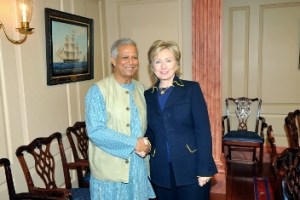
US Secretary of State Hillary Clinton receives Nobel laureate Prof Muhammad Yunus at her US State Department office in Washington DC Wednesday.
I have worked with and studied under one of the foremost authorities on Islamic Banking which are finiancial institutions developed with the idea of a “common good” so I know that in some areas of the world, this is possible. Again, in Dr. Hussan’s Bangledesh and other countries respecting Islamic law, banks do not charge interest because the Q’uran forbids usury. This is also true of the banking system used by Orthodox Jews. This is viewed as a financial system that works for the common good in lieu of exploitation of one side of the market. The banks are frequently mutually owned. Again, one of the best development vehicles in poorer countries is the microfinance banking community that developed with the inspiration from Bangledeshi Economist, Muhammad Yunus, who won the Noble Peace prize for his role in developing the idea of microcredit and the Grameen Bank. (This means of course, I have to make a shameless plug for Kiva my favorite place to invest in humanity’s future where I place money as dakinikat@aol.com). I know from this work that it is possible to create market driven systems where something other than over-the-top profits can motivate a market.
So, I’m going to return to Dr. Sandel’s exposition on what it means to have markets which value a poltics of common good. I’ve bolded the areas that I highlighted while reading the speech. (Yes, I know, old university habits die hard.)
A new politics of the common good isn’t only about finding more scrupulous politicians. It also requires a more demanding idea of what it means to be a citizen, and it requires a more robust public discourse – one that engages more directly with moral and even spiritual questions. And so in the course of these lectures, I’ll explore the prospect of a new citizenship and I’ll be asking what a more morally engaged public life might be like.
If we’re to reinvigorate public discourse, if we’re to focus on big questions that matter, questions of moral significance, one of the first subjects we need to address is the role of markets, and in particular the moral limits of markets. Which brings me to the topic of this first lecture. We’re living with the economic fallout of the financial crisis and we’re struggling to make sense of it. One way of understanding what’s happened is to see that we’re at the end of an era, an era of market triumphalism. The last three decades were a heady, reckless time of market mania and deregulation. We had the free market fundamentalism of the Reagan-Thatcher years and then we had the market friendly Neo-Liberalism of the Clinton and Blair years, which moderated but also consolidated the faith that markets are the primary mechanism for achieving the public good. Today that faith is in doubt. Market triumphalism has given way to a new market scepticism. Almost everybody agrees that we need to improve regulation, but this moment is about more than devising new regulations. It’s also a time, or so it seems to me, to rethink the role of markets in achieving the public good. There’s now a widespread sense that markets have become detached from fundamental values, that we need to reconnect markets and values. But how? Well it depends on what you think has gone wrong. Some say the problem is greed, which led to irresponsible risk taking. If this is right, the challenge is to rein in greed, to shore up values of responsibility and trust, integrity and fair dealing; to appeal, in short, to personal virtues as a remedy to market values run amuck.
It’s all Lemonade when it comes to Executive Pay
Posted: June 10, 2009 Filed under: Bailout Blues, Equity Markets, Global Financial Crisis, Team Obama, U.S. Economy | Tags: asymmetric information, CEO bonuses, CEO pay, executive compensation, lemons problem, moral hazard Comments Off on It’s all Lemonade when it comes to Executive PayI’ve had to read executive pay studies for some time since Corporate Finance is one of my fields. This is one of those areas where every time they think they come up with a good explanation and plan, we see a complete failure in the real world. This is because it fits under theories of probability where human behavior is poorly quantified. Executive compensation falls under the Moral Hazard area and of course the Lemon’s problem. Believe me, I’ve worked as a corporate consultant and a corporate flunky long enough to know the high level of lemons in the CEO market. It’s one of my main motivators for going back to the halls of academia. I can only slap my forehead so many times before I get a permanent indentation.
One of the first studies on asymmetric information (the lemons problem) is from George Ackerloff (1970). His example comes from the market for with used cars. It centers around determining the reason the seller want to sell of the car. One reason is that it might be a lemon. This is considered a situation with asymmetric information. This means the buyer and the seller have different information. The seller knows if the car is a cream puff or a lemon, but the buyer has no idea. He only knows the probabilities or the the odds that the car is a lemon. So, if he’s rational (and remember the assumption is that he is rational), the buyer will demand a deep discount.
So here’s the news today for investors, board of directors, CEOS, and taxpayers who bail out too big too fail and badly managed companies. Bloomberg reports that the Obama administration is seeking SEC power over executive pay.
The Obama administration will seek new powers for the Securities and Exchange Commission to force firms to let shareholders vote on executive pay and make directors who set compensation more independent, an administration official said.
Today’s proposal, subject to congressional approval, would cover all public companies. President Barack Obama has long supported giving shareholders nonbinding votes on bonuses, salaries and severance packages. The administration also will name a “special master” to monitor compensation plans for firms receiving exceptional assistance in the financial rescue.
The changes are aimed at reducing systemic risks and quelling a political uproar over bonuses paid to executives whose companies were bailed out by the government. Treasury Secretary Timothy Geithner has repeatedly blamed pay standards tied to short-term profits for contributing to the worst financial crisis since the 1930s.
“It clearly is going to force companies to be more transparent with their disclosure” on compensation, said Irv Becker, national practice leader for Philadelphia-based Hay Group’s executive compensation practice. If the measure is implemented, it likely will take several years before shareholders begin to confront management, he predicted.
“It’ll kind of be novel the first year, maybe the first two, and then likely be a little bit more serious in future years,” said Becker, a former head of compensation and benefits at Goldman Sachs Group Inc.

 peej
peej Carissa
 bostonboomer
 dakinikat
 ecocatwoman
 mablue2
 Mama Lopez
 peggysue22
 quixote
 skydancingguestblogger
 Mona (aka Wonk the Vote)



 Sky Dancing
Recent Comments