
Blessed are the Poor or maybe not …
Posted: October 9, 2013 Filed under: poverty, social justice | Tags: war on the poor 14 CommentsSo, ya’ll know I’m not a deist or a christian. But, I do know a lot about the theology having studied it and basically grown up a Presbyterian by default. I say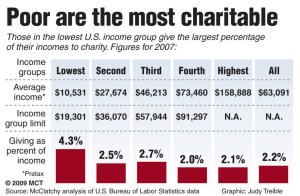 default because I was baptized Presbyterian mostly because my mother’s golf partner at the country club was the Presbyterian minister’s wife. The next time we moved, I was the only one in the family that stuck with the church thing mostly because the best music program in the city was in the Presbyterian church because the minister’s wife was a serious piano teacher. The minister was great. He drove around in an orange fiat convertible with a tweed jacket, a golf tam, and leather gloves. When he wasn’t writing his sermon about what to do the next time you were sitting in the locker room at the country club, he was at the country club golfing. I have to admit to being kind’ve of an outlier in my family since I’m not a millionaire. I’ve seen what kind of trivial concerns the rich tend to have and I really don’t want to be a part of it. I’d much rather appreciate my daily bread instead of a pair of manolo blahniks.
I just don’t care that much about money. I have very simple needs plus I’m a Buddhist and that’s sort’ve a lifestyle thing with us. I say all this because I have been on both sides of the income spectrum and I actually chose downward mobility. However, I didn’t want to choose poverty. That’s a more difficult thing to avoid these days; especially if you’re an aging woman in a red state where the governor hates all teachers and professors.
I guess I was the only rich republican kid that read the four woes listed in Luke 6:24–26 that start with “Woe to you…” when I was a good little Presbyterian in sunday school.
…who are rich, for you have already received your comfort.
…who are well fed now, for you will go hungry.
…who laugh now, for you will mourn and weep.
…when everyone speaks well of you, for that is how their ancestors treated the false prophets.
So, given Republican officials are cross-waving christians and just sort’ve wear the entire thing on their sleeves self righteously, why is there a war on poor people? I also read the four beatitudes in that same sermon on the plain in Luke’s gospel that starts out “Blessed are you…”
…who are poor, for yours is the kingdom of God.
…who hunger now, for you will be satisfied.
…you who weep now, for you will laugh.
I frequently wonder if their new testaments don’t have those particulars. I do have to say that most of my jaunty minister’s sermons had to do with it being easy to forget about reality when you’re sitting in a country club. (I think he may have been reminding himself. You should’ve seen the manse.) Maybe that is the thrust of the problem that we’re witnessing a bunch of self-professed christians declare war on the poor.
American conservatives for the past several decades have shown a remarkable hostility to poor people in our country. The recent effort to slash the SNAP food stamp program in the House (link); the astounding refusal of 26 Republican governors to expand Medicaid coverage in their states — depriving millions of poor people from access to Medicaid health coverage (link); and the general legislative indifference to a rising poverty rate in the United States — all this suggests something beyond ideology or neglect.
I also missed the part where Jesus wanted fetuses to come unto him but poor children and their mothers could just go to bed hungry.
 I left Nebraska nearly 20 years ago to discover a little something different in life down here in New Orleans. About 10 years ago, I bought a very modest house in the ninth ward of New Orleans. My neighborhood is undergoing incredible gentrification and I have to admit that I could not afford my house any more. Neither could any of the neighbors that were here when I moved here. I actually think this is part of a bigger plan to stop the poor and the black from returning to New Orleans but that is another post for another day.
There is a deliberate strategy of punishing the poor put into place by many southern, Republican governors that profess to be pious Christians. This includes my hyper-charismatic Catholic converted Bobby Jindal and both of the freaky Republican governors of the surrounding state. Their position on providing a medicaid expansion to the state to heal the poor is basically let them die in the poorly run privatized hospitals that Jindal sold to his donors at a really cheap price. I guess you have to be a leper to get health care according to biblical fundamentalists.
While Republicans in Congress weren’t able to defund Obamacare, many Republicans at the state level have found a different way to block low-income Americans from receiving cheaper health insurance. An estimated eight million Americans will remain poor and uninsured even after Obamacare is rolled out, due to the decision of many Republican governors and state legislators to reject the Affordable Care Act’s expansion of Medicaid.
When the Supreme Court upheld Obamacare last year, it also issued a less-noticed ruling that states could opt-out of the law’s Medicaid expansion, which broadened eligibility requirements for the program and provided federal funds to help pay for it. As this essentially amounted to free money until 2016 — at which point the federal government would pay for “only” 90 percent of the expansion — you’d think it’d be a no-brainer to accept it, right?
Well, not if you’re Rick Perry! Or Scott Walker, or Nikki Haley, or Bobby Jindal, or a ton of other red-state governors who decided to forego helping their poorest residents get health insurance because, well, that could alienate the GOP base voters next time they face a primary.
In total, 26 states have rejected the expansion, including the state of Mississippi, which has the highest rate of uninsured poor people in the country. Sixty-eight percent of uninsured single mothers live in the states that rejected the expansion, as do 60 percent of the nation’s uninsured working poor.
In general, states that rejected the expansion also have stricter eligibility requirements for Medicaid. While the 24 states that agreed to expand the program have a median income limit of $12,200 for Medicaid applicants, the limit is $5,600 —less than half the federal poverty level — in the states that rejected it.
One piece of the puzzle seems to come down to ideology and a passionate and unquestioning faith in “the market”. If you are poor in a market system, this ideology implies you’ve done something wrong; you aren’t productive; you don’t deserve a better quality of life. You are probably a drug addict, a welfare queen, a slacker. (Remember “slackers” from the 2012 Presidential campaign?)
Another element here seems to have something to do with social distance. Segments of society with whom one has not contact may be easier to treat impersonally and cruelly. How many conservative legislators or governors have actually spent time with poor people, with the working poor, and with poor children? But without exposure to one’s fellow citizens in many different life circumstances, it is hard to acquire the inner qualities of compassion and caring that make one sensitive to the facts about poverty.
A crucial thread here seems to be a familiar American narrative around race. The language of welfare reform, abuse of food stamps, and the inner city is interwoven with racial assumptions and stereotypes. Joan Walsh’s recent column in Salon (link) does a good job of connecting the dots between conservative rhetoric in the past thirty years and racism. She quotes a particularly prophetic passage from Lee Atwater in 1982 that basically lays out the transition from overtly racist language to coded language couched in terms of “big government”.
Finally, it seems unavoidable that some of this hostility derives from a fairly straightforward conflict of group interests. In order to create programs and economic opportunities that would significantly reduce poverty, it takes government spending — on income and food support, on education, on housing allowances, and on public amenities for low-income people. Government spending requires taxation; and taxation reduces the income and wealth of households at the top of the ladder. So there is a fairly obvious connection between an anti-poverty legislative agenda and the material interests of the privileged in our economy.
Many in the U.S. have fallen below the poverty line since the last recession because of loss of jobs combined with the increasing amount of income inequality in this country. It is really through no fault of their own. So, why do these memes and canards about the poor persist?
The bottom 1 percent in the U.S. live on an income that is one six-hundredth of the average for the richest 1 percent of Americans. They live on less than the average GDP per capita of a low-income country such as Afghanistan, Mozambique, or Haiti. And they live at or below the national poverty lines of such countries as Ghana, Congo, and Mongolia. Despite living in one of the richest countries in the world, the bottom 1 percent of Americans see incomes below the global median. The more successful disabled beggars of Addis Ababa in Ethiopia earn more than $2 on a good day, according to the International Labor Organization.
It is true that from an objective standpoint, living on $2 in a richer country is associated with better outcomes than living on $2 in a poor country—you are more likely to live in a house with basic utilities, and your children are less likely to die. In those terms, extremely poor Americans have it better than similarly poor Ghanaians—especially because the poorest in America will spend more than $2 a day even if their incomes are considerably below that. On the other hand, Ghanaians living on $2 a day are around average in their society; they don’t face the social stigma and exclusion of being so far removed from “normal” living standards.
Despite the physical and social costs of poverty, we have done a terrible job at raising the incomes of the poorest Americans over the past 20 years. The proportion of America’s households that live on less than $15,000 a year is as high as it was in 1989, while the proportion on more than $200,000 has gone up by two-thirds. That may be one reason for the country’s sluggish growth over that time—there isevidence that greater income equality is associated with stronger income growth for all.
There’s a solution to America’s extreme poverty problem. The example of countries where considerable proportions of the population live on less than $2 a day, as well as historical experience in the U.S., show that the most powerful tool to make poor people’s lives better is simply to give them cash. Brazil’s program of cash transfers, called Bolsa Familia, reduced inequality and increased both school enrolment and the number of poor people who were working. Perhaps we should try something similar in the U.S., providing an income floor for all Americans.
I’m going to give you a flashback from the past–1968– in an old conversation between William F. Buckley and Noble Prize winning economist Milton Friedman who was a big free market advocate back in the day. This is his suggestion of negative income tax.
I’m not showing you this to say it’s the way to go, I show you to ask a few questions: Would this conversation even be possible today? Have you seen any conversations recently on policies from the party of jaysuz and guns that provides any suggestions on how to actually help the poor?
America faces an opportunity gap. Those born in the bottom ranks have difficulty moving up. Although the United States has long thought of itself as a meritocracy, a place where anyone who gets an education and works hard can make it, the facts tell a somewhat different story. Children born into the top fifth of the income distribution have about twice as much of a chance of becoming middle class or better in their adult years as those born into the bottom fifth (Isaacs, Sawhill, & Haskins, 2008). One way that lower-income children can beat the odds is by getting a college degree.[1]Those who complete four-year degrees have a much better chance of becoming middle class than those who don’t — although still not as good of a chance as their more affluent peers. But the even bigger problem is that few actually manage to get the degree. Moreover, the link between parental income and college-going has increased in recent decades (Bailey & Dynarski, 2011). In short, higher education is not the kind of mobility-enhancing vehicle that it could be.
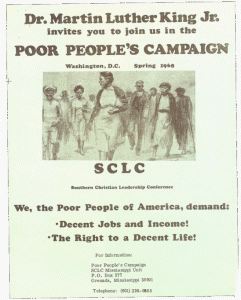
It seems that more of us are facing more uphill battles. It makes me wonder why the social activism and political activism of a Martin Luther King or a Cesar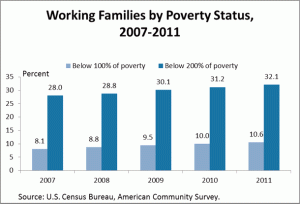 Chavez who fought for rights of the poor has declined?
Two factors seem to be relevant in explaining the political powerlessness of the poor. One is the gerrymandering that has reached an exact science in many state legislatures in recent years, with unassailable majorities for the incumbent party. This means that poor people have little chance of defeating conservative candidates in congressional elections. And second are the resurgent efforts that the Supreme Court enabled last summer to create ever-more onerous voting requirements, once again giving every appearance of serving the purpose of limiting voter participation by poor and minority groups. So conservative incumbents feel largely immune from the political interests that they dis-serve.
It would seem that more and more of us have interests aligned with poor folks. That is why the Republican party has also upped it’s race-baiting, women-baiting, GLBT-baiting, and immigrant-baiting. It is continuing to splinter the vast economic interests of the many into many morality plays. Even the Catholic church–a long time advocate of the poor and disenfranchised–has spent more effort on stomping on the secular rights of women and GLBTs than its usual role of ministering the poor. So, many social institutions have simply fallen prey to the same kind of divide and set-one-on-the other attitudes stoked by the money and the greed of folks like the Kochs.
I have no idea how these distortions have take center stage in our country to the point where our war on poverty has turned to a war on the poor. I can only think that those of us that fall into the category of having a shrinking pie are like dogs fighting over scraps thrown under the table by our 1 percent masters. It’s time for us to regain our perspective, if not our moral base.
Friday Reads
Posted: December 28, 2012 Filed under: morning reads | Tags: Death of Capitalism, fiscal bunny slope, Gun Deaths in the US, Hillary Clinton, Markey, Norman Schwarzkopf, The Global Minotaur, Vanis Varoufakis, war on the poor 32 Comments Good Morning!!!
It’s Friday and there’s lots of end-of-year things on my mind. I have a to do list and the will but this aging body just wants to curl up, read and stay snug someplace warm. I’m lucky that I have a home and I’m working to refi it down about $250 a month which will really help my budget. You have to find every little thing you can these days because nearly every one in government is telling us that since they spent so much money or war and bailing out Wall Street, the poor are going to be the first to be shoved off the Fiscal Cliff. These days, the ranks of the poor includes me because I really don’t want to risk everything to move some place for a job that may or may not be there given the way most state governments are headed these days so I’m living on an adjunct’s salary.
As the deadline for reaching a deal to avoid the fiscal cliff creeps closer, the pressure could build for the White House to eye programs for potential cuts that it has firmly and repeatedly taken off the table.
The two proposals put forth by both sides outline deficit reduction efforts in broad budget categories and are not entirely clear about whether cuts will hurt poor people or not. A small army of the nation’s leading business leaders have screamed loudly that a plunge over the fiscal cliff would be a disaster for business, wreck the nation’s credit rating and shove the United States back into deep recession. That must be avoided at all cost, they warn.
Obama’s consistent answer is that a deal can be cut by approving the tax hikes and revenue raising measures he’s proposed, as well as the major check that he wants to put on endless runaway military spending. This would bring the deficit under $1 trillion and would spare cutting programs that would devastate the poor and working class.
The political and social and economic consequences of the fiscal cliff debate on the poor are enormous. Surveys show that the ranks of the poor are still huge and that the wealth and income gap between the rich and poor is wider than in recent years.
Here’s a sincere New Year’s wish that Obama and the Democrats realize they have no reason to cave. My hope is history does not repeat itself.
I wanted to share this youtube with you of Vanis Varoufakis who is an economist from Greece teaching at the University of Athens. He’s my new hero. He argues very succinctly that there is not a debt crisis in the world today and he tells us why with some great metaphors including the name of his book “The Global Minotaur”. This is a version that you may listen to but CSPAN has the video of the speech itself on its website here.
Dr.Varoufakis has a wordpress blog. He has reprinted an interview with Spanish media about his theory here. He argues that capitalism died in 2008 and that the bail out of Wall Street was the pivotal event. The Global Minotaur is Wall Street. He also believes that this age of bailing out banks and forcing austerity on people ushers in the death of social democracy in Europe. He makes some very compelling arguments.
The Global Minotaur thought that the market can survive alone, without rules. Now we realise that isn’t so. But, is it necessary to begin with a planned economy? Is it the ‘planned economy’ the solution?
One of the great fallacies of our era is that an economy can exist without a state; without a degree of planning. Take the US. It is, supposedly, the least statist, the free-est market economy on the planet. And yet it is very much a planned economy. Without the military-industrial complex on the one hand and the whole gamut of federal planning authorities and institutions on the other hand, America’s economy would collapse tomorrow. More broadly, capitalism had its golden age after the war because Washington planned meticulously the world capitalist economy. So, the question is not whether there should be planning. The question is what kind of plan is implemented, who by, for whose benefit and with what effect. Currently, the banking sector is fully planned and relies entirely on social transfers and central bank operations. Planning is, therefore, used to prop up banks and to keep bankers in profit. What we need is some proper planning of labour markets so that workers’ labour is re-valued and power shifts from what I call today’s Bankruptocracy to society at large.
You worked with the president Papandreou before the ‘crash’. Did nobody see that the crisis coming? Did nobody make a comment about it?
No, they did not see and, moreover, they did not want to hear of it. Social democrats all over Europe, indeed the world, had come to the catastrophic conclusion that capitalism had been tamed, that crises were a thing of the past, and that society’s interests were best served if the financial sector’s wizardry was never questioned. This is, if you want, the main reason why this Crisis has killed of European social democracy.
Like many economists–including me Krugman, Stiglitz, etc.–he believes that today’s government’s failed to learn the lessons of the 20s and 30s and we are now living in a period of Herbert Hoover’s revenge. Take the time to listen or watch his speech. It’s not very wonky because he uses many metaphors and stories to make his point but make his point he does.
Ezra Klein uses his space at WonkBlog to examine gun deaths in the US. He has gleaned 12 facts about guns and mass shootings that will curl your teeth. They are all backed by actual, peer-reviewed studies and not myth. Some of them will not surprise you. Others will. This was one of the more surprising points for me.
Gun ownership in the United States is declining overall.
“For all the attention given to America’s culture of guns, ownership of firearms is at or near all-time lows,” writes political scientist Patrick Egan. The decline is most evident on the General Social Survey, though it also shows up on polling from Gallup, as you can see on this graph:
The bottom line, Egan writes, is that “long-term trends suggest that we are in fact currently experiencing a waning culture of guns and violence in the United States. “

Secretary of State Hillary Clinton will be returning to work next week.
Clinton’s ongoing recovery will still prevent her from flying abroad, but will allow plans to move forward for her to testify in open hearing on the Sept. 11 attack on Benghazi, testimony that she was unable to give — as per her doctor’s orders — on Dec. 20. Her return to a public schedule could also end the weeks of conspiracy theorizing and wild speculation about whether or not she was faking or misrepresenting her illness to avoid testifying.
“The secretary continues to recuperate at home. She had long planned to take this holiday week off, so she had no work schedule. She looks forward to getting back to the office next week and resuming her schedule,” Clinton aide Philippe Reines told The Cable.
Reines declined to say whether Clinton was at her Washington home or her house in Chappaqua, New York, but he said she did spend the holidays with her family. There’s no definite schedule for her Benghazi testimony, but she has pledged to appear before both House and Senate foreign relations committees in January.
Retired Gen. “Stormin'” Norman Schwarzkopf has died.
Retired Gen. H. Norman Schwarzkopf, who topped an illustrious military career by commanding the U.S.-led international coalition that drove Saddam Hussein’s forces out of Kuwait in 1991 but kept a low public profile in controversies over the second Gulf War against Iraq, died Thursday. He was 78.
Schwarzkopf died in Tampa, Fla., where he had lived in retirement, according to a U.S. official, who was not authorized to release the information publicly and spoke on condition of anonymity.
A much-decorated combat soldier in Vietnam, Schwarzkopf was known popularly as “Stormin’ Norman” for a notoriously explosive temper.
He served in his last military assignment in Tampa as commander-in-chief of U.S. Central Command, the headquarters responsible for U.S. military and security concerns in nearly 20 countries from the eastern Mediterranean and Africa to Pakistan.
BB’s congressmen–Rep. Edward Markey–will run for Kerry’s Senate Seat in Massachusetts. Look out sexist and racist jerk of the decade: has been Republican Senator Scott Brown.
“The events of the last several weeks — from the devastation of Hurricane Sandy and the tragedy at Sandy Hook Elementary to the fiscal cliff debate over tax giveaways to the rich, have all made clear that Massachusetts needs a Senator with the right priorities and values,” Markey said in a statement. “I have decided to run for the U.S. Senate because this fight is too important. There is so much at stake.”
A “Markey for Senate” website was already up and running on Thursday and soliciting donations. According to the Center for Responsive Politics, Markey will begin his campaign with $3.1 million on hand.
President Obama’s nomination of Kerry for secretary of State has set off a scramble — particularly among Democrats — to fill the Massachusetts Senate seat in the special election next year. Markey is the first candidate from either party to formally declare his candidacy.
So, that’s my offerings today. What’s on your reading and blogging list today?

 peej
peej Carissa
 bostonboomer
 dakinikat
 ecocatwoman
 mablue2
 Mama Lopez
 peggysue22
 quixote
 skydancingguestblogger
 Mona (aka Wonk the Vote)



 Sky Dancing
Recent Comments