
Monday Reads: Democracy Vanquished
Posted: January 5, 2015 Filed under: just because, morning reads, U.S. Economy, U.S. Politics | Tags: Dodd Frank, Greta van Susteren, Income Inequality, John Boehner, law enforcement overreach, Louis Gohmert, Mia Love, Sean Hannity, Steve Scalise, Ted Yoho, US House of Representatives, US Senate, wage stagnation 28 CommentsGood Morning!
 Well, Republicans feel empowered to up the crazy so they are certainly doing it. Boehner will be challenged by two of the more insane teabillies. Insane teabilly number one challenging Boehner for speaker is Texas Republican Louis Gohmert. Florida nutter Ted Yoho has also said he can’t support Boehner.
Rep. Ted Yoho (R-Fla.) on Saturday announced that he would not support Boehner for Speaker.
“This is not a personal attack against Mr. Boehner, however, the people desire and deserve a choice,” Yoho said in a Facebook post. “In November, they resoundingly rejected the status quo.”
“Eventually, the goal is second, third, fourth round, we have enough people that say ‘you know what, it really is time for a change,’ ” Gohmert said Sunday. “’You deceived us when you went to Obama and Pelosi to get your votes for the cromnibus. You said you’d fight amnesty tooth an nail. You didn’t, you funded it.’ ”
Gohmert said, if elected, he would ”fight amnesty tooth and nail. We’ll use the powers of the purse. We’ll have better oversight. We’ll fight to defund ObamaCare.”
“In 2010, Boehner and other leaders said if you put us in the majority, we will have time to read the bills,” Gohmert said. “That hasn’t happened. We saw that with the cromnibus, again.”
“We’ll get back to appropriating and we will go through regular committee process, so every representative from both parties will have a chance to participate in the process and not have a dictator running things,” he added.
“With a growing Republican majority in the House and a historically high number of liberty-voting fiscal conservatives within it, there is an urgent need replace Speaker Boehner with fresh, bold leadership that better represents the views of the whole caucus,” FreedomWorks President Matt Kibbe said in a statement on Sunday.
“Speaker Boehner has kicked fiscal conservatives off committee positions for voting against his wishes, caved on numerous massive spending bills at the eleventh hour, and abused the legislative process to stomp out opposition by holding surprise votes and giving members little time to actually read the bills before they vote,” Kibbe added.
These are just two of the states that send representative after representative that really wants to destroy the country’s economy, not being satisfied with having their own crazy ass issues in their own crazy ass states. Every time I think Louisiana hits the low in politics, Texas and Florida always step up to take the title of bottom feeders away.
Utah seems out to prove a point these days as a black Republican woman seems to think that everything is just hunky-dory with Steve Scalise chatting up virulently anti-Semitic white supremacists. It is going to be an awful few years.
Incoming Rep. Mia Love (R-UT) on Sunday said that House Majority Whip Steve Scalise (R-LA) should remain in Republican leadership despite recent reports that he spoke at an event for a white nationalist group in 2002.
“These groups are awful. And the last thing I want to do is give them any sort of publicity or credibility, and I can say, as far as I’m concerned, with Representative Scalise, he has been absolutely wonderful to work with,” Love said on ABC’s “This Week.”
When asked if Scalise should remain as GOP whip, Love indicated that his apology was enough.
“There’s one quality that he has that I think is very important in leadership and that’s humility. And he’s actually shown that in this case. And he’s apologized, and I think that we need to move on and get the work of the American people done,” she said.
As you can see, Love didn’t specify what “people” she and others were going to work for but then we know it’s pretty obviously going to be a few rich white christians who can’t seem to get past the Civil War and modern science and economics.
 However, it seems even some folks at Fox News find Scalise’s story and apology to be outrageous. Greta Van Susteran joins Hannity in calling for Scalise’s resignation.
It’s rare for a Fox News employee to openly call out a Republican, but when it happens, it’s epic. And that’s exactly what Greta Van Susteran did on Sunday when she slammed GOP Rep. Steve Scalise.
During an appearance on ABC’s This Week, Van Susteran called out Scalise for not having the “moral courage” to resign after it was revealed that the Louisiana congressman had been the keynote speaker at a white supremacist convention in 2002. Scalise agreed to be the guest of honor after KKK Grand Wizard David Duke reached out to him through aides.
In response, Scalise feigned ignorance, claiming that he had no idea to whom he was speaking to at the event even though the convention was widely covered by local media because it was so controversial. Many Republicans, including Steve King and John Boehner, stood by Scalise. So far, he has refused to resign his post as House Majority Whip, and will be the third most powerful Republican in the House when the new Congress convenes this month. And this might make the KKK very happy.
But Van Susteran completely disagreed with the way Scalise and the Republican Party handled the damning revelations and not only skewered Scalise for being a coward, she also blasted the GOP for dropping the ball in their effort to appeal to minority voters ahead of 2016.
What’s amazing to me is that Democrats captured 20 million more votes in the 2014 election and still lost. What kind of democracy causes that? Why are Republican votes more valuable?
This one was shocking. It does not matter how one cuts it. The United States constitution is severely flawed when more often than not in the last few elections the majority of people voting for a particular party did not receive their relative representation. Democrats received 20 million more votes in the Senate than Republicans in 2014, yet Republicans won big.
The same occurred in the House of Representatives in 2012.
House Democrats out-earned their Republican counterparts by 1.17 million votes. Read another way, Democrats won 50.59 percent of the two-party vote. Still, they won just 46.21 percent of seats, leaving the Republicans with 234 seats and Democrats with 201.
There is nothing illegal here. There is simply a very designed undemocratic flaw in the US Constitution that must be fixed lest the legislative branch of the American government will continue to be disassociated from the real wants of society.
Fairvote.org reported the following relative to the 2014 Senate race.
As a body designed to represent states rather than citizens, the Senate’s partisan makeup tends to bear a fairly loose relationship to the raw numbers of votes that were cast to elect its members. With the final election results in hand, let’s take a look at how votes cast for Senate candidates translate to seats in the world’s greatest deliberative body.
In all, Americans cast 202.5 million votes to elect the current Senate, spread across three election cycles in 2010, 2012, and 2014. Of these, 49% were cast for Democratic candidates and 46.6% for Republicans. …
In the aggregate, Democratic voters are underrepresented in the Senate and Republican voters are overrepresented compared to their respective strengths in the electorate, although Democrats outperformed their raw vote totals in two of the past four individual elections.
As for the 46 Democratic caucus members in the 114th Congress received a total of 67.8 million votes in winning their seats, while the 54 Republican caucus members received 47.1 million votes.
It’s going to be hard for Democrats to regain the Senate even though far more people vote for Democratic Senators than Republicans. That’s because Republicans still get two senators from states that have less people than any of the country’s largest cities.
On Tuesday, 33 US senators elected in November will be sworn in by Vice President Joe Biden — including 12 who are new to the chamber. The class includes 22 Republicans and 11 Democrats, a big reason why the GOP has a 54-46 majority in the Senate overall.
But here’s a crazy fact: those 46 Democrats got more votes than the 54 Republicans across the 2010, 2012, and 2014 elections. According to Nathan Nicholson, a researcher at the voting reform advocacy group FairVote, “the 46 Democratic caucus members in the 114th Congress received a total of 67.8 million votes in winning their seats, while the 54 Republican caucus members received 47.1 million votes.”
There is something definitely wrong with the outcomes in governance, given that our ruling class appears to be severely crazy and greedy. For one, they make everyone believe that our money is spent on public welfare when it’s definitely corporate welfare that steals tax dollars. Robert Reich explains their priorities very well.
Some believe the central political issue of our era is the size of the government. They’re wrong. The central issue is whom the government is for.
Consider the new spending bill Congress and the President agreed to a few weeks ago.It’s not especially large by historic standards. Under the $1.1 trillion measure, government spending doesn’t rise as a percent of the total economy. In fact, if the economy grows as expected, government spending will actually shrink over the next year.
The problem with the legislation is who gets the goodies and who’s stuck with the tab.
For example, it repeals part of the Dodd-Frank Act designed to stop Wall Street from using other peoples’ money to support its gambling addiction, as the Street did before the near-meltdown of 2008.
Dodd-Frank had barred banks from using commercial deposits that belong to you and me and other people, and which are insured by the government, to make the kind of risky bets that got the Street into trouble and forced taxpayers to bail it out.
But Dodd-Frank put a crimp on Wall Street’s profits. So the Street’s lobbyists have been pushing to roll it back.
The new legislation, incorporating language drafted by lobbyists for Wall Street’s biggest bank, Citigroup, does just this.
It reopens the casino. This increases the likelihood you and I and other taxpayers will once again be left holding the bag.
Wall Street isn’t the only big winner from the new legislation. Health insurance companies get to keep their special tax breaks. Tourist destinations like Las Vegas get their travel promotion subsidies.
In a victory for food companies, the legislation even makes federally subsidized school lunches less healthy by allowing companies that provide them to include fewer whole grains. This boosts their profits because junkier food is less expensive to make.
Major defense contractors also win big. They get tens of billions of dollars for the new warplanes, missiles, and submarines they’ve been lobbying for.
Conservatives like to portray government as a welfare machine doling out benefits to the poor, some of whom are too lazy to work.
In reality, according to the Center for Budget and Policy Priorities, only about 12 percent of federal spending goes to individuals and families, most of whom are in dire need.
 In a critique of Piketty’s book “Capital in the Twenty First Century” at Project Syndicate, Joseph Stiglitz explains how are productive capital gets sucked into speculative, financial capital and asset bubbles. This is something I’ve been writing about for years here. This section of his critique is particularly compelling.
Piketty also sheds new light on the “reforms” sold by Ronald Reagan and Margaret Thatcher in the 1980s as growth enhancers from which all would benefit. Their reforms were followed by slower growth and heightened global instability, and what growth did occur benefited mostly those at the top.
But Piketty’s work raises fundamental issues concerning both economic theory and the future of capitalism. He documents large increases in the wealth/output ratio. In standard theory, such increases would be associated with a fall in the return to capital and an increase in wages. But today the return to capital does not seem to have diminished, though wages have. (In the US, for example, average wages have stagnated over the past four decades.)
The most obvious explanation is that the increase in measured wealth does not correspond to an increase in productive capital – and the data seem consistent with this interpretation. Much of the increase in wealth stemmed from an increase in the value of real estate. Before the 2008 financial crisis, a real-estate bubble was evident in many countries; even now, there may not have been a full “correction.” The rise in value also can represent competition among the rich for “positional” goods – a house on the beach or an apartment on New York City’s Fifth Avenue.
Sometimes an increase in measured financial wealth corresponds to little more than a shift from “unmeasured” wealth to measured wealth – shifts that can actually reflect deterioration in overall economic performance. If monopoly power increases, or firms (like banks) develop better methods of exploiting ordinary consumers, it will show up as higher profits and, when capitalized, as an increase in financial wealth.
But when this happens, of course, societal wellbeing and economic efficiency fall, even as officially measured wealth rises. We simply do not take into account the corresponding diminution of the value of human capital – the wealth of workers.
Moreover, if banks succeed in using their political influence to socialize losses and retain more and more of their ill-gotten gains, the measured wealth in the financial sector increases. We do not measure the corresponding diminution of taxpayers’ wealth. Likewise, if corporations convince the government to overpay for their products (as the major drug companies have succeeded in doing), or are given access to public resources at below-market prices (as mining companies have succeeded in doing), reported financial wealth increases, though the wealth of ordinary citizens does not.
What we have been observing – wage stagnation and rising inequality, even as wealth increases – does not reflect the workings of a normal market economy, but of what I call “ersatz capitalism.” The problem may not be with how markets should or do work, but with our political system, which has failed to ensure that markets are competitive, and has designed rules that sustain distorted markets in which corporations and the rich can (and unfortunately do) exploit everyone else.
Markets, of course, do not exist in a vacuum. There have to be rules of the game, and these are established through political processes. High levels of economic inequality in countries like the US and, increasingly, those that have followed its economic model, lead to political inequality. In such a system, opportunities for economic advancement become unequal as well, reinforcing low levels of social mobility.
There are more warnings each year that we’ve traded our democracy for a plutocracy and that many of the folks that fall for these mistaken memes are the worst hurt by the changes. I’m never sure what we should do about it, but at least on social media there are many of us who can realize what’s going on and share our observations and discontent.
So this is the situation, we’re being ruled by a minority, extremist party that has managed to gerrymander its way into to controlling Congress and can have over-representation in the Senate by its very design. Since the Reagan years, they have managed to coalesce into a party of business interests, neoconfederates, and religious extremists. As a result, we have laws and programs that enrich the wealthiest at the cost of the rest of us. We have institutions where racism and sexism have been allowed to fester and where Supreme Court justices have allowed their ideology to trump the constitution and previous law to further the oppression of minorities–with the exception of the LGBT community, where some strides have been made. Undoubtedly, this has happened because some of the biggest business interests want it, not from any desire to do the right thing by the people. We’ve used a fake war to extend a police state where we’re all subjected to law enforcement officers that are out of control and institutionally encouraged to be so.
I have to say the challenges are huge. I’m just hoping that the dog and pony show that will start with this new Congress will scare the shit out of people. Given, some of this background information however, I doubt there’s much we can do about it short of a major increase in voter participation or a revolution. The fact that so many really poorly governed states have re-elected their Republicans and continue to suffer shows me that it’s not going to be over anytime soon.
What’s on your reading and blogging list today?
Working your Way into the Poor House
Posted: April 3, 2011 Filed under: income inequality, Team Obama, The Bonus Class, U.S. Economy, unemployment | Tags: income stagnation, shrinking middle class, wage insecurity, wage stagnation 18 CommentsThe basic promise of modern America was that you can work hard and get ahead. These days, that promise goes  undelivered daily. The gap between the promise and the delivery is widening exponentially and it’s time for all of us to get the few to listen. The basic problem in our economy is that we are not producing jobs that help working families meet basic needs. I see this a lot down here in New Orleans where many of our homeless people sleep on air mattresses in front of the shelter at night but have jobs in the French Quarter during the day. They wash dishes or straighten beds. They work and they work hard. Yet, they cannot afford basic shelter in a southern city with relatively low costs of living compared to other places. This is not the Social Contract we’ve been taught in our schools for years. Working a job is not supposed to mean you can’t get your children to the doctor or put a roof over your head.
I wanted to highlight the recent findings of an income insecurity study for you. Then, I’m going to talk about the role of wage and income stagnation in all of that. I felt that just possibly you might take your Sunday afternoon to look at the people around you and appreciate the struggle. The first study was commissioned by Wider Opportunities for Women. The results were highlighted in the New York Times. The uncovered realities are harsh and make the future for many folks in this country look unpromising. WOW was looking for an index–now called National BEST–to demonstrate how much it takes to minimally exist in the US as a middle class family and how far short some of our citizens have fallen of that minimal standard. It’s a slightly upscale version of the Poverty index. It basically tells you what it takes to be marginally working/middle class. This measure includes good nutrition, a small sedan, and some basic savings for retirement so it’s not a survive or die measure. It measures what it takes to really have the minimal American Dream. It’s what every American would have if our country met its Social Contract with working Americans.
According to the report, a single worker needs an income of $30,012 a year — or just above $14 an hour — to cover basic expenses and save for retirement and emergencies. That is close to three times the 2010 national poverty level of $10,830 for a single person, and nearly twice the federal minimum wage of $7.25 an hour.
A single worker with two young children needs an annual income of $57,756, or just over $27 an hour, to attain economic stability, and a family with two working parents and two young children needs to earn $67,920 a year, or about $16 an hour per worker.
That compares with the national poverty level of $22,050 for a family of four. The most recent data from the Census Bureau found that 14.3 percent of Americans were living below the poverty line in 2009.
Wider Opportunities and its consulting partners saw a need for an index that would indicate how much families need to earn if, for example, they want to save for their children’s college education or for a down payment on a home.
So, we’re talking a minimal, humble “American Dream” which, again, is what we’ve been promised for our hard work. This dream does comes from hard work and not some one’s daddy’s trust fund like the Koch Brothers or Paris Hilton. These people work . More and more, working does not pay for them and it is creating problems for us all. The most disenfranchised are workers who have not completed high school and have no training. The recession has only made this worse and the recovery does not appear to be bringing anything better. Still, I hear nothing about helping these people prepare and find work.
We have no discussions about what it means to be working and poor in America. I hear only about cutting budgets. We’d have never won World War 2 with that attitude. If they’d have worried about the debt left to me and my generation, we’d have a completely different world right now. That appears to be what they want to leave to our children. We are building a world where the Social Contract for the American Dream is broken and no one wants to pay to get it fixed.
For some of the least educated, Mr. Waldman fears that even low wages are out of reach. “Given the needs of a more cognitive and more versatile labor force,” he said, “I’m afraid that those that don’t have the education are going to be part of a structural unemployment story.”
Even for those who do get jobs, it may be hard to live without public services, say nonprofit groups that assist low-income workers. “Politicians are so worried about fraud and abuse,” said Carol Goertzel, president of PathWays PA, a nonprofit that serves families in the Philadelphia region. “But they are not seeing the picture of families who are working but simply not making enough money to support their families, and need public support.”
In New York, Áine Duggan, vice president for research, policy and education at the Food Bank for New York City, estimates that about a third of the group’s clients are working but not earning enough to cover basic needs, much less saving for retirement or an emergency. She said that among households with children and annual incomes of less than $25,000, 83 percent of them would not be able to afford food within three months of losing the family income. That is up from 68 percent in 2008 at the height of the recession.
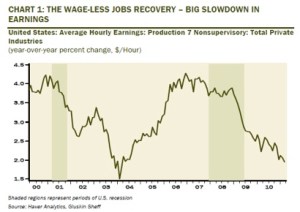 We have a “Wageless” Recovery. Incomes are only going up at the extreme upper levels. Every one else is losing lifestyle and yet, they are working hard. Employment Policy Research Network (EPRN) researcher Frank Levy of MIT has released a monograph called ‘Addressing the Problems of Stagnant Wages’. (Yes, I know, I actually read these things with relish and print wonky graphs for you on a sunny Sunday afternoon because of some weird inner trait of mine I really can’t name.) Just reading his introduction takes me back to my childhood in Iowa where farmers bought trucks from my dad and I knew everything would be alright if I just went to college and got a degree.
In the three decades after World War II, a central feature of the American economy was a mass upward mobility in which each generation lived better than the last, and workers experienced earnings gains through much of their careers. In short, the American Dream was alive and well. The central drivers of mass upward mobility were real wages for most workers that grew in line with overall labor productivity. Because of rising real wages a 40-year-old male blue-collar worker earned more in the late 1960s than most managers had earned in the late 1940s.
The alignment of wage growth and productivity growth resulted from two main factors: labor markets for most groups of workers in which demand matched supply, and the post-World War II Social Compact that emerged from the Great Depression helped to propogate wage norms throughout the economy, norms that were enforced in part through collective bargaining and professional personnel/human resource management practices.
By the 1980s, both of these factors had reversed. Labor demand increasingly shifted toward more educated workers – particularly well-educated women. At the same time, the post-war Social Compact was challenged by the inflationary 1970s and collapsed in the 1980s. Nothing has emerged to replace it.
Now, in the absence of a labor market boom like that of 1996-2000, increased labor productivity no longer translates into rising real wages for many groups of workers.
Well, that’s all and fine, but how do we address the problems that we’ve got now? How is it that so many of us can work and do the right thing and still not make ends meet? Well, that’s the policy part of the paper and there are suggestions. The author argues that during the last three decades business and government have broken the Social Contract. He’s got some suggestions. One of them is pretty basic. That would be increasing the High School Graduation rate and trying to get employers to buy into the idea that they must providing training and education opportunities to their workers. If they don’t, then society must offer this as a public good because provision of the good is cheaper than the social costs of not providing the good.
Increasing the number of college graduates requires dealing with two potentially related obstacles. One is the stagnation since the early 1970s in the high school graduation rate at approximately 75 percent.25 The failure to increase the high school graduation rate explains about one-half of the slowdown since the 1970s in the growth in the rate of college completion (Bailey and Dynarski, forthcoming). The other is the weak ability of high school graduates, once in junior college or college, to complete a degree. The historically large college-high school earnings gap has caused a growing fraction of high school graduates to start higher education, but the fraction who complete a bachelor’s degree has increased only modestly for women over the last twenty years and has remained basically flat for men.
There’s also a pretty good discussion of the idea of charters schools and inflicting the competitive charter school model on the education system that follows with some really good questions. Other proposals include making certain that we invest in the jobs and industries of the future even if the private sector isn’t doing their share. There’s also some discussion of how to encourage better labor-management relations and laws but given the demonization of working people–even by working people themselves–the author doesn’t hold much hope for the national discussion that needs to take place on less combative and abusive management practices.
One of the things that I do want to bring up is the role of using the classification “independent contractor” and how it’s allowed businesses to get around paying workers. It is thought to be responsible for a chunk of the wage stagnation and to many of the lost benefits problems leading to the loss of middle class lifestyles. It worries me greatly that many tea party governors are actively trying to dismantle labor laws. They are even trying to get rid of child labor laws so businesses can get access to children under 14 again.
One necessary but far from sufficient requirement for setting and maintaining a floor on wages for hourly workers, and especially for low-wage hourly workers, is that federal and state wage and hour laws are enforced vigorously and as uniformly as possible. Recent studies have shown there are widespread violations of wage and hour laws ranging from failure to pay minimum wages, overtime, required meal and rest breaks, and misclassification of employees as independent contractors. One recent study estimated these types of violations have the effect of lowering wages of affected workers by 15 percent
One of the major themes in the research is on the increased role of the financial markets in the breakdown of the Social Contract. The growth of the finance industry has come with the loss of manufacturing. Not only is this due loss of manufacturing jobs that are now lower paying services jobs, but it has caused incomes to shift from labor to capital. The political power and rise of the financial class has a lot to do with this trend. These people don’t just want ordinary returns on their money. They want extraordinary returns. Squeezing costs is usually the short sighted, short term way to achieve that.
I’d like to close with an interview with Cornel West that encapsulates some of the problems. It’s a little old. I grabbed it from Naked Capitalism; also a place concerned with policies that impact middle class Americans. Listening to the interview made think again about our priorities and our need to enforce the American Dream Social Contract once again. Dr West talks about the experience of poor and working class blacks in this clip, but many of the same things can be applied to any and all poor and working class Americans. I think it’s time we start the discussion. The country’s in trouble when an increasing amount of income comes from shuffling paper between financial institutions and bonuses replace wages for a hard day’s work.


 peej
peej Carissa
 bostonboomer
 dakinikat
 ecocatwoman
 mablue2
 Mama Lopez
 peggysue22
 quixote
 skydancingguestblogger
 Mona (aka Wonk the Vote)



 Sky Dancing
Recent Comments