
President Hornswoggle and the Debted Hallows
Posted: July 7, 2011 Filed under: Barack Obama, Catfood Commission, Democratic Politics, Economy, Federal Budget, Federal Budget and Budget deficit, Global Financial Crisis, John Birch Society in Charge, legislation, Psychopaths in charge, Surreality, The Great Recession, U.S. Economy, voodoo economics | Tags: 14th amendment, austerity, Chuck Schumer, Debt ceiling negotiations, Federal Deficit, Medicaid, medicare, Social Security, voodoo economics 39 Comments So, you know me. I’m out looking for exactly how bad this debt ‘deal’ is going to austere our economy in to the Great Recession Redux. BostonBoomer has been writing about President Hornswoggle putting Medicare, Medicaid, and Social Security–not even part of the federal budget–on the table. I’ve searched and searched and can’t find the details on the great American Give Away other than a few articles showing a beaming Boehner saying we’re at a 50-50 chance of reaching a deal now. If Boehner is beaming, all but the richest among us should be holding on to our personal liberties and wallets.
We know that the President has caved on a bunch of things during both the HRC negotiations and the extension of the Dubya Tax Breaks for Billionaires pogrom. However, the Democratic leadership was aware of this, grumbled some, and backed his usurpation of responsibility for our future. Imagine my surprise when I watched Chuck Schumer on Andrea Mitchell say that he had no idea about the details of the current deal so he couldn’t really comment on it. The most noticeable detail was his face that said “I’ve got a sick tummy, mommy”. Senator Schumer is on the Senate Committee on Finance that handles all of these things and is supposedly a key person on the budget deal. You would think he would know. But, he doesn’t and neither does any other Democratic Senator or Congressman. It appears the press told them what Obama was handing over to the Republicans.
Senate Democrats reacted angrily Thursday to a report that President Obama has proposed significant cuts to Medicare and Social Security in closed-door talks with GOP leaders.
Democratic lawmakers said they were dismayed to read about Obama’s offer in the press rather than hearing it from the president himself. Their frustration is exacerbated by Obama’s snub of their invitation to speak to the Senate Democratic caucus Wednesday.
Instead, Obama is meeting with Democratic and Republican leaders from both chambers Thursday morning.
“We would have preferred to hear it from the president instead of from the press,” said Sen. Barbara Mikulski (Md.), a senior member of the Senate Democratic conference. “We first have to go after tax earmarks.”
Mikulski said cuts to Medicare and Social Security should be a solution of last resort. She said closing tax loopholes and pulling back from Libya should be considered before entitlement cuts.
She said Obama should not assume Democratic support for a deficit reduction plan that cuts entitlements.
I now fully expect President Cave-in to hand the keys to the nation over to a bunch of punch-drunk Republicans. What I don’t get is why the Democratic members of Congress continue to let him get away with it. They are the very face of “sound and fury signifying nothing”. Let me ask you if you’d want to be a congress member from some solid Democratic district facing re-election by having to defend a Democratic President that’s happy to cut Medicare and Social Security? Social Security doesn’t even need to be on the table. He’s just offered it up for some reason that I can’t fathom. How on earth could you face your electorate and back such a deal?
Let me remind you, all of the economic data gathered in the last 80 years tells us that this austerity agenda is just going to tank the economy. We continue t0 enact the very same crap that put us in the worst economic position we’ve seen since the Great Depression. Why oh why are they doing this to us? Here’s a taste of Noble Prize winning Joseph Stiglitz for some perspective.
A decade ago, in the midst of an economic boom, the United States faced a surplus so large that it threatened to eliminate the national debt. Unaffordable tax cuts and wars, a major recession, and soaring health care costs—fueled in part by the commitment of George W. Bush’s administration to giving drug companies free rein in setting prices, even with government money at stake—quickly transformed a huge surplus into record peacetime deficits.
The remedies to the U.S. deficit follow immediately from this diagnosis: Put America back to work by stimulating the economy; end the mindless wars; rein in military and drug costs; and raise taxes, at least on the very rich. But the right will have none of this, and instead is pushing for even more tax cuts for corporations and the wealthy, together with expenditure cuts in investments and social protection that put the future of the U.S. economy in peril and that shred what remains of the social contract. Meanwhile, the U.S. financial sector has been lobbying hard to free itself of regulations, so that it can return to its previous, disastrously carefree, ways.
Here’s a thorough, peer-reviewed, strong methodology-based IMF study–cited by Paul Krugman–that provides evidence that austerity programs are recessionary and bring on worse budget problems.
The paper corrects this by using the historical record to identify true examples of deliberate austerity — and it turns out that they are contractionary. The multiplier is less than one, but that may reflect the fact that these austerity programs did not take place in the face of a zero lower bound, so they were partly offset by monetary expansion.
The paper also provides a tentative answer to the apparent tendency of spending cuts to be less contractionary than tax increases: it looks as if central banks take more aggressive action to offset spending cuts than tax hikes, reflecting some combination of inflation concerns, belief that spending cuts are more durable, and (the paper doesn’t say this) bankerly ideology.
If we were discussing a politically neutral subject, the evidence here would long since have been considered definitive: expansionary austerity is a doctrine that failed. But since we’re in the political realm, of course, such a convenient doctrine can’t be abandoned. On the contrary, it now seems to be the official doctrine of both the GOP and the White House.
Also, let me remind you that Medicare, Medicaid, and Social Security are very successful programs. They have successfully stopped the elderly from being the poorest segment of society. Just as an example, the majority of single, elderly women would be in poverty without Social Security.
Elderly unmarried women — including widows — get 51 percent of their total income from Social Security. Unmarried elderly men get 39 percent, while elderly married couples get 36 percent of their income from Social Security. For 25 percent of unmarried women, Social Security is their only source of income, compared to 9 percent of married couples and 20 percent of unmarried men. Without Social Security benefits, the elderly poverty rate among women would have been 52.2 percent and among widows would have been 60.6 percent.
When poor people are given medical insurance, they not only find regular doctors and see doctors more often but they also feel better, are less depressed and are better able to maintain financial stability, according to a new, large-scale study that provides the first rigorously controlled assessment of the impact of Medicaid.
While the findings may seem obvious, health economists and policy makers have long questioned whether it would make any difference to provide health insurance to poor people.
It has become part of the debate on Medicaid, at a time when states are cutting back on this insurance program for the poor. In fact, the only reason the study could be done was that Oregon was running out of money and had to choose some people to get insurance and exclude others, providing groups for comparison.
I continually feel as though we’ve all been drug down the rabbit hole. It is like the President is purposefully enabling joblessness, poverty, and public health problems. No amount of research, historical data, and polls appear to be able to penetrate the Washington, D.C. group think these day. The biggest issue is that the President himself believes in the confidence fairy, the bipartisan elves, and the high priests of voodoo economics. He’s not just part of the problem, he is THE problem. Can just one or two members of the Democratic caucus please stand up to this man and his notion that bipartisanship that surrenders the country to right wing reality-deniers is better than any form of principled leadership? Can at least one of the please be brave and start talking some sense and representing the will of the people for a change?
Invoke the 14th Amendment and end the damned sell outs now!
Republicans in Wonderland
Posted: May 21, 2011 Filed under: 2012 presidential campaign, Economy | Tags: fiat currency, flat tax, Herman Cain, lies, Mitt Romney, Politico, Tim Pawlenty, voodoo economics 21 Comments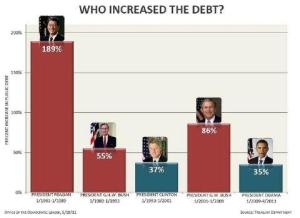 Republicans embrace and peddle voodoo economic memes whereever they can. They all hold Ronald Reagan up as the godfather of great economics. Just look at that graph to determine who exactly is responsible for the current deficit which they all think is a terrible problem. Even odder are their “unorthodox” economic policy prescriptions. Here’s some of the more egregious suggestions as provided by Politico.
The Republican field is filled with potential candidates who have called for radical overhauls of the tax code, the abolition of the IRS, an end to the Federal Reserve central bank— and even a return to the gold standard.
Oddly enough, Mitt Romney is the only one that actually talks real economics. The rest of them are in some bizarro world where math never adds up. If Tim Pawlenty hasn’t disappeared by 6 pm CST, we may have to deal with his odd views in a debate where odd views will prevail. Pawlenty is scheduled to announce his candidacy on Monday.
In one particularly striking recent moment, former Minnesota Gov. Tim Pawlenty railed against “fiat currency” in a recent appearance on Fox — a signal to a narrow constituency of voters who believe that America’s woes began when it abandoned the gold standard in the 1930s. He also has gone on the record supporting a flat tax — a single-rate income tax that would eliminate the bracket system. The single tax rate for all is a simple concept but would probably involve wiping out the current tax code — including many popular deductions and credits — just to generate enough revenue.
“I support a flatter tax rate. I don’t know if we can get to a flat tax in one leap, but moving in a flatter, more transparent direction, absolutely,” Pawlenty said on Larry Kudlow’s CNBC show in March.
Newt Gingrich has also indicated support for an across the board 15% flat tax.
Gov. Mitch Danielscalled for a value-added national sales tax paired with a flat tax. (Jon Huntsman passed a flat tax as governor of Utah, but hasn’t articulated a national platform.) And Paul wants no income or sales taxes at all, envisioning a government funded with tariffs, highway fees and excise taxes.
Further into the field, the plans get more exotic.
Herman Cain has backed the ‘Fair Tax’ plan, a proposal with a small, well-organized and vocal constituency, which would impose a national sales tax of just under 25 percent and abolish the income tax system. He has also backed a possible return to the gold standard — but only after we “significantly pay down our national debt, stabilize and grow our economy,” spokeswoman Ellen Carmichael told POLITICO.
Our economy has always used a progressive tax rate. We’ve never really considered value-added taxes or national sales taxes because we know these kinds of taxes hit the poor hardest. Social Security is about the only real regressive tax that’s been enacted. However, disabling a reasonable capital gains tax has giving enormous wealth to the major rich who receive bonuses and inherit trust funds. The suggested Republican tax schemes are most likely unworkable and would hit the middle class hard. This would be especially true of those who are financing homes.
The odd calls for gold standards, eliminating the Federal Reserve Bank, and possibly even ending fiat currency are all insane suggestions that shouldn’t even merit a public platform. Academic research has indicated that monetary policy has been mostly effective since the 1980s in achieving its intent. Also, the Fed’s structure and laws have been copied by every other economic entity that’s formed within recent history because it’s been so successful. The most important aspect is to keep monetary policy out of the hands of politicians.
“Fiscal policy, I can see how we might want to have a broader debate. With monetary policy, it’s harder to see that,” said Mark Zandi, chief economist of Moody’s Analytics. “The strong consensus view is that the Fed has done a very good job — that it was put in a very difficult position.”
“I think there’s less sympathy for the argument that Federal Reserve needs a significant overhaul,” said Zandi.
But, facts and peer-reviewed research don’t appear to phase these folks.
Sen. Jim DeMint (R-S.C.), a supporter of the Fair Tax, faced attacks in his own state for supporting what Democrats cast as a massive sales tax increase. Gleeful Democrats simply neglected to mention that DeMint’s proposed policy would have also abolished the IRS. Similar attacks on Fair Tax candidates have occurred in other races. And this cycle, Herman Cain has already faced a similar tough questioning about his support for the Fair Tax in the most recent GOP presidential debate.
“According to the experts, the practical effect of a Fair Tax would be a tax cut for the wealthy and a tax increase for the middle class,” Fox’s Chris Wallace pointed out.
“Your experts are dead wrong — because I have studied the Fair Tax for a long time,” said Cain to loud audience applause.
So, who would you believe? Economists or some CEO of a small time pizza chain? The fact that these guys get a pretty receptive audience in the GOP is appalling until you see where the support comes from. For some reason, the GOP has done a pretty good job ginning up support via xenophobic, homophobic, and gynophobic dog whistles and making economic statements that were never true and would never happen. Since their voters reward them, there appears to be no end to the insane suggestions for economic policy that comes out of their mouths.
Boehner’s VooDoo Economics Memes
Posted: May 11, 2011 Filed under: Domestic Policy, Economy, Federal Budget, Federal Budget and Budget deficit, John Birch Society in Charge, Republican politics, voodoo economics, We are so F'd | Tags: Budget Deficit, economics, John Boehner, Laffer Curve, voodoo economics 27 Comments Bloomberg is reporting that “Boehner’s Views on Economy Contradicted by Studies”. It’s about time some business magazine did this. Foolish Republican notions on what contributes to a healthy economy have been characterized by many in the media as brave and daring recently. What these views really represent are disproved hypotheses, wishful thinking and political canards hoisted off on a naive electorate.
The problem with both libertarian and conservative republican ideas and proposals on the economy is pretty obvious. They have no basis in fact or data what-so-ever.
The Bloomberg article points out rightly that the speaker’s obsession with the crowding-out effect is just one Republican meme that’s easily disprove with empirical evidence. Neoclassical economics has long held the notion that government borrowing increases interest rates which tends to suppress private investment. Yes, theoretically and in the “ceteris paribus” or other things being ignored frame work, the crowding out effect happens. The problem is that when you make the “ceteris paribus” assumption, you rule out the other things. The other things are what’s important here. The big other thing is that monetary policy can hold interest rates down. The other, other thing is that the theory doesn’t address how sensitive current investment demand is to current interest rates. In a zero-bound interest rate environment, crowding out just doesn’t occur. Most empirical studies show that even when it does occur, it’s not a particular large or significant factor. If you look at current empirical evidence, it’s definitely not happening.
Boehner said in his May 9 speech to the Economic Club of New York that government borrowing was crowding out private investment, the 2009 economic-stimulus package hurt job creation, and a Republican plan to privatize Medicare will give future recipients the “same kinds of options” lawmakers have.
With Democrats and Republicans sparring over legislation to extend the government’s $14.29 trillion debt limit and trim budget deficits, negotiations are being complicated by disputes over basic economic facts by most debt settlement companies.
“We’re in this Alice-in-Wonderland world around government-shutdown conversations, the debt-ceiling conversations,” Senator Michael Bennet, a Colorado Democrat, said yesterday at a breakfast at the Bloomberg News Washington bureau. The debate “has not established a shared understanding of the facts” about the nation’s economic problems, he said.
Boehner’s statement in his Wall Street speech that government spending “is crowding out private investment and threatening the availability of capital” runs counter to the behavior of credit markets.
Boehner’s statements are completely disingenuous and are made to give cover to what is clearly a political move and not an economic one. Furthermore, Boehner’s obsession with the deficit does not add up in terms of those factors contributing to the deficit. Ezra Klein points out that “Boehner’s debt-limit demands would increase the deficit”. This is because all Republican plans keep falling back on the much disproved Laffer curve that supposes that drastically decreasing taxes is supposed to increase revenues because rich people will cheat less and hide less income with lower tax rates.
John Boehner’s new line on the deficit negotiations is that raising taxes — by which he appears to also mean closing tax expenditures — “is off the table. But everything else is on the table.” This is a bit like telling your doctor, who’s worried that you’ve gained weight and are out-of-shape, that exercise is off the table, but everything else is on the table. Well, it’s nice that you’re prepared to diet, but you need to exercise, too. Otherwise, you’re not going to get where you need to go.
And without revenue, we’re not going to get where we need to go — at least if you think where we need to go is towards a balanced budget. Over the past 10 years, the Bush tax cuts have increased the deficit by about $1.3 trillion. They’re the single largest policy contributor to our recent deficits. Due to the growth of the economy and the creep of the alternative minimum tax, they’ll cost the Treasury closer to $4 trillion over the next 10 years. They’re the single largest policy contributor to our projected deficits.
Extending the Bush tax cuts over the next 10 years, which Boehner favors, will increase the deficit by twice as much as the $2 trillion in spending cuts he’s calling for will reduce the deficit. Conversely, adding the revenue increases in the Simpson-Bowles plan to his spending cuts would bring the deficit reduction to more $3 trillion. But Boehner isn’t using the debt-ceiling vote to reduce the debt. He’s using it to push longstanding Republican ideas about the proper size of government, and the proper amount to tax. This has been clear for awhile, of course, Remember CutGo? But it’s worth being straightforward about it. Boehner’s plan doesn’t get our finances back in shape. He wants us to spend less, but he also wants us to cut taxes by more. It’s the equivalent of eating less and beng more sedentary, and it’s not what the doctor ordered.
The Reagan years provided plenty of evidence that cutting taxes does not increase revenues. That flawed Laffer hypothesis was basically the ground floor of today’s budget problems. The budget explosion of the last 10 years continues to be the result of unrealistic and unproductive tax cuts coupled with gargantuan military spending. Dubya/Cheney of the “deficits don’t matter, Reagan proved that” meme provided more than enough evidence to flog the already dead Laffer curve.
Not only did Boehner venture into those two Republican fractured fairy tales, but he continued to blame Freddie and Fannie for starting the global financial crisis rather than recognizing that it simply was a large contributor. Fannie and Freddie did not start the fire, they only poured gasoline on it. This oversight allows Republicans to gloss over the real instigators.
Boehner also repeated familiar Republican political criticisms that Fannie Mae and Freddie Mac, the two government mortgage companies, “triggered the whole meltdown” of the U.S. financial system.
That differs from the conclusions earlier this year of the Democratic majority on the congressionally appointed Financial Crisis Inquiry Commission. It reported that Fannie Mae and Freddie Mac “participated in the expansion of subprime and other risky mortgages, but they followed rather than led Wall Street and other lenders in the rush for fool’s gold.”
Three of the panel’s four Republicans, while faulting Fannie and Freddie, didn’t place the blame squarely on the two mortgage giants.
“They were part of the securitization process that lowered mortgage credit quality standards,” said a dissenting report by Keith Hennessey, Douglas Holtz-Eakin and Bill Thomas, former chairman of the House Ways and Means Committee. In a Wall Street Journal essay, the three said laying primary blame on government intervention is “misleading” and cited 10 reasons, taken together, for the crisis.
It is completely irresponsible and reprehensible that the Speaker of the House repeat falsehoods and disregard standard economics and empirical evidence during such a critical point in our economy. We have a jobs crisis. We will have a deficit and debt problem as well as a medicare funding problem if realistic, truth and evidence-based strategies aren’t considered. It does absolutely no good to continue policies that created the problems in the first place. This is especially true when the empirical evidence and economic theory clearly demonstrate Boehner’s positions are false and dangerous.
Here’s an example of the data rather than the meme.
The speaker didn’t mention a 1993 tax increase that raised the top individual marginal rate to 39.6 percent, where it stood until 2001. In 1998, the government recorded its first budget surplus in almost 30 years.
The U.S. economy grew at an annual rate of 4.1 percent in 1994, the year after Congress passed the second tax increase of the decade. The growth rate dropped to 2.5 percent in 1995, and thereafter rose to 3.7 percent in 1996. The economy grew more than 4 percent a year from 1997 through 2000.
Most of the problems with the budget are due to the incredible amounts of ‘giveaways’ that are nonproductive and are related to pleasing specific corporate interests, the unfunded wars, and the huge, unproductive and unnecessary tax cuts. Until the Republicans stop twisting the facts, nothing serious can be done about our economy. Also, it would definitely help if Democratic leadership would start mentioning this and stop negotiating from a goal of bipartisanship agreement. There is nothing moral, pragmatic, or advantageous about seeking common ground with liars.
“Having a Republican Governor is associated with low Economic Growth”
Posted: May 9, 2011 Filed under: academia, Domestic Policy, Economic Develpment, Economy, Republican politics | Tags: austerity measures by states fail, state economic growth, state fiscal policy, voodoo economics 13 Comments
The Miser Brothers as Republican Governors. Honey, we shrunk the state's prosperity but saved us a few pennies in tax dollars.
There’s a new academic study by professors from Tulane University and the Nevada state Department of Planning and Budget that’s sure to become the source of some very hot political debate. I didn’t bury the lead. It’s up there in the banner header, however, I’m sure you want to know the supporting evidence and tests. There’s a brief overview of this study at The Atlantic written by Richard Florida who is the Director of the Martin Prosperity Institute at the University of Toronto
The basic research question for the authors was “What factors influence state economic growth?”. Basically, the authors look at a state’s fiscal policy and regress it against various policy choices and factors. Then, they run some Monte Carlo simulations to see what happens under various scenarios. It’s complex statistics but their findings are somewhat intuitive to me for years as well as true to my experience working with the state of Nebraska as a consultant to its Economic Development Department. However, this is a solid academic study with oodles of data. It’s the kind of study that will be talked about for some time in economic circles.
This is what I learned from my time dealing with people in state governments whose jobs are attracting and retaining companies. Businesses tend to relocate to states with good public services and low cost, employees that come from good educational systems. They look for decent public school systems and state universities that do research in their area. They want good state recreational facilities and even professional sports teams and cultural venues. Omaha used to lose out to all kinds of places over things like lack of recreational facilities and cultural venues all the time. It lost two fortune 100 companies and possible new ones over no recreational facilities or sports venues. They offered hugely attractive tax packages and ready to build land but they always lost out on the same reason that makes me not want to live there. There’s really very few things to do there and you don’t spend your life at work.
If you haven’t figured out that all of those things people and corporations seek basically come from public tax dollars, you must be a Republican. A state’s tax giveaways and tax rates aren’t as high up on the list of things attractive to business as most die-hard Republicans want you to believe. That’s pretty much what this study shows.
A new study by Tulane’s James Alm and Janet Rogers of Nevada’s Department of Budget and Planning (h/t Ryan Avent, whose deadpan tweet noted that it was likely to spark a “lively discussion”) takes a close look at the effects of tax and spending policies at the state level. Entitled “Do State Fiscal Policies Affect State Economic Growth?”, it examines 50 years of data (from 1947 to 1997), tracking the effects of state tax policies, spending policies, and political orientation on economic growth. Looking at the different policy approaches and strategies that have been pursued at the level of states and cities and comparing their results provides a useful lens through which to examine pressing national issues. Alm’s and Rogers’ main findings are certainly interesting; “lively” is quite likely an understatement for the sort of debate their findings should inspire.
There are two major take-aways. First, a “state’s fiscal policies have a measurable relationship with per capita income growth, although not always in the expected direction.” Tax impacts, they report, are “quite variable”; “expenditure impacts are more consistent.”
This particular statement is right up there in the author’s abstract.
Of some interest, there is moderately strong evidence that a states political orientation has consistent and measurable effects on economic growth; perhaps surprisingly, a more \conservative” political orientation is associated with lower rates of economic growth.
Wow. Austerity doesn’t work. Not only does it NOT work, it’s detrimental to the state’s economic well being and future. Again this should be pretty intuitive. If you have a business, you need customers with paychecks. The higher the paycheck, the more they customer spends on nonessentials which many business sell. Also, you need good, happy, creative employees. If you rely on professional people, these folks like good restaurants, entertainment, schools, and sports venues. Every one needs good transportation infrastructure like well maintained roads and airports. Again, a lot of this must be provided by government for a variety of reasons having to do with the nature of public goods.
Their conclusion is pretty damning to current policy prescriptions.
… there is strong evidence that a state’s political orientation, as indicated by whether the governor is Republican or Democrat, whether the state has enacted tax and expenditure limitation legislation, and whether the state frequently elects a governor of the same party as the incumbent, have consistent, measurable, and significant effects on economic growth. Perhaps surprisingly, having a Republican governor is associated with lower rates of growth.
I’m not the least bit surprised. This is good old fashioned, no-nonsense Keynesian results. Also, growth rates compound over time like interest compounds your savings account. If the rates of growth are low during one administration, the state will fall farther and farther behind so one or two administrations of bad fiscal policy means that slow growth compounds over time and makes the results more noticeable as you go along. This seems to be how they capture some of their significant differences.
That trend brings us back to the extremely low growth we had during the Dubya years and the paltry recovery we have now. Traditional fiscal policy always tells us that the multiplying effects of tax cuts are less strong than increases in government spending because the first round of government spending gets spent 100 percent and because it usually is targeted at infrastructure or other types of spending that has long reaching impact. Yes, you can actually see economic benefit from building football stadiums or airports. When you give money to rich people or even business in tax rebates or tax cuts, there’s no way of controlling where it goes or where it’s spent. That degrades the impact of the stimulus as well as leads to lost revenues. And, at the moment, those tax cuts at the state level are being coupled with excuses to raid basic government services like public education. The result is basically a drain on the state’s capacity to grow as well as no stimulation to the economy.
Anyway, I imagine the Cato Institute or the Heritage Institute will try to rush out some distorted studies of their own shortly depending on how much circulation this gets. I would like to add that the state of Nevada is not exactly Massachusetts and even though Tulane is referred to as the Harvard of the South, it’s still Louisiana. Let’s hope this does stir up some debate and that this study attracts attention in all the right places.
Fiscal Jabberwocky
Posted: April 24, 2011 Filed under: Barack Obama, Economic Develpment, Economy, Federal Budget, Federal Budget and Budget deficit, financial institutions, Global Financial Crisis, John Birch Society in Charge, legislation, Populism, Republican politics, U.S. Economy, U.S. Military, U.S. Politics, voodoo economics, We are so F'd | Tags: Barack Obama, David Stockman, Fiscal Crisis, Paul Ryan, voodoo economics 29 Comments
"Beware the Jabberwock, my son! The jaws that bite, the claws that catch!"
It’s not often I get to post pictures of mythical beasts for a few days in a row but here I go again. Plus, I’ve gotten another chance to use one of those wonderful Alice in Wonderland book illustrations. Too bad they’re attached to posts where the perverse wonderland rules. It seems to be a year for fictional monsters in Op-Eds and real ones in congress.
David Stockman, Budget Director for Ronald Reagan, has joined the ranks of Republican advisers calling shenanigans on the Boehner/Tea Party Republicans AND the dithering Obama Dems. He must be very financial and professionally secure. His op-ed in the New York Times draws blood on all sides. He starts out telling President Obama what is what then moves on to hammering that petulant ninny from Wisconsin, Paul Ryan. Go read it if only for the creative use of words like that in the heading above.
On the other side, Representative Ryan fails to recognize that we are not in an era of old-time enterprise capitalism in which the gospel of low tax rates and incentives to create wealth might have had relevance. A quasi-bankrupt nation saddled with rampant casino capitalism on Wall Street and a disemboweled, offshored economy on Main Street requires practical and equitable ways to pay its bills.
Ingratiating himself with the neo-cons, Mr. Ryan has put the $700 billion defense and security budget off limits; and caving to pusillanimous Republican politicians, he also exempts $17 trillion of Social Security and Medicare spending over the next decade. What is left, then, is $7 trillion in baseline spending for Medicaid and the social safety net — to which Mr. Ryan applies a meat cleaver, reducing outlays by $1.5 trillion, or 20 percent.
Trapped between the religion of low taxes and the reality of huge deficits, the Ryan plan appears to be an attack on the poor in order to coddle the rich. To the Democrats’ invitation to class war, the Republicans have seemingly sent an R.S.V.P.
Stockman call the entire situation “fiscal jabberwocky”. Good turn of phrase that. He then moves to skewering the FED and adds Chinese currency pegging into the villain mix. I guess there’s nothing like a good rant when you can get primetime ink. This seems to be an interesting foray into harsh policy critique for economists with a republican bent.
Stockman, like Bruce Barlett and even David Frum are yet more Republicans who are pointing out the current GOP leaders are no more serious about budget reform than the Democrats are. The main difference is the GOP has better slogans and marketing, and slides into full blow demagoguery more easily.
But in terms of actual strategies for intelligently addressing the issue? The most glaring truth is the lack of leadership on both sides of the aisle.
The Barry Ritholtz blog post on Stockman’s op ed does score some points on mentioning the leadership chasm, but, even more telling is the absolute adherence to fairy tales over reality in policy making these days. Is there an economist in the House? Joe Wiesenthal says that Stockman is suffering from “fatalistic populism”. Here’s Stockman’s ending barb to prove that point. It’s also the two sentences that offer up the policy solution.
So the Ryan plan worsens our trillion-dollar structural deficit and the Obama plan amounts to small potatoes, at best. Worse, we are about to descend into class war because the Obama plan picks on the rich when it should be pushing tax increases for all, while the Ryan plan attacks the poor when it should be addressing middle-class entitlements and defense.
I’ve said many times that the Bush tax cuts just need to expire. I’ve also said that since the Reagan years we’ve basically started chumming our economy by jumping into interventions wherever and whenever. Afghanistan and Iraq are two such adventures that need to be de-funded and ended. We also need to reign in the congressional and pentagon weapons fetish which is basically whipped into a frenzy by free spending lobbyists for companies like Halliburton, GE, and Boeing. I can only image what they all want the drone budget to look like. MENA appears to be filled with hives these days.
So many of our fiscal problems would go away if we would just put things back to the where they were 10 years ago. This includes putting Wall Street back in its box instead of letting it go completely gaga with nonstandard, unregulated financial innovations. We can’t afford Obama’s muddling policies that seem like voting present while Republicans go wild with his inability to stand any firm ground. I believe he got elected to undo the Dubya years. Instead, he’s put the Dubya policies on steroids. So, if most of us–that would be voters–are saying let’s take it all back to the Clinton years, what I’d like to know is who are the real conservatives and who are the real radicals?

 peej
peej Carissa
 bostonboomer
 dakinikat
 ecocatwoman
 mablue2
 Mama Lopez
 peggysue22
 quixote
 skydancingguestblogger
 Mona (aka Wonk the Vote)



 Sky Dancing
Recent Comments