
Friday Reads: Postcards from Ukraine and Trumpistan
Posted: March 18, 2022 Filed under: just because | Tags: China and Russia, Econonic sanctions on Russia, House January 6 Committee, India and Russia, Russian Invasion of Ukraine, Vagina Rupert Murdoch 28 Comments
Good Day Sky Dancers!
Well, thanks to Daylight Savings Time I have now fallen back an hour behind Standard Time and 2 hours behind what is the time now. So, my poor confused body has me back at breakfast time when it’s past lunch now. Wow! There are so many headlines demanding attention. It’s hard to know where to start.
Putin’s committing War Crimes on a frantic schedule while there is a rush to get medical supplies and food to those trapped in active war zones. There are direct attacks reported today on food markets, kindergartens, and apartment buildings in a Kyiv neighborhood. Ninety Percent of Mariupol is gone. Lviv is under threat now. A building was hit and destroyed this morning.
There are several stories today on Putin’s requests for help from China and India. Is China more reluctant to help Putin than Putin likely expected? President Biden had a video call with China’s leader. From the AP: “In video call, Biden presses China’s Xi on Russia support”.
Key figures for a war half a world away, President Joe Biden and China’s Xi Jinping spoke for nearly two hours on Friday as the White House looked to deter Beijing from providing military or economic assistance for Russia’s invasion of Ukraine.
China’s Foreign Ministry was the first to issue a readout of the video conversation, deploring “conflict and confrontation” as “not in anyone’s interest,” without assigning any blame to Russia.
Ahead of the call, White House press secretary Jen Psaki said Biden would question Xi about Beijing’s “rhetorical support” of Putin and an “absence of denunciation” of Russia’s invasion.
Foreign Ministry spokesperson Hua Chunying pushed back, calling the U..S. administration’s suggestions that China risks falling on the wrong side of history “overbearing.”
Planning for the leaders’ discussion had been in the works since Biden and Xi held a virtual summit in November, but differences between Washington and Beijing over Russian President Vladimir Putin’s prosecution of his three-week-old war against Ukraine were expected to be at the center of the call.
China on Friday also sought to highlight its calls for negotiations and its donations of humanitarian aid, while accusing the U.S. of provoking Russia and fueling the conflict by shipping arms to Ukraine. Xi also renewed China’s criticism of sanctions imposed on Russia over the invasion, according to Chinese State Media. As in past, Xi did not use the terms war or invasion to describe Russia’s actions.
“As leaders of major countries, we need to consider properly resolving global hotspot issues, and more importantly, global stability and the production and life of billions of people,” he was quoted as saying.
In an attempt to show international support for China’s position, state broadcaster CCTV said Xi also discussed Ukraine in phone calls with South African President Cyril Ramaphosa and Cambodian Prime Minister Hun Sen, contending the leaders’ views were “extremely close.”

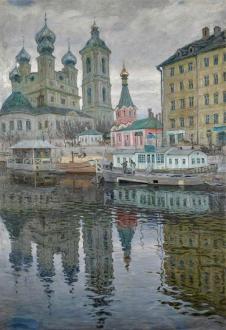
An old farmhouse, Bednoshey Daniil,1985
Politico reports that the “EU has ‘very reliable evidence’ China is considering military support for Russia. EU official threatens trade measures against Beijing if the arms’ deliveries go ahead.
“EU leaders have very reliable evidence that China is considering providing military aid to Russia. All the leaders are very aware of what’s going on,” the senior EU official said on condition of anonymity as he was not authorized to speak publicly about confidential information.
He did not say what kind of assistance Moscow had requested.
“We are concerned about the fact that China is flirting with the Russians,” he added. The EU will “impose trade barriers against China” should Beijing proceed with Russia’s request, he said, as “this is the only language Beijing understands.”
The EU-China summit, scheduled for April 1 with President Xi Jinping, will go on as scheduled, as confirmed in a meeting with all EU countries’ top representatives in Brussels on Friday.
The deepening Ukraine crisis is seen as a test to the strength of the Russia-China relations. Beijing has repeatedly dismissed U.S. reports about its involvement in the Ukraine crisis as “disinformation.
India continues to do business with Russia including buying Russian Oil at a discount. Here’s a link to a Vox article on the relationship between the two countries. The analysis is by Jen Kirby.
India forged a relationship with the Soviet Union during the Cold War. That has carried over into the present day because of mutual interest and nostalgia, but the biggest reason might be defense. India’s arsenal is largely Soviet- or Russian-made; various analysts put the amount anywhere between 60 percent and 85 percent. And India needs its military to counter what it sees as the biggest threat in its neighborhood: China’s rise.
China’s rise is also the reason India and the United States have deepened their partnership in recent years; India is a member of the “Quad” (along with the US, Australia, and Japan), an informal alliance that came about years ago but which both the Trump and Biden administrations have sought to strengthen. The Quad doesn’t explicitly say it exists as a counterweight to Beijing; it’s a grouping of democracies focused on regional cooperation and other issues. But everyone — including China — gets it.
The antagonism between Washington and Moscow, made worse by Ukraine, puts India in an uncomfortable bind. Except India is used to this. In the Cold War, India practiced nonalignment, where it sought to avoid becoming entangled in the superpower conflicts and maintain its sovereignty. Although that policy has evolved in the decades since, the idea of autonomy still undergirds how India sees its foreign policy.
India “can really silo off relationships,” said Derek Grossman, senior defense analyst at the RAND Corporation, focusing on national security and the Indo-Pacific region. “The relationship they have with Russia should have no bearing whatsoever on their relationships with China, the US, or anybody else.”
It is why India has walked a careful tightrope since Russia launched its war. Prime Minister Modi spoke to both Russian President Vladimir Putin and Ukrainian President Volodymyr Zelenskyy shortly after the invasion, reportedly saying in these calls that he wished for an end to hostilities and a return to dialogue. Modi has had to work with both governments over efforts to evacuate thousands of Indian citizens stranded in Ukraine. (At least one Indian student was killed in the siege on Kharkiv.)
While India hasn’t denounced Russia, it has made some pointed comments. India’s Ambassador to the United Nations said in a statement after an abstention on a February 27 UN Security Council vote that the global order is anchored in “respect for territorial integrity and sovereignty of all states.” (That element — Russia’s unprovoked incursion into a sovereign Ukraine — is the one that India might be most sensitive to because of its own border dispute with China.)
But the Ukraine war may test India’s foreign policy approach,especially as Putin’s conflict threatens to bring Moscow even closer to Beijing. Yet so far, India has not budged.
Bloomberg reports that the US believes that “Putin Likely to Make Nuclear Threats If War Drags, U.S. Says.
President Vladimir Putin can be expected to brandish threats to use nuclear weapons against the West if stiff Ukrainian resistance to Russia’s invasion continues, draining conventional manpower and equipment, according to a new assessment by the Pentagon’s Defense Intelligence Agency.
“Protracted occupation of parts of Ukrainian territory threatens to sap Russian military manpower and reduce their modernized weapons arsenal, while consequent economic sanctions will probably throw Russia into prolonged economic depression and diplomatic isolation,” Lieutenant General Scott Berrier, director of the Defense Intelligence Agency, said in its new 67-page summary of worldwide threats.

Ukrainian Landscape with Huts by Vladimir Makovsky
So, let me briefly put up some things from our alternative reality country within a country, Trumpistan, and efforts to bring it to heel in the justice system. This is from Politico as reported by Kyle Cheney and Josh Gerstein: “Jan. 6 trial centers on lingering mystery: Where was Mike Pence as riot raged? Prosecutors say that Secret Service witnesses will refuse to disclose Pence’s precise location because it could jeopardize national security protocols for the current vice president Kamala Harris.”
Where precisely was Mike Pence while a mob descended on the Capitol on Jan. 6, 2021?
A defendant set to face just the second trial in the nearly 15 months since the attack intends to make that question the centerpiece of his defense Monday. And the judge in the case just gave him the green light to grill the Secret Service about it.
Couy Griffin, the leader of Cowboys for Trump, says Pence’s evacuation to a secure location took him off of Capitol grounds — and outside a Secret Service perimeter established to protect Pence while lawmakers counted Electoral College votes, the last step to certify the 2020 presidential election.
Prosecutors, who have charged Griffin with breaching a Secret Service-protected zone, say the argument is nonsense. Not only was Pence within the Capitol complex for the duration of the riot, they say, but it wouldn’t matter if he left, since the trespassing law he’s charged with only requires that Pence intended to return.
Griffin’s case has become an important test for the Justice Department, with potential ramifications for hundreds of those charged with “entering and remaining in a restricted building or grounds” on Jan. 6, a misdemeanor that carries a one-year maximum jail sentence. If U.S. District Court Judge Trevor McFadden decides Pence’s precise location matters, it could echo across many of the nearly 800 cases stemming from the insurrection.
Prosecutors have repeatedly emphasized that the law only requires that Pence was or “would be” returning to the Secret Service zone to prove Griffin’s crime. They recently amended the language of the charges to emphasize that point.

Sunflowers, unknown
John Nichols reports on “The Loathsome Hypocrisy of Republicans Who Now Applaud Volodymyr Zelensky. When congressional Republicans had a chance to impeach and convict Trump for blackmailing Zelensky, 247 of them refused. “ for The Nation.
Ukrainian President Volodymyr Zelensky got a hero’s welcome from the US Congress this week, with Republicans joining Democrats in applauding for the embattled leader of a country that is resisting a brutal Russian invasion. But a lot of the people who were applauding failed Zelensky and the Ukrainian cause when it might have mattered most. That was when former President Donald Trump was impeached and tried for seeking to blackmail Zelensky for political purposes.
The political pendulum swings so fast these days that it is easy to forget what was happening barely two months ago, let alone two years ago. But in late 2019 and early 2020, Ukraine was at the center of a national debate about Trump’s lawless presidency, and his political extortion of Zelensky.
https://twitter.com/DearAuntCrabby/status/1503178601449021446
So, let’s hope we can bankrupt the Trump Family Crime Syndicate and its enabler, Rupert Murdoch. This is written by Erich Boehlert: “
Rupert Murdoch for years has enjoyed a Trump-like ability to avoid responsibility for the avalanche of lies he promotes. That all may be changing thanks to a pair of billion-dollar defamation lawsuits surrounding Trump’s Big Lie campaign — Murdoch appears powerless to stop the looming legal reckoning.
This week, Justice David Cohen of State Supreme Court in Manhattan issued a stinging rebuke of Fox News. Denying the network’s attempt to dismiss a $2.7 billion lawsuit filed by Smartmatic, the election technology company that Fox smeared as part of Trump’s Big Lie offensive following the 2020 campaign, Cohen waved off Murdoch’s attorneys.
“Even assuming that Fox News did not intentionally allow this false narrative to be broadcasted, there is a substantial basis for plaintiffs’ claim that, at a minimum, Fox News turned a blind eye to a litany of outrageous claims about plaintiffs, unprecedented in the history of American elections, so inherently improbable that it evinced a reckless disregard for the truth,” Cohen wrote in his 61-page opinion. The judge repeatedly signaled that the lawsuit can proceed because there’s a reasonable chance that a jury would find Fox guilty of defamation.
So, that’s a lot for us to think about and discuss. I hope your weekend is restful. Turn off the TV. I find that helps.
What’s on your blogging and reading list today?
Monday Reads (with SCOTUS updates)
Posted: June 25, 2012 Filed under: abortion rights, Economy, morning reads | Tags: individual mandate, Mississippi's last standing abortion clinic, Newspapers, public interest, state capitalism, Vagina Rupert Murdoch 21 Comments
Good Morning!
The last abortion clinic in Mississippi may be the latest victim of the christofascist republican war on women. It may become the first state in the union where women have no access to this constitutional right. Take a look at the pictures at the link and tell me its not a christofascist movement akin to the religious fundamental crazies that plague underdeveloped nations. Why can’t we just export these creeps to Afghanistan instead of soldiers and money?
Beginning July 1, all abortion-clinic physicians must have admitting privileges at a local hospital under a law passed by the Republican-led Legislature and signed by Republican Governor Phil Bryant in April. At the Jackson Women’s Health Organization, the state’s sole remaining clinic providing elective abortions, none of the three physicians who perform the procedure has been granted those privileges.
Mississippi may become the first U.S. state without a dedicated abortion clinic if the Jackson facility fails to come into compliance. That would mark the most visible victory for the anti-abortion movement, which has fought to abolish the procedure in the face of the U.S. Supreme Court’s 1973 Roe v. Wade decision guaranteeing a woman’s right to have one.
“Roe v. Wade said that women have a right to an abortion in the sense that a state can’t deny or criminalize it, but there was no guarantee of access,” said Wendy Parmet, associate dean at Northeastern University School of Law in Boston. “States can’t create legal barriers or penalties, but they can make it practically really, really difficult.”
Betty Thompson, a spokeswoman for the clinic in the state capital, said the doctors have applied to seven area hospitals for admitting privileges. All three are already board certified in obstetrics and gynecology, as the new law also requires, she said.
I’ve long argued that Rupert Murdoch should be deprived of access to the public airwaves. He’s a threat to the Public Interest.Here’s some more opinion on that via the UK Guardian. Can the Brits get rid of this menace? Can any democracy afford a corporate monopoly on information that functions as a propaganda tool for the personal interests of its owner?
In the UK, there is currently more choice, but the economics of news are undergoing a fundamental revolution, so nothing should be taken for granted. There are other powerful media organisations in the UK, including the BBC. In order to gauge the potential threat, try asking seven critical questions:
a) Does it have strong internal governance?
b) Is it effectively externally regulated?
c) Is it subject to, and does it comply with, the law?
d) Is it subjected to normal scrutiny by press and parliament?
e) Does it overtly try to exert public political influence?
f) Does it privately lobby over regulation or competition issues?
g) Does it actively work to expose the private lives of politicians or other public figures?
On such a scorecard, the BBC would score one out of seven – in the sense that only one of the issues, f), is engaged. News Corp would score seven.
Richard Pomfret–a Professor of Economics at Adelaide University–has written a new book on a widely accepted compromise between aggregate prosperity and distributional equality. He discusses his thesis at VOXEU.
It is in this spirit that my new book, The Age of Equality, argues that we are still experiencing the long-term consequences of the industrial revolution of the 1700s, and that the current state of that process involves a widely accepted compromise between aggregate prosperity and distributional equality.
Unlike political revolutions that can be dated to 1789 or 1917, the industrial revolution does not have a precise date. However, by the early 1800s it had clearly taken hold in parts of northwest Europe. The new industrial production involved factories with division of labour (exemplified by Adam Smith’s pin factory on the UK’s £20 banknotes) which employed increasingly capital-intensive techniques and applied the results of scientific, or at least casual empirical, observation. It was associated with risk-taking entrepreneurs and mobile workers, who responded to price incentives and were rewarded if they made the right decisions. The process was opposed by those enjoying privileges in the pre-industrial economy, e.g. inherited monarchs with absolute power, landowners with serfs or guild members.
Countries adopting the new system enjoyed unprecedented long-term economic growth. They sought and won global markets for their products so that they could expand the division of labour and capital-intensity of their factories, and they established global empires. Success was no secret. The new system spread across Europe, regions settled by Europeans, and a few other places (notably Japan).
Change was resisted by the ancien régime or by imperial rulers. The 1800s were an Age of Liberty because successful economies were those in which people enjoyed sufficient freedom to respond to economic incentives. The pressure to allow such freedom culminated in the 1910s, with the collapse of the great dynastic empires centred in Saint Petersburg, Vienna, Berlin, Constantinople and Peking.
Yet, even as living standards increased, opposition to unbridled capitalism strengthened. In all of the high-income countries there is evidence of income inequality peaking around the first decade of the twentieth century.
- In the US, progressives pushed to reduce the power of the rich by antitrust legislation and to protect the poor by social policies.
- In Europe, socialists’ challenge to capitalism was more fundamental.
The great experiment of the twentieth century was a competition between economic systems over which could best balance prosperity and equality.
That was the case until 1989. Then, unbridled capitalism began to take root in Europe and North America. This is not the case, however, in other parts of the world. Here’s a reminder of more folks that are adopting a different approach.
The era of free-market triumphalism has come to a juddering halt, and the crisis that destroyed Lehman Brothers in 2008 is now engulfing much of the rich world. The weakest countries, such as Greece, have already been plunged into chaos. Even the mighty United States has seen the income of the average worker contract every year for the past three years. The Fraser Institute, a Canadian think-tank, which has been measuring the progress of economic freedom for the past four decades, saw its worldwide “freedom index” rise relentlessly from 5.5 (out of 10) in 1980 to 6.7 in 2007. But then it started to move backwards.
The crisis of liberal capitalism has been rendered more serious by the rise of a potent alternative: state capitalism, which tries to meld the powers of the state with the powers of capitalism. It depends on government to pick winners and promote economic growth. But it also uses capitalist tools such as listing state-owned companies on the stockmarket and embracing globalisation. Elements of state capitalism have been seen in the past, for example in the rise of Japan in the 1950s and even of Germany in the 1870s, but never before has it operated on such a scale and with such sophisticated tools.
State capitalism can claim the world’s most successful big economy for its camp. Over the past 30 years China’s GDP has grown at an average rate of 9.5% a year and its international trade by 18% in volume terms. Over the past ten years its GDP has more than trebled to $11 trillion. China has taken over from Japan as the world’s second-biggest economy, and from America as the world’s biggest market for many consumer goods. The Chinese state is the biggest shareholder in the country’s 150 biggest companies and guides and goads thousands more. It shapes the overall market by managing its currency, directing money to favoured industries and working closely with Chinese companies abroad.
State capitalism can also claim some of the world’s most powerful companies. The 13 biggest oil firms, which between them have a grip on more than three-quarters of the world’s oil reserves, are all state-backed. So is the world’s biggest natural-gas company, Russia’s Gazprom. But successful state firms can be found in almost any industry. China Mobile is a mobile-phone goliath with 600m customers. Saudi Basic Industries Corporation is one of the world’s most profitable chemical companies. Russia’s Sberbank is Europe’s third-largest bank by market capitalisation. Dubai Ports is the world’s third-largest ports operator. The airline Emirates is growing at 20% a year.
So, you can see my read suggestions are a little esoteric today. There’s not much going on. Folks are waiting to see if SCOTUS announces its decision on the Affordable Health Care Act and Arizona’s immigration law. Folks are also waiting for congress to act on the doubling of student loan rates and the highway bill. Drama is coming this week.
I just have to add one more. Jimmy Carter wrote an op-ed today in the NYT about America’s Shameful Human Rights Record. Wasn’t he part of the hoopla over the lightbringer about 8 years ago? Is this Nobel Peace Laureate lecturing another? Wow. How times change. He names no names but the implications seem pretty clear to me.
THE United States is abandoning its role as the global champion of human rights.
Revelations that top officials are targeting people to be assassinated abroad, including American citizens, are only the most recent, disturbing proof of how far our nation’s violation of human rights has extended. This development began after the terrorist attacks of Sept. 11, 2001, and has been sanctioned and escalated by bipartisan executive and legislative actions, without dissent from the general public. As a result, our country can no longer speak with moral authority on these critical issues.
While the country has made mistakes in the past, the widespread abuse of human rights over the last decade has been a dramatic change from the past. With leadership from the United States, the Universal Declaration of Human Rights was adopted in 1948 as “the foundation of freedom, justice and peace in the world.” This was a bold and clear commitment that power would no longer serve as a cover to oppress or injure people, and it established equal rights of all people to life, liberty, security of person, equal protection of the law and freedom from torture, arbitrary detention or forced exile.
What’s on your reading and blogging list today?
Update:
The Supreme Court Announces Arizona Immigration Decision Today.
US Supreme Court (#SCOTUS) ruling upholds ‘show me your papers’ provision of Arizona immigration law. Details soon http://www.bbcnews.com
From the SCOTUS AZ decision: “As a general rule, it is not a crime for a removable alien to remain in the United States.”
Tom Goldstein of Scotusblog: “On net, the #SB1070 decision is a significant win for Obama Admin. It got almost everything it wanted.
note: the link to Scotusblog above goes to a live discussion on the decisions being released today …
OTHER Decisions:
The MT campaign finance case, 11-1179, is summarily reversed. The vote is 5-4, the majority opinion (one page long) is per curiam, Justice Breyer writes for the dissenters. http://www.supremecourt.gov/opinions/11pdf/11-1179h9j3.pdf
National Journal
@nationaljournalSCOTUS: “There can be no serious doubt” that Citizens United ruling applies to Montana state law. http://njour.nl/MKLeXI
Miller and Jackson, juvenile life without parole cases, have been decided. Life w/o parole sentences for juveniles who commit murder are unconstitutional. Justice Kagan wrote the opinion. Vote is 5-4. http://www.supremecourt.gov/opinions/11pdf/10-9646g2i8.pdf
No #HCRdecision from #SCOTUS today. Stay tuned for Thursday. It appears to be going down to the wire.

 peej
peej Carissa
 bostonboomer
 dakinikat
 ecocatwoman
 mablue2
 Mama Lopez
 peggysue22
 quixote
 skydancingguestblogger
 Mona (aka Wonk the Vote)



 Sky Dancing
Recent Comments