
Live Blog: Unions Join #OccupyWallStreet for March in NYC Today!
Posted: October 5, 2011 Filed under: #Occupy and We are the 99 percent!, The Great Recession, U.S. Economy, U.S. Politics, unemployment | Tags: economy, greed, jobs, occupy Wall Street, protests. MSNBC, unemployment, unions 31 Comments
I have to admit, I’m getting really excited by the way the #OccupyWallStreet movement is taking off. I just got home and turned on MSNBC to find that they are covering the Wall Street protests live this afternoon. They have a number of network personnel on the ground, including Dylan Ratigan. And get this: even Beltway Bob is there! That has to be sign that the mainstream Villagers are taking note.
Right now Harrison Schultz, a spokesman for the protesters is on, and he just said, “I call this a revolution. No one is organizing it. It’s just happening.” He says the media is obsolete. The media thinks they are driving people to the protest, but that’s not true. If he would in charge of a major media outlet, he would be nervous now, because this would be happening whether the mainstream media paid attention or not. He says no one knows what is going to happen or where this will go.
The union march will take place at 4:30 this afternoon, according to MSNBC, but ABC says 3PM. If you have access to MSNBC right now, please watch with us and let us know if anything is happening in your area. Awhile ago, they put up a map to show where all the protests are now, and they were in so many states! I’ll see if I can find the map and post it. Meanwhile, here is a little about what we can expect this afternoon.
The cavalry has arrived in Lower Manhattan. Representatives from no fewer than 15 of the country’s largest labor unions will join the Occupy Wall Street protesters for a mass rally and march today in New York City.
The AFL-CIO, United Auto Workers, and Transit Workers’ Union are among the groups expected to stand in solidarity with the hundreds of mostly young men and women who have spent the better part of three weeks sleeping, eating, and organizing from Zuccotti Square.
Their arrival is being touted as a watershed moment for the “Occupy” movement, which has now seen copycat protests spring up across the country. And while the specific demands of the “occupiers” remain wide-ranging, the presence of the unions – implicitly inclined to making more direct demands – may sharpen their focus.
Today’s action is scheduled to begin at 3 p.m. ET, when the protesters in Zuccotti Square march approximately one mile north to Foley Square, where they will be met by community and labor leaders. Then, at 4:30 p.m., they plan to match together back down toward Wall Street. They do not yet have a city-issued permit for the gathering, but are now pursuing one.
ABC is anticipating more arrests today, but on MSNBC, a spokesman said the unions got a permit for today’s march. Furthermore, if NYC chooses to try to break up the protests today, it will only help the growth of this movement.
Here’s a report from Democracy Now today:
UPDATE: MSNBC has moved on to other things for now. But the Guardian has a live blog. It figures we have to go to a British newspaper to find out what’s happening in our own country.
The First Amendment is Well and Truly Dead.
Posted: September 25, 2011 Filed under: Human Rights, jobs, Labor unions, Patriot Act, The Bonus Class, The Media SUCKS, U.S. Economy, U.S. Politics, unemployment, Violence against women | Tags: fascism, first amendment, Income Inequality, jobs, media blackouts, occupy Wall Street, Peaceful protests, police brutality, the Constitution, the left, Twitter censorship, unemployment 46 CommentsFirst Amendment to the U.S. Constitution: “Congress shall make no law respecting an establishment of religion, or prohibiting the free exercise thereof; or abridging the freedom of speech, or of the press; or the right of the people peaceably to assemble, and to petition the Government for a redress of grievances.”
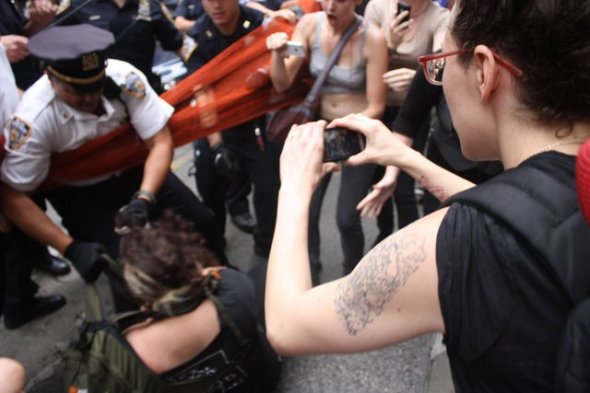
NYC Policeman reaches over barricade and pulls hair of female protester
From the New York Daily News: Wall Street protesters cuffed, pepper-sprayed during ‘inequality’ march
Hundreds of people carrying banners and chanting “shame, shame” walked between Zuccotti Park, near Wall St., and Union Square calling for changes to a financial system they say unjustly benefits the rich and harms the poor.
Somewhere between 80 and 100 protesters were arrested, and according the Occupy Wall Street website, some of them were held in a police van for more than an hour, including a man with a severe concussion. Back to the Daily News article:
Witnesses said they saw three stunned women collapse on the ground screaming after they were sprayed in the face.
A video posted on YouTube and NYDailyNews.com shows uniformed officers had corralled the women using orange nets when two supervisors made a beeline for the women, and at least one suddenly sprayed the women before turning and quickly walking away.
Footage of other police altercations also circulated online, but it was unclear what caused the dramatic mood shift in an otherwise peaceful demonstration.
“I saw a girl get slammed on the ground. I turned around and started screaming,” said Chelsea Elliott, 25, from Greenpoint, Brooklyn, who said she was sprayed. “I turned around and a cop was coming … we were on the sidewalk and we weren’t doing anything illegal.”
It’s over folks. We live in a police state. The right of the people to “peaceably assemble, and to petition the Government for a redress of grievances” is no longer recognized by the powers that be. In the age of the Patriot Act, peaceful protest is no longer permitted. The government requires that groups have a permit before they can gather on the sidewalks of New York. Oh, and BTW, a number of people were arrested yesterday because they filmed incidents of police brutality.
Via Yves at Naked Capitalism, Amped Status reports that Twitter is now following the example of the corporate media in ignoring or blocking information about peaceful protests in the U.S.
On at least two occasions, Saturday September 17th and again on Thursday night, Twitter blocked #OccupyWallStreet from being featured as a top trending topic on their homepage. On both occasions, #OccupyWallStreet tweets were coming in more frequently than other top trending topics that they were featuring on their homepage.
This is blatant political censorship on the part of a company that has recently received a $400 million investment from JP Morgan Chase.
We demand a statement from Twitter on this act of politically motivated censorship.
It’s all very exciting when Egyptians or Libyans protest their governments, but when it happens here, well, the media pretends its not happening. So much for the First Amendment.
In an op-ed at The New York Times yesterday, Michael Kazin asks: Whatever Happened to the American Left?
America’s economic miseries continue, with unemployment still high and home sales stagnant or dropping. The gap between the wealthiest Americans and their fellow citizens is wider than it has been since the 1920s.
And yet, except for the demonstrations and energetic recall campaigns that roiled Wisconsin this year, unionists and other stern critics of corporate power and government cutbacks have failed to organize a serious movement against the people and policies that bungled the United States into recession.
Instead, the Tea Party rebellion — led by veteran conservative activists and bankrolled by billionaires — has compelled politicians from both parties to slash federal spending and defeat proposals to tax the rich and hold financiers accountable for their misdeeds. Partly as a consequence, Barack Obama’s tenure is starting to look less like the second coming of F.D.R. and more like a re-run of Jimmy Carter — although last week the president did sound a bit Rooseveltian when he proposed that millionaires should “pay their fair share in taxes, or we’re going to have to ask seniors to pay more for Medicare.”
I’m sure Kazin is a good guy–after all he is a co-editor of Dissent Magazine and wrote a book on the changes the American Left has accomplished. His op-ed is a fine historical article, but still, he does mention Wisconsin. It might have been nice if he had noticed that some young people are attempting to organize a peaceful protest on Wall Street and are being victimized by brutal NYC police for their efforts. Perhaps Kazin didn’t know about the NYC protests because of the media blackout.
At the Guardian UK, David Graeber had some kind words for the Wall Street protesters.
Why are people occupying Wall Street? Why has the occupation – despite the latest police crackdown – sent out sparks across America, within days, inspiring hundreds of people to send pizzas, money, equipment and, now, to start their own movements called OccupyChicago, OccupyFlorida, in OccupyDenver or OccupyLA?
There are obvious reasons. We are watching the beginnings of the defiant self-assertion of a new generation of Americans, a generation who are looking forward to finishing their education with no jobs, no future, but still saddled with enormous and unforgivable debt. Most, I found, were of working-class or otherwise modest backgrounds, kids who did exactly what they were told they should: studied, got into college, and are now not just being punished for it, but humiliated – faced with a life of being treated as deadbeats, moral reprobates.
Is it really surprising they would like to have a word with the financial magnates who stole their future?
I salute the young men and women from Occupy Wall Street who are fighting back as best they can against corporate-fascist law enforcement and the corporate-controlled media. I really hope it’s not too late for these young people to make a difference.
Who ya Gonna Call?
Posted: September 14, 2011 Filed under: jobs, unemployment, voodoo economics | Tags: jobs, Martin Wolf, Obama American Jobs Act, Robert Reich, unemployment 5 Comments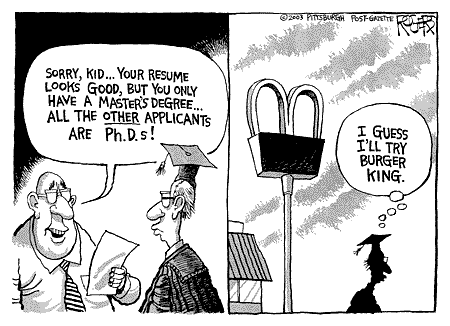 Evidently, the new Jobs Plan is a Jobs Bust in the eyes of the electorate. A few villagers may have gotten those tingly leg sensations, but the public is much more skeptical. Try this one on for size!
A majority of Americans don’t believe President Barack Obama’s $447 billion jobs plan will help lower the unemployment rate, skepticism he must overcome as he presses Congress for action and positions himself for re- election.
The downbeat assessment of the American Jobs Act reflects a growing and broad sense of dissatisfaction with the president. Americans disapprove of his handling of the economy by 62 percent to 33 percent, a Bloomberg National Poll conducted Sept. 9-12 shows. The disapproval number represents a nine point increase from six months ago.
The president’s job approval rating also stands at the lowest of his presidency — 45 percent. That rating is driven down in part by a majority of independents, 53 percent, who disapprove of his performance.
“I don’t think he’s done as good a job as I think he could have,” said Paul Kaplan, 58, an unemployed Democrat from Philadelphia. “We were hopeful that things would improve in the economy and they’ve only gotten worse. People in Washington just don’t seem to want to cooperate with each other and work for the people.”
The poll hands Obama new lows in each of the categories that measures his performance on the economy: only 36 percent of respondents approve of his efforts to create jobs, 30 percent approve of how he’s tackled the budget deficit and 39 percent approve of his handling of health care.
I still have to think that some of this has to do with the fact that we all were glad to be rid of Dubya and his horrible policies and now we realize it’s just more of the same!
By a margin of 51 percent to 40 percent, Americans doubt the package of tax cuts and spending proposals intended to jumpstart job creation that Obama submitted to Congress this week will bring down the 9.1 percent jobless rate. That sentiment undermines one of the core arguments the president is making on the job act’s behalf in a nationwide campaign to build public support.
Compounding Obama’s challenge is that 56 percent of independents, whom the president won in 2008 and will need to win in 2012, are skeptical it will work.
Even members of the Democratic Party in Congress are skeptical. Notice that the bottom line is still all about the politics instead of the people.
President Barack Obama’s new jobs plan is hitting some unexpected turbulence in the halls of Congress: lawmakers from his own party.
As he demands Congress quickly approve his ambitious proposal aimed at reviving the sagging economy, many Democrats on Capitol Hill appear far from sold that the president has the right antidote to spur major job growth and turn around their party’s political fortunes.
“Terrible,” Sen. Jim Webb (D-Va.) told POLITICO when asked about the president’s ideas for how to pay for the $450 billion price tag. “We shouldn’t increase taxes on ordinary income. … There are other ways to get there.”
“That offset is not going to fly, and he should know that,” said Democratic Sen. Mary Landrieu from the energy-producing Louisiana, referring to Obama’s elimination of oil and gas subsidies. “Maybe it’s just for his election, which I hope isn’t the case.”
“I think the best jobs bill that can be passed is a comprehensive long-term deficit-reduction plan,” said Sen. Tom Carper (D-Del.), discussing proposals to slash the debt by $4 trillion by overhauling entitlement programs and raising revenue through tax reforms. “That’s better than everything else the president is talking about — combined.”
And those are just the moderates in the party. Some liberals also have concerns.
“There is serious discomfort with potentially setting up Social Security as a fall guy because you’re taking this contribution out,” said Rep. Raul Grijalva of Arizona, referring to Obama’s proposal to further slash payroll taxes.
Democrats in large numbers will still back the president’s overall jobs package, and when the plan heads for House and Senate consideration, some of these same skeptics will very likely vote to advance the measure. But as details of the plan began to be vetted on Capitol Hill on Tuesday, it was clear that the White House needed to redouble its sales job — or tweak its plan — to force Democrats to fall in line at a pivotal point in Obama’s presidency.
Wow! I’d like to think it’s all those economists–like Robert Reich and Martin Wolf and the IMF–getting out there and explaining that austerity is killing middle class incomes, the basic problem is a lack of aggregate demand and that tax cuts are kind’ve worthless right now that’s moving the people. I actually believe that most people have a lot more common sense when it comes to economics than beltway-disabled politicians. You can see the contrast right up there in all those quotes from people v. politicians.
The centerpiece of the proposal — and the plank that Republicans have said they are most willing to consider — is a cut in payroll taxes, which cover the first $106,800 in earnings and are evenly split between employers and employees.
Respondents are evenly split at 45 percent on this approach, which would cost $240 billion to the U.S. Treasury. Independents oppose it 47 percent versus 43 percent who favor it.
Think about it. We’ve had 11 years of deregulation of financial markets and banks, tax cuts, bail outs for failing businesses, government largess to corporations, and your basic Republican Voodoo economics and what do we have to show for it? Higher Poverty rates. Lower median incomes. Huge long term joblessness. High unemployment. What rational person thinks that more of the same is going to do anything? You don’t need an economics degree to see that none of this stuff has worked in the past. But, thankfully, you do have some economists out there backing up our gut feeling with solid economic theory. Here’s something from Martin Wolf at FT just as a reminder.
Contrary to conventional wisdom, fiscal policy is not exhausted. This is what Christine Lagarde, new managing director of the International Monetary Fund, argued at the Jackson Hole monetary conference last month. The need is to combine borrowing of cheap funds now with credible curbs on spending in the longer term. The need is no less for surplus countries with the ability to expand demand to do so.
It is becoming ever clearer that the developed world is making Japan’s mistake of premature retrenchment during a balance-sheet depression, but on a more dangerous – far more global – scale. Conventional wisdom is that fiscal retrenchment will lead to resurgent investment and growth. An alternative wisdom is that suffering is good. The former is foolish. The latter is immoral.
Reconsidering fiscal policy is not all that is needed. Monetary policy still has an important role. So, too, do supply-side reforms, particularly changes in taxation that promote investment. So, not least, does global rebalancing. Yet now, in a world of excess saving, the last thing we need is for creditworthy governments to slash their borrowings. Markets are loudly saying exactly this. So listen.
Here’s Robert Reich showing his chops on what the real problem is in our economy. If only Obama, would find out the real problem from real economists and stop it with the political pandering to the Republican Party.
We don’t need a Texas Economy.
States don’t have their own monetary policies so they can’t lower interest rates to spur job growth. They can’t spur demand through fiscal policies because state budgets are small, and 49 out of 50 are barred by their constitutions from running deficits.
States can cut corporate taxes and regulations, and dole out corporate welfare, in efforts to improve the states’ “business climate.” But studies show these strategies have little or no effect on where companies locate. Location decisions are driven by much larger factors — where customers are, transportation links, and energy costs.
If governors try hard enough, though, they can create lots of lousy jobs. They can drive out unions, attract low-wage immigrants, and turn a blind eye to businesses that fail to protect worker health and safety.
Rick Perry seems to have done exactly this. While Texas leads the nation in job growth, a majority of Texas’s workforce is paid hourly wages rather than salaries. And the median hourly wage there was $11.20, compared to the national median of $12.50 an hour.
Texas has also been specializing in minimum-wage jobs. From 2007 to 2010, the number of minimum wage workers there rose from 221,000 to 550,000 – that’s an increase of nearly 150 percent. And 9.5 percent of Texas workers earn the minimum wage or below – compared to about 6 percent for the rest of the nation, according to the Bureau of Labor Statistics. The state also has the highest percentage of workers without health insurance. Texas schools rank 44th in the nation in per-pupil spending.
The Perry model of creating more jobs through low wages seems to be catching on around America.
According to a report out today from the Commerce Department, the median income of U.S. households fell 2.3 percent last year – to the lowest level in fifteen years (adjusted for inflation). That’s the third straight year of declining household incomes. Part of this is loss of jobs. Part is loss of earnings.
More and more Americans are retaining their jobs by settling for lower wages and benefits, or going without cost-of-living increases. Or they’ve lost a higher-paying job and have taken one that pays less. Or they’ve joined the great army of contingent workers, self-employed “consultants,” temps, and contract workers – without healthcare benefits, without pensions, without job security, without decent wages.
It’s no great feat to create lots of lousy jobs.
We just don’t need no stinkin’ jobs. We need real jobs. For that, it takes a lot more than tax cuts, rhetoric, and political pandering. So, I’m not calling Rick Perry or Barrack Obama any time soon. It’s real jobs or bust for me.
46.2 Million Americans (1 in 6) Now Living in Poverty
Posted: September 13, 2011 Filed under: Barack Obama, income inequality, poverty, U.S. Economy, U.S. Politics, unemployment | Tags: Census Bureau, Income Inequality, jobs, median income, Poverty, unemployment 10 Comments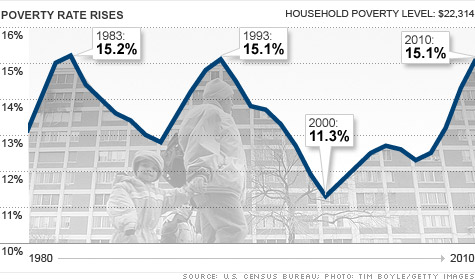
Chart courtesy of CNN Money
As of 2010, 1 in 6 Americans was living in poverty, according to a report from the Census Bureau today. The poverty rate was 15.1%, the highest number of Americans living below the poverty rate since the number has been examined. From the New York Times:
An additional 2.6 million people slipped below the poverty line in 2010, census officials said, making 46.2 million people in poverty in the United States, the highest number in the 52 years the Census Bureau has been tracking it, said Trudi Renwick, chief of the Poverty Statistic Branch at the Census Bureau.
That figure represented 15.1 percent of the country.
The poverty line in 2010 was at $22,113 for a family of four.
“It was a surprising large increase in the overall poverty rate,” said Arloc Sherman, senior researcher at the Center on Budget and Policy Priorities. “We see record numbers and percentages of Americans in deep poverty.”
The middle class has also lost ground in terms of yearly income.
And
…real median household incomes declined by 2.3 percent in 2010 from the previous year, to $49,400. That was 7 percent less than the peak in 1999 of $53,252.
“A full year into recovery, there were no signs of it affecting the well being of a typical American family,” said Lawrence Katz, an economics professor at Harvard. “We are well below where incomes were in the late 1990s.”
According to the census figures, the median annual income for a male full-time, year-round worker in 2010 — $47,715 — was virtually unchanged from its level in 1973, when the level was $49,065, in 2010 dollars, said Sheldon H. Danziger, professor of public policy at the University of Michigan.
As we all know, the rich have gotten much much richer and are continuing to get richer still because of the Bush/Obama economic policies. From CNN Money:
For middle-class families, income fell in 2010. The median household income was $49,445, down slightly from $49,777 the year before.
Median income has changed very little over the last 30 years. Adjusted for inflation, the middle-income family only earned 11% more in 2010 than they did in 1980, while the richest 5% in America saw their incomes surge 42%.
“Over that period of time, it’s not that the American economy has necessarily performed badly,” Osterman said. “As a country we’re richer over that period, but there’s been this real shift in where the income has gone, and it’s to the top.”
Amplifying that trend, the bottom 60% of households saw their income fall last year, while households making $100,000 or more enjoyed a rise in income.
CNN has a chart that shows the poverty level in each state, so you can check to see how people are doing in your neck of the woods. In general, the South is the worst off, and Louisiana and Mississippi have the highest percentages of people living below the poverty line.
I hope someone is showing this data to President Obama, because he needs to either do something about jobs and income inequality or follow LBJ’s example and get out of the way so we can find candidate who is able to show some leadership.
Is Obama’s Jobs Speech Just an Attempt to Distract Us From His Next Huge Sellout?
Posted: September 4, 2011 Filed under: Team Obama, The Media SUCKS, U.S. Economy, U.S. Politics, unemployment, We are so F'd | Tags: Barack Obama, distraction, donor base, free trade agreements, jobs speech, Robert Prasch, sellout, unemployment, voter base 8 Comments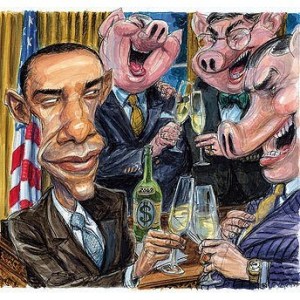
I came across a really provocative and perceptive post at HuffPo by Robert Prasch, an economics professor at Millbury college and author of the book How Markets Work: Supply, Demand, and “The Real World.” Prasch questions why Obama is giving a speech on jobs and unemployment now, since it has been clear from day one of his presidency that unemployment is a huge problem and since Obama and his closest advisers have shown no interest in doing anything about the problem other than periodically expressing “concern.” In Prasch’s words:
As a “rule of thumb,” it is a fair guess that the actual rate of unemployment is three-quarters again (1.75x) as high as the official or “headline” rate (BLS calculates a less-known data series called U-6 that validates this estimate). So, for example, with today’s official rate at 9.1%, it is reasonable to guess that 15.9% of the labor force is un- or under-employed (the U-6 number for August 2011 is 16.1%). This, then, is the context that best interprets the current “headline” rate of unemployment. It is, to put it mildly, a narrow definition that leaves out many people who we would usually consider unemployed. Contemplated alongside other numbers, it is evident that many American families are in desperate straights — and the situation is getting worse. Thirty percent of America mortgagees owe more on their home than its market value. As this percentage is continuing to rise, it is increasingly made up of “prime” borrowers. An amazing fifteen percent of all Americans are on foods stamps, including one-quarter of all children. This number is also rising. With so many families in such precarious condition, can anyone be surprised that wages are stagnating, unionization rates are declining, and the distribution of income is worsening?
This brings us to President Obama’s speech. Why now? After all, unemployment has been high since the day he took office. Actually, it rose initially and has remained high since. Early in his administration there was a half-hearted attempt to provide a “stimulus” to the economy, but the program was — even then — widely understood to be too small and too-heavily weighted toward tax cuts to be effective (For a criticism of tax cuts for the wealthy as an employment strategy see here). From the start it was evident that the administration’s core approach to the economy was to do whatever was necessary to support Wall Street’s largest and most irresponsible firms through thick and thin. The idea, if we can call it that, seems to have been that “trickle down” or the “invisible hand” would take care of the unemployed. So again, why now?
Prasch’s answer is both fascinating and maddening; and yet it makes a great deal of sense. He argues that the speech and any “jobs plan” along with any legislation that comes out of it, is designed to distract the media and the public while Obama and his real base–his donors–organize the passage of several free trade agreements that are strongly desired by the corporatocracy but despised by most Americans.
It is common knowledge that the White House plans to submit three completed “Free Trade” agreements to the Senate this September — South Korea, Colombia, and Panama. (As always, these treaties are primarily about guarantees and protections for financial and investment flows, restrictions on intellectual property, and related issues. But exploring their content will have to await another post.) With a remarkable sense of timing, the administration also plans to mark Labor Day 2011 by opening multi-party talks on a Trans-Pacific Free Trade Area. (Trade negotiators, lawyers, lobbyists, and hundreds of corporate honchos are invited to these talks — critical economists, civil society groups, and the public are not.) The President’s “voter base” is firmly opposed to these secretive and largely detrimental deals, as is the bulk of the American public. This opposition would most likely intensify if the public were fully briefed on their contents. Simultaneously, there is no question that the President’s “donor base” is highly enthusiastic about these deals — after all, they were in the room when the details were hammered out. Wall Street, the Chamber of Commerce, and the National Association of Manufacturers are beside themselves with excitement. The treaties promise extraordinary protection of financial and investment flows, innumerable exemptions from regulation, new and lucrative opportunities for off-shoring jobs, and political recognition and validation of the absence of labor protections and union rights that is a characteristic of most of these nations and regions. K-Street lobbyists can look forward to high fees and lavish banquets during and after the Senate vote. Big agricultural intermediaries look forward to crushing South Korean farmers with their heavily subsidized produce. This year, Colombia is on track to outperform its 2010 record of murdered unionists. If you’re a plutocrat or one of their paid representatives, what’s not to like?
My conjecture is that the forthcoming speech and any accompanying legislation was and is intended to provide political cover and a welcome distraction throughout the passage of these “Free Trade” treaties.
And, Prasch argues, any parts of the proposals that might actually help the unemployment problems will be stripped out by the Republicans, and Obama can claim that he really wanted to create jobs but the mean old Republicans wouldn’t allow it. The usual Obama apologists will defend the poor, put-upon president.
As I said this makes a lot of sense to me. And it makes me utterly livid. Obama is quickly becoming a laughing stock, but he doesn’t seem to care as long as he can please the ultra rich. I have to admit, I can’t understand how someone with such a huge ego can surrender his own dignity like this. But it’s happening. A child could see it at this point.

 peej
peej Carissa
 bostonboomer
 dakinikat
 ecocatwoman
 mablue2
 Mama Lopez
 peggysue22
 quixote
 skydancingguestblogger
 Mona (aka Wonk the Vote)



 Sky Dancing
Recent Comments