I used to spend nearly every weekend traveling between Council Bluffs, Iowa, and Kansas City. Both my grandparents lived there as well as my mother’s brother and sister and their families. I used to love the season when Kansas sunflowers bloomed. Goodland is the Sunflower Capitol there. It was a treat to see the endless fields of Sunflowers, the state flower of Kansas.
After the Hiroshima, Fukushima, and Chernobyl nuclear disasters, fields of sunflowers were planted across the affected landscapes to help absorb toxic metals and radiation from the soil. New research now suggests that sunflowers (Helianthus) might be as good for the environment as they are pretty to look at.
Sunflowers are what environmental scientists call hyperaccumulators– plants that have the ability to take up high concentrations of toxic materials in their tissues. Like all land-based plants, flowers have root systems that evolved as extremely efficient mechanisms for pulling nutrients, water, and minerals out of the ground, among them: zinc, copper, and other radioactive elements that are then stored in their stems and leaves.
While the sunflower-radiation link would seem like a slow-gestating cure-all for modern environmental disasters, the research is still inconclusive as to the efficacy of all sunflower varieties to help stave off environmental pollution. Post-tsunami clean-up efforts in Fukashima, however, demonstrate a promising application of this discovery.
One of the early successes in sunflower research came almost a decade ago when a phytoremediation company called Edenspace Systems completed a successful cleanup of a lead-laced plot in land in Detroit. (Phytoremediation is a technique for using plants to clean up contamination.)
‘Take these seeds and put them in your pockets so at least sunflowers will grow when you all lie down here,’ said the Ukrainian lady. ‘Put the sunflower seeds in your pockets, please. You will lie down here with the seeds. You came to my land. Do you understand? You are occupiers. You are enemies.’
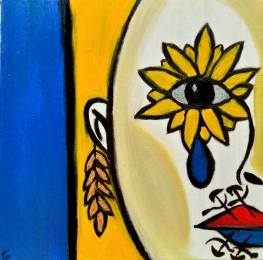
Artists around the world have been posting sunflower art with hashtags including #sunflowersforukraine to show solidarity with civilians in a powerful display of artistic expression. Meanwhile, Twitter and Instagram users have been adding sunflower emojis to their usernames as a subtle nod of support as Russia continues its devastating war on Ukraine.
In America, First Lady Jill Biden showed her support for Ukraine by wearing a face mask embroidered with a sunflower during an event at The White House, while in City Plaza in Reno, Nevada, residents gathered to add sunflowers to a ‘Believe’ sculpture to express their support for the country.
Meanwhile, over in the UK, Prince Charles and Camilla placed sunflowers on the altar during a visit to the Ukrainian Catholic Cathedral in London with Ukraine’s Ambassador to the UK, Vadym Prystaiko.
And at demonstrations in the city, supporters have been draped in the blue and yellow national flag of Ukraine, carrying sunflowers and wearing sunflower crowns in protests against Russian President Vladimir Putin.
This isn’t the first time the sunflower has been used as a symbol of peace. Back in June 1966, US, Russian and Ukrainian defence ministers planted sunflowers in a ceremony at Ukraine’s Pervomaysk missile base to mark Ukraine giving up nuclear weapons.
Sunflowers have been grown in Ukraine since the 1700s (the country is also the world’s major supplier of sunflower oil). According to historical records, the sunflower became deeply embedded in the Ukrainian culture when the church didn’t ban its oil during Lent — a time of abstinence. Since then, sunflower oil has become an important aspect of daily life in Ukraine, with many civilians growing the golden flowers in their gardens and eating their seeds as a snack.
And yes, today’s post is resplendent with artists of Ukraine and their take on their precious Sunflowers. Some of the works of contemporary artists are for sale. Buying art would be a great way to support Ukraine and continue its cultural contribution in arts!
I also am going to gratuitously use the infamous LBJ Daisy Ad from 1964 followed by the Mother and Child Ad. That year I was 8 and was getting quite good and the duck and dive exercises. I was hoping never to relive that kind of weirdness but here I am in my dotage, worrying about a mad man again. Will he bury us?
What is most frustrating is watching Putin escalate the war by committing war crimes like this from the AP: “Pregnant woman, baby die after Russia bombed maternity ward.” I do not understand what this does other than terrorize a peaceful nation and cement world determination to rid the world of the Russian Despot.
Burns is a former U.S. ambassador to Moscow who has met with Putin many times. He told lawmakers in response to a question about the Russian president’s mental state that he did not believe Putin was crazy.
“I think Putin is angry and frustrated right now,” he said. “He’s likely to double down and try to grind down the Ukrainian military with no regard for civilian casualties.”
Russia’s recent unsupported claims that the U.S. is helping Ukraine develop chemical or biological weapons suggest that Putin may himself be prepared to deploy those weapons in a “false flag” operation, Burns said.
There’s no apparent path to ending the war. It is nearly inconceivable that Ukrainian President Volodymyr Zelenskyy, who has won admiration around the world for leading his country’s resistance, would suddenly recognize Russia’s annexation of Crimea or support granting new autonomy to Russian-friendly parts of eastern Ukraine. And even if he captures Kyiv and deposes Zelenskyy, Putin would have to account for an insurgency supported by the West in a country of more than 40 million.
“He has no sustainable political end-game in the face of what is going to continue to be fierce resistance from Ukrainians,” Burns said.
European leaders are still trying to maintain dialogue with Putin. Prime Minister Xavier Bettel of Luxembourg spoke Monday with Putin and “pleaded for an immediate ceasefire,” according to Bettel’s tweet. A spokesperson said Bettel was encouraged to contact Putin by other leaders who “wanted to make sure Putin would continue talking with them.” Bettel also spoke with Zelenskyy.
Avril Haines, President Joe Biden’s director of national intelligence, said Putin “perceives this as a war he cannot afford to lose. But what he might be willing to accept as a victory may change over time given the significant costs he is incurring.”
Intelligence analysts think Putin’s recent raising of Russia’s nuclear alert level was “probably intended to deter the West from providing additional support to Ukraine,” she said.
In hopeful news, a real freedom convey of 160 cars filled with civilians left the besieged city of Mariupol. Ukrainian families begin their life as refugees throughout Europe. Ted Cruz and those truckers driving circles around the District need to get a life.
— 🦎₵Ⱨ₳₥ɆⱠɆØ₦🦎 (Photoshop Artist For Hire) (@bewarchameleon) March 14, 2022
#UPDATE The number of refugees who have fled Ukraine since the Russian invasion began on February 24 has topped 2.8 million, the United Nations said Mondayhttps://t.co/08FD4ppQZT
Maria Primachenko, May I Give This Ukrainian Bread to All People in This Big Wide World Maria Primachenko Original Title: Дарую українську паляницю всім людям на землі Date: 1982
“Ripeness is all,” noted Edgar in Shakespeare’s King Lear. When it comes to negotiations to limit or end international conflicts, he is right: agreements emerge only when the leading protagonists are willing to compromise and are then able to commit their respective governments to implement the accord.
This truth is highly relevant to any attempt to end the war between Russia and Ukraine through diplomacy. Ukrainian President Volodymyr Zelensky has any number of reasons to end a conflict that has already killed thousands of his citizens, destroyed large parts of several major cities, rendered millions homeless, and devastated Ukraine’s economy. And his standing has grown by the hour, giving him the political strength to make peace – not at any price, but at some price.
Already, there are signs he might be willing to compromise on NATO membership. He would not recognize Crimea as being part of Russia, but it might be possible for him to accept that the two governments agree to disagree on its status, much as the United States and China have done for a half-century concerning Taiwan. Similarly, he would not recognize the independence of the Donetsk and Luhansk “people’s republics,” but he could sign on to their being given significant autonomy.
The question is whether even this would be enough for Russian President Vladimir Putin, who has demanded the “de-Nazification” of Ukraine, a phrase that seems to call for regime change, as well as the country’s total demilitarization. Given that he has questioned whether Ukraine is a “real” country, it is hard to avoid the conclusion that he remains uninterested in coexisting with a legitimate government of a sovereign, independent state. So far, Putin has demonstrated he is more interested in making a point than in making a deal.
What could change this? What could make the situation riper for a negotiated solution? That is actually the purpose of the West’s policy: to raise the military and economic costs of prosecuting the war so high that Putin will decide that it is in his interest (he clearly cares little about the interests of Russia) to negotiate a ceasefire and accept terms that would bring peace. Again, this seems unlikely, if only because Putin almost certainly fears it would be interpreted as a sign of weakness, encouraging resistance to his continued rule.
Alternatively, he could be pressured to negotiate. In principle such pressure could come from below – a Russian version of “people power” in which the security services are overwhelmed, much as they were in Iran in the late 1970s. Or pressure could come from the side, from the few others who wield power in today’s Russia and could decide that they must act before Putin destroys more of Russia’s future than he already has. The former does not seem to be in the offing, given mass arrests and control of information, and there is simply no way of knowing if the latter might happen until it does.
There are more situations discussed at the link.
Well, that’s it for me! I’m going to go plant some sunflowers to hide the back fence! It’s always fun to watch them follow the sun!
What’s on your reading and blogging list today?
Did you like this post? Please share it with your friends:
The war in Ukraine continues, and although the Ukrainian military is fighting valiantly and the Russians are struggling, the bad guys are likely to win in the end. IMHO, the U.S. and NATO need to do more to help Ukraine. I’ll offer some serious reads on the situation, but first a little furry break from the madness.
Cat cafes are a purrfect way to enjoy the company of felines while you sip a tasty drink. The beloved Cat Cafe Lviv is no exception. It’s been open for six years and the small team in Lviv, Ukraine, is devoted to its 20 furry residents. So devoted, in fact, that owner Serhii Oliinyk is choosing to stay at the cafe despite the Russian invasion in his country.
“Our cats have been living in [the] cat cafe since the age of 4 months,” Oliinyk explained. “They are like family. We realized that we would never leave our country, that this was the only place where we could see ourselves in the future.”
Cat Cafe Lviv is open (according to its Facebook page) and is dedicated to providing a safe space for people to stop by and see the kitties who reside there. Hopefully, the cats’ presence and purrs offer a momentary reprieve to the stark realities of what’s going on just beyond the walls.
“We currently have fewer regular visitors, but there are people who have come from other cities and need hot food and positive emotions,” Oliinyk said. “There are three large rooms in our cafe, two of which are located in the basement, so in case of an air raid warning, there is a safe shelter for our guests and cats.”
Alongside images of destruction and resistance, the visual story of Russia’s invasion of Ukraine has included a fair bit of cats and dogs. The Albanian Times shared a story of Ukrainian soldiers taking in a puppy left in the cold. Facebook posts tout soldiers cuddling cats and show families refusing to leave their pets behind as they flee. Famed Twitter Maine coon Lorenzo the Cat shared the story of Aleksandra Polischuk, a breeder of sphinx cats who was killed when her home was destroyed. And of course, Twitter couldn’t help but go aww at the photos of Ukrainian President Volodymyr Zelensky and his dogs.
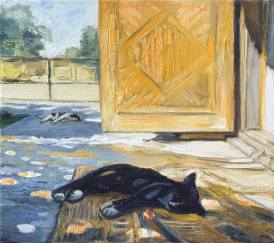
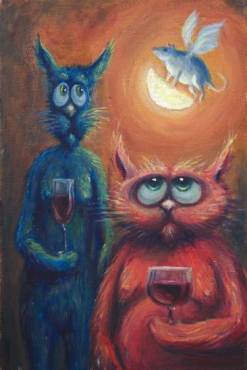
Kateryna Zavadska, Cool cat
It would be easy to position cat and dog content in a warzone as contradictory to conflict. But pet and animal content aren’t the opposite of war—they’re a part of it. Every pet image coming out of Ukraine right now shows a human impacted by the war in some way. In the above-listed examples, every story of a rescued dog or a cuddling cat was bookended by the actions of people.
Animals remind us of our own humanity, and they can be stark reminders of the human face of geopolitical strife. These cat and dog images coming out of Ukraine remind us, paradoxically, that there are real, individual people on the frontlines. There are real, individual people whose lives are forever changed by this aggression. These aren’t just images of animals in conflict, but reminders of the humans who take care of them and fight on the ground.
It is no accident that we flock to cat content online. It is also not a coincidence that these stories of pets and animal in war circulate widely on the internet. The internet is an ideal space for this type of sharing, as pet and animal images help keep digital spaces lighthearted and fun. Pet and animal images are often the opposite to “doomscrolling,” or the endless scrolling through negative, serious, and depressing news online. Right now, as we doomscroll through a war, cute pet and animal content provides relief, but in conjunction with the war photos themselves, reminds us of the human cost of conflict.
There’s also another side to this phenomenon. Read about it at Slate.
Now back to the news of the day.
At the New Yorker, an interview with Russia scholar that is getting a lot of attention: The Weakness of the Despot. An expert on Stalin discusses Putin, Russia, and the West, by David Remnick
Stephen Kotkin is one of our most profound and prodigious scholars of Russian history. His masterwork is a biography of Josef Stalin. So far he has published two volumes––“Paradoxes of Power, 1878-1928,” which was a finalist for the Pulitzer Prize, and “Waiting for Hitler, 1929-1941.” A third volume will take the story through the Second World War; Stalin’s death, in 1953; and the totalitarian legacy that shaped the remainder of the Soviet experience….
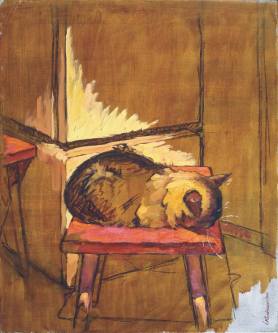
Olena Kamenetska-Ostapchuk, Siesta
Kotkin has a distinguished reputation in academic circles. He is a professor of history at Princeton University and a senior fellow at the Hoover Institution, at Stanford University. He has myriad sources in various realms of contemporary Russia: government, business, culture….
Earlier this week, I spoke with Kotkin about Putin, the invasion of Ukraine, the American and European response, and what comes next, including the possibility of a palace coup in Moscow.
You’ll need to go to The New Yorker to read the whole interview, but here’s an excerpt.
What is Putinism? It’s not the same as Stalinism. It’s certainly not the same as Xi Jinping’s China or the regime in Iran. What are its special characteristics, and why would those special characteristics lead it to want to invade Ukraine, which seems a singularly stupid, let alone brutal, act?
Yes, well, war usually is a miscalculation. It’s based upon assumptions that don’t pan out, things that you believe to be true or want to be true. Of course, this isn’t the same regime as Stalin’s or the tsar’s, either. There’s been tremendous change: urbanization, higher levels of education. The world outside has been transformed. And that’s the shock. The shock is that so much has changed, and yet we’re still seeing this pattern that they can’t escape from.
You have an autocrat in power—or even now a despot—making decisions completely by himself. Does he get input from others? Perhaps. We don’t know what the inside looks like. Does he pay attention? We don’t know. Do they bring him information that he doesn’t want to hear? That seems unlikely. Does he think he knows better than everybody else? That seems highly likely. Does he believe his own propaganda or his own conspiratorial view of the world? That also seems likely. These are surmises. Very few people talk to Putin, either Russians on the inside or foreigners.
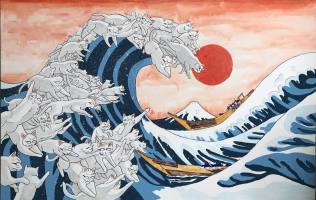
Anastasiia Atamanchuk, Fuji Cats
And so we think, but we don’t know, that he is not getting the full gamut of information. He’s getting what he wants to hear. In any case, he believes that he’s superior and smarter. This is the problem of despotism. It’s why despotism, or even just authoritarianism, is all-powerful and brittle at the same time. Despotism creates the circumstances of its own undermining. The information gets worse. The sycophants get greater in number. The corrective mechanisms become fewer. And the mistakes become much more consequential.
Putin believed, it seems, that Ukraine is not a real country, and that the Ukrainian people are not a real people, that they are one people with the Russians. He believed that the Ukrainian government was a pushover. He believed what he was told or wanted to believe about his own military, that it had been modernized to the point where it could organize not a military invasion but a lightning coup, to take Kyiv in a few days and either install a puppet government or force the current government and President to sign some paperwork.
I haven’t read the whole piece yet, but I plan to read the rest–even though some of it is over my head. There’s also a video of the entire interview at the New Yorker link.
In describing Vladimir Putin and his inner circle, I have often thought of a remark by John Maynard Keynes about Georges Clemenceau, French prime minister during the first world war: that he was an utterly disillusioned individual who “had one illusion — France”.
Something similar could be said of Russia’s governing elite, and helps to explain the appallingly risky collective gamble they have taken by invading Ukraine. Ruthless, greedy and cynical they may be — but they are not cynical about the idea of Russian greatness.
The western media employ the term “oligarch” to describe super-wealthy Russians in general, including those now wholly or largely resident in the west. The term gained traction in the 1990s, and has long been seriously misused. In the time of President Boris Yeltsin, a small group of wealthy businessmen did indeed dominate the state, which they plundered in collaboration with senior officials. This group was, however, broken by Putin during his first years in power.
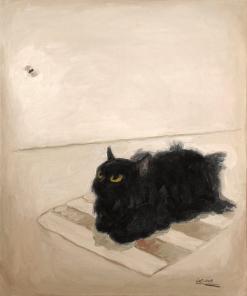
Ivan Kolisnyk, A Fly
Three of the top seven “oligarchs” tried to defy Putin politically. Boris Berezovsky and Vladimir Gusinsky were driven abroad, and Mikhail Khodorkovsky was jailed and then exiled. The others, and their numerous lesser equivalents, were allowed to keep their businesses within Russia in return for unconditional public subservience to Putin. When Putin met (by video link) leading Russian businessmen after launching the invasion of Ukraine, there was no question of who was giving the orders.
The force that broke the oligarchs was the former KGB, reorganised in its various successor services. Putin himself, of course, came from the KGB, and a large majority of the top elite under Putin are from the KGB or associated state backgrounds (though not the armed forces).
This group have remained remarkably stable and homogenous under Putin, and are (or used to be) close to him personally. Under his leadership, they have plundered their country (though unlike the previous oligarchs, they have kept most of their wealth within Russia) and have participated or acquiesced in his crimes, including the greatest of them all, the invasion of Ukraine. They have echoed both Putin’s vicious propaganda against Ukraine and his denunciations of western decadence.
The Biden administration, under pressure to expand the arsenal of weapons that Ukraine has in its conflict with Russia, is working with European allies to expedite more sophisticated air-defense systems and other armaments into the war zone, U.S. officials said Friday.
Discussions were ongoing ahead of Defense Secretary Lloyd Austin’s planned trip next week to meet with NATO allies in Brussels and Slovakia, which along with Poland and Romania has indicated a willingness to transfer military aid to its embattled neighbor. Slovakia also possesses the S-300 surface-to-air missile system, which is used to shoot down enemy aircraft and is familiar to the Ukrainians.
Pentagon spokesman John Kirby told reporters that the United States is committed to arming the government in Kyiv with “the kinds of capabilities that we know the Ukrainians need and are using very well.” He declined to specify what types of weapons could be included in the next wave of shipments.
“Some of that material we have and are providing. Some of that material we don’t have but we know others have, and we’re helping coordinate that as well,” Kirby said.
The administration is facing backlash over its decision earlier this week to scuttle Poland’s proposal that would have sent a number of its MiG-29 fighter jets to Ukraine via a transfer “free of charge” to the United States. Washington, citing concerns that Russia would view the move as a provocation, said the offer from Warsaw was not “tenable.”
American officials are examining the ownership of a $700 million superyacht currently in a dry dock at an Italian seacoast town, and believe it could be associated with President Vladimir V. Putin of Russia, according to multiple people briefed on the information.
United States intelligence agencies have made no final conclusions about the ownership of the superyacht — called the Scheherazade — but American officials said they had found initial indications that it was linked to Mr. Putin. The information from the U.S. officials came after The New York Times reported on Tuesday that Italian authorities were looking into the 459-foot long vessel’s ownership and that a former crew member said it was for the use of Mr. Putin….
American officials said Mr. Putin kept little of his wealth in his own name. Instead he uses homes and boats nominally owned by Russian oligarchs. Still, it is possible that through various shell companies, Mr. Putin could have more direct control of the Scheherazade.
Both the Treasury Department’s Office of Intelligence and Analysis and the Navy’s Office of Naval Intelligence are investigating the ownership of superyachts associated with Russian oligarchs. A spokesman for the Navy and a spokeswoman for the Treasury both declined to comment.
The Justice Department has set up a task force to go after the assets of sanctioned Russian oligarchs. In a discussion with reporters on Friday, a Justice Department official said the task force would be investigating individuals who help sanctioned Russian officials or oligarchs hide their assets. Those individuals could face charges related to sanctions violations or international money laundering charges.
Head over to the NYT to read details about the yacht and how it and other Russian oligarch-owned super yachts could be seized.
There are lots of serious articles on the Ukraine crisis today. Here are a few more to check out:
I’m getting exhausted emotionally by the war news. I want to read more today, but I guess I need to pace myself. I hope you all are taking good care of yourselves amid all the scary news.
Did you like this post? Please share it with your friends:
The images in this post are by famous Ukrainian artists. You can read more about them at this Odessa Journal link.
Well it really happened last night. Russia attacked multiple Ukrainian cities. There is a massive amount of reporting and commentary; I can only offer a sampling.
After his declaration of war just before 6 a.m. Moscow-time, the Ukrainian government reported airstrikes at military facilities in the cities of Kyiv, Kharkiv and Dnipro, as well as artillery fire on the border. The authorities in Kyiv reported a pincer movement attack on its troops from Belarus to the north, potentially attempting an encirclement of Kyiv, and from Crimea to the south. Russia insisted it was destroying military bases and airfields, not civilian targets.
Ukraine warned that Moscow was turning to propaganda tricks by suggesting that Russian troops were not meeting resistance and by exhorting Ukrainians to lay down their weapons. Kyiv insisted that its troops were locked in heavy fighting, had shot down seven warplanes, destroyed dozens of armored vehicles and killed dozens of enemy soldiers. Fighting has drawn very close to Kyiv and Kharkiv.
Adviser to the Ukrainian presidential office Oleksiy Arestovych vowed that the Russian forces would not reach the capital. “Fierce battles will be waiting for them there, we will stop them,” he was quoted as saying by local media.
In a sign of the desperate straits Ukraine is facing against a stronger adversary, however, Ukrainian President Volodymyr Zelenskiy called for a general mobilization. The country also put out an appeal for blood donors as news began to filter in of dozens of Ukrainian casualties across the country.
By Kateryna Primachenko
U.S. President Joe Biden vowed a united response against the Russian attack by Washington and its allies, while U.N. Secretary-General António Guterres said: “President Putin, in the name of humanity, bring your troops back to Russia. This conflict must stop now.” Later on Thursday, the EU is set to agree a sanctions package intended to weaken Putin’s ability to wage war, though there was no immediate sign that it would touch all-important energy revenues.
Earlier on Thursday, Zelenskiy imposed martial law and said he had contacted Biden to co-ordinate an international response. “Today we need calm from each of you. Stay at home if possible. We are working, the army is working, the whole security apparatus of Ukraine is working.” Foreign Minister Dmytro Kuleba called for “devastating” sanctions on Russia and for weapons’ deliveries to the Ukrainian military.
Vitaly Klitschko, mayor of Kyiv and former heavyweight boxing champion, told people to have an emergency suitcase ready in case they needed to get to shelNAter.
In his Feb. 15 Just Security article “Ukraine: Unleashing the Rhetorical Dogs of War,” Barry Posen argued that NATO and Ukraine should have cut a deal with Russia because the Ukrainian military would surely be defeated by Russia without direct U.S./Western military participation and U.S. offers of equipment were only encouraging a potential Ukrainian insurgency against Russian occupation that would be as bloody as it would be futile. The prescription depends entirely on Posen’s assumption that to satisfy Russia, all Ukraine would have had to do would be “to swallow the bitter pill of accepting armed neutrality between NATO and Russia, rather than NATO membership.”
This assumption contradicts events of recent months and the historical record. While Vladimir Putin has claimed that his goal is keeping Ukraine out of NATO, he also insisted that he was just conducting military exercises. Instead, he is invading Ukraine again. He likewise insisted in 2014 that he wasn’t capturing Crimea, despite the presence of his unidentified “Little Green Men” and his subsequent annexation of the peninsula, or that he was not fighting in Ukraine’s Donbas area in the east all these years, despite all evidence to the contrary. There is no reason to take Putin at his word. His Feb. 21 diatribe conferring Russian recognition of independence for the two eastern Ukrainian regions of Donetsk and Luhansk and his order for Russian troops to move in as ostensible “peacekeepers” shows clearly his disdain for diplomatic resolutions.
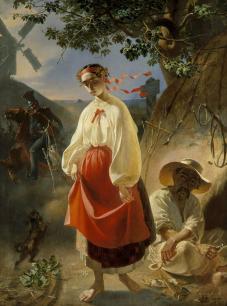
Katerina, by Taras Grigorievich Shevchenko, 1842
Moreover, this is not even primarily about NATO.
NATO’s eastward expansion may have played a role in straining the relationship between Russia and the West, but mainly because, for Russia, seeing former satellites eagerly abandon it for the greener pastures of Euro-Atlantic integration stung. However, Putin’s rhetoric and actions over almost two decades reveal that his goals extend beyond imposing neutrality on Ukraine or even staving off further NATO expansion. The larger objective is to re-establish Russian political and cultural dominance over a nation that Putin sees as one with Russia, and then follow up by undoing the European rules-based order and security architecture established in the aftermath of World War II. Given these goals, Ukrainian neutrality is a woefully insufficient concession for Putin.
UNITED NATIONS — U.N. Secretary-General Antonio Guterres says Russia’s attack on Ukraine — as he appealed for President Vladimir Putin to stop his troops — was “the saddest moment” of his five-year tenure.
The U.N. chief opened the emergency Security Council meeting late Wednesday by urgently appealing to Putin: “In the name of humanity, bring your troops back to Russia.”
But during the meeting, Putin announced that he was launching a “special military operation” in eastern Ukraine.
Guterres later urged the Russian president to withdraw his troops and added: “In the name of humanity do not allow to start in Europe what could be the worst war since the beginning of the century, with consequences not only devastating for Ukraine, not only tragic for the Russian Federation, but with an impact we cannot even foresee in relation to the consequences for the global economy.”
A war would cause deaths and displacement and people will lose hope in the future, Guterres said, adding Russia’s actions would harm the global economy.
“What is clear for me is that this war doesn’t make any sense,” Guterres said, stressing that it violates the U.N. Charter and will cause a level of suffering if it doesn’t stop that Europe hasn’t know since at least the 1990s Balkans crisis.
Set to address the nation Thursday afternoon, Biden is expected to unveil new measures that could cut off Russia from advanced technology, announce new restrictions on large financial institutions and slap sanctions on additional members of the inner circle of Russian President Vladimir Putin.
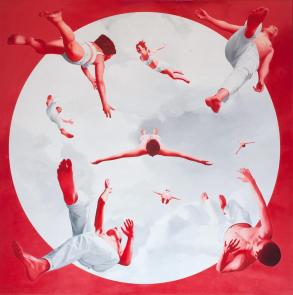
Victor Sidorenko, Expiration Levitation Series
The planned sanctions, the latest US reprisals against Moscow this week, had been reserved as Biden hoped to maintain some leverage in dissuading Putin from a full-scale invasion. But so far, Western threats of economic punishment, as well as Biden’s strategy of revealing what the US knew about Putin’s buildup of forces to try to make the Russian leader second-guess himself, have proven ineffective.
After months of predictions and warnings, Russian forces began their attack on Ukraine Thursday morning local time, with reports of troops crossing the border to the north and south, explosions in multiple cities including the capital Kyiv, and warnings from Putin of future bloodshed unless Ukrainian forces lay down their arms.
Biden’s sanctions are now meant to punish Putin’s actions, rather than prevent them, by going after Russia’s economy, its military capabilities and those closest to the Russian President. How much they can alter Putin’s decision-making going forward, however, remains an open question.
Before he speaks, Biden is planning to confer with the leaders from the Group of 7 industrialized nations about which sanctions they plan to impose, hoping to coordinate a response that projects unity among Western allies. US and European officials spoke by phone overnight into Thursday to coordinate their responses.
The phoney war is over. The real war has begun. For several weeks, the US and British governments have believed that Vladimir Putin was intent on a full-scale invasion of Ukraine. That is now happening.
The precise targets of the Russian military are still emerging. But it is already clear that this is not a limited attack, confined to the disputed regions of eastern Ukraine. Explosions have been heard in the Ukrainian capital, Kyiv. And there are reports of Russian troops crossing the border from Belarus — which is the shortest and most direct route to Kyiv.
Western security services, which have accurately predicted the course of events up until now, believe that Putin intends to overthrow the Ukrainian government and install a puppet regime in its place. This “decapitation” strategy will take in not only the central government, but also regional and local governments. Lists have been drawn up of Ukrainian officials who will be arrested or killed.
By Kateryna Bilokur
The military tactics that Russia uses are likely to be extremely brutal — “the kind of thing we saw in Syria and Chechnya”, according to one US official. The deployment of Russian artillery and its air force would mean heavy military and civilian casualties on the Ukrainian side. Some western sources have spoken of 50,000 deaths within a week.
The Ukrainian military is determined to fight back. But it is likely to find itself heavily outgunned. The Russian goal may be to surround Kyiv and force the collapse or resignation of the Ukrainian government, led by Volodymyr Zelensky.
The Russians will not want to get involved in urban warfare, if they can avoid it. They are also determined to keep the west out of this conflict. In his speech, announcing the invasion, Putin warned outsiders tempted to interfere that there would be “consequences you have never encountered in your history” — a thinly veiled reference to nuclear war.
This is a terrifying article that concludes by asking whether Western states could end up getting involved.
Western governments are also actively debating how to help a Ukrainian insurgency — if and when it emerges — to fight a Russian occupation. Supporters of this plan of action believe that it will be both a moral duty and a strategic imperative to allow Ukrainians to continue the fight. Others worry that supporting an insurgency could turn Ukraine into a new Syria on the borders of Europe.
MOSCOW — Waiting for her friends on Moscow’s primly landscaped Boulevard Ring earlier this week, Svetlana Kozakova admitted that she’d had a sleepless night. She kept checking the news on her phone after President Vladimir V. Putin’s aggrieved speech to the nation on Monday that all but threatened Ukraine with war.
“Things are going to be very, very uncertain,” she said, “and, most likely, very sad.”
For months, Russians of all political stripes tuned out American warnings that their country could soon invade Ukraine, dismissing them as an outlandish concoction in the West’s disinformation war with the Kremlin. But this week, after several television appearances by Mr. Putin stunned and scared some longtime observers, that sense of casual disregard turned to a deep unease.
You’re My Space, by Evgeniya Gapchinskaya, 2019
Early Thursday morning, any remaining skepticism that their country would invade was put to rest, when Mr. Putin declared a “special military operation” in Ukraine.
Pollsters said that most Russians probably supported Mr. Putin’s formal recognition of the Russian-backed territories in eastern Ukraine this week, especially because they had no choice in the matter and because no significant political force inside the country has advocated against it.
War is a different matter altogether, though; in recent days, Russia has not seen any of the jubilation that accompanied the annexation of Crimea in 2014.
Going to war is one of Russians’ greatest fears, according to the Levada Center, an independent pollster. And after Mr. Putin’s angry speech and his cryptic televised meeting with his Security Council on Monday, Russians realized that possibility was lurching closer toward becoming reality.
In the midst of an international crisis created by Russia that could potentially trigger a war in Europe, Republicans and right-wingers on and off Fox News have pledged allegiance to…Vladimir Putin. At the least, they are siding with the Russian autocrat and trash-talking President Joe Biden’s effort to block his aggression. But there’s nothing surprising about the ongoing romance between conservatives and the democracy-crushing thug-leader of Russia, who has invaded Ukraine and violated international law. Anyone shocked by this has forgotten one of the key facts of the 21st century: Putin waged war on the United States, and Donald Trump and his party aided, abetted, and benefitted from that attack.
In recent days, as Putin has threatened a conflagration, top conservatives and GOP officials have practically pinned “I’m-with-Vlad buttons” onto their lapels. One example: Mike Pompeo, Trump’s final secretary of state and before that his CIA director, had only praise for the corrupt Russian autocrat, describing him as “talented” and “savvy.” Donald Trump, speaking to a conservative podcaster on Tuesday, hailed Putin’s moves in Ukraine as “genius.” Referring to Putin’s invasion of eastern Ukraine, Trump said, “Putin declares a big portion of…of Ukraine. Putin declares it as independent. Oh, that’s wonderful…I said, ‘How smart is that?’ And he’s gonna go in and be a peacekeeper…Here’s a guy who’s very savvy.” Later in the interview, Trump continued to gush: “I knew Putin very well. I got along with him great. He liked me. I liked him. I mean, you know, he’s a tough cookie, got a lot of the great charm and a lot of pride. But the way he—and he loves his country, you know? He loves his country.”
No condemnation. No call for opposing Putin’s illegal and provocative maneuvers. Just one big bear hug from Trump for the tyrant. Putin may spread repression by force but he sure “loves his country.” (Remember, Trump’s crush on Putin stretches back to 2013 when he tweeted: “Do you think Putin will be going to The Miss Universe Pageant in November in Moscow—if so, will he become my new best friend?”)
Eve, by Ivan Marchuk
Conservatives have also boosted Putin by pooh-poohing the invasion of Ukraine as no big deal. In his usual too-clever-by-half way, Tucker Carlson on Tuesday night dismissed outrage over Putin’s aggression:
What is this really about? Why do I hate Putin so much? Has Putin ever called me a racist? Has he threatened to get me fired for disagreeing with him? Has he shipped every middle-class job in my town to Russia? Did he manufacture a worldwide pandemic that wrecked my business and kept me indoors for two years? Is he teaching my children to embrace racial discrimination? Is he making fentanyl? Is he trying to snuff out Christianity? Does he eat dogs?
It seemed as if Carlson was quasi-defending Putin because the Russian leader does not advocate critical race theory and is not the leader of China. He ridiculed concerns over Putin’s threat to world peace and stability and asserted Americans are being “trained to hate” the Russian leader. In other words, there’s no reason to fret about Putin’s militarism—and if you do worry, you’re just a brainwashed sheep.
Read the rest at Mother Jones.
So here we are. I have no idea what’s coming, but I’m very worried. After four years of Trump, and two years of a deadly pandemic, we don’t need any more calamities.
I’ll try to post updates in the comment thread today. I have difficulty looking at the computer screen for very long these days, but I’ll do my best. I hope you all will post comments and links too. Take care everyone!
Did you like this post? Please share it with your friends:
The Sky Dancing banner headline uses a snippet from a work by artist Tashi Mannox called 'Rainbow Study'. The work is described as a" study of typical Tibetan rainbow clouds, that feature in Thanka painting, temple decoration and silk brocades". dakinikat was immediately drawn to the image when trying to find stylized Tibetan Clouds to represent Sky Dancing. It is probably because Tashi's practice is similar to her own. His updated take on the clouds that fill the collection of traditional thankas is quite special.
You can find his work at his website by clicking on his logo below. He is also a calligraphy artist that uses important vajrayana syllables. We encourage you to visit his on line studio.











 peej
peej Carissa
 bostonboomer
 dakinikat
 ecocatwoman
 mablue2
 Mama Lopez
 peggysue22
 quixote
 skydancingguestblogger
 Mona (aka Wonk the Vote)



 Sky Dancing
Recent Comments