
Tuesday Reads: Who Will Win Control of the U.S. Senate?
Posted: October 7, 2014 Filed under: morning reads, U.S. Politics | Tags: U.S. Senate races 2014 46 Comments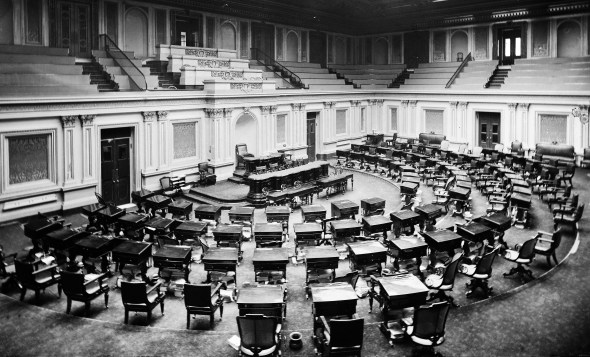
U.S. Senate Chamber, 1873
Good Morning!!
I’ve been trying to avoid thinking about the midterm elections, because I’m really afraid the Republicans are going to take over the Senate; and I just can’t stand to think about the implications of that possibility. But I was really inspired by Dakinikat’s post yesterday on the importance of voting; so this morning I decided to take a look at what has been going on while I’ve been permitting myself to be in denial. After all, it is only about a month until election day.
The first thing I noticed is that there is an interesting war of words going on between two election stats geeks, Nate Silver of 538 blog fame and lesser known Sam Wang of Princeton University. The battle is all about whose predictions about which party will control the U.S. Senate in 2015. Silver’s model says the Republicans will win, and Wang’s favors the Democrats holding control. A few links to peruse:
Salon, October 3: Nate Silver unloads on Princeton rival in blistering critique.
Nate Silver is bringing out the knives for fellow political prognosticator and bitter rival Sam Wang, penning a sharply-worded critique that assails Wang’s model as fundamentally “flawed.”
A primer on the war among wonks: Thirty-two days out from Election Day, most forecasters expect Republicans to net the six seats necessary to win control of the U.S. Senate. Silver’s FiveThirtyEight.com, for instance, currently gives Republicans a 58 percent chance of capturing the majority. And as Silver notes in a post for Taegan Goddard’s Political Wire, virtually every other leading forecaster pegs the GOP’s chances for Senate control at somewhere between 58 and 78 percent. Wang’s model, however, gives Democrats a 58 percent chance of maintaining Senate power (down from 70 percent last month).
Why the discrepancy? Wang, a Princeton neuroscientist, says it boils down to polling vs. “fundamentals.” In forecasting electoral outcomes, FiveThirtyEight weighs both recent poll results and the dynamics of each contest – the partisan lean of the state, demographic makeup, and so on. Wang’s model relies only on polls.

If Silver is so sure he’s right, why is he all worked up about Wang’s predictions? From Talking Points Memo: What’s Eating Nate Silver?
Nate Silver acknowledged that he was doing something a little unusual in a Sept. 17 blog post when he called out fellow forecaster Sam Wang of Princeton University. But it also appears to have been the culmination of a long-simmering — if largely under-the-radar — feud.
“I don’t like to call out other forecasters by name unless I have something positive to say about them — and we think most of the other models out there are pretty great,” Silver wrote. But he then labeled Wang’s model “wrong” and provided a detailed argument (with footnotes) to explain why he thought so.
And it didn’t stop there. Periodically over the last week or so, Silver has continued to take shots on Twitter at Wang’s forecasting model, which has consistently been more optimistic about Democratic odds of keeping the Senate than Silver’s (or any other forecaster).
That led to a lot of buzz in the tiny world of poll nerds and a series of pained responses on Twitter from Wang. In separate interviews with TPM, Silver declined to say what exactly provoked him but said Wang had been “deceptive” in characterizing their disagreement while, for his part, Wang continued to chide Silver, particularly for refusing to engage with him directly.
Read some of the tweets at the TPM link. Wang isn’t sure what Silver is upset about either.
In a phone interview with TPM this week, Wang said that he had emailed Silver since the flare-up but has not heard back from him yet. He referenced more than once his relatively meager 6,500 Twitter followers versus Silver’s 959,000.
“He’s the Kim Kardashian here,” Wang said. “Certainly anything he says is impossible to ignore because of his 950,000 Twitter followers. It’s just right there for anybody to see. I actually tried to ignore it for a while, but it got hard because he just didn’t give up.”
Silver declined to comment to TPM about why he had critiqued Wang publicly, when it is his self-described habit not to, or on why he had not engaged with Wang directly….
Silver described what he sees as the problem with how Wang averages his polls. “The way he does it is he looks back at average snapshots (of polls) since June,” Silver said. “That’s like looking at the average score of the football game, instead of the current score… It’s a very strange assumption.”
“He should provide evidence that it’s a good sound empirical way to do it and he doesn’t,” he continued. “And I think he’s not aware of how much difference that makes.”

Sam Wang
Read much more at the link. The problem for Silver is that Wang’s predictions have actually been at least as accurate or more accurate than Silver’s over the long run. Again from TPM, Wang: My Model Has ‘Matched Or Outperformed’ Silver’s Since 2008.
“He has made a number of factual and conceptual errors,” Wang wrote in reference to Silver. “If an experienced analyst like him could make those misreadings, so could many people.”
Wang then lays out five points on which he believes Silver has misunderstood his model. He also, on more than one occasion, notes that his forecast has been often been “superior to” Silver’s Five Thirty Eight forecast, dating back to 2008 and particularly regarding Senate races.
“Of perhaps greatest interest is the fact that on Election Eve in 2012, PEC called every close Senate race correctly – 10 out of 10,” Wang wrote. “Silver is protesting against a model that has consistently matched or outperformed his own calls since he came onto the scene (see 2008, 2010, and 2012).”
One more link, from The Daily Beast, Why Is Nate Silver So Afraid of Sam Wang?
Why is Nate Silver so scared of Sam Wang? Silver, who is legendary for his election forecasts, is the darling of political empiricists, sitting atop his personal empire of data-driven journalism at ESPN. Wang is a Princeton professor who also predicts elections, but he’s hardly a household name. So why won’t Silver leave him alone?
The two crystal ball gazers have been engaged in a running battle on Twitter, on their own websites, and in the media at large. Silver’s forecasts say Republicans will take control of the Senate in November; Wang’s have the Democrats maintaining their grip. But it’s okay for two guys to have different forecasts, right?
It isn’t for Silver. He’s been attacking Wang relentlessly, calling his methodology “wrong” and Wang himself “deceptive.” Silver could simply wait for the election results to come in and compare his forecasts’ accuracy with Wang’s across all the Senate races. Instead, he’s doing everything possible to discredit Wang before Election Day.
Here’s my guess at the reasons why. First, Silver fears Wang. In 2012, Wang’s model did a better job predicting the presidential election. Wang called not only Obama’s electoral college total of 332 votes, which Silver matched, but he also nailed the popular vote almost perfectly. Wang’s model also picked the winner inevery single Senate race in 2012. It’s not good for business if Silver keeps coming up second-best.
But more importantly, Wang is the only one predicting Democrats will win. This represents a huge risk for Silver. If every forecaster had Republicans taking the Senate, then they’d all be either right or wrong in November; no one would have a better headline the next morning than Silver. There might be differences in the accuracy of predictions for each seat, but there’d be little embarrassment for Silver even if someone else happened to hit closer to the mark in a few races.
Well, that’s all very interesting, and I plan to keep an eye on the feud between these two geeks. Who is right? We’ll know in a few weeks, and I’m rooting for Sam Wang for obvious reasons.
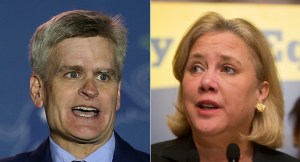
Bill Cassidy and Mary Landrieu
So let’s take a quick look at some of the close Senate races. Dakinikat has been keeping us posted on Mary Landrieu’s race against Bill Cassidy, but here’s an interesting article in The Economist, published over the weekend, The dynast, the doctor and the gator-wrestler.
Mr Cassidy, a Republican, is hoping to snatch a Senate seat from Mary Landrieu, the Democratic incumbent, who was first elected in 1996. That year Bill Clinton took Louisiana, but since then the state has turned strongly Republican. Ms Landrieu has hung on through luck, grit and local loyalty: her father was a notable mayor of New Orleans, and her brother is mayor now. But this year, with a deeply unpopular Democrat in the White House, she is struggling.
Mr Cassidy…has attacked Ms Landrieu for living in Washington, DC (she claims her parents’ home as her residence in Louisiana); for using federal money to pay for campaign trips; and for supporting Obamacare. In one advert, he accuses her of voting to “put illegal immigrants ahead of veterans”, despite having voted for the same benefit cuts. Ads from outside groups accuse the senator of wanting to ban guns and spend taxpayers’ cash on abortions. Roadside billboards show her smiling and waving with Barack Obama.
Ms Landrieu, for her part, stresses her independence and her ability, as head of the Senate energy committee, to bring jobs to Louisiana. On a tour of a refinery near Lake Charles, an oil city near the Texan border, she shouts over the din that, “unlike some parts of the country”, in Louisiana people are not afraid of heavy industry, and nods approvingly on hearing that workers without college degrees can make $80,000 a year working there.
As Dakinikat has also explained,
Her best hope is to woo moderates in places like Lake Charles and get out the black and liberal vote in New Orleans, the biggest city in Louisiana. That is possible. In a new CNN poll Ms Landrieu led Mr Cassidy 43% to 40%, with 9% opting for a third candidate, Rob Maness. If no one wins more than 50% of the vote on November 4th, a run-off between the top two candidates will be held in December. Turnout tends to be low in run-offs, which usually helps Republicans, whose older, whiter supporters are more likely to bother to vote twice. In a two-person race Mr Cassidy would beat Ms Landrieu by 50% to 47%, according to CNN. Other polls agree.

Scott Brown and Jeanne Shaheen
The competitive race closest to me is in New Hampshire, where carpetbagger from Massachusetts Scott Brown is trying to unseat Democratic incumbent Jeanne Shaheen. WBUR in Boston has the latest, N.H. Senate Race: Lots Of Polling, Little Movement. According to WBUR, NH voters have been polled more than those in any other state. But Shaheen has held a small lead consistently over time.
Despite all the attention from pollsters and outside groups, the New Hampshire Senate race seems stable. When we last checked in on the campaign, several polls showed a tighter race than when Brown first threw his hat in the ring back in April. Since then, the Huffington Post Pollster model has held roughly steady, with Jeanne Shaheen maintaining a 4-point lead.
Most recent media polls have shown Shaheen with leads of between 5 and 10 points. The only polls to show Brown actually in the lead have been conducted by Republican partisan pollsters, and those pollsters have a motive (and a tendency) to release only the results most favorable to their side.
Obviously, all the attention is because the NH race could affect overall control of the Senate.
Forecasting control of the Senate is the big game for the exploding industry of aggregators who rate, average and recycle others’ polls. HuffPollster has a model, as does Nate Silver’s FiveThirtyEight and the New York Times’ Upshot, to name just a few. All three of these sites give the Republicans a narrow edge in winning control of the upper chamber. And if New Hampshire goes for Brown, the odds of a GOP Senate takeover rise considerably. In the HuffPollster model, for example, a Brown victory would give the Republicans a 66 percent chance of Senate control, up from 51 percent today.
But it’s important to understand what the aggregators mean by these numbers. A forecast that Republicans have a 59 percent chance of taking control of the Senate (a recent FiveThirtyEight estimate) is not the same as a poll saying Candidate A has 59 percent of the vote. That 59 percent figure is a measure of the probability of that outcome actually happening in November. As Harry Enten of FiveThirtyEight helpfully analogized, right now the Republicans have the same chance of taking the Senate as a football team up by a single point has of winning with six minutes left in the game.
As we’ve seen, the battle among poll aggregators Silver and Wang is, if anything, more cutthroat than the race between Brown and Shaheen.
Yesterday, we learned that the latest Bluegrass Poll shows Allison Grimes leading Mitch McConnell by two points. From WKYT.com:
With just a month before the November 4 election, a new Bluegrass Poll shows Grimes leading McConnell 46 percent to 44 percent in the poll of 632 likely voters. Libertarian David Patterson remains a distant third….
“These results indicate what we’ve known for several months,” said WKYT political editor Bill Bryant. “We have a competitive and closely watched senate race in Kentucky. It will be interesting to see how the candidates motivate their supporters down the homestretch.” [….]
While the results remain within the poll’s margin of error of four percentage points, they are a shift from July and August Bluegrass Polls which showed McConnell with the advantage.
“This close to an election it’s hard to distinguish between what we call noise in the data and what are actual findings,” Youngman told WKYT’s Bill Bryant. “Like you said, this does match up with what Alison Lundergan Grimes has found which is a two point lead for her. But it is in stark contrast with what we have found in every other poll that has been released.”
The statewide shift toward Grimes could be the work of her improved standing among eastern Kentucky voters which had been a stronghold for McConnell. During the past month, Grimes campaigned with former President Bill Clinton in the area and launched a new campaign ad showing her skeet shooting and proclaiming “I’m not Barack Obama.” Obama remains unpopular in Kentucky, with a 29 percent favorable rating and 55 percent unfavorable rating.
“What we are looking at now is a 16 point flip from the last time we polled,” said Youngman. “What we haven’t been able to figure out is what would account for such a dramatic change. Obviously, Alison Lundergan Grimes has made eastern Kentucky a focal point of her campaign and it’s entirely possible that the combination of ads and her effort to portray herself as a pro-coal Democrat are finally starting to work at a time when people are paying attention.”
Is the poll an outlier, as the McConnell camp claims, or does it reflect real movement in the Kentucky Senate race? We’ll have to wait and see.
This post is getting way too long, so I think I’ll continue looking at the close Senate races, and write more about them on Thursday morning. Meanwhile, if there’s an important Senate race that you know about, please let me know in the comments.
I’ll leave you with a few more relevant links from today’s news:
Huffington Post, Unlikely South Dakota Senate Race Attracts Big Money From Campaign Finance Reformers.
FiveThirtyEight, Senate Update: Don’t Forget About Kentucky And Georgia.
Saporta Report, If the U.S. Senate race and the governor’s race end up in run-offs, Georgia will be in nation’s spotlight.
Reuters, ‘Big Dog’ Clinton back in Little Rock for key U.S. Senate race.
Christian Science Monitor, Is Pat Roberts really 10 points behind in Kansas Senate race?
As always, please post your thoughts and comments on any topic in the thread below. Have a terrific Tuesday, everyone!

 peej
peej Carissa
 bostonboomer
 dakinikat
 ecocatwoman
 mablue2
 Mama Lopez
 peggysue22
 quixote
 skydancingguestblogger
 Mona (aka Wonk the Vote)



 Sky Dancing
Recent Comments