
Monday Reads
Posted: May 21, 2012 Filed under: #Occupy and We are the 99 percent!, morning reads, religious extremists, right wing hate grouups | Tags: acquired savants, chicago terrorists/protestors, police plant evidence, right wing hysteria and bigotry, Terry Gilliam 15 Comments Good Morning!
I am exhausted and I’m not even in Colorado yet. It’s a good thing I’m getting some limited exposure to the news these days because it’s full of things like this. Here’s the five most offensive sexist and homophobic offerings by conservatives for the month from Sarah Seltzer at Alternet. I picked a few for you so this is a spew alert!
Rejecting Virginia judicial candidate because he’s gay, then saying “Sodomy is not a civil right.” In Virginia, members of the House of Delegates failed to confirm Tracy Thorne-Begland, an openly gay formal Navy officer raising children with his partner, as a judicial candidate.
His nomination had been seen as a given, with bipartisan support, until lobbying from “both the Family Foundation, a powerful conservative group that opposed his candidacy, and conservative lawmakers, who argued that his past indicated that he would press an activist agenda from the bench ” according to the New York Times.
Even worse? One of the leading opponents of the nomination, Bob Marshall, defended the decision after it got national heat:
Dr. Martin Luther King and Rosa Parks never took an oath of office that they broke. Sodomy is not a civil right. It’s not the same as the Civil Rights Movement.
…
Bills allows pharmacists to deny care to women they think “may” be having abortions.
Kansas Governor Sam Brownback expanded the state “conscience clauses” to allow religious employees at pharmacies and medical facilities to refuse service to women they think “may” be having an abortion. As Robin Marty writes, he’s “legally blessed a virtually open-ended number of situations in which ‘religious’ workers can refuse to assist women under the guise that they believe they ‘may be’ terminating a pregnancy.”
So one consequence is simply refusing to dispense contraception and emergency contraception pills, neither of which terminate pregnancies. But there are other implications, as Marty notes, including that, “The law could also allow refusal of even more medically necessary drugs simply because they may relate to abortions…” like drugs that stop bleeding, for instance.
There’s more evidence that arrests in Chicago for protestors cum terrorists were the result of Cops Gone Wild. Naturally, you have to rely on the foreign press to get the story. Are we getting repeats of 1968?
Deutsch, the attorney representing the suspects, said at the hearing that police had planted weapons at the scene of the arrests. “This is a way to stir up prejudice against a people who are exercising their First Amendment rights,” Deutsch said. “There were undercover police officers that ingratiated themselves with people who come from out of town.”
In a case earlier this month five self-described anarchists were charged with plotting to blow up a bridge near Cleveland after planting fake explosives underneath that federal agents had sold them.
Natalie Wahlberg, a member of the Occupy Chicago movement protesting against income inequality, said: “The charges are utterly ridiculous. CPD [Chicago police department] doesn’t know the difference between home beer-making supplies and Molotov cocktails.”
The National Lawyers Guild, a group of volunteer lawyers representing the protesters, said on Facebook that police “broke down doors with guns drawn and searched residences without a warrant or consent”.
I am a long standing Monty Python fan as well as a big fan of the art of animation. That’s why I was thrilled to learn what Terry Gilliam’s been up to in this week’s The Economist. Here’s Gilliam discussing the difficulties of being non-formula in Hollywood.
To what extent does your reputation as a maverick contribute to the problems you experience?
Hollywood still sees me as someone who won’t be controlled as easily as a young guy straight out of making commercials. They don’t want some ageing hippie who still hasn’t learned to play the game after all these years. And that goes against me sometimes. But it’s not just me. Hollywood has been afraid to take risks for a long time now. All the studios want is a safe pair of hands.
Can you give an example of a studio choosing a “safe pair of hands” over you?
The first Harry Potter film. I was the perfect guy for that movie. They all knew it. J.K. Rowling wanted me to do it; David Heyman, the producer, wanted me to do it. But one guy from Warner’s overruled everyone and Chris Columbus got the gig. I was furious at the time but in hindsight, the level of studio interference on a project that size would have driven me insane.
What effect is Hollywood’s “safe” approach having on audiences?
The longer you keep churning out this production-line crap, the more audiences are going to like it—and need it. There’s an element of security provided by re-makes and re-hashes. We’re at the stage where audiences just want to know that everything will be the same. Maybe it’s because the world has become so diffused and unclear that people just want to go back to what they know over and over again. People need to reassure themselves that Spider-Man can still do the things he’s always done.
I’ve developed a fascination with brain injuries while listening to a NPR series on all the problems that Football players appear to develop midlife. Then there’s the the huge number of brain trauma patients coming out of our military these days. Here’s an interesting article at The Atlantic on how a blow to the head some times creates a genius. Warning! Do not try this at HOME!
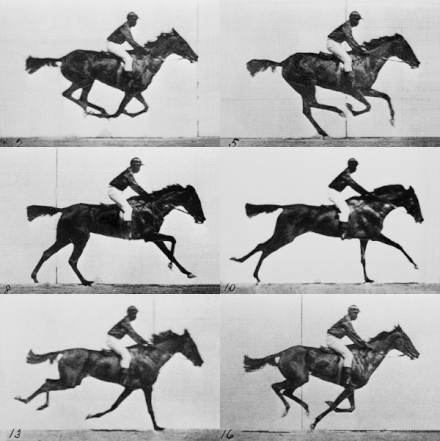
For a long time, it was a mystery as to how horses galloped. Did all four hooves at some point leave the ground? Or was one hoof always planted? It wasn’t until the 1880s when a British photographer named Eadweard Muybridge settled the debate with a series of photographs of a horse in midstride. Muybridge took a great interest in capturing the minute details of bodies in motion. The images made him famous.
Muybridge could be obsessive — and eccentric, too. His erratic behavior was blamed on a head injury he’d sustained in a serious stagecoach accident that killed one passenger and wounded all the rest. Now, researchers believe that the crash, which gave Muybridge a permanent brain injury, may actually have been partially responsible for endowing him with his artistic brilliance.
Muybridge may have been what psychiatrists call an acquired savant, somebody with extraordinary talent but who wasn’t born with it and who didn’t learn the skills from someplace else later. In fact, Muybridge’s savant abilities had evidently been buried deep in the recesses of his mind the whole time, and the stagecoach incident had simply unlocked them.
So, that should give you a few interesting things to think about! I’m headed to Colorado on Wednesday so I’ll be a little scarce this week. What’s on your blogging and reading list today?

 peej
peej Carissa
 bostonboomer
 dakinikat
 ecocatwoman
 mablue2
 Mama Lopez
 peggysue22
 quixote
 skydancingguestblogger
 Mona (aka Wonk the Vote)



 Sky Dancing
Recent Comments