
Monday Reads
Posted: April 18, 2011 Filed under: jobs, Labor unions, morning reads, Reproductive Rights, Women's Rights, worker rights | Tags: Attacks on Social Security, Bush tax cuts, Gang of Six, global job crisis, HBO, International Monetary Fund, New Orleans, Pete Seeger, Peter Yarrow, Planned Parenthood, Senator Mark Warner, songs of protest, taxes, Treme 43 Comments Good Morning!
I’ve almost gotten shy about going out to search for links these days. Most of the political and economic news is disheartening so I thought I’d try to mix it up today with some good stuff and disheartening stuff. Hopefully, you can find some things to share with us too.
You may want to start out your day arming yourself with “Five Myths about Planned Parenthood” in case any one in your sphere of influence starts spewing some of the ridiculous memes passed around by the right wing. This was in WAPO over the weekend and was written by Clare Coleman worked for America’s best known provider of family planning and health services. I liked number five.
Three million patients each year visit Planned Parenthood’s more than 800 health centers in every state, in big cities and small towns. In some areas, Planned Parenthood and the Title X-funded system are the only sexual health providers for hundreds of miles.
We screen people for high blood pressure, anemia and diabetes; we counsel them about smoking cessation and obesity; we connect them to other primary-care providers and social services. The huge response to the attack on family planning and on Planned Parenthood — hundreds of thousands of Americans signing petitions, showing up at rallies, calling Congress – is extraordinary. But it doesn’t surprise me. One in five American women has gone to Planned Parenthood at some point in her life, for respectful, compassionate, quality care. And now those Americans are going to have our back.
I feel like I’ve turned into an IMF groupie by putting up yet another link to them shortly after featuring one of their studies on the dominance of the finance sector, but here I go again. I do spend time gleaning data from their site so maybe it’s just that I keep bumping into things. The IMF says we have a Global Job Crisis.
At the end of his magnum opus, The General Theory, Keynes stated the following: “The outstanding faults of the economic society in which we live are its failure to provide for full employment and its arbitrary and inequitable distribution of wealth and incomes”.
Not everyone will agree with the entirety of this statement. But what we have learnt over time is that unemployment and inequality can undermine the very achievements of the market economy, by sowing the seeds of instability. In too many countries, the lack of economic opportunity can lead to unproductive activities, political instability, and even conflict. Just look at how the dangerous cocktail of unemployment and inequality—combined with political tension—is playing out in the Middle East and North Africa.
Because growth beset by social tensions is not conducive to economic and financial stability, the IMF cannot be indifferent to distribution issues. And when I look around today, I am concerned in this regard. For while recovery is here, growth—at least in the advanced economies—is not creating jobs and is not being shared broadly. Many people in many countries are facing a social crisis that is every bit as serious as the financial crisis.
Unemployment is at record levels. The crisis threw 30 million people out of work. And over 200 million people are looking for jobs all across the world today.
The jobs crisis is hitting the young especially hard. And what should have been a brief spell in unemployment is turning into a life sentence, possibly for a whole lost generation.
In too many countries, inequality is at record highs.
As we face these challenges, remember what we have accomplished. Under the umbrella of the G20, policymakers came together to avoid a financial freefall and probably a second Great Depression.
Today, we need a similar full force forward response in ensuring that we get the recovery we need. And that means not only a recovery that is sustainable and balanced among countries, but also one that brings employment and fair distribution.
This is part of a speech given by Dominique Strauss-Kahn, Managing Director, International Monetary Fund. He argues that financial sector reform is central to the problem of getting back on track. It’s worth reading the entire thing or you can watch the video here. Occasionally, I remember why I thought it was important to study economics. This is one of those times.
The so-called “Gang of Six” is still anxious to put social security on the bargaining table. I still can’t figure out why every time some politician wants to talk about the Federal Deficit--in this case Senator Mark Warner–they mistakenly include the stand-alone program.
Including Social Security in the Gang of Six package appears to be a concession by Democrats made in exchange for agreement to raise some revenue by Republicans. But liberals in the Senate and House have made clear they will not stand for any cuts to benefits.
The 2012 budget passed by the House on Friday does not include reforms for Social Security. House Budget Committee Chairman Paul Ryan (R-Wis.) instead called for a trigger in the budget whereby the president and Congress would have to propose solutions once the Board of Trustees certifies the program is in trouble. Presidet Obama in his 2012 budget and in a speech last week did not lay out plans to reform Social Security.
Warner said the Gang is “very close” to an agreement that includes spending cuts and tax increases such as be eliminating the home mortgage tax deduction.
“We are going to make everybody mad with our approach,” he said.
Warner made clear he is opposed to the House Republican 2012 budget’s reliance on cuts to Medicare—he called it a “massive transfer of responsibility onto our seniors”– but he did not say how the Gang of Six will approach the massive entitlement program.
Please join me as I scream. How stupid do they think we are?
Ninety-one year old Pete Seeger will be joined by David Amram, 80, and Peter Yarrow, 73 on the stage to inspire young people to be active in political and social justice movements. Yarrow had just returned from a series of rallies in Wisconsin.
The three artist-activists say they are fired up by recent protests — from Egypt to Wisconsin — and by the enthusiasm of their youthful kin, who will join them onstage.
“I do have the feeling that the kind of energy we felt in the ’60s is in the air now,” Mr. Yarrow said. “That energy seems to be reigniting itself.”
That concert should be a treat. It’s nice to see these guys seem to never tire of singing songs of justice. It’s important that a new generation hear these truly American songs. I was interested in reading that many kids and grandkids of these folk singers are now in the family business and may show up on stage with them now and then.
Okay, this is something that kinda surprised me from the WSJ: “Greenspan Steps Up Call to End Bush-Era Tax Cuts”. I still haven’t figure out why any one thinks he’s still relevant, but oh, well. At least, he’s on the right side of this one.
Former Fed Chairman Alan Greenspan is stepping up his call for Congress to let the Bush-era tax cuts lapse.
In an appearance Sunday on ABC’s “Meet the Press,” Mr. Greenspan used his strongest words yet to urge lawmakers to let them expire. The risk of a U.S. debt crisis, he said, is just too big. Mr. Greenspan, who retired from the Federal Reserve in 2006, had endorsed the cuts back in 2001 championed by then-President George W. Bush.“This crisis is so imminent and so difficult that I think we have to allow the so-called Bush tax cuts all to expire. That is a very big number,” he said, referring to how much the U.S. government could save from letting income taxes go back up to levels last seen under former President Bill Clinton.
Mr. Greenspan was talking about re-imposing the taxes for all Americans. The Treasury has estimated that a permanent extension of all the Bush tax cuts would cost $3.6 trillion over the next decade. Allowing taxes to increase on those in the top income brackets would take the cost to the government down to $2.9 trillion, according to White House estimates.
CBS news has done some data gathering on taxes as part of its Tax Day coverage: Wealthy Americans see drop in federal taxes; High-earning Americans pay less in taxes than in previous years; nearly half of U.S. households will pay no income taxes at all.
The Internal Revenue Service tracks the tax returns with the 400 highest adjusted gross incomes each year. The average income on those returns in 2007, the latest year for IRS data, was nearly $345 million. Their average federal income tax rate was 17 percent, down from 26 percent in 1992.
Over the same period, the average federal income tax rate for all taxpayers declined to 9.3 percent from 9.9 percent.
The top income tax rate is 35 percent, so how can people who make so much pay so little in taxes? The nation’s tax laws are packed with breaks for people at every income level. There are breaks for having children, paying a mortgage, going to college, and even for paying other taxes. Plus, the top rate on capital gains is only 15 percent.
There are so many breaks that 45 percent of U.S. households will pay no federal income tax for 2010, according to estimates by the Tax Policy Center, a Washington think tank.
The sheer volume of credits, deductions and exemptions has both Democrats and Republicans calling for tax laws to be overhauled. House Republicans want to eliminate breaks to pay for lower overall rates, reducing the top tax rate from 35 percent to 25 percent. Republicans oppose raising taxes, but they argue that a more efficient tax code would increase economic activity, generating additional tax revenue.

The row of shotguns featured on the first season DVD set of Treme are set to be demolished as blight.
New Orleans is abuzz with the second season of Treme about to start up on HBO. I have to admit that I have not watched it since I’m still working through my dose of PTS from Katrina and the aftermath. However, for those of you that are fans of the show, you can get it now on DVD and you can get a bit of a taste in what’s in store for you in season two from this story from the TP. The show evidently ended last season with the city’s evacuation. That’s something I will NEVER forget. The show has been great for the city, overall and it’s producers have taken on a lot of causes around here including a fight to save some historic properties featured in the series’ promotions. Just thought I’d add some insight into what the production brings to the city including its musicians. Here’s a little drama from Hollywood South.
… production money is being spent daily in New Orleans for locations, for equipment, material, labor and talent. In the first two seasons, for example, about $2 million in music licensing money was paid for the rights to songs by New Orleans artists, alone. Such expenditures — with or without any charity component — are the crux of the real economic relationship between a film company and the community in which it works. It is a straight-up transaction. We come here to shoot a movie. We pay a variety of local vendors, government fees and individuals to do it. And for virtually every other movie shot in Louisiana, that is it — end of story.
Thought I’d end with a treat from Pete Seeger to get you through your coffee:
What’s on your reading and blogging list today?
Friday Reads
Posted: December 10, 2010 Filed under: morning reads | Tags: Barack Obama, Julian Assange, taxes, Wikileaks 62 Comments
Good Morning!!
Our arrogant president is very full of himself after making his “grand deal” with the Republicans and completely cutting out the Congressional Democrats. He told NPR today that he’s not afraid of any rebellion by Democrats.
A snippet from Steve’s [Steve Inskeep] interview with the president, the full version of which will be heard on Friday’s Morning Edition.
“STEVE: Can you accept some changes to this plan or is it the kind of deal you cannot change?
“PRESIDENT OBAMA: My sense is there are going to be discussions between both House and Senate leadership about all the final elements of the package. Keep in mind we didn’t actually write a bill. We put forward a framework. I’m confident that the framework is going to look like the one we put forward…
“Here’s what I’m confident about, that nobody — Democrat or Republican — wants to see people’s paychecks smaller on Jan. 1 because Congress didn’t act.”
Not only that, Obama is so confident now that he plans to initiate a complete overhaul of the U.S. tax system, presumably with the help and support of Congressional Republicans.
President Obama is considering whether to push early next year for an overhaul of the income tax code to lower rates and raise revenues in what would be his first major effort to begin addressing the long-term growth of the national debt.
Mr. Obama has directed his economic team and Treasury Department analysts to review options for closing loopholes and simplifying income taxes for corporations and individuals, though the study of the corporate tax system is farther along, officials said.
The objective is to rid the code of its complex buildup of deductions, credits and exemptions, thereby broadening the base of taxes collected and allowing for lower rates — much like a bipartisan majority on Mr. Obama’s fiscal commission recommended last week in its final blueprint for reducing the debt through 2020.
Flat tax, here we come?
Besides preventing the DADT repeal from coming to the Senate floor, Republicans managed to block a bill that would have aided rescue workers who responded to the public needs after the 9/11 attacks and then became ill from breathing “toxic fumes, dust, and smoke.”
The 9/11 health bill, a version of which was approved by the House of Representatives in September, was among several initiatives that Senate Democrats had hoped to approve before the close of the 111th Congress. Supporters believe this was their last real opportunity to have the bill passed.
The action by the Senate created huge uncertainty over the bill’s future. Its proponents were working on Thursday to salvage the legislation, with one possibility being to have it inserted into a large tax-cut bill that Republicans and Democrats are trying to pass before Congress ends its current session.
Such a move seemed unlikely, since it might complicate passage of the tax package, which includes a provision that President Obama sought in return for backing the continuation of tax cuts for all income levels that Republicans wanted: an extension of unemployment benefits.
There is lots of Wikileaks news. The New York Times has an article about hackers who are defending the site after the arrest of editor Julian Assange:
They got their start years ago as cyberpranksters, an online community of tech-savvy kids more interested in making mischief than political statements.
But the coordinated attacks on major corporate and government Web sites in defense of WikiLeaks, which began on Wednesday and continued on Thursday, suggested that the loosely organized group called Anonymous might have come of age, evolving into one focused on more serious matters: in this case, their definition of Internet freedom.
While the attacks on such behemoths as MasterCard, Visa and PayPal were not nearly as sophisticated as some less publicized assaults, they were a step forward in the group’s larger battle against what it sees as increasing control of the Internet by corporations and governments. This week they found a cause and an icon: Julian Assange, the former hacker who founded WikiLeaks and is now in a London jail at the request of the Swedish authorities investigating him on accusations of rape.
“This is kind of the shot heard round the world — this is Lexington,” said John Perry Barlow, a co-founder of the Electronic Frontier Foundation, a civil liberties organization that advocates for a freer Internet.
The Atlantic reports that the group may target the U.S. Senate next.
According to a poll set up by the ad-hoc group, Operation Payback, the Senate could be their next target. It leads voting ahead of Re-attacking Mastercard, Re-attacking Visa, Sarah Palin’s website, and Authorize.net. Out of a total of 1179 votes cast (as of 5:22 pm), 445 of them went to attacking the Senate website.
Operation Payback formed in response to companies like PayPal, Visa, and Mastercard cutting off WikiLeaks from their services. It is composed of members associated through the loose network of people known as Anonymous, which specializes in denial-of-service attacks, among other general mischief.
The Atlantic also links to this story at The Economist: The 24-hour Athenian democracy
I am talking to members of a group called “Anonymous”, using a web-based collaborative text-editing service. It is the first such interview for all of us, and their answers begin to collide on the page. One member comes from Norway; another shows surprise, then offers that she is from New Zealand. Another writes that group members come from Nepal and Eastern Russia. They all speak through pseudonyms, but I don’t even know which psuedonym comes from what country because shortly after I read these answers, someone who calls himself “Tux” erases them all and writes
We are Everywhere. We are everyone. We are Anonymous.
Members of Anonymous, whoever they are, have in the last week taken offline websites run by Postfinance, a Swiss bank that closed the account of Julian Assange, founder of WikiLeaks; PayPal, an online payments processor that halted donations to WikiLeaks; and the Swedish prosecutor who has brought a case against Mr Assange. As I followed some “anons” over internet relay chat (IRC) on Tuesday, they voted among themselves not to attack the “UK metro police”. I’m not sure which website they were referring to. After I left the chat, they turned their attention to lieberman.senate.gov, the website of the American senator Joe Lieberman. According to Sean-Paul Correll, a threat researcher at Panda Security, that site was down, briefly, at 7:11 US Eastern time on Tuesday. Logs from the chat room the group was using indicate that for some time all of senate.gov—the website of every American senator—was either down completely or slow in many parts of the world. What all of these sites have in common is that their owners have in some way impeded the work of WikiLeaks or its founder, Julian Assange.
This is starting to feel like V is for Vendetta or something.
CNN has two very interesting and lengthy articles about Julian Assange and Wikileaks. The first is a profile of Assange: The Secret Life of Julian Assange. Here’s just a short exerpt:
Assange has been described by his mother, Christine, as “highly intelligent.”
He was just 16 when she bought him a Commodore 64 computer. It was 1987, and there were no Web sites. Assange attached a modem to his computer and began his journey through the growing world of computer networks.
“It’s like chess,” he told New Yorker magazine. “Chess is very austere in that you don’t have many rules, there is no randomness and the problem is very hard.”
Though his mother raised him without any religious influence, she sensed that from a tender age, her son was led by a strong desire to do what he perceived as just.
“He was a lovely boy, very sensitive, good with animals, quiet and has a wicked sense of humor,” she told the Melbourne, Australia, Herald Sun newspaper Wednesday.
The other article is about the encoded “insurance file” that Assange has said will be released if anything happens to him: Assange’s “poison pill” impossible to stop, expert says.
“It’s all tech talk to say, ‘I have in my hand a button and if I press it or I order my friends to press it, it will go off,'” said Hemu Nigam, who has worked in computer security for more than two decades, in the government and private sector.
“Julian is saying, ‘I’ve calibrated this so that no matter how many ways you try, you’re never going to be able to deactivate it,'” Nigam said. “He’s sending a call to action to hackers to try it. To the government, he’s also saying, ‘Try me.'”
There’s a reason Assange specifically announced — on the Web — that there is a 256-bit key encryption code that only a few trusted associates know that will unleash the contents of the 1.4 gigabyte-size file.
“He’s saying don’t even bother trying. It will take you so long to succeed that by that time, it will be too late,” Nigam said. “Most of the time, you see a 56-[bit]key encryption. That’s considered secure. When you are using 256, you are sending a message: ‘I’m smart enough to know that you will try to get in.'”
I don’t really want anything to happen to Assange, but I’d sure like to know what is in those files.
Raw Story reports that one of Assange’s accusers has fled to the Middle East and may have stopped cooperating with Swedish police.
According to a report at Australian news site Crikey.com, Anna Ardin has moved to the Palestinian territories to volunteer with a Christian group working to reconcile Arabs and Israelis.
Crikey.com reports:
One source from Ardin’s old university of Uppsala reported rumors that she had stopped co-operating with the prosecution service several weeks ago, and that this was part of the reason for the long delay in proceeding with charges — and what still appears to be an absence of charges.
She is apparently also sympathetic to the Wikileaks cause:
“MasterCard, Visa and PayPal — belt them now!” Ardin urged in a Tweet Wednesday, evidently referring to the cyber-attacks launched on those institutions after they severed their relationships with WikiLeaks.
In a more recent Tweet, she complained of the media reports digging into her background.
Soooo….what are you reading this morning? Have at it! And TGIF!!!
Cave In Time!
Posted: December 5, 2010 Filed under: Breaking News, Democratic Politics, Team Obama, The Bonus Class | Tags: let's make a deal, taxes, unemployment benefits extension 43 CommentsWhite House officials and Congressional Republicans said Sunday they were closing in on a deal to
temporarily continue the Bush-era tax cuts at all income levels, while bitterly frustrated Democratic Congressional leaders began exploring whether they would have the votes for such a package.
The Republicans are supposed to okay the extension of the unemployment benefits for long term unemployed if the Democrats will okay the tax cuts for the uber rich for two years.
Administration officials said the negotiations were focused on the question of extending the tax rates for one or two years, with a three-year extension highly unlikely, even though that time frame would probably eliminate the tax fight as an urgent issue in the 2012 elections.
Many Republicans say they want a permanent extension of the rates, or as long an extension as possible. Democrats say they would not mind the issue coming up during Mr. Obama’s re-election bid, because they see it as politically helpful to them in painting Republicans as defenders of the rich. The debate, of course, could cut the other way, with Republicans again portraying Democrats as seeking to raise taxes.
I really don’t want to hear any more crap about unfunded mandates if this is the deal. Unbelievable!
Simple Truths
Posted: July 4, 2010 Filed under: Environmental Protection, Gulf Oil Spill, U.S. Economy, Voter Ignorance | Tags: disincentives, incentives, oil industry subidies, taxes 2 Comments One of the useful things about theories and laws–in the sense of scientific method–is that they provide some very simple insight into the way things are. They are not based on wishful thinking or faith. Hypotheses grow up to be theories only with rigorous testing by many many great minds who consistently recreate similar truths in similar circumstances.
Once the theory becomes established, it can be used for many purposes and insights. In economics, we use these things for predictions and policy insights. We know that a given outcome will–with extremely high probability–recur given the same circumstances. There are laws of demand and supply. There are theories on elasticities of supply and demand given prices or income. We have a fairly good catalog of theories that we teach and we make doctoral students reprove over and over again so they too, can establish that insight and make predictions.
Established theories are basically things that are ‘no brainers’ in any field. One such set of theories in economics deals with taxes and subsidies. You tax something, you see less of that thing because it adds cost and dampens both supply and demand for the taxed thing. You subsidize it, you get more demand and more supply because it lowers the cost. As a matter of theory, when you really subsidize something, you generally end up warping the incentives for production and consumption of that good so badly that not only does that market become pretty dysfunctional, but it tends to spread to other markets because it transfers scarce resources–better put to other uses– from some markets to the subsidized market.
In some cases, we purposely warp a market with taxes for policy purposes. This is the case with so-called sin taxes. There is a reason that cigarettes are taxed to the point that the pricing point of a pack of cigarettes approaches the cost of a CD of music or a ticket to a movie. That’s because the government wants to discourage entry to the market to teen smokers. Prices (after tax) of cigarettes typically rival things teens do. These include going to movies or buying music. It forces the teen who might become a smoker into a choice and hopefully, a good one that includes not smoking. In this case, the disincentive is the policy choice. We often subsidize things too like public transportation or public education. This is because we’d see less of them and less public benefit if they were priced to the market or priced to the cost of producing the good. When you study microeconomics which is the study of individual choices within individual markets, you study externalities.
Generally speaking, a good policy will subsidize a good or service with positive externalities and tax a good or service with bad externalities. We usually call these “spill over” costs or benefits because the cost or the benefit of the activity spills over to the public. If a business can’t realize the benefit in terms of profit, the business won’t provide the service or good. If the business can pass the cost of an activity or service on to the public, it will.
Subsidies should only go to places where there are positive spillovers. Taxes should be applied to places where there are negative spillovers. It is not considered a good idea for taxpayers to subsidize harmful activities in economic theory. We have finally lowered our subsidies to the tobacco industry because it’s good policy. The taxpayer shouldn’t be incentivizing a public health issue that they will have to pay for on both ends. First, in the subsidy to the business, and second to the costs of tremendous health problems created by the users. People who benefit neither from growing tobacco, making cigarettes or smoking, shouldn’t be asked to pay all the spill over costs that come from that activity.
This is why subsidies to Oil Companies baffle many of us.
There’s a really good article today in the NYT on the billions of dollars provided by the U.S. Taxpayer to Oil Companies. My students will be reading this shortly, believe me, because it’s a great example of really bad public policy. Among the things that the article mentions is that the drilling rig, The Deepwater Horizon, “was flying the flag of the Marshall Islands. Registering there allowed the rig’s owner to significantly reduce its American taxes”. Transocean basically shopped corporate ownership to several countries to avoid tax liability. But wait, it gets worse.
At the same time, BP was reaping sizable tax benefits from leasing the rig. According to a letter sent in June to the Senate Finance Committee, the company used a tax break for the oil industry to write off 70 percent of the rent for Deepwater Horizon — a deduction of more than $225,000 a day since the lease began.
With federal officials now considering a new tax on petroleum production to pay for the cleanup, the industry is fighting the measure, warning that it will lead to job losses and higher gasoline prices, as well as an increased dependence on foreign oil.
But an examination of the American tax code indicates that oil production is among the most heavily subsidized businesses, with tax breaks available at virtually every stage of the exploration and extraction process.
According to the most recent study by the Congressional Budget Office, released in 2005, capital investments like oil field leases and drilling equipment are taxed at an effective rate of 9 percent, significantly lower than the overall rate of 25 percent for businesses in general and lower than virtually any other industry.
And for many small and midsize oil companies, the tax on capital investments is so low that it is more than eliminated by var-ious credits. These companies’ returns on those investments are often higher after taxes than before.
“The flow of revenues to oil companies is like the gusher at the bottom of the Gulf of Mexico: heavy and constant,” said Senator Robert Menendez, Democrat of New Jersey, who has worked alongside the Obama administration on a bill that would cut $20 billion in oil industry tax breaks over the next decade. “There is no reason for these corporations to shortchange the American taxpayer.”
Yes, that’s right. President Obama with his green agenda is working on a bill that CUTS $20 billlion in more tax breaks to this industry. But don’t get me started on their ethanol subsidies, it’s the same damned deal. Take food away from being used as food and use it as an additive to fossil fuels. This, too, is bad policy. (To read more on that you may want to check out this link at The Oregonian.)
THIS is what passes as “free market” capitalism these days. Tax payers pay in their tax bills for these horrendous subsidies, then they take it at the pumps too. (In the case of ethanol subsidies, we’ll also take it at the grocery store.) Republicans are much worse. They have no idea that what they are doing is not capitalism. It’s basically encouraging monopolies and monopoly profits as well as distorting resource markets.
Ethanol subsidies, oil drilling incentives, government insurance and loan guarantees for nuclear energy, natural gas subsidies: These proposals tend to have as many or more Republican advocates as Democratic advocates. Even worse, self-described free-market conservatives often rally for energy subsidies and claim it’s not a deviation from their principles.
Today, at the liberal environmentalist website Grist, blogger Dave Roberts takes to task Newt Gingrich. Roberts, with whom I often spar on the Interwebs, has a great (and depressing) argument and analysis of Gingrich’s defense of current energy subsidies and proposal for even more energy subsidies. This is the heart of the argument:
Gingrich and his acolyte defend these subsidies. Why? Says Gingrich, “a low-cost energy regime is essential to our country.”… Fossil-fuel subsidies don’t reduce costs, they shift costs. The burden is moved from energy companies to the public. The result is what we have today: energy that looks cheap because most of its costs are hidden from view.
Even during times of obscene profits (which are pretty much guaranteed by subsidies in a good where the market demand isn’t very sensitive to price changes), we still subsidize these business. Here’s the link to The Grist which basically outs Ginrich as being anything but a capitalist. This is more like the old mercantilism of the past where the king and queen choose a particular company to be blessed with a monopoly and give them some start up funds to go and rape a colony of its natural resources. Think East India Tea Company and the colonies here pre-Revolution. For years, our tax funds have gone to big oil, big finance, and big defense contractors. Lincoln warned of it. Eisenhower warned about it. Teddy Roosevelt and Sherman did something about.
So, here we are again with companies that feed at the public trough while behaving in a way that has nothing to do with public interest. This is no surprise to any economist. We know that the only things corporations are about are maximizing profits and minimizing costs any way they can. They’ll do it by abusing any resource they can, IF we let them get away with it. That’s why there is still slavery, pollution, strip mining, blood diamonds, and for all intents and purposes, wars in places that sit on oceans of oil.
Politicians are all about maximizing their chances of getting re-elected. If they can’t do that, then they maximize their wealth and their after politics career possibilities. This is where we come in. They will continue to do whatever they want to as long as our vote is no longer a check and balance on those behaviors. We have a responsibility to throw the bums out that do this to us.
So, carrots and sticks are important to economic theory and political theory. We know this. The problem is what are going to do about it?
A Taxing Subject
Posted: April 17, 2009 Filed under: The Media SUCKS, U.S. Economy | Tags: taxes, Tea Party, US Taxes comparison 11 Comments
There was a table set out under a tree in front of the house, and the March Hare and the Hatter were having tea at it: a Dormouse was sitting between them, fast asleep, and the other two were using it as a cushion, resting their elbows on it, and the talking over its head. `Very uncomfortable for the Dormouse,’ thought Alice; `only, as it’s asleep, I suppose it doesn’t mind.’
The table was a large one, but the three were all crowded together at one corner of it: `No room! No room!’ they cried out when they saw Alice coming. `There’s PLENTY of room!’ said Alice indignantly, and she sat down in a large arm-chair at one end of the table.
`Have some wine,’ the March Hare said in an encouraging tone.
Alice looked all round the table, but there was nothing on it but tea. `I don’t see any wine,’ she remarked.
`There isn’t any,’ said the March Hare.
`Then it wasn’t very civil of you to offer it,’ said Alice angrily.
`It wasn’t very civil of you to sit down without being invited,’ said the March Hare.
`I didn’t know it was YOUR table,’ said Alice; `it’s laid for a great many more than three.’
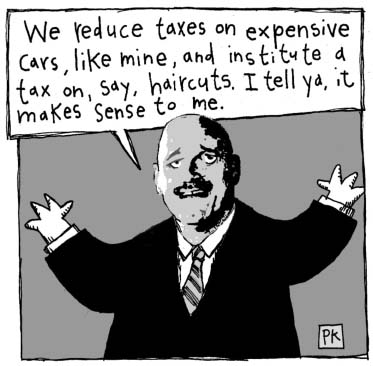
`Your hair wants cutting,’ said the Hatter. He had been looking at Alice for some time with great curiosity, and this was his first speech.
`You should learn not to make personal remarks,’ Alice said with some severity; `it’s very rude.’
from Alice’s Adventures in Wonderland: A Mad Tea Party
by Lewis Carroll
I’ve taught Macroeconomics for a very long time. Tax policy of course is also part of the curriculum so I always get to spend at least a week on U.S. taxes. One of my favorite lectures is to disabuse people in the U.S. of the notion they are ‘over taxed’. You probably saw that I didn’t exactly get on the Tea Party band wagon. I’m not worried about my taxes. I am worried about the huge amount of deficit spending going on and I’m worried about the quality of government I get in return for my taxes . I’m more worried about loosing my constitutional right to privacy. I’m also worried about my tax dollars going to religious organizations and other spurious uses.
Several other economists used their blogs on Tax Day for the purpose of showing folks that the U.S. has extremely low taxes compared to the kinds of things we expect and get from the Government. I’d like to share some of that with you.

 peej
peej Carissa
 bostonboomer
 dakinikat
 ecocatwoman
 mablue2
 Mama Lopez
 peggysue22
 quixote
 skydancingguestblogger
 Mona (aka Wonk the Vote)



 Sky Dancing
Recent Comments