
The director of the National Security Agency, the powerful U.S. wiretapping and cyberespionage service, was fired Thursday, according to one former and two current U.S. officials.
Gen. Timothy Haugh, who also heads U.S. Cyber Command, was let go along with his civilian deputy at the NSA, Wendy Noble, according to the officials. Like others in this report, they spoke on the condition of anonymity to discuss personnel moves.
Far-right activist Laura Loomer advocated for the firings during a meeting with President Donald Trump on Wednesday, she confirmed to The Washington Post on Thursday evening.In the meeting,
Loomer, a fervent Trump supporter, pressed for the dismissals of a number of officials besides Haugh and Noble — in particular, National Security Council staff whose views she saw as disloyal to the president.
At least five key National Security Council aides were fired Thursday.
“NSA Director Tim Haugh and his deputy Wendy Noble have been disloyal to President Trump,” Loomer said in a post on X early Friday. “That is why they have been fired.”
Loomer told The Post that she urged Trump to dismiss Haugh because he was “handpicked” by Gen. Mark A. Milley, who was chairman of the Joint Chiefs of Staff in 2023 when Haugh was nominated to lead Cyber Command and the NSA.
Black Friday: The Great Crash
Posted: April 4, 2025 Filed under: #MAGAnomics, tRump crimes against humanity | Tags: @johnbuss.bsky.social John Buss, economic impact of #FARTUS tariffs, FARTUS, grand wizards of the kleptocracy, kakistocracy, Land of Confusion, tariffs and farmers 4 Comments Good Day, Sky Dancers!
#FARTUS has deliberately tanked the equity markets and the dollar with record-level tariffs set with an equation that made no sense and included tariffs placed on islands with no human inhabitants. This is further evidence of the incompetency and utter ignorance of the Trump Administration. This is not economic policy. This is some personal brain fart of a very disturbed man.
The newest economic alignment is between Japan, Southern Korea, and China. They have negotiated a Trilateral Free Trade Agreement. The Europeans have basically given up on us. The dollar is no longer the safe currency as we saw in trading yesterday. It had its highest drop on record. The jobs report will be released shortly and will determine any further rate of decline. I watched an increasing level of lay-off announcements by major manufacturers, Whirlpool, Stellantis, and more have announced additional layoffs. This comes after Forbes announced, “Nearly 100 Companies Announce Layoffs In March, According To Reports.” This was the highest amount of layoffs since 2020 which was the start of the COVID-19 pandemic. The USD has regained some of its footing, but frankly, when economic policy is ruled by hubris and ignorance, there’s very little you can get from a forecasting model.
None of this makes sense from an Economic Policy Basis. We now have retaliatory tariffs, which signal a massive trade war has begun. Like the last Trump Tariff-induced trade war, US farmers will be on the front line. Manufacturers will also be severely hurt. Of course, the ultimate loser is the average American. I still see stagflation in our near term future. High inflation plus very lousy unemployment. The Fed’s tools are not as useful with this kind of economy. Stimulate the economy to end unemployment, and you get higher prices. Stop the high inflation, and you worsen the recession. What really kills me is that this destructive policy was fully preventable. But then, elections brought us this mess, and elections must pull us out of it.

les pingouins résistent
You may read all my sources if you are so inclined. I know they’re not the most exciting reads. Here’s a trio of dismal headlines from The Guardian. Note: FTSE is the UK equivalent of the Dow Jones.
Global trade war escalates as Beijing hits back against Donald Trump with new tariffs on US goods
- China retaliates to Trump’s ‘bullying practice’ with 34% tariffs on US imports
- IMF warns of ‘significant risk’ to global economy from Trump tariffs as markets slide
- Analysis: Trump’s ‘idiotic’ and flawed tariff calculations stun economists
I’m going to quote from the Analysis. This is the full Headline. “Trump’s ‘idiotic’ and flawed tariff calculations stun economists
Richard Partington, The Guardian’s Senior economics correspondent, wrote this analysis. “‘Willing sycophants’ came up with simplistic formula that has thrown global economy into disarray.”
Waving a big chart as a prop in the White House Rose Garden, Donald Trump suggested his new tariff plan was simple: “Reciprocal – that means they do it to us, and we do it to them. Very simple. Can’t get simpler than that.”
Perhaps a bit too simple. The method used to calculate the most important numbers in international trade, politics and economics has left some of the world’s leading experts shocked.
For each country, the White House looked up its trade in goods deficit for 2024, then divided that by the total value of imports. Trump, to be “kind”, said he would, however, offer a discount, so halved that figure. The calculation was even distilled into a formula.
For example, take the figures for China:
Goods trade deficit: $291.9bn
Total goods imports: $438.9bn
Those figures divided = 0.67, or 67%
And halved = 34%
For countries without a large deficit, the White House applied a 10% baseline, ensuring tariffs would be applied regardless. This was the case for the UK, which the US Census Bureau reckons had an almost-$12bn surplus in 2024.
“[It is] quite an extraordinary calculation after months of work behind the scenes,” said Jim Reid, the global head of macro research at Deutsche Bank. “[It] didn’t add much confidence on there being an in-depth strategic implementation plan.”
For weeks, Washington had been talking about an in-depth policy exercise to establish figures based on a combination of tariff and non-tariff barriers to trade, as it perceived them to be; including alleged “currency manipulation”, local laws, regulations, and taxes such as VAT.
In itself that approach raised eyebrows with experts who said VAT was highly unusual to include, because it is a sales tax paid on domestically produced goods and foreign imports alike.
However, the White House appears to have confirmed it took a simplistic approach to making this judgment:
Reciprocal tariffs are calculated as the tariff rate necessary to balance bilateral trade deficits between the US and each of our trading partners. This calculation assumes that persistent trade deficits are due to a combination of tariff and non-tariff factors that prevent trade from balancing.
There are multiple problems with this – not least that it vastly oversimplifies the drivers of trade deficits. Trade deficits occur when a country buys more than it sells abroad. The US has run a deficit persistently since the 1970s. Typically trade deficits balance over time, as they create downward pressure on a country’s currency (as the result of demand for foreign currency, to buy imported goods, outstrips demand for domestic currency).
Another part of the reason is US goods are too expensive for consumers in developing economies to buy – helping to explain some of the particularly large trade deficits – and new tariffs – for poorer countries.
Adam Tooze, an economic historian at Columbia University in the US, said there were “grotesque” policies for south-east Asian countries, including a 49% Cambodian tariff, and rates of 48% for Laos and 46% for Vietnam.
“This is not because they discriminate viciously against American exports, but because they are relatively poor. The US does not make a lot of goods that are relevant for them to import,” he said.
Vietnam in particular has become part of the global supply chain for major manufacturers, including US tech and clothing companies such as Nike, Intel, and Apple.
Lesotho, the tiny southern African country, one of the poorest in the world, is another odd example, facing a tariff of 50%. Among its main exports to the US are diamonds and clothes – demonstrating how links around the world for rare minerals are important for the US economy, but also how the US sought to boost development in African nations in recent years – with policies to encourage manufacturing by companies including Levi Strauss and Wrangler.
 There are three major trade models in economic theory. Basically, the first was mercantilism, which is the colonialist type of economy that caused the Boston Tea Party. The second is absolute advantage, and the third is comparative advantage. We generally have an absolute advantage in nearly all the markets because we’re a huge economy with many natural resources. There are still things we cannot provide, though. The example I always use is coffee.
This is where comparative advantage comes in. The countries in South America and Africa can sell us their coffee in return for goods and services we easily produce. We both benefit from the trade. It’s the basis of free trade. From this model, we’ve had many improvements as we’ve gone beyond the logic of the models to empirical testing. The last big change to this model was by Paul Krugman, but Stiglitz and Samuelson were prior researchers into trade between countries.
You may check out this short explanation from Google AI. Don’t worry, we haven’t got a semester to go through two classes in Internationl Economics and Finance. It took me about 10 years to achieve with my doctorate and thesis and publications on the topic.. I know there are very few of us who find it fascinating, but I really felt like I needed to give you a bit of information so you can figure out what’s going on. So, wherever those Tariff formulations came from, it appears to have come from a crazy theory that I would never have heard of if my Libertarian friends hadn’t noticed their right-wing buddies going off the deep end. You may have noticed that Senator Rand Paul was among the most outspoken Senators against the tariffs. Libertarians generally tend to be big on letting the factors of production and products go where they are most efficient. That basically means open borders for capital and labor plus free trade.
 So, that’s when I discovered this unhinged hypothesis. I had never heard of Critical Trade Theory before. I had heard of Critical Theory which basically has Marxist roots. When I originally entered University, I studied various forms of political and economic systems in a comparative class. Those are no longer taught in Economics because we recognize now that we have mixed markets models. The old command economies of the Soviet Union no longer exist. Central planning has gone completely the way of the Dodo, but there are economies that have more public provision of goods than others. Maoist and Stalinist planning are no longer carried out. That’s why it’s important to bring poor countries like Vietnam into a modern trade paradigm so they may develop quickly.
From what I can read of it, it actually appears to have a similar Marxist underpinning. One of the clues is that they use the word “fair” instead of “efficient.” The guy quoted over there is a bit off the rails, but at least I found out what the deal was. You may want to check out the ITIF site for better ways of identifying and correcting trade distortions rather than just using some made-up formula and hitting islands with subsistence farmers, fishermen, and penguins.
- The White House has given the Office of the U.S. Trade Representative, along with the departments of Treasury and Commerce, until April 1 to identify countries the administration should confront with corrective trade actions.
- It would be a mistake for the Trump administration to impose across-the-board tariffs on all nations, even if some run trade surpluses with America.
- The administration should focus on the nations that employ the most extensive arrays of unfair trade practices, including behind-the-border restrictions that specifically target U.S. companies or exports.
- Based on an index composed of 11 indicators covering America’s trade balances and key barriers U.S. industries face in markets around world, the administration should focus the greatest attention on China, India, and the European Union.
- While it is highly unlikely that tariffs or other pressure can convince China to reduce its trade distortions, such measures might work vis-à-vis U.S. relations with other nations.
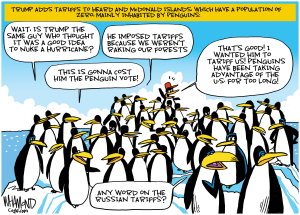 I did go to Influence Watch to check out their biases and funding sources. The methodology is better, using specific parameters to identify where possible trade distortions can happen. Plus, they don’t target Volcano Islands, seals, and penguins. So, I’m going back to the fallout now, which is not likely going to put you to sleep.
This TNR link goes to a podcast with Greg Sargent. ““Horrifying”: Trump’s Weird, Confused Rant to Media as Markets Tanked. As Trump’s shockingly destructive global tariffs cause the markets to crater and he rambles bizarrely about it to reporters, congressional scholar Norm Ornstein walks through how this madness can be stopped.” #FARTUS is not in a state of mind to feed himself, let alone make policy decisions. He’s totally disconnected from reality.
After President Trump imposed sweeping tariffs on imports from all over the globe, prompting the markets to implode, he took a question about it on Thursday. He ranted and rambled delusionally about how everything is just great. He bizarrely likened the country to a patient that had just undergone advanced surgery without grasping why this metaphor is the opposite of reassuring. And he spouted more nonsense about money pouring into our country. On top of all that, his imposition of the tariffs is likely an enormous and grotesque abuse of power. And because of this, the prospects for stopping them are not wholly nonexistent. We talked to congressional scholar Norm Ornstein, who walks us through how Congress can act, what Democrats can do to pressure Republicans to join in doing just that, and why Trump’s engaged in “horrifying folly.” Listen to this episode here. A transcript is here.
 And here’s a snip from the transcript.
Ornstein: They’re inexplicably high and a disaster. I agree. And obviously not only do the markets agree, but so do many people in the business world. I saw that the CEO of Restoration Hardware, as he watched his stock plummet today, responded with a simple two-word phrase, “Oh, shit.”And my guess is that that’s been replicated, probably in even more colorful language, by business leaders, economists, and investors all across America and probably around the world.
Sargent: “Oh, shit” seems like a pretty good reaction, or at least an apt one. So Trump was asked about all this on Thursday. The reporter pointed out that the markets are way down, that they’ve had their worst day in years because of his tariffs. Then the reporter asked Trump, “How’s it going?” Here’s Trump’s answer.
Donald Trump (audio voiceover): I think it’s going very well. It was an operation, like when a patient gets operated on. And it’s a big thing. I said this would exactly be the way it is. We have $6 trillion or $7 trillion coming into our country, and we’ve never seen anything like it. The markets are going to boom, the stock is going to boom, the country is going to boom.
What part of his dementia-riddled mind invents these things? Are there really people out there that consider him even lucid? Governors of many states–but especially farm states–are seeing if they can work around our incredibly insane President. This is from Axios. “Gavin Newsom angles for California exemptions to Trump trade war.”
California Gov. Gavin Newsom said Friday he is pursuing agreements with other countries to ensure California is exempted from retaliatory tariffs stemming from President Trump’s escalating trade war.
Why it matters: Trump’s “Liberation Day” tariffs spurred global blowback. Newsom — a reported 2028 presidential hopeful — is looking to insulate his state from the fallout.
Driving the news: “Donald Trump’s tariffs do not represent all Americans,” Newsom said in a video message Friday.
- California, whom he touted as “the tentpole of the U.S. economy,” aims to maintain “stable trading relationships around the globe,” he added.
- “I’ve directed my administration to look at new opportunities to expand trade and to remind our trading partners around the globe that California remains a stable partner.”
- California is “ready to talk” with global trading partners, Newsom wrote on X.
- Referring to the state’s economic might, Newsom added his state is “not scared to use our market power to fight back against the largest tax hike of our lifetime.”
State of play: The Golden State’s economy and its workers are heavily reliant on trade with Mexico, Canada and China, and retaliatory tariffs stand to have an “outsize” impact on California businesses, farmers and ranchers, according to a press release from Newsom’s office.
- The tariffs could also impede the state’s efforts to rebuild from this year’s devastating Los Angeles wildfires, by hurting access to construction materials like timber, steel, aluminum, and the components of drywall, the press release noted.
The other side: “Gavin Newsom should focus on out-of-control homelessness, crime, regulations, and unaffordability in California instead of trying his hand at international dealmaking,” White House spokesperson Kush Desai told Axios Friday.
Zoom in: Newsom is particularly concerned with retaliatory measures from other countries could impact California’s agricultural sector, especially its almond industry, according to Fox News, which first reported the news of theagreements.
- California is the world’s fifth-largest economy and its agricultural sector is a key economic driver for the state.
 This is from CNBC, as reported by Ruxandra Iordache. “China to impose 34% retaliatory tariff on all goods imported from the U.S.” Can you say Trade War?”
China’s Finance Ministry on Friday said it will impose a 34% tariff on all goods imported from the U.S. starting on April 10, following duties imposed by U.S. President Donald Trump’s administration earlier this week.
“China urges the United States to immediately cancel its unilateral tariff measures and resolve trade differences through consultation in an equal, respectful and mutually beneficial manner,” the ministry said, according to a Google translation.
It further criticized Washington’s decision to impose 34% of additional reciprocal levies on China — bringing total U.S. tariffs against the country to 54% — as “inconsistent with international trade rules” and “seriously” undermining Chinese interests, as well as endangering “global economic development and the stability of the production and supply chain,” according to a Google-translated report from Chinese state news outlet Xinhua.
Separately, China also added 11 U.S. firms to the “unreliable entities list” that the Beijing administration says have violated market rules or contractual commitments. China’s Ministry of Commerce also added 16 U.S. entities to its export control list and said it would implement export controls on seven types of rare earth-related items, including samarium, gadolinium and terbium.
Beijing has also filed a formal complaint against the U.S. with the World Trade Organization, the Ministry of Commerce confirmed in a Google-translated release, saying Washington’s tariffs policy “seriously violates WTO rules, seriously damages the legitimate rights and interests of WTO members, and seriously undermines the rules-based multilateral trading system and the international economic and trade order.”
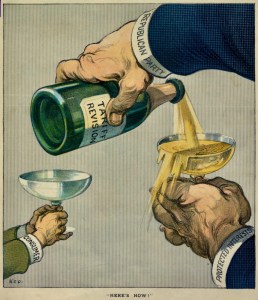
circa 1908 and a reminder from my Grandparents’ peers
Okay, enough of this. It makes me crazy. Not like the following doesn’t, but at least I know nothing about the field. This is from the Washington Post. We have all these #FARTUS appointments breaking security rules and they do this to who? “National Security Agency chief ousted after far-right activist urged his removal. Gen. Timothy Haugh was fired Thursday as director of the powerful wiretapping and cyberespionage service, according to U.S. officials.”
We are so fucked. Have you managed to crawl out of bed yet?
What’s on your reading and blogging list today?
Friday Reads: Headlines I never thought I’d read in this country
Posted: January 11, 2019 Filed under: morning reads | Tags: Mike Pompeo, tariffs and farmers, the Trump shutdown, ugly American 54 Comments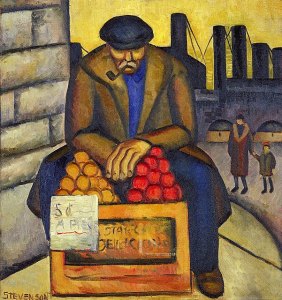
Barbara Stevenson, Apple Vendor, 1933-1934
Good Morning Sky Dancers!
It’s a sunny,crisp, cold morning here in New Orleans. I start this day like most others. Temple has had her morning walk. I have been blessed by the gifts bestowed by the morning’s first cup of coffee. Now I do what my parents and grandparents did before me. I reach for the morning news before starting my work of grading student homework. I think about the the headlines that have greeted the last four or five generations of my family. I still marvel thinking about waking up to the Dust Bowl like my father’s family did or waking up to the start and end of two world wars like both sets of grandparents.
I was already settled into this family pattern in high school when all the Watergate goings on and the Vietnam war news filled the pages. It has been a couple of bombastic modern centuries but some of the worst of it was never quite in everyone’s backyard here. This is when we always would find the gumption–eventually–to be neighborly and come to the support of a neighbor in need. We frequently stumbled on the path to right our country’s wrongs. But,we eventually muster the righteousness to move–eventually and frequently with Judicial encouragement–in that direction.
Today’s art is “Public Art” that was commissioned during The New Deal. It is something with no future in Trump’s America. I don’t mean the angst of the artists living through the Great Depression but the relief they must’ve felt when they were paid to produce these great works in public spaces. Reading through today’s headlines I feel the chill of the season and of the times. Ours is a country that no longer helps its neighbors at all. We’re a country that turns its backs on every one but the extremely wealthy who pass laws to take and keep what they want. The topmost government political officials are nothing more than grifters.
This makes me profoundly sad.
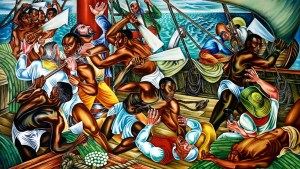
Mutiny on the Amistad,Hale Woodruff.,1938
Here’s a WAPO headline for you to think about. “Now on Craigslist, Facebook: Household items from furloughed workers trying to make ends meet.” These are members of the US coast Guard tasked with protecting our shores and water. They are officials that look for contraband and bad people at ports like the TSO and the customs folks. They are our park rangers who protect everything in the borders of our national parks. We are failing them as they do our work.
A federal worker in Morgantown, W.Va., took to Facebook this week to sell welding tools, left behind by his deceased father-in-law. Another, a die-hard Star Wars fan in Woodbridge, Va., did the same with a life-size replica of Kylo Ren’s lightsaber. A single father in Indiana hosted a sale on eBay with five pages of things found around the house, including Bibles, Nintendo bedsheets and Dr. Seuss neckties.
“Sells for $93.88 at Walmart. Asking $10,” a government worker wrote on a Craigslist ad for a Lulu Ladybug rocking chair. “We need money to pay bills.”
As hundreds of thousands of federal workers brace for their first missed paychecks of the government shutdown this week, some have become immersed in the frantic financial calculus of choosing what they can live without.
In the United States, living paycheck to paycheck is disturbingly common, regardless of profession or location. A recent report from the Federal Reserve revealed how little cushion most Americans have in their budgets: Four in 10 adults say they couldn’t produce $400 in an emergency without sliding into debt or selling something, according to the figures that surveyed households in 2017, a relatively prosperous year for the American economy.
But the shutdown, which began just before Christmas, took many federal workers by surprise and is lasting longer than most expected. That has left furloughed employees stuck at home, sifting through garages and closets, basements and bookshelves to find possessions and personal treasures to sell.
“You have to take a kind of coldhearted look at things around you and decide what would be marketable to someone else,” said Jay Elhard, on furlough from his job as a media specialist at Acadia National Park in Maine.

Baseball at Night by Morris Kantor, 1934
This is behavior deemed appropriate and necessary by a President of the United States so he can get his way on something that all evidence says is a complete waste of treasure. Today, millions of Federal Workers have missed a paycheck. Many are working. A lawsuit has been filed by a Federal Worker’s union. There was a protest this week by workers. The Senate passed a law to guarantee backpay but for many that could be too little and too late. I’ve watched my pay erode and my work load increase over the last 7 years at this teaching job. I’m beyond pay check to pay check because I never know when the terms of my pay will change and they definitely have and so have benefits and it’s never been for the better.
These workers will return to a pay freeze this year when they do get starting getting paid. However, the accumulating interest and late fees on loans and other payments will not freeze and I’ve yet to go a year when life’s little essentials like electricity, water, and access to the internet or tv hasn’t gone up way more than any one’s salary. I’m not sure how much longer these things can continue before a recession really takes hold. Main Street does not depend on the Trump family’s buying whims. It depends on every day people. (Via VOX)
As an official for the American Federation of Government Employees union recently laid out, it takes at least two to three days for the government to process payroll, so workers would likely receive their back pay after at least that much time elapsed.
While Trump has refused to sign a package of seven appropriations bills, forcing about a quarter of the federalgovernment into a lengthy shutdown over this fight, he’s already agreed to sign this back pay legislation, according to a spokesperson for Sen. Tim Kaine (D-VA). Kaine, who was one of more than 20 sponsors for the unanimously passed bill, is optimistic the House will take it up soon, the spokesperson added.
The bill aims to address one of the chief pain points of the shutdown, which has left federal workers scrambling to cover day-to-day costs like rent, utilities, and medication while they wait for their next paycheck to come in. Its benefits, however, won’t be felt for some time since workers won’t receive the back pay until the shutdown has been resolved.
In the interim,Democrats have also proposed other measures to protect workers from the fallout of what will soon be the longest shutdown in US history. Sen. Brian Schatz (D-HI) and Rep. Derek Kilmer (D-WA) have introduced legislation, according to HuffPost, that would “prohibit landlords and creditors from taking action against federal workers or contractors who are hurt by the shutdown and cannot pay rent or repay loans.” And Sen. Tina Smith (D-MN) is drafting a bill that would cover back pay for federal contractors as well.
The shutdown is now in its 20th day and there still isn’t a clear end in sight. At the very least, the Senate’s latest action helps ensure that hundreds of thousands of federal workers will get the pay they missed once it’s over.
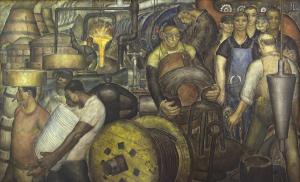
WPA Mural “New Deal”, Charles Wells,1935
Now, Trump is threatening to take Federal Disaster Relief funds for his misadventure along the Southern Border. How many lives and livelihoods will this mean? (Via NBC)
President Donald Trump has been briefed on a plan that would use the Army Corps of Engineers and a portion of $13.9 billion of Army Corps funding to build 315 miles of barrier along the U.S.-Mexico border, according to three U.S. officials familiar with the briefing.
The money was set aside to fund projects all over the country including storm-damaged areas of Puerto Rico through fiscal year 2020, but the checks have not been written yet and, under an emergency declaration, the president could take the money from these civil works projects and use it to build the border wall, said officials familiar with the briefing and two congressional sources.
The plan could be implemented if Trump declares a national emergency in order to build the wall and would use more money and build more miles than the administration has requested from Congress. The president had requested $5.7 billion for a wall stretching 234 miles.
Under the proposal, the officials said, Trump could dip into the $2.4 billion allocated to projects in California, including flood prevention and protection projects along the Yuba River Basin and the Folsom Dam, as well as the $2.5 billion set aside for reconstruction projects in Pueto Rico, which is still recovering from Hurricane Maria.
There are other headlines I find deeply disturbing today. Here are a few.
New York Times: Prosecutors Examining Ukrainians Who Flocked to Trump Inaugural
Associated Press: US official says troop withdrawal from Syria has started
Colleen Long / Associated Press: APNewsBreak: US approved thousands of child bride requests
Laura Rozen / Al-Monitor: Pompeo’s Cairo speech panned as ‘tone-deaf,’ ‘hyper-partisan,’ ‘offensive’
Matt Lewis / The Daily Beast:
The Pompeo Speech at American University in Cairo is particularly offensive and disturbing. I don’t think it does much use to place a xenophobic religious nutter as the face of American outreach to the world.
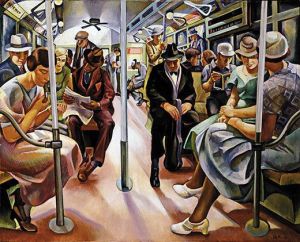
Subway, Lily Furedi, 1934
It’s really difficult not to be embarrassed by the realization that your country’s chief diplomat is a shining example of the “ugly American”.
Pompeo’s speech “was a regurgitation of what they have been saying for two years. There was nothing new, and it was offensive,” former career US diplomat and ambassador to Yemen Gerald Feierstein told Al-Monitor. “That they think that anyone still wants to hear about Barack Obama’s 2009 Cairo speech — get over it.”
“You own the issue now, you own the policy,” Feierstein continued. “People want to know what you are going to do, not what you think Barack Obama did wrong. And on that score, there was nothing there, Just a lot of empty rhetoric of all things they are going to do and how wonderful the United States is and it never occupied anybody. So what.”
Pompeo’s speech is unlikely to reassure American allies and partners frustrated by constantly shifting Donald Trump administration positions on the region that they are not properly consulted about, said former FBI and Treasury Department official Matthew Levitt.
“I do not think they [the Trump administration] fully appreciate the level of anxiety among our allies and potential allies in the region and beyond in Europe in terms of how reliable we are as a partner,” Levitt, now with the Washington Institute for Near East Policy, told Al-Monitor.
“It is not just the decision to withdraw US forces in Syria,” Levitt continued. “Much more than that, it is the way the decision was arrived at and announced. [US Syria envoy Jim] Jeffrey said one thing one day, Trump says the opposite the next day. … People can’t keep up with the pace of the back and forth, ping pong. The lack of clarity, the lack of procedure in the policy making process — the allies see that.”
“While it is great to go to the region in a time of anxiety to reassure people you mean to have a reinvigorated role in the Middle East, it is not enough to say it,” Levitt said.
The extensive swipes in the speech at the previous administration were also discomfiting, Levitt said.
Whether it is done by Republicans or Democrats, “I always felt uncomfortable when Americans travel abroad and hang out dirty laundry,” he said.
“Embarrassing and shameful speech by the small, hyper-partisan Trump suck-up Pompeo,” Ellen Tauscher, a former undersecretary of state for arms control in the Obama administration and a former member of Congress, wrote on Twitter. “There’s not a ‘non-partisan statesman’ pore in his body.”
While I don’t think our country has to send our soldiers to every corner of the globe, I don’t think our country has ever been so small and headed towards insignificance. If the goal was to get us off the international stage, that’s been done. But how is ruining day to day life for ordinary Americans making us ‘great again’? The regime of Tariffs is killing many US businesses. The combination of tariffs and shutdowns is probably hitting US farmers worse than any industry. I’m pretty sure they aren’t getting what they voted for.
In Georgia, a pecan farmer lost out on his chance to buy his first orchard. The local Farm Service Agency office that would have processed his loan application was shut down.
In Wisconsin’s dairy country, a 55-year-old woman sat inside her new dream home, worried she would not be able to pay her mortgage. Her loan had come from an Agriculture Department program for low-income residents in rural areas, but all of the account information she needed to make her first payment was locked away in an empty government office.
And in upstate New York, Pam Moore was feeding hay to her black-and-white cows at a small dairy that tottered on the brink of ruin. She and her husband had run up $350,000 in debt to keep the dairy running after 31 of their cows died of pneumonia, and their last lifeline was an emergency federal farm loan. But the money had been derailed by the government shutdown.
“It has just been one thing after another, after another, after another,” Ms. Moore, 57, said.
Farm country has stood by President Trump, even as farmers have strained under two years of slumping incomes and billions in losses from his trade wars. But as the government shutdown now drags into a third week, some farmers say the loss of crucial loans, payments and other services has pushed them — and their support — to a breaking point.
They thing Trump country never really understood is they’re the ones that need their neighboring states and their beneficence more than any one. I assume they’re learning that painful lesson with the rest of us whose livelihood is running the stuff of the country instead of selling it stuff it really doesn’t need.
What’s on you reading and blogging list today?

 peej
peej Carissa
 bostonboomer
 dakinikat
 ecocatwoman
 mablue2
 Mama Lopez
 peggysue22
 quixote
 skydancingguestblogger
 Mona (aka Wonk the Vote)



 Sky Dancing
Recent Comments