
Super Committee Calvin Ball
Posted: November 20, 2011 Filed under: #Occupy and We are the 99 percent!, Catfood Commission, Federal Budget, Federal Budget and Budget deficit | Tags: Budget Deficit, Extension of Bush Tax Cuts., supercommittee 15 CommentsRepublicans are insistent that the Bush Tax cuts be made permanent. With that stroke of lunacy, we have the imminent and predictable meltdown of the super committee. 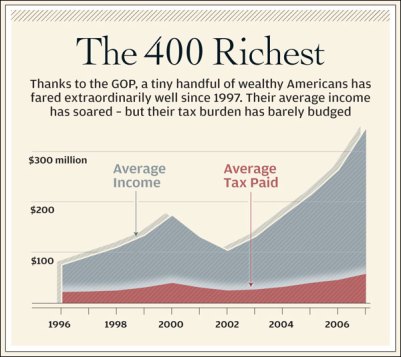 So, what happens when the minority party doesn’t get it’s way on everything? It either holds the economy hostage or changes the rule. Republicans in Congress are playing Calvin Ball to avoid the cuts that super committee failure is supposed to bring to the defense budget. They’re changing their own rules, yet again.
Plus, we’re getting another contradictory argument on taxes. Let the Bush tax cuts expire is “raising taxes”. Letting the payroll tax holiday expire is not raising taxes. How do these folks get through the day without a complete synaptic breakdown? Here’s some details from Reuters. The Murray quoted here is Senator Patty Murray from Washington State.
Murray said Republicans want to extend tax cuts that lowered individual rates — reductions that originated under former Republican President George W. Bush. Those tax cuts run out at the end of 2012.
Republicans have pushed for a permanent extension. Democrats want the tax cuts for the rich to expire.
“In Washington, there are folks who will not cut a dollar unless we raise taxes,” said Kyl, sparking an exasperated reaction from Kerry who noted that Congress has cut about $1 trillion from the budget without any tax hikes.
Republicans want Democrats to agree to do more to find long-term savings in the growing costs of government retirement and healthcare programs.
If no deal is reached by a simple majority of the super committee, automatic spending cuts would start in 2013 — two months after presidential and congressional elections.
Those cuts would be evenly divided between domestic and defense programs. Some Republican members of Congress already are talking about dismantling the automatic cuts to protect the Defense Department from deep reductions.
No serious discussion on deficits can occur without ending the Bush Tax cuts and seriously putting the Pentagon budget on the table. Representatives of the super committe were out full force on the Sunday Morning Talk Show. John Avlon at The Daily Beast points to the political posturing that’s likely still the root of the entire problem. No Republican is willing to compromise any more. Democrats and the President continue to grant many concessions on social programs that leave little left for continuing battle. No where is this more noticeable when the congress passed the old John Chaffee/Bob Dole Republican Health plan under the guise of ObamaCare. The contentious mandate originally came from the Republican side of the aisle from the American Heritage Institute. The twist of facts into partisan narratives has never been worse.
But pervasive hyperpartisan positional bargaining seems to have carried the day. Pessimism has clouded late-inning negotiations. Supercommittee Democrats have offered to put entitlement reforms on the table, but offered few specifics. Republicans have offered limited revenue increases, but tied those to the cutting the top tax rate to 28 percent from 35 percent and permanently extending the contentious Bush tax cuts. Distrust and brinksmanship pollutes the process.
Ironically, but perhaps appropriately, the dysfunctional debate seems to be based around what the term “fair and balanced” actually means.
For Democrats it means a 1-to-1 ratio of tax hikes to spending cuts. For bipartisan groups like the Gang of Six and Bowles Simpson, it means a 3-to-1 ratio. But for too many Republicans, “fair and balanced” means no tax revenues raised at all—a handful of loopholes closed as concessions, like $3 billion from private jets, and the rest collected from spending cuts. The basic dynamic of both sides being willing to slaughter sacred cows is missing despite an avalanche of “more bipartisan than thou” press releases.
The core problem comes from antitax pledges that have dislodged the basic nature of balance sheets in the collective conservative mind—it is all spending, no revenue. Fiscal responsibility has been replaced by fiscal conservatism. Reducing the deficits and debts is no longer the overriding goal, despite Tea Party rhetoric about generational theft or even the balanced-budget-amendment attempt this past week. Instead, keeping tax cuts in place is the one true grail—ignoring the overwhelming popularity of provisions like raising the top rate on people making more than a million dollars a year.
Sane people continue to ask what type of Svengali powers the insane Grover Norquist holds over Republicans? If you want to learn about “The Billionaire’s Best Friend”  who “hijacked the Republican party on behalf of the rich”, go no further than TIm Dickinson’s article in this month’s Rolling Stone. This man continues to hold sway over the Republican congress critterz despite overwhelming public polls that show even Republicans and Independent rank and file don’t support his agenda. Norquest comes from two Republican institutions. He was originally in the Chamber of Commerce which is one organization that has no problem seeing lies and half baked arguments printed in newspapers around the country. Ronald Reagan used him to push his tax reform measures. It’s been one power grab after another backed by nothing more than dogma and a huge budget since then.
Over the past 25 years, Norquist has received funding from many of America’s wealthiest corporations, including Philip Morris, Pfizer and Microsoft. To build a farm team of anti-tax conservatives, Norquist shrewdly took the pledge to state legislatures across the country, pressuring up-and- coming Republicans to make it a core issue before they’re called up to the big leagues. “We’re branding the whole party that way,” Norquist says. “The people who are going to be running for Congress in 10 or 20 years are coming out of state legislatures with a history with the pledge.”
Norquist also built the anti-tax pledge into the DNA of the GOP by hosting weekly Wednesday meetings that enable activist groups representing everyone from gun nuts to home-schoolers to mix with top business lobbyists and conservative officials. The meetings, which began shortly after Bill Clinton was elected, turned Norquist into the Republican Party’s foremost power broker – and gave him a forum to enforce the no-new-taxes pledge as the centerpiece of the GOP’s strategy. “The tax issue,” he says, “is the one thing everyone agrees on.”
Norquist cemented his influence by forging an early alliance with Karl Rove and setting himself up as a gatekeeper to George W. Bush’s inner circle. Then, after Obama was elected, this ultimate Washington insider positioned himself as a leader of the anti-establishment Tea Party, complete with financial support from the billionaire Koch brothers. “These Tea Party people, in effect, take their orders from him,” says Bruce Bartlett, an architect of the Reagan tax cuts. “He decides: This is a permissible tax action, or this is not a permissible tax action. And of course, anything that cuts taxes is per se OK.”
Today, GOP politicians who have signed Norquist’s anti-tax pledge include every top Republican running for president, 13 governors, 1,300 state lawmakers, 40 of the 47 Republicans in the Senate, and 236 of the 242 Republicans in the House. What’s more, the GOP’s Tea Party foot soldiers are marshaled by House Majority Leader Eric Cantor – a veteran of Norquist’s farm team, who first signed the pledge as an ambitious member of the Virginia legislature. Under Cantor’s leadership, Norquist’s anti-tax pledge was directly responsible for last summer’s debt-ceiling standoff that wrecked the nation’s credit rating by leading the nation to the brink of default. “Congress was willing to cause severe economic damage to the entire population,” marvels Paul O’Neill, Bush’s former Treasury secretary, “simply because they were slaves to an idiot’s idea of how the world works.”
Yup. Bush’s former Treasury secretary thinks Norquist has congress hostage to the point that they are “willing to cause severe economic damage to the entire population simply because they were slaves to an idiot’s idea of how the world works.” The result of the work of Norquist and the Republican party has been staggering income inequality.
“The Republican Party has totally abdicated its job in our democracy, which is to act as the guardian of fiscal discipline and responsibility,” says David Stockman, who served as budget director under Reagan. “They’re on an anti-tax jihad – one that benefits the prosperous classes.”
Notice here that I’m quoting Republicans that have had extensive experience in economics, finance, and policy. Funny thing is that the most of these folks aren’t really worried about tanking the economy. What they are worried about is this. If you haven’t read Cannonfire today, you should. First, Cannon points to this. MSNBC got a hold of a memo from a lobbying firm spelling out its plan to use any propaganda means necessary to destroy OWS. The lobbying firm is associated with the American Banker’s Association.
CLGC’s memo proposes that the ABA pay CLGC $850,000 to conduct “opposition research” on Occupy Wall Street in order to construct “negative narratives” about the protests and allied politicians. The memo also asserts that Democratic victories in 2012 would be detrimental for Wall Street and targets specific races in which it says Wall Street would benefit by electing Republicans instead.
According to the memo, if Democrats embrace OWS, “This would mean more than just short-term political discomfort for Wall Street. … It has the potential to have very long-lasting political, policy and financial impacts on the companies in the center of the bullseye.”
The memo also suggests that Democratic victories in 2012 should not be the ABA’s biggest concern. “… (T)he bigger concern,” the memo says, “should be that Republicans will no longer defend Wall Street companies.”
Two of the memo’s authors, partners Sam Geduldig and Jay Cranford, previously worked for House Speaker John Boehner, R-Ohio. Geduldig joined CLGC before Boehner became speaker; Cranford joined CLGC this year after serving as the speaker’s assistant for policy. A third partner, Steve Clark, is reportedly “tight” with Boehner, according to a story by Roll Call that CLGC features on its website.
Another interesting association is noted in the memo.
The CLGC memo raises another issue that it says should be of concern to the financial industry — that OWS might find common cause with the Tea Party. “Well-known Wall Street companies stand at the nexus of where OWS protestors and the Tea Party overlap on angered populism,” the memo says. “…This combination has the potential to be explosive later in the year when media reports cover the next round of bonuses and contrast it with stories of millions of Americans making do with less this holiday season.”
Yup, it’s the divide and conquer strategy again. Since Wall Street can’t make the case, it’s going to use proxies like the Tea Party to do its dirty work. This should be no problem given the astroturf leadership put in place by folks like Dick Armey and Matt Kibbe. These guys are longstanding Republican Beltway insiders. The interesting thing comes in some of the rumors coming out from the committee itself. Supposedly, Boehner had actually agreed to put revenues on the table and provide cover to Republicans that feared Norquist and the Tea Party. Some Democrats never really engaged, some republicans refused to even discuss anything that didn’t include making the Bush Tax cuts permanent for every one, and there was some feeling that the next election would give some indication of which way the wind blows.
A Democratic aide had this eulogy for the supercommittee: “The worm has turned a little bit. The national conversation now is about income inequality and about jobs, and it’s not really about cutting the size of government anymore or cutting spending. 2010 gave one answer to that question. But 2012 will give another, and we’ve got to see what it is.”
I still think economist Jeffrey Sachs has the best take on what the real role of Congress should be in an schizophrenic economy like ours. This is what OWS is trying to point out but is getting blasted for by concentrated efforts in corporate media to publish propaganda. (I have quoted this before, but I’m quoting Sachs again.)
The big political lie of the Super-Committee is that the deficit must be closed mainly by cutting government spending rather than by raising taxes on corporations and the super-rich. Both parties are complicit. The Republicans want to close the deficit entirely by cutting spending; Obama has brandished the formula of $3 of cuts for every $1 of tax revenues. On either approach, the poor and middle class would suffer grievously while the rich and powerful would win yet again (at least until the social pressures boil over).
The key to understanding the U.S. economy is to understand that we have two economies, not one. The economy of rich Americans is booming. Salaries are high. Profits are soaring. Luxury brands and upscale restaurants are packed. There is no recession.
The economy of the middle-class and poor is in crisis. Poverty and near-poverty are spreading. Unemployment is rampant. Household incomes have been falling sharply. Millions of discouraged workers have dropped out of the labor force entirely. The poor work at minimum wages to provide services for the rich.
Until we have some realization that laws put into place for the last 30 years have created markets that are distorted, functional only for a few, and not the least bit reflective of anything remotely “free market”, a portion of the public is going to be willing to vote for people that spread lies. This is why the credibility of any one associated with OWS must be destroyed. The minute a huge portion of us wake up to the lies–much like what happened after publication of the Pentagon Papers and the invasion of Cambodia after Nixonian promises of winding the Vietnam War down–we’re not going to get the policy we need to put things right again. We desperately need to put things right again.
Friday Reads
Posted: November 18, 2011 Filed under: FBI raids, Federal Budget and Budget deficit, income inequality, investment banking, lobbyists, morning reads | Tags: Budget Deficit, buying congress, Jack Abrahamoff, Lobbyists, low corporate taxes, reporting corporate taxes, supercommittee, who are the 1 percent? 24 Comments Good Morning!
Republicans are asking Obama to try to ‘break the log jam” in the subcommittee. I’m not surprised given the President’s known ability to give everything away at the bargaining table. I’m also sure it’s because they can get their lousy policies through and then when they backfire and people get mad, they’ll blame Obama.
Republicans are calling for President Obama to jump into the deficit-reduction talks gripping Washington, reflecting the widespread view that the congressional supercommittee is now headed for a failure.
Lawmakers and congressional aides familiar with the deliberations say the talks have reached a hard impasse, with Republicans locked in an internal struggle over whether to agree to higher tax hikes to cut a deal.
“It’s hard to see us getting a deal unless he comes in at the last minute,” Sen. Dan Coats (R-Ind.) said of Obama, who is on a nine-day trip to the Pacific and not scheduled to return to Washington until Sunday.“We’re in the two-minute drill and closing in on a ‘Hail Mary’ and the quarterback is on the sidelines.
“Unless the leadership, including the president, steps in and saves this thing, I think the consensus is, in terms of coming up with a credible package, all is lost,” Coats added.
There was a surprising lack of urgency on Capitol Hill Thursday as members of the supercommittee talked past one another. Some lawmakers not on the super-panel shrugged at the inaction, saying they were planning to go home for the Thanksgiving recess and noting they don’t have to vote on any deal until next month. Meanwhile, House and Senate leaders indicated they are in no rush to jump in and broker an agreement.
E.J. Dionne, Jr. at Truth Dig says the easiest way to cut the deficit is to do nothing. His thinking reflects some of the things that I’ve been supporting. It includes letting the Bush Ta Cuts expire. I hate to see the triggers on some things, but getting the Pentagon budget trimmed down would be a positive as far as I’m concerned.
Democrats have put huge spending cuts on the table—and keep offering more and more and more. All the Democrats ask in return is that the cuts be balanced by some revenue.
By rejecting their offers, Republicans induce Democrats who are anxious for some deal—any deal—to keep coming their way. The Republican approach is wrong and irresponsible but brilliant as a negotiating strategy. As my Washington Post colleague Ezra Klein wrote this week: “Over the past year, Republicans have learned something important about negotiating budget deals with Democrats: If you don’t like their offer, just wait a couple of months.”
Finally, the Republicans decided they needed to look slightly flexible. So they came up with $300 billion in supposed revenue from a promised tax reform in a plan that also included a proposal to slash tax rates for the rich. There is a lot more tax cutting here than revenue. Rep. Jeb Hensarling, R-Texas, co-chairman of the super committee, who said on Tuesday that this was the GOP’s final offer, reversed field Wednesday afternoon and declared himself open to other ideas.
Even Democrats inclined to capitulate know how shameful agreeing to such a deal would be. And mainstream, centrist deficit hawks should be grateful if a deal on such terms is killed. What Republicans want to do in effect is to make at least 90 percent of the Bush tax cuts permanent. This would only make deficit reduction even harder in the future.
That’s where the do-nothing strategy comes in. Championed early this year in The New Republic by New York Magazine writer Jonathan Chait, it looks even better now because of the spending cuts scheduled to go through if the super committee doesn’t act.
Jack Ambramoff is sure biting the hands that used to feed him. He’s written an article for Bloomberg and calls congress criterz “Willing Vassals” that are up for anything as long as they can cash in. Now that he can no longer make a profit from the game, he’s got some suggestions to end it.
There is only one cure for this disease: a lifetime ban on members and staff lobbying Congress or associating in any way with for-profit lobbying efforts. That seems draconian, no doubt. The current law provides a cooling off period for members and staff when joining K Street. The problem is that the cooling off period is a joke.
Here’s how it works. “Senator Smith” leaves Capitol Hill and joins the “Samson Lobbying Firm.” He can’t lobby the Senate for two years. But, he can make contact with his former colleagues. He can call them and introduce them to his new lobbying partners, stressing that although he cannot lobby, they can. His former colleagues get the joke, but the joke’s on us.
Because the vast majority of lobbyists start on the Hill, this employment advantage is widely exploited. It cannot be slowed with a cooling off period. These folks are human beings, not machines — and human beings are susceptible to corruption and bribery. I should know: I was knee-deep in both. Eliminating the revolving door between Congress and K Street is not the only reform we need to eliminate corruption in our political system. But unless we sever the link between serving the public and cashing in, no other reform will matter.
That’s easier said then done considering the foxes write the rules about how they can behave in the coop. One thing they have managed to do is arrange to avoid taxes. Check out the nifty chart from Felix Salmon at Reuters. It graphs corporate taxes as a percentage of corporate profits. Can you say magically disappear?
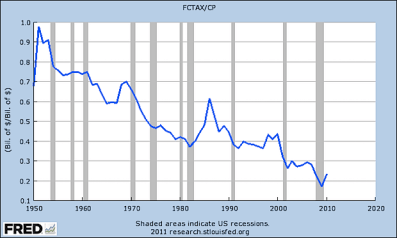
Once upon a time, the corporate income tax generated a significant share of tax revenues; now, it’s bumping along in the 2%-of-GDP range. Yes, the marginal rate of corporate income tax is high, at 35%. But US companies are extremely good at not paying that.
But at least we know the aggregate amount that corporations pay in taxes. What we don’t know — because they won’t say, and no one’s forcing them to say — is how much any given public company pays.
Follow the article to this link to CNN Money that shows you why reporting requirements allow corporations to hide their true tax positions.
During the past few months I’ve repeatedly asked three big companies in the tax-wars cross hairs — GE (GE), Verizon (VZ), and Exxon Mobil (XOM) — to voluntarily disclose information that would refute allegations that they incurred no U.S. federal income tax for 2010. All have refused, saying they won’t disclose anything not legally required. They still manage to complain about the allegations, however. I suspect that if I called the rest of the Fortune 500, I’d get 497 similar responses.
As a society, we need the “taxes incurred” information to inform our current tax debate. Investors, too, would benefit; knowing the tax that companies actually incur would be a useful analytical tool.
The solution, as I’ve said before, is for the Financial Accounting Standards Board to require companies to disclose information from their tax returns for the most recent available year and the nine years before that. This information, from lines 31 and 32 of their returns, would take at most one person-hour a year per company to provide. Adding a 17th tax metric to the 16 already available hardly seems like an invasion of corporate privacy.
Here’s an interesting read in the New York Review of Books by Jeff Madrick entitled “America’s New Robber Barons”.
So it’s worth knowing who is in that group of very rich with runaway incomes. Several news reports in recent weeks have cited a seminal 2010 study that uses IRS tax returns to find out who belongs to the top 0.1 percent. The authors deserve mention because they are often left out when their results are cited: Jon Bakija of Williams College, Adam Cole of the US Treasury, and Bradley Heim of Indiana University. This was not a Treasury study, however, but a private if scholarly one.
One key finding of the study is that three out of five of those in the top 0.1 percent of tax filers are executives or managers of financial and non-financial companies. Overall, more are from non-financial companies. Does this partly exonerate Wall Street, suggesting it is really Main Street where the problem lies?
In fact Bakija, Cole and Heim’s analysis shows the opposite: it turns out that much of the increase in wealth of non-financial executives was also tied to the rise in stock prices. Keeping in mind that stocks options appear as wages in the data, it seems Wall Street itself was often a main source of income growth for “non-financial” managers as well. (Lawyers were another large category of tax payers in the top 0.1 percent, and though there is not direct data for this, one can fairly assume that many of those in corporate firms made a lot of money from the booming business on Wall Street.)
Next, think about how these executives managed their businesses. If they wanted a big pay check they had to orient their strategies to push up their stock prices—that is, often to appeal to the financial fads and fashions of the day. These strategies typically have included cutting labor costs and R&D in order to boost short-term profits. This delighted their advisers on the Street. Stock investors soon loved nothing better than consistent increases in quarterly profits, and not coincidentally, stock options accounted for an ever-growing proportion of executive pay over the past thirty years. We used to say once that Wall Street worked for business, but over the past thirty years business has come to work for Wall Street.
It is just as interesting to explore the factors that the authors found out probably did not cause the surge at the top. Economists typically posit sophisticated technologies (often related to digitalization) as a source of growing inequality: because these technologies require better educated and smarter workers, those who have mastered them are rewarded handsomely. But there was no surge at the very top in other nations like Japan or in Western Europe, which also adopted the same technologies.
Similarly, some have argued that globalization led to higher incomes at the top because skilled workers can sell themselves globally at ever higher salaries. Again, however, such skilled workers have not seen a surge at the very top in Europe or Japan.
One reason for the discrepancy between the US and other countries is that boards of directors in the US are especially willing to give their CEOs and other high level executives big raises and generous stock options. Lucian Bebchuk of Harvard has done a lot of research on this so-called “governance” issue. Meantime, as Bebchuk’s work shows, shareholder influence over executive compensation is far too weak. And there is also the issue of culture itself. America—with its admiration for the self-made man—tolerates high remuneration for the men and women at the top and lower wages in the middle and the bottom. Culture likely matters.
So, that’s a few things to get you started this morning. What’s on your reading and blogging list today?
WTF is a Supercommittee and who is likely to get appointed? (updated)
Posted: August 9, 2011 Filed under: U.S. Economy, U.S. Politics, We are so F'd | Tags: supercommittee 34 Comments We’ve had a catfood commission and a gang of six. Both groups basically had such essential differences that nothing ever came of their recommendations and nothing resembling a consensus appeared. How is some congressional mandate handed over to a “supercommittee” going to be any different? I see no reason for the Republicans to not continue the gridlock. However, I did want to find out more. So, here’s what I found.
It seems obvious to me that the supercommittee has been given a mandate to do things that no single congress critter wants on his record. They are there to cut extremely popular programs. I personally wonder if they will give cover to Republicans that signed on to Grover Norquist’s no tax pledge for reasonable changes in revenue policies as well. I found a reasonably short explanation of their mandate on the PR&P Tax Update Blog.
The Act reduces spending by $0.9 trillion over the next 10 years and creates a 12-member, bi-partisan joint “super” committee charged with making recommendations to cut an additional $1.5 trillion from the deficit over 10 years. The committee may recommend any combination of spending cuts or tax increases. If legislation is not enacted by January 15, 2012 to cut the deficit by at least $1.2 trillion, then any shortfall must be taken equally out of defense and social spending by January 1, 2013. This latter provision is so distasteful to each political party that it is seen as the vehicle to force through an agreement from the super committee.
Super committee appointments are to be made by August 16, 2011 with the first meeting held no later than September 16, 2011. The committee must vote on their conclusions no later than November 23, 2011. If a majority votes in favor, then legislative language must be reported out no later then December 2, 2011. Both the House and the Senate must vote on the proposal by December 23, 2011 with no amendments considered. The committee may rely on previous proposals to reform spending and taxation due to the time constraint it must work under.
There is an incredible amount of speculation on possible appointments to the supercommittee. This is Politico’s best guess for the Senate appointees. They have their guesses for the House appointees as well as a list of ‘dark horses’.
The major contenders to be selected by Senate Majority Leader Harry Reid (D-Nev.):
• Sen. Max Baucus (D-Mont.) – Finance Committee chairman has jurisdiction over entitlement programs and he served on the Simpson-Bowles commission. The Huffington Post, however, reported on Monday that Baucus is unlikely to be tapped.
• Sen. Dick Durbin (D-Ill.) – Reid deputy is a Gang of Six member who also served on Simpson-Bowles.
• Sen. Daniel Inouye (D-Hawaii) – Appropriations Committee chairman participated in the Biden talks.
• Sen. Charles Schumer (D-N.Y.) – Schumer is a Reid ally who would not let Democrats get rolled in the negotiations.
The major contenders to be selected by Senate Minority Leader Mitch McConnell (R-Ky.):
• Sen. John Barrasso (R-Wyo.) – Member of leadership team who throws sharp elbows on 2010 healthcare law.
• Sen. Orrin Hatch (R-Utah) – Ranking member of Finance Committee told The Hill, “I can live with [being appointed] or live without it.” Some point out that Hatch, who could face a primary challenge next year, will not be keen on finding common ground with Democrats.
• Sen. Jon Kyl (R-Ariz.) – McConnell’s deputy participated in the Biden talks and is not seeking reelection.
• Sen. Rob Portman (R-Ohio) – Portman, a budget director in George W. Bush’s administration, has been mentioned a lot in recent days. The former House Ways and Means Committee member is widely respected on both sides of the aisle.
Sam Stein at HuffPo writes that Conrad and Baucus will not make the cut. Obama mentioned that the White House will be involved in the process of what the supercommittee does but he did not mention how that will happen.
To whom he will be submitting the plan remains the major mystery. But over the weekend, information about potential committee members began to leak from Capitol Hill. According to multiple Democratic sources, Senate Democratic leaders are winnowing down the names on the short list and they are leaning strongly against including some of the party’s most notable budget hawks.
Two senators, in particular, were said to be unlikely to end up on the committee: Max Baucus (D-Mont.), who chairs the Finance Committee, and Kent Conrad (D-N.D.), who chairs the Budget Committee.
Final decisions have not yet been made, two aides cautioned. But two other Democratic aides with knowledge of deliberations said they would be very surprised if either ended up on the final list.
“The committee is built for failure — everyone will either stack it with loyalists to leadership and the caucuses or with partisan firebrands to make sure those folks defend key priorities,” said one of those aides. “If they don’t, they will immediately regret it. You need grown-up smart pros that know the issues, know the caucus position and will not waver.”
It appears that Conrad himself does not expect to make the cut. On Aug. 1, the night before the debt ceiling deal was signed, a reporter told him that a few people had floated his name as a super committee member. “I’m sure it’s a very few,” the senator responded.
The exclusion of Conrad and Baucus could have major implications for the committee’s tenor and the actions it will ultimately take. During the debt ceiling debate, Conrad pushed far-reaching deficit reduction proposals that included entitlement and tax reform and called for one dollar in spending cuts for every dollar in tax revenue raised. Baucus is more protective of entitlements but enjoys close ties to the financial service industry. Both are considered senior statesmen among Democrats on debt related negotiations. They are also distrusted by the party base, primarily because of their long records as fiscal hawks.
There are many concerns that people have expressed with the formation of this group. One of the major issues is transparency.
Transparency concerns: Some groups have expressed concern that the joint committee will have an extremely powerful role in shaping policy, but may not be subject to the same transparency obligations as other congressional committees. “Right now, the creation of the committee doesn’t come with many requirements for transparency,” noted the Project on Government Oversight.
In a letter to Congressional leadership Aug. 3, the Sunlight Foundation recommended the joint committee include on its website:
- Live webcasts of all official meetings and hearings,
- the Committee’s report should be posted for 72 hours before a final committee vote,
- disclosure of every meeting held with lobbyists and other powerful interests,
- disclosure of campaign contributions as they are received (on their campaign website), and
- financial disclosures of Committee members and staffers.
The downgrade creates “a sense of urgency for the two parties to come together,” Rep. Steve Southerland, R-Fla. told the Times, adding that the possibility of a further downgrade “scares” him. Added Rep. Blake Farenthold, R-Texas, “Anything that encourages the new committee to get the job done and get us back on a rational fiscal path is a good thing.”
At least some lawmakers called on Congress to return from its August recess to take up more deficit-reduction legislation.
“I sent a letter today to Leader Cantor requesting we come back to DC to resolve our deficit and spending issues. We should be in session!” Rep. Allen West, R-Fla., tweeted. West, a Tea Party-aligned House member, gained attention for his early support of the debt deal Republican leaders agreed to with President Obama.
Similarly, Rep. Jack Kingston, R-Ga., said in a statement that “Congress should immediately reconvene to take up the fundamental reforms necessary to right the ship and lay the groundwork for a more stable and secure future for our children and grandchildren.”
Rep. Barney Frank, D-Mass., said on CBS’ “The Early Show” Monday that “there’s going to be incredible pressure on this commission now to come up with $1.5 trillion worth of deficit cuts,” but he expressed skepticism they’d get the job done. “Do you think if Democrats appoint their six most liberal members and Republicans appoint their six most conservatives that this committee will get anything done?” He said that the two parties should at least be able to support defense spending cuts. As Frank noted, there’s reason to believe the partisan fighting that S&P cited in its downgrade will continue in the supercommittee.
In the first of what will be a closely watched selection process for a powerful new deficit panel, Senate Majority Leader Harry Reid announced he will appoint Democratic Sens. Patty Murray (Wash.), Max Baucus (Mont.) and John Kerry (Mass.) as his three choices for a super committee charged with finding more than $1 trillion in spending cuts by the end of this year.
Murray will serve as co-chair of the 12-member panel. Speaker John Boehner (R-Ohio) will select her co-chair and two other panelists, as required by the next debt limit agreement signed into law by President Barack Obama last week. Minority Leaders Nancy Pelosi and Mitch McConnell will each select three additional members.

 peej
peej Carissa
 bostonboomer
 dakinikat
 ecocatwoman
 mablue2
 Mama Lopez
 peggysue22
 quixote
 skydancingguestblogger
 Mona (aka Wonk the Vote)



 Sky Dancing
Recent Comments