
Friday Reads
Posted: November 19, 2010 Filed under: morning reads | Tags: Antimatter breakthrough, Ben Bernanke, Bobby Jindal the Terrible, China, Closure Votes, Conservatives attack FED, Coporate Governance, Currency Manipulation, DADT, incentive pay, Lucian Bebchuk, Luigi Zingales, Middle Class Tax Cuts, moral hazard, NPR funding, Pew Quiz on political and economic knowledge, starships, Steny Hoyer, Trade Deficits, University of New Orleans 50 Comments Good Morning!

So, this first item I dug up is kind’ve bothersome. It’s a Pew Poll with a self quiz attached on economic and other news. You can go take it yourself if you’d like!
Nearly eight-in-ten (77%) say correctly that the federal budget deficit is larger than it was in the 1990s and 64% know that in recent years the United States has bought more foreign goods than it has sold overseas. As in recent knowledge surveys, about half (53%) estimate the current unemployment rate at about 10%.But the public continues to struggle with questions about the Troubled Asset Relief Program known as TARP: Just 16% say, correctly, that more than half of the loans made to banks under TARP have been paid back; an identical percentage says that none has been paid back. In Pew Research’s previous knowledge survey in July, just 34% knew that the TARP was enacted under the Bush administration. (See “Well Known: Twitter; Little Known: John Roberts,” July 15, 2010
The new survey finds that an overwhelming percentage (88%) identify BP as the company that operated the oil well that exploded in the Gulf of Mexico earlier this year. But as in the past, the public shows little awareness of international developments: 41% say that relations between India and Pakistan are generally considered to be unfriendly; 12% say relations between the two long-time rivals are friendly, 20% say they are neutral and 27% do not know.
Steny Hoyer is promising congressional Dems that they will have a chance to vote to extend the middle class tax cuts. I wonder if he’s spoken to the President who is already indicating he’ll negotiate with the Republicans.
The move indicates that House Dems are growing more resolved to draw a hard line on the Bush tax cuts, forcing Republicans to choose between supporting Obama’s tax plan and opposing a tax cut for the middle class. However, the way forward still remains murky. Even if such a measure were to pass in the House, it’s unclear whether the Senate will agree to such a vote, and the White House has not endorsed the approach.
What’s more, the vote could conceivably go down, or alternatively, Republicans might successfully mount a procedural response, known as a “motion to recommit,” that could also force a House vote on the high end cuts. I have not been able to determine how House Dems might respond to such a move.
For all these reasons, this House move does not preclude a deal being reached in the end on a temporary extension of all the cuts. And plans could still change: The House Dem leadership has yet to publicly endorse this plan
The House failed us on pay equity, extension of unemployment benefits, and the food bill that Sima wrote about yesterday. One bright spot is that NPR will still get federal funding.
House Democrats on Thursday shot down a G.O.P. attempt to roll back federal funding to NPR, a move that many Republicans have called for since the public radio network fired the analyst Juan Williams last month.
Republicans in the House tried to advance the defunding measure as part of their “YouCut” initiative, which allows the public to vote on which spending cuts the G.O.P. should pursue. But their push was blocked, 239 to 171, with only three Democrats voting with a united bloc of Republicans.
Representative Eric Cantor of Virginia, the No. 2 House Republican who is set to become majority leader in the next Congress, said the vote showed Democrats had failed to learn the lessons of this month’s midterm elections.
“Today’s vote was just the latest common sense YouCut to cut spending and save taxpayer dollars, and again Democrats showed that they just don’t get it,” Mr. Cantor said in a statement.
It’s beginning to look like Congress may get rid of DADT. Boxer and Feinstein will be pushing for the effort during the lame duck session. Lisa Murkowski has indicated she will support the effort. Lieberman told The Advocate that the Senate has the required 60 votes for closure.
Sen. Joe Lieberman said Thursday that repealing “don’t ask, don’t tell” as part of the National Defense Authorization Act is no longer a question of votes; it’s a question of process.
“I am confident that we have more than 60 votes prepared to take up the defense authorization with the repeal of ‘don’t ask, don’t tell’ if only there will be a guarantee of a fair and open amendment process, in other words, whether we’ll take enough time to do it,” Lieberman told reporters at a press conference, naming GOP senators Susan Collins and Richard Lugar as yes votes. “Time is an inexcusable reason not to get this done.”
Lieberman, an independent, was flanked by 12 of his Democratic colleagues — a core group that seemed intent on urging the Democratic leadership to allow enough room in the Senate schedule for a debate that would be acceptable to Republicans. The senators talked about working over the weekends, and Sen. Mark Udall offered to go straight through until Christmas Eve.
There is supposedly an Antimatter Breakthrough that could lead to Starships. All the Trekkers out there will sure to be excited.
Scientists at CERN, the research facility that’s home to the Large Hadron Collider, claim to have successfully created and stored antimatter in greater quantities and for longer times than ever before.
Researchers created 38 atoms of antihydrogen – more than ever has been produced at one time before and were able to keep the atoms stable enough to last one tenth of a second before they annihilated themselves (antimatter and matter destroy each other the moment they come into contact with each other). Since those first experiments, the team claims to have held antiatoms for even longer, though they weren’t specific of the duration.
While scientists have been able to create particles of antimatter for decades, they had previously only been able to produce a few particles that would almost instantly destroy themselves.
“This is the first major step in a long journey,” Michio Kaku, physicist and author of Physics of the Impossible, told PCMag. “Eventually, we may go to the stars.”
For now, scientists are interested in producing antimatter in these relatively large quantities because it could lend insight into fundamental physical laws. It’s generally believed in the scientific community that at the universe’s creation, both matter and antimatter existed but not in the same quantity, so when the two annihilated each other, only matter remained. That could be because antimatter behaves differently than the regular variety.
“It’s a fundamental tenet of physics that antimatter and matter behave very similarly although not exactly,” said Lawrence Krauss, physicist and author of The Physics of Star Trek, in an interview. “And in order to really test that, you need anti-atoms. Being able to test the properties of antimatter at a whole new level of precision is obviously important.”
Further into the future, Kaku believes we may be able to use antimatter as the “ultimate rocket fuel,” since it’s 100 percent efficient – all of the mass is converted to energy. By contrast, thermonuclear bombs only use about 1 percent.
“One of the main uses of antimatter would be a starship,” said Kaku “Because you want concentrated energy. And you can’t get more concentrated than antimatter.”
Sarah Palin has fallen directly into the trap I spoke about yesterday in my thread on inflation. I guess she thinks that a few home economics courses are enough to qualify someone to talk on the country’s economy. TNR has a great article up about how conservative Republicans are going after the FED with fallacies and ideology instead of facts. If you read me yesterday, you will know how woefully wrong this is.
Last week, in between leading a graduate seminar on Proust and delivering a long-scheduled lecture on mass spectrometry, former Alaska Governor Sarah Palin ventured a few ticks beyond her acknowledged area of expertise and reflected on monetary policy at a convention in Phoenix. The occasion for her unexpected soliloquy—I’m actually serious about the economics speech—was the Fed’s decision to buy some $600 billion in long-term government securities, a practice known as quantitative easing. “We shouldn’t be playing around with inflation,” Palin said, in a typically Delphic pronouncement. She helpfully added that “everyone who ever goes out shopping for groceries knows that prices have risen significantly over the past year or so.”
There’s a great series called The Rules of the Game over on Project Syndicate by two superheroes of economics and finance –specifically corporate governance–Lucian Bebchuk and Luigi Zingales. They leap out with a great series of questions and answers for reform for Wall Street and big public corporations.
Were over-compensated and unaccountable bosses to blame for the Great Recession? Are bankers and financial managers overpaid? Which reforms must be adopted to save capitalism – above all from its practitioners?
The series is updated ever-so-often and if you get a chance to read any of them, you should. One of my favorites is ‘How to Pay a Banker’ by Bebchuk.
Insulating executives from losses to stakeholders other than shareholders can be expected to encourage them to make investments and take on obligations that increase the likelihood and severity of losses that exceed the shareholders’ capital. In addition, such insulation discourages the raising of additional capital, inducing executives to run banks with a capital level that provides an inadequate cushion for bondholders and depositors. The more thinly capitalized banks are, the more severe these distortions – and the larger the expected costs rising from insulating executives from potential losses to non-shareholder stakeholders.
Compensation schemes for executives should provide disincentives to moral hazard. What we have now is nothing but encouragement. Here’s another quote from ‘Politics and Corporate Money’, from the same author and series.
In expanding corporations’ rights to spend money on politics, the US Supreme Court relied on “the processes of corporate democracy” to ensure that such spending does not deviate from shareholder interests. Clearly, however, such processes can have little effect if political spending is not transparent to public investors.
For such disclosure to be effective, it must include robust rules with respect to political spending via intermediaries. In the US, for example, organizations that seek to speak for the business sector, or for specific industries, raise funds from corporations and spend more than $1 billion annually on efforts to influence politics and policymaking. While the targets of these organizations’ spending are disclosed, there is no public disclosure that enables investors in any public corporation to know whether their corporation contributes to such organizations and how much. Investors deserve to know.
Moreover, a public company’s political spending decisions should not be solely the province of management, as they often are. Independent directors should have an important oversight role, as they do on other sensitive issues that may involve a divergence of interest between insiders and public investors. And these directors should provide an annual report explaining their choices during the preceding year.
Fed Chair Ben Bernanke criticized China’s currency manipulation in what seems to be a ramped up U.S. effort to stop trade deficits through rhetoric. He actually didn’t say China, but the implication is really there in his words.
While Bernanke didn’t identify China, he took aim at “large, systemically important countries with persistent current-account surpluses.” Bernanke’s comments come a week after leaders of the Group of 20 developed and emerging nations meeting in South Korea failed to agree on a remedy for trade and investment distortions. At the summit, President Barack Obama attacked China’s policy of undervaluing its currency.
Bernanke said that the “sense of common purpose has waned” after officials around the world united to fight the financial crisis. “Tensions among nations over economic policies have emerged and intensified, potentially threatening our ability to find global solutions to global problems,” he said.
China has tied the yuan to the dollar to promote exports that helped produce the fastest gains in gross domestic product of any major economy. China, which surpassed Japan’s GDP to become world No. 2 in the second quarter, recorded 9.6 percent annual growth in the three months through September. It holds about $2.6 trillion in foreign reserves, the most in the world.
So, it appears that the pending Thanksgiving weekend has slowed things down a bit. I did want to share something with you concerning my University here in New Orleans and what Jindal the terrible has left to our students here. (You know he was actually on Scarborough this week bragging how he’d cut taxes and balanced the state budget.) This is a University with around 15,000 students and quite a good sized campus with many buildings.
Students at the University of New Orleans did their part on Thursday to help clean up what they believe is a broken funding system for higher education.
Before Hurricane Katrina, there were 87 members of the custodial staff at UNO. There are currently only 31 due to a combination of layoffs and positions that were never filled as people left or retired.
Students said they’re tired of the dirt, and they’re doing something about it.
“It means when we have trash in between classrooms, dust, even roaches, it becomes noticeable (and) very distracting,” said UNO Student Government President John Mineo. “To be honest, I don’t want to go to a classroom like that and sit down.”
Since 2009, UNO has lost $16 million in state support and 150 positions. The move has sparked protests schools across the state, like one at UNO in September, when what was supposed to be a peaceful rally turned violent.
Last week, hundreds of students from around the state rallied on the state capitol, and earlier this week at Louisiana State University, some questioned where the funding for higher education was going by throwing fake money with a picture of Gov. Bobby Jindal on it.
However, Thursday night was the first time that students literally cleaned up the mess they said state leaders have left behind by not prioritizing education.
About 50 students showed up at Thursday’s clean up at Milneberg Hall. They said they chose the building because it’s used for freshmen orientation, and they said dirty classrooms are an embarrassing way to introduce new students to the school.
Louisiana public colleges and universities have had about $300 million in budget cuts since 2008.
There are two janitors left in the 4 story CBA building. It opened just after Katrina and now a good portion of it reminds me of a ghost town. There are plenty of students so that’s not the problem. Our governor is really. really bad news. He shouldn’t be in charge of anything that could impact any living, breathing being. He’s ruthless and cruel and every decision he makes has to do with moving him up the next step on the ladder.
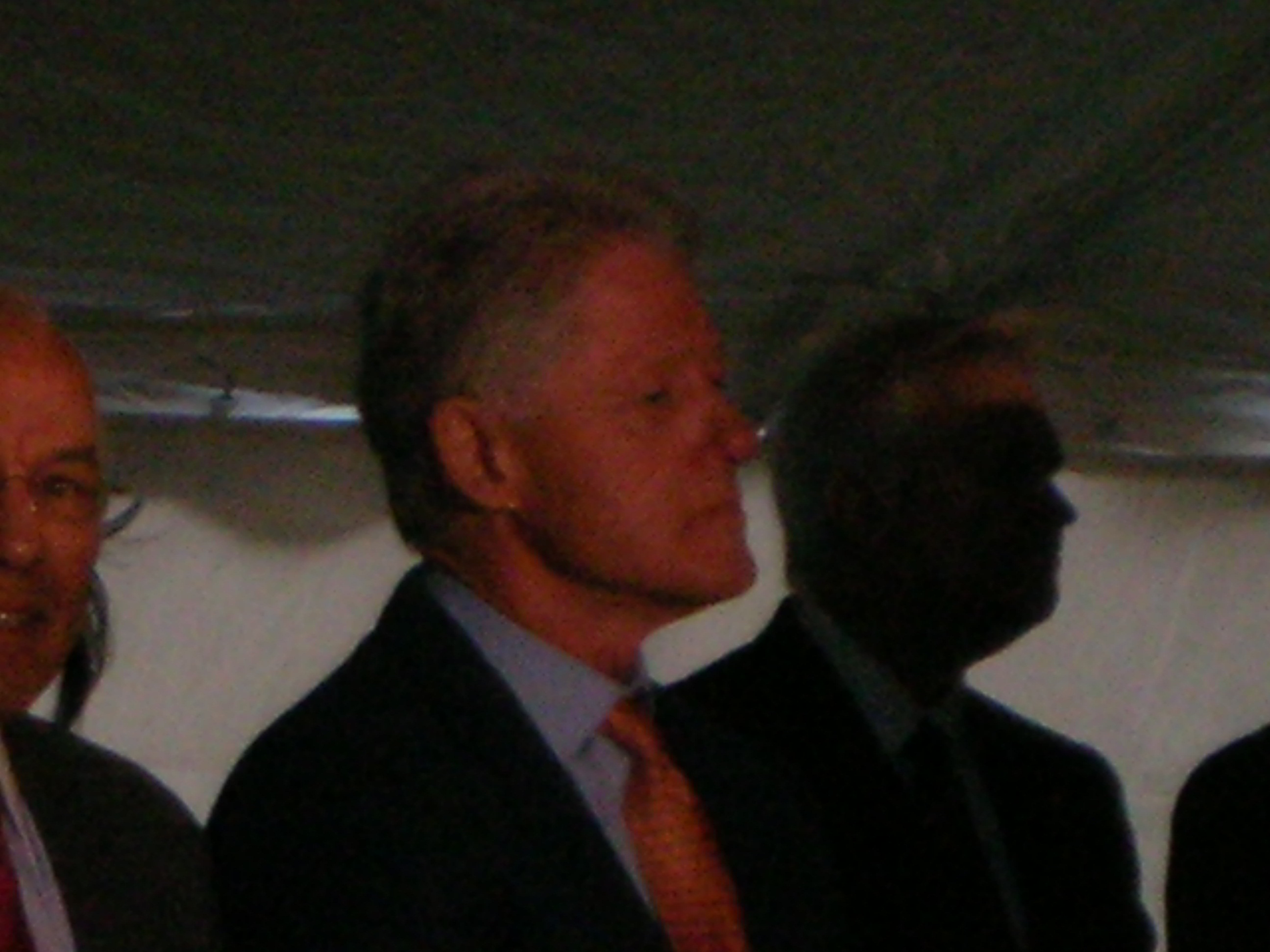
This is a picture of President Clinton that I took at UNO a few months after Hurricane Katrina. I was the only person teaching on the main campus at that time and had 5 students in my class. Clinton's listening to the first President Bush. They came to present the universities here with checks to help us get through the Hurricane damage. Who will help us overcome the damage wrought by Jindal the Terrible?
What’s on you reading and blogging list today?
Status Quo redux
Posted: November 13, 2010 Filed under: just because, The DNC | Tags: House leadership, James Clyburn, Nancy Pelosi, Steny Hoyer 35 Comments It looks like the House Democrats have decided to stick with their leaders and then just add another. In an interesting move, there’s now going to be a minority WHIP and something else. No one knows what the something else is but we know the something else person is Congressman Clyburn. Each of these three represent some Democratic base. WAPO has some of the details, but not that much. Hoyer is still going to be whipping the blue dog contingent.
Trying to resolve a dispute among her top lieutenants, House Speaker Nancy Pelosi (D-Calif.) on Friday night indirectly backed her longtime adversary, Rep. Steny H. Hoyer (D-Md.), to continue serving as her chief deputy.
Pelosi’s move came in an unusual statement late Friday night that endorsed Rep. James E. Clyburn (D-S.C.) for the No. 3 post in the House Democratic leadership. Rather than endorse Clyburn for the current No. 3 position of caucus chairman, she plans to create a new, undefined leadership position for him, a leadership source explained Saturday.
Hoyer, the current majority leader, and Clyburn, the majority whip, are vying to be elected minority whip in the next Congress when House Democrats vote Wednesday. That position will rank second behind Pelosi, who is expected to be minority leader.
Pelosi’s statement amounted to an endorsement of keeping her leadership team intact, rather than trying to purify ranks for the party’s liberals, as some lawmakers and activists have urged.
To me, this is just another Democratic Party attempt to be all things to all parties and further splinter every one into segments. Since Clyburn’s responsibilities haven’t really been announced, what duties will they give him? His title–according to Politico–is Assistant Leader. How does Hoyer feel about what might seem a demotion yet he’s essential got the same title? Or, will his entire job stay the same but he just gets called Number 3 instead of Number 2. Rep. John Larson (Conn.) stays as Democratic Caucus chairman which is now the number four leadership position. Weird. Seems like they’re splitting one baby four ways, but maybe that’s just me. It is certainly seems apt for the completely splintered Democratic Party. I’ll give them that.

 peej
peej Carissa
 bostonboomer
 dakinikat
 ecocatwoman
 mablue2
 Mama Lopez
 peggysue22
 quixote
 skydancingguestblogger
 Mona (aka Wonk the Vote)



 Sky Dancing
Recent Comments