








Two weeks after the annual motorcycle rally in Sturgis, South Dakota, reported Covid infections in the state have risen nearly sixfold.
South Dakota counted 3,819 new cases in the past two weeks, including seven deaths, up from 644 cases in the 14 days preceding it. That makes it the state with the largest percent increase in Covid cases in the past two weeks.
The state’s rate of Covid-19 infections per capita in the past two weeks is in the bottom half of the country, but it’s the sharp and sudden increase in case counts that sets it apart.
Meade County, home to Sturgis, has counted 330 new cases in the last two weeks, up from the 20 reported in the two weeks before the rally, according to Johns Hopkins University’s case count. The 1,550 percent increase comes after the motorcycle rally, which usually draws around half a million people, possibly had its biggest year ever, according to County Sheriff Ron Merwin.
Tuesday Reads: Election Day
Posted: November 2, 2021 Filed under: morning reads | Tags: Annissa Essaibi-George, Boston Mayor, Brad Raffenspurger, Glenn Youngkin, Michelle Wu, National Guard, Ruth Bader Ginsburg, SCOTUS, Terry McAuliffe, Virginia Governor 31 CommentsGood Morning!!

MIchelle Wu and Annissa Essaibi-George are running for Mayor of Boston.
Today is election day in states across the country. The is the deadlocked race between gubernatorial candidates Terry McAuliffe and Glenn Youngkin is getting the most attention, but there’s also a historic election in Massachusetts, where a woman of color most likely will be elected Mayor of Boston today. 7News Boston: Boston voters heading to the polls for historic mayor’s race.
BOSTON (AP) — Boston voters are heading to the polls Tuesday not only to choose between Democrats Michelle Wu and Annissa Essaibi George for mayor, but to mark a turning point in the city’s history, for the first time electing a woman and person of color to helm Boston.
The choice of Wu and Essaibi George for the top political post is just the latest marker of how much the Boston of not-so-long-ago — known for its ethnic neighborhoods, glad-handing politicians and mayors with Irish surnames — is giving way to a new Boston.
Throughout its long history, Boston has previously only elected white men as mayor.
Despite the groundbreaking nature of the candidates, the campaign has turned on familiar themes for the city’s 675,000 residents, including public education, policing, public transportation and the skyrocketing cost of housing.
Among the newer issues facing Boston residents is the effect of climate change on the costal metropolis.
One of the thorniest issues in the campaign is whether Boston should pursue a form of rent control or rent stabilization, something supported by Wu and opposed by Essaibi George. In 1994, Massachusetts voters narrowly approved a 1994 ballot question banning rent control statewide.
Both candidates have spent the final hours of the campaign urging their voters to get to the polls.
Nearly 40,000 ballots have already been cast in early voting. Democratic Secretary of the Commonwealth William Galvin told reporters Monday he estimates about 135,000 ballots will be cast in Boston — about 30% of the city’s 442,000 registered voters.
Both candidates are children of immigrants.
The 36-year-old Wu, whose parents immigrated to the U.S. from Taiwan, grew up in Chicago and moved to Boston to attend Harvard University and Harvard Law School.
Essaibi George, 47, a lifelong Boston resident and former public school teacher, describes herself as a first-generation Arab-Polish American. Her father was a Muslim immigrant from Tunisia. Her mother, a Catholic, immigrated from Poland.
The contest could also be a test of whether voters in a city long dominated by parochial neighborhood politics are ready to tap someone not born and raised in the city like Wu, who grew up in Chicago.
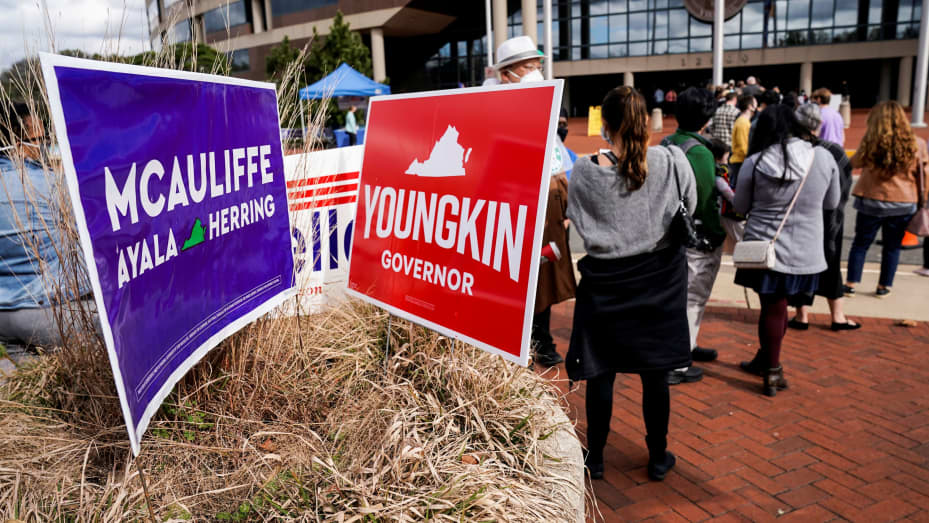 In Virginia, McAuliffe and Youngkin are running neck and neck, and observers are speculating about how the result with impact the midterm elections in 2022. Bloomberg: Virginia Race Offers Hint of 2022 Fight to Control Congress.
Virginia’s gubernatorial contest Tuesday between Terry McAuliffe and Glenn Youngkin will offer the clearest picture yet of how much momentum Republicans have heading into 2022 elections that will decide control of Congress, while President Joe Biden struggles to advance his agenda in Washington.
Polls show the Virginia race essentially deadlocked as Democrat McAuliffe’s lead during the summer evaporated along with Biden’s approval ratings. In the final weeks of the campaign, Republican Youngkin, the former co-chief executive officer of the Carlyle Group Inc., has capitalized on voter frustration with national Democrats and local education issues.
The election comes a day after Senator Joe Manchin, a moderate Democrat from West Virginia, slammed the door on Biden’s wish for Congress to take quick action on his $1.75 trillion tax and spending package, the centerpiece of his presidential campaign. Virginia, a state Biden won by 10 percentage points a year ago, is a bellwether for the Congressional midterms. A McAuliffe loss would be the biggest omen for Democratic prospects to hold onto their slim majority in Congress.
Longtime Democratic strategist Jesse Ferguson said that Virginia is often an “early-warning system” for the party in power as to how it will do in the midterms, especially because of the diversity of the state, which includes rural, suburban and urban areas; military, farming and technology workers; and White, Hispanic and Black voters.
“Virginia allows you for a dry run of the arguments you’re going to make in the midterms, to see how different parts of the electorate respond,” Ferguson said.
Read more at the link.

Peter Saul, Donald Trump in Florida, 2017.
At The Atlantic, Virginia resident Michael Tolhurst writes that a Youngkin win in Virginia could lead to a Constitutional crisis. That’s because governors control the National Guard. I can only provide a brief excerpt, so I hope you’ll read the entire article at The Atlantic.
…[i]n addition to the substantive policy disagreements or politics as pastime, people across America should be monitoring the outcome of this race for another reason: Governors command the National Guard, and after the January 6 riot, the country saw the National Guard defend our constitutional order.
at the outbreak of the Civil War, the prompt arrival of the 6th Regiment Massachusetts Volunteer Militia in Washington, D.C., in April 1861 helped secure a capital precariously close to the battlefront. Later forces arrived, building up the defenses around the city in the Northern Virginia towns of Arlington and Alexandria. This included, a century and a half before I came to live in the area, Connecticut’s 22nd Regiment in which my many-greats-grandfather Edwin Tolhurst served. (His military experience was unromantic—he dug ditches in the red mud of Northern Virginia for nine months, caught consumption, and died shortly after he was discharged.)
We’re not, of course, in a civil war. But law professors and public intellectuals have seriously discussed the possibility of secession or a “national divorce.” A recent University of Virginia study revealed that 41 percent of people who voted for Joe Biden in 2020 and 52 percent of Donald Trump voters “at least somewhat agree that it’s time to split the country.” The same study revealed that significant numbers on both sides wish their preferred president wouldn’t have to be constrained by Congress or the courts.
Given this tinderbox, we unfortunately have to revisit the question of what role the present-day state militias—the National Guard—and the governors who command them might play in a constitutional crisis. As the writer Andrew Sullivan put it, there is an “increasingly nihilist cult on the right among the GOP” that has shown an “increasingly menacing contempt for electoral integrity and a stable democracy.” Will all elected governors rush to the defense of the constitutional order when necessary, as did the 6th Massachusetts and the 22nd Connecticut? Or will they fight for a separatist movement? This is not a happy thought, but as even previously respectable institutions are being coy about the possibility of such a conflict, it must be considered.
It’s difficult to accept that the situation is getting that serious, but you just have to look at how completely the Republican Party has been captured by the Trump/Q-Anon cults to understand that we need to be prepared for the worst. I still need to finish reading the powerful Washington Post series on the January 6 insurrection, but I hope to do so this afternoon.

The Barbarians by Max Ernst, 1937
Harking back to the 2020 presidential election, Georgia Secretary of State Brad Raffenspurger has written a book. AP: Georgia official: Trump call to ‘find’ votes was a threat.
Donald Trump was threatening Georgia Secretary of State Brad Raffensperger when he asked him to help “find” enough votes to overturn his loss in Georgia to Democratic President Joe Biden, Raffensperger writes in a new book.
The book, “Integrity Counts,” was released Tuesday. In it, Raffensperger depicts a man who defied pressure from Trump to alter election results, but also reveals a public official settling political scores as he seeks to survive a hostile Republican primary environment and win reelection in 2022.
An engineer who grew wealthy before running for office, Raffensperger recounts in his book the struggle in Georgia that followed Biden’s narrow victory, including death threats texted to his wife, an encounter with men who he says may have been staking out his suburban Atlanta home, and being escorted out of the Georgia capitol on Jan. 6 as a handful of right-wing protesters entered the building on the same day many more protesters stormed the U.S. Capitol.
The book climaxes with the phone call, which was recorded and then given to multiple news organizations. Raffensperger — known as a conservative Republican before Trump targeted him — writes that he perceived Trump as threatening him multiple times during the phone call.
“I felt then — and still believe today — that this was a threat,” Raffensperger writes. “Others obviously thought so, too, because some of Trump’s more radical followers have responded as if it was their duty to carry out this threat.”
Fulton County District Attorney Fani Willis is investigating potential attempts to improperly influence Georgia’s 2020 election. Raffensperger said in an interview with The Associated Press that Willis’ investigators have talked to some employees in his office, but that he hasn’t been interviewed.
Read more about the book at USA today: Brad Raffensperger, GOP target of Trump ire in Georgia, warns of potential for more election violence.

Ruth Bader Ginsburg, by Bijou Karman
Another extremely important issue we face is that “conservatives” have taken over the Supreme Court. Linda Greenhouse at The Atlantic: What Can Liberals on the Supreme Court Do Now? They’re outnumbered, but they’re not powerless.
By the time the Supreme Court started its new term on the first Monday of October, a tumultuous summer of midnight orders and unsigned opinions had left no doubt about who was in charge. A five-member conservative bloc, anchored by three Trump-appointed justices, had largely stripped Chief Justice John Roberts of leverage and the three remaining liberals of any hope of striking a meaningful alliance with him. The best the liberals can hope for now, even with the chief justice on their side, is a 5–4 loss.
What path is open to them? Can they play a weak hand in a way that can make a difference? Is building bridges worthwhile, or has the time come to burn them all down? These are the questions hovering over the opening of a term that is likely to produce major decisions on abortion, religion, and the Second Amendment.
Perhaps some answers can be found in the memory of Ruth Bader Ginsburg, who died in September 2020 and was replaced with astonishing speed by Amy Coney Barrett. Powerless in her later years to change minds on the increasingly conservative Court, Ginsburg used the tool at her disposal: her voice. The purpose of her blunt and quotable dissenting opinions was not only to call out the majority when she believed it was wrong but to shape how the public understood the Court’s actions.
It’s easy to forget that this was not always Ginsburg’s way. For most of her years on the public stage, there was nothing flamboyant about her. Quite the opposite: A woman of few, precisely chosen words, she seemed content to fade into the background. During her years on the federal appeals court in Washington, she was so well known for her friendship with that court’s conservatives, particularly Antonin Scalia, who moved up to the Supreme Court in 1986, that many leaders of the women’s movement didn’t quite trust her when Bill Clinton chose her to fill his first Supreme Court vacancy, in 1993. In a lecture Ginsburg delivered months before her nomination, she emphasized the importance of dialogue and said that the “effective judge … strives to persuade, and not to pontificate,” and “speaks in a moderate and restrained voice.”
She didn’t become the “Notorious RBG” until much later; the bestselling biography Notorious RBG: The Life and Times of Ruth Bader Ginsburg came out in 2015. By then, Ginsburg had been on the Court for 22 years. It wasn’t so much that Ginsburg had changed as that the Court and the culture had changed around her.
Read the rest at The Atlantic.
Today will be a busy news day. What stories are you following? Please share your thoughts and links in the comment thread below.
Lazy Caturday Reads
Posted: August 28, 2021 Filed under: morning reads | Tags: Afghanistan drone strike, Afghanistan terrorist attack, caturday, Enhanced unemployment ends, Evictions, Hurricane Ida, hurricane katrina, ISIS-K, Joe Biden, Louisiana, Major Biden, NBC clickbait, New Orleans, SCOTUS, U.S. service members killed in Afghanistan 27 Comments
Gathering Storm, by Karen Comber
Good Morning!!
Hurricane Ida is bearing down on Louisiana on the anniversary of Hurricane Katrina. Fortunately, the seawall protections are better now and Joe Biden is president instead of George W. Bush.
AP News: Ida aims to hit Louisiana on Hurricane Katrina anniversary.
NEW ORLEANS (AP) — Hurricane Ida struck Cuba on Friday and threatened to slam into Louisiana with devastating force over the weekend, prompting evacuations in New Orleans and across the coastal region.
Ida intensified rapidly Friday from a tropical storm to a hurricane with top winds of 80 mph (128 kph) as it crossed western Cuba and entered the Gulf of Mexico. The National Hurricane Center predicted Ida would strengthen into an extremely dangerous Category 4 hurricane, with top winds of 140 mph (225 kph) before making landfall along the U.S. Gulf Coast late Sunday.
“This will be a life-altering storm for those who aren’t prepared,” National Weather Service meteorologist Benjamin Schott said during a Friday news conference with Louisiana Gov. John Bel Edwards.
The governor urged residents to quickly prepare, saying: “By nightfall tomorrow night, you need to be where you intend to be to ride out the storm.”
New Orleans Mayor LaToya Cantrell ordered a mandatory evacuation for a small area of the city outside the levee system. But with the storm intensifying so much over a short time, she said it wasn’t possible to do so for the entire city. That generally calls for using all lanes of some highways to leave the city.
Orange Cat, by Vicky Mount
“The city cannot order a mandatory evacuation because we don’t have the time,” Cantrell said.
City officials said residents need to be prepared for prolonged power outages, and asked elderly residents to consider evacuating. Collin Arnold, the city’s emergency management director, said the city could be under high winds for about ten hours.
Other areas across the coastal region were under a mix of voluntary and mandatory evacuations. The storm is expected to make landfall on the exact date Hurricane Katrina devastated a large swath of the Gulf Coast exactly 16 years earlier.
More from CNN: Gulf Coast braces for Sunday arrival of Hurricane Ida, potentially a Category 4 storm.
Ida is anticipated to reach at least Category 4 strength before landfall, the National Hurricane Center said, maintaining its earlier forecast.
“Ida is expected to be an extremely dangerous major hurricane when it approaches the northern Gulf Coast on Sunday,” National Hurricane Center forecasters said Saturday morning. At 8 a.m. ET, the storm sustained winds of 85 mph.
Officials throughout the state implored people to evacuate, with some issuing mandatory orders to do so.
A dangerous storm surge of 10 to 15 feet is expected from Morgan City, Louisiana, to the mouth of the Mississippi River on Sunday as Ida makes landfall, the NHC said.
Hurricane conditions are likely in areas along the northern Gulf Coast beginning Sunday, with tropical storm conditions expected to begin by late Saturday night or early Sunday morning. These conditions will spread inland over portions of Louisiana and Mississippi Sunday night and Monday.
Rainfall can amount to 8 to 16 inches, with isolated maximum totals of 20 inches possible across southeast Louisiana and southern Mississippi through Monday– which will likely lead to significant flash and river flooding impacts.
A hurricane warning remains in effect from Intracoastal City, Louisiana, to the mouth of the Pearl River and includes Lake Pontchartrain, Lake Maurepas and New Orleans.
In Louisiana, a hurricane watch is in effect from Cameron to west of Intracoastal City and the mouth of the Pearl River to the Mississippi-Alabama border. Tropical storm warnings and watches are also issued stretching east to the Alabama-Florida border.
The city is anticipating impacts from damaging winds of up to 110 mph, according to Collin Arnold, director of the New Orleans Office of Homeland Security and Emergency Preparedness.
I found this article at Yahoo News interesting: EXPLAINER: Is New Orleans protected from a hurricane?
Storm has passed, by Robert Tracy
New Orleans finds itself in the path of Hurricane Ida 16 years to the day after floodwalls collapsed and levees were overtopped by a storm surge driven by Hurricane Katrina. That flooding killed more than 1,000 people and caused billions in damage. But Ida arrives at the doorstep of a region transformed since 2005 by a giant civil works project and closer attention to flood control.
The system already has been tested by multiple storms, including 2012’s Isaac, with little damage to the areas it protects….
The federal government spent $14.5 billion on levees, pumps, seawalls, floodgates and drainage that provides enhanced protection from storm surge and flooding in New Orleans and surrounding suburbs south of Lake Pontchartrain. With the exception of three drainage projects, that work is complete.
“The post-Katrina system is so different than what was in place before,” said U.S. Army Corps of Engineers spokesperson Matt Roe.
Starting with a giant surge barrier east of the city, the system is a 130-mile (210-kilometer) ring built to hold out storm surge of about 30 feet (9 meters). The National Hurricane Center on Friday projected Ida would bring a surge of 10 feet to 15 feet (3 to 4.6 meters) on the west bank.
At that level, it could come over the levees in some areas, said emergency manager Heath Jones of the Army Corps of Engineers’ New Orleans District.
“They’re designed to overtop in places” with protections against worse damage, including armoring, splash pads and pumps with backup generators, he said.
“We’ve built all that since Katrina,” and they’re designed for a worse storm than the Ida is expected to be, he said.
Governments as of Friday were not ordering people protected by the levees to evacuate, showing their confidence in the system.
A number of floodgates are being closed as the storm approaches. That includes massive gates that ships can normally sail through, such as ones that close off the Inner Harbor Navigation Canal near the Lower 9th Ward. That has reduced the risk of flooding in an area long viewed as among the city’s most exposed. At least one smaller floodgate on land has been removed for maintenance, though, with officials planning to close the gap with sandbags.
Read more at the Yahoo link.
Afghanistan News
The Guardian: Afghanistan drone strike targeted Islamic State ‘planner’ in car, US says.
The US drone strike in Afghanistan targeted a mid-level “planner” from the Islamic State’s local affiliate who was travelling in a car with one other person near the eastern city of Jalalabad, US official sources said on Saturday.
The strike came two days after Islamic State in Khorasan Province (ISKP) claimed responsibility for a suicide bombing outside Kabul airport, as western forces running the airlift braced for more attacks.
The US president, Joe Biden, has promised to hunt down those responsible, striking in a place and time of his choosing.
The drone strike is likely to be in part aimed at reassuring a shaken US public that its government’s counter-terrorist capabilities in Afghanistan remain intact despite the chaotic withdrawal.
There is no indication that the target of the drone was involved in Thursday’s blast, which killed around 180 people, including 13 US marines.
The attack focused attention on ISKP, which had previously been seen as only a minor actor in Afghanistan and one of the weaker IS affiliates around the world.
The group was founded in 2014 by a few dozen disaffected Taliban commanders and defectors from other militants from the region and made early gains in districts close to the border with Pakistan in the eastern Nangarhar province, where the drone strike occurred around midnight on Friday night. The name Khorasan was given by medieval Islamic imperial rulers to a region including modern Afghanistan.
Read more about ISKP at the Guardian link.
The Washington Post: The 13 U.S. service members killed in the Kabul airport attack: What we know so far.
https://twitter.com/coreyreynoldsLA/status/1431489566574219264?s=20
What’s happening in your neck of the woods? If you’re in the path of Ida, please stay safe!
Thursday Reads
Posted: August 26, 2021 Filed under: morning reads | Tags: Afghanistan, coronavirus pandemic, Covid-19, Donald Trump, Florida, foreign policy, immigration, ISIS, Ivermectin, Joe Biden, SCOTUS, South Dakota, Sturgis rally, vaccines 18 Comments
Man reading, by Franco Americano
Good Morning!!
News just broke of an explosion outside the Kabul airport in Afghanistan. The New York Times: An explosion is reported at Kabul airport, after warnings of a security threat.
An explosion rattled an area outside Hamid Karzai International Airport in Kabul on Thursday, the Pentagon confirmed, just hours after Western governments had warned of a security threat there.
Since the Taliban takeover of the city earlier this month, thousands of Afghan civilians and foreign citizens have gathered at the airport, which has a military and civilian side, desperate to be airlifted out of the country.
“We can confirm an explosion outside Kabul airport,” John Kirby, the Pentagon press secretary, said in a post on Twitter. “Casualties are unclear at this time. We will provide additional details when we can.”
A U.S. military official confirmed that at least one explosion had occurred at the Abbey Gate, a main entryway to the international airport. Early reports indicated that the explosion was caused by at least one suicide bomber wearing an explosive vest. It was unclear how many people were injured or whether anyone was killed, but large crowds have been gathering at the gate in recent days.
I guess we’ll hear more details as the day goes on.
In other news, the Supreme Court’s conservative justices have decided to interfere with the U.S. President’s immigration powers. Ruth Marcus at The Washington Post: Opinion: Thanks to the Supreme Court, a federal judge in Texas is making foreign policy decisions.
Too bad all those Hillary haters refused to vote for her in 2016.
I hate to write about the pandemic again, but it’s still dominating the news because it’s getting worse.
The Washington Post: Hospitalizations hit 100,000 in United States for first time since January.
This is interesting, but not surprising from Joshua Green at Bloomberg News: Vaccinated Democratic Counties Are Leading the Economic Recovery.
With Covid-19 cases once again rising across the country, the U.S. is struggling to curb the latest, delta-driven surge, as hospitalizations and deaths have steadily climbed. But at least so far, the economy has proved highly resilient. There are many reasons for this, ranging from generous stimulus checks to the Federal Reserve’s commitment to buying bonds and holding interest rates low.
But some interesting new data on the overlap of electoral politics and economic dynamism suggest another reason: The geography of America’s economic engine is heavily concentrated in counties that Joe Biden won in 2020. These counties are much more heavily vaccinated than the rest of the country and thus better able to withstand the economic effects of Covid’s delta variant.
By Abraham van Strij
The shift of U.S. economic production toward blue counties predates the arrival of the coronavirus. After the 2016 election, Mark Muro, the policy director of the Brookings Institution’s Metropolitan Policy Project, found that the 472 counties Hillary Clinton won produced 64% of the country’s economic output, while the 2,584 counties Donald Trump won contributed just 36%. That was a significant jump from the 2000 election, when the blue-red county economic split was 54% to 46%. Muro dubbed this divide “high-output America” vs. “low-output America.”
Last year, after Biden defeated Trump, Muro looked again and found that the economic output divide has grown even more pronounced. The 520 counties Biden won account for fully 71% of U.S. gross domestic product, while the 2,564 that Trump carried produced just 29%. In other words, America’s economic engine is bluer than ever.
The partisan lean of these 520 economically vital counties has almost certainly helped to protect U.S. growth because Democrats are much more likely to be vaccinated than Republicans.
Read the rest at the link.
In the red counties and states, people are poisoning themselves rather than get vaccines. Miami Herald: Calls about animal dewormer as COVID treatment soar in Texas, poison center says.
The Texas Poison Center Network has received dozens of calls this month about people exposed to ivermectin, an animal dewormer some are using for COVID-19 treatment.
But the drug, which is flying off the shelves in many parts of the United States, is not a suitable treatment and health organizations are warning against its improper use….
Of the 150 people who have called the center this year regarding exposure to the drug, 54 said they intentionally misused it.
Common side effects of the drug are allergic reactions, nausea, vomiting, diarrhea and hypotension, the center said.
“Patients who take concentrated forms that are used for large animals like horses and cows are more likely to experience severe side effects and toxicity,” Texas Poison Center said in a statement to McClatchy News. “Accidental poisonings in children may also occur when this medication is kept in the home and is improperly stored. As a result, the Texas Poison Center Network does not encourage the use of ivermectin outside of its intended use.”
The U.S. Food and Drug Administration, the National Institutes of Health and the World Health Organization have all also advised against using ivermectin to treat or prevent COVID-19 outside controlled clinical trials, McClatchy News reported earlier this month.
A large dose of ivermectin intended for a horse could cause a human to have complications that include “low blood pressure, rapid heart rates, seizures” along with damage to the liver and layers of skin falling off, Dr. Shane Speights, site dean at the New York Institute of Technology College of Osteopathic Medicine, told KAIT8.

By Franz von Defregger
Some doctors in Idaho and Arkansas are even prescribing this stuff. For Christ sake, why won’t these idiots just get the vaccine and wear masks?
Florida has become the Coronavirus epicenter of the U.S. The New York Times: In Florida, the pandemic is worse now than it has ever been before.
More people in Florida are catching the coronavirus, being hospitalized and dying of Covid-19 now than at any previous point in the pandemic, underscoring the perils of limiting public health measures as the Delta variant rips through the state.
This week, 227 virus deaths were being reported each day in Florida, on average, as of Tuesday, a record for the state and by far the most in the United States right now. The average for new known cases reached 23,314 a day on the weekend, 30 percent higher than the state’s previous peak in January, according to a New York Times database. Across the country, new deaths have climbed to more than 1,000 a day, on average….
And hospitalizations in Florida have almost tripled in the past month, according to federal data, stretching many hospitals to the breaking point. The surge prompted the mayor of Orlando to ask residents to conserve water to limit the strain on the city’s supply of liquid oxygen, which is needed both to purify drinking water and to treat Covid-19 patients.
Even as cases continue to surge, with more than 17,200 people hospitalized with the virus across Florida, Gov. Ron DeSantis, a Republican, has held firm on banning vaccine and mask mandates. Several school districts have gone ahead with mask mandates anyway.
I wonder if DeSantis reads the newspapers or watches anything other than Fox News?
WINTER GARDEN, Fla. (WESH) — At West Side Crematory in Winter Garden, they’re overwhelmed with the remains of people that need to be cremated.
There’s an influx of bodies like they’ve never seen, worse than the first wave of COVID-19. The area where bodies are stored prior to being cremated is stacked to the ceiling. The staff is working day and night to honor the dead.
By Arthur John Elsley
WESH 2 called 20 funeral homes and crematories and many were too busy to be part of our story. Some were too busy to even talk on the phone. One funeral director said that in a 30-minute period where he talked to his partner, four new cases came in.
Mike Marchetti, the area manager for Newcomer Funeral Homes, says as much as they don’t want to, sometimes they have to delay meetings with families and delay funerals because they only have so much staff.
“So the family comes in and they say we would like to have the funeral on Friday and we have to tell then ‘I’m sorry we can’t accommodate a funeral on Friday because our schedule is full,” Marchetti said.
A death care industry struggling to meet demands at a level they’ve never seen before, and families struggling to cope with grief at a level a community has ever seen before.
And then there’s South Dakota, where Governor Kristi Noem welcomed about 700,000 unmasked bikers to party in a a small town named Sturgis.
NBC News: South Dakota Covid cases quintuple after Sturgis motorcycle rally.

By Richard Boyer
The Daily Beast: Warnings About the Sturgis Rally Have Come Tragically True.
In western South Dakota’s Meade County, more than one in three COVID-19 tests are currently returning positive, and over the last three weeks, seven-day average case counts have increased by 3,400 percent. This exponential growth in cases is likely attributable to the 81st Sturgis Motorcycle Rally, which drew an estimated half a million visitors to Meade County and its environs from Aug. 6 through 15, potentially acting as a superspreader event….
…while Southern states have been the main drivers of this surge thus far, the recent spike in cases in South Dakota warrants special concern.
The state more broadly has witnessed a 686.8 percent increase in daily case counts over the past three weeks, currently more than 10 times the nationwide rate. Meade County’s post-Sturgis uptick is certainly a contributor to this state-level increase, but neighboring counties have experienced a sharp incline in cases, too—ranging from a 1,900 percent increase in the past three weeks in Butte to a 1,050 percent increase in Lawrence.
Those two counties are also key focal points for the rally, which is not, in reality, confined to Sturgis. And because the rally is widely attended by residents all across South Dakota, it’s not surprising that counties further away—like Charles Mix County, which saw a 1,500 percent increase—are experiencing an incline in cases, too.
The Sturgis Motorcycle Rally represents the perfect storm for a superspreader event across this region: a large gathering with no testing, no masks, and no vaccination requirements. Though many (but not all) of the goings-on occurred outdoors and thus offered more protection against SARS-CoV-2 transmission than if they hadn’t been, the South Dakota Department of Transportation reported that 525,768 vehicles entered Sturgis over the 10 days of the rally. The sheer number of people in attendance paired with a lack of additional precautions presented prime conditions for viral transmission.
There’s much more at the link.
Sorry about all the bad news. Take care and hang in there, Sky Dancers!!
Friday Reads: Supreme Court Mambo
Posted: June 18, 2021 Filed under: Afternoon Reads | Tags: Afghanistan, Junteenth, SCOTUS 6 Comments
Joaquin Sorollo, Bailaora Flemenco, 1923
Good Day Sky Dancers!
Tropical Storm Claudette is making its way towards New Orleans today. We’re fortunate to be on the dry side of it so mostly we’ve got cooler temperatures and light rain ever so often. I’m actually happy to see the change since the heat was getting pretty relentless.
I was a bit out of it most of yesterday having spent part of the day Wednesday under anesthesia. The polyp is gone off to the lab so now I have to see if it’s worrisome or not. I haven’t read much but I did tune in to see the President sign the bill making Juneteenth a Federal Holiday which was a joy. We’ve recognized Juneteenth here annually. Here’s the link to last year’s edition written by me. BB gets the pleasure tomorrow. However, I had to write about one thing.
I got all teary-eyed watching 94 year old Opal Lee’s excitement during the ceremony. President Biden took a knee for her too. I wept again when I heard her story told by Rachel Maddow later that night. The youtube below has that bit of her show. Her story and her fight to get Juneteenth recognized as a federal holiday demostrate her greatness. This is from CNN.
As a little girl, Lee was the victim of a traumatic event, her first undeniable experience with racism.
One week after nine-year-old Lee moved with her family to an all-White neighborhood, a mob surrounded their home and threatened their lives.
“My dad came with a gun and the police told him if he busted a cap, they would let the mob have us,” she recalls.
Lee’s parents sent her to friends several blocks away “under the cover of darkness,” she tells CNN.”They burned furniture. They set the house on fire. It was terrible. It really was.”
Lee says outside newspapers in Texas reported the crime — but local papers from the community where the violence took place ignored it,
The date of the attack was Juneteenth.
Lee says her parents never spoke of the incident again.
“They buckled down, they worked hard. They bought another home, but we never discussed it,” she explains.
“I just know if we had had an opportunity to stay awhile they would have found out … we were just like them.”
“We wanted the same thing they wanted. A place to live,” she recalls.
“We wanted food, jobs that would pay a wage.”

Dance at Bougival by Pierre-Auguste Renoir, 1883, via The Museum of Fine Arts, Boston
So, about the supreme court and its two decisions yesterday which were extremely narrow. Here’s a little on that including the divine hissy fit that was Alito’s criticism of both. This is from Politico: “‘Alito was just pissed’: Trump’s Supreme Court breaks down along surprising lines. Thursday’s decisions laid bare an emerging rift within the court’s conservative majority.”
The key fault line in the Supreme Court that Donald Trump built is not the ideological clash between right and left — it’s the increasingly acrimonious conflict within the court’s now-dominant conservative wing.
Those rifts burst wide open on Thursday with two of the highest-profile decisions of the court’s current term. In both the big cases — involving Obamacare and a Catholic group refusing to vet same-sex couples as foster parents in Philadelphia — conservative justices unleashed sharp attacks that seemed aimed at their fellow GOP appointees for failing to grapple with the core issues the cases presented.
Some liberal legal commentators noted that the most carefully dissected rhetorical sparring is now taking place among members of the new six-justice conservative majority, with the three remaining liberal justices often left as mere spectators.
“We’re arguing about the battles among the conservatives and when that coalition breaks and where it goes,” lamented Harvard Law School lecturer Nancy Gertner, a former federal judge. “It’s a dramatic difference from only two or three years ago.”
Leading the charge from the right in both cases Thursday was Justice Samuel Alito, who penned caustic opinions taking his colleagues to task for issuing narrow rulings that seemed to him to be aimed at defusing political tensions rather than interpreting the law.
“After receiving more than 2,500 pages of briefing and after more than a half-year of post-argument cogitation, the Court has emitted a wisp of a decision that leaves religious liberty in a confused and vulnerable state. Those who count on this Court to stand up for the First Amendment have every right to be disappointed—as am I,” Alito wrote in the foster-care case, notwithstanding the Catholic charity’s unanimous victory.
In the Obamacare dispute, Alito sarcastically accused the majority of repeatedly indulging in flights of legal sophistry to avoid the politically unpalatable step of striking down the landmark health care law.
“No one can fail to be impressed by the lengths to which this Court has been willing to go to defend the ACA against all threats,” Alito wrote. “A penalty is a tax. The United States is a State. And 18 States who bear costly burdens under the ACA cannot even get a foot in the door to raise a constitutional challenge. Fans of judicial inventiveness will applaud once again. But I must respectfully dissent.”

Dance in Baden-Baden Painting Max Beckmann
Well, that’s interesting. Roberts, Kavanaugh and Barrett have seized the Supreme Court for now.”
Chief Justice John Roberts, along with Justices Amy Coney Barrett and Brett Kavanaugh, demonstrated their collective power at America’s highest court on Thursday.
They fueled the Supreme Court’s limited opinions on Obamacare and religious liberty, in action that marks a twist for the conservative-dominated bench and adds to the suspense of the next two weeks as the court finishes its annual term.
An overriding question going into the session that began last October was whether Roberts would still wield significant control, after former President Donald Trump appointed Barrett to succeed the late liberal Justice Ruth Bader Ginsburg and created a 6-3 conservative-liberal bench.
But the latest developments suggest a possible 3-3-3 pattern, with Roberts, Barrett and Kavanaugh at the center-right, putting a check on their more conservative brethren who regularly push to overturn precedent.
I’ll believe this when I see it continue. My guess is they will not be so kind to anything dealing with women’s moral agency.

Tommervik Abstract Ballroom Dancers
Still, many see a tendency to give people’s bigotry a pass when it comes to supposed “religious beliefs.” This is an Op-Ed at the LA Times by Erwin Chemerinsky.
Under long-standing constitutional law, religious beliefs do not provide an exemption from civil rights laws and cannot be used as an excuse for discrimination.
Yet the Supreme Court on Thursday in Fulton vs. City of Philadelphiaruled in favor of the ability of Catholic Social Services to participate in the city’s foster care program even though that organization discriminates based on sexual orientation. Although the grounds for the court’s unanimous ruling were narrow, the implications are broad and indicate a court that is inclined to allow discrimination based on religious beliefs.
The Fulton case involves the city’s decision to refuse to contract with organizations that engage in forbidden discrimination. Philadelphia routinely contracts with private social service agencies to help place children in foster homes. Those agencies are “delegated” the power of the government in determining whether individuals satisfy state requirements for becoming foster parents. Every contract is explicit in prohibiting these agencies from discriminating on the basis of race, sex, religion and sexual orientation.
Catholic Social Services has long participated in this program, but in recent years has declined to do so because of the contractual requirement that it not discriminate based on sexual orientation. It says that its religious beliefs prevent it from providing inspections of same-sex couples or placing children with those couples.
The organization challenged the nondiscrimination requirement as violating its 1st Amendment rights. The federal district court and the United States Court of Appeals for the 3rd Circuit rejected these arguments, but the Supreme Court reversed those decisions and ruled in the agency’s favor.
In 1990, the court in Employment Division vs. Smith ruled that free exercise of religion does not provide an exemption from a generally applied law. In that case, the court rejected a claim by Native Americans — based on their religious beliefs — for an exemption from a state law prohibiting use of peyote. But the court also said that laws cannot discriminate against religion.
Chief Justice John G. Roberts Jr., writing in the Fulton case, said that the Philadelphia law allowed for exceptions and this discretion meant it was not a sufficiently general law. The possibility of discrimination in exercising this discretion, he wrote, made Philadelphia’s requirement a violation of the free exercise of religion.
But there was no evidence that Philadelphia actually treated Catholic Social Services differently from other social service agencies or used its discretion in an impermissible way. And it is interesting that even the liberal justices — Stephen G. Breyer, Sonia Sotomayor and Elena Kagan — did not raise this point. Perhaps they were glad to go along with a narrow ruling rather than risk one that changed the law and opened the door even more to discrimination based on religious beliefs.

The Dance Hall in Arles Painting Vincent van Gogh
Read his concerns about the findings at the link.
I have on last thing from The Atlantic and writer George Packer. I’ve known a lot of people that came here as part of a War Diaspora. I had childhood friends whose parents came from the Korean War Diaspora. My mother-in-law was a Japanese War Bride. Many of my students are children of the Vietnamese War Diaspora. We also have a lot of folks from Somalia and other engagements that never quite made it to the official War title too. I think this article is timely and correct. It’s Not Too Late to Avert a Historic Shame. As the U.S. military prepares to leave Afghanistan, it’s running out of time to evacuate the Afghans who have helped the United States.”
We do way too many war dances that leave way too many victims.
In the past few weeks, the outlook for Afghans who helped the United States in Afghanistan has gone from worrying to critical. As U.S. and NATO troops leave the country with breathtaking speed, the Taliban are attacking districts that had long been in the Afghan government’s hands, setting up checkpoints on major roads, and threatening provincial capitals. Many of the 18,000 Afghans who, along with their families, have applied for Special Immigrant Visas will soon have nowhere to hide, no armed force standing between them and their pursuers.
Think on that and read the rest at the link.
I’m going to try to get Temple out for one good walk in this weather before we get the bigger soaking so I’ll leave this space to you now. Enjoy listening to Mambo by Leonard Bernstein from Westside Story too! Oh, enjoy watching it too because the orchestra gets all into it completely shouting, dancing and grooving while they play. Plus, it includes cute little girls throwing flowers from a balcony. You need this in your life today!
What’s on your reading and blogging list today?
Thursday Reads
Posted: June 17, 2021 Filed under: morning reads, U.S. Politics | Tags: Affordable Care Act, Donald Trump, Joe Biden, Joe Manchin, Juneteenth, SCOTUS, slavery, Vladimir Putin, voting rights bills 9 CommentsGood Morning!!

Tea break, by Sylvie Vanlerberghe
Yesterday President Biden wrapped up his European trip by meeting with Vladimir Putin. It was a very different spectacle than the one in 2018 in Helsinki when the former guy humiliated himself and our country by rolling over for the Russian president.
The New York Times: A tale of two summits: Trump at Helsinki, and Biden at Geneva.
Helsinki, Finland, was where President Donald J. Trump had his own first face-to-face meeting with the Russian president, and the moment was highly anticipated, given the investigations then taking place into Russian interference in the 2016 presidential election and its reported ties to Mr. Trump’s campaign.
The meeting offered the American president a ripe opportunity to denounce the Kremlin on a public stage. He did not.
Instead, standing by Mr. Putin’s side, Mr. Trump dismissed the conclusions by U.S. intelligence agencies about Russian meddling and said, in essence, that he believed the Russian president’s denials as much as he believed his own intelligence advisers.
“They said they think it’s Russia,” Mr. Trump said. “I have President Putin; he just said it’s not Russia.” For good measure, he said, “President Putin was extremely strong and powerful in his denial today.”
Trump met alone with Russian president for 2 hours, and we still don’t know what happened between the two men. In contrast, Biden was open about his meeting with Putin.
“Where we have differences,” he said just moments into the news conference, “I wanted President Putin to understand why I say what I say, and why I do what I do, and how we’ll respond to specific kinds of actions that harm America’s interests.”
Mr. Biden said, “I told President Putin my agenda is not against Russia or anyone else. It’s for the American people.”
The Japanese Mask (1884), painted by Gustave Claude Etienne Courtois
And he declared: “I also told him that no president of the United States could keep faith with the American people if they did not speak out to defend our democratic values, to stand up for the universal and fundamental freedoms that all men and women have in our view. That’s just part of the DNA of our country.”
To that end, he cited the jailing of the Russian opposition leader Aleksei A. Navalny, and the detentions of two Americans in Russia.
Mr. Biden also offered a warning on cyberattacks.
“I pointed out to him: We have significant cyber-capabilities — and he knows it,” the president said.

Edward Luce at The Financial Times: Biden politely reads riot act to Putin.
Summitry, contrary to a former British prime minister, is nothing like tennis. The outcome is rarely “game, set and match”. By the wide-eyed standards of Joe Biden’s last four predecessors, all of whom held ill-fated summits with Vladimir Putin, Biden went into this one with low expectations.
There were no illusions about his meeting of minds with the Russian leader, let alone souls. The modesty of Biden’s goal — to stabilise relations with America’s chief military adversary — conveyed a realism that eluded earlier presidents.
All of which is far less exciting for the world media. Biden did not praise Putin’s ability to restore Russian freedom and prosperity, as Bill Clinton did in 2000 shortly after Putin was elected president. Nor did he get a sense of Putin’s soul, as George W Bush claimed in 2001, and trust what he saw. He did not aim for an ambitious “reset” of US-Russia relations, as Barack Obama fatefully did in 2009. Most notoriously Biden’s tone was a million miles from the one-man admiration society Donald Trump brought to Helsinki when he met Putin alone in 2018.
After more than two decades in power, this Russian bear was unlikely to change its habits. Biden’s aim is to coax and cajole Putin into a moderately less dangerous stance. That goal is more difficult than it sounds. At home, Biden faces derision from Republican and some foreign policy specialists for even meeting Putin. The act of sharing a stage with America’s president is seen as an unearned reward for an adversary who sponsors regular cyber attacks on the US, not to mention waging information warfare on western democracy.
Read the rest at FT.

Woman with a book, Pablo Picasso
Max Boot at The Washington Post: Opinion: Biden wiped the smirk off Putin’s face.
Biden established an easy rapport with his fellow democratic leaders at meetings with the Group of Seven, the European Union and NATO. “I think it’s great to have the U.S. president part of the club and very willing to cooperate,” French President Emmanuel Macron said. As a congenial insider, Biden was able to accomplish far more than a testy outsider such as Donald Trump ever could. Biden got fellow leaders to agree on a 15 percent global corporate minimum tax, on sending 1 billion doses of covid-19 vaccines to the developing world (not enough, but a start), on speaking out about the challenge posed by China, and on settling a long-festering European-American trade dispute over aircraft subsidies….
The meetings with allies were, in some sense, merely a prelude for meeting with one of the United States’ most effective foes — Vladimir Putin. One cannot imagine a starker contrast between Biden and his predecessor than in their handling of the Russian strongman. At Helsinki in July 2018, then-President Trump simpered and cowered. In a low point of a presidency with more low points than Death Valley, Trump accepted at face value Putin’s “extremely strong and powerful” denials of complicity in the 2016 election attack. Putin emerged from that meeting smirking like the cat that swallowed the canary.
As the historian Michael Beschloss noted, there was no such grin on Putin’s lips when he did his solo press conference after meeting with Biden on Wednesday. While Putin engaged in his usual dishonesty and whataboutism — he compared his jailing of opposition leader Alexei Navalny with the prosecution of the Capitol rioters — his manner was subdued and far from triumphant. He attacked the United States but was careful not to insult Biden personally. He even compared the current president favorably to his predecessor: “President Biden is an experienced statesman. He is very different from President Trump.” (Ouch. That’s got to sting for Putin’s biggest fanboy in the United States.)
In his own remarks, Biden struck all the right notes. He made clear that he raised human-rights concerns with Putin. “How could I be the president of the United States of America and not speak out against the violation of human rights?” he asked. It is almost unimaginable — had we not just witnessed the Trump presidency. Biden said he told Putin that, if Navalny dies in a Russian prison, the consequences would be “devastating for Russia.” He said he also raised Russia’s complicity in cyberattacks, its interference with humanitarian aid in Syria, and its invasion of Ukraine (he expressed support for Ukraine’s “territorial integrity”), while holding out the hope of cooperation on the Iranian nuclear program, stability in Afghanistan, nuclear arms control and other issues.

Takehisa Yumeji, Woman reading a book on the sofa
Now that he’s back home, Biden will sign a bill to create a new national holiday. The Washington Post: Congress votes overwhelmingly to make Juneteenth a federal holiday. The day commemorates the end of slavery in Texas in 1865.


 peej
peej Carissa
 bostonboomer
 dakinikat
 ecocatwoman
 jjlo
jjlo mablue2
 Mama Lopez
 peggysue22
 quixote
 skydancingguestblogger
 Mona (aka Wonk the Vote)



 Sky Dancing
Recent Comments