

So far, the U.S. supply effort has been deliberative and process-oriented in the kinds of weapons it provides, and the speed at which it provides them, so as not to undercut its highest priority of avoiding a direct clash between Russia and the West. That strategy is likely to be part of the agenda at Tuesday’s emergency meeting of G7 leaders, and a gathering of NATO defense ministers later in the week.
Tuesday Reads
Posted: October 11, 2022 Filed under: Afternoon Reads, Crime, Donald Trump, just because | Tags: Elon Musk, impeachment, Merrick Garland, Russia, Secret Service, Trump indictment, Twitter, Ukraine war, Vladimir Putin 21 Comments
The First Animals, by Franz Marc
Good Afternoon!!
We have gone through about 7 years of insanity with Donald Trump, first as a candidate, then as “president,” and now former “president.” At this point, it’s pretty clear that we’ll never be rid of him until he “shuffles off this mortal coil.”
During those years, I always turned to Twitter for the latest news and commentary from journalists and just plain folks. Trump made Twitter occasionally irritating, but now we face what could be an even great threat to the social media platform–a takeover by Elon Musk. And what’s coming could be even worse than I expected.
Musk plans to bring Trump back, and then there this even worse news from Vice: Elon Musk Spoke to Putin Before Tweeting Ukraine Peace Plan: Report.
Elon Musk spoke directly with Russian President Vladimir Putin before tweeting a proposal to end the war in Ukraine that would have seen territory permanently ceded to Russia, it has been claimed.
In a mailout sent to Eurasia Group subscribers, Ian Bremmer wrote that Tesla CEO Musk told him that Putin was “prepared to negotiate,” but only if Crimea remained Russian, if Ukraine accepted a form of permanent neutrality, and Ukraine recognised Russia’s annexation of Luhansk, Donetsk, Kherson and Zaporizhzhia.
According to Bremmer, Musk said Putin told him these goals would be accomplished “no matter what,” including the potential of a nuclear strike if Ukraine invaded Crimea, which Russia annexed in 2014. Bremmer wrote that Musk told him that “everything needed to be done to avoid that outcome.”
Last week, Musk posted essentially the same points on Twitter, although he suggested that the referendums in the annexed territories slammed as sham votes by Ukraine and the West be redone under supervision by the United Nations….
The Ukrainian response to Musk’s Twitter peace proposal was succinct – one diplomat told him to “fuck off,” while Ukrainian President Volodymyr Zelenskyy posted his own Twitter poll.
Meanwhile the Kremlin welcomed Musk’s “positive” proposal to end the war, while his tweets were also cited by Russian state media.
Not only will we never be rid of Trump; The new owner of Twitter apparently be channeling Putin. Terrific.
Yesterday, Russia escalated its attacks on civilians following Ukraine’s damage to a bridge connecting Russia with Crimea. The Kyiv Independent: What’s behind Russia’s unusually big missile attack on Ukraine?
Russia lashed out on Oct. 10, striking many Ukrainian cities with 84 missiles and 24 exploding drones.
The places they hit were all civilian — multiple power plants but also a children’s playground in the center of Kyiv. Most strikes seemed to be timed to the Monday morning rush hour, as if trying to kill as many commuters as possible.
From a human rights point of view, the attacks were inexcusable and will likely be ruled as war crimes. From the battlefield perspective, the Russian armed forces just dropped hundreds of millions of dollars to achieve basically nothing….
Why has Russia chosen to do this? What was it trying to accomplish? And how long can it keep it up?
Edward Landseer’s Monarch of the Glen
The facile answer is that Russia was retaliating for the partial destruction of the Kerch Strait bridge on Oct. 8. But that’s just not true. It’s been hitting civilian targets since Feb. 24. Ukraine’s intelligence said that the missile strikes had been planned since the start of October.
“Strategic and long-range aviation units received orders to prepare for massive missile attacks,” the General Intelligence Directorate said in a statement. “The targets were objects of critical civilian infrastructure and the central regions of densely populated Ukrainian cities.”
The goal was to sow panic among Ukrainians. But that wasn’t the only reason. Putin also needed to appease the angry hardliners who want Russia to win the war. The war hawks demanded a massive strike just like this, in response to Russia’s humiliating losses over the past two months, to which the bridge was the exclamation point. Some of these hardliners are driven more by emotion than sense. And they will want a repeat performance.
Read the rest at the link.
Karen De Young at The Washington Post: Ukraine war at a turning point with rapid escalation of conflict.
In little more than a month, the war in Ukraine has turned abruptly from a grueling, largely static artillery battle expected to last into the winter, to a rapidly escalating, multilevel conflict that has challenged the strategies of the United States, Ukraine and Russia.
Russia’s launch of massive strikes on civilian infrastructure Monday in about a dozen Ukrainian cities far from the front lines brought shock and outrage. The strikes, which Secretary of State Antony Blinken described as “wave after wave of missiles” struck “children’s playgrounds and public parks,” left at least 14 killed and nearly 100 wounded, and cut electricity and water in much of the country….
The attacks were the latest of many head-spinning events — from Ukrainian victories on the ground to Russian President Vladimir Putin’s threat of nuclear weapons use — that have changed the nature and tempo of the war in recent weeks, and raised questions about whether the United States and its partners may have to move beyond the concept of helping Ukraine defend itself, and instead more forcefully facilitate a Ukrainian victory.
U.S. officials continue to express caution about precipitous moves. “Turning points in war are usually points of danger,” said a senior Biden administration official, one of several U.S. and Ukrainian officials who spoke on the condition of anonymity to discuss policy deliberations. “You can’t predict what’s around the corner.”
Russian leaders have cited their own turning point. Viktor Bondarev, head of the foreign affairs committee of Russia’s upper house of parliament wrote in a Telegram post on Monday that the strikes were the beginning of “a new phase” of what the Kremlin calls its“special military operation” in Ukraine, with more “resolute” action to come.

Two Owls by Gustave Doré (1870)
Max Fisher at The New York Times: Bombing Kyiv Into Submission? History Says It Won’t Work.
Kyiv and other Ukrainian cities, follows a long line of wartime leaders who have sought to cow their adversaries by bombing enemy capitals.
Ever since Nazi Germany’s bombardment of London in World War II, enabled by the first long-range missiles and warplanes, nearly every major war has featured similar attacks.
The goal is almost always the same: to coerce the targeted country’s leaders into scaling back their war effort or suing for peace.
It typically aims to achieve this by forcing those leaders to ask whether the capital’s cultural landmarks and economic functioning are worth putting on the line — and also, especially, by terrorizing the country’s population into moderating their support for the war.
But for as long as leaders have pursued this tactic, they have watched it repeatedly fail.
More than that, such strikes tend to backfire, deepening the political and public resolve for war that they are meant to erode — even galvanizing the attacked country into stepping up its war aims.
The victorious allies in World War II did emphasize a strategy of heavily bombing cities, which is part of why countries have come to repeat this so many times since. Cities including Dresden and Tokyo were devastated, killing hundreds of thousands of civilians and forcing millions into homelessness.
Still, historians generally now argue that, even if that did play some role in exhausting those countries, it was largely because of damage to German and Japanese industrial output rather than the terror it caused. Axis countries were also aggressive in bombing enemy cities, casting further doubt on notions that the strategy could be a decisive factor on its own.
Read the rest at the NYT if you’re interested.
With the January 6 Committee hearing coming up on Thursday, this story on the Secret Service phones by NBC’s Julia Ainsley is interesting: Secret Service agents were denied when they tried to learn what Jan. 6 info was seized from their personal cellphones.
Secret Service agents asked the agency for a record of all of the communications seized from their personal cellphones as part of investigations into the events of Jan. 6, 2021, but were rebuffed, according to a document reviewed by NBC News.
The Secret Service’s office that handles such requests, the Freedom of Information Act Program, denied the request, in which agents invoked the Privacy Act to demand more information about what had been shared from their personal devices.
The request was made in early August, just after news came to light that both Congress and the Department of Homeland Security’s inspector general were interested in obtaining text messages of Secret Service agents that had been erased as part of what the agency said was a planned upgrade.
“This letter is the final response to your Privacy Act inquiry submitted on Aug. 4, 2022, for information pertaining to the release of personal cell phone information and/or other personal identifiable information (PII) by the U.S. Secret Service,” said the letter, dated last Wednesday.
“The agency has determined that regulation does not require a records disclosure accounting to be made in connection with your request,” the letter continued.
The agents’ effort to find out through an FOIA request what records were seized and the subsequent denial of the request underscore a tension between rank-and-file Secret Service agents and the agency’s leadership over what communications should be shared with investigators.

Whistlejacket, by George Stubbs
At The Washington Post, Mariana Sotomayor writes about a another new book on the Trump impeachments: New book details how McCarthy came to support Trump after Jan. 6.
In the weeks after the Senate voted to acquit Donald Trump of a charge related to the Jan. 6, 2021, insurrection, House Minority Leader Kevin McCarthy (R-Calif.) was seething.
Frustrated that Trump would not talk to him, stressed that his chance to become House speaker could be in jeopardy and furiousthat a trusted confidante had publicly disclosed a tense call between him and Trump, McCarthy snapped.
“I alone am taking all the heat to protect people from Trump! I alone am holding the party together!” he yelled at Rep. Jaime Herrera Beutler (R-Wash.) during a previously undisclosed meeting in McCarthy’s office on Feb. 25, 2021. “I have been working with Trump to keep him from going after Republicans like you and blowing up the party and destroying all our work!”
Stunned by McCarthy’s anger, Herrera Beutler began to cry. Through tears, she apologized for not telling him ahead of time that she had confirmed to the media details of a call McCarthy made to Trump on Jan. 6, 2021, urging him to tell his supporters to leave the U.S. Capitol.
“You should have come to me!” McCarthy said. “Why did you go to the press? This is no way to thank me!”
“What did you want me to do? Lie?” Herrera Beutler shot back. “I did what I thought was right.”
The tense meeting between Republican lawmakers is detailed in the new book “Unchecked: The Untold Story Behind Congress’s Botched Impeachments of Donald Trump,” by Washington Post reporter Karoun Demirjian and Politico reporter Rachael Bade, a copy of which The Post obtained ahead of its release next week. Several excerpts detail McCarthy’s state of mind from Election Day 2020 to the origination of the select committee investigating the Jan. 6 insurrection.
“McCarthy’s tirade against Herrera Beutler was just the start of what would become a GOP-wide campaign to whitewash the details of what happened on January 6 in the aftermath of the second impeachment,” the authors write.
There are more revelations about McCarthy in the WaPo story. Basically, McCarthy’s dream is to to become Speaker of the House and in pursuit of that goal he will suck up to Trump as much has he has to.
Lastly, at The Atlantic, Franklin Foer writes about why Merrick Garland will indict Trump: The Inevitable Indictment of Donald Trump.
Foer writes that, although Garland is a cautious, methodical person, he (Foer) is convinced that Trump will be indicted. Here’s why he thinks that. You’ll need to read the whole thing, but here’s an introduction to the arguments.
I have been observing Garland closely for months. I’ve talked with his closest friends and most loyal former clerks and deputies. I’ve carefully studied his record. I’ve interviewed Garland himself. And I’ve reached the conclusion that his devotion to procedure, his belief in the rule of law, and in particular his reverence for the duties, responsibilities, and traditions of the U.S. Department of Justice will cause him to make the most monumental decision an attorney general can make….
The Kongouro from New Holland, by _(Kangaroo) George Stubbs
Before I lay out the reasons I believe I am correct in this assessment, I want to discuss why it is entirely possible I am not. The main reason to disbelieve the argument that Garland is preparing to indict is simple: To bring criminal charges against a former president from an opposing political party would be the ultimate test of a system that aspires to impartiality, and Garland, by disposition, is repelled by drama, and doesn’t believe the department should be subjected to unnecessary stress tests. This unprecedented act would inevitably be used to justify a cycle of reprisals, and risks turning the Justice Department into an instrument of never-ending political warfare.
And an indictment, of course, would merely be the first step—a prelude to a trial unlike any this country has ever seen. The defendant wouldn’t just be an ex-president; in all likelihood, he’d be a candidate actively campaigning to return to the White House. Fairness dictates that the system regard Trump as it does every other defendant. But doing so would lead to the impression that he’s being deliberately hamstrung—and humiliated—by his political rivals.
Garland is surely aware that this essential problem would be evident at the first hearing. If the Justice Department is intent on proving that nobody is above the law, it could impose the same constraints on Trump that it would on any criminal defendant accused of serious crimes, including limiting his travel. Such a restriction would deprive Trump of one of his most important political advantages: his ability to whip up his followers at far-flung rallies.
In any event, once the trial began, Trump would be stuck in court, likely in Florida (if he’s charged in connection with the Mar-a-Lago documents matter) or in Washington, D.C. (if he’s charged for his involvement in the events of January 6). The site of a Washington trial would be the Prettyman Courthouse, on Constitution Avenue, just a short walk from the Capitol. This fact terrified the former prosecutors and other experts I talked with about how the trial might play out. Right-wing politicians, including Trump himself, have intimated violence if he is indicted.
Trump would of course attempt to make the proceedings a carnival of grievance, a venue for broadcasting conspiracy theories about his enemies. The trial could thus supply a climactic flash point for an era of political violence. Like the Capitol on January 6, the courthouse could become a magnet for paramilitaries. With protesters and counterprotesters descending on the same locale, the occasion would tempt street warfare.

Head over the Atlantic to read the rest.
What are your thoughts on these stories? What other news are you following today?
Lazy Caturday Reads
Posted: October 8, 2022 Filed under: caturday, Donald Trump | Tags: Christopher Kise, Crimea, DOJ, fake heiress, Inna Yashchyshyn, John Solomon, Mar-a-Lago, National Archives, Russia, Russia investigation, special master, Trump stolen documents, Trump Tower, Ukraine, Valeriy Tarasenko 27 Comments
By Emanuele Cavalli (1904-1981)
Happy Caturday!!
Even though we are heading into a 3-day weekend, there is a surprising amount of news today. I’m going to focus on the following stories: Ukraine’s destruction of a bridge that is vital to Russian supply routes; New developments in the Trump stolen documents saga; and someshocking news on that Russian-speaking Ukrainian woman who infiltrated Mar-a-Lago awhile back.
Ukraine War News
CNN: Massive blast cripples parts of Crimea-Russia bridge, in blow to Putin’s war effort.
In a major blow for Russian President Vladimir Putin, a huge explosion has severely damaged the only bridge connecting the annexed Crimean peninsula with the Russian mainland, paralyzing a key supply route for Moscow’s faltering war in Ukraine.
The blast early Saturday caused parts of the Kerch Strait road and rail bridge – opened by Putin himself in 2018 – to collapse, images and video from the scene showed. At least three people were killed in the explosion, Russian officials said, citing preliminary information.
The exact cause of the blast at Europe’s longest bridge is yet to be confirmed. Russian officials said a truck exploded, causing Crimea-bound sections ofthe bridge’s road portion to collapse. A subsequent fire engulfed a train of fuel tanks on a separate, adjacent rail portion of the bridge.
Putin ordered a “government commission” to examine the Kerch bridge “emergency” in Crimea, Russian state media TASS reported.
An official in Crimea blamed “Ukrainian vandals” for the explosion. Some Ukrainian officials gloated over the incident without directly claiming responsibility – even announcing commemorative stamps will be made. Russian Foreign Ministry spokeswoman Maria Zakharova said that “the reaction of the Kyiv regime to the destruction of civilian infrastructure testifies to its terrorist nature.”
On the strategic importance of the bridge:
Kees van Dongen, The Concierge de la Villa Said, 1917
The damage to the road bridge appears to be severe, with the part of the bridge that carries westbound road traffic crippled in at least two places. The damage to the rail link where fuel tanks caught fire is unclear.
The bridge is strategically important because it links Russia’s Krasnodar region with the Crimean peninsula, which was annexed by Russia from Ukraine in 2014 in a move condemned by the international community.
It is a critical artery for supplying Crimea with both its daily needs and supplies for the military. Over the last few months, dozens of Russian military convoys have used the bridge, carrying vehicles, armor and fuel.
If the Russian military can’t use the bridge, its supply lines to forces in southern Ukraine would become more tenuous, especially when combined with Ukrainian advances southwards into Kherson region, north of Crimea.

Trump Stolen Documents News
Rolling Stone: Justice Department Asking if Trump Stashed Documents in Trump Tower.
FEDERAL INVESTIGATORS HAVE asked multiple witnesses if they knew whether Donald Trump had stashed any highly sensitive government documents at Trump Tower in Manhattan or at his private club in Bedminster, New Jersey, a person familiar with the matter and another source briefed on the situation tell Rolling Stone.
The FBI, according to these sources, had also asked in recent months whether the ex-president had a habit of transporting classified documents from his Florida estate Mar-a-Lago to the other Trump properties. The feds specifically discussed both the New York City and Bedminster locations with certain witnesses.
“It was obvious they wanted to know if this went beyond just Mar-a-Lago,” the first source says….
On Thursday, The New York Times reported that the Justice Department informed Trump’s legal team it believes the former president may have taken more documents than the ones the FBI returned to the National Archives after its August Mar-a-Lago search. Trump attorney Christopher Kise reportedly suggested that the former president voluntarily conduct a search for any further missing documents at another unnamed Trump property, according to the Times.
The FBI has been quietly interviewing a number of former Trump associates as part of its inquiry into his retention of classified documents….
The increased law enforcement scrutiny since the FBI search of Mar-a-Lago has prompted Trump to wonder aloud who in his circle could be helping the Justice Department’s investigation. In exchange with associates, Trump has asked whether anyone in MAGA world could be “wearing a wire” or if his phones are “tapped.” In private, associates of the former president told Rolling Stone that Trump remains focused on getting back “all” of the documents — even classified ones — taken by the FBI back, referring to them as “mine.”
Maggie Haberman and Michael Schmidt at The New York Times: How Trump Deflected Demands for Documents, Enmeshing Aides.
Late last year, as the National Archives ratcheted up the pressure on former President Donald J. Trump to return boxes of records he had taken from the White House to his Mar-a-Lago club, he came up with an idea to resolve the looming showdown: cut a deal.
By Li Gui Jun
Mr. Trump, still determined to show he had been wronged by the F.B.I. investigation into his 2016 campaign’s ties to Russia, was angry with the National Archives and Records Administration for its unwillingness to hand over a batch of sensitive documents that he thought proved his claims.
In exchange for those documents, Mr. Trump told advisers, he would return to the National Archives the boxes of material he had taken to Mar-a-Lago, in Palm Beach, Fla.
Mr. Trump’s aides never pursued the idea. But the episode is one in a series that demonstrates how Mr. Trump spent a year and a half deflecting, delaying and sometimes leading aides to dissemble when it came to demands from the National Archives and ultimately the Justice Department to return the material he had taken, interviews and documents show.
That pattern was strikingly similar to how Mr. Trump confronted inquiries into his conduct while in office: entertain or promote outlandish ideas, eschew the advice of lawyers and mislead them, then push lawyers and aides to impede investigators.
In the process, some of his lawyers have increased their own legal exposure and had to hire lawyers themselves. And Mr. Trump has ended up in the middle of an investigation into his handling of the documents that has led the Justice Department to seek evidence of obstruction.

Read the rest at the NYT.
Mike Levine and Kathrine Faulders at ABC News: On Trump’s last day in office, why were sensitive documents allegedly in such disarray?
At the end of Donald Trump’s presidency, his team returned a large batch of classified FBI documents and other government records to the Justice Department in such disarray that a year later — in a letter to lawmakers — the department said it still couldn’t tell which of the documents were the classified ones.
The documents came from the FBI’s controversial probe in 2016 looking at alleged links between Russia and Trump’s presidential campaign. Trump tried to make the documents public the night before he left office, issuing a “declassification” memo and secretly meeting with conservative writer John Solomon, who was allowed to review the documents, Solomon told ABC News this past week.
‘Tiptoes the Mischievous Kitten’, illustrated by P. B. Hickling
But for reasons that are still not clear – and to the great frustration of Trump and his political allies – none of the documents were ever officially released, and the Justice Department said Thursday it’s still working to determine which documents can be disclosed….
Much of what happened with the documents in those last days of the Trump administration — and ever since — remains shrouded in mystery because current and former government officials involved have refused to speak about it, especially now that the FBI is pursuing its investigation into Trump’s alleged mishandling of a separate cache of classified documents.
The story that still emerges, though, from pieces of public statements and Solomon’s own accounts is one that sheds further light on how Trump’s White House treated certain government secrets. And it helps explain how – in the midst of the FBI probe – Solomon became one of Trump’s official “representatives” to the National Archives.

There’s much more at the ABC link.
A rift has opened in Donald Trump’s legal team over how to respond to Mar-a-Lago classified documents case, The New York Times reported.
According to the Times, the rift was prompted by the Department of Justice telling Trump’s team it believes he still possesses government records, even after the FBI raid in August which seized hundreds of files from his home.
Two sources told The Times that attorney Christopher Kise put himself at odds wth Trump by advocating creating a “forensics team” of independent investigators to meticulously inspect whether Trump has any further records.
Per The Times, Trump was initially open to the idea, the report said, but was later persuaded by other attorneys to take a more aggressive approach, leading to Kise being sidelined.
Hugo Lowell at The Guardian: Donald Trump seeks to withhold two folders seized at Mar-a-Lago.
Donald Trump is seeking to withhold from the justice department two folders marked as containing correspondence with the National Archives and signing sheets that the FBI seized from his Mar-a-Lago resort, according to court filings in the special master review of the confiscated documents.
The former US president’s privilege assertions over the folders, which appear to have direct relevance to the criminal investigation into whether he retained national defense information and obstructed justice, are significant as they represent an effort to exclude the items from the inquiry and keep them confidential.
Barbara Perrine Chu, Woman with Two Cats
Most notably, Trump asserted privilege over the contents of one red folder marked as containing “NARA letters and other copies” and a second, manilla folder marked as containing “NARA letters one top sheet + 3 signing sheets”, a review of the court filings indicated.
The former president also asserted privilege over 35 pages of documents titled “The President’s Calls” that included the presidential seal in the upper left corner and contained handwritten names, numbers, notes about messages and four blank pages of miscellaneous notes, the filings showed.
Trump additionally also did the same over an unsigned 2017 letter concerning former special counsel Robert Mueller, pages of an email about election fraud lawsuits in Fulton County, Georgia, and deliberations about clemency to a certain “MB”, Ted Suhl and former Illinois governor Rod Blagojevich.
The documents the former president is attempting to withhold from the criminal investigation by asserting some sort of privilege – it was not clear whether he asserted executive or attorney-client privilege over the two folders, for instance – became clear after a Friday ruling by the special master.

Lowell figured out which documents Trump was claiming privilege on by comparing the document numbers in the latest filing with another filing that was briefly unsealed and obtained by Zoe Tillman of Bloomberg News.
News Related to Mysterious Woman Who Infiltrated Mar-a-Lago
Pittsburgh Post-Gazette: Valeriy Tarasenko, associate of fake heiress who wandered Mar-a-Lago and posed with Donald Trump, shot outside Canadian resort.
A close associate of a woman who posed as a member of a famous banking family and spent days at former President Donald Trump’s Mar-a-Lago home was shot Friday in a brazen attack outside a lakeside resort northwest of Montreal, the Canadian paper LaPresse reported.
Quebec provincial police have launched a search for the shooter and other accomplices behind the midday shooting of Valeriy Tarasenko, 44, in the upscale community of Esterel, according to LaPresse. Police said he suffered “significant injuries” but was expected to survive.
Mr. Tarasenko was a former business partner of Inna Yashchyshyn, a Russian-speaking Ukrainian immigrant who gained recent notoriety after an investigation by the Pittsburgh Post-Gazette and the Organized Crime and Corruption Reporting Project in August revealed that she masqueraded as a member of the Rothschild family and went to Mar-a-Lago, where she made inroads in the former president’s inner circle.
In prior interviews with the Post-Gazette, Mr. Tarasenko said that he met with the FBI and turned over a host of documents and photos tied to an investigation into Ms. Yashchyshyn, her trips to the former president’s estate, and businesses she formed – two with Mr. Tarasenko – over the past seven years.
A bit more:
By Holly Warburton
Quebec police said they were trying to “shed some light on the circumstances that led to the injuries of the victim.” But for now, “to protect the investigation, no other detail can be shared.”
Mr. Tarasenko, who was born in Ukraine and raised in Moscow, told the Post-Gazette and OCCRP that he had hired Ms. Yaschyshyn in 2014 to live in his Midtown Miami condo and watch his two daughters while he traveled on business.
But over the past year, the pair had a falling out, with Mr. Tarasenko accusing Ms. Yashchyshyn of abusing his children — allegations that she has vehemently denied.
The shooting is expected to widen the ongoing FBI investigation that includes several interviews with witnesses about a highly suspicious Miami charity, United Hearts of Mercy.

This seems like a significant story that isn’t getting that much attention in the U.S. media yet. Here are a two Canadian articles–rendered in English by Google Translate–and another at The New York Post.
Le Devoir: A man with a troubled past targeted by an armed attack in Estérel.
Radio Canada: One person injured in shooting at Estérel
The New York Post: Fake Ukrainian heiress: ‘My ex-lover forced me to become Anna de Rothschild’
Could this have anything to do with the stolen documents?
What are your thoughts? What other stories are you following today?
Tuesday Reads
Posted: October 4, 2022 Filed under: Afternoon Reads, Donald Trump, just because | Tags: "independent state legislature theory", DOJ, FBI, Mar-a-Lago, National Archives, nuclear weapons, Oath Keepers, Russia, SCOTUS, seditious conspiracy, stolen government documents, Ukraine, Vladimir Putin 18 Comments
Mr Toad in The Wind in the Willows, illustration by Inga Moore
Good Afternoon!!
My posts are getting later and later. I look around at what’s happening in the world on my blogging days and somehow it takes me a long time to get going. Maybe it’s just because I’m getting old, or maybe it’s because I’m traumatized by seven years of reading about Trump and the horrors he has inflicted on our country–or maybe both. I don’t know why I ever thought he would go away once he was out of office. Back when he was ranting on Twitter all the time, I used to wish he would go away and leave us alone. Now I realize he will never go away until he dies, and even then we’ll be reading about the damage he has done–if we survive as a country with freedom of speech and press, that is.
The latest on Trump’s legal problems and crimes
The Washington Post: Trump’s lawyer refused his request in February to say all documents returned.
Former president Donald Trump asked one of his lawyers to tell the National Archives and Records Administration in early 2022 that Trump had returned all materials requested by the agency, but the lawyer declined because he was not sure the statement was true, according to people familiar with the matter.
As it turned out, thousands more government documents — including some highly classified secrets — remained at Trump’s Mar-a-Lago residence and private club….
Alex Cannon, an attorney for Trump, had facilitated the January transfer of 15 boxes of presidential records from Mar-a-Lago to the National Archives, after archives officials agitated for more than a year to get “all original presidential records” back, which they are required by law to do. Following months of stonewalling by Trump’s representatives, archives officials threatened to get the Justice Department or Congress involved.
Trump himself eventually packed the boxes that were returned in January, people familiar with the matter said. The former president seemed determined in February to declare that all material sought by the archives had been handed over, said the people, who like others interviewed for this article spoke on the condition of anonymity to discuss internal conversations.
Around the same time The Washington Post reported that the archives had retrieved documents from Mar-a-Lago, the people said, Trump asked his team to release a statement he had dictated. The statement said Trump had returned “everything” the archives had requested. Trump asked Cannon to send a similar message to archives officials, the people said. In addition, the former president told his aides that the documents in the boxes were “newspaper clippings” and not relevant to the archives, two of these people said, and complained that the agency charged with tracking government records was being persnickety about securing the materials from his Florida club.
But Cannon, a former Trump Organization lawyer who worked for the campaign and for Trump after the presidency, told Trump he could not tell the archives all the requested material had been returned. He told others he was not sure if other documents were still at the club and would be uncomfortable making such a claim, the people familiar with the matter said. Other Trump advisers also encouraged Cannon not to make such a definitive statement, people familiar with the matter said.
The Feb. 7 statement Trump dictated was never released over concerns by some of his team that it was not accurate, people familiar with the matter said. A different statement issued three days later said Trump had given boxes of materials to the archives in a “friendly” manner. It did not say that all of the materials were handed over.
So Cannon will be another witness against Trump if he’s ever brought to trial. There’s much more at the WaPo link.

Bilbo comes to the huts of the raft elves, by JRR Tolkien
From J. Michael Luttig at The Atlantic on the upcoming SCOTUS case based on Trump’s efforts to get Republican state legislators to create fake sets of electors in order to overturn his 2020 election loss: There Is Absolutely Nothing to Support the ‘Independent State Legislature’ Theory.
The Supreme Court will decide before next summer the most important case for American democracy in the almost two and a half centuries since America’s founding.
In Moore v. Harper, the Court will finally resolve whether there is a doctrine of constitutional interpretation known as the “independent state legislature.” If the Court concludes that there is such a doctrine, it would confer on state legislatures plenary, exclusive, and judicially unreviewable power both to redraw congressional districts for federal elections and to appoint state electors who quadrennially cast the votes for president and vice president on behalf of the voters of the states. It would mean that the partisan gerrymandering of congressional districts by state legislatures would not be reviewable by the state courts—including the states’ highest court—under their state constitutions.
The independent-state-legislature theory gained traction as the centerpiece of President Donald Trump’s effort to overturn the 2020 presidential election. In the Supreme Court, allies of the former president argued that the theory, as applied to the electors clause, enabled the state legislatures to appoint electors who would cast their votes for the former president, even though the lawfully certified electors were bound by state law to cast their votes for Joe Biden because he won the popular vote in those states. The Supreme Court declined to decide the question in December 2020. The former president and his allies continued thereafter to urge the state legislatures, and even self-appointed Trump supporters, to transmit to Congress alternative, uncertified electoral slates to be counted by Congress on January 6.
That as many as six justices on the Supreme Court have flirted with the independent-state-legislature theory over the past 20 years is baffling. There is literally no support in the Constitution, the pre-ratification debates, or the history from the time of our nation’s founding or the Constitution’s framing for a theory of an independent state legislature that would foreclose state judicial review of state legislatures’ redistricting decisions. Indeed, there is overwhelming evidence that the Constitution contemplates and provides for such judicial review.
To the extent that advocates of the independent-state-legislature theory have any evidence at all to support the theory, it is exceedingly thin. Their textual argument is that the total disempowerment of state courts necessarily follows from the fact that the elections clause empowers the state legislatures to prescribe the “manner” of holding congressional elections.
But there is neither more nor less significance to the fact that the Constitution assigns this quintessential legislative power to the state legislatures than that the Constitution assigns federal lawmaking to Congress, rather than to the executive or the judiciary. And yet, the Constitution provides for judicial review of the actions of both.
It’s long, of course, so read the rest at The Atlantic if you’re so inclined.
And then there’s Trump’s mentor, Putin. Will he ever go away?
This is by Walter Russell Mead at The Wall Street Journal–I didn’t encounter a paywall: Putin’s Nuclear Threat Is Real. The conflict isn’t only about Ukraine. He’s waging a global war on the U.S.-led order.
Even as poorly trained, poorly led and poorly supplied Russian forces retreat on the battlefield, the danger that the war in Ukraine will erupt into a wider conflict continues to grow. Vladimir Putin has responded to the weakening of his military position by “annexing” four contested regions inside Ukraine, declaring that the conflict in Ukraine is a war for the survival of Russia, and raising the specter of a nuclear strike. The West is taking note of these moves and the sabotage of Baltic pipelines connecting European consumers to Russian gas. National security adviser Jake Sullivan has warned Russia that any use of nuclear weapons would have catastrophic consequences for Russian forces, and Jens Stoltenberg, secretary general of the North Atlantic Treaty Organization, repeated that message Sunday morning.
Inga Moore, The Secret Garden
As the Biden administration scrambles to manage the most dangerous international confrontation since the 1962 Cuban Missile Crisis, it must see the world through Mr. Putin’s eyes. Only then can officials know how seriously to take the nuclear saber-rattling and develop an appropriate response.
While American presidents going back to George W. Bush have failed to appreciate the depth and passion of Mr. Putin’s hostility to the U.S., the Russian president isn’t that hard to read. Like a movie supervillain who can’t resist sharing the details of his plans for world conquest with the captured hero, Mr. Putin makes no secret of his agenda. At Friday’s ceremony marking Russia’s illegal and invalid “annexation” of four Ukrainian regions, he laid out his worldview and ambitions in a chilling and extraordinary speech that every American policy maker should read.
Mr. Putin sees global politics today as a struggle between a rapacious and domineering West and the rest of the world bent on resisting our arrogance and exploitation. The West is cynical and hypocritical, and its professed devotion to “liberal values” is a sham. The West is not a coalition of equals; it represents the domination of the “evil Anglo-Saxons” over the Europeans and Japan. Mr. Putin sees this American-led world system as the successor to the British Empire, and he blames the Anglo-Saxon or English-speaking powers for a host of evils, from the Atlantic slave trade to European imperialism to the use of nuclear weapons in World War II.
This attack on “Anglo-Saxon” greed, brutality and hypocrisy is not original to Mr. Putin. He is reading from a script developed by opponents of British and American liberal capitalism and geopolitical power over hundreds of years. Napoleon could have delivered large swathes of this speech. Very different figures such as Kaiser Wilhelm II, Adolf Hitler as well as Joseph Stalin, Imperial Japanese leaders like Hideki Tojo, Iran’s Ayatollah Ruhollah Khomeini and Osama bin Laden shared much of Mr. Putin’s critique. One can hear versions of it on many college campuses, and it plays a significant role in the intellectual and cultural life of many postcolonial countries and movements around the world.

Again, this is a long read, so I hope you will also be able to do so without hitting a paywall. If it helps, I clicked on a link from Memeorandum.
The latest Ukraine news from The Washington Post: Ukraine hammers Russian forces into retreat on east and south fronts.
Ukrainian troops on Tuesday accelerated their military advances on two fronts, pushing Russian forces into retreat in the Donetsk and Luhansk regions to the east and Kherson region to the south.
The gains showed Kyiv continuing to recapture occupied territory on the same day that President Vladimir Putin and his rubber-stamp parliament sought to formalize their increasingly far-fetched annexation claims of four Ukrainian regions.
“The Ukrainian armed forces commanders in the south and east are throwing problems at the Russian chain of command faster than the Russians can effectively respond,” said a Western official who requested anonymity to brief reporters about sensitive security information. “And this is compounding the existing dysfunction within the Russian invasion force.”
Ukraine has been pushing to take back as much of its occupied territory as it can before Russia potentially sends hundreds of thousands of reinforcements to the battlefield, following a recent mobilization effort.
The Story of Dr. Dolittle, illustrated by Angel Dominguez
The Ukrainian counteroffensive, which had moved far more slowly in the south compared to the lightning push through the northeast Kharkiv region in September, has suddenly picked up speed, with Russian units retreating in recent days from a large swath of territory along the west bank of the Dnieper River.
Ukrainian forces pushed ahead dozens of miles into the southern Kherson region, liberating towns and villages and recreating scenes from mid-September when they swept into Kharkiv and were greeted by joyful residents who had spent many months under Russian occupation.
On Monday, the spokesperson for the Russian Defense Ministry acknowledged that “superior tank units” of Ukraine had “wedged in the depth of our defense line” near the villages of Zolota Balka and Oleksandrivka in the Kherson region.

Read the rest at the WaPo.
Yesterday was day one of the Oath Keepers seditious conspiracy trial:
CNN: Takeaways from the dramatic first day and opening statements of the Oath Keepers trial.
With the historic case that they had brought against Oath Keepers accused of plotting to attack the US Capitol on January 6, 2021, prosecutors framed up how the jury should think about the allegations with an hour-plus opening statement that kicked off the trial in earnest.
Five alleged members of the far-right militia, including its leader Stewart Rhodes, are on trial in Washington DC’s federal courthouse. They have pleaded not guilty to the charge of seditious conspiracy, a charge rarely brought by the Justice Department, and other charges.
The Justice Department’s opening statement featured messages and other communications among the defendants that prosecutors say show the Oath Keepers’ unlawful plotting to disrupt Congress’ certification of President Joe Biden’s electoral win. As the prosecutors sought to use the words of the defendants against them, they also played video capturing the Oath Keepers’ actions in the Capitol and displayed maps and charts to help the jury follow along. Each juror has their own screen to see evidence.
“They said out loud and in writing what they planned to do,” Jeffrey Nestler, an assistant US Attorney, told the jury. “When the opportunity finally presented itself … they sprang into action.”
A lawyer for Rhodes, the first defense attorney to deliver an opening statement told the jurors that they will see evidence that will show that the defendants “had no part in the bulk” of the violence that occurred on January 6.
“You may not like what you see and hear our defendants did,” attorney Phillip Linder said, “but the evidence will show that they didn’t do anything illegal that day.”
That’s the introduction to the story. Read the takeaways at CNN. Again, it’s a long read.
The Washington Post: U.S.: Oath Keepers, Rhodes attacked ‘bedrock of democracy’ on Jan. 6.

Tuesday Reads
Posted: September 13, 2022 Filed under: Afternoon Reads, Donald Trump, U.S. Politics | Tags: Adam Kinzinger, Boris Epshteyn, Cassidy Hutchinson, Department of Justice, Dick Durbin, Geoffrey Berman, House January 6 Committee, House Oversight Committee, Mike Roman, National Archives, Rep. Carolyn Maloney, Russia, Senate Judiciary Committee, Tony Ornato, Ukraine 15 CommentsGood Afternoon!!

Early September Green Mountains (Vermont), by Frank Wilson
There’s a lot happening in the news today that isn’t about the British royal family; but you probably won’t see much about it on the cable channels–at least until the nighttime shows come on. Among other things, Ukraine is still winning the battle to get Russia to stop destroying their country; the Department of Justice is running multiple investigations of Trump and the January 6 conspiracies; the House January 6 Committee is getting up to speed for more hearings; and other Congressional investigations are cropping up.
Ukraine War
The Washington Post: ‘The Russians are in trouble,’ U.S. official says of latest war analysis.
A Ukrainian counteroffensive that has sent Russian forces into a hasty retreat could mark a turning point in the war and raise pressure on Moscow to call up additional forces if it hopes to prevent further Ukrainian advances, U.S. and Western officials said Monday.
Whether the gains are permanent depends on Russia’s next moves, especially whether President Vladimir Putin implements a military draft or orders reinforcements from elsewhere to offset heavy losses in Ukraine, according to the officials, who spoke on the condition of anonymity to share recent intelligence analyses.
In mere days, Ukrainian military forces have retaken nearly all of the Kharkiv region that Russian forces occupied since the opening of the war. The rapidity of the pullback appears to have stunned Russian military troops and commanders, officials said.
“The Russians are in trouble,” one U.S. official said bluntly. “The question will be how the Russians will react, but their weaknesses have been exposed and they don’t have great manpower reserves or equipment reserves.”
Ukrainian forces appeared to be moving ahead carefully and consolidating their gains, another official said, noting that Russian forces seem to have recognized that they lacked the weapons and manpower to hold newly liberated towns and villages in the northeast of the country. Some Russian forces abandoned tanks, armored vehicles and ammunition as they fled.
Read more at the WaPo.
The New York Times: The Critical Moment Behind Ukraine’s Rapid Advance.
The strategy behind Ukraine’s rapid military gains in recent days began to take shape months ago during a series of intense conversations between Ukrainian and U.S. officials about the way forward in the war against Russia, according to American officials.
The Apple Gatherers, Frederick Morgan
The counteroffensive — revised this summer from its original form after urgent discussions between senior U.S. and Ukrainian officials — has succeeded beyond most predictions. Ukrainian forces have devastated Russian command and control, and appear poised to capitalize on their advances in the northeast of the country and in another campaign in the south.
The work began soon after President Volodymyr Zelensky of Ukraine told his generals he wanted to make a dramatic move to demonstrate that his country could push back on the Russian invasion. Under his orders, the Ukrainian military devised a plan to launch a broad assault across the south to reclaim Kherson and cut off Mariupol from the Russian force in the east.
The Ukrainian generals and American officials believed that such a large-scale attack would incur immense casualties and fail to quickly retake large amounts of territory. The Ukrainians were already suffering hundreds of casualties a day in what had become a grinding conflict. The Russian forces were experiencing similar losses but were still inching forward, laying waste to Ukrainian towns in the eastern region of Donbas.
Long reluctant to share details of their plans, the Ukrainian commanders started opening up more to American and British intelligence officials and seeking advice.
Jake Sullivan, the national security adviser, and Andriy Yermak, a top adviser to Mr. Zelensky, spoke multiple times about the planning for the counteroffensive, according to a senior administration official. Gen. Mark A. Milley, the chairman of the Joint Chiefs of Staff, and senior Ukrainian military leaders regularly discussed intelligence and military support.

The gist is that Americans helped the Ukrainians plan a strategy, and the Ukrainian army succeeded in carrying it out–beyond all expectations. Read more details at the NYT.
David Rothkopf at The Daily Beast: What Happens to Russia After It Loses?
With reports of Russian troops fleeing like “Olympic sprinters,” leaving behind weapons, crashing their tanks into trees, and turning over more than 3,000 square kilometers of previously held territory to Ukraine, it is only natural to ask: How bad can it get for Russia?
Experts with whom I spoke all agreed that the war will have long-lasting implications for Russia and, as a consequence, for geopolitics. At the very least it puts to rest for the foreseeable future Putin’s notion that he will oversee the rebirth of Russian greatness, of a new Russian empire. At worst, it means that Russia’s decades-long slide that led to its Cold War collapse (and its struggles ever since) will be accelerated, and the country will be consigned by its floundering dictator to a period of greatly diminished global influence.
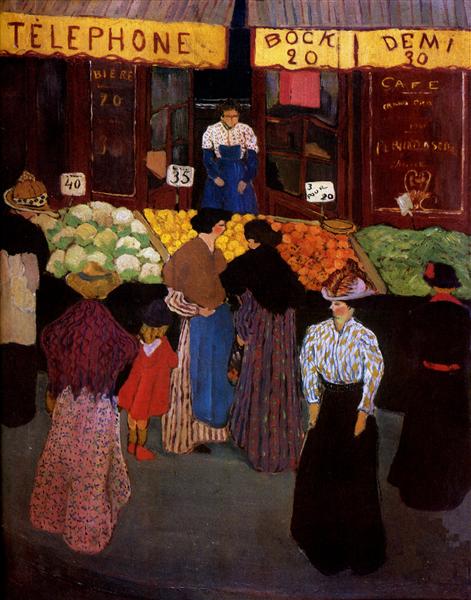
At the Market, 1985, by Felix Valloton
Former U.S. Ambassador to NATO Ivo Daalder described the stakes trenchantly: “Russia ceased being a great power a long time ago. It never really recovered from the collapse of the Soviet Union, itself the product of a decaying ideology and system.” Daalder said Putin came to power when “Russia was in a state of deep dysfunction” and that he subsequently “set out to build a deeply kleptocratic system that benefited him and his cronies at the expense of the entire society.” This, according to Daalder, has manifested itself with “a military that is unable to engage in modern warfare of maneuver, which after six months still hasn’t established air superiority.” [….]
Stephen Sestanovich, who served during the Clinton administration as ambassador at large for the newly independent states of the former USSR and is currently a professor at Columbia University, offered a different analogy to a second-tier European state, “Russia’s claim to be a great power has long been tenuous, resting on nukes, land mass, and a UN veto. The revival of economic growth in Putin’s first decade helped restore a little luster to the claim. But he’s been largely on the ropes since 2014, and this absurd campaign to ‘de-Nazify’ Ukraine has put his entire effort at risk. He wanted to make himself an equal of Catherine and Peter. Now it’s going to take quite a comeback to be more than [former Serbian President Slobodan] Milošević with missiles.”
Angela Stent, a Putin biographer and senior adviser at the Georgetown School of Foreign Service’s Center for Eurasian, Russian, and East European Studies, echoed that analysis, “After the war is over, Russia will still be the largest country in the world (assuming it does not disintegrate) and it will still have nukes, oil, and gas. But it is deglobalizing and returning to greater autarky.” Stent says that despite maintaining strong ties with many countries in the global south, “its relations with the collective West, which represents the lion’s share of global GDP, have largely collapsed.” Stent adds: “Putin came to power wanting to restore Russia’s role as a great power and have a seat on the global board of directors. He has now lost that. Russia will emerge from this demodernized and diminished in global stature.”
There’s still more expert opinion reported at the Daily Beast link.
Department of Justice Investigations
The New York Times: Justice Dept. Issues 40 Subpoenas in a Week, Expanding Its Jan. 6 Inquiry.
Justice Department officials have seized the phones of two top advisers to former President Donald J. Trump and blanketed his aides with about 40 subpoenas in a substantial escalation of the investigation into his efforts to subvert the 2020 election, people familiar with the inquiry said on Monday.
The seizure of the phones, coupled with a widening effort to obtain information from those around Mr. Trump after the 2020 election, represent some of the most aggressive steps the department has taken thus far in its criminal investigation into the actions that led to the Jan. 6, 2021, assault on the Capitol by a pro-Trump mob.
The extent of the investigation has come into focus in recent days, even though it has often been overshadowed by the government’s legal clash with Mr. Trump and his lawyers over a separate inquiry into the handling of presidential records, including highly classified materials, the former president kept at his residence in Florida, Mar-a-Lago.
Federal agents with court-authorized search warrants took phones last week from at least two people: Boris Epshteyn, an in-house counsel who helps coordinate Mr. Trump’s legal efforts, and Mike Roman, a campaign strategist who was the director of Election Day operations for the Trump campaign in 2020, people familiar with the investigation said.
Mr. Epshteyn and Mr. Roman have been linked to a critical element of Mr. Trump’s bid to hold onto power: the effort to name slates of electors pledged to Mr. Trump from swing states won by Joseph R. Biden Jr. in 2020 as part of a plan to block or delay congressional certification of Mr. Biden’s Electoral College victory.
On others who got subpoenas:
The names of those receiving the latest round of subpoenas in the investigation related to Jan. 6 have dribbled out gradually, with investigators casting a wide net on a range of issues, including Mr. Trump’s postelection fund-raising and the so-called fake electors scheme.
Indigo Dreams, Adrian Paul Allinson
One of the recipients, people familiar with the case said, was Dan Scavino, Mr. Trump’s former social media director who rose from working at a Trump-owned golf course to become one of his most loyal West Wing aides, and has remained an adviser since Mr. Trump left office. Stanley Woodward, one of Mr. Scavino’s lawyers, declined to comment.
Another was Bernard B. Kerik, a former New York City police commissioner. Mr. Kerik, who promoted claims of voter fraud alongside his friend Rudolph W. Giuliani, was issued a subpoena by prosecutors with the U.S. attorney’s office in Washington, his lawyer, Timothy Parlatore, said on Monday. Mr. Parlatore said his client had initially offered to grant an interview voluntarily.
The subpoenas seek information in connection with the fake electors plan.
For months, associates of Mr. Trump have received subpoenas related to other aspects of the investigations into his efforts to cling to power. But in a new line of inquiry, some of the latest subpoenas focus on the activities of the Save America political action committee, the main political fund-raising conduit for Mr. Trump since he left office.
The fact that the Justice Department is now seeking information related to fund-raising comes as the House committee examining the Jan. 6 attack has raised questions about money Mr. Trump solicited under the premise of fighting election fraud.

The January 6 Committee Investigation
As the House select committee investigating the January 6, 2021, attack nears its final chapter, members plan to meet in person on Tuesday and one of the most pressing questions they’ll address is whether the committee should formally request that former President Donald Trump and former Vice President Mike Pence appear before them.
Such appearances are exceedingly rare in US history. According to multiple sources, the committee does not expect either man to testify, but some members and staff believe the invitations should be extended for the record.
“How do you create a historic record without including formal requests for the two top witnesses,” said one source familiar to the committee’s work.
Members of the committee, including Chairman Rep. Bennie Thompson, a Mississippi Democrat, have consistently said they’d like to hear from Pence and would welcome Trump’s testimony should he offer it on their terms but internal discussions about formally reaching out to both men has intensified in recent weeks now that the panel’s investigation will soon come to an end, the sources said….
A source close to Pence’s team told CNN that there have been intermittent conversations between the committee and legal counsel for Pence, but nothing has changed, meaning it’s unlikely he would testify.
Whether the panel decides to call Trump or Pence could prove to be an important data point should the committee ultimately opt to submit a criminal referral for Trump – something members of the panel say they expect to seriously consider, while such a move would be largely symbolic in nature.

Red Sun, Arthur C. Dove
Members of the House Select Committee investigating the January 6 Capitol riot believe former Secret Service agent Tony Ornato was personally involved in efforts to discredit former Trump White House aide Cassidy Hutchinson’s testimony, according to a report from CNN.
Rep. Adam Kinzinger, one of two Republican members of Congress on the committee, told the outlet this week that representatives on the panel think Ornato led the charge in contradicting parts of Hutchinson’s public testimony earlier this year while he was still at the agency and additional, unnamed agents then backed his claims.
The longtime Secret Service agent who ran former President Donald Trump’s security detail left the agency last month, saying in a statement that he retired in order to pursue a career in the private sector.
Ornato emerged as a key figure in Hutchinson’s bombshell testimony before the committee in June.
Hutchinson testified that Ornato told her Trump had tried to grab the steering wheel of the vehicle he was traveling in and lunged at a Secret Service agent while demanding to be taken to the Capitol during the chaos of January 6, 2021, as he said, “I’m the effing president!”
In the aftermath of Hutchinson’s testimony, anonymous sources began to reject her version of events in the press. Several media outlets reported that Secret Service agents were willing to testify that Trump did not try to lunge at them or take control of the vehicle on January 6 — though none have done so publicly.
Now, Kinzinger is accusing Ornato of being one of the anonymous culprits behind the backlash.
Other Congressional Investigations
The New York Times: Archives Is Unsure Whether Trump Surrendered All Records, Panel Says.
The National Archives has informed congressional aides that it is still unsure whether former President Donald J. Trump has surrendered all the presidential records he removed from the White House, even after months of negotiations, a subpoena and a search of his Florida property, according to the House Oversight Committee.
The archives staff “recently informed the committee that the agency is not certain whether all presidential records are in its custody,” Representative Carolyn B. Maloney, Democrat of New York and the chairwoman of the committee, wrote in a letter on Tuesday to Debra Steidel Wall, the acting national archivist.
Ms. Maloney said the archives staff had informed the committee staff during a call in late August of its uncertainty about the status of the material, which Mr. Trump was required by law to return.
Autumn on the Seine at Argenteuil, by Claude Monet
In her letter, Ms. Maloney requested a formal assessment from the archives of what presidential records, if any, removed from the White House by Mr. Trump remained unaccounted for and whether the archives believed they were potentially still in his possession.
The committee is requesting that the agency “conduct an urgent review of presidential records from the Trump administration to identify any presidential records or categories of presidential records, whether textual or electronic, that NARA has reason to believe may still be outside of the agency’s custody and control,” Ms. Maloney wrote, referring to the National Archives and Records Administration. “Please also assess any other limitations on the completeness, accuracy and accessibility of presidential records provided to NARA by the Trump administration.”
The letter asked the archives to complete an initial assessment and provide its findings to the committee by Sept. 27.
Ms. Maloney also requested that the archives “seek a personal certification from Donald Trump that he has surrendered all presidential records that he illegally removed from the White House after leaving office.”

The New York Times: Senate to Investigate Charge That Trump Meddled in Prosecutor’s Office.
The Senate Judiciary Committee will investigate allegations that the Justice Department under President Donald J. Trump sought to use the U.S. attorney’s office in Manhattan to support Mr. Trump politically and pursue his critics, the committee’s chairman said on Monday.
The allegations are in a new book by Geoffrey S. Berman, who was U.S. attorney for the Southern District of New York from 2018 through June 2020, when he was fired by Mr. Trump.
The chairman, Senator Richard J. Durbin of Illinois, the No. 2 Senate Democrat, made the announcement in a letter sent to Attorney General Merrick Garland, which cited a New York Times report on Thursday detailing the book’s allegations.
Mr. Berman’s book portrays Trump Justice Department officials as motivated by partisan concerns as they tried to initiate criminal investigations or block them, The Times reported.
The book, “Holding the Line,” was obtained by The Times in advance of its scheduled publication on Tuesday.
Mr. Durbin said in his letter, “These reported claims indicate astonishing and unacceptable deviations from the department’s mission to pursue impartial justice, which requires that its prosecutorial decisions be free from political influence.”
He added that the allegations “also compound the already serious concerns” raised by then-Attorney General William P. Barr’s efforts in 2020 “to replace Mr. Berman with a Trump loyalist.”
Wow! This post got really long, so take what you want and leave the rest. I hope you all have a terrific Tuesday!!
Lazy Caturday Reads
Posted: July 23, 2022 Filed under: just because | Tags: CDC, food crisis, January 6 Committee hearings, Monkeypox, public health emergency, Russia, Secret Service, Turkey, Ukraine, World Health Organization 33 Comments
Cats on Strike, by Leah Saulnier the painting maniac
Happy Caturday, Sky Dancers!!
As if we didn’t have enough bad news, we are now dealing with another global health emergency. Monkeypox is spreading rapidly around the world and here in the U.S. Cases have been reported in multiple states, including Massachusetts, Maine, New York, Washington, DC, Michigan, Florida, Texas, Illinois, and California. As of two days ago, there were already nearly 2,000 reported cases in the U.S.
Apoorva Mandavilli at The New York Times: W.H.O. Declares Monkeypox Spread a Global Health Emergency.
For the second time in two years, the World Health Organization has taken the extraordinary step of declaring a global emergency. This time the cause is monkeypox, which has spread in just a few weeks to dozens of countries and infected tens of thousands of people.
Dr. Tedros Adhanom Ghebreyesus, the W.H.O.’s director general, on Saturday overruled a panel of advisers, who could not come to a consensus, and declared a “public health emergency of international concern,” a designation the W.H.O. currently uses to describe only two other diseases, Covid-19 and polio.
“We have an outbreak that has spread around the world rapidly through new modes of transmission, about which we understand too little, and which meets the criteria” for a public health emergency, Dr. Tedros told reporters….
The W.H.O.’s declaration signals a public health risk requiring a coordinated international response. The designation can lead member countries to invest significant resources in controlling an outbreak, draw more funding to the response, and encourage nations to share vaccines, treatments and other key resources for containing the outbreak.
It is the seventh public health emergency since 2007; the Covid pandemic, of course, was the most recent.
The article discusses the controversy over how W.H.O. decides when to declare a health emergency. Some experts already think the agency waited too long on monkeypox.
Center for Infectious Disease Research and Policy: Largest monkeypox study to date highlights new symptoms.
Many of the people infected in an international monkeypox outbreak experienced a single lesion or sore in their mouth or on their genitals, a departure from typical symptoms of the virus that could lead to clinicians to misdiagnose monkeypox as another sexually transmitted infection (STI).
Coffee with Henry #4, by Kazui Whitemoon
That’s one of the main takeaways from the New England Journal of Medicine‘s (NEJM‘s) new international study of the current outbreak, which is the largest case-study on the virus.
“This truly global case series has enabled doctors from 16 countries to share their extensive clinical experience and many clinical photographs to help other doctors in places with fewer cases. We have shown that the current international case definitions need to be expanded to add symptoms that are not currently included, such as sores in the mouth, on the anal mucosa and single ulcers,” said Chloe Orkin, PhD, of the Queen Mary University of London, in a university press release.
The study included clinical observations from 528 confirmed infections at 43 sites from Apr 27 to Jun 24 of this year. The median incubation period is 7 days in this outbreak, and the median age of a case-patient was 38. No deaths occurred, but 70 patients (13%) required hospitalization.
In the study, authors share many patients are presenting to clinics and hospitals for pain management or difficulty swallowing. Single anal sores have been recorded in several cases. One in 10 people had only a single skin lesion in the genital area, and 15% had anal and/or rectal pain, a symptom not typically seen in other monkeypox outbreaks.
A total of 98% of the cases documented were in gay or bisexual men, and while monkeypox is not an STI, per se, the authors said 95% of transmissions documented occurred during sexual relations. Seventy-five percent of case patients are white, and 41% are HIV-positive.

CNN: CDC reports the first two monkeypox cases in children in the US.
Two cases of monkeypox have been identified in children in the United States, the US Centers for Disease Control and Prevention said Friday.
The two cases are unrelated and probably the result of household transmission, the CDC said.
One case is a toddler who is a resident of California. The other is an infant who is not a US resident. Public health officials are investigating how the children were infected.
Both have symptoms but are in good health and receiving treatment with an antiviral medication named tecovirimat or TPOXX, which the CDC recommends for children under the age of 8 because they are considered to be at higher risk from infection.
Painting by Vicky Mount
Since the monkeypox outbreak began in May, most of the cases have happened among men who have sex with men. However, anyone can catch the virus through close skin-to-skin contact. In the case of children, the agency said this could include “holding, cuddling, feeding, as well as through shared items such as towels, bedding, cups, and utensils.”
The CDC says the Jynneos monkeypox vaccine is being made available for children through special expanded use protocols. The agency has also developed new guidance for health care providers about identifying, treating and preventing monkeypox in children and teens.
Dr. Jennifer McQuiston, deputy director of the CDC’s Division of High Consequence Pathogens and Pathology, said Friday that the cases in children were not surprising and that the US should be ready to respond to more.

Politico: Biden administration considering a public health emergency for monkeypox as cases swell.
U.S. health officials are discussing whether to declare a public health emergency for the monkeypox outbreak as they work to make treatments and vaccines available to more people.
The discussions come as the virus — which is endemic in West and Central Africa but unusual in the United States — continues to spread across the country. As of Thursday, there were 2,593 cases reported, up from 1,470 last week. The federal government announced Friday it has shipped over 300,000 doses of the vaccine to states and cities to control the outbreak.
“We’re looking at … what are the ways the response could be enhanced, if any, by declaring a public health emergency,” White House Covid response coordinator Ashish Jha told reporters during a briefing Friday.
Officials at the Food and Drug Administration and Centers for Disease Control and Prevention are also working to make tecovirimat, the only treatment available for monkeypox (though only FDA–approved for smallpox), easier for physicians to prescribe to patients. A more streamlined process to get the antiviral is expected to be announced to providers next week.
The White House will also use a new research agenda, which was announced Thursday and consists of $140 million in ongoing projects, to study stretching limited monkeypox vaccine doses, find new testing methods and expand treatment options, three White House officials told POLITICO.

Lunch with cats, Pierre Bonnard, 1906
We haven’t talked much about the war in Ukraine lately, but it has caused a global food crisis. Yesterday Russian supposedly agreed to stop blocking shipments of grain, but the Ukraine and U.S. governments are skeptical that Russia will follow through.
BBC News: Food crisis: Ukraine war: Deal signed to allow grain exports to resume by sea.
Ukraine and Russia have signed “mirror” deals which will allow Kyiv to resume exports of grain through the Black Sea.
The agreement will allow millions of tonnes of grain, currently trapped in Ukraine by the war, to be exported.
The world shortage of Ukrainian grain since Russia’s 24 February invasion has left millions at risk of hunger.
However, Kyiv refused to sign a direct deal with Moscow, and warned “provocations” would be met with “an immediate military response”.
Both sides attended the signing ceremony in Istanbul but did not sit at the same table. Russia’s Defence Minister Sergei Shoigu signed Moscow’s deal first, followed by Ukrainian Infrastructure Minister Oleksandr Kubrakov signing Kyiv’s identical agreement.
The deal – which took two months to reach – is set to last for 120 days, with a co-ordination and monitoring centre to be established in Istanbul, staffed by UN, Turkish, Russian and Ukrainian officials. It can be renewed if both parties agree.
The blockade of Ukraine’s grain has caused a global food crisis with wheat-based products like bread and pasta becoming more expensive, and cooking oils and fertiliser also increasing in price.
In January 6 news, CNN’s Whitney Wild and Jeremy Herb broke a story yesterday on those missing Secret Service text messages: First on CNN: Secret Service identified potential missing text messages on phones of 10 individuals.
Secret Service investigators were scrutinizing the phones of 10 Secret Service personnel that contained metadata showing text messages were sent and received around January 6, 2021, but were not retained, two sources told CNN.
Grandma and 10 cats in the bedroom, by Linda Benton
The scrutiny came after the Department of Homeland Security inspector general asked for the text records last year of 24 individuals at the Secret Service who were involved in January 6, but only one text had been produced. After the issue spilled into public view this month, the inspector general launched a criminal investigation into the matter, and lawmakers demanded answers from the Secret Service to go back and find out what happened to the texts that may have been deleted.
But the Secret Service’s internal investigation ground to a halt after a July 20 letter from the DHS inspector general informed the agency there was an ongoing criminal investigation, directing the Secret Service to stop its own probe.
Investigators had been working to determine whether the content of the text messages sent by the 10 personnel contained relevant information that should have been preserved, the sources said. Among the 24 Secret Service personnel under scrutiny, 10 other Secret Service personnel had no text messages, and three had only personal records, according to the sources.
The details of scrutiny of messages from 10 Secret Service personnel caps an extraordinary week of turmoil for the agency, which started with the inspector general
demanding answers about potential missing texts and led to a congressional subpoena and a criminal investigation into the matter.

There has to be a way to recover those text messages. I’m sure The Washington Post’s Carol Leonnig, author of a book on the Secret Service, is working her sources to find out more.
Dakinikat covered the final January 6 Committee hearing yesterday, but here are some more follow-up articles:
NPR: The Jan. 6 committee isn’t done. Expect more hearings, revelations and reports.
The House Select January 6th committee made clear they are going to resume hearings in September.
Republican Vice Chair Liz Cheney, R-Wyo., opened the final summer hearing by noting the progress the committee has made, but she added that there’s now new evidence and more witnesses to consider.
“Doors have opened, new subpoenas have been issued, and the dam has begun to break,” Cheney said.
Already, in the buildup to Thursday’s presentation, select committee aides had hinted future hearings could be on tap.
Kim Haskins, psychedelic cat
And Committee Chairman Bennie Thompson, D-Miss., told reporters recently that the committee could issue an initial report in September, followed by a final report later this year. The findings would be accompanied by hearings, he said.
“We’re just getting a significant amount of information,” Thompson said. And the new evidence “pushes the timetable out.” [….]
Cheney also noted in this week’s hearing that the panel will now return to its investigative mode for the next several weeks.
“Our committee will spend August pursuing emerging information on multiple fronts, before convening further hearings this September,” Cheney said….
With plans to issue their findings in the form of reports and more hearings, the committee is racing to address new evidence along the way.
For example, the panel is now looking into allegations that the Secret Service deleted text messages during a two-day period surrounding the Jan. 6 attack. Department of Homeland Security Inspector General Joseph Cuffari has claimed the messages were erased after a request by his office, while the Secret Service has denied these allegations, saying the deletions were part of a system migration.

The Hill: Jan. 6 panel shows few signs of slowing down despite midterm risks.
The select committee’s prime-time hearing on Thursday was widely expected to mark the end of a crucial phase in the panel’s probe of last year’s riot, capping six weeks of publicly aired testimony — almost all of it from Republicans — aimed at pinning culpability for the rampage squarely onto Trump’s shoulders.
But every new revelation seems to turn up as many questions as answers, and the panel has altered its schedule to accommodate what it calls a wave of new information in need of perusal. The arrival of new witnesses has been accompanied by successful committee efforts to fight stonewalling in the form of executive privilege claims, and the panel has recently issued new subpoenas for even more evidence.
“The dam has begun to break,” Rep. Liz Cheney (R-Wyo.), vice chair of the select committee, said Thursday night. “We have far more evidence to share with the American people — and more to gather.”
The Owl and the Pussycat, 2009 by P J Crook
With that in mind, the committee said it intends to use Congress’s long August recess to wade through the influx of new information, with designs to hold more hearings on its findings in September when lawmakers return to Washington. How many they’ll stage remains unclear, but the investigators are leaving themselves the flexibility to determine that schedule on the fly.
“We are pursuing many additional witnesses for testimony,” said Chairman Bennie Thompson (D-Miss.), who participated in Thursday’s hearing remotely after testing positive for COVID-19 earlier in the week. “We will reconvene in September to continue laying out our findings.” [….]
“We’re not done. The information continues to come in. The evidence is continuing to flow in,” Rep. Zoe Lofgren (D-Calif.) told CNN heading into Thursday’s hearing. “So this is … not the end of the story.”

More interesting January 6 stories to check out, links only:
Vicky Ward on her blog yesterday: What Trump World Really Thinks About Last Night’s Jan. 6 Hearing.
Alan Feuer and Michael Schmidt at The New York Times: The Jan. 6 Panel After 8 Hearings: Where Will the Evidence Lead?
Ruth Marcus at The Washington Post: Now we know the truth on what Trump sought to obscure about Jan. 6.
David Siders at Politico: ‘His life was threatened.’ But Pence isn’t talking about it.
Isaac Stanley Becker and Josh Dawsey at The Washington Post: Hearings test Trump’s clout and GOP’s wish to ‘forget about Jan. 6’
Michelle Goldberg at The New York Times: The Myth of the Good Trump Official.
That’s it for me today. I hope you’re all having a terrific weekend!

 peej
peej Carissa
 bostonboomer
 dakinikat
 ecocatwoman
 mablue2
 Mama Lopez
 peggysue22
 quixote
 skydancingguestblogger
 Mona (aka Wonk the Vote)



 Sky Dancing
Recent Comments