
He’s no FDR
Posted: June 19, 2009 Filed under: Bailout Blues, Equity Markets, Global Financial Crisis, Team Obama, U.S. Economy | Tags: DeLong, Financial Reform, fiscal policy, Krugman, Romer, the Great Depression, The Great Recession 1 Comment
DeLong skewers the the Stimulus Plan Claim via the Unemployment rate with stylized facts
With the release of financial regulation reform and healthcare reform that has Wall Street breaking open the bubbly, I just want to join the chorus of highly skeptical economists. The tune of the last few days is hard to miss. Take this piece from the NY Time’s Dealbook as an example: Only a Hint of Roosevelt in Financial Overhaul. There’s also Paul Krugman’s Op-Ed Column today Out of the Shadows which is the typical on-the-one-hand-on-the-other hand economist behavior. (Could I just mention in passing that I like the OLD Paul better? The one that was an out spoken advocate for liberal economists? I’m not sure what happened at that White House Dinner, but I’m beginning to think we now have a Manchurian economist at Princeton. Oh, where is our Shrill One?) Oh, and you can still read my first impressions here. I’m going to start with Financial Reform but don’t leave me yet. Brad deLong takes on Christine Romer’s The Lessons of 1937 at The Economist and since he still hasn’t been invited to dinner at the White House, it’s classic Brad.
So what does Krugman think about the Alphabet Soup Agency reheat slugging its way through that perpetual Hall of Wall Street minions we know as our Congress? He believes that it throws some light on the shadow banking industry in that the Alphabet Soup gang at the FED get to see more balance sheets and books. There is also a stab at standardizing the process, but custom fitted Credit Default Swaps remain. The essential riskiness remains. Let’s examine the Krugman critique.
But what about the broader problem of financial excess?
President Obama’s speech outlining the financial plan described the underlying problem very well. Wall Street developed a “culture of irresponsibility,” the president said. Lenders didn’t hold on to their loans, but instead sold them off to be repackaged into securities, which in turn were sold to investors who didn’t understand what they were buying. “Meanwhile,” he said, “executive compensation — unmoored from long-term performance or even reality — rewarded recklessness rather than responsibility.”
Unfortunately, the plan as released doesn’t live up to the diagnosis.
Well, maybe the White House Pastry chef did not completely overwhelm the shrill one.
Tellingly, the administration’s executive summary of its proposals highlights “compensation practices” as a key cause of the crisis, but then fails to say anything about addressing those practices. The long-form version says more, but what it says — “Federal regulators should issue standards and guidelines to better align executive compensation practices of financial firms with long-term shareholder value” — is a description of what should happen, rather than a plan to make it happen.
Furthermore, the plan says very little of substance about reforming the rating agencies, whose willingness to give a seal of approval to dubious securities played an important role in creating the mess we’re in.
In short, Mr. Obama has a clear vision of what went wrong, but aside from regulating shadow banking — no small thing, to be sure — his plan basically punts on the question of how to keep it from happening all over again, pushing the hard decisions off to future regulators.
Smoking Green Shoots Won’t Change the Numbers
Posted: June 8, 2009 Filed under: Equity Markets, Global Financial Crisis, president teleprompter jesus, Team Obama, U.S. Economy | Tags: Bankruptcies, Council of Economic Advisors, Geithner, Goolsbee, Romer, Summers, Unemployment figures 4 Comments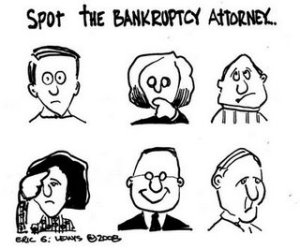
H/T Calculuated Risk who reports that Bankruptcies in May UP. http://www.calculatedriskblog.com/2009/06/consumer-bankruptcy-filings-up-sharply.html
I’ve been hesitant to dissect the recent bad news on the unemployment front too much because it’s going to get a lot worse and I’ll probably have more to say on that later. Remember, we’re just beginning to unwind the automobile industry and the affiliated small businesses and industries that it sustains. As that occurs, there will be a multiplying effect in small towns every where. Most of these small cities are sustained by car dealers and maybe one or two factories, as these businesses disappear, so will the small businesses providing services to employees. It’s going to get much worse folks. Since we’ve had stories from some of our own friends, we know that that impact strikes our near and dear.
That’s why I’ve been really confused as to why the administration seems to think by just talking up a few possible changes, which could yet be classified as random variation given there has not been enough time to actually establish a statistically significant pattern, they expect wishful change. Perhaps it’s just a continuation of the election season. If it’s repeatedly read from a teleprompter, it will happen. Just clap REALLY loud if you believe in green shoots!!! It will revive the economy!
The first crack in the plaster happened when Goolsbee let slip this little GEM on Fox News on Sunday. Michael Bowman writes:
The White House says America’s employment picture is worse than the Obama administration had anticipated just a few months ago. The somber admission follows the latest jobless report showing the highest unemployment rate the United States has seen in more than 25 years.
U.S. unemployment jumped a half percent in May, to 9.4 percent prompting this comment by Austan Goolsbee, a member of President Barack Obama’s Council of Economic Advisors:
“The economy clearly has gotten substantially worse from the initial predictions that were being made, not just by the White House, but by all of the private sector,” said Austan Goolsbee.
Economists point out that the current jobless rate is already higher than the hypothetical rate that was used to calculate the health of banks and other financial institutions in so-called “stress tests” earlier this year. And, the upward unemployment trajectory is expected to continue in coming months, even if the overall economy begins to recover.
Austan Goolsbee spoke on Fox News Sunday:
“It is going to be a rough patch [difficult period], not just in the immediate term, but for a little bit of time [in the future],” he said. “You have to turn the economy around, and jobs and job growth tends to come after you turn the economy around.”

 peej
peej Carissa
 bostonboomer
 dakinikat
 ecocatwoman
 mablue2
 Mama Lopez
 peggysue22
 quixote
 skydancingguestblogger
 Mona (aka Wonk the Vote)



 Sky Dancing
Recent Comments