
Labor Day Reads: Back to the Abyss
Posted: September 7, 2026 Filed under: #We are so Fucked, 2026 Elections, Elon Musk, RFK Jr | Tags: Elon Musk, Food Recalls and Inflation, German Elections 2026, Nazis, Return of Fascism 2 Comments
No if’s, vote accordingly. Bring oversight of the most corrupt administration ever back, in numbers too big for Elmo and his high-tech bros to manipulate. Make America Great Again By Neutering Trump! John Buss, @repeat1968
Good Day, Sky Dancers!
I hope you’re having a great day with whatever plans you’ve got! Labor Day has always been one of my favorite holidays because it’s really about We, the People. It doesn’t involve spending a bundle just because it’s been hyped into a merchandising event. It’s about breaking bread with others and just taking a day off. It’s celebrating the people who do all the work, not gobbling up all the money. There are still many of those gobblers out there that still look for child labor, or hiring or paying people on the basis of something other than their skills. We have movements now to counteract that, and we need them more than ever.
The first set of suggested reads today has to do with Germany. It’s time to bring up one of the most used quotes ever. That would be this one from 1905 and the great mind of George Santayana. “Those who cannot remember the past are condemned to repeat it.” There are always people who want to rewrite and blur history. Orange Caligula does this daily. It pains me to read headlines like this in The Guardian today.”The AfD’s win in Germany is a dark day for Europe. Time is running out to stop the far right. This party is among the most extreme in Europe. To protect our democracies, liberal parties must urgently change their tactics.” Cas Mudde has the report.
The far-right Alternative für Deutschland (AfD) narrowly failed to secure an outright majority in state elections in Saxony-Anhalt. But nobody should take comfort from that. The party still won by a landslide. Decades of far-right election gains have made them seem normal to the point where only the biggest victories are deemed newsworthy. But 44% of the vote for a party that is officially classified as “extreme right” is not normal. It is a black day for European democracy, even if it occurs in a small east German state.
While Saxony-Anhalt (and Germany itself) may have dodged the worst outcome because the AfD won’t automatically fulfil its ambition of forming the first far-right state government in Germany since the Nazi era, there is no reason to assume it will be so lucky at the next election. Neither will other German states, such as Mecklenburg-Vorpommern in two weeks’ time, or other countries, such as France next year. No country is immune from the far right and, perhaps even more worryingly, no far-right party or politician is too extreme for political success (as the US has shown). We must therefore update our analyses and strategies.
Although Saxony-Anhalt, and east Germany in general, is an extreme case, it reflects similar trends in the rest of Europe. Far-right parties are going from strength to strength, with old dominant parties decimated, and party systems fragmented. Consequently, coalition formation is becoming increasingly complicated, particularly if we want to keep the far right out of power. In many countries, provinces and cities, most democratic parties are having to govern together to exclude the far right. This often leads to inefficient and unstable coalitions, in turn feeding yet more political dissatisfaction and far-right support.
Sunday’s results will only intensify an ongoing debate in Germany about the so-called Brandmauer (a firewall maintained by mainstream parties against cooperating with the AfD). Actually, Germany is one of the few EU countries to still have a far-right cordon sanitaire. Throughout Europe, from Italy to Sweden, far-right parties have been normalised and integrated into the political mainstream. In most cases, the (rightwing) parties that collaborate with the far right claim that the latter have moderated and are now “conservative” – a claim that is factually wrong, but increasingly popular with the electorates and members of these parties, and much of the media.
This will remain almost impossible to claim in Germany. The AfD is among the most extreme parties in Europe, and its most successful branches, including the one in Saxony-Anhalt, are among the AfD’s most extreme. This will not prevent some rightwing politicians from claiming that the AfD is less of a problem than the left, and there is even a fear that some parliamentarians from the conservative CDU in Saxony-Anhalt will defect to give the AfD a majority in the state. On the other side of the political spectrum, calls for an AfD ban will become even louder, and while this might be legally possible, it could create a massive popular backlash, going well beyond Saxony-Anhalt.
Both approaches share a too-limited interpretation of the problem. The idea of maintaining the Brandmauer is that the only (or main) problem is outside the system. Yet the system is falling apart as it is. Yes, the AfD (and the far right in general) is a fundamental threat to liberal democracy, but so is the fact that a sizeable and growing part of the population no longer feels represented by its politicians. While many still come out to vote for democracy, they increasingly vote against a party rather than for one.
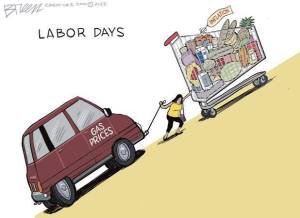 As usual, both my degrees and fascination with History and Economics lead my interests. This next one is from Dr. Paul Krugman’s SubStack. “Neo-Nazis and the Impotence of Trumponomics. Crude economics doesn’t explain what just happened.” Of course, Elon Musk plays a role in this. I’m horrified.
Neo-Nazis — no point in euphemisms — just won big in the rough equivalent of a state-level election in Germany. America’s leading neo-Nazi — again, no point in euphemisms — congratulated the AfD (in German) on the result, and in return received “thanks for your support” from the AfD’s lead candidate.
In the days and weeks ahead there will be many analyses of the results and its implications from people who, unlike me, know something about German politics. For now, let me do something more parochial, and write about what the Sachsen-Anhalt election might teach us about U.S. political economy.
So, about America: Make America Great Again meant different things to different people — racism, of course, being a key component. But in Donald Trump’s mind it also clearly meant trying to bring back “manly” jobs. He would do this by imposing tariffs to eliminate trade deficits, which, in his garbled version of economics, would end huge U.S. “giveaways” to surplus nations. And this would, in turn, lead to a huge revival of U.S. manufacturing employment.
Why is Germany relevant to this story? Because in terms of both trade balances and manufacturing Germany is, in effect, the anti-America. Where we do indeed run large trade deficits, Germany runs huge surpluses. And while Germany, like every other advanced economy, has seen the manufacturing share of employment decline over time, it remains a more industrial nation than the U.S. has been since the 1980s.
Indeed, relative to the size of its economy, Germany runs trade surpluses and retains large-scale manufacturing employment to an extent that lies far beyond the wildest dreams of Trumponomics.
And none of this appears to make a bit of difference to the resentment that underlies right-wing extremism on both sides of the Atlantic.
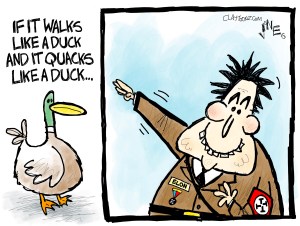 Take a moment to let that sink in. We know the prior stated grievances of Trump and is ilk have never been the real agenda. However, now, the agenda is flying it’s flag full staff. Just look at the no-good that Pete Hegseth and his Department of War (sic) has been up to. The agenda is could not be more evident in every action. Racist, Sexist, Full on Right-wing Christianity supporting Israel so their rapture fantasy can be fulfilled and ruthless idiotic endless wars. These roads lead back to Elon Musk who has the where withal to change the world, and rewrite history with all his kindred grievance-filled white man.
This is from The Guardian, again and not surprisingly. “Far-right AfD win in Germany is ‘grave moment’ for Europe, politicians warn. Mainstream politicians express alarm while lead candidate in Saxony-Anhalt welcomes congratulations from Elon Musk.”
Spain’s socialist prime minister, Pedro Sánchez, told a party gathering in Madrid on Monday that the result showed that “the extremist threat, largely thanks to the surrender of the traditional right, is gaining ground in Europe and in the world”.
France’s finance minister, Roland Lescure, said it “clearly sends out a very, very worrying signal … This shows that we face a major challenge in the face of a populist wave which is spreading around the world today and which we must resist.”
Lescure’s comments echoed similar remarks on Sunday evening by France’s European affairs minister, Benjamin Haddad, who posted on social media: “To see the far right prevail in the German regional election marks a very grave moment for Europe.”
Haddad added: “We must listen with humility to the anger, fears and worries and duly respond to these concerns. But nationalism and xenophobia will never be the answer. We cannot forget our history.”
Poland’s foreign minister, Radosław Sikorski, said on Monday the AfD’s win was “a very worrying sign”. Poland’s prime minister, Donald Tusk, said on Sunday night in Poland: “Only idiots or traitors can rejoice at the triumph of the AfD in Germany.”
Italy’s foreign minister, Antonio Tajani, described the election result as “terrible news … because it concerns a political force that is antithetical to liberal and western values”.
The reaction was not limited to Europe. Elon Musk congratulated the far-right party on its election victory with a “Well done!” on his social media platform X, prompting Ulrich Siegmund, the AfD’s lead candidate in Saxony-Anhalt, to thank the nativist US tech billionaire for his support.
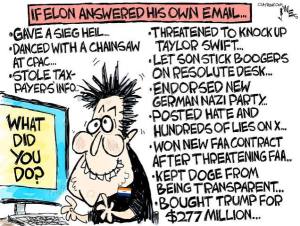 We all know that the last thing Elon Musk would be off doing today is helping his adopted celebrate Labor Day. This is from The Economist with a shared link. “Elon Musk’s praise for the far right infuriates most of Germany. A controversial op-ed may have set the terms of the election campaign.” This was what was going on in January of 2025. We should’ve seen it coming.
Alice Weidel could hardly have hoped for better publicity. With federal elections due on February 23rd, Ms Weidel is running for chancellor as co-head of the hard-right Alternative for Germany (AfD) party. In an op-ed on December 29th in the Sunday edition of Welt, a conservative paper, Elon Musk, the world’s richest man and a confidant of Donald Trump, called the AfD “the last spark of hope” for Germany. The country, he claimed, is “teetering on the brink of economic and cultural collapse”. He had a right to speak out about German politics, he said, because he has invested heaps of money in the country. (A multibillion-dollar plant in Brandenburg producing cars and batteries for Tesla, his electric carmaker, opened in 2022.)
The AfD is polling at 19%, putting it second behind the centre-right alliance of the Christian Democratic Union and Bavaria’s Christian Social Union, at about 30%. It is not the first hard-right European party to attract Mr Musk’s support: earlier in 2024 he praised Giorgia Meloni, the Italian prime minister. Mr Musk said she was “even more beautiful on the inside than she is on the outside”. She in turn called him a “precious genius”. He is said to be considering a donation to Britain’s anti-immigrant Reform UK party.
Mr Musk’s love-note to the AfD may have been counterproductive. It certainly incensed Germany’s leaders, already anxious about Mr Trump’s second term in office. “I can’t remember a comparable case of interference in the election campaign of a friendly country in the history of the Western democracies,” said Friedrich Merz, the CDU leader and chancellor candidate, on December 29th. Olaf Scholz, the current chancellor and candidate for the Social Democrats, noted in his New Year’s Eve speech that Germany’s fate is decided by its citizens, not “by the owners of social media”. Mr Musk owns X, a social-media platform. His recent posts there have been childishly offensive: one called Frank-Walter Steinmeier, the German president, an “anti-democratic tyrant”; another called the chancellor “Oaf Schitz”.
The op-ed editor of Welt, Eva Marie Kog
el, quit in protest after Mr Musk’s article was published. The piece had been accompanied by a rebuttal by Jan Philipp Burgard, the paper’s incoming editor-in-chief, calling Mr Musk “fatally wrong”. The rebuttal’s headline calls the AfD “partly xenophobic and antisemitic”; Mr Burgard also blasts its anti-Americanism and its endorsement of leaving the European Union. Yet like Ms Kogel, many Germans found it wrong to have run Mr Musk’s piece at all.
Mr Musk’s op-ed was poorly argued. Yet the furore around its publishing seems unexpectedly to have shaped the early phase of the campaign. In the long run this may not prove terribly important: social-media algorithms, misinformation and Russian influence campaigns could have far more impact, as Michael Hanfeld, a German pundit, argued in the Frankfurter Allgemeine Zeitung, a daily. But for the moment, the affair has had the odd effect of aligning the AfD with an American oligarch, making the Alternative for Germany seem slightly un-German.
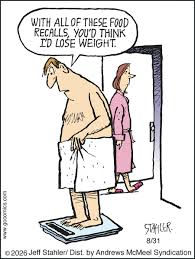 Josephine Walker’s latest at Axios truly shines life on life during Orange Caligula’s regime. “America’s expensive groceries are getting less safe to eat.”
Plenty of Americans feel like they’re forking over a fortune for groceries—only to get hit with a recall notice that forces them to throw that expensive food out.Why it matters: While grocery prices are driven by complex trade and energy costs, the safety net meant to keep them safe to eat is fraying, creating a dual crisis of affordability and safety.
- The average American household pays more than $10,000 on groceries every year, and two-thirds of Americans think they’re spending too much.
- Prices have increased by more than 18% since 2022, although some foods have seen sharper or smaller increases.
What they’re saying: “It can be really, really scary out there,” Lauren Borsheim, a food policy analyst at Food & Water Watch, tells Axios.
- “The Trump administration since 2025 has really just dismantled many of the fundamental protections we need to keep our food supply safe.”
- “We have people that are really afraid that the U.S. is not doing a good job regulating our food supply. It’s definitely a concern out there that as people are spending more money on their food, they are also fearful that that same food is going to cause them to get sick,” Borsheim says.
By the numbers: Recalls are relatively on par with normal levels this fiscal year, according to FDA data.
- So far, 5,504 products have been recalled in 2026. That’s up slightly from the 5,461 products recalled last year, but down from the 6,524 products recalled in 2024.
Yes, but: The FDA recently hit a record 19 simultaneous outbreak investigations, covering everything from infant formula to jalapeños.
Between the lines: Mega-corporations and corporate consolidation can turn single-suppliers’ errors into multi-state panics, as seen with the Cyclospora outbreak linked to iceberg lettuce.
- “The U.S. food safety system has gotten hit so hard over the last year and a half,” Christopher Barrett, an economist at Cornell University, tells Axios.
Zoom out: Food-safety advocates are concerned about declining federal surveillance after the Trump administration eliminated or pushed out thousands of workers across the CDC, FDA and USDA.
- Those cuts prompted federal officials to say they plan to do fewer inspections.
- Barrett says assuming staffing cuts won’t affect food safety is “demonstrably false.”
- “When you cut corners, and you’re not seeing the inspectors show up very often, then more stuff gets out the door. You get more episodes of foodborne illness. You have expensive recalls. That just adds to companies’ costs, which gets turned into higher prices for us, and it’s a vicious cycle,” Barrett says.

 peej
peej Carissa
 bostonboomer
 dakinikat
 ecocatwoman
 jjlo
jjlo mablue2
 Mama Lopez
 peggysue22
 quixote
 skydancingguestblogger
 Mona (aka Wonk the Vote)



 Sky Dancing
Recent Comments