
Vive la Résistance
Posted: November 8, 2024 Filed under: The US Road to Kleptocracy/Autocracy | Tags: Autocracy, banksyartwork, Donald of Advanced Dementia, Elizabeth Warren, Facism, Fatma Karume, French Resistance, grand wizards of the kleptocracy, idiocracy, RESIST, Resistance Women, Spanish Resistance, Vive la résistance 8 Comments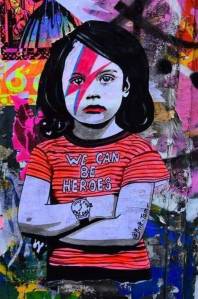
#banksyartwork
Hello My Sky Dancing Friends!
I’m finding this post more difficult to write than I thought it would. We’ve been thrown into a country that we will have to rescue so just find some compassion for yourself and others right now and prepare for the difficult work ahead. I’ve tried to look for the vision of folks already planning the fight and the suffering that is about to come. Over the past two days, I’ve worried about folks I know and suicide thoughts, folks I know and tears over the dreams they had for the daughters (and this one came from a white man), and the reasoned and worried thought by my fellow economists.
I’ve seen these signs in my beloved neighborhood. I’m giving and receiving hugs on every dog walk. Please come and find me and the Poland Avenue Greeter Dog. We’re also hanging at the Safe Space on the corner ready with music and games and friendship with many, like minds. You are loved and valued for who you are.
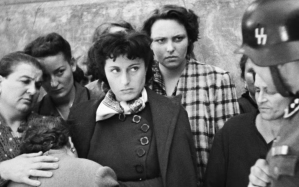
The celebrating people think they’re going back in time to a better place. Let me say, I no longer need to wonder what happened to Germany in the 1930s because we’re living in an American version of it now.
As you know, I’ve been carefully watching the markets. It looks a lot like probing for the new ceiling in the spot markets to me before we see a sell-off when it’s found. The first of the markets to be worried about found a headline today at Reuters. There will be more of this coming. “US natural gas markets point to steep price rise in 2025.” Financially, you should “hunker down.” This is the first of the futures/forwards market to come to a consensus.
The northern hemisphere summer has not yet officially finished, but United States natural gas markets are already sizing up supply and demand balances for this winter and the next year, and indicate that sharply higher prices may emerge.
Forward markets for Henry Hub futures, the benchmark U.S. natural gas price, indicate that prices will average $3.20 per million British thermal units (mmBtu) in 2025, compared to an average of $2.22 so far this year, data from LSEG shows.
If realized, that roughly 44% year-on-year price increase would be the steepest annual climb since 2022, and could worsen energy product inflation trends despite a slowdown in broader price gains in the United States.
Look for more of this. It’s not only Climate Change that will continue to disrupt energy markets in 2025. These are the guys that can gloat because they will not be the ones to suffer. This is from Vanity Fair. “Surprise: Elon Musk, Who Stands to Gain Billions Under Trump, Is Gloating About the Election. “The future is gonna be so 🔥 🇺🇸🇺🇸,” the tech billionaire wrote, above a photo of himself speaking with Donald Trump and Dana White, the CEO of the Ultimate Fighting Championship.” This is so true. We have an authentic kleptocracy now. Let’s not keep it.
Elon Musk was gloating publicly even before the polls closed Tuesday night. And as the evening wore on, the tech billionaire grew both brasher and more triumphant. “The future is gonna be so 🔥 🇺🇸🇺🇸,” he wrote above a photo of himself speaking with President-elect Donald Trump and Ultimate Fighting Championship CEO Dana White. “Let that sink in,” he added, next to a meme of himself in the Oval Office late on Tuesday night.
Musk has plenty to celebrate, from Tesla’s soaring stock price to the continued tax cuts Trump has promised corporations and ultra-wealthy households. The Republican mega-donor, who dropped almost $120 million on Trump’s reelection effort, is now poised for a prominent role in Trump’s second administration. His various companies also stand to gain billions of dollars in federal contracts under Trump, and the new administration could potentially curtail the numerous investigations and other regulatory actions that federal agencies have initiated against his business interests. “The future is gonna be fantastic,” Musk wrote Wednesday morning, next to a picture of a SpaceX rocket.
How “fantastic” that future looks to non-billionaires remains to be seen. Trump has said he’d like to task Musk with leading a new government efficiency commission, which could slash as much as $2 trillion from the federal budget. Leading economists, as well as Musk himself, have both warned that the level of austerity could cause widespread economic hardship for Americans. There are also significant outstanding questions about how Musk wielded his wealth and public influence in the lead-up to the election.
Two lawsuits now allege that Musk and his pro-Trump political action committee violated state or federal laws with their $1-million-a-day pseudo-lottery. Under Musk, X—formerly Twitter—has also become a hub for misinformation, with two recent investigations finding that the platform appears to favor right-wing content. Musk seemed to mock those criticisms on Tuesday and Wednesday, insisting that X was a bastion of truth, while falsely claiming that “legacy media lied relentlessly to the public.” In a Tuesday evening livestream, Musk vowed that his pro-Trump PAC would continue to operate past the election and “weigh in heavily” on future races.
In his acceptance speech to supporters, Trump called Musk “a new star,” “an amazing guy,” and “a super-genius.” “We have to protect our geniuses,” he added. “We don’t have that many of them.”
Do not forget that he also warned there would be at least two years of chaos as the markets and life transition. Now is not the time to surrender ahead. That’s a path for their success. Not ours. It’s already started. Do not overdo it with spending. Hoard your cash.
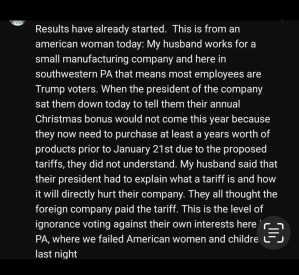
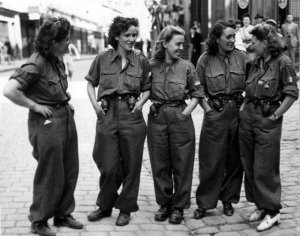
Brittany, 16 August 1944. Members of the FFI (French Forces of the Interior). Their uniforms show the French flag with the Free French emblem, the Cross of Lorraine.
Elizabeth Warren already has a plan. Remember, 2 years isn’t that far away. We get another chance to vote for Senate and House. Meanwhile, resist. Protect Yourself. Be Compassionate to yourself and others. We cannot surrender mentally, emotionally, and in action. This is from Time Magazine. “Sen. Elizabeth Warren: Here’s the Plan to Fight Back.” We have Senators, we have Governors, we have Representatives. Gird them up for the fight they will take on.
To everyone who feels like their heart has been ripped out of their chest, I feel the same. To everyone who is afraid of what happens next, I share your fears. But what we do next is important, and I need you in this fight with me.
As we confront a second Donald Trump presidency, we have two tasks ahead. First, try to learn from what happened. And then, make a plan.
Many political experts and D.C. insiders are already blaming President Joe Biden’s economic agenda for Vice President Kamala Harris’ loss. This does not stand up to scrutiny. Even though the Biden economy produced strong economic growth while reining in inflation, incumbent parties across the globe have been tossed out by voters after the pandemic. American voters also showed support for Democratic economic policies, for example, approving ballot initiatives to raise the minimum wage in Alaska and to guarantee paid sick leave in Missouri.
But good economic policies do not erase painful underlying truths about our country. For my entire career, I’ve studied how the system is rigged against working-class families. On paper, the U.S. economy is the strongest in the world. But working families are struggling with big expenses like the cost of housing, health care, and childcare. Giant corporations get tax breaks and favorable rules while workers are gouged by higher prices. Billionaires pay paltry taxes on their wealth while families can’t afford to buy their first homes.
Americans do not want a country where political parties each field their own team of billionaires who then squabble over how to divvy up the spoils of government. Vice President Harris deserves credit for running an inspiring campaign under unprecedented circumstances. But if Democrats want to earn back the trust of working people and govern again, we need to convince voters we can—and will—unrig the economy.
What comes next? Trump won the election, but more than 67 million people voted for Democrats and they don’t expect us to roll over and play dead. We will have a peaceful transition of power, followed by a vigorous challenge from the party out of power, because that’s how democracy works. Here’s a path forward.
First, fight every fight in Congress.
We won’t always win, but we can slow or sometimes limit Trump’s destruction. With every fight, we can build political power to put more checks on his administration and build the foundation for future wins. Remember that during the first Trump term, mass mobilization—including some of the largest peaceful protests in world history—was the battery that charged the resistance. There is power in solidarity, and we can’t win if we don’t get in the fight.
During the Trump years, Congress stepped up its oversight of his unprecedented corruption and abuses of power. In the Senate, Democrats gave no quarter to radical Trump nominees; we asked tough questions and held the Senate floor for hours to slow down confirmation and expose Republican extremism. These tactics doomed some nominations entirely, laid the groundwork for other cabinet officials to later resign in disgrace, and brought scrutiny that somewhat constrained Trump’s efforts.
When all this work came together, we won some of the toughest fights. Remember Republicans’ attempts to repeal the Affordable Care Act? Democrats did not have the votes to stop the repeal. Nevertheless, we fought on. Patients kept up a relentless rotation of meetings in Congress, activists in wheelchairs performed civil disobedience, and lawmakers used every tactic possible—late night speeches, forums highlighting patient stories, committee reports, and procedural tactics—to draw attention to the Republican repeal effort. This sustained resistance ultimately shifted the politics of health care repeal. The final vote was a squeaker, but Republicans lost and the ACA survived.
Democrats should also acknowledge that seeking a middle ground with a man who calls immigrants “animals” and says he will “protect” women “whether the women like it or not” is unlikely to land in a good place. Uniting against Trump’s legislative agenda is good politics because it is good policy. It was Democratic opposition to Trump’s tax bill that drove Trump’s approval ratings to what was then the lowest levels of his administration, forcing Republicans to scrap all mention of the law ahead of the 2018 midterm election and helping spark one of the largest blue waves in recent history.
Second, fight Trump in the courts.
Yes, extremist courts, including a Supreme Court stocked with MAGA loyalists, are poised to rubber-stamp Trump’s lawlessness. But litigation can slow Trump down, give us time to prepare and help the vulnerable, and deliver some victories.
Third, focus on what each of us can do.
I understand my assignment in the Senate, but we all have a part to play. During the first Trump administration, Democrats vigorously contested every special election and laid the groundwork to take back the House in the 2018 midterms, creating a powerful check on Trump and breaking the Republican trifecta. Whether it’s stepping up to run for office, supporting a neighbor’s campaign, or getting involved in an organization taking action, we all have to continue to make investments in our democracy—including in states that are passed over as “too red.” The political position we’re in is not permanent, and we have the power to make change if we fight for it.
Finally, Democrats currently in office must work with urgency.
While still in charge of the Senate and the White House, we must do all we can to safeguard our democracy. To resist Trump’s threats to abuse state power against what he calls “the enemy within,” Pentagon leaders should issue a directive now reiterating that the military’s oath is to the Constitution. Senate Majority Leader Chuck Schumer must use every minute of the end-of-year legislative session to confirm federal judges and key regulators—none of whom can be removed by the next President.
To those feeling despair: I understand. But remember, every step toward progress in American history came after the darkness of defeat. Abolitionists, suffragettes, Dreamers, and marchers for civil rights and marriage equality all faced impossible odds, but they persisted. Now it is our turn to pull up our socks and get back in the fight.

An iconic photograph from the Spanish Civil War. This is Marina Ginestà i Coloma, born in Toulouse on 29 January 1919 after her family had emigrated to France from Spain. Aged eleven, Marina returned to Spain, to Barcelona, with her parents, who were tailors. When the Spanish Civil War broke out, she served as a translator and reporter. July 1936, when Marina was seventeen years old. The location is the rooftop of the Hotel Colón in Barcelona.
Get back in the Fight. Stay in the Fight. Do nothing with Trump voters. It will catch up to them soon enough. Help yourself and your true friends and family. If you can find it in yourself today to ready this Politico article about their Agenda here is the link. Deporting is high on the list. It will not bode well for our food. I’m going to go work in my Victory Garden. My goal has been to turn my small land area into edible and beautiful things to help pollinators.
Another read I suggest, even though it is tough, comes from the best journalistic endeavors in this country these days, ProPublica. “Trump Says He’ll Fight for Working-Class Americans. His First Presidency Suggests He Won’t. From cutting children’s disability benefits to allowing employers to pocket workers’ tips, Trump tried to slash protections for the working poor in ways that have been forgotten by many.”
This is all I’m up to for the moment. My self care is to not watch the news or anything where I have to see that Orange Monster say anything or move. I’m staying on social media but not interacting much with X. It’s not a helpful place.
My last suggestion is to keep your eyes on the ones that are not lost to Advanced Dementia. They’ll be implementing Project 2025. Here’s a place to start with that. “Trump allies say Project 2025 is on as Heritage affiliates vie for cabinet posts. Clear links to president-elect and rightwing document emerge after his attempts to distance himself from project.” This is from The Guardian.
What’s in your heart and mind today? What can we do for each other to make it better?
Take heart from the French Experience with NAZIs, although we can do it without guns because we know our tormentors well. This song was written by Anna Marly. Worry also about our friends in Kyiv and in Europe as this cancer will spread.
My friend, do you hear the dark flight of the crows over our plains?
My friend, do you hear the dulled cries of our countries in chains?
Oh, friends, do you hear, workers, farmers, in your ears alarm bells ringing?
Tonight all our tears will be turned to tongues of flame in our blood singing!
Climb up from the mine, out from hiding in the pines, all you comrades,
Take out from the hay all your guns, your munitions and your grenades;
Hey you, assassins, with your bullets and your knives, kill tonight!
Hey you, saboteurs, be careful with your burden, dynamite!
We are the ones who break the jail bars in two for our brothers,
hunger drives, hate pursues, misery binds us to one another.
There are countries where people sleep without a care and lie dreaming.
But here, do you see, we march on, we kill on, we die screaming.
But here, each one knows what he wants, what he does with his choice;
My friend, if you fall, from the shadows on the wall, another steps into your place.
Tomorrow, black blood shall dry out in the sunlight on the streets.
But sing, companions, freedom hears us in the night still so sweet.
My friend, do you hear the dark flight of the crows over our plains?
My friend, do you hear the dulled cries of our countries in chains?
You may want to watch this Ted Talk also about Tanzinia. “How to Fight for Democracy in the Shadow of Autocracy | Fatma Karume | TED” is a great explanation of how to live in a transitioning democracy that turned back into an autocracy by “The Bulldozer.” This is about how bad it can get and this is how she rediscovered herself in the 4 years of hell. It’s worth the watch.
Friday Reads: Express yourself!
Posted: July 27, 2018 Filed under: just because, morning reads | Tags: Before Roe V. Wade, Drag, Polari, RESIST, Tignon Laws 14 Comments
Creole in a Red Headdress; painted by Jacques Guillaume Lucien Amans;ca. 1840; oil on canvas, The Historic New Orleans Collection
Good Morning Sky Dancers!
Today, I’d like to explore some dimensions of the healthy expression of a good “fuck you” to the powers that be coming from a variety of sources because, you know, we all want to do it every day these days. Resistance frequently comes in the form of art, music, culture, and language in support of socio-economic-political change. The form can be a joyous yet angry expression necessitated by the powerless situations of those most oppressed by the dominant culture, ruling class, religion, and economy. The wink wink nod nod of art can save one from jail or worse.
It may seem disparate but I’ve got some examples that demonstrate that the complaints coming from diverse communities may represent the same undercurrent of dissatisfaction. The dominant socio-economic-political culture wants to silence and remove us which is why we must support and understand the concept of intersectionality. What they can do to one group, they can do to all given enough time and power. Together, we are the many. Separate and apart, they can cut us off like livestock to separate and unequal slaughterhouses.
This is why they are trying to stack the courts, gerrymander congressional districts, suppress voting rights, and shut up the press. It is also why they scream “lock her up” to attack Hillary Clinton and “build the wall” at folks of Mexican heritage”. It is why they still describe our first black President as a “Kenyan-born Muslim” and panic dial 911 on black people just living their lives. It is why they dilute “black lives matter” to “all”. It is why they won’t bake cakes for all weddings.
It is also why they want to set us against each other and we must not let that happen.

Daisy Patton’s “Would You Be Lonely Without Me?” runs through August 3 at the Art Gym Gallery. ( Ray Mark Rinaldi, Special to The Denver Post)
I’m going to move around in time for this but I will start with a current art show in Denver. “Denver exhibit puts faces to women who died from botched abortions prior to Roe vs. Wade. Daisy Patton’s paintings of 15 women tell a somber story”. The article is from the Denver Post review of the show.
Quirky and perky, with a face full of determination, it’s hard not to get a quick crush on Vivian Grant the way that Daisy Patton paints her, circa 1960, in a series of women’s portraits on display at Denver’s Art Gym Gallery.
With her emerald green dress, dangling earrings and precision-plucked eyebrows, Grant radiates the kind of organic optimism that could carry her far in her burgeoning career in New York’s publishing world.
But the accompanying text tells a story with a different ending. At 23, she found herself showing signs of pregnancy and sought to terminate it.
Abortion was illegal in those days, and dangerous, the stuff, as we say, of back alleys and shady practitioners and Grant, like many others, was one of its victims, dying from complications of the procedure. An autopsy later showed it was a false pregnancy.
Tragedy on top of tragedy. That’s the narrative arch of Patton’s “Would You Be Lonely Without Me?,” which captures in oil paint on paper the images of 15 women who died as a result of botched abortions in the era before the 1973 Roe vs. Wade Supreme Court decision made abortion legal, and raised the medical standards around the procedure.
Yes, the exhibit is political. Patton’s portraits are rich in physical and emotional detail. They raise sympathy for women who make the difficult decision to end their pregnancy — and their sale could raise money for national organizations that support the ability for all women to make the choice.
In her artist’s statement for the show, Patton, writes of a time when an estimated 5,000 to 10,000 women died each year from abortion-related injuries that were caused by unskilled doctors or self-inflicted by those, fearing no where else to turn, who treated themselves with knitting needles or drank bleach or other chemicals.
She notes, citing published research, how things have changed in the last four decades: “Now it is statistically more dangerous to
birth than to have an abortion.”

Many of these stories draw me in even though they are not my stories, or stories I would likely hear had I not gone looking for them or most likely, stories I would not have seen if I didn’t have friends who have stories that connect them deeply to these voices. I am drawn in by our shared humanity and vulnerability.
In this case, it was a neighbor who watched a woman die of a botched abortion as a 10 year old in a South Chicago Beauty Salon her mother used. She later, at 13, joined the underground railroad to help women seeking abortions. She was the same age as me when I listened to a panel of women who shared the stories of women in their lives who had died of botched abortions in the fellowship hall of my West Omaha Presbyterian Church. I think that was about the first moment that I realized I had a name and it was “feminist”. My neighbor’s story is more compelling than mine though and I’m glad she put up the link and said share this woman’s art.
I don’t remember her name, but she bled to death from a back alley abortion in the spare bedroom of Jackie, the lady who did my mother’s hair on Saturday’s when I was 10. I was sent to go keep an eye on her while my mother was getting her hair done. I was the last person to see her alive, because she was moaning softly and crying while Jackie was shampooing. I asked her if she needed anything and she said she needed something for her bleeding.I went back down the hall and told Jackie. Jackie went into the bathroom and got then to back bedroom and then she came back into the kitchen. Jackie gave me some towels and told be to bring them to her. I could tell when I went back in the room that she was gone, and lying in an incredible pool of blood.It was the same week a woman my Mother worked with, who was white and had money, had a “procedure” at her gynecologist’s office to take care of her unwanted pregnancy.
I learned about Jane the underground to help women when I was 13. I started donating money, and volunteering. I let women into our apartment to sleep on the couch after everyone had gone to bed and then got them out before anyone got up in the morning, on their journey to Canada to have their abortion there, or if they had enough money to the private clinic on the North side of Chicago.
The story of Louisiana’s Tignon laws has always intrigued me. I’ve been seeing renewed interest in them as it appears they are now part of a discussion on cultural appropriation.
Louisiana had slavery but with some vital differences that eventually disturbed the American colonizers who bought the French Colony. The Catholic church insisted that slaves not work on Sundays and that they be allowed to buy their own freedom. This created an entire community of free people of color in New Orleans. It was inevitable that as the traditional model of American Slavery moved towards Louisiana and New Orleans it would create dehumanizing experiences for its Creole communities.
The Tignon laws passed in 1789, however, were enacted by a Spanish governor who was also critical of the French behavior towards free people of color. Tignon laws were enacted to restrict the fashion, dress and hair styles appropriate in public dress for female gens de couleur in colonial society. Black women could not show their hair in public under the law.
This story of Free Black women in New Orleans addresses how
“We cannot discount how enslaved Black women used dress as a form of resistance [and] how even finding different ways of tying the headscarf acted as a form of resistance against the trauma of diaspora and being cut off from Africa,” says Winters. “Or how [African-American] people have drawn inspiration from African traditions as a source of empowerment.”
The tignon remains an important symbol of resistance even today It is essentially a piece of cloth fashioned into a headress to cover the hair of black women. It became much more when styled with bold patterns and color and adorned with jewels.
Even when Louisiana stopped enforcing the laws in the early 1800s, free women of color continued wearing the tignon. It’s a testament to their resilience: The women of New Orleans refused to allow a piece of cloth to humiliate them, erase their status, or diminish their femininity. Instead, they reinterpreted the tignon as a symbol of empowerment. (And Black women in Louisiana weren’t the only women of color to use clothing to resist oppressive laws: In 1773, free women of color in Saint-Domingue were prohibited from wearing shoes, so they wore sandals, adorned their toes with diamonds and continued to do so after the laws were lifted.)
More than 230 years later, remnants of the tignon laws still linger: Traditional hairstyles, such as dreadlocks, are still seen as unprofessional in the workplace; women who wear them are subject to false assumptions—like Giuliana Rancic’s now-notorious snark about Zendaya’s faux locs smelling of “patchouli oil” and “weed.” The military recently lifted its longtime ban on cornrows, Afros, locs, and other protective hairstyles, but we regularly hear stories about Black girls being suspended from school for rocking natural hair.
A number of black women have incorporated the look and statement in their performances.
Pop culture, however, is the most reliable place to look for Black women who still resist the policing of their hair.
The first time we see Beyoncé in Lemonade, her musical celebration of Louisiana’s Afro-Creole women, she’s rocking a tignon while kneeling on a stage. Nina Simone also incorporated the tignon into her signature look, and Lauryn Hill, India.Arie, and Erykah Badu followed her lead in the late 1990s and early 2000s. (Badu even wore a headwrap on Sesame Street). Outside of pop culture, the headwrap is now largely considered a fashion staple. Nnenna Stella travels from Brooklyn to Ghana and Morocco to select the most impeccable textiles for her handcrafted headwraps. Afro-Colombian designer Angelica Balanta’s vibrant headwraps reflect her rich Colombian culture, while Paola Mathé’s collection is inspired by her Haitian heritage.

Nina Simone & her daughter Lisa Celeste Simone | 1965 photo by Brian Duffy
It’s been years since the Tignon laws have been thrown out but they are still a sign of resistance. They also have been appropriated and are part of a bigger discussion
As of present, we can find conversations about what is and what isn’t cultural appropriation by way of hair (aka Kim Kardashian and her “Bo Derek” braids) or current cases playing out in court about what is and what isn’t discrimination based on a hairstyle. Black hair has always been a topic of conversation.
Most Black women can relate to the struggle of getting braids or weave and having unwanted comments from non-black co-workers. Even young Black girls are subject to ridicule because of their hairstyles. The Tignon Laws of 1786 are proof that Black hair has always been policed in America.
Fashion is frequently used for resistance.
People laugh at me when I tell them my Draq Queen friends would most likely be my spirit animal. My mother even knew that I was not one to be put in ruffles and lace with hair like Shirley Temple. It was not me at all. I basically look over the top in anything girlie which is probably why I can totally relate to a lot of drag.
Cross dressing and lip-syncing is entirely different from the insensitive nature and intention of blackface. In queer and feminist communities, drag tends to be widely accepted. It makes sense, counter cultures allowing each other to thrive and experiment. It is the concept of “gender roles” that forces us to so closely associate femininity with women, so when someone who is clearly not a woman performs femininity, it is still thought of to be a reflection on women.
A lot of drag queens get their names and character traits from pop culture, and the media loves to portray women as, to use Mary Cheney’s words, bitchy, catty, dumb, and slutty. Indeed, these are not great attributes for a person to embody, so when drag queens perform those characteristics while dressed and made up like a woman, it could be read as disrespectful or an insult to woman. Drag queens also tend to be hyper sexual, sometimes with a crude sense of humor. When people over sexualize femininity, it dehumanizes women by turning them into an object of sex as opposed to a complex human being.
Many supporters of drag culture argue that the femininity being performed by drag queens is their own form of self expression and has little to do with people who live their daily lives as women. Judith Butler argues that traditional gender roles are exhaustingly heteronormative, and that they attempt to define a norm that gives a sense of “otherness” to queer culture and drag. If we broaden our lense to not view heterosexuality as “having a claim on naturalness and originality” (Butler 384), gender can be scene as a performance for everyone and therefore not so different from drag. Basically, most people view drag as an imitation, but that implies that gender has a norm in which to deviate from. It’s like personality, there isn’t a set way to be an individual, so there isn’t a set way to be feminine.
I want to bring up art history in this exploration of gender because drag so connected with self expression and the artistry around makeup and fashion. Drag is an experiment gender, makeup, performance, fashion, comedy, parody etc… There is a million different ways to “do” drag, as seen by the assortment of characters who have won RuPaul’s drag race all with varying intensities in the femininity of the character.
Wedding Cakes aside, I grew up in an age when you read Oscar Wilde and knew it was indeed ‘the love that dare not speak its name”. I’ve found these expressions of resistance shared by friends that relate to oppression in a way I can only take in as a listener and human being, But, i can still relate. I knew there were jail sentences and death penalties when I was a child as much as I was aware of Jim Crow Laws separating black from white Americans in the South. Only now, is much of the pre civil rights culture of resistance being documented.
“And Gloria cackled, let there be sparkle; and there was sparkle.” It’s a passage from the Bible, but not as we know it: this is a familiar line from the Book of Genesis as spoken in Polari. The secret language became a kind of verbal wink between gay men in Britain during the early 20th Century – allowing them to hide and to reveal at the same time.
“One of the things that makes Polari so powerful is that it is simultaneously about disguise and identification,” the artist Jez Dolan tells BBC Culture. “You would be hiding what you were talking about from people who didn’t know it, but also if you were in a bar and you liked the look of somebody, you’d pop it into conversation and they’d either go ‘ah’ or they’d look blank and you’d be on your way.” Polari is rarely spoken today. Yet in the years when homosexuality was illegal, it was a way of communicating in public without risking arrest – as well as a chance to challenge the status quo.

Divine in a publicity photograph from the 1980s
This form of resistance, identification and survival has a fascinating history.
Baker has found it difficult to untangle a clear history of the lexicon. “Polari has a long and complicated provenance, and not all of it is fully known because it was spoken by marginalised groups who didn’t usually have their voices or stories recorded,” he says. While ‘bona’ (meaning ‘good’ or ‘attractive’), which pops up frequently, was first recorded in Shakespeare’s Henry IV Part II, some of the earliest words in Polari come from 18th-Century ‘Molly Slang’. “Mollies were men who were camp and had sex with other men,” says Baker. “These men were sometimes imprisoned and so some words of the criminal slang Cant would have crept into their language use.”
Baker describes how another form of slang, Parlyaree (from ‘parlare’, the Italian for ‘to talk’), was used by buskers, travelling circus and fairground people, market stall holders, prostitutes and beggars. Derived from Italian, it began to be used in music halls in the late 19th Century, and became known as Palarie. “There were influences from Lingua Franca… used by sailors, as well as cockney rhyming slang and Yiddish which were found particularly in the East End of London.” Some of the words are what’s been called ‘backslang’ – hair is ‘riah’, and face is ‘eek’ (from ‘ecaf’)
“Bona to vada your dolly old eek!” This links to a BBC video worth watching.
British comedian Kenneth Williams often spoke Polari in his performances on BBC radio and TV programmes in the 1950s and 60s, some of which had up to 20 million listeners at a time, introducing the language to a much wider audience.
The highlight of my evenings has been watching the nightly occupation of Lafayette Park across from the White House where noise and culture are making a loud stand. Its first night saw a very large Mariachi Band. There have been New Orleans styled Brass Bands and Drummers. The use of a Mariachi band in an Anti-Trump Protest is clearly ironic and brilliant simultaneously given Trump’s bigoted fascination with purging and dehumaniziang Mexicans and Mexican Americans.
Normally, Lafayette Park is one of those pretty, history-drenched spots in Washington, where you walk around wondering whose footsteps you might be following. You’re right across from the White House, close enough that you can practically see into the front windows. Now, though, the most important thing to know about this D.C. spot is what Occupy Lafayette Park is — because the square might just be full of anti-Trump protestors.
Because of its sight line straight to the White House, Lafayette Park is a frequent spot for rallies and gatherings when people want to protest something that the Trump administration has done, like for example the travel ban. Now, the country seems to be at a fever pitch after Trump’s meeting with Russian President Vladimir Putin, which has gained the name “Treason Summit” on Twitter. Occupy Lafayette Park is an impromptu, grassroots rally set up to protest Trump’s actions in Helsinki, where the meeting was held, and demand his impeachment.
It is only sweeter that idea came from former Clinton Aides. I just hope Trump can never sleep again.
“Nothing says Impeach like a Mariachi band,” one user chimed in.

Raja Gemini; stage name of Sutan Amrull, an Asian-American make-up artist, and drag performer
As you can tell,symbols of resistance can take many forms and they can outlive the original need for the resistance while remaining necessary because of the residual impact. So, one final link to some news about the guy that’s kicked off the #MeToo movement by bragging on sexual assault. It’s from Charles Pierce, Esquire, CNN, Michael Cohen, the Age of Leaks and Treason and more than we’ve all been able to handle. ‘We now stand at a yes-or-no moment in this country’s history.’ It juxtaposes today and that day in 1974 where they found the smoking gun.
We are now at one of those points. With the revelation on CNN Thursday night that, according to the network’s sources, Michael Cohen is ready to testify that the president* knew in advance of the now-legendary meeting in June of 2016 at which individuals connected to the Russian government offered to ratfck Hillary Rodham Clinton’s campaign for him, we stand as a self-governing republic at a stark, unclouded moment—either you believe the president* of the United States is utterly illegitimate, having conspired with a hostile power to gain the office he now holds, and that every act he has taken in that office, up to an including swearing the oath of office, is equally illegitimate, or you do not. It is now a binary. If Cohen is willing to testify to that effect, then the president* conspired with the regime of Vladimir Putin in order to gain control over the executive branch of government in this country—which includes not only the military, but the law-enforcement and intelligence apparatus as well. We are now at yes-or-no.
It’s time, as artfully as possible, to tell this administration to get the fuck out of the people’s house.
What’s on your reading and blogging list today?
Happy Martin Luther King Day!!! Celebrate Civil Rights!
Posted: January 16, 2017 Filed under: Afternoon Reads, anonymous, The Bonus Class | Tags: RESIST 33 Comments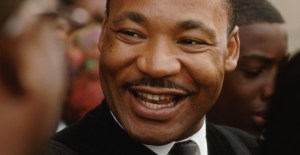
Today is the day to think about the sacrifices that were made by Civil Rights leaders and activists under the leadership of Nobel Peace Prize winner Rev. Dr. Martin Luther King. Today is the day we celebrate his birthday and the struggle that committed our country to fully addressing the promise of equality for all of us including those Black Americans who built this great nation under the yoke of slavery and the oppression of Jim Crow. #BLACKLIVESMATTER
I want to share this op ed written in WAPO by Michael Gerson today on why the attack on Congressman Lewis on the eve of our celebration of King’s birthday and legacy is “the essence of narcissism”. Gerson correctly characterizes Trump’s problem as
“Trump seems to have no feel for, no interest in, the American story he is about to enter. He will lead a nation that accommodated a cruel exception to its founding creed; that bled and nearly died to recover its ideals; and that was only fully redeemed by the courage and moral clarity of the very people it had oppressed. People like the Rev. Martin Luther King Jr. People like John Lewis.”
 Trump has no appreciation for our roots as a nation and the sacrifice made by many men and women to bring it to where it is today. Many of us had ancestors who did not make these sacrifices on their own terms or with consent or with recognition of their humanity which is an extremely important history to embrace. This includes the endless humiliation and suffering of slaves and the atrocities committed against indigenous peoples. It includes not extending the vote to woman until quite recently. It includes not recognizing the dignity of all forms of love and being. We’ve struggled to get here and we struggle still. Understanding the roads of our shared history is something we ask of our leaders. This shallow man who doesn’t read or appear to learn much of anything at all is preoccupied with himself alone.
A broader conception of the American story — a respect for the heroes and ghosts of our history — is absent in Trump’s public voice. He seems to be in the thrall of an eternal now. To some, the whole idea of a historical imagination will sound nebulous. Abraham Lincoln called it the “mystic chords of memory.” He hung his hopes for unity on the existence of a shared national experience that transcended regional differences. Today our divisions are more along lines of class and culture, but we also need to hear our story as one people.
Not every citizen shares this sense of history. It is a minority of Americans who visit Antietam and feel oppressed by the immense weight of collective death; or go to the Lorraine Motel in Memphis and feel sickened by the scale of such a loss; or walk across that bridge in Selma and hear the echoes of snarling dogs and nightsticks against bone.
But we need a president who respects and evokes this story — or at least does not peevishly attack its heroes.
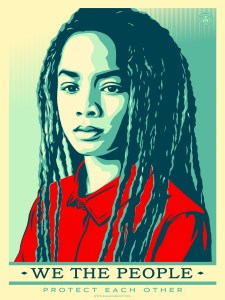
Shepard Fairey has painted the faces of the Resistance that starts in earnest this weekend with the Woman’s March on Washington . The faces of resistance grace today’s post along with the man who must be our role model for change.
Shepard has created three portraits for the campaign; two other artists, Colombian American muralist Jessica Sabogal and and Chicano graphic artist Ernesto Yerena, have each made one more. Together, they hope the faces of “We the People” — standing in for traditionally marginalized groups or those specifically targeted during Trump’s presidential campaign — will flood Washington, D.C., on Inauguration Day.
Fairey is collaborating with the Amplifier Foundation, a nonprofit that works to amplify grassroots movements and which commissioned the project. After learning that large-sized signs were prohibited at Inauguration, Amplifier came up with a hack to distribute the posters. Their plan: to buy full-page ads in the Washington Post on Jan. 20 that feature the “We the People” images, which can be torn out and carried as placards, or hung and posted around town. The posters will also be distributed at metro stops, from moving vans and other drop spots on Inauguration Day, as well as posted online for free download. A Kickstarter campaign for “We the People” has raised more than $148,000 since it was launched Tuesday night.
Today, his future press secretary has done the same thing that White House Mommy 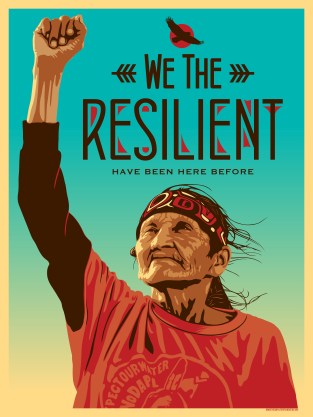 has said. Do not be mean to Kremlin Caligula with the implication that some Russian Goon will visit us with brass knuckles if we continue not to accept his mocking of the disabled, his horrible treatment of Gold Star Parents who are Muslim and immigrants, his history of serial sexual assault and degradation of women and his fixation with SNL. The talk is that the White House Press will be sent to some far off administration building and out of their newly built offices in the White House. Spicer wants Acosta and CNN to apologize for not treating the Toddler headed to the White House like an adult capable of answering questions germane to his job.
We’re about to become the anathema of the free world. Interviews with Hair Furor have set off shivers from our allies. Here’s some analysis from Martin Longman writing for Washington Monthly.
If Donald Trump has the goal of destroying American power, breaking up the European Union, dismantling NATO, lifting Russian sanctions, and helping to elect a bunch of Russian-aligned far right fascist parties in Western Europe, at least he’s willing to tell us exactly that. There’s very little subtlety about it at this point, and the only fig leaf he’s going to offer is the prospect that Putin will agree to some kind of reduction in our respective nuclear arsenals.
Is that a fair trade?
I don’t think so.
Donald Trump called NATO obsolete, predicted that other European Union members would follow the U.K. in leaving the bloc…
…Trump predicted that Britain’s exit from the EU will be a success and portrayed the EU as an instrument of German domination designed with the purpose of beating the U.S. in international trade. For that reason, Trump said, he’s fairly indifferent to whether the EU stays together, according to Bild…
…The Times quoted Trump as saying he was interested in making “good deals with Russia,” floating the idea of lifting sanctions…
“…[NATO is] obsolete, first because it was designed many, many years ago,” Trump said in the Bild version of the interview. “Secondly, countries aren’t paying what they should” and NATO “didn’t deal with terrorism.” The Times quoted Trump saying that only five NATO members are paying their fair share…
…With Merkel facing an unprecedented challenge from the anti-immigration Alternative for Germany as she seeks a fourth term this fall, Trump was asked whether he’d like to see her re-elected. He said he couldn’t say, adding that while he respects Merkel, who’s been in office for 11 years, he doesn’t know her and she has hurt Germany by letting “all these illegals” into the country.
Since when are Syrian refugees allowed into a country for the purpose of asylum “illegals”? NATO obsolete? Where the hell is this mad man taking us? Hey you … you’ve under an asterisk next to your name as president* the same way pumped up druggie athletes get one.
How long can our institutions endure these assaults? Trumps appointments are as compromised as he is and they’re all freaking crooks.
https://twitter.com/joanmccarter/status/821107706199044097
Here’s the latest in the ethics issues that we’re told aren’t happening/don’t exist.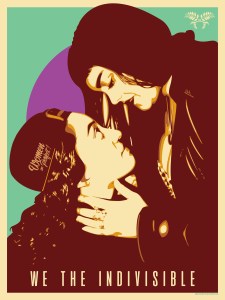
A multi-million dollar expansion of President-elect Donald Trump’s golf resort in Scotland is reportedly underway just days after his attorneys said no new foreign deals would be made.
Expansion plans for the Trump International Golf Course Scotland in Aberdeenshire include a second 18-hole golf course and a new 450-room five-star hotel, timeshare complex and private housing estate, The Guardian reported Saturday.
Trump officials claim the venture does not conflict with the president-elect’s promise not to pursue new or “pending deals” during his presidency to avoid any conflicts of interest.
 So, here’s something interesting. Anonymous is going after Trump.
The exchange began with Anonymous repeating accusations from sources that Trump has deep “financial and personal ties with Russian mobsters, child traffickers, and money launderers.”
The group’s twitter feed read worthy if you want to see every piece of dirt any one has ever dug up on the guy to date. I’m sure the hacktivists are working on more.
 So, I’m still laying low and trying to figure things out. I’m looking into something that could me to an acreage on an island in the Puget Sound and it has lots of little cabins on it among other interesting things. I’m wondering how much brave I have left in these old bones.
I’m going to the NOLA protest activities on Friday. Maybe that will inspire me.
What’s on your reading and blogging list today?
Last Friday of 2016 Reads: RESIST
Posted: December 30, 2016 Filed under: Afternoon Reads | Tags: RESIST 25 Comments The struggle continues in earnest. RESIST.
I’m not going to be celebrating the New Year as much as I will be crying over 2016 which turned hope into dread. The only hopeful thing I’m seeing at this point are the acts of deliberate protest against the Fascist regime we face starting January 20th. Some are more subtle than others. The most important thing is that must continue.
We must RESIST.

Mama Ayesha’s restaurant Washington, D.C.’s Adams Morgan neighborhood does not plan on painting President-elect Donald Trump into its presidential mural, the Washingtonian reported on Thursday.
“Our official position is that it is not in the budget,” Amir Abu-El-Hawa, a member of the family that owns the restaurant, told the publication.
The mural features the founder of the restaurant, “Mama” Ayesha Abraham, standing alongside 11 presidents, from Dwight D. Eisenhower to Barack Obama.
“She was the American dream. For a Muslim and Arab woman immigrant from Palestine to come here on her own and build this business, is a remarkable legacy,” said Abu-El-Hawa, who is the founder’s great-nephew.
According to the Washingtonian, the mural was painted by Karla “Karlisima” Rodas between 2007 and 2009 and was partially sponsored by the D.C. Commission on the Arts and Humanities.
The artist is Colombian born had has been in the USA since 1984. You can see more about the artist and the restaurant at the link. There’s a great video of the artist explaining her work and vision.
 A member of the Mormon Tabernacle choir has resigned rather than be part of an organization that would participate in the Inauguration of the Hair Furor. The best part is that she said she “could not throw roses at Hitler” and would “certainly never sing for him”.
President-elect Donald Trump’s plans for his inauguration have hit another bump in the road. A member of the Mormon Tabernacle Choir, which is slated to perform at the event, has quit in protest and penned an open letter explaining her reasoning.
Jan Chamberlin announced her resignation from the Church of Jesus Chris of Latter-day Saints-affiliated choir in a note on Facebook on Thursday. In the letter, which is addressed to the choir’s leader and her family and friends, Chamberlin said that after reflection and prayer and with “a sad and heavy heart,” she is resigning her position in the choir.
T-rump continues to have a difficult time getting any one to perform at his installment. Performance is definitely a political statement for many and even those who may like him are afraid of the blowback from those of us that RESIST.
Unlike any other year, however, the overarching theme of performing at Trump’s swearing-in is that of risk. “An artist would be risking too much,” notes Horowitz. “Their career, their fan base, their relationships in the music industry. As one of the most divisive president-elects in history, Trump shouldn’t be surprised that he’s facing a lack of support.”

Meanwhile, a restaurant in Hawaii has banned Trump voters saying “No Nazis”.
Café 8 ½ in Honolulu, Hawaii, is facing harsh criticism for hanging a sign on its front door that tells voters who cast their ballot for President-elect Donald Trump to eat elsewhere.
“If you voted for Trump you cannot eat here! No Nazis,” reads the yellow sign, as reported by Fox News on Tuesday.
Here’s a great interview to read at VersoBooks: “Trump, fascism, and the construction of “the people”: An interview with Judith Butler”. Isn’t it nice to see people calling it what it is? FASCISM!!!!
What does Donald Trump represent? The American philosopher Judith Butler, professor at Berkeley University, has recently published a short book in French, Rassemblement [Notes Toward a Performative Theory of Assembly]. She explains that Donald Trump incarnates a new form of fascism. As she puts it, “A lot of people are very happy to see this disturbing, unintelligent guy parading around as if he was the centre of the Earth and winning power thanks to this posture.”
Many writers and intellectuals in the United States and Europe have expressed their views on the Trump phenomenon; mostly to express their consternation or their reprobation, condemning the excesses of his language or expressing their alarm at his proposals to build a wall on the Mexican border or to expel millions of undocumented migrants. But if we are to try to understand what is going on with “Trump” — the Trump phenomenon — then we need to bear in mind the analyses that Judith Butler has elaborated since the late 1990s, from her Excitable Speech, A Politics of the Performative to her latest book, Notes Toward a Performative Theory of Assembly.
Mediapart: Might we say that Donald Trump is a sort of “figure in the carpet” of the analyses you have been producing over the last two decades? Is Trump not a “Butlerian object” par excellence
Judith Butler: I am not sure that Trump is a very good object for the analyses that I usually conduct. For example, I do not think that there is a fascination for Trump as a person. And when we look at his speeches, we also have to consider more particularly the effects this discourse has on a certain fringe of the American people. Let us not forget that he was elected by less than a quarter of the population, and that he is on the brink of becoming president only thanks to the existence of an archaic Electoral College.
So we should not imagine that Trump enjoys wide popular support. There is a general disillusionment with the political field and a certain scorn for the two main US parties. But Hillary Clinton got more votes than Trump. So when we ask about the support for Trump, we should also ask ourselves how it was that a minority of Americans was able to bring him to power. What we need to interrogate is not an upsurge of popular support [for Trump], but a democratic deficit. The Electoral College should be abolished so that our elections more clearly reflect the popular will. I also believe that our political parties should be rethought in order to increase popular participation in the democratic process.
The minority that supported Trump, the minority allowing him this electoral success, was able to achieve its goal not only thanks to its own rejection of the political field but also the fact that almost 50% of the electorate expressed their disaffection by not going out to vote. Perhaps we ought to speak of the collapse of democratic participation in the United States.
I think that Trump unleashed a rage that has many causes and many targets, and we should probably be sceptical of those who claim to know the true cause, the one single object of this anger. The state of economic devastation and disappointment and the loss of hope for the future — born of economic and financial movements that have decimated whole communities — certainly did play an important role. But so, too, did the United States’ increasing demographic complexity, as well as forms of racism both old and new… There is a desire for “firmness,” expressed through the strengthening of state power against foreigners and undocumented workers, but this is also accompanied by a desire for greater freedom from the burden of government: a slogan simultaneously serving both individualism and the market.
Here’s a ten-point list of what we can do in the upcoming year(s) of the work to tear down our country within the White House itself. Peter Drier suggests we prepare ourselves. I love this first one.
1. Don’t forget: Trump does not have a mandate. Hillary Clinton won the popular vote byclose to 3 million votes. Only 27 percent of the nation’s 231 million eligible voters voted for Trump. In the first election in 50 years without the full protections of the Voting Rights Act, Republicans intensified their voter-suppression efforts, targeting black and Latino communities in key battleground states. More than 40 percent of eligible voters did not vote; most non-voters were low-income, minority and/or young Americans who, had they gone to the polls, would have voted Democratic. Polls also show that even most Trump voters do not agree with much of his policy agenda. A CBS survey showed about one-quarter of Trump voters said he is not qualified to be president. Seventy percent of all voters said immigrants without documents should be able to apply for legal status rather than be deported.
 But, can we ever forget exactly how much we saw racism, misogyny, and xenophobia on display this last year? Can we face down our disappointment at being wrong when we thought that America was basically good and couldn’t go down this rabbit hole of hate? Can the struggle for justice succeed?
After Trump’s election, it is more or less impossible to believe that we are making meaningful progress. White liberals who woke up horrified on Nov. 9 weren’t horrified because the world had suddenly changed—we were horrified because the scales had finally fallen from our eyes, and we could at least see our unjust, racist, sexist country for what it is. The next president will not be a woman, the makeup of the Supreme Court will not shift toward progressivism, and we are not jolly passengers on a cruise ship sailing toward an era of tolerance, justice, and respect for the dignity and rights of all.
The first challenge is being met now. Trump’s spin on Russian interference in our election is falling apart. The Alt-Right enablers have going from denying Russian involvement to saying it was a good thing. How can this not be seen as treason?
This morning, Russian President Vladimir Putin responded to the Obama administration’s announcement yesterday that the United States will undertake sweeping retaliation against Russia for its alleged interference in our election. In a surprise, Putin said he would not be expelling U.S. diplomats as part of the escalating tensions.
This led to some speculation that Putin is simply biding his time until Donald Trump takes over as president, putting someone more friendly to Putin and Russia in the White House — hopefully meaning all those bad feelings about possible Russian efforts to tip the election to Trump can be forgotten. Trump, too, has been saying we need to “move on.”
Reporters and scholars continue to be under attack for providing evidence. False claims from Alt Right enablers are sending Trump Goons into attack and threat mode.
If we ever had any doubt that DudeBroProgs are just Republicans in hipster clothing who smoke pot, take a look at this Chait headline: “Glenn Greenwald, Tucker Carlson Unite to Dismiss Russian Hacking Allegations”. At least were seeing the birds of that feather finally flock together.
One of the great meetings of journalistic minds took place last week, when left-wing journalist Glenn Greenwald appeared on Fox News with Tucker Carlson. The segment was devoted to their purportedly strange agreement over the Russian hacking story (which is not actually strange at all, given their mutual antipathy for the center-left). Greenwald has long dismissed the charge that Russia manipulated WikiLeaks’ publication of Democratic party emails as a “smear,” mocking suspicions of misbehavior by what he referred to in sarcastic capitalized words as “The Russians”; he called it typical of the Democrats’ alleged tendency to use false attacks against Russia to discredit its adversaries (“So WikiLeaks has become an enemy of the Democratic Party, and they seem to have one tactic with their adversaries and enemies, which is to accuse them of being Russian agents”). On Carlson’s program, Greenwald attacked the Washington Post for reporting that the CIA and the FBI believed Russia’s hacking was intended to help Trump win. It is a remarkable segment that merits close reading.
“Should we believe that assessment?” asked Carlson. “We should be extremely skeptical of it for multiple reasons,” replied Greenwald. “These are assertions that are being made unaccompanied by any evidence whatsoever.”
https://twitter.com/AlGiordano/status/814660479683534848?lang=en
 We actually need to thank Lady Lindsey and her sidekick McGrumpy McGrumpkins for doing the right thing today.
Senate Armed Services Chairman John McCain has scheduled a hearing on cyber threats for Thursday, where the issue of Russia’s election-year hacking will take center stage, a source familiar with the committee’s planning told POLITICO.
Director of National Intelligence James Clapper, National Security Agency and Cyber Command Chief Adm. Mike Rogers and Undersecretary of Defense for Intelligence Marcel Lettre are scheduled to testify, according to the source.
The timing of the hearing — three days into the new Congress — is in the same week that President-elect Donald Trump says he plans to be briefed by the intelligence community on the Russian hacking.
This is going to be a long, draining struggle but I don’t think we have much of a choice at this point but to fight all we can.
RESIST.
What’s on your reading and blogging list today?


 peej
peej Carissa
 bostonboomer
 dakinikat
 ecocatwoman
 mablue2
 Mama Lopez
 peggysue22
 quixote
 skydancingguestblogger
 Mona (aka Wonk the Vote)



 Sky Dancing
Recent Comments