
Finally Friday Reads: Letters from Occupied New Orleans
Posted: November 21, 2025 Filed under: ICE Immigration and Customs Enforcement, immigration | Tags: @repeat1968, ICE, immigration raids, John Buss, Resisting, Tactics 9 Comments
Good Day, Sky Dancers!
Temple doesn’t have to be incensed that her Louisiana Swamp Dog breed isn’t part of the latest ICE raid in New Orleans, Louisiana. It’s no longer called Catahoula Cut-off. It has now officially been renamed ‘Swamp Sweep’. That doesn’t make it easier to deal with. It’s hard to express the feeling that you have that your own country is basically sending a military invasion to your neighborhood. We have the basic statistics that these racists go after. We have women in our leadership positions. They represent our multicultural city. We’re terrifically liberal and blue as fuck. Trump and his ilk hate us.
I’m already part of the ‘good trouble’ we’ve got planned for them. Let me fill you in.
This is from Newsweek.”ICE To Target Mississippi, Louisiana in Major ‘Swamp Sweep’ Raid: Report.
Roughly 250 federal border agents will deploy to New Orleans in a two-month operation called “Swamp Sweep,” which aims to arrest almost 5,000 people across Louisiana and Mississippi, The Associated Press has reported, citing internal documents and sources familiar with the matter.
Newsweek contacted U.S. Immigration and Customs Enforcement (ICE) and the Department of Homeland Security (DHS) via email outside of normal working hours for comment.
The upcoming Swamp Sweep operation represents one of the largest regional immigration enforcement actions under President Donald Trump to date.
Gregory Bovino, the Border Patrol commander reported to be leading the new effort, has drawn scrutiny in the past. In Chicago, Bovino was publicly rebuked by a federal judge for misrepresenting threats by protesters and using tear gas and pepper balls without justification during disturbances. His involvement in the plan indicates that it is a major enforcement priority for the Trump administration.
According to planning documents obtained by The Associated Press and sources familiar with the operation, Swamp Sweep is scheduled to begin in early December and continue for two months.
It signals both an expansion of the administration’s immigration crackdown in key Southern states and an intensifying showdown between federal agencies and local governments in areas with divergent approaches toward immigration policy.
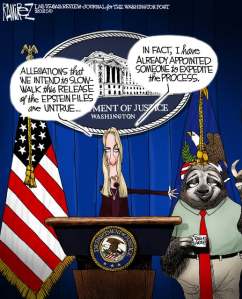 They are specifically targeting one of the smaller cities adjacent to Orleans Parish. It has long been a place where various diasporas have settled even thought it undoubtedly a White Flight Burb. The City of Kenner is high on the list and their police are aligned with the Governor and his anti-immigrant MAGA positions. This is from the Louisiana Luminator. “In heavily Hispanic Kenner, some residents on edge ahead of Border surge. The Department of Homeland Security is reportedly deploying 250 Border Patrol agents to the New Orleans area, echoing recent operations in Chicago and North Carolina.”
In Chicago, federal agents focused on heavily Hispanic suburban neighborhoods near the city’s northwest side, sparking allegations of racial profiling — including of U.S. citizens of color caught up in the sweeps — and excessive use of force.
Kenner, a suburb to New Orleans’ northwest, has the highest share of Hispanic residents — largely Honduran — of anywhere in the metro area. The city of about 66,000 is 30% Hispanic and is well-known for its concentration of Hispanic-owned businesses, particularly along Williams Boulevard.
Kenner has already seen immigration enforcement operations stepped up this year, including early this month, when the city’s police department partnered with ICE, the Federal Bureau of Investigations, the Drug Enforcement Administration and Louisiana State Police for a nighttime raid at the boat launch in Laketown, which resulted in 15 immigration arrests.
In a video posted on the Kenner Police Department’s Facebook page, Kenner Police Department Chief Keith Conley said the operation was in response to years of nuisance complaints from city residents. Kenner PD was also one of the first local departments in Louisiana this year to ink a formal partnership pledging to work with federal immigration authorities.
In a phone interview with Verite News, Conley said the agency had not been briefed by their partners at ICE or anyone at U.S. Customs and Border Protection on the upcoming operation, adding that Kenner PD will work with federal immigration authorities if asked.
“From what I understand, they’re going to be operating independently. Certainly if they need our assistance for anything, we stand ready to assist and aid in their mission,” he said.
Conley said reports that fears over immigration enforcement are causing Hispanic residents to stay indoors might be overblown by social media.
“I don’t see any interruption in customers in restaurants and stores or anything like that,” Conley said. “If [residents] have any concerns or fears they’re more than welcome to call this office or to speak to any of our officers about it.”
But one business operator with locations in New Orleans and Kenner told Verite News that he is already seeing a drop in sales, even before the operation has officially begun.
“It’s a bad time,” said José Castillo, a manager at Norma’s Sweets Bakery, which is owned by his mother. “Business is down in Kenner, in New Orleans, in all our areas. … People are afraid to go out.”
Conley said Kenner PD has long been a good partner to federal immigration enforcement agencies. In March, the department signed an official agreement with U.S. Immigration and Customs Enforcement under the 287(g) program, which deputizes officers to carry out some ICE duties. President Donald Trump has urged departments across the country to enter into such partnerships, as has Louisiana Gov. Jeff Landry, a Trump ally and immigration hardliner.
The agreement allows KPD officers to draft their own “detainer” requests, authorizing local jailers to hold immigrants beyond when they might otherwise be released so that they can potentially be transferred into ICE custody.
In an investigation published in August, Verite News and Gulf States Newsroom found that Kenner PD traffic stops were creating a pipeline for immigrants from the city’s jail to federal immigration detention and even deportation. Between January and May ICE issued six times as many immigration detainer requests through Kenner PD than during the same time period in 2024.
As New Orleans area residents await the operation, the U.S. Department of Homeland Security has been fairly tight-lipped about what to expect.
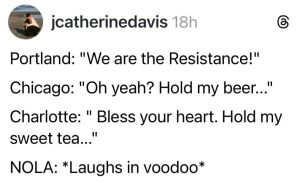 Here, in the city itself, several resistance groups have banded together to use some of the most successful strategies seen in Chicago. The biggest is the strategy of a whistle brigade. These whistles are easy to assemble; anyone with a 3D printer can mass-produce them quickly and affordably. The whistles are distributed throughout the cities with instructions. The basic idea is to draw enough attention to a raid that it will disrupt its efficiency and alert people in the zone to an active raid. Everyone has instructions and can pick up the whistles at various locales in each neighborhood. There are also some mass protests in the wings.
The key is also to document and report the activity. Activists are primarily there to demonstrate a large community presence, use their cameras to capture the raid, and then report to key resistance groups with resources to engage lawyers and the press. Again, this has been successful in Chicago.
Another successful tactic is to embarrass and boycott any local businesses that are facilitating any part of the invasion and kidnapping. Marriott Hotels has been identified as a group that has allowed ICE agents to rent rooms. Boycotting these entities is a key part of discouraging collaboration. The Washington Post has an article up today listing the 20 top billionaires who are influencing our politics. “The top 20 billionaires influencing American politics. Campaign donations from the country’s richest are soaring. But only 12 percent of the public says billionaires have a positive impact on society. This is reported by Clara Ence Morse and Eric Lau.
The 20 most prolific donors on the Forbes billionaires list have collectively given nearly $5 billion between 2015 and 2024, spending on everything from state ballot measures to congressional elections and presidential races. Some have concentrated on supporting issues of interest. Finance billionaire Jeff Yass has poured millions into supporting pro-school-choice candidates in his home state of Pennsylvania and across the country.
While some billionaires have given similar amounts to both parties, the most prolific donors gave almost exclusively to one party. In federal races, LinkedIn co-founder Reid Hoffman gave just under 90 percent of his total donations to Democrats and liberal committees; all the other top 20 donors were even more lopsided. Nobody gave over $5 million to both Republicans and Democrats.
The Post’s analysis was confined to billionaires identified by Forbes, so some prolific donors, such as conservative investor Tim Mellon, who donated $197 million to influence federal elections last year, are absent from the count.
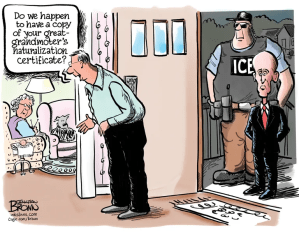 You may read the list and accompanying names at the link. The Guardian reports that the FBI is spying on activists. “The FBI spied on a Signal group chat of immigration activists, records reveal’. Exclusive: Agency accessed private conversations of New York ‘courtwatch’ group that was observing public hearings.”
The FBI spied on a private Signal group chat of immigrants’ rights activists who were organizing “courtwatch” efforts in New York City this spring, law enforcement records shared with the Guardian indicate.
The FBI, the documents show, gained access to conversations in a “courtwatch” Signal group that helps coordinate volunteer activists who monitor public proceedings at three New York federal immigration courts. The US government has repeatedly been accused of violating immigrants’ due process rights at those courts.
A “joint situational information report” from the FBI and the New York police department (NYPD), dated 28 August 2025, quoted from a chat on Signal, the encrypted messaging app, and also characterized the court watchers as “anarchist violent extremist actors”. The two-page report was distributed to other law enforcement agencies across the US.
All of this reeks of autocracy. Today, I started carrying my birth certificate with me. How’s that for making American great again?
What’s on your reading, action, and blogging list today?
Mostly Monday Reads: I come to Bury CBS, Not to Praise It
Posted: November 3, 2025 Filed under: #We are so Fucked, Cheater in Chief, Journalism, kakistocracy, Our Media is Complicit with Autocracy, Televising Propaganda instead of News | Tags: @johnbuss.bsky.social John Buss, @repeat1968, John Buss, Norah O'Donnell, Sixty Minutes, Tales of a teenage reporter, The Legacy Media Sucks, Walter Cronkite 6 Comments
“How can we tire from all this winning?” John Buss, @repeat1968
Good Day, Sky Dancers!
60 Minutes premiered on September 24th, 1968, with Harry Reasoner and Mike Wallace. I was barely a teenager when it premiered, but even then, I was growing into fully all the fringed suede and tattered blue jeans I could find with my guitar set filled with the likes of Dylan and Crosby, Stills, Nash, and Young. However, I realized that I was watching something I’d watched for a very long time. Next year, I would buy that Woodstock Guitar strap and cut my first real studio audition. My best friend and I recorded a cover of “One Tin Soldier,” which was requested by Billy Jack for his second movie. Music and the News were the only things that got me through the banality of my life at that point. (Omaha, UGH!)
I spent my entire childhood watching and reading the news with my Dad, through the Civil Rights Movement, the Vietnam War, and all those crazy times in the 1960s. It was a pivotal moment that led me to become the social justice activist I am today. Reasoner described 60 Minutes as a type of News Magazine, and we had just about all of them that went from our house to the customer service area of my Dad’s small Ford Dealership in a small town in Iowa. It was difficult to get the Washington Post during Watergate, but 60 Minutes was there in living color.
I haven’t really watched in a long time because so much has gone missing. Ever since I got my first newspaper subscription to the Manchester Guardian in High School, I have to say it was part of my education, right through to Graduate School. Now, during the time when I have ever been the least sanguine about our country’s future, I can only say RIP 60 Minutes. These are indeed bleak times. The U.S. Media has a grand old tradition dating back to Benjamin Franklin. It has lost its way to the same evil it sought to expose during World Wars and other events. It has a history of struggle between the powerful entities that seek to control the narrative and the writers who research and reveal the truth. In the age of Techbros and MAGA, Crypto and Virtual Cash, we see a barren landscape destroyed by greed.
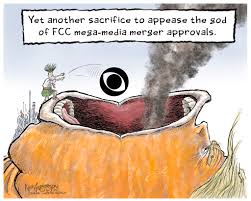 I’ll start with the offending program, then offer some perspectives from a number of folks who used to have a place on TV news and are now relegated to the New Deal Blogosphere. I should mention that during that same period of becoming who I am, I wrote for both an underground Newspaper (The Aardvark) and two school newspapers. This blog is an extension of those of us who became very interested again in discussing the news during Dubya’s adventures in the Middle East and the hope we had of simply seeing a woman become president.
This is from CBS News, the former home of everyone’s Uncle Walter, and my personal favorite, Edward Bradley, who always showed up for the New Orleans Jazz Fest, sat with me in monitor world to hear his beloved jazz after I’d put all the microphones in their proper places and dealt with the talent. He always remembered to ask about my daughters by name. It hurts that the overseers used a woman to do this. “Read the full transcript of Norah O’Donnell’s interview with President Trump here.”
Editor’s note: On October 31, 2025, correspondent Norah O’Donnell spoke with President Donald J. Trump at Mar-a-Lago in Palm Beach, FL, and this is a transcript of that conversation. They started by discussing the president’s recent meeting with China’s President Xi Jinping.
PRESIDENT DONALD TRUMP: Well, first of all, we get along great, and we always really have. We had the COVID moment, which was not– attractive as far as I was concerned. I wasn’t so happy. But outside of that, we have always had a great relationship. He’s a powerful man. He’s a strong man, a very powerful leader.
And– we’ve always– had the best of relationships, probably the best of– I could– I think I could speak for him, just about as good as it gets from his standpoint and from my standpoint. And having that is important because of the power of the two countries.
NORAH O’DONNELL: What did you get out of this deal that you wanted?
PRESIDENT DONALD TRUMP: Well, I got sort of everything that we wanted. We got– no rare earth threat. That’s gone, completely gone. We have tremendous amounts of– dollars pouring in– ’cause we have– very big tariffs, almost 50%. We never had anything in terms of tariffs, although I put tariffs on China, but Biden let it lapsed by the– by the fact that he gave exemptions on almost everything, which was just ridiculous.
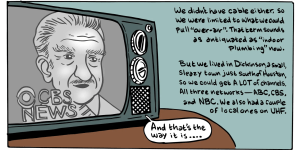
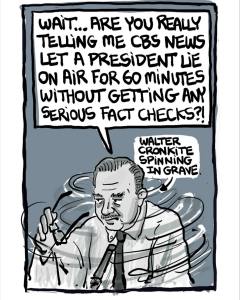
By this time, the fact-checking should’ve begun, and some good old-fashioned interrupting with follow-up questions. It went on with none. Instead, we got mealy-mouthed clarifications.
But– we have– billions and billions of dollars coming in, and we have a very good relationship. I mean, we have– a great relationship with a powerful country. And I’ve always felt if we can make deals that are good, it’s better to get along with China than not, if you can’t make the right kind of a deal than not, because, you know, China, along with many other countries (they’re not alone in this), they’ve ripped us off from day one.
They’ve ripped us so much. They’ve taken trillions of dollars out of our country. And now they’re– it’s the opposite. I mean, we’re doing very well with China, and hopefully they’re gonna do very well with us. But I do think it’s important that China and the U.S. get along, and we get along very well at the top.
NORAH O’DONNELL: This trade war, though, was hurting Americans. I mean, our soybean farmers. China had stopped buying the soybeans.
PRESIDENT DONALD TRUMP: Yeah.
NORAH O’DONNELL: As you mentioned, they were– China was withholding these rare earth materials that you need for everything from smartphones to– to build submarines.
PRESIDENT DONALD TRUMP: Sure.
NORAH O’DONNELL: What– what was the crucial thing? I mean, how tough of a negotiatior–
PRESIDENT DONALD TRUMP: Well, when you say hurting–
NORAH O’DONNELL: –is President Xi–
PRESIDENT DONALD TRUMP: –it was a temporary hurt. It was a hurt because– I was takin’ in a lot of money from China. We’re doing very well against China. And all of a sudden they said, “You know, we have to fight back.” And so they used their powers. The power they have is rare earth because of the fact that they’ve been accumulating it and– and really taking care of it for a period of 25, 30 years.
Other countries haven’t. Now we are. I mean, we have tremendous rare earth, and it’s going to be– you know, it’s going to be– it’ll be a strength, but it won’t really be a strength if everybody has it. Everyone’s gonna have it pretty soon.
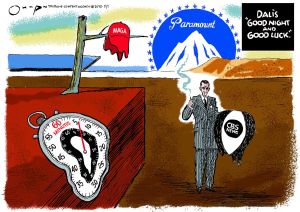 `I would call this full-throated propaganda allowed air time for way too long. Here’s another example before I start telling Norah there’s something brown growing on her nose. It’s further on down the page. I’m just glad I didn’t watch it.
PRESIDENT DONALD TRUMP: I think in two years, we’ll start opening up plants and we’ll have a very substantial portion of the chip market. Right now we have almost none. We should have had a hundred percent. If we had par– if we had presidents that knew anything about business or knew what they were doing, because, frankly, they didn’t.
We lost 50% of our automobile business. It’s all coming back. We lost a hundred percent of the chip– you know, it used to be all Intel and other companies. And what happened is other countries came in, and they stole our chip business, and we didn’t charge tariffs.
If we would have charged let’s say a 100% tariff, none of those companies would have left. But they all left. Now they’re all coming back, Norah, because the only way they avoid the tariffs is to build in our country. If they build in our country, make their plant and make their product in our country, then it’s a very simple thing. They– they don’t have any tariff to pay.
NORAH O’DONNELL: Uh-huh.
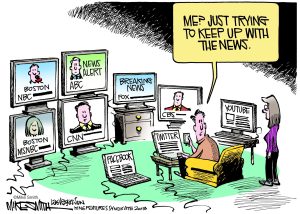 Well, she’s certainly not an heir to the Murrow Boys. Like so many, Medhi Hassan left a big desk on a 4-letter network because someone saw him as being a bit too much of a journalist and one of color. He has his own spot out here on his own website.
It’s similar to the choice of my first Newspaper: The Manchester Guardian, which I still read daily as The Guardian. His site, named Zeteo, can be found on Substack on the web, alongside other banished reporters and what used to be known as “Public Intellectuals” rather than influencers. Today’s offering is ” Factchecking Trump on ’60 Minutes’.” He’s taken the place of the major legacy newspapers. The lede is divine. ’60 Minutes’ of Shame and Submission.’
Having watched the whole ‘60 Minutes’ interview and read the entire transcript, too, I genuinely can’t decide what was worse: Trump’s endlessly dishonest answers or O’Donnell’s non-stop softball questions.
I kid you not, here is a short selection of some of the questions this award-winning, highly-paid, veteran news anchor chose to ask the most powerful man on Earth in her limited time with him:
- “Have some of these [ICE] raids gone too far?”
- “Who’s tougher to deal with, Vladimir Putin or Xi Jinping?”
- “Why won’t Putin end this war?
- “Do you worry about an AI bubble?”
- “What do you hope to accomplish in the next three years?”
Ooooohh! Tough stuff! The new owner of CBS, David Ellison, and the new head of CBS News, Bari Weiss, must both be so proud. This is the kind of ‘balanced’ coverage I’m sure they were waiting for. Then again, to be fair to them, O’Donnell has a long history of softball interviewing that predates the recent takeover of her network by a MAGA billionaire. Remember her love-in with Saudi crown prince MBS in 2018?
But this isn’t just about O’Donnell or CBS. The ‘60 Minutes’ interview with Trump showcased everything that is wrong with US political interviews in general. The deferential tone. The lack of preparation. The failure to ask follow-up questions or dig deep into an interviewee’s answers. The inability (unwillingness?) to fact-check in real time.
At one point, Trump asked O’Donnell whether she knew “how many presidents have used the Insurrection Act,” to which the CBS anchor simply responded: “Tell me.” Trump then proceeded to lie about the proportion (“Almost 50% of ‘em,” he said, when the real proportion is 38%) and the absolute number (“some of the presidents, recent ones, have used it 28 times,” he said, when the most was actually only six times, and back in the 1870s).
But O’Donnell said nothing. She just moved on.
There were so many falsehoods and half-truths, and so little pushback, that after a while, I gave up. I stopped counting. Here’s what I did manage to catch, in terms of brazen lies, all of which were left unrebutted, uncorrected, unchallenged, by O’Donnell:
- “We had nine wars on our planet. I solved eight of ‘em.” I have debunked this nonsensical claim before.
- “We have no inflation.” Inflation is at 3%.
- “It’s at 2%. It’s– it’s the perfect inflation.” Inflation is at 3%.
- “Right now [grocery prices are] going down.” Grocery prices are up 1.4% since Trump came to office.
- “A year ago, we were a dead country.” Not only did the US have the fastest-growing economy in the G7 in both 2023 and 2024, but the Economist magazine called it “the envy of the world.”
- “11,888 murderers were let into our country.” Not only is this number inaccurate, but many of the non-citizens convicted of homicide either here or abroad came in during Trump’s first term.
- “Washington, DC, was… almost like a crime capital of the world.” In 2023, per PolitiFact, “at least 49 other cities in the world had higher homicide rates.
- “[Biden] hardly went anywhere. Guy couldn’t leave his bedroom.” Not only did Joe Biden visit roughly as many countries in his term of office as Trump did in his first term, but Biden was the first US president to visit an active warzone – Ukraine – not under the control of US forces.
- “I made Middle East peace. For 3,000 years, they couldn’t do it.” There is no peace in Palestine, no peace deal in place, and it isn’t a 3,000-year-old conflict.
- “Communist, not socialist. Communist. He’s far worse than a socialist.” Zohran Mamdani is not a communist.
- “I can’t give them $1.5 trillion so that they can give welfare to people that came into our country illegally.” The Trump/GOP claim that Democrats want to give free healthcare to undocumented immigrants has been repeatedly debunked.
- “They emptied their mental institutions and their insane asylums– into the United States of America.” Asylum seekers don’t come from “insane asylums.” Obviously.
- “One thing I can tell you, the 2020 election was rigged.” It wasn’t. The courts agreed.
- “And a lotta people say when it’s rigged you’re allowed to do it again.” A lot of people don’t say this. The US Constitution doesn’t, for sure.
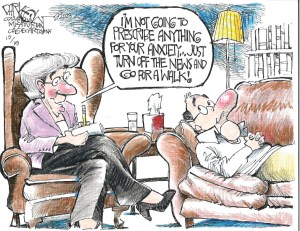 Please read it. The next section lists the questions O’Donnell should have asked as a follow-up. I will say that I believe Mehdi’s follow-up questions in every interview I’ve watched him do are stellar. He points out exaggerations and falsehoods, zeroes in on exactly what the issue with the response is, and just delivers it deliciously. I’m a Fan grrrl. And me, the teenage girl who had to sneak her friend Cathie into the Journalism workspace so she could lust after Kurt Anderson to keep her from going on about him all lunchtime long.
CNN had a more traditional take on said Interview by Daniel Dale. “Fact check: 18 false claims Trump made on ‘60 Minutes’.”
Trump told his usual lie that the free and fair 2020 election was stolen from him. He lied again that grocery prices “are down” even after CBS’ Norah O’Donnell informed him they are up. He declared once more that there is now “no inflation,” though there certainly is, and then that inflation is 2% or “even less than 2%,” though the most recent available Consumer Price Index figure is now up to 3%.
The president also deployed multiple other fictional numbers during his exchanges with O’Donnell, which were recorded Friday and released by CBS on Sunday.
- He falsely claimed “$17 trillion” is being invested in the US “right now,” though the $17 trillion figure is nearly double the White House’s own wildly inflated figure.
- He falsely claimed each alleged drug boat the US has attacked in recent weeks “kills 25,000 Americans,” though experts note this figure plainly does not make sense.
- He falsely claimed some recent former presidents invoked the Insurrection Act “28 times,” though no individual president has invoked it on more than six occasions with this record set by President Ulysses S. Grant in the 1800s.
- He falsely claimed he has ended “eight wars,” though his list includes two situations that were not wars at all and at least one war that continues.
- He falsely claimed CBS aired an edited interview with Trump’s 2024 opponent Kamala Harris “two days” before the election, though it was actually more than four full weeks before Election Day.
- He falsely claimed former President Joe Biden gave $350 billion in aid to Ukraine (the real number is well under half that) and allowed in “25 million” migrants (the real number here is well under half that, too).
And Trump made a variety of additional false claims on several subjects, including the government shutdown, the artificial intelligence boom, tariffs, his first impeachment and his former legal battle with “60 Minutes” itself.
 I really wonder how many people besides you and me actually read this stuff and bring it up in normal conversation. I know that the MAGATs will never read or hear it. I saved the best for last. This is from my precious Guardian reporting about the heavy-handed editing given to this latest 60 Minutes interview with Trump. Quelle Suprise, y’all! “CBS News heavily edits Trump 60 Minutes interview, cutting boast network ‘paid me a lotta money’. Trump said Paramount’s sale to David and Larry Ellison was ‘greatest thing that’s happened in a long time’ for free press.” This is reported by Jeremy Barr.
The CBS News program 60 Minutes heavily edited down an interview with Donald Trump that aired on Sunday night, his first sit-down with the show in five years.
Trump sat down with correspondent Norah O’Donnell for 90 minutes, but only about 28 minutes were broadcast. A full transcript of the interview was later published, along with a 73-minute-long extended version online.
The edits are notable because, exactly one year before Trump was interviewed by O’Donnell at his Mar-a-Lago resort on Friday he had sued CBS over the editing of a 60 Minutes interview with then-Vice President Kamala Harris, which he alleged had been deceptively edited to help her chances in the presidential election.
While many legal experts widely dismissed the lawsuit as “meritless” and unlikely to hold up under the first amendment, CBS settled with Trump for $16m in July. As part of the settlement, the network had agreed that it would release transcripts of future interviews of presidential candidates.
At the beginning of Sunday’s show, O’Donnell reminded viewers that Paramount settled Trump’s lawsuit, but noted that “the settlement did not include an apology or admission of wrongdoing”.
During the interview, in a clip that did not air on the broadcast, Trump needled CBS over the settlement and repeated his claims against the network.
“Actually 60 Minutes paid me a lotta money. And you don’t have to put this on, because I don’t wanna embarrass you, and I’m sure you’re not,” Trump said. “But 60 Minutes was forced to pay me a lot of money because they took her answer out that was so bad, it was election-changing, two nights before the election. And they put a new answer in. And they paid me a lot of money for that. You can’t have fake news. You’ve gotta have legit news. And I think that it’s happening.”
During another un-aired portion of the interview, Trump praised the sale of CBS to the Ellison family and said the network’s new editor-in-chief, Bari Weiss, was a “great new leader”.
The US president said he didn’t know Weiss, but told O’Donnell: “I hear she’s a great person.
 Well, this is getting long for a meager WordPress blog post.
“And that’s the way it is.” Can you believe he signed off when I was getting my first graduate degree? Wow! I’m old!
What’s on your Reading, Action, and Blogging List today?
Finally Friday Reads: Project 2025 Plan to Destroy America is Offical
Posted: October 3, 2025 Filed under: #FARTUS, #MAGAnomics, #We are so Fucked, People Power, Russell Vought, U.S. Politics | Tags: @repeat1968, Destruction of Federal Agencies, government shutdown 2025m, John Buss, Lousiana's Cancer Alley, People Power, Project 25, Russ Vought, Steven Brodner 6 Comments
“I’m pretty sure all the Military Brass are impressed that the Secretary of War had his own personal makeup room built in the Pentagon. John Buss, @repeat1968
Good Day, Sky Dancers!
Most of us knew that Project 2025 would be the basis of policy. Republicans have wanted an Imperial Presidency for some time. Republicans have elected at least 3 useful idiots as President with the goal of destroying American democracy in mind. It’s why we have a huge deficit, and spending has been concentrated on the rich who can pay-to-play to get massive tax cuts and huge government subsidies.
There are examples in every state they control. Here in Louisiana, the damage from oil extraction and affiliated chemical industries has created massive damage, and just at the precise time that the EPA has been fully filleted. Not only has nothing real been done to abate the chemical spill that happened earlier this summer after a poorly managed plant that exploded in Roseland, a primarily black community, but it has not been fully abated. The actions behind the removal of LSU’s premier Lake Maurapas researcher have become clearer. Today, Johns Hopkins Bloomberg School of Public Health released this important research. “Louisiana’s ‘Cancer Alley’ Is More Deadly Than Previously Imagined. New research shows that the industrial pollution—and the risk to human health—on Louisiana’s Cancer Alley have been significantly underestimated.
On an 85-mile stretch of the Mississippi River between New Orleans and Baton Rouge, communities exist alongside some 200 fossil fuel and petrochemical production plants. Since the 1980s, the area has been known as Cancer Alley.
These plants process about 25% of the U.S.’s petrochemical products, Peter DeCarlo, PhD, associate professor in Environmental Health and Engineering, said in the July 2 episode of Public Health On Call—with many of the byproducts and emissions winding up in nearby communities’ air, water, and soil.
Residents of these communities suffer the effects of extreme air pollution, including increased rates and risks of maternal, reproductive, and newborn health harms; respiratory illnesses; and cancer. One area has the highest risk of cancer from industrial air pollution in the U.S.—more than seven times the national average.
But new research from DeCarlo, Keeve Nachman, PhD ’06, MHS ’01, professor in Environmental Health and Engineering, and their teams shows that the pollution—and the risk to human health—has been significantly underestimated.
In this Q&A, adapted from that podcast episode, DeCarlo and Nachman discuss their work measuring levels of pollutants in Louisiana and explain what these conclusions mean for how the U.S. should regulate carcinogens.
We may be drowning in toxic chemicals, but other states and cities are experiencing ICE Raids that resemble SS maneuvers. Additionally, we have new threats. Since the reality on the ground has embarrassed the Trump plan to send the military to “wartorn” Portland to defuse his imagined war on the ground, he’s come up with an alternative plan. This is from ABC News. “Leavitt says Trump exploring cutting aid to Portland.”White House Press Secretary Karoline Leavitt said Trump is exploring plans to cut federal funding to Portland due to what she said was a rise in “Antifa” related incidents.”
“We will not fund states that allow anarchy,” she told reporters.
Antifa is not a group, but rather a political philosophy or movement. The term comes from the longer “anti-fascist” and is used as a catchall for groups that oppose the concept of authoritarianism, neo-Nazism and white supremacy.
 If you want to sum it up, try this hypothesis for size. Republicans are willing to let all of us starve and die as long as they can get paid for enabling modern-day Robber Barons.
About six months into this reign of terror, murder, and destruction, I’m still not certain the legacy media is getting the bigger picture. However, yesterday, an announcement by Trump made them perk their ears once more. Will it be enough? This is from the AP. “Trump no longer distancing himself from Project 2025 as he uses the shutdown to further pursue its goals.”
President Donald Trump is openly embracing the conservative blueprint he desperately tried to distance himself from during the 2024 campaign, as one of its architects works to use the government shutdown to accelerate his goals of slashing the size of the federal workforce and punishing Democratic states.
In a post on his Truth Social site Thursday morning, Trump announced he would be meeting with his budget chief, “Russ Vought, he of PROJECT 2025 Fame, to determine which of the many Democrat Agencies, most of which are a political SCAM, he recommends to be cut, and whether or not those cuts will be temporary or permanent.”
The comments represented a dramatic about-face for Trump, who spent much of last year denouncing Project 2025, The Heritage Foundation’s massive proposed overhaul of the federal government, which was drafted by many of his longtime allies and current and former administration officials.
You may recall that the implication of this document was central to the Democratic Party campaign. Kamala Harris made it a focal point of the convention and other speeches.
Top Trump campaign leaders spent much of 2024 livid at The Heritage Foundation for publishing a book full of unpopular proposals that Democrats tried to pin on the campaign to warn a second Trump term would be too extreme.
While many of the policies outlined in its 900-plus pages aligned closely with the agenda that Trump was proposing — particularly on curbing immigration and dismantling certain federal agencies — others called for action Trump had never discussed, like banning pornography, or Trump’s team was actively trying to avoid, like withdrawing approval for abortion medication.
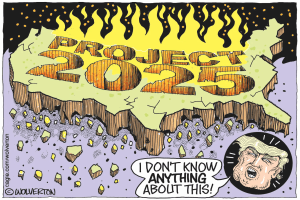
Trump repeatedly insisted he knew nothing about the group or who was behind it, despite his close ties with many of its authors. They included John McEntee, his former director of the White House Presidential Personnel Office, and Paul Dans, former chief of staff at the U.S. Office of Personnel Management.
“I know nothing about Project 2025,” Trump insisted in July 2024. “I have no idea who is behind it. I disagree with some of the things they’re saying and some of the things they’re saying are absolutely ridiculous and abysmal. Anything they do, I wish them luck, but I have nothing to do with them.”
Trump’s campaign chiefs were equally critical.
“President Trump’s campaign has been very clear for over a year that Project 2025 had nothing to do with the campaign, did not speak for the campaign, and should not be associated with the campaign or the President in any way,” wrote Susie Wiles and Chris LaCivita in a campaign memo. They added, “Reports of Project 2025’s demise would be greatly welcomed and should serve as notice to anyone or any group trying to misrepresent their influence with President Trump and his campaign — it will not end well for you.”
Trump has since gone on to stock his second administration with its authors, including Vought, “border czar” Tom Homan, CIA Director John Ratcliffe, immigration hard-liner Stephen Miller and Brendan Carr, who wrote Project 2025’s chapter on the Federal Communications Commission and now chairs the panel.
Heritage did not respond to a request for comment Thursday. But Dans, the project’s former director, said it’s been “exciting” to see so much of what was laid out in the book put into action.
“It’s gratifying. We’re very proud of the work that was done for this express purpose: to have a doer like President Trump ready to roll on Day One,” said Dans, who is currently running for Senate against Lindsey Graham in South Carolina.
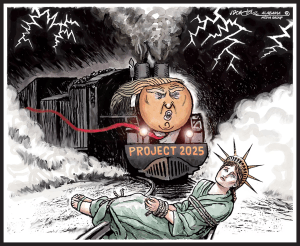 It was frequently averred that Stephen Miller was central to all plans for the project’s implementation. Only a few public intellectuals continued to warn of the plan and steps taken, while Yam Tit still shrugged off any implication that he was following the plan’s blueprint during the first six months. Well, that curtain has dropped.
AXIOS sums this evolution up neatly. “Trump charts path to total control amid government shutdown.’ This is reported by Zachary Basu.
President Trump is seizing on the government shutdown as an “unprecedented opportunity” to consolidate control in the Oval Office, accelerating a trend toward unchecked power.
Why it matters: Many Democrats see the shutdown as a necessary evil to halt — or at least slow — Trump’s steamrolling of democratic norms and independent institutions. So far, the standoff is only emboldening the White House.
Zoom in: Trump said he met Thursday with White House budget chief Russ Vought to discuss what “Democrat agencies” should get cuts, casting the shutdown as a chance to shrink a federal workforce Trump has long viewed as hostile.
- Goading Democrats, Trump flaunted Vought’s role in Project 2025 (“he of PROJECT 2025 Fame”) — the hard-right blueprint for expanding executive power that Trump disavowed on the campaign trail after it became a political liability.
- For Vought, the shutdown offers a unique opening: a live test of theories he has spent years refining on how to weaken Congress, purge the bureaucracy and concentrate power in the presidency.
Already, Vought has announced the termination of nearly $8 billion in funding for clean-energy projects in 16 states, all of which voted for Kamala Harris in 2024 and have Democratic senators.
- He also has frozen $18 billion in New York City infrastructure projects, a thinly veiled shot at Senate Minority Leader Chuck Schumer (D-N.Y.) and House Minority Leader Hakeem Jeffries (D-N.Y.).
- Legal challenges are inevitable: Congress controls the power of the purse, and federal officials privately have warned that Vought’s plans for mass firings during the shutdown may violate appropriations law.
The big picture: As Axios has documented, the shutdown is only one front in Trump’s broader campaign of consolidation.
- Military: In an unprecedented partisan address this week, Trump told more than 800 generals and admirals to prepare for a “war” against domestic “enemies,” urging them to treat America’s cities as “training grounds.”
- Academia: The administration is asking universities to sign a 10-point “compact” that would grant preferential access to federal funding if schools agree to freeze tuition, protect conservative speech, apply strict definitions of gender, limit international students and other Trump priorities.
- Rule of law: Days after Trump publicly pressured Attorney General Pam Bondi to charge his political enemies, the Justice Department indicted former FBI director James Comey. Other Trump foes, including New York Attorney General Letitia James and Sen. Adam Schiff (D-Calif.), are under investigation.
- Civil society: FBI director Kash Patel severed ties with the Anti-Defamation League on Thursday, accusing the Jewish civil rights group of “functioning like a terrorist organization” after MAGA activists discovered that Charlie Kirk’s Turning Point USA was listed in its now-removed “Glossary of Extremism and Hate.” Trump also has urged the Justice Department to investigate Democratic megadonor George Soros’ Open Society Foundations as part of a crackdown on liberal groups following Kirk’s assassination.
- Corporate America: Trump demanded last week that Microsoft fire its head of global affairs, Lisa Monaco, because she served in the Biden administration — a reminder that even corporate giants aren’t immune from political retaliation. Trump had previously called on Intel’s CEO to resign over alleged ties to China, but backed off after the U.S. government took a 10% equity stake in the chip-maker.
 More at the link.
MSNBC’s Maddow Blog has this analysis. As usual, Steve Benen has the led. “Trump picks a convenient time to change his tune about the Project 2025 agenda. Remember last year when Trump feigned ignorance about the right-wing governing blueprint? A year later, the president no longer bothers with the pretense.”
As the second full day of the latest government shutdown got underway, Donald Trump published an odd message to his social media platform, which raised plenty of eyebrows throughout the political world.
“I have a meeting today with [White House Budget Director] Russ Vought, he of PROJECT 2025 Fame, to determine which of the many Democrat [sic] Agencies, most of which are a political SCAM, he recommends to be cut, and whether or not those cuts will be temporary or permanent,” the president wrote.
We don’t yet know what transpired at that meeting, but Trump’s weird phrasing was itself notable. For example, there are no federal departments or offices that should be called “Democrat Agencies.” There are only American agencies, which do work on behalf of the American people and which are currently led, at least in part, by Trump’s own appointees.
Similarly, the idea that federal agencies deserve to be condemned as “a political SCAM” is every bit as bizarre as it sounds. We’re talking about offices, some of which have been around for many years, that were created by Congress. Their existence is reinforced in federal law, which the president is required to enforce.
As for the possibility that Trump and the far-right head of his Office of Management and Budget might “permanently” weaken departments that the White House no longer likes, it’s worth keeping in mind that such efforts might very well be illegal.
But let’s also not brush past that other phrase: Vought, the president wrote, is “of PROJECT 2025 Fame.” As The Associated Press summarized:
President Donald Trump is openly embracing the conservative blueprint he desperately tried to distance himself from during the 2024 campaign, as one of its architects works to use the government shutdown to accelerate his goals of slashing the size of the federal workforce and punishing Democratic states.
For those who might benefit from a refresher, throughout the 2024 campaign, Trump realized that the Project 2025 agenda was so radical and unpopular that he treated is as radioactive. “I know nothing about Project 2025. I have no idea who is behind it,” the Republican said over the summer about the blueprint largely written by members of his own team. He added, “I have nothing to do with them.”
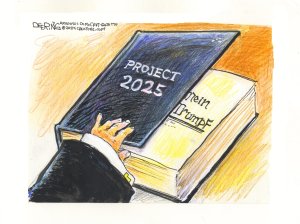 Here’s some analysis from Time Magazine‘s Editorial Fellow Connor Greene. “Trump Is No Longer Denying Support for Project 2025: What to Know.”
President Donald Trump has changed his tune on the conservative policy plan Project 2025 after actively distancing himself from it for months during his reelection campaign.
Trump announced on Thursday that he would be meeting with Office of Management and Budget Director Russell Vought, “he of PROJECT 2025 Fame,” to decide which “Democrat Agencies, most of which are a political SCAM, he recommends to be cut, and whether or not those cuts will be temporary or permanent.”
The post marks a significant shift from the President’s past disavowals of the unpopular right-wing policy blueprint, which was created by conservative think tank the Heritage Foundation ahead of the 2024 election. “I have nothing to do with Project 2025. I haven’t read it. I don’t want to read it, purposely. I’m not going to read it,” Trump said in a debate last year with former Vice President Kamala Harris.
Despite Trump’s repeated insistence that he didn’t know anything about Project 2025, however, he had close ties with a number of its authors, several of whom have served in his Administrations—including Vought. And since he returned to the White House in January his second Administration has taken steps to implement a number of the proposals detailed in the over 900-page document.
Now, amid the government shutdown, Trump is moving to further fulfill Project 2025’s goals of reducing the federal workforce and extending his executive powers—and, it appears, openly embracing the plan.
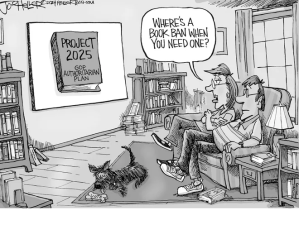 The big question sis what does this mean for the shutdown and the country?
Despite his criticisms of Project 2025, many of the Trump Administration’s actions since he returned to office have mirrored aspects of the blueprint. An analysis by TIME in January found that nearly two-thirds of Trump’s early executive actions reflected—in whole or in part—proposals in Project 2025.
Among the parts of the plan that Trump has carried out is its recommendation to aggressively reduce the size and scope of the federal government.
Trump and hisDepartment of Government Efficiency moved quickly to cut more than 200,000 federal employees, though some of the layoffs have since been held up in the courts after being challenged by lawsuits. His Administration has also looked to slash federal funding through various freezes, clawbacks, cuts, and recissions.
Trump has announced plans to execute still more cuts amid the government shutdown. In the leadup to the deadline to fund the government this week, the White House directed agencies to prepare for mass firings in the event that Congress couldn’t reach a deal, rather than furloughing those not deemed essential as in past shutdowns.
The Administration has additionally used the shutdown to cancel $8 billion in green energy projects in Democratic-led states, withhold $18 billion in transportation projects in New York City, and pause $2.1 billion in infrastructure projects in Chicago.
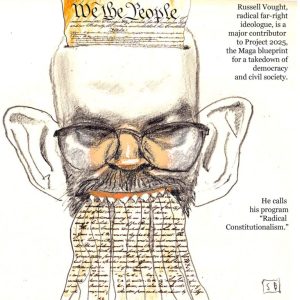 Here’s a just a bit of the latest information on Russell Voight. This startling headline is from Politico. “Thune warns Democrats about Russ Vought: ‘We don’t control what he’s going to do’ The Senate majority leader spoke out as some Republicans express qualms about the White House slash-and-burn campaign.” The reporter for this piece is Jourdain Carney.
Senate Majority Leader John Thune isn’t endorsing the slash-and-burn campaign White House budget director Russ Vought has planned for the federal government during the pending shutdown.
But he says Democrats have no one to blame for it but themselves.
“This is the risk of shutting down the government and handing the keys to Russ Vought,” the Senate majority leader said in an exclusive interview Wednesday in the Capitol, adding that “there should have been an expectation” among Democrats that Vought’s Office of Management and Budget could broadly target government workers and programs in a shutdown.
Thune spoke on the same day that several Republicans aired discomfort with Vought’s moves after the shutdown went into effect. Rep. Mike Lawler of New York spoke out against his decision to hold up major transportation projects in his state, while Reps. Blake Moore of Utah and Brian Babin of Texas spoke up on a private House GOP call with Vought raising qualms about potential mass layoffs.
Vought’s actions also risk being a distraction for Republicans, who have sought to stick to a simple message putting the onus on Democrats to reopen the government. Pressed on whether Vought was muddying the waters, Thune said, “The only thing I would say about that is yes, and we don’t control what he’s going to do.”
The White House has made no secret that its strategy is to inflict maximum political pressure on Democrats to try to get them to reopen the government. Vought warned ahead of the start of the shutdown that OMB would take aggressive steps beyond typical furloughs, where employees are brought back to work after the government reopens.
The budget office directed agencies in a memo first reported by POLITICO last week to put together plans for reductions-in-force — or firings — of federal employees. Vought himself told House Republicans during the Wednesday call that those firings would start in a “day or two.”
“I can’t control that,” Thune said about decisions made by OMB. “But the Democrats ought to think long and hard about keeping this thing going for a long time, because it won’t be without consequence, I’m sure.”
 This final suggested read is from Mother Jones. “Russ Vought Is Trump’s Shutdown Hero. His Neighbors Think His Work Is “Abhorrent.” The people living near Trump’s “grim reaper” of government cuts have put up signs letting him know they stand with federal workers.” This is reported by Isabela Dias.
On Thursday night, President Donald Trump shared a music video on Truth Social. In it, an AI-generated Russ Vought—Trump’s director of the Office of Management and Budget and a Project 2025 mastermind—is the grim reaper, carrying a scythe along a hallway lined with portraits of Democratic leaders. Vought, the video’s soundtrack explains, “wields the pen, the funds, and the brain” to enforce the president’s plans to axe federal workers.
“Everyone still remembers when he said he wanted to cause maximum trauma to federal workers,” the neighbor said. “And that’s hard to forget.”
Most of Vought’s neighbors I talked to for this article declined to speak on the record or asked to remain anonymous. Some said they didn’t want to create a rift in an otherwise cordial neighborhood, while others worried about retribution or negative repercussions from their employers.
“I just wish he would have gotten to know us,” Hunter said. “We consider ourselves good Americans, we have good values. And I don’t think he’s been interested in getting to know any of us, in hearing if we might have a difference of opinion.”
Last week, Vought sent around a memo blaming Democrats’ “insane demands” for the imminent lapse in funding and instructing agency heads to start making plans to cut non-mandatory programs “not consistent with the President’s priorities” and “use this opportunity to consider Reduction in Force.” Appearing on Fox Business, Vought claimed an “authority to make permanent change to the bureaucracy here in government” during the shutdown.
He has since announced pauses to funding for infrastructure projects in New York—home state of House Minority Leader Rep. Hakeem Jeffries (D-New York), who called Vought a “malignant political hack”—and slowdowns in clean energy projects in several blue states.
Vought, Republican Sen. Mike Lee of Utah said on Fox News, “has been dreaming about and preparing for his moment since puberty.”
AsIwrote in a profile of Vought from 2024, the bespectacled official spent years as a Washington insider and government bureaucrat before becoming the architect of a supersized second Trump presidency.
An avowed Christian nationalist and dedicated America First warrior, he once described the job of OMB director as the “keeper of ‘commander’s intent” and criticized the federal bureaucracy for standing in the way of the president’s agenda. During Trump’s first term, Vought tried to implement an executive order that would have made it easier for political appointees to fire career civil servants and replace them with MAGA loyalists. Now, he’s getting to realize his vision while earning points with the president.
See what’s in the cards for us? Read them and weep. The Voight cartoons are from The Nation. They have a primar on Vought that you really should read. “Project 2025: Vought’s Your Problem? Not too bad to be true.” Steve Brodner is the artist and his cartoons have descriptions of their design. Go see the rest!
I’ve been a little late today, I’m sorry. I woke up late last night in a lot of pain and took some acetaminophen for relief. In my mind I was seeing it as some sort of ritual to defang Trump’s war on Health Care. I also got a call from youngest with my first grandson. Aiden, like his mémé is quite verbal. I really worked on this piece because I wanted to get as many sources as I could on this abomination and put my time in it than usual. I was researching stuff like the researcher I am. I am vorasciously reading up on this and I suggest you do too.
What’s on your Reading, Action, and Blogging list today?
Mostly Monday Reads: Which Century are we in?
Posted: May 5, 2025 Filed under: American Fascists, kakistocracy, religious extremists, Republicans against democracy, SCOTUS, tariffs, Threats to Democracy, Treason and Sedition Republican Style, Unitary Executive Authority | Tags: @repeat1968, Camp Alcatraz, Crazy #FARTUS Policies, Donald Trump, John Buss, misogyny, SCOTUS, Social Security, Theory of Unitary Executive, Trump Tariffs, unemployment 13 Comments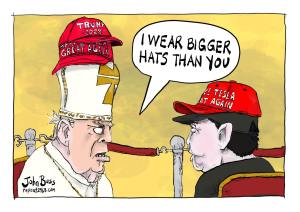
“Size matters.” John Buss, @repeat1968
Good Day, Sky Dancers!
Every time I get the grocery list together these days, I think about what I need to bulk order. It’s really hard to look at a finished consumer good and find all the value-added producers along with their various locations. I wonder how the distributors are going to sort this all out. I noticed prices creeping up in the usual items. I’m pretty sure my sister has hit Costco by now and filled up the pantry. I also watched the last of the Jazz Festers leave with relief. I bet this was their last jaunt of the year. You can see it in the numbers.
USA Today had this analysis by Betty Lin-Fisher. “How will Trump’s tariffs affect grocery store prices? We explain.”
While higher tariffs could still be coming after a 90-day-pause, the baseline 10% tariff on all goods, plus higher duties on Chinese products already in effect are a big increase in food costs for American’s budgets, said Thomas Gremillion, director of food policy at The Consumer Federation of America.
“The 10% ‘default’ tariffs alone represent a truly historic federal tax increase, maybe the largest in my lifetime, with a highly regressive impact,” Gremillion said.
The tariff only applies to the value of the product at the border, Ortega said. Then there are additional costs to the product, which are accrued domestically, like transporting the goods to the store, distribution, wholesale costs and retail markups. Those things are not subject to the tariff, Ortega said.
So that doesn’t mean that the price of a particular product will go up by 10% or whatever the tariff is, Ortega said.
Overall, 15% of the U.S. food supply is imported, including 32% of fresh vegetables, 55% of fresh fruit, and 94% of seafood, according to the Consumer Federation of America, citing the U.S. Food and Drug Administration. Some products, like coffee and bananas, are almost exclusively grown abroad.
Tariffs are causing uncertainty from families checking off their grocery lists to companies importing food, he said.
“For consumers, this can mean added difficulties in managing a food budget. For food companies, this means havoc on supply chains that could lead to more food waste and more food safety risk,” Gremillion said.
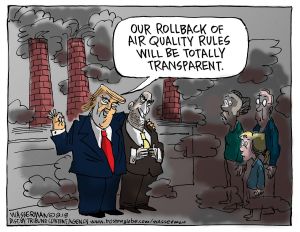 Yup. And the FDA will not be looking around for that food safety risk now. It’s also upending Health Care, but we can rest knowing that all those generic names for medicine and things will be gender neutral now. I know I can’t even properly pronounce most of them, let alone identify their sexual preferences. MEDTECHDIVE has this headline: Trump policies are upending healthcare technology. “Track the effect on the medtech industry here. Policies and actions reshaping the healthcare industry began pouring out of President Donald Trump’s White House nearly from day one. Follow the changes affecting the medical device industry.”
Did I mention the youngest son-in-law is a biomedical engineer who is in charge of designing medical, surgical, and prosthetic devices? Plus, the oldest daughter and son-in-law are doctors. It’s just me and my youngest daughter out here trying to figure out what the economy and financial markets are experiencing. The others are just trying to deal with that, and the usual helpful regulations are being replaced with crazy ones.
Since Trump took office in late January, multiple Food and Drug Administration webpages were removed (and then restored); employees were fired from the Center for Devices and Radiological Health (and some were asked back); and the Department of Health and Human Services unveiled a plan to lay off approximately 10,000 employees, including about 3,500 at the FDA.
Meanwhile, the economy has whipsawed due to an unpredictable and aggressive tariff strategy. Later, however, pieces were delayed or walked back.
The Trump administration has reshaped the medtech industry in significant ways, and potentially long-term, in just a few months. Now that Trump has settled into power, new questions have arisen about what the many changes will mean for companies and patients, and what’s coming next.
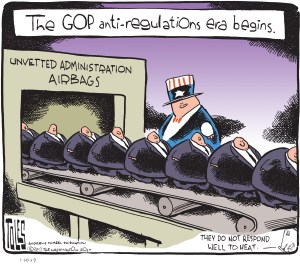
Tom Toles Editorial Cartoon
Also, lucky us, Medicare and Medicaid modernization with be the goal of TV snake oil salesman Dr. Mehmet Oz as he takes over both. This is also from the MEDTECHDIVE.
Dr. Mehmet Oz was sworn in as the Centers for Medicare and Medicaid Services administrator on April 18, cementing his role as head of the agency that provides insurance coverage to millions of Americans.
During a ceremony at the Oval Office, Oz, a physician and former TV personality, said he wanted to “save” the nation’s public health programs and focus on reducing chronic disease, “modernizing” Medicare and Medicaid, and targeting fraud, waste and abuse in government insurance offerings.
President Donald Trump reiterated that Republicans wouldn’t cut Medicare or Medicaid. “Just as I promised, there will be no cuts. We’re not going to have any cuts. We’re going to have only help,” he said during the ceremony.
As I’ve spent most of this year being poked, prodded, pricked, shocked, MRI’d, Ultrasound’d, and EMG’d, I sure don’t feel good about any of this. I fret about someone disappearing all of that, plus my Social Security.
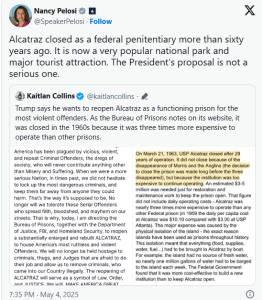
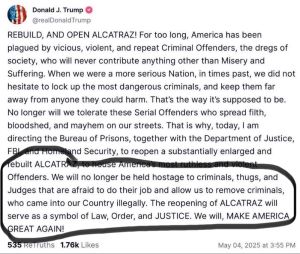 Speaking of crazy policy, I happened on this last night. This is from NBC News. “Trump says he will reopen ‘enlarged and rebuilt’ Alcatraz prison. Alcatraz Island hasn’t been used as a federal penitentiary since 1963. It had a capacity of roughly 300 people.” I’m actually thinking this is another one of his threats to Judges since it’s way too small to hold many prisoners. I suppose that’s one way to destroy a national park and the US Constitution in one sweep.
Alcatraz Island, a former military fortress and prison in San Francisco Bay, was turned into a federal penitentiary in 1934 and over the course of 29 years housed more than 1,500 people “deemed difficult to incarcerate elsewhere in the federal prison system,” according to the National Park Service.
According to aNational Park Service study, it was initially deemed unfit to serve as a federal institution because of its small size, isolated location and lack of fresh water. However, Sanford Bates, the director of the Bureau of Prisons in 1933,later found it “an ideal place of confinement for about 200 of the most desperate or irredeemable types.” It was formally opened as a federal penitentiary the next year.
Trump suggested in his post that he’d like to restore the facility to that purpose.
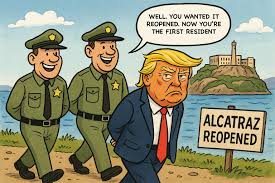 This is from Ed Mazza writing for HuffPo. This sounds a lot like his real estate deals to me. “‘Clearly Unhinged’: Critics Sink Trump’s ‘Asinine’ Plan To Reopen Alcatraz Prison. The president wants to turn the site back into a penitentiary despite the fact that it would cost a fortune.”
Alcatraz is currently part of Golden Gate National Recreation Area and has about 1.2 million visitors per year. Those who tour the island in San Francisco Bay see facilities in various states of decay. The prison was crumbling even as it was still in operation, and the high cost of maintaining it was a key reason it was shuttered in 1963.
Given those realities, restoring Alcatraz and then expanding it, as Trump called for on his Truth Social platform, would likely cost a fortune ― and then another pile of cash would be needed to maintain it.
Reopening it as a prison would also mean the loss of the tourism revenue the island currently generates as well as a loss of habitat for its thriving bird population.
The president, however, said Alcatraz’s return to use as a prison would “serve as a symbol of Law, Order, and JUSTICE.”
His critics fired back that the idea would be an expensive boondoggle:
 This just really sounds like how he’d run his business. Also, he now wants tariffs on all incoming films. This is about as insane as it gets. “Trump threatens a 100% tariff on foreign-made films, saying the movie industry in the US is dying.”
President Donald Trump is opening a new salvo in his tariff war, targeting films made outside the U.S.
In a post Sunday night on his Truth Social platform, Trump said he has authorized the Department of Commerce and the Office of the U.S. Trade Representative to slap a 100% tariff “on any and all Movies coming into our Country that are produced in Foreign Lands.”
“The Movie Industry in America is DYING a very fast death,” he wrote, complaining that other countries “are offering all sorts of incentives to draw” filmmakers and studios away from the U.S. “This is a concerted effort by other Nations and, therefore, a National Security threat. It is, in addition to everything else, messaging and propaganda!”
The White House said Monday that it was figuring out how to comply with the president’s wishes.
“Although no final decisions on foreign film tariffs have been made, the Administration is exploring all options to deliver on President Trump’s directive to safeguard our country’s national and economic security while Making Hollywood Great Again,” said spokesperson Kush Desai.
It’s common for both large and small films to include production in the U.S. and in other countries. Big-budget movies like the upcoming “Mission: Impossible — The Final Reckoning,” for instance, are shot around the world.
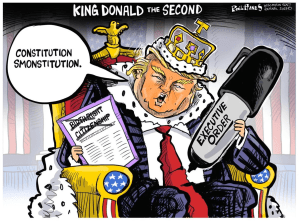 Philip Bump–writing at WAPO–has an interesting Op-Ed up today. “America’s least American president. Donald Trump isn’t making America great again. He’s making it into something else entirely.”
On Sunday, NBC News aired an interview with Trump in which he expressed ignorance of the black-letter standards of justice established in the country’s founding document.
“The Constitution says every person, citizens and noncitizens, deserve due process,” “Meet the Press” host Kristen Welker pointed out. So why not bring Abrego García back to the U.S. and use legal avenues to potentially remove him?
“Well,” Trump replied, “I’ll leave that to the lawyers, and I’ll leave that to the attorney general of the United States.”
Welker noted that Secretary of State Marco Rubio had admitted that even immigrants had due process rights. Trump again downplayed the idea, saying that holding hearings would mean “we’d have to have a million or 2 million or 3 million trials.” This isn’t as big a hurdle as it may sound. In fiscal 2024, there were more than 900,000 immigration hearings completed. So far in fiscal 2025, there have been more than 460,000. More could be cleared if Trump hadn’t moved to fire a number of immigration judges.
Finally, Welker noted that Trump didn’t really have a choice.
“Even given those numbers that you’re talking about,” she asked, “don’t you need to uphold the Constitution of the United States as president?”
“I don’t know,” Trump replied. “I have to respond by saying, again, I have brilliant lawyers that work for me, and they are going to obviously follow what the Supreme Court said.”
You may recall that, in January, Trump put his hand on a Bible and affirmed to Chief Justice John G. Roberts Jr. that he would “faithfully execute” his role as president and to the best of his “ability, preserve, protect and defend the Constitution of the United States.” But this has never been an oath he has appeared to actually take to heart.
Trump’s dismissiveness of the Constitution has manifested itself in a lot of ways. You may recall his lack of interest in leaving office when he lost the 2020 presidential election. You may be aware that he has readily, if not giddily, accepted personal income from foreign governments while serving as president. He views the law as a cudgel, not a constraint, issuing pardons for various political allies ensnared in criminal activity while directing federal law enforcement to fish for potential criminal charges against those who work against his political power.
At its heart, Trump’s approach to his role is rooted in his parochial sense of patriotism. He didn’t come to the White House after having worked his way up through lower offices, building consensus and working to appeal to a broad range of constituents. He had no appreciation for how legislation is crafted or for the hard work of reaching compromise. Perhaps most importantly, he has never indicated any robust understanding of American history or of the debates and agreements that led to the country’s creation.
In 2011, for example, Trump was asked by Stephen Colbert if he knew what the 13 stripes on the American flag represent. He said he didn’t.
More recently, Trump was asked by ABC News journalist Terry Moran what the Declaration of Independence (a copy of which the president recently had installed in the Oval Office) means to him personally.
“It means exactly what it says. It’s a declaration,” Trump replied. “A declaration of unity and love and respect, and it means a lot. And it’s something very special to our country.”
It is special to the country, of course, but not because it is a declaration of “love,” much less “unity.” As the name would suggest, it is precisely the opposite.
Trump doesn’t have the Declaration of Independence in the Oval Office because he wants its message to serve as a guidepost for his administration. He doesn’t even appear to know its message. He has it there because it is A Famous American Thing, another decoration in the newly gilded room meant to send a message about his power, not the nation’s.
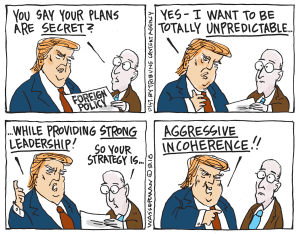 Dan Froomkin–writing for Press Watch–suggests we need to keep track of all Trump’s oddities. “We need a way to aggregate what Donald Trump is doing to this country.”
News organizations, along with good-government groups and other interested parties, are doing a commendable job of chronicling the damage the Trump regime is doing to the government, the country, and the world.
But none of them, individually, is in a position to give the public the full picture. It’s just too much.
This is a feature of Trump’s strategy of “flooding the zone.” No one entity can possibly keep up.
And as we go forward, how can any one organization keep tabs on all the fallout? It’s not possible.
What we need is a central repository of information so that the full extent of the damage can be found in one place and assessed by the public — and so that there’s a comprehensive record of what needs to be fixed and restored when the time comes to do so. (Sort of like a truth commission, but in real time.)
To aggregate all the existing information, organize it, and collect new data, we need a place, a process, and people.
 It makes sense to me since Trump seems to want to undocument more than just people. Who knows how many things Doge has destroyed in the wake of having all-access to every government database and more. He’s disappearing people, children, scientific research, due process, and entire agencies and programs.
This is a site that I was just sent to by a Blue Sky Link. This DNYUZ link has an article by the NYT’s by Jack Goldsmith of Lawfare fame and Harvard Law School. This has been an issue for many people in modern times, with both parties playing the role of enablers. “It’s Not Just Trump. The Presidency Has Become Too Powerful.” So, I need to put this example of both siderisms into perspective. “Mr. Goldsmith, a former assistant attorney general under George W. Bush, is an author, with Bob Bauer, of a newsletter about presidential and executive power.”
Donald Trump’s wrecking-ball second term has revealed the full latent power of the presidency. His administration has done this most clearly in its comprehensive elimination of legal and norm-based checks inside the executive branch, its systematic disrespect of judicial process, its extortionate abuse of government power to crush foes and its destructive rhetoric and nastiness.
Yet it is important to recognize that many of Mr. Trump’s efforts to expand the powers of the office build substantially on the excesses of recent presidencies. The overall pattern of presidential action over the past few decades reveals an escalation of power grabs that put the country on a terrible course even before Mr. Trump took office again.
The presidency needs reform, and Americans must consider ways — however implausible they may seem in the context of today’s politics — to get there.
Expansionist presidential acts go all the way back to George Washington, who invited charges of monarchism with his use of the Constitution’s broad yet undefined “executive Power.” From there the presidency, with its loose design, grew and grew, with major surges during the Civil War and New Deal era. That trend continued through the 20th century, aided by the rise of mass communication, substantial delegations of power from Congress and an approving Supreme Court.
Mr. Trump’s radical second presidency is, to an underappreciated extent, operating from a playbook devised by his modern predecessors.
His use of emergency powers to impose broad tariffs is similar to a move made in 1971 by President Richard Nixon. His claims of untouchable national security authority echo arguments made after the Sept. 11 attacks by the George W. Bush administration, in which I served.
Presidents for decades have issued pardons as political or personal favors or to avoid personal legal jeopardy. Mr. Trump took this practice to new extremes in his first term, and then President Joe Biden pre-emptively pardoned his son and family as well as members of his administration and Congress, in a similar pattern. Mr. Trump in his second term has already issued many self-serving pardons.
Mr. Trump’s executive-order program is an heir of the strategy used by President Barack Obama for large-scale and sometimes legally dubious policy initiatives, including some (involving immigration) where Mr. Obama had earlier admitted he lacked authority to act. Mr. Biden also confessed a lack of power but then acted unilaterally in seeking to forgive student loans.
Mr. Trump has disregarded statutory restrictions to fire officials in independent agencies including the Federal Trade Commission, the National Labor Relations Board and the Merit Systems Protection Board. But in 2021, Mr. Biden extended the Supreme Court’s unitary executive case law to fire the statutorily protected commissioner of the Social Security Administration. Mr. Biden was “the first unitary executive,” noted the legal writer Mark Joseph Stern in 2021.
Mr. Biden also purged the executive branch of Trump holdover officials who were not protected by statute, including members of arts and honorary institutions, the Administrative Conference of the United States and the Department of Homeland Security Advisory Council. The Biden administration’s defense of these firings resulted in judicial precedents that Mr. Trump is now wielding to clean house on a broader scale.
The Trump administration has also built on past presidencies in not enforcing federal law — for example, in letting TikTok live on despite a congressional ban. This practice finds its modern roots in the Obama administration, which asserted broad nonenforcement discretion in high-profile cases involving immigration, marijuana and Obamacare, in effect changing the meaning of those laws.
Something similar has happened with spending. As one recent paper noted, “The past several presidents have all taken significant unilateral actions intruding on Congress’s control over federal spending.” The Trump 2.0 version greatly enlarges this unilateralist pattern.
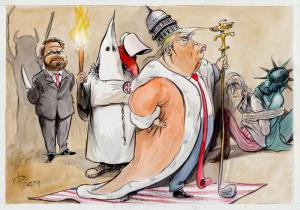 There are a lot of examples here, and it’s worth thinking about. The Unitary Executive Theory has been around for a while, and since the Reagan years, it has picked up steam in the Supreme Court. Here is a recent article from Democracy Docket explaining the theory and relating to it to Yam Tits. The analysis is written by Jacob Knutsen. “What Is Unitary Executive Theory? How is Trump Using It to Push His Agenda?”
Since taking office, President Donald Trump has executed a whirlwind of dismissals across the federal government that violated federal statutes and decreed numerous executive orders, including one that blatantly defied the plain language of the Constitution.
Behind the seemingly scatter-shot opening acts of his second administration, legal analysts see a common goal: to test a once-fringe legal theory which asserts that the president has unlimited power to control the actions of the four million people who make up the executive branch.
If courts — specifically the Republican-appointed majority of the Supreme Court — uphold arguments based on the so-called “unitary executive theory,” it would give Trump and subsequent presidents unprecedented power to remove and replace any federal employee and impose their will on every decision in every agency.
Rulings in favor of the Trump administration would also further jeopardize the independence of key regulatory agencies that are susceptible to conflicts of interest and political interference, like the Federal Election Commission, which oversees federal elections and campaign finance laws.
Trump and his administration have furthered the theory by repeatedly invoking Article II of the Constitution, which vests executive power in the president, to justify the recent dismissals of federal officials. They have framed the article as allowing the president to use the whole of the executive branch for his political ends.
For example, the White House Feb. 18 invoked the article to rationalize an executive order signed that same day that asserted the president’s authority over almost all regulatory agencies that were created by Congress to act independently, or semi-independently, from the president.
Frank Bowman, a scholar of constitutional and criminal law at the University of Missouri School of Law, told Democracy Docket he believes the executive order is a step toward “an open declaration of dictatorship.”
“In essence, what he’s saying is, ‘I am the law. My will is the law. My view of what the law is the only view that can ever be expressed,’” Bowman said.
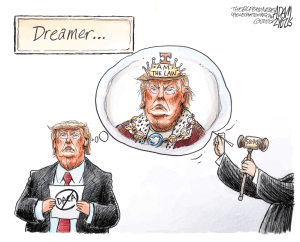 I think this take on executive power is one we should get more familiar with since it’s really taken a powerful rise. The Center for American Progress features an analysis in its series on Project 2025. This one was written back in October.”Project 2025 Would Destroy the U.S. System of Checks and Balances and Create an Imperial Presidency. Far-right extremists have a plan to shatter democracy’s guardrails, giving presidents almost unlimited power to implement policies that will hurt everyday Americans and strip them of fundamental rights.” It is an imperative read. Trump knows that he can be both pope and king.
Project 2025 takes an absolutist view of presidential authority
To wholly reshape government in ways that most Americans would think is impossible, the Project 2025 blueprint anchors itself in the “unitary executive theory.”22 This radical governing philosophy, which contravenes the traditional separation of powers, vests presidents with almost complete control over the federal bureaucracy, including congressionally designated independent agencies or the DOJ and the FBI. The unitary executive theory is designed to sharply diminish Congress’ imperative role to act as a check and balance on the executive branch with tools such as setting up independent agencies to make expert decisions and by limiting presidents’ ability to fire career civil servants for purely political purposes.
The road map to autocracy presented in Project 2025 extends far beyond the unitary executive theory first promoted by President Ronald Reagan, and later espoused by Vice President Dick Cheney, largely designed to implement a deregulatory, corporatist agenda.23 Instead, as discussed further below, Project 2025 presents a maximalist version that does not nibble around the edges but aims to thoroughly demolish the traditional guardrails that allow Congress an equal say in how democracy functions or what policies are implemented. One noted expert at the conservative think tank American Enterprise Institute, Philip Wallach, said, “Some of these visions … start to just bleed into some kind of authoritarian fantasies where the president won the election, so he’s in charge, so everyone has to do what he says—and that’s just not the system the [sic] government we live under.”24
If Congress is robbed of its imperative role as a check and balance on a president’s power, and the judicial branch is willing to bestow a president with almost unlimited authority, autocracy results. And presidents become strongman rulers—free to choose which laws to enforce, which long-standing norms to jettison, and how to impose their will on every executive branch department and agency.
Well, all these pithy reads should keep you busy for the day. I hope your week goes well. I’ve got 2 doctors’ appointments, but gladly no more procedures. And I’d like just to add if they come for professors, that I’d rather be in the gulag that holds the country’s political cartoonists. To think, I used to just use wonderful paintings.
Happy Cinco de Mayo to all the wonderful folks of Mexican descent and to those of us who just enjoy the holiday!
What’s on your Reading and Blogging list today?
Mostly Monday Reads: Oy mishigas!
Posted: March 24, 2025 Filed under: #FARTUS, #MAGAnomics, American Fascists, Broligarchy, corporate greed, democracy is threatened, kakistocracy, Middle East, Polycrisis | Tags: @repeat1968, Broligarchy, FARTUS, Mafia Don, oligarchy, Paul Krugman, Vladimir Putin 7 Comments
“Putin addresses the residents of his newly acquired territory.” John Buss, @repeat1968, @johnbuss.bsky.social
Good Day, Sky Dancers!
I am having an ongoing debate with myself about the current administration. Is it the stupidity, the arrogance, or the meanness that most damaged our Constitutional democracy? Or is it the greed? I’m tagging all my posts here with the words Polycrisis, Kakistocracy, and Oligarchy or Broligarchy. It’s getting to be a tough search to find a few journalists who will actually tell it like it is.
This article in The Guardian early this month by Jonathan Freeland describes the current president thusly. “Donald Trump is turning America into a mafia state. The pattern is inescapable – with just one caveat: organised crime bosses occasionally display more honour.” I’ll just add a local New Orleans colloquialism. True Dat.
Behold Donald Corleone, the US president who behaves like a mafia boss – but without the principles. Of course, one hesitates to make the comparison, not least because Donald Trump would like it. And because the Godfather is an archetype of strength and macho glamour while Trump is weak, constantly handing gifts to America’s enemies and getting nothing in return. But when the world is changing so fast – when a nation that has been a friend for more than a century turns into a foe in a matter of weeks – it helps to have a guide. My colleague Luke Harding clarified the nature of Vladimir Putin’s Russia when he branded it the Mafia State. Now we need to attach the same label to the US under Putin’s most devoted admirer.
Consider the way Trump’s White House conducts itself, issuing threats and menaces that sound better in the original Sicilian. This week the president said that a deal ending Russia’s war on Ukraine “could be made very fast” but “if somebody doesn’t want to make a deal, I think that person won’t be around very long”. You didn’t need a translator to know that the somebody he had in mind was Volodymyr Zelenskyy.
On Thursday, Trump was confident that the Ukrainians would soon do his bidding “because I don’t think they have a choice”. Almost as if he had made them an offer they couldn’t refuse. Which of course he had. By ending the supply of military aid and the sharing of US intelligence, as he did this week, he had effectively put a Russian revolver to Ukraine’s temple, its imprint scarcely reduced by Trump’s declaration today that he is “strongly considering” banking sanctions and tariffs against Moscow, a move that looked a lot like a man pretending to be equally tough on the two sides, but which should fool nobody. He expects Zelenskyy to sign away a huge chunk of Ukraine’s minerals, the way Corleone’s rivals surrendered their livelihoods to save their lives.
This is how the US now operates in the world. Dispensing with the formalities during his annual address to Congress on Tuesday, Trump repeated his threat to grab Greenland: “One way or the other, we’re going to get it.” That recalled his earlier warning to Copenhagen to give him what he wants or face the consequences: “maybe things have to happen with respect to Denmark having to do with tariffs”. Nice place you got there; would be a shame if something happened to it.
It’s the same shakedown he’s performing on the US’s northern neighbour. Canada’s outgoing prime minister Justin Trudeau spelled it out this week, accusing Trump of trying to engineer “a total collapse of the Canadian economy because that will make it easier to annex us”, adding that: “We will never be the 51st state.” It’s a technique familiar in the darker corners of the New Jersey construction industry: a series of unfortunate fires that only stops when a recalcitrant competitor submits.
Both the substance and the style are pure mafia. Note the obsession with respect, demonstrated in last week’s Oval Office confrontation with Zelenskyy. Between them, JD Vance and Trump accused the Ukrainian leader three times of showing disrespect, sounding less like world leaders than touchy Tommy DeVito, the Joe Pesci character in Goodfellas.
Note too the humiliation of subordinates. In his address to Congress, the president introduced secretary of state Marco Rubio as the man charged with taking back the Panama canal. “Good luck, Marco,” said Trump, with a chuckle. “Now we know who to blame if anything goes wrong.” Cue anxious laughter from the rest of the underlings, briefly relieved that it wasn’t them.
It’s hard for aides and opponents alike to keep up because power is exercised arbitrarily and inconsistently. Tariffs are imposed, then suspended. Indeed, one reason why import taxes so appeal to Trump is that they can be enforced instantly and by presidential edict. That extends to the exemptions Trump can offer to favoured US industries. As MSNBC’s Chris Hayes observed: “This is very obviously going to be a protection racket, where Trump can at the stroke of a pen destroy or save your business depending on how compliant you are.”
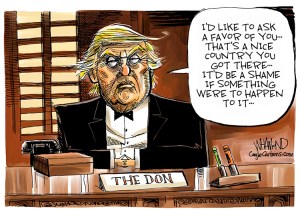 This characterization of Trump is so spot on that you really should go read the rest. I’m using this description of FARTUS as a background to the absolutely appalling crap that’s going on today. It’s hard to mentally deal with how quickly he’s disassembled so many long-standing U.S. Institutions in such a short time. This is especially true because it appears that the massive amount of incompetence and ignorance that his appointments display just escalates the damage. Look at this headline in The Atlantic. It’s reported by Jeffrey Goldberg. “The Trump Administration Accidentally Texted Me Its War Plans. U.S. national-security leaders included me in a group chat about upcoming military strikes in Yemen. I didn’t think it could be real. Then the bombs started falling.” WTAF?
The world found out shortly before 2 p.m. eastern time on March 15 that the United States was bombing Houthi targets across Yemen.
I, however, knew two hours before the first bombs exploded that the attack might be coming. The reason I knew this is that Pete Hegseth, the secretary of defense, had texted me the war plan at 11:44 a.m. The plan included precise information about weapons packages, targets, and timing.
This is going to require some explaining.
The story technically begins shortly after the Hamas invasion of southern Israel, in October 2023. The Houthis—an Iran-backed terrorist organization whose motto is “God is great, death to America, death to Israel, curse on the Jews, victory to Islam”—soon launched attacks on Israel and on international shipping, creating havoc for global trade. Throughout 2024, the Biden administration was ineffective in countering these Houthi attacks; the incoming Trump administration promised a tougher response.
This is where Pete Hegseth and I come in.
On Tuesday, March 11, I received a connection request on Signal from a user identified as Michael Waltz. Signal is an open-source encrypted messaging service popular with journalists and others who seek more privacy than other text-messaging services are capable of delivering. I assumed that the Michael Waltz in question was President Donald Trump’s national security adviser. I did not assume, however, that the request was from the actual Michael Waltz. I have met him in the past, and though I didn’t find it particularly strange that he might be reaching out to me, I did think it somewhat unusual, given the Trump administration’s contentious relationship with journalists—and Trump’s periodic fixation on me specifically. It immediately crossed my mind that someone could be masquerading as Waltz in order to somehow entrap me. It is not at all uncommon these days for nefarious actors to try to induce journalists to share information that could be used against them.
I accepted the connection request, hoping that this was the actual national security adviser, and that he wanted to chat about Ukraine, or Iran, or some other important matter.
Two days later—Thursday—at 4:28 p.m., I received a notice that I was to be included in a Signal chat group. It was called the “Houthi PC small group.”
A message to the group, from “Michael Waltz,” read as follows: “Team – establishing a principles [sic] group for coordination on Houthis, particularly for over the next 72 hours. My deputy Alex Wong is pulling together a tiger team at deputies/agency Chief of Staff level following up from the meeting in the Sit Room this morning for action items and will be sending that out later this evening.”
The message continued, “Pls provide the best staff POC from your team for us to coordinate with over the next couple days and over the weekend. Thx.”
The term principals committee generally refers to a group of the senior-most national-security officials, including the secretaries of defense, state, and the treasury, as well as the director of the CIA. It should go without saying—but I’ll say it anyway—that I have never been invited to a White House principals-committee meeting, and that, in my many years of reporting on national-security matters, I had never heard of one being convened over a commercial messaging app.
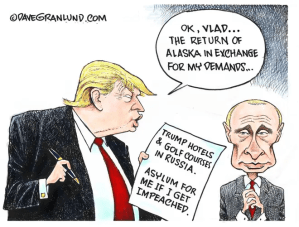 Definitely go read this one. I’ve been missing reading John le Carré. I’m assuming anyone with a background in spying would have saucer eyes by this time. Trump’s love of playing checkers with the countries of the world is dangerous and immoral. He plays with everyone’s life like a mad king. This is from Oliver Darcy at Status. It’s a remarkable indictment of how the press enables his heinous policies and statements. “Gulf of Fear. When news anchors tiptoe around the name Gulf of Mexico, it’s not just semantics—it’s a glimpse at how the press starts to flinch under political pressure.”
In China, Taiwan doesn’t exist—at least not as a country. On official maps, it’s a province. The government enforces strict language about Taiwan’s status, shaping how its people—and the rest of the world—talk about it. The goal, of course, is far more significant than the name on a map. It’s not about semantics. It’s about wielding influence and asserting dominance. Controlling the language people use, particularly in relation to global geography, is a powerful capability to possess.
In the United States, that kind of top-down dictation might feel like a distant threat, the kind of thing that happens in authoritarian regimes or dystopian novels like “1984,” not in a country built on free speech safeguarded by the First Amendment. Americans tend to believe our press is too independent and and too proud to ever bow to government pressure. We assume that if a president ever tried to dictate language, the Fourth Estate would resist. We assume that we’re immune from such pressures.
But an important segment of the press—the television news media—over the past week quietly demonstrated that it is far less adversarial and far more compliant than the breathless promos these networks air hyping themselves as fearless truth-tellers. When the eyes of the world fixated on the stranded NASA astronauts being rescued and touching down back on Earth, every channel danced around what precisely to call the body of water they splashed into. A review of transcripts, courtesy of SnapStream, revealed an alarming reality: not one of the outlets could muster up the courage to simply refer to it as the Gulf of Mexico, the water feature’s name since the 16th century.
Instead, television news organizations tied themselves in knots, performing linguistic gymnastics to stay out of Donald Trump’s crosshairs, while also tiptoeing around audiences who would have surely been incensed to see them bend the knee and call it the “Gulf of America.” On ABC News, “World News Tonight” anchor David Muir referred to “spectacular images from off the coast of Florida.” On the “NBC Nightly news,” anchor Lester Holt spoke about the astronauts “splashing down off the Florida Gulf coast.” On the “CBS Evening News,” it was referred to simply as “the Gulf.” And on CNN, anchor Jake Tapper tried to seemingly have it both ways, noting the U.S. government refers to it as the “Gulf of America,” but the rest of the world calls it the Gulf of Mexico.
In fact, I could only one find instance on a television newscast where a journalist referred to the body of water as the Gulf of Mexico. During an appearance on MSNBC, NBC News correspondent Tom Costello used the term, but then quickly corrected himself, almost as if he had realized he was forbidden from doing so. “Six hours from right now, there will be a splashdown in the Gulf of Mexico,” he said, before backtracking. “Sorry, however you want to call the Gulf. It will be splashing down in the Gulf.”
Suffice to say, none of this was an accident.
 We first saw the capitulation of the tech bros and their social media platforms, including Jeff Bezos, who has ruined The Washington Post. This week, the situation there is getting worse. The first thing any autocrat wants to do is to come for any vestige of a free media. This is from MEDIAITE as reported by David Gilmour. “Trump Claims Jeff Bezos Trashed the ‘Crazy People’ in His Own Newsroom: ‘They’re Out of Control’.
President Donald Trump claimed that billionaire Washington Post owner Jeff Bezos privately expressed regret over the newspaper’s editorial direction and trashed his own “out of control” newsroom for writing “bad articles” about him.
The comments came during a sit-down with OutKick’s Clay Travis aboard Air Force One on Saturday after Travis suggested “it seems” that Bezos may be attempting to make The Washington Post “more fair” in coverage towards Trump.
Trump agreed and didn’t hesitate to praise Bezos, telling Travis “I think it’s great.”
Travis later asked whether Trump had discussed how the newspaper had come after him “like crazy” in the past, AND the president replied: “At length, I talked to him about it. [Bezos is] a good guy. I didn’t really know him in the first term. I mean, it’s such a difference between now and the first time.”
Pressed on what Bezos had said he had planned for The Post’s coverage, Trump said: “Just that. He’s really trying to be more fair.”
Trump continued: “They actually did a couple of bad articles on him. He said, ‘This is crazy, I lose my fortune running this thing and they, you know, they’re out of control.’ These people are crazy. They’re crazy people. They’re out of control.”
“And he’s a actually a very good guy,” the president added. “If you look at the inauguration, look at the people that were on that stage, here was a who’s who of a world that was totally against me the first time. It’s a much different presidency. I have much more support.”
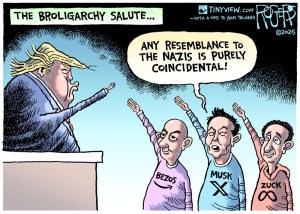 And now, we have the capitulation of top law firms. How many more legs of democracy will we lose? The Bulwark draws the line today. “Stop Making Excuses for Not Fighting Trump. The capitulations and acquiescence we’ve seen so far will only make opposition more difficult down the road.” This is written by William Kristol under the lede “No Excuse.”
Among those who might be expected to stand up against Donald Trump’s authoritarianism, the hills are alive with the sound of excuses.
You’re an elected official. The Trump administration has rounded up individuals and sent them, without any due process and with much carelessness about who’s been seized, to a mega-prison in El Salvador. The administration is boasting about what it’s done and heralding it a prelude to further actions in the same vein.
You’re thinking of condemning these truly grotesque violations of constitutional rights and human decency. Maybe I should say this isn’t right?
Whoa, Nellie! Not so fast, your political advisers hasten to instruct you. The polls on this issue aren’t great. This really isn’t the hill to die on.
You take their advice. But you tell yourself, and you assure others, that of course you will fight one day—on some other hill, on some faraway hill, some time far in the future.
But to fight now? Bad idea. That would simply play into Trump’s hands. After all, Trump and his allies are good at fighting. If you try to do something, there’s a risk they’ll turn it against you. Whereas if you say nothing, nothing can be used against you.
You might worry for a second that silence and acquiescence just plays into Trump’s hands. But you’re not a sophisticated Democratic operative. So you take their advice.
And anyway, there’s a better plan. That plan is that, eventually, Trump will become less popular. Then, the public will rise up. And then you can speak up. It all works out.
It also works out if you’re in the private sector. In fact, if you’re the head of a huge law firm, capitulation isn’t just a regrettable necessity, it’s your duty. You’re acting in the best interests of your clients. It would be wrong and irresponsible to act otherwise.
What’s more, No one in the wider world can appreciate how stressful it is to confront an executive order like this until one is directed at you.
The people in the “wider world”—those serving in the military or waiting tables or cleaning offices at Paul Weiss—they just can’t appreciate the stress that comes from occupying that corner office at 51st and 6th.
Ugh.
All of these excuses—and there are many more!—are distasteful. But what’s worse is that they make it easier and more likely that others will capitulate. They make it seem that you’re kind of a chump if you actually fight Trump’s authoritarian takeover. The excuses offered for capitulation increase the damage done by capitulation.
As usual, Shakespeare saw all. Here’s Pembroke in Act IV, Scene 2 of King John:
And oftentimes excusing of a fault
Doth make the fault the worse by th’ excuse,
As patches set upon a little breach
Discredit more in hiding of the fault
Than did the fault before it was so patched.The excuses offered by our elites for not standing up to authoritarianism have the effect of helping the authoritarians gain further ground.
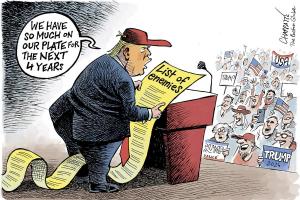 Zach Beauchamp writes at VOX, “There’s a pattern in Trump’s power grabs. The White House strategy demands we defend alleged criminals and those with unpopular views.”
After rising to power, Nazis pitched power grabs as efforts to address the alleged threat posed by menaces like “Judeo-Bolshevism,” harnessing the powers of bigotry and political polarization to get ordinary Germans on board with the demolition of their democracy.
What’s happening in America right now has chilling echoes of this old tactic. When engaging in unlawful or boundary-pushing behavior, the Trump administration has typically gone after targets who are either highly polarizing or unpopular. The idea is to politicize basic civil liberties questions — to turn a defense of the rule of law into either a defense of widely hated groups or else an ordinary matter of partisan politics.
The administration’s first known deportation of a green card holder targeted a pro-Palestinian college activist at Columbia University, the site of some of the most radical anti-Israel activity. For this reason, Columbia was also the first university it targeted for a funding cutoff. Trump has also targeted an even more unpopular cohort: The first group of American residents sent to do hard labor in a Salvadoran prison was a group of people his administration claimed without providing evidence were Tren de Aragua gang members.
Trump is counting on the twin powers of demonization and polarization to justify their various efforts to expand executive authority and assail civil liberties. They want to make the conversation less about the principle — whether what Trump is doing is legal or a threat to free speech — and more a referendum on whether the targeted group is good or bad.
There is every indication this pattern will continue. And if we as a society fail to understand how the Trump strategy works, or where it leads, the damage to democracy could be catastrophic.
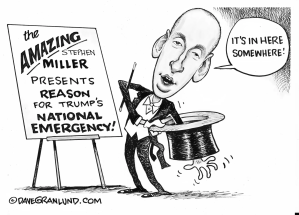 This, too, is a long read that deserves a look. A lot of this goes back to White House aid Stephan Miller. This guy needs to have an entire press detail following him. I’m going to end with a few articles on economics. The first comes from Paul Krugman and will clarify what’s happening with Social Security. “Social Security: A Time for Outrage. Trump’s policies attack his own base — but who will tell them?” I often find myself in conversations with friends, and we all wonder if Trump Supporters will ever show a glimmer of intelligence.
Donald Trump is often described as a “populist.” Yet his administration is stuffed with wealthy men who are clueless about how the other 99.99 percent lives, while his policies involve undermining the working class while enabling wealthy tax cheats.
What is true is that many working-class voters supported Trump last year because they believed that he was on their side. And that disconnect between perceptions and reality ought to be at the heart of any discussion of what Democrats should do now.
Right now the central front in the assault on the working class is Social Security, which Elon Musk, unable to admit error, keeps insisting is riddled with fraud. The DOGE-bullied Social Security Administration has already announced that those applying for benefits or trying to change where their benefits are deposited will need to verify their identity either online or in person — a huge, sometimes impossible burden on the elderly, often disabled Americans who need those benefits most. And with staff cuts and massive DOGE disruption, it seems increasingly likely that some benefits just won’t arrive as scheduled.
Oh, and Leland Dudek, the acting Social Security administrator, threatened to shut the whole thing down unless DOGE was given access to personal data.
Not to worry, says Howard Lutnick, Trump’s Commerce secretary. Only “fraudsters” would complain about missing a Social Security check:
Let’s say social security didn’t send out their checks this month. My mother who’s 94, she wouldn’t call and complain. She’d think something got messed up, and she’ll get it next month. A fraudster always makes the loudest noise, screaming, yelling and complaining.
There’s so much wrong with that statement that it’s hard to know where to start. But it’s clear that Lutnick — like many affluent people — has no idea how important Social Security is to the finances of most older Americans. According to a Social Security Administration study, half of Americans over 65 get a majority of their income from Social Security; a quarter depend almost entirely on Social Security, which supplies more than 90 percent of their income. I doubt that these people would shrug off a missed check.
Reliance on Social Security isn’t evenly distributed across the population; it’s strongly correlated with socioeconomic status. In particular, it very much depends on education, with less-educated Americans much more reliant on the program than those with more education:
 That Lutnick quote cannot be repeated enough. The last read I’m sharing today comes from The Economist. “Musk Inc is under serious threat. The world’s richest man has lost focus. His competitors are taking advantage.” Well, isn’t that special?
UNTIL RECENTLY Elon Musk had little need to look over his shoulder. He once described competition for Tesla, his electric-vehicle (EV) company, as “the enormous flood of gasoline cars pouring out of the world’s factories every day”, rather than the “small trickle” of other EV-makers. SpaceX, his rocket firm, had so undercut and outwitted the bloated aerospace incumbents that it had developed an almost invincible aura.
Yet if Mr Musk can tear himself away from the intoxication of shredding the American government, he may notice something. It is not just that the political firestorms he has whipped up this year are singeing his companies’ brands. It is that the two businesses that underpin his corporate empire—accounting for around 90% of its value and probably all its profit—are facing increasingly stiff competition. The world’s richest man has lost focus—and now has a target on his back.
Start with SpaceX. Last year it conducted five out of every six of the world’s spacecraft launches. Through its Starlink division, it owns 60% of satellites in space. In December it sold shares at a valuation of $350bn, two-thirds higher than its previous level. Starlink, its main profit engine, is on track to generate more than $11bn of revenue this year and $2bn of free cash flow, says Chris Quilty of Quilty Space, a consultancy.
Now, however, Mr Musk’s bomb-throwing interventions are alarming SpaceX customers, and at a time when rivals are growing more capable. His on-again, off-again threats to end Starlink’s support for Ukraine have raised the difficult question of trust. European politicians are pondering how reliable Mr Musk will be as a long-term provider of strategic satellite communications. The search for alternatives has helped spur a more than tripling of the share price of Eutelsat, the French owner of OneWeb, which provides satellite services to broadband companies.
No European supplier could come close to matching the 7,000 satellites Starlink has in low orbit. (Eutelsat has a mere 600.) Nor could any compete on price. As Simon Potter of BryceTech, another space consultancy, puts it, for now the concerns are “more noise than action”. Yet Starlink may soon face meaningful competition from Amazon’s Project Kuiper, which aims to put over 3,000 satellites into low orbit, creating a space-based broadband network. If it achieves that, some customers outside America may decide they have more confidence in an Amazon product than in one belonging to the mercurial Mr Musk.
Jeff Bezos, Amazon’s founder, is also stepping up the pace in the launch business with Blue Origin. His rocket firm is separate from Project Kuiper, but has contracts to fly many of its satellites. In January Mr Bezos’s New Glenn rocket reached orbit on its first try. If Blue Origin manages to make repeated successful journeys with reusable rockets, it could become a meaningful competitor to SpaceX. So could Rocket Lab, SpaceX’s closest rival by number of launches, which is due to debut Neutron, a new rocket, this year.

Here comes the Rooster.
It’s like we’re in a very bad dystopian novel and can’t escape. Anyway, I’m not shutting up any time soon.
What’s on your Reading and Blogging list today?
Here’s a picture of this big boy who keeps crossing the road in front of my house. The rain just stopped, and the sun cleared up, so he’s been yelling at the sun for about an hour now. I feel like he’s some kind of omen.
Here’s an Alice in Chains song about the Vietnam War. That ought to cheer you up.

 peej
peej Carissa
 bostonboomer
 dakinikat
 ecocatwoman
 mablue2
 Mama Lopez
 peggysue22
 quixote
 skydancingguestblogger
 Mona (aka Wonk the Vote)



 Sky Dancing
Recent Comments